« Si je devais recommencer ma vie, je tâcherais de faire mes rêves encore plus grands, parce que la vie est infiniment plus belle et plus grande que je ne l’aurais cru . »
traduction approximative :
“If I had to start my life over again, I would try to make my dreams even bigger, because life is infinitely more beautiful and bigger than I thought. »
Georges Bernanos (1888 – 1948)est un écrivain français. Il recevra le prix Femina en 1929 et le Grand prix du roman de l’Académie française en 1936. En 1926, il connaîtra le succès avec la publication de Sous le soleil de Satan.
You are the ink that runs in my quill
Becoming the colors that my dreams spill.
You are the letter that shapes my word
Spanning the page like wings of a bird.
You are the thought that fills up my sense
You are the longing that is so immense.
You are the breath that escapes in a sigh
You are the memory in my mind's eye.
You are the peace that whispers in my heart
The oxygen that gives my heart a start .
You are the tear that I hold in my eye
You are the yearning I cannot deny.
You are the rhyme in my April sky
The twinkle in the stars that pass me by.
You are the light in the black of my eyes
You are the answer to all of my why's.
You are the arms that embrace me tight
Together in a love so…
As far as we know the term “objective correlative” was first coined by the American painter and poet Washington Allston and only later introduced by T.S.Eliot into his essay “Hamlet and His Problems”. Eliot regarded “Hamlet ” as a sort of “artistic failure”, because Shakespeare, according to him, had not succeeded in making the audience feel properly Hamlet’s overwhelming emotions. The bard had not gone beyond describing the Prince of Denmark’s emotional state through the play’s dialogue, rather than stirring minds and souls to feelas he did, and this could have happened only through a skilful use of images, actions and characters:
The only way of expressing emotion in the form of art is by finding an “objective correlative”; in other words, a set of objects, a situation, a chain of events which shall be the formula of that particular emotion; such that when the external facts, which…
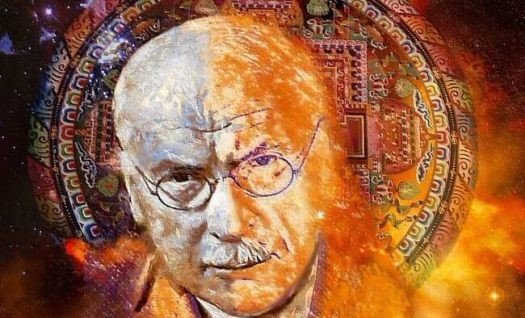
Carl G. Jung: Prefacio al “I Ching” (traducción de Richard Wilhelm)
“Opposites always balance -a sign of high culture;
while one-sidedness,
although it always gives impulse,
it is therefore a sign of barbarism “
Carl G. Jung
“… In no way do I want to underestimate the enormous differentiation of Western intellect; measured by him, the oriental intellect can be designated as infantile. (This naturally has nothing to do with intelligence!) If we managed to elevate to the same dignity granted to the intellect to another, and even to a third psychic function, the West would have every justification to hope to leave the East far behind. That is why it is so deplorable that the European abandons himself and imitates the East, when he would have so many possibilities if he remained himself and developed from his modality and essence what, starting from his own, gave birth to the East in the course of millennia. In general, and seen from the incurably external position of the intellect, it must seem as if what the East values so extremely was not for us anything appetizing.
Certainly, the mere intellect can not immediately understand what practical importance oriental ideas could have for us, for which reason it only knows how to classify them as philosophical and ethnological curiosities. The incomprehension goes so far that the same learned sinologists do not understand the practical application of the I Ching and, therefore, have considered this book as a collection of abstruse magic spells … “
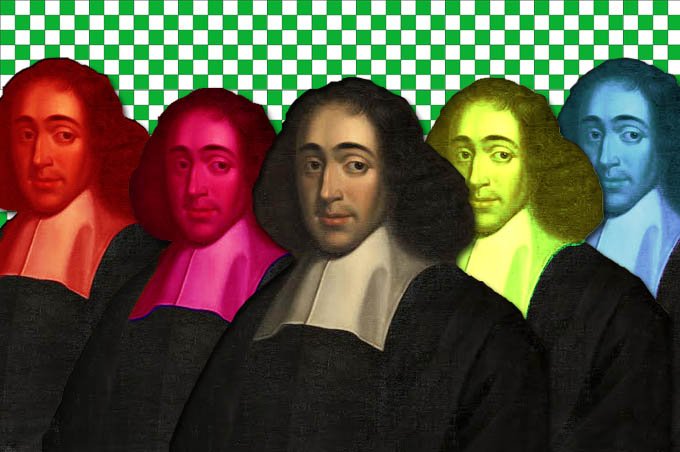
Baruch-de-Spinoza-multicolor
Spinoza (“Ethics”): First page: (first line) – Definition I: “For its own sake I understand that whose essence implies existence, or, what is the same, that whose nature can only be conceived as existing”.
Definition III: “By substance I understand that which is in itself and is conceived by itself, that is, that which its concept, to be formed, does not require the concept of something else”.
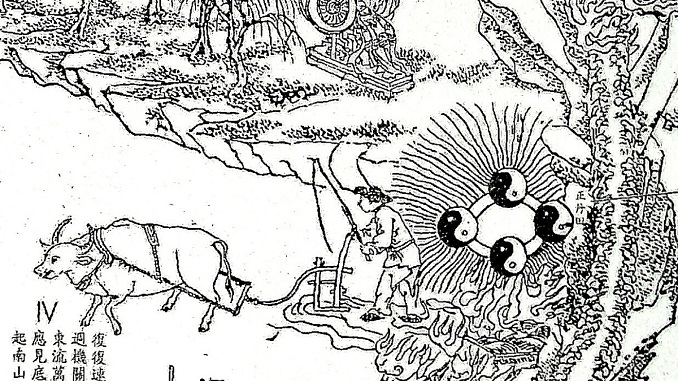
The Secret of the golden flower (I Ching), first lines:
The Golden Flower is the Light. What color does the Light have? The Golden Flower is taken as an allegory. This is the true force of the transcendent Great One. The phrase: “The lead of the water region has only one flavor,” he says. In the Book of Mutations it is said: “Heaven begets water through the One”. This is exactly the true force of the Great One. If man attains that One, he vivifies himself; if he loses it, he dies. But although man lives in force (air, prana) he does not see force (air), just as fish live in water but do not see water. Man dies when he has no air of life, just as fish perish without water. Therefore, the adepts have taught people to hold firm the primordial and to preserve the One: that is the circular course of light and the preservation of the Center. If this legitimate force is preserved, one can lengthen his life time and then apply the method to create an immortal body “fusing and mixing” (…) “.
A great analysis here as I just can add how important and also dangerous is the fact: Narcissism, which we might take it so carelessly easy. by Symbolreader, with a heartily thank ❤ https://symbolreader.net/
“I love myself…I love you. I love you…I love myself.”
Rumi
You have probably seen this image – the illustration to a short story by Kristen Roupenian’s entitled “Cat Person,” which was published in December 2017 in The New Yorker and went viral online. A young and fresh-looking feminine face, lips closed, is “under attack” of mature male lips, open and charging ahead. The story plunged itself right in the middle of the “me too” movement. Now Roupenian has published a collection of short stories, which significantly depart from the sordid realism of “Cat Person.” You Know You Want It is a captivating collection with some of the stories very rich in symbolism steeped in the aesthetics of horror stories with a good dose of the supernatural.
The story called “The Mirror, the Bucket, and the Old Thigh Bone” stood out for me. It tells the story of a princess who rejects all her suitors, which deeply worries and exasperates her father, the king. One night the princess hears a knock on the door to her rooms. When she opens it, she sees a stranger “with the most captivating and warm face,” who speaks to her in a melodious voice. The princess spends a happy night talking and snuggling with him on her bed. In the morning, the king’s advisor reveals that he had played a trick on her. The stranger was nothing but a contraption made of a cracked mirror, a bucket and an old thigh bone:
“You see, said the royal advisor. When you looked in your lover’s face, you were looking at your own face reflected in this cracked mirror. When you heard his voice, you heard only your own voice echoing back to you from this dented bucket. And when you embraced him, you felt your own hands caress your back, though you held nothing but this old thigh bone.”
The princess feels ashamed at being exposed like this and decides to marry one of the suitors. Her husband falls in love with her in the course of the marriage but she does not reciprocate his feelings. Instead, she appears to be depressed and nothing can relieve her unrelenting happiness. Her husband, now the king, is concerned, so he asks her about the source of her sadness. She tells him about the trick played upon her by the advisor and confesses her love for the stranger:
“The night I spent with it in my bed was the only night I have ever been happy. And even knowing what it is, I ache for it, I yearn for it, I love it still. What can this mean but that I am spoiled, and selfish, and arrogant, and that I am capable of loving nothing but a distorted reflection of my own twisted heart?”
The husband tries to win her heart through deception, by dressing in a black cloak, pretending to look like the apparition, but all of that is in vain. It is only when he brings her a figure constructed from a cracked mirror, a mouldy bucket and a smelly old bone that the queen experiences a state of bliss again. She abandons all her duties as queen, wife and mother and spends hours in her bed “naked among the bedclothes, nuzzling the mirror, murmuring into the bucket, and cradling the old thigh bone in her arms.”
Years pass and she slowly turns into a ghastly monster “with matted hair and corpse-white skin and huge, unseeing eyes.” When the husband tries to intervene, she slits his throat with a piece of glass. She goes on to ascend the throne with the cloaked “figure” beside her as the new king. After many years, when she dies, they are buried together, according to her wishes. Subsequently, the kingdom falls into disarray while “deep beneath the earth, the tin bucket echoed with the sound of gnawing maggots, and the mirror reflected a dance of grim decay.”
La Santa Muerte
In the book Soul: Treatment and Recovery: The Selected Works of Murray Stein, there is a chapter dedicated to the myth of Narcissus, which seems to have been an obvious inspiration for Roupenian’s “fairy tale.” Stein argues that Narcissus is not so much self-absorbed as “soul-absorbed;” for he longs for and is in love with his own soul. The external reality holds less fascination for him than the internal world of reflection and imagination. As a result, he neglects his physical body and dies. Stein comments:
“…to each subject his soul image is of such surpassing fascination and beauty that this warning must be dramatized in a story of death or in mockery of navel-gazing.”
For Freud, narcissism consisted in withdrawing of libido from the outside world and directing it onto the ego. Stein warns, however, that if we accept this definition, narcissism and introversion would be quite similar, since an introvert directs his or her libido towards the subject and away from the object. Thought that turns inwards becomes mythological rather than based on external empirical data and “hard facts.”. Freud was very suspicious of introverts, whom he perceived as stuck in a primitive, childish stage of development. Stein retorts that perhaps the nymph Echo symbolizes the traps of extreme extroversion, since she seems to lack any form of inner life but simply repeats, echoes the sounds of the external world.
It is easy to condemn the queen from Roupenian’s story for her narcissism. Yet while reading I was also feeling a lot of compassion towards her. She is trapped in a society where everybody is expected to play specific, rigidly-defined roles. Longing for the soul is not tolerated. Another crucial aspect mentioned by Stein is the difference between the feminine and the masculine experience of relationships. Stein refers here to an early psychoanalyst Else Voigtländer, who in her work distinguishes the sexual experience of men and women. The masculine experience, she claims, is object-oriented and “seeks to overcome the subject-object abyss” in order to be one with his beloved. The feminine experience, in contrast, “is lived out in quite another way, in itself, …, in its own interior, and therein the woman lives and moves, swimming as it were, in her proper element” (here quoted after Stein). In the archetypally feminine experience of sexual love the libido is turned inwards, as if, Stein comments, brilliantly, “the love of the object and the object’s reciprocated love would form a pathway of self-love.”
Will the Red Red Robin be soon a bobbin along? Depending on where you live the sighting of a Robin is a sign of Spring. I don’t know about you but it seems old man winter doesn’t wish to leave us sometime soon. This makes for a long winter and spring birds excite us when we spot them, then we know for sure that Spring has sprung.
Robins have been pictured on UK Christmas cards, because in the past the British postmen wore red jackets and were nicknamed ‘Robins’, so they appear in their bird form as a icon of the deliverymen.
According to folklore the wren stole fire from heaven and returned to earth aflame, so the other birds all gave one feather each to replace the burnt feathers but the Robin was nervous and came too close to the poor wren thus he also caught fire, the remains…
« It’s worth remembering this: freedom of expression sustains all the other freedoms we enjoy. Without free speech, democracy is a sham. Every freedom we possess or wish to possess (of habeas corpus and due process, of universal franchise and of assembly, union representation, sexual equality, of sexual preference, of the rights of children, of animals – the list goes on) has had to be freely thought and talked and written into existence. No single individual can generate these rights alone. »
« Il ne faut pas l’oublier : la liberté d’expression soutient toutes les autres libertés dont nous jouissons. Sans liberté d’expression, la démocratie est une imposture. Toute liberté que nous possédons ou souhaitons posséder (d’habeas corpus et de procédure régulière, de droit de vote universel et de réunion, de représentation syndicale, d’égalité sexuelle, de préférence sexuelle, de droits des enfants, d’animaux – la liste est longue) a dû être librement…









 lampmagician
You must be logged in to post a comment.