
Month: April 2019
Was Shakespeare Italian and born in Italy?
Standard

William Shakespeare is the emblem of English literature for sure, but, you know, every time I read his works he seems so familiar to me, so Italian. This is not only because 15 out 37 of his works are set in Italy, he knows the nature of the Italians so well, that some of his immortal lines mirror perfectly some unchangeable traits of our society. An example? In his famous soliloquy “to be or not to be” , he actually seems to be pondering about committing suicide speculating on life and death, but he truly complains about some aspects of society that have the stamp of the Italian character. First of all ” the law’s delay” (it may take more than ten years to see the conclusion of a trial here and in the end you have spent so much money to pay the lawyers to end up…
View original post 450 more words
Turgenev’s Smoke
StandardThe Union of Cupid and Psyche, Part 1/4: Cast of Characters


We have come to use the words “comedy” and “tragedy” very differently than the Greeks, which is who we get those two words from.
For the Greeks, a comedy was any narrative that started darkly – pain, suffering, death, grief – and ended happily – joy, love, marriage, reconciliation, even birth.
A tragedy, on the other hand, ran the opposite direction – from bliss to sorrow, from peace to strife.
Given that definition, the tale of Cupid and Psyche is a comedy.
*
The visual narrative can be found in Greek art dating back to the 4th century B.C.E.; however, we have no extant literary sources until the 2nd century C.E., where it appears as a central chapter in Apuleius’ The Golden Ass. In the same way that his fellow Roman, Ovid, retold (and reinterpreted) Greek myths, this is as close to the source material as we can…
View original post 437 more words
The Union of Cupid and Psyche, Part 2/4, the Banishment and the Villa

In part 1, we met our cast of characters. Now, it’s time to let them play out their parts:
So imagine this: you are the most beautiful princess in the world. Your beauty rivals that of the Goddess of Beauty, Aphrodite.
This has two unfortunate side effects:
First, it has drawn the ire of the Goddess herself.
Second, it means that unlike your two older sisters, no suitors pursue you; they believe themselves unworthy of your affections.
Your father, the King, is troubled that he can’t find you a suitable husband. He wonders if the Gods are offended.
And so he does the most logical thing he can think of: he goes to consult the Oracle of Delphi.
The Sybil has grave news:
“Your daughter is destined to marry a terrible beast, one that even the Gods fear. Take her to a rocky outcropping, high over the seas, and…
View original post 496 more words
“J’ai beau être matinal, j’ai mal…”
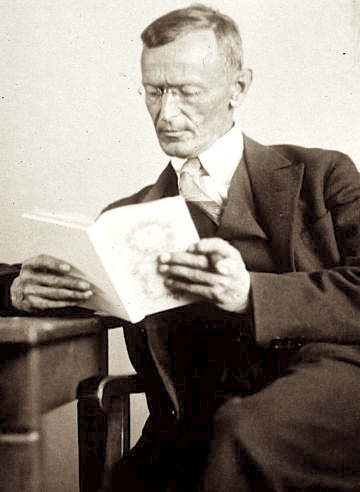
« Each of us considers his or her sufferings to be the cruellest of all. »

« Chacun de nous tient ses souffrances pour les plus cruelles de toutes »
Traduction approximative :
“Each of us considers his or her sufferings to be the most cruel of all.”
Hermann Hesse (1877 – 1962) est un romancier, essayiste, poète et peintre allemand naturalisé suisse : prix Bauemfeld en 1905, prix Goethe en 1946, prix Nobel de littérature en 1946. Il a notamment écrit Le Loup des steppes en 1927, chef d’oeuvre de la littérature, interdit sous le régime nazi, Herman Hesse fuira ce régime pour s’installer en Suisse.
Friedrich Nietzsche & his search for the “übermensch”
Standard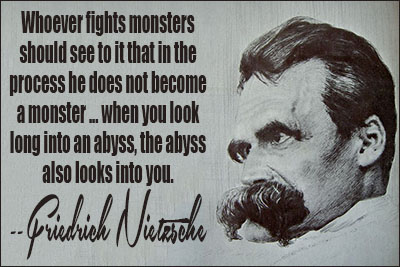
There’s no doubt that any thinker is somehow fascinated over this man; Nietzsche. As I once in my youth was interested in Philosophy, after struggling to understand Socrates by Plato, got a book about the story of philosophy; by Will Durant ” William James “Will” Durant ” of course translated in Persian, by Abbas Zirab-Khuii, a great historian and translator in Iran, from Plato to the new world philosophers like William James. You can imagine the situation for a young man about 20 years old, to handle all these new thoughts (for me of course!) and to process with.
Anyway, one of these highly recommended geniuses was Friedrich Nietzsche, who got my not only thoughts but also soul occupied or more engaged to keep thinking about him and to understand this madness!
I adore Socrates and I love Espinoza and I’d stared in front of Schuppenhauer but Nietzsche makes me crazy!! his determination over “Selbstüberwindung” overcome self, or “übermensch” Superman. or his desperation about God’s creation;

or his doubt of a God who wants to be adored;
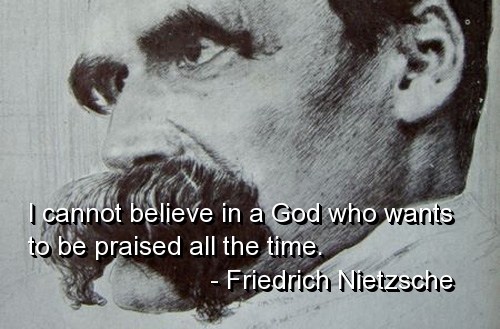
or “Sklavenmoral” slave morality. especially the latest; I was and am also against this term; Moral or Morality, this is a social problem! as history tells us, the moral has been changing all through the time especially, in the time of wars in according with the situation. I prefer to use “Conscience” as in German: “Gewissen”; that has nothing to do with the mass, it is individual, it is the self; you with you yourselves conscience, and nobody else.
So here comes another nice work by open culture with thanks 🙂http://www.openculture.com/
An Animated Introduction to Friedrich Nietzsche’s Life & Thought
There’s no shame if you’ve never known how to pronounce Friedrich Nietzsche’s name correctly. Even less if you never remember how to spell it. If these happen to be the case, you may be less than familiar with his philosophy. Let Alain de Botton’s animated School of Life video briefly introduce you, and you’ll never forget how to say it: “Knee Cha.” (As for remembering the spelling, you’re on your own.) You’ll also get a short biography of the disgruntled, dyspeptic German philosopher, who left a promising academic career at the University of Basel in his mid-20s and embarked to the Swiss Alps to write his violently original books in solitude before succumbing to a mental breakdown at 44 when he saw a cart driver beating a horse.
Nietzsche died after remaining almost entirely silent for 11 years. In these years and after his death, thanks to the machinations of his sister Elizabeth, his thought was twisted into a hateful caricature. He has since been rehabilitated from associations with the Nazis, but he still calls up fear and loathing for many people because of his relentless critiques of Christianity and reputation for staring too long into abysses. Maybe we can’t help but hear fascistic overtones in his concept of the ubermensch, and his ideas about slave morality can make for uncomfortable reading. Those steeped in Nietzsche’s thought may not feel that de Botton’s commentary gives these ideas their proper critical due.
Likewise, Nietzsche himself is treated as something of an ubermensch, an approach that pulls him out of his social world. Important figures who had a tremendous impact on his personal and intellectual life—like Arthur Schopenhauer, Richard and Cosima Wagner, Lou Salomé, and Nietzsche’s sister—don’t even receive a mention. But this is a lot to ask from a six-minute summary. De Botton hits some of philosophical highlights and explains some misconceptions. Yes, Nietzsche held no brief for Christianity at all, but this was because it caused tremendous suffering, he thought, by making people morally stunted and bitterly resentful.
Instead, he argued, we should embrace our desires, and use so-called sinful passions like envy to leverage our ambitions. Nietzsche is not a seducer, corrupting the youth with promises of greatness. You may very well fail, he admitted, and fail miserably. But to deny yourself is to never become who you are. Nietzsche scholar Babette Babich has described this aspect of the philosopher’s thought as the ethics of the supportive friend. She quotes David B. Allison, who writes that Nietzsche’s advice comes to us “like a friend who seems to share your every concern—and your aversions and suspicions as well. Like a true friend, he rarely tells you what you should do.”
Except that he often does. Babich also writes about Nietzsche as educator, and indeed he considered education one of the highest human goods, too precious to be squandered on those who do not appreciate it. His philosophy of education is consistent with his views on culture. Since God is Dead, we must replace scripture and liturgy with art, literature, and music. So far, so many a young Nietzsche enthusiast, pursuing their own form of Nietzschean education, will be on board with the philosopher’s program.
But as de Botton also explains, Nietzsche, who turned Dionysus into a philosophical ideal, might have issued one prescription too many for the average college student: no drinking. If that’s too much to stomach, we should at least take seriously that stuff about staring into abysses. Nietzsche meant it as a warning. Instead, writes Peter Prevos at The Horizon of Reason, “we should go beyond staring and bravely leap into the boundless chasm and practice philosophical base jumping.” No matter how much Nietzsche you read, he’s never going to tell you that means. We only become who we are, he suggests, when we figure it on our own.
https://en.wikipedia.org/wiki/William_James
https://en.wikipedia.org/wiki/Will_Durant
Related Content:
Free Online Philosophy Courses
Josh Jones is a writer and musician based in Durham, NC. Follow him at @jdmagness
Sorting Seeds: Psyche’s First Labor Gives Us Lessons for Life
StandardBy Elaine Mansfield https://elainemansfield.com/
Health, Psychology and Mythology
When I read this I must again think and thank my brother who had learned me, among the others, the might of Mythology.
It is really interesting how Mythology Saga, has been interconnected to our Curriculum Vitae. As I began to know and learn about it, he gave me a dictionary of the Greece Mythology which helped me as a gadgetry to open it if needed! It was a fascinating dictionary as I ever saw in my life.
Now as my dear friend Elaine Mansfield tells about her feebleness of her hearing, that I wish it will get better and best, I’d say I mention almost a same feebleness not about my hearing but my eyecare. yes, it is unfairly destiny of ageing!!
Yes: We might all know Helen Keller http://Helen Keller who was
deaf-blind but I think it’s wrong to compare with the people who lose their one or other senses through their life. they have had them for many years and they would miss them, as Elaine explains here:
“Last night I heard a chorus of birds singing their joyful evening songs. I felt one step closer to Eros.”
Anyway, I’m honoured to share her blog to feel whit and learn a lot. ❤ ❤
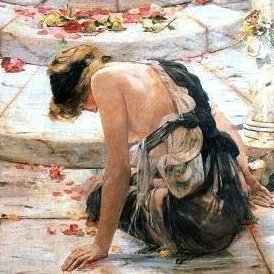
Psyche at the Throne of Aphrodite, Edward Hale, 1883
- “Is this easier or harder?” my audiologist asks. “Raise your hand when you hear a beep. Do you prefer program 1 or program 4? You made great progress in a week, so keep going.”
- It feels impossible, but keep sorting. I don’t recognize that sound, but I can stay calm and learn. I wear the audio receiver every waking minute as instructed. It’s OK to be tired.
In the Roman story of Eros (Love) and Psyche (Soul), Eros visits his lover Psyche, but only in the dark. Who is this midnight lover? One night she lights a candle to take a look. Burned by dripping wax, Eros flees. Psyche is dragged before Eros’s mother, the goddess Venus.

Psyche at the Throne of Aphrodite, Edward Hale, 1883
After raging at Psyche, Venus gives the girl Four Labors. The “impossible” tasks are Psyche’s way back to Eros. I don’t think of Eros as only sexual love, but as a broader love for the sensory world, for connection and embodiment. Eros brings sacred as well as sexual pleasure. The heart lifts and opens to receive an angelic choir or celestial symphony or a bird song.
With hearing loss, I lost the joy of music and spoken words. Like Psyche, I fought despair.
A cochlear implant promises to connect me back to the world of sound through a slow sorting process. Knowing Psyche’s story gives me patience.

Here’s a description of the First Labor translated from the original story:
“Venus leaped upon the face of poor Psyche, and took her by the hair, and dashed her head upon the ground. Then she took a great quantity of wheat, of barley, poppy seeds, peas, lentils, and beans, and mingled them altogether on a heap saying: Thou evil favored girl, thou seemest unable to get the grace of thy lover, by no other means, but only by diligent and painful service, wherefore I will prove what thou canst do: see that thou separate all these grains one from another disposing them orderly in their quantity, and let it be done before night.” Apuleius, The Golden Ass
Apuleius wrote this in 150 AD, but it’s as relevant now as it was almost 2000 years ago. Since I had many years of vertigo, I relate to being thrown to the ground, but think of it symbolically.

My audiologist & his resident unpacking & tuning
Psyche’s sorting job feels impossible, but helpers arrive for Psyche and for me. Before and after surgery, friends and sons offer gifts of healing balms, soup, rides, and loving patience. Six weeks after surgery, my audiologist programs my audio receiver. He opens a backpack plus a cloth bag filled with directions, warranties, audio receivers, chargers for domestic and foreign travel, a dehydrator for humid months, and more. Then he sorts to make sure everything is there.
It’s a mountain of chaos, but somehow I will figure it out.
Ants, those discriminating seed gatherers, come to Psyche’s rescue and sort the seeds into tidy piles. I have a surgeon and audiologist instead. My process is slower, but it’s coming along.

Cochlear implant audio receiver: mine is hidden under hair (wikimedia commons)
One task won’t be enough to reunite me with embodied pleasure and joyful listening. I want to love music enough to dance. More tasks lie ahead. More steps to unite body and soul with the love of hearing. Like Psyche, I’ll complete one task at a time. I’ll also doubt, before remembering. I don’t have to do this alone.
Last night I heard a chorus of birds singing their joyful evening songs. I felt one step closer to Eros.
***

I often return to Psyche’s Four Labors when life’s tasks are overwhelming. When have you had a repetitious sorting job like putting together a book or moving to a new home, taking a new job or cleaning out a closet? For a post about Psyche’s last task, see Clutched: An Essential Lesson from Psyche’s Fourth Labor. For more about how I prepared for this life-changing surgery, see A Healing Ritual in a Sweetgrass Bowl: Self-care for Surgery.
Pegasus Flying, Cassiopeia Chained
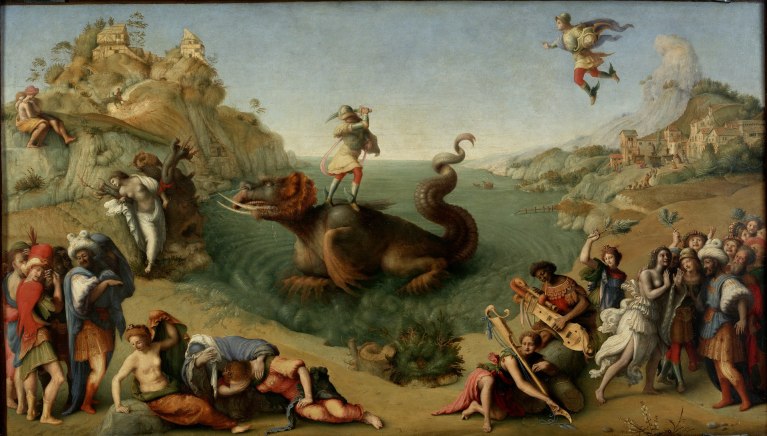
The Gods are vain;
Mortals, be warned…
*
Cassiopeia was an Ethiopian Queen who dared to boast of her daughter’s beauty (as well as her own).
She compared herself, and her child, as being more enchanting than even the Nereids, the sea-children of Nereus, a sea God who served under Poseidon, God of all waters.
Nereus was offended.
Poseidon was not pleased…
*
There are differing accounts at this point:
Maybe Poseidon chose to flood all of Ethiopia;
More likely, he let loose a monster –
P.S. it wasn’t the Kraken, as many of us might like to believe (blame the original 1981 movie, Clash of the Titans, starring Harry Hamlin, for that)
No, the Monster in question was called Cetus.
And while Heracles would a Cetus later, this version of the sea monster had no match.
Save a wandering hero…(yeah, now we’re back to Harry Hamlin)…
*
King Cepheus…
View original post 541 more words
Matorrales
StandardScrub
Butterflies That they locked themselves against the desired death, mad deranged, after a gram … dark tile parties of bars. The tulips go out against the cobbles that adorn the sidewalk of the neighbourhood.
Morpheus today will sleep among the crystals stirred by bandits of easy kisses, you were born young in times of hunger. Lost between circuses without acrobatics and hard bread.
Sleep now … the dawn comes with noise and ruin. His enraged prayer appears among the brooms, concrete buildings lime and stone in the bushes that saw you born.
And they got tired of being the mule of hunger and garrote, of the kicks of few words … lucid, like a night of the full moon, they ended up leaning their desire to the precipice between coyotes and dogs without a collar. They howled desperately for cheap taverns and smoke. A difficult goodbye … 🙏💖

ariposas. Que se enzarzaron contra la deseada muerte, locas desquiciadas, tras un gramo… fiestas de azulejos de bares oscuros. Desperezan los tulipanes contra los adoquines que adornan la vereda del barrio.
Morfeo hoy dormirá entre los cristales revueltos por bandidos de besos fáciles, habéis nacido jóvenes en tiempos de hambre. Perdidas entre circos sin acrobacias y pan duro.
Dormíos ya… que el alba viene con ruido y ruina. Su rezo enfurecido asoma entre los serojos, edificios hormigonados a cal y canto entre los matorrales que os vieron nacer.
Y se cansaron de ser mula de hambre y garrote, de las coces de pocas palabras… lúcidas, como una noche de luna llena, terminaron asomado sus ganas al precipicio entre coyotes y perros sin collar. Aullaron desesperadas por tabernas baratas y humo. Un difícil adiós…

 lampmagician
You must be logged in to post a comment.