
via Jung on Alchemy (9): the Coniunctio – part 2 – the Red Stone
Month: September 2018
Virginia Satir – The Self-Esteem of the Child
StandardSeptember 9, 2018
a very important issue which in many parts of the world, would not care about!

The child comes to the world with its empty, clean plaque and the sense of value and appreciation is a byproduct of its treatment by the adults.
Adults may not realize that the way they catch a child can contribute to self-esteem.
Children learn to appreciate themselves from the voices they hear, from the expressions of the eyes of the big ones that hold them in their arms, from the muscular tone of the embrace that holds them, from the way the adults respond to their crying.
If the baby could speak, he would say, “They love me,” “no one cares about me, I feel rejection, I feel lonely,” “I am very important,” “I do not care. I am a burden for others. ” All this is a precursor to the subsequent messages, about its self-esteem.
Parents who are now starting with a baby, let us take a look at the following paragraphs, which will help them create more opportunities to develop their self-esteem.
1. Realize how you catch the baby. If you were like that, how would you feel? When you catch your child, think about what your child is learning. Is the grip hard, soft, cold, impossible, full of love, fear, anxiety? Tell your child what you feel.
2. Learn to realize the expressions of your eyes. And I admit: “I’m angry”, “I’m afraid”, “I’m happy” and so on. The important thing is to give your child immediate emotional information from you about you.
3. Very young children tend to believe that everything around them happens because of them, both good and bad incidents. An important part of learning self-esteem is the clear separation of child-related incidents from those relating to someone else. When you talk to your child, specify exactly who the names are used to.
For example, a mother who is angry with the behaviour of one of her children may say, “You children never hear me when I speak to you!” This phrase is heard and believed by all the children who happen to be in front, although its message is specifically addressed to one.
4. Support the ability and freedom of children to comment and ask for each person to be able to ascertain what is happening. In the example I mentioned above, the child who is free to ask, will ask to learn: “Do you say to me?”
I use a transfer that families find very useful. Think of a round source that has hundreds of small fountains. Imagine each of these small holes, as a symbol of our personal development. As we grow older, more and more fountains are opening. Others end and close. The water pattern is constantly changing. It can always be beautiful.
We are dynamic beings, in constant motion. Each of our sources works even in our infancy.
The psychological reserve from which the infant draws self-esteem is the essence of all the actions, reactions and interactions between the persons who care about this child.
Excerpt from Virginia Sathir ‘s book, “Freedom of Humans,” Kedros Publications.
source: http://www.o-klooun.com /
Kafka, Or “The Secret Society”
Standardas I’ve known Kafka, I began to love spiders! 😉

![richter-kafka[1]](https://lampmagician.com/wp-content/uploads/2018/09/richter-kafka1.jpg?w=687) Gerhard Richter-48 Portraits-Franz Kafka 1972 The French writer Jean Levy, who wrote under his wife’s surname as Jean Ferry worked mainly as a screen-writer for various French directors, including Henri-George Clouzot, the French Hitchcock, and was a pre-eminent expert on the work of that notable Surrealist precursor Raymond Roussel. Ferry only book of fiction, the short story collection The Conductor and Other Tales, was initially published in a limited edition of 100 copies in 1950, then again in 1953 with a very laudatory introduction by The Pope of Surrealism himself, Andre Breton.
Gerhard Richter-48 Portraits-Franz Kafka 1972 The French writer Jean Levy, who wrote under his wife’s surname as Jean Ferry worked mainly as a screen-writer for various French directors, including Henri-George Clouzot, the French Hitchcock, and was a pre-eminent expert on the work of that notable Surrealist precursor Raymond Roussel. Ferry only book of fiction, the short story collection The Conductor and Other Tales, was initially published in a limited edition of 100 copies in 1950, then again in 1953 with a very laudatory introduction by The Pope of Surrealism himself, Andre Breton.
The Conductor and Other Tales is an absolute gem of a volume. Every tiny story perfectly conveys Ferry’s unique style that is comprised of equal parts charm, weariness and a subtle terror. As Michael Richardson writes, Ferry never appeared to have convinced himself that the world actually exists.
Andre Breton called Kafka, Or “The Secret Society” a…
View original post 576 more words
The Captives of Longjumeau
Standard![Félicien_Rops_-_Les_Sataniques._Satan_semant_l'ivraie[1]](https://lampmagician.com/wp-content/uploads/2018/09/fc3a9licien_rops_-_les_sataniques-_satan_semant_livraie1.jpg?w=687) Introduction
Introduction
One of the most glaring omissions from Breton’s Anthologie de l’ humour noir is of the symbolist writer Leon Bloy. Bloy’s scathing, vitriolic assaults on the bourgeoisie are certainly fine examples of black humour. His highly idiosyncratic, reactionary Catholicism is diametrically opposed to the Surrealist militant left-wing atheism, however the similarly politically inclined decadent writers J.K Huysmans and Villers de L’isle-Adam are both included. Maybe the absence of Bloy has more to do with his personality, he had an enormous talent for making enemies. By the end of his impoverished life he had managed to fall out with everyone in the Parisian literary world, former friends especially, and had earned the nickname The Ungrateful Beggar for his constant written requests for money.
The following story by Leon Bloy was much admired by Borges who positions it as one of the few precedents of Kafka. Translation is my own.
View original post 1,490 more words
The Dunhuang Celestial Chart
StandardIt’s wonderful, isn’t it? 😉

Carl G. Jung and Islam by Tarek M. Bajari
Standardvia https://carljungdepthpsychologysite.blog/
Karl Marx had said; Religions are the opium for the folk! and as I had to run away from one of them, I’d thank Marx  🙂 Anyway, here is a nice and fair description of Dr Jung’s adventures in the Islamic world.
PS; the story of Moses with the Wiseman in the middle of the article, remembers me of the story of Moses and Ezekiel as my aunt once told us to learn us the might of patience.


Carl G. Jung and Islam by Tarek M. Bajari
Religious experience plays an important role in Jungian psychology. Jung, a Christian by birth, believed that this experience is nothing but a product of the psyche, and consequently viewed other world religions as an expression of one psychic function that has its roots deep in the collective unconscious of mankind. Having said that, Jung’s relation to Islam is still unclear and can be explored only indirectly through sporadic hints in his writings.
“Every servant professes a special belief in his Lord, of whom he asks assistance according to the knowledge he has of himself. Thus the faiths differ with the Lords, just as the Lords differ, although all the faiths are forms of the one faith, just as all the Lords are forms in the mirror of the Lord of Lords. . . .” Ibn al-Arabi (1165 – 1240) (Source: Corbin, H.: Creative Imagination in the Sufism of Ibn-Arabi, 1969. p. 310)
The first encounter of the young Carl G. Jung with Arabic culture was most probably through his father. In his autobiography Memories, Dreams, Reflections we learn that the senior Jung who was a country pastor received a PhD in oriental languages and wrote a dissertation on an Arabic version of the Song of Songs of Solomon (Memories, p. 91).
The major direct encounter of Jung with the Arabic/Islamic culture was during his visit to North Africa. In his memories, Jung gives a description of the deep impact of this visit on him. Jung writes: “What the Europeans regard as oriental calm and apathy seemed to me a mask; behind it, I sensed a restlessness, a degree of agitation which I could not explain.” And then he goes on to describe how he was haunted by the smell of blood as though the soil was soaked with blood (Memories, page 239).
The emotional intensity of the Orient, the encounter with a tribe leader and the sound of the muezzin calling for morning prayer all that let him feel that he had fallen under the spell of this land (Memories, p. 242).
One cannot leave Jung’s comment about his visit to North Africa without mentioning the dream he had on the last day of his trip to Tunis. Jung writes: “I dreamt that I was in an Arab city, and as in most such cities there was a citadel, a casbah. The city was situated in a broad plain and had a wall around it. The shape of the wall was square, and there were four gates. The Kasbah in the interior of the city was surrounded by a wide moat (which is not the way it really is in Arab countries). I stood before a wooden bridge leading over the water to a dark,
horseshoe-shaped portal, which was open. Eager to see the citadel from inside also, I stepped out on the bridge. When I was about halfway across it, a handsome, dark Arab of aristocratic, almost royal bearing came toward me from the gate. I knew that this youth in the white burnoose was the resident prince of the citadel. When he came up to me, he attacked me and tried to knock me down. We wrestled. In the struggle we crashed against the railing; it gave way and both of us fell into the moat, where he tried to push my head under water to drown me. No, I thought, this is going too far. And in my turn, I pushed his head under water. I did so although I felt great admiration for him, I did not want to let myself be killed. I had no intention of killing him; I wanted only to make him unconscious and incapable of fighting.
Then the scene of the dream changed, and he was with me in a large vaulted octagonal room in the centre of the citadel. The room was white, very plain and beautiful. Along the light colour, coloured marble walls stood low divans, and before me on the floor lay an open book with black letters written in magnificent calligraphy on milky-white parchment. It was not Arabic script; rather, it looked to me like the Uigurian script of West Turkistan, which was familiar to me from the Manichaean fragments from Turfan, I did not know the contents, but nevertheless, I had the feeling that this was “my book”, that I had written it. The young prince
with whom I had just been wrestling sat to the right of me on the floor. I explained to him that now that I had overcome him he must read the book. But he resisted. I placed my arm around his shoulders and forced him, with a sort of paternal kindness and patience, to read the book. I knew that this was absolutely essential, and at last, he yielded (Memories, pp. 242-244).”
Jung’s interpretation of this dream is quite helpful in trying to understand the impact of his encounter with the Arab culture on him. Jung recognized the Arab youth, the inhabitant of the mandala-shaped castle, as a figuration of the Self or in his words as a messenger or emissary of the Self. Jung goes on to interpret the struggle between him and the youth figure as an echo of the Biblical struggle of Jacob with the Angel of God who wished to kill men because he did not know them. At the end of the dream Jung, himself become the master of the castle and the Arab youth sits at his feet trying to learn how to know men.
Jung ends his comments by asserting that his encounter with the Arab culture had struck him overwhelmingly and that the emotional nature of the people touched historical layers within him, which helped him to gain some perspective on his European condition. The Arab in the dream, Jung goes on to say, was seen as a shadow, but not a personal one rather a shadow of the Self.
Jung’s experience with the emotional “primitive” Islamic culture as he describes it might be due to him not being completely aware of the other side i.e. more developed Islamic personality as represented by several Muslim philosophers such as Ibn Arabi and Avicenna. Meanwhile, one cannot avoid having the impression that Jung had enough knowledge of this other part of the Islamic culture as a result of his compassionate study of Arabic alchemy.
One other aspect of Jung’s relation to Islam comes from his apparent reasonable knowledge of the Quran and the Khidr figure, who plays a great role in Sufism Islam, as it is apparent from his interpretation of the 18th Sura of the Quran (The Cave) in his essay, “Concerning the Rebirth” (collected works, vol. 9, part I).
The Cave Sura starts with the story of three, five or seven young men who remain sleeping in the cave for 309 years. The sleepers as understood by Jung signify that anyone who finds himself in the darkness of the unconscious (the cave) will undergo a process of transformation that will lead to momentous changes of personality in either positive or negative sense, grasped sometimes as a prolongation of life or immortality. The fate of the numinous figures, Jung goes on saying, grips the hearer, because the story gives expression to parallel processes in his own unconscious which in that way are integrated into consciousness again.
The repristination of the original state is tantamount to attaining once more the freshness of youth. The story of the sleepers is followed by some moral observations that seem, as Jung points out to have no connection to the previous text. But Jung describes these comments as just what is needed for those who cannot be reborn themselves and have to be content with moral conduct, that is to say with adherence to the law.
Jung continues his interpretation of the Sura by focusing on the story of Moses and Khidr. The story of Moses and his encounter with the Khidr figure is described in the Quranic Sura as follows: ”And when Moses said unto his servant: I will not give up until I reach the point where the two rivers meet, though I march on for ages. So when they had reached the junction of the two (rivers) they forgot their fish, and it took its way into the sea, going away. And when they had gone further, he said unto his servant: Bring us our breakfast. Verily we have found fatigue in this our journey. He said: Didst thou see when we took refuge on the rock, and I forgot the fish – and none but Satan caused me to forget to mention it – it took its way into the waters by a marvel. Moses said: “That was what we were seeking after:”
So they went back to their footsteps, following (the path they had come). Then they found one of our servants, unto whom we had given mercy from us, and had taught him knowledge from our presence. Moses said unto him: Shall I follow you on condition that you should teach me the right knowledge of what you have been taught? (The other) said: Surely you cannot have patience with me. How can you have patience in that of which you have not got a comprehensive knowledge? Moses said: Allah willing, you will find me patient and I shall not disobey you in any matter.
The other said: If you would follow me, then do not question me about anything until I myself speak to you about it. So they went (their way) until when they embarked in the boat he made a hole in it. (Moses) said: Have you made a hole in it to drown its inmates? Certainly, you have done a grievous thing.
He answered: Did I not say that you will not be able to have patience with me?
Moses said: Rebuke me not for forgetting, nor grieve me by raising difficulties in my case. So they went on until, when they met a boy, he slew him.
(Moses) said: Have you slain an innocent person otherwise than for manslaughter? Certainly, you have done an evil thing.
He answered: Did I not say to you that you will not be able to have patience with me?
(Moses) said: If I ask you about anything after this, keep me not in your company; indeed you shall have (then) found an excuse in my case. So they went on until when they came to the people of a town, they asked them for food, but they refused to entertain them as guests. Then they found in it a wall which was on the point of falling, so he put it into a right state.
(Moses) said: If you had pleased, you might certainly have taken a recompense for it. He answered: This shall be a separation between me and you; now I will inform you of the significance of that with which you could not have patience. As for the ship, it belonged to poor people working on the river, and I wished to mar it, for there was a king behind them who is taking every ship by force. As for the youth, his parents were people of Faith, and we feared that he would grieve them by obstinate rebellion and ingratitude. So we desired that their Lord would give them in exchange (a son) better in purity (of conduct) and closer in affection. And as for the wall, it belonged to two orphan boys in the city, and there was beneath it a treasure belonging to them, and their father was a righteous man; so your Lord desired that they should attain their maturity and take out their treasure, a mercy from your Lord, and I did not do it of my own accord. This is the significance of that with which you could not have patience.”
Jung sees in the figure of Moses as described in the Sura a representation of an individual on the quest for transformation, together with his servant “shadow” Joshua bin (son) Nun. The word Nun in Arabic means whale or fish in general which indicates that Joshua’s origin is nothing but the deep sea i.e. the unconscious. Both Moses and his servant encounter the Khidr as a teacher and experience strange and rather immoral events. Moses, however, learns from his teacher a greater wisdom.
The teacher Khidr appears to Moses at the junction of the two rives where the east and west seems to come close together. Moses and his servant had forgotten their fish (Nun), the father of the shadow, the carnal of man, who comes from the dark world of the creator. The fish as Jung understands it is a symbol of the instinctive unconscious, a source of renewal found in the conditions of “Loss of soul”. The fact that Khidr appears at the same place where the fish disappeared led Jung to consider the fish as a prefiguration of Khidr who represents a symbol of the Self.
Jung writes: “To the initiate who is capable of transformation it is a comforting tale; to the obedient believer, an exhortation to not murmur against Allah’s incomprehensible omnipotence. Khidr symbolizes not only the higher wisdom but also a way of acting which is in accord with this wisdom and transcends reason.”
Jung goes on to stress that we all are the questing Moses, and what is transformed here is neither Moses nor Joshua, rather it is the forgotten fish because the place where the fish disappeared is exactly the place of Khidr´s appearance.
Jung concludes his interpretation of the Sura as follows:
“In spite of its apparently disconnected and illusive character, it gives an almost perfect picture of a psychic transformation or rebirth which today, with our greater psychological insight, we would recognize as an individuation process. Because of the great age of the legend and the Islamic prophet’s primitive cast of mind, the process takes place entirely outside the sphere of consciousness and is projected in the form of a mystery legend or a pair of friends and the deeds they perform. That is why it is all so illusive and lacking in a logical sequence. Nevertheless, the legend expresses the obscure archetype of transformation so admirably that the passionate religious Eros of the Arab finds it completely satisfying. It is for this reason that the figure of Khidr plays such an important role in Islamic mysticism.”
Keeping in mind the extremely difficult task of interpreting the Quran especially for a person who is not familiar with the Arabic language, one cannot read Jung’s interpretation without being impressed by its richness and creativity.
Jung’s interpretation of the Sura reflects an apparent knowledge of the Quran, the Khidr and Islamic mysticism, but at the same time it is somehow irritating for Muslims, as it would be to the believers of any other faith, to describe their religious leader as “having a primitive cast of mind”. This comment leaves one wondering whether to attribute to the Arab figure in the previously mentioned dream some characteristics of a personal shadow instead of limiting to it to be only a shadow of the Self.
Marvin Spiegelman in the introduction of his book Sufism, Islam and Jungian Psychology writes:
“We are here dealing with a frequent shadow problem involving any growth of consciousness when we confront it at a collective level: the previous height of awareness needs to be denigrated somehow. It is as if one’s parents must be defeated and made ´less-than` so that we can find and enjoy our own individuality”.
For me as a layman, Jung’s most important contribution to understanding human mind is his “discovery” of the collective unconscious as a psychic structure that is universal and shared by all mankind, predates the individual and form the origin of all the religious, spiritual, and mythological symbols. The consequence of this discovery is the assumption that the Self is the common source and the aim of our emerging consciousness and that different world religions and their various symbols are nothing but different faces of one truth that manifests itself differently according to the individual and culture that perceives it.
This is why I believe that the study of world religious believers and their symbolism might prove to be an important factor in our quest toward becoming more conscious. Finally, I feel that more research is needed to investigate the meeting points between Islam and Jungian Psychology. Such studies, I believe, will enrich our understanding of both, Islam and Jungian psychology.
The original link to this article in its entirety may be found here: http://www.cgjung-gesellschaft-oesterreich.at/forum_2007.pdf
Precious Transformation: Monarch Butterflies, Mystery, and Mythology
StandardBy https://elainemansfield.com/ Elaine Mansfield ❤
Another wonderful read which I’m honoured to share it here especially, it remembered me on a song by Moody Blues, one of my favourite music band in 70’s, the song named Om. With grateful Thanks ❤ ❤
 When I wake up each morning, I head for the back porch to check the Monarch nursery. First thing. Who will hatch today? Does anyone need a fresh milkweed leaf? Who became a chrysalis overnight? I feed the caterpillars before my dog and I eat breakfast.
Most of my thirty back porch Monarchs are in chrysalis stage as the days shorten. These will hatch by mid-September to join the fall migration. By summer’s end, I’ll have raised and released over 70 Monarchs.
Six caterpillars are tiny, carried home on milkweed leaves collected to feed the larger ones. The little ones munch milkweed in their own half-pint jars. Soon, I’ll transfer them to a mesh crate with milkweed cuttings so they can move and explore. Do they have time to become adult butterflies and join the migration? I don’t know but couldn’t resist trying.

When I become this fascinated, I want to know why. Yes, they’re beautiful and mystical. The Greek word Psyche means both Soul and Butterfly. Yes, they’re threatened and an egg’s survival rate goes from 1-2% in the wild to 95% in my nursery. While it’s a pleasure to increase the Monarch population on my land, this passion feels deeper than that.

The Monarchs hold a Mystery, quiet proof of unending transformation.
Last week, frustrated with internet searches with inadequate references, I spent a few hours at the library. A helpful librarian and I didn’t come up with much. I know a university librarian willing to help. We’ll keep looking.
I asked a scholar for help. He connected me with Martha Ramirez Oropeza, a mural painter, author and researcher/lecturer of the Nahuatl pre-Hispanic codices of Mexico.
“Does the name I found online, Quetzalpapalotl, mean Monarch Butterfly?” I asked.
“No,” Martha said. I was afraid that’s what she’d say. The word has many interpretations, but refers to a moment of transformation or “precious regeneration,” not specifically a Monarch, but the “creative spirit that transforms and regenerates.”
I decided to return to Monarch geography, so looked up the Monarch Butterfly Biosphere Reserve, a World Heritage Site. It’s surprisingly small considering how many Monarchs winter there. The culture isn’t Aztec or Mayan, but Mazahuan with its own language and customs. The area is in the mountains northwest of Mexico City. Much of the habitat was destroyed, just as the conquerors destroyed the spiritual history of these people.


About to hatch (see Monarch wings Two in the previous photo 10 minutes later, wings not fully
through the chrysalis case,) extended
Fortunately, the invaders couldn’t destroy all indigenous spiritual connections. Like the Virgin of Guadalupe, some old sacred forms became part of the new.
Monarchs return to the Mazahua area of Mexico around November 1 when The Day of the Dead (Dia de Los Muertos or All Saint’s Day) is honoured in Mexican Catholicism. Monarchs float in by the hundreds of thousands to roost in trees for the winter after travelling 2000-3000 miles.
“The Mazahua believe that the souls of the departed return on the Day of the Dead in the form of monarch butterflies to enjoy the offerings of fruit and bread that are left on altars. To welcome them, they have a procession from the church to the cemetery and to bid them goodbye, they have a procession in the opposite direction.” Mazahua Offering to the Dead set at the National Museum of Anthropology MNA, INAH. November 1, 2010.
It’s unlikely the Mesoamericans knew where the Monarchs went when they disappeared each spring. They didn’t know about milkweed, eggs, and caterpillars. The Monarchs appeared from the north as adults in autumn, stayed a few months, and then flew back north. We know they flew to Mexico from the northeastern United States and Canada over a two month period, but the Mazahua people must not have known that. I’m fascinated by a world where arriving Monarchs are honoured as dead relatives returning home for a visit

Raising Monarchs inspires me with hands-on contact with the Mystery of Transformation. When they’ve left for Mexico, I’ll dig for more ancient stories and see what I find.
***
Do you search for meaning in surprising fascinations? Thanks to Martha Ramirez Oropeza, co-author of The Toltec I-Ching, for sharing her knowledge with me. I’m also grateful to Tom Burns of Tompkins County Public Library for patiently searching with me. After I left the library, I realized I should search the geography of the Monarch Biopreserve and the people who lived there. For another post about Monarch butterflies, see Mothering Monarchs, Mothering My Soul. For a post about the Greek Goddess Psyche, see Clutched: An Essential Lesson from Psyche’s Fourth Labor.
Μικρές καθημερινές αλήθειες Little Daily Truths
Quotevia Μικρές καθημερινές αλήθειες
August 29, 2018

When I really started to love myself, I was able to understand that emotional pain and sorrow just warned me not to live against the truth of my life. Today I know that we call it AUTHENTICITY
When I started to really love myself, I realized what a difficult situation someone was when I was imposing my wishes. And when it was not the right time and the man was not ready, even if he was me. Today I know that what we say UNDERSTANDING
When I started to really love myself, I stopped longing for another life and I was watching around me that everything was telling me to grow up. Today I know that we call this QUALITY
When I started to really love myself, I realized that in every circumstance I was in the right place and always at the right time. This made me calm down. Today I know that we are saying this TRUTH
When I started to really love myself, I stopped wasting my free time and making great plans for the future. Today I only do what I like and it fills me with joy, I love and makes my heart laugh. In my own way and at my own pace. Today I know that we call it ELICRINIA
When I started to really love myself, I was released from being unhealthy for me. From food, people, things, situations, and everything that has left me alone. I used to call this “healthy selfishness.” Today I know this is what we call AUTUMN
When I started to really love myself, I stopped being always right. So I was wrong much less. Today I know that we call this SIMPLY
When I started to really love myself, I refused to continue living in my past and worrying about my future. Now I live every day every moment I know ALL is happening. Today I know that we call it COMPLETE
When I started to really love myself, I realized that my thoughts made me a person miserable and sick. When I invoked the power of my heart, my logic found a precious ally. Today I say this SOUL OF HEART
When I started to really love myself, I realized that we should not be afraid of the conflicts, conflicts and any problems we face with ourselves or with others. This is what we call SELF-ASSESSMENT
I know new stars are born from explosions in the Universe. Today I know that THIS IS THE LIFE.
From Tarlin Chaplin (1889 – 1977), speech at his 70th birthday
Tempting Fate: Part Six
Standard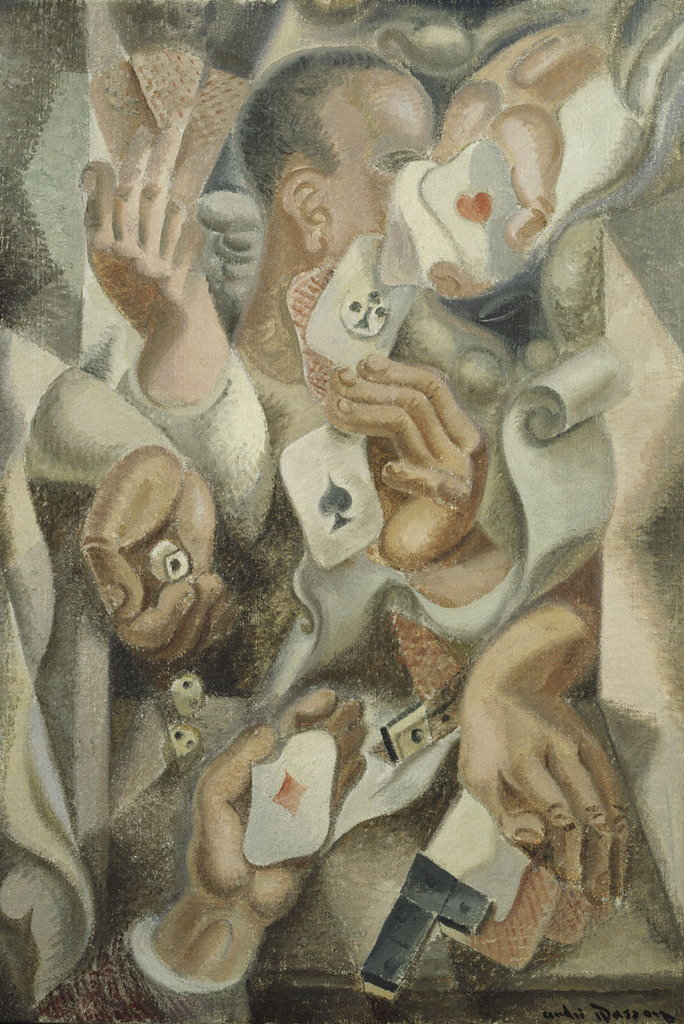 Andre Masson-Card Trick 1923
VII.
The interplay of light was different, even the very air seemed different to Max. As they walked along the avenue, the horizon stretched out before them indefinitely. He could detect the curvature of the earth —meaning that if they carried on walking as did, in a perfectly straight line, they would eventually reach this point again. There was no end. They were two tiny specks scurrying across the crust of a tiny ball spinning in space. For the first time, Max understood, really comprehended, that the world was round.
A heat haze shrouded the street, as the sun slowly but perceptibly leeched away all colour from their surroundings. Margot had dug out a pair of sunglasses from her small black handbag. As Max raised his hand up to shield his eyes from the sun glinting off the windscreens of the speeding cars, he cursed himself…
View original post 1,219 more words
 lampmagician
You must be logged in to post a comment.