When I read this I must again think and thank my brother who had learned me, among the others, the might of Mythology.
It is really interesting how Mythology Saga, has been interconnected to our Curriculum Vitae. As I began to know and learn about it, he gave me a dictionary of the Greece Mythology which helped me as a gadgetry to open it if needed! It was a fascinating dictionary as I ever saw in my life.
Now as my dear friend Elaine Mansfield tells about her feebleness of her hearing, that I wish it will get better and best, I’d say I mention almost a same feebleness not about my hearing but my eyecare. yes, it is unfairly destiny of ageing!!
Yes: We might all know Helen Keller http://Helen Keller who was deaf-blind but I think it’s wrong to compare with the people who lose their one or other senses through their life. they have had them for many years and they would miss them, as Elaine explains here: “Last night I heard a chorus of birds singing their joyful evening songs. I felt one step closer to Eros.”
Anyway, I’m honoured to share her blog to feel whit and learn a lot. ❤ ❤
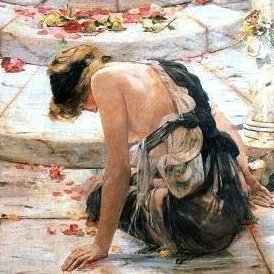
Psyche at the Throne of Aphrodite, Edward Hale, 1883
“Is this easier or harder?” my audiologist asks. “Raise your hand when you hear a beep. Do you prefer program 1 or program 4? You made great progress in a week, so keep going.”
It feels impossible, but keep sorting. I don’t recognize that sound, but I can stay calm and learn. I wear the audio receiver every waking minute as instructed. It’s OK to be tired.
In the Roman story of Eros (Love) and Psyche (Soul), Eros visits his lover Psyche, but only in the dark. Who is this midnight lover? One night she lights a candle to take a look. Burned by dripping wax, Eros flees. Psyche is dragged before Eros’s mother, the goddess Venus.
Psyche at the Throne of Aphrodite, Edward Hale, 1883
After raging at Psyche, Venus gives the girl Four Labors. The “impossible” tasks are Psyche’s way back to Eros. I don’t think of Eros as only sexual love, but as a broader love for the sensory world, for connection and embodiment. Eros brings sacred as well as sexual pleasure. The heart lifts and opens to receive an angelic choir or celestial symphony or a bird song.
With hearing loss, I lost the joy of music and spoken words. Like Psyche, I fought despair.
A cochlear implant promises to connect me back to the world of sound through a slow sorting process. Knowing Psyche’s story gives me patience.
Here’s a description of the First Labor translated from the original story:
“Venus leaped upon the face of poor Psyche, and took her by the hair, and dashed her head upon the ground. Then she took a great quantity of wheat, of barley, poppy seeds, peas, lentils, and beans, and mingled them altogether on a heap saying: Thou evil favored girl, thou seemest unable to get the grace of thy lover, by no other means, but only by diligent and painful service, wherefore I will prove what thou canst do: see that thou separate all these grains one from another disposing them orderly in their quantity, and let it be done before night.” Apuleius, The Golden Ass
Apuleius wrote this in 150 AD, but it’s as relevant now as it was almost 2000 years ago. Since I had many years of vertigo, I relate to being thrown to the ground, but think of it symbolically.
My audiologist & his resident unpacking & tuning
Psyche’s sorting job feels impossible, but helpers arrive for Psyche and for me. Before and after surgery, friends and sons offer gifts of healing balms, soup, rides, and loving patience. Six weeks after surgery, my audiologist programs my audio receiver. He opens a backpack plus a cloth bag filled with directions, warranties, audio receivers, chargers for domestic and foreign travel, a dehydrator for humid months, and more. Then he sorts to make sure everything is there.
It’s a mountain of chaos, but somehow I will figure it out.
Ants, those discriminating seed gatherers, come to Psyche’s rescue and sort the seeds into tidy piles. I have a surgeon and audiologist instead. My process is slower, but it’s coming along.
Cochlear implant audio receiver: mine is hidden under hair (wikimedia commons)
One task won’t be enough to reunite me with embodied pleasure and joyful listening. I want to love music enough to dance. More tasks lie ahead. More steps to unite body and soul with the love of hearing. Like Psyche, I’ll complete one task at a time. I’ll also doubt, before remembering. I don’t have to do this alone.
Last night I heard a chorus of birds singing their joyful evening songs. I felt one step closer to Eros.
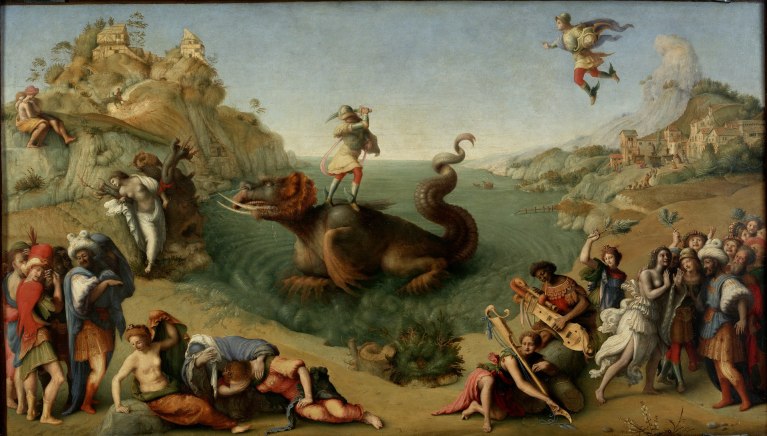
Cassiopeia was an Ethiopian Queen who dared to boast of her daughter’s beauty (as well as her own).
She compared herself, and her child, as being more enchanting than even the Nereids, the sea-children of Nereus, a sea God who served under Poseidon, God of all waters.
Nereus was offended.
Poseidon was not pleased…
*
There are differing accounts at this point:
Maybe Poseidon chose to flood all of Ethiopia;
More likely, he let loose a monster –
P.S. it wasn’t the Kraken, as many of us might like to believe (blame the original 1981 movie, Clash of the Titans, starring Harry Hamlin, for that)
No, the Monster in question was called Cetus.
And while Heracles would a Cetus later, this version of the sea monster had no match.
Save a wandering hero…(yeah, now we’re back to Harry Hamlin)…
Butterflies That they locked themselves against the desired death, mad deranged, after a gram … dark tile parties of bars. The tulips go out against the cobbles that adorn the sidewalk of the neighbourhood.
Morpheus today will sleep among the crystals stirred by bandits of easy kisses, you were born young in times of hunger. Lost between circuses without acrobatics and hard bread.
Sleep now … the dawn comes with noise and ruin. His enraged prayer appears among the brooms, concrete buildings lime and stone in the bushes that saw you born.
And they got tired of being the mule of hunger and garrote, of the kicks of few words … lucid, like a night of the full moon, they ended up leaning their desire to the precipice between coyotes and dogs without a collar. They howled desperately for cheap taverns and smoke. A difficult goodbye … 🙏💖
ariposas. Que se enzarzaron contra la deseada muerte, locas desquiciadas, tras un gramo… fiestas de azulejos de bares oscuros. Desperezan los tulipanes contra los adoquines que adornan la vereda del barrio.
Morfeo hoy dormirá entre los cristales revueltos por bandidos de besos fáciles, habéis nacido jóvenes en tiempos de hambre. Perdidas entre circos sin acrobacias y pan duro.
Dormíos ya… que el alba viene con ruido y ruina. Su rezo enfurecido asoma entre los serojos, edificios hormigonados a cal y canto entre los matorrales que os vieron nacer.
Y se cansaron de ser mula de hambre y garrote, de las coces de pocas palabras… lúcidas, como una noche de luna llena, terminaron asomado sus ganas al precipicio entre coyotes y perros sin collar. Aullaron desesperadas por tabernas baratas y humo. Un difícil adiós…
My thoughts and as a consequence my dreams have been occupied by Prague lately, (a place I have never visited, incidentally), the city of Emperor Rudolf II with his court of alchemists, magicians, scientists and artists; where Dr John Dee and his medium Edward Kelley conjured up a vast array of angels in a Aztec obsidian mirror and Guiseppe Arcimboldo painted his bizarre composite portraits of visages made of fruit, branches, flowers and books. The city (fast forwarding three centuries) of Meyrink and his Golem haunting the ghetto; of Kafka and his monstrous metamorphoses, bewildering reversals and byzantine bureaucracies. The city of the incomparable Toyen.
Reducing an artist’s work to their biography produces crude understanding. But in very many cases, life and work cannot be teased apart. This applies not only to Sylvia Plath and her contemporary confessional poets but also to James Joyce and Marcel Proust and writers they admired, like Dante and Cervantes.
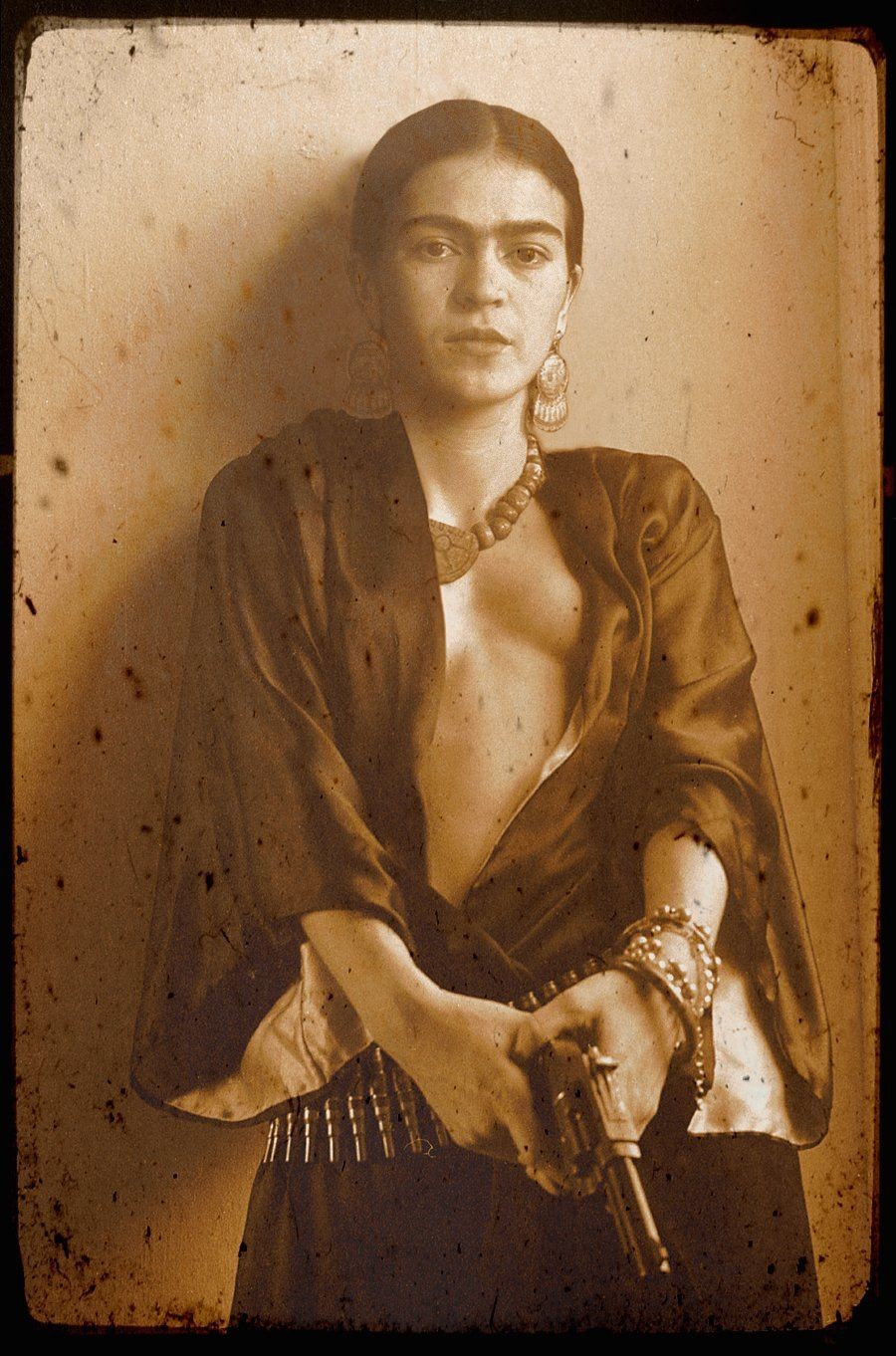
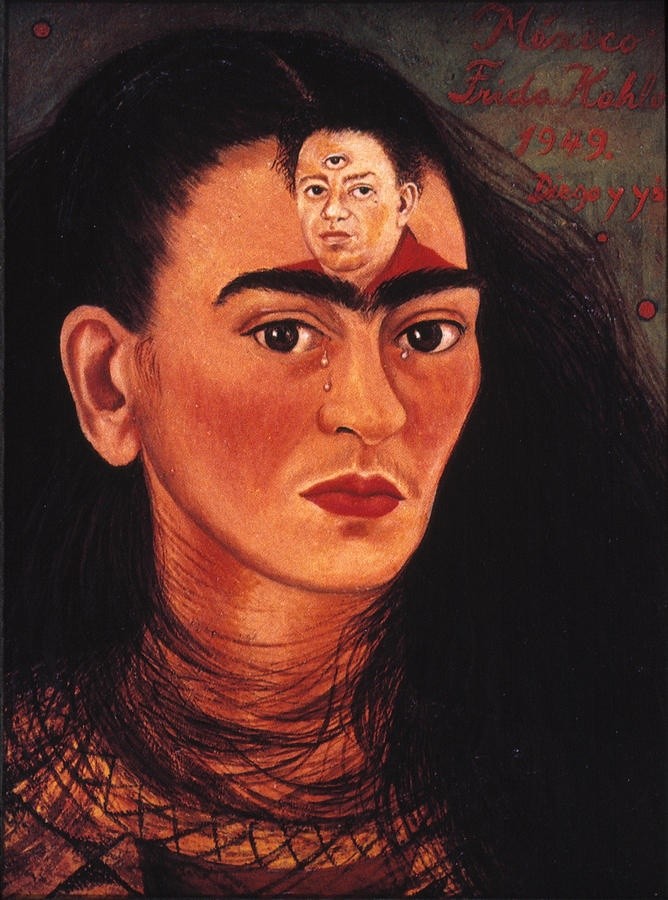
Such an artist too is Frida Kahlo, a practitioner of narrative self-portraits in a modernizing idiom that at the same time draws extensively on tradition. The literary nature of her art is a subject much neglected in popular discussions of her work. She wrote passionate, eloquent love poems and letters to her husband Diego Rivera and others, full of the same kind of visceral, violent, verdant imagery she deployed in her paintings.
More generally, the “obsession with Kahlo’s biography,” writes Maria Garcia at WBUR, ends up focusing “almost voyeuristically—on the tragic experiences of her life more than her artistry.” Those terribly compounded tragedies include surviving polio and, as you’ll learn in Iseult Gillespie’s short TED-Ed video above, a bus crash that nearly tore her in half. She began painting while recovering in bed. She was never the same and lived her life in chronic pain and frequent hospitalizations.
Perhaps a certain cult of Kahlo does place morbid fascination above real appreciation for her vision. “There’s a compulsion that’s satiated only through consuming Kahlo’s agony,” Garcia writes. But it’s also true that we cannot reasonably separate her story from her work. It’s just that there is so more to the story than suffering, all of it woven into the texts of her paintings. Kahlo’s mythology, or “inspirational personal brand,” ties together her commitments to Marxism and Mexico, indigenous culture, and native spirituality.
Like all self-mythologizing before her, she folded her personal story into that of her nation. And unlike European surrealists, who “used dreamlike images to explore the unconscious mind, Kahlo used them to represent her physical body and life experiences.” The experience of disability was no less a part of her ecology than mortality, symbolic landscapes, floral tapestries, animals, and the physically anguished experiences of love and loss.
Generous approaches to Kahlo’s work, and this short overview is one of them, implicitly recognize that there is no need to separate the life from the work, to the extent that the artist saw no reason to do so. But also, there is no need to isolate one narrative theme, whether intense physical or emotional suffering, from themes of self-transformation and transfiguration or experiments in re-creating personal identity as a political act.
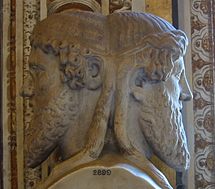
Janus is considered god of the Romans, but there are some who say that Janus was a stranger from Thessaly who had been exiled in Rome, where they say, that Kamiesis welcomed him and shared his kingdom with him. Janus then built a town on the hill, named Janiculum from the name of the goddess!…
Bust of the Roman god Janus at the Vatican Museum. January, January, or Calandar, or the Calandar (Pontian), is the first month of the year in the Gregorian Calendar and has 31 days. The first day of the month, which is the first day of the year, is known as New Year’s Eve.
As everyone knows, Janus is one of the most ancient gods of the Roman pantheon. They stand him with two faces looking opposite, one front and the other back. These myths are exclusively Roman and are connected with the city authorities.According to some mythologists, Janus was a native of Rome, where he once reigned with Cameses, a mythical king whose only name we know. According to others, Janus was a foreigner who came from Thessaly and had been exiled in Rome, where they say, that Kamiesis welcomed him and shared his kingdom with him. Janus then built a town on the hill, which was named Janiculum by the name of the god. When he came to Italy with his wife, called Kamisis or Kamassinis, he had children, and especially the Tiber, a surname of the Tiber River. Later, after the death of Kamissi, Janus reigned alone in Latium, and when Saturnus, chased from Greece by his son Jupiter, arrived there, he hosted him (see Saturnus and Jupiter).In the reign of Janus, they attribute the usual characteristics of the Golden Age, the honesty of people, plenty of goods, stable peace, etc. They say that Janus invented the use of ships to come from Thessaly to Italy, as well as the coin. Indeed, the most ancient Roman bronze coins had on their front the image of Janus, while on the back of a ship’s bow. They also say that Janus deposed the first inhabitants of Lazio, the Aborigines (but this fact is attributed to Saturnos). Prior to this, the Aborigines lived in a miserable way and did not know either the cities or the laws or the cultivation of the land. Janus taught them all that.When Janus died, they deified him. His mythical personality is linked to other myths that have no apparent relationship with the past. They are particularly attributed to him by a miracle, which saved Rome from its capture by the Savines. At the time when Romulus and his companions kidnapped the Sabine women, Titus and the Savages attacked the new city. One night, therefore, Tarpius, the daughter of Capilla’s guardian, delivered the Acropolis to the Savines. They climbed up the Capitol Hill and were ready to overthrow the city’s defenders when Janus set off a fountain of hot water in front of the attackers, scaring them and letting them flee. In memory of this miracle, they decided in time of war to always leave the gate of the temple of Janus open, so that God can at any time help the Romans. They closed it only when peace reigned in the Roman Empire.They also believed that Janus had married Nymph Jcturna, whose sanctuary and source were near the temple of Janus in the Roman Agora. Together we did, say, a son, the god Fons or Fontus, who was the god of the springs. Seneca in his satirical poem about the transformation of Emperor Claudius into a zucchini (the Apolococity) tells Janus, a skilful orator, because he had the experience of buying, and experienced in his art, to look back and forth (that is, all their views), he advocated Claudius. But it is obviously a literary and ironic narrative ornament about the personality of a god, who did not take him any more seriously.
Who’s January
January is the first month of the Gregorian calendar. It was named after the god of the Romans, Janus. In January, Nomas Pompilios added the eleventh place to Romulus, which until then was ten months old. January has often changed its name, in honour of various emperors or members of the imperial family, even the goddess Hera. Initially, January counted 29 days, but later, with Julius Caesar’s calendar reform, two additional days were added.In January – as the Wikipedia has written – our people have given us names such as January because they bear the grazes and Meso Chimonas because it is the middle of the winter months, as the saying goes “as to Ai-Gianni, tiger, is the winter scream. ” It is also the moon with the brightest moon: “On January the moon looks like an hour or so.” It is also called Canto because during its duration the cats are mated, and the Great Month or the Transylvanian Month or Megalomnassas because it is the first month of the year and in contrast to February, which is “lame” (Koutsoflevaros). Oialkyon days have also given him the name “lax”, but he is also known as the “creeper”: “January moon cries, the moon is not looking”. Other names: Genolaitos (because this month they give birth to the herds), Kriaritsi because he is the most “cranky”. BIBLIOGRAPHY:
Baron, De ling. lat. 5, 156, 7, 26 and 27. Macro., Saturn. I, 7, 19. 1, 9 et seq. Cell, Met. 14, 785 et seq. / Fasti 1, 63-294. Virg., Ain. 7, 180. 7, 610. 8, 357. 12, 198. Plut., Rev. El., 41, Ser., Comment. virg., Ain. 8.319. August. 7, 4. Solo 2, 5 et seq. Lydos 4, 2. cf. P. Grimal, “Janus and the origins of Rome”, Lcilves d’Humanite, 4th Holland, Janus and the Bridge, Am. Acad, in Rome, 1961. source: https://www.sakketosaggelos.gr/
Or; I believe every Artists: Male or Female, need a Guardian Angel 😉
a happy end? I couldn’t imagine in the life of the great genius; Dostoyevsky, as I almost have grown up with his works (among the others 😉 ) I felt that he was, almost in his life, trying to focus the dark side of the human being;
“Happy? But I haven’t had any happiness yet. At least, not the kind of happiness I always dreamed of. I am still waiting for it.”
For example; when I read the Charles Dickens works, I got to know his abilities and his observation on the humans, that is genial knowledge over their soul but he was not so pointing on the dark side of us as Dostoyevsky tried to explore. I have learned a lot about my dark side as I read his book
Here I have the presence of light side, which it happens in his true life, and of course with the help of a wonderful woman “what else” who understood him better than any others. I knew just a few great artists who were so lucky to find their Guardian Angel; among Charles Dickens, my father was also so lucky; a pity that he had noticed it deeply at his last night on this Earth and how I wish if my brother could be so as well… what a pity!
Anyway, let’s read this wonderful story with the stunnishing happy end. 🙂
In the summer of 1865, just after he began writing Crime and Punishment, the greatest novelist of all time hit rock bottom. Recently widowed and bedevilled by epilepsy, Fyodor Dostoyevsky (November 11, 1821–February 9, 1881) had cornered himself into an impossible situation. After his elder brother died, Dostoyevsky, already deeply in debt on account of his gambling addiction, had taken upon himself the debts of his brother’s magazine. Creditors soon came knocking on his door, threatening to send him to debtors’ prison. (A decade earlier, he had narrowly escaped the death penalty for reading banned books and was instead exiled, sentenced to four years at a Siberian labour camp — so the prospect of being imprisoned was unbearably terrifying to him.) In a fit of despair, he agreed to sell the rights to an edition of his collected works to his publisher, a man named Fyodor Stellovsky, for the sum of his debt — 3,000 rubles, or around $80,000 in today’s money. As part of the deal, he would also have to produce a new novel of at least 175 pages by November 13 of the following year. If he failed to meet the deadline, he would lose all rights to his work, which would be transferred to Stellovsky for perpetuity.
Only after signing the contract did Dostoevsky find out that it was his publisher, a cunning exploiter who often took advantage of artists down on their luck, who had purchased the promissory notes of his brother’s debt for next to nothing, using two intermediaries to bully Dostoyevsky into paying the full amount. Enraged but without recourse, he set out to fulfil his contract. But he was so consumed with finishing Crime and Punishment that he spent most of 1866 working on it instead of writing The Gambler, the novel he had promised Stellovsky. When October rolled around, Dostoyevsky languished at the prospect of writing an entire novel in four weeks.
Portrait of Fyodor Dostoyevsky by Vasily Perov, 1871
His friends, concerned for his well-being, proposed a sort of crowdsourcing scheme — Dostoyevsky would come up with a plot, they would each write a portion of the story, and he would then only have to smooth over the final product. But, a resolute idealist even at his lowest low, Dostoyevsky thought it dishonourable to put his name on someone else’s work and refused.
There was only one thing to do — write the novel, and write it fast.
On October 15, he called up a friend who taught stenography, seeking to hire his best pupil. Without hesitation, the professor recommended a young woman named Anna Grigoryevna Snitkina. (Stenography, in that era, was a radical innovation and its mastery was so technically demanding that of the 150 students who had enrolled in Anna’s program, 125 had dropped out within a month.)
Twenty-year-old Anna, who had taken up stenography shortly after graduating from high school hoping to become financially independent by her own labor, was thrilled by the offer — Dostoyevsky was her recently deceased father’s favorite author, and she had grown up reading his tales. The thought of not only meeting him but helping him with his work filled her with joy.
The following day, she presented herself at Dostoyevsky’s house at eleven-thirty, “no earlier and no later,” as Dostoyevsky had instructed — a favorite expression of his, bespeaking his stringency. Distracted and irritable, he asked her a series of questions about her training. Although she answered each of them seriously and almost dryly, so as to appear maximally businesslike, he somehow softened over the course of the conversation. By the early afternoon, they had begun their collaboration on the novel — he, dictating; she, writing in stenographic shorthand, then transcribing at home at night.
For the next twenty-five days, Anna came to Dostoyevsky’s house at noon and stayed until four. Their dictating sessions were punctuated by short breaks for tea and conversation. With each day, he grew kinder and warmer toward her, and eventually came to address her by his favorite term of endearment, “golubchik” — Russian for “little dove.” He cherished her seriousness, her extraordinary powers of sympathy, how her luminous spirit dissipated even his darkest moods and lifted him out of his obsessive thoughts. She was touched by his kindness, his respect for her, how he took a genuine interest in her opinions and treated her like a collaborator rather than hired help. But neither of them was aware that this deep mutual affection and appreciation was the seed of a legendary love.
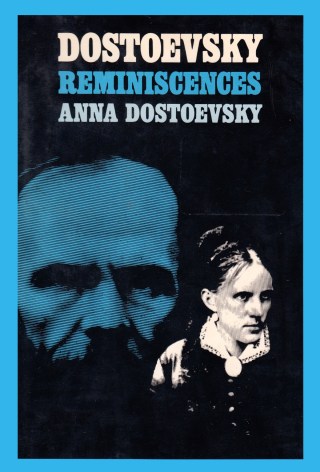
In her altogether spectacular memoir of marriage, Dostoevsky Reminiscences(public library), Anna recounts a prescient exchange that took place during one of their tea breaks:
Each day, chatting with me like a friend, he would lay bare some unhappy scene from his past. I could not help being deeply touched at his accounts of the difficulties from which he had never extricated himself, and indeed could not.
[…]
Fyodor Mikhailovich always spoke about his financial straits with great good nature. His stories, however, were so mournful that on one occasion I couldn’t restrain myself from asking, “Why is it, Fyodor Mikhailovich, that you remember only the unhappy times? Tell me instead about how you were happy.”
“Happy? But I haven’t had any happiness yet. At least, not the kind of happiness I always dreamed of. I am still waiting for it.”
Little did either of them know that he was in the presence of that happiness at that very moment. In fact, Anna, in her characteristic impulse for dispelling the darkness with light, advised him to marry again and seek happiness in family. She recounts the conversation:
“So you think I can marry again?” he asked. “That someone might consent to become my wife? What kind of wife shall I choose then — an intelligent one or a kind one?”
“An intelligent one, of course.”
“Well, no… if I have the choice, I’ll pick a kind one, so that she’ll take pity on me and love me.”
While we were on the theme of marriage, he asked me why I didn’t marry myself. I answered that I had two suitors, both splendid people and that I respected them both very much but did not love them — and that I wanted to marry for love.
“For love, without fail,” he seconded me heartily. “Respect alone isn’t enough for a happy marriage!”
Their last dictation took place on November 10. With Anna’s instrumental help, Dostoyevsky had accomplished the miraculous — he had finished an entire novel in twenty-six days. He shook her hand, paid her the 50 rubles they had agreed on — about $1,500 in today’s money — and thanked her warmly.
The following day, Dostoyevsky’s forty-fifth birthday, he decided to mark the dual occasion by giving a celebratory dinner at a restaurant. He invited Anna. She had never dined at a restaurant and was so nervous that she almost didn’t go — but she did, and Dostoyevsky spent the evening showering her with kindnesses.
But when the elation of the accomplishment wore off, he suddenly realized that his collaboration with Anna had become the light of his life and was devastated by the prospect of never seeing her again. Anna, too, found herself sullen and joyless, her typical buoyancy weighed down by an acute absence. She recounts:
I had grown so accustomed to that merry rush to work, the joyful meetings and the lively conversations with Dostoyevsky, that they had become a necessity to me. All my old activities had lost their interest and seemed empty and futile.
Unable to imagine his life without her, Dostoyevsky asked Anna if she would help him finish Crime and Punishment. On November 20, exactly ten days after the end of their first project, he invited her to his house and greeted her in an unusually excited state. They walked to his study, where he proceeded to propose marriage in the most wonderful and touching way.
Dostoyevsky told Anna that he would like her opinion on a new novel he was writing. But as soon as he began telling her the plot, it became apparent that his protagonist was a very thinly veiled version of himself, or rather of him as he saw himself — a troubled artist of the same age as he, having survived a harsh childhood and many losses, plagued by an incurable disease, a man “gloomy, suspicious; possessed of a tender heart … but incapable of expressing his feelings; an artist and a talented one, perhaps, but a failure who had not once in his life succeeded in embodying his ideas in the forms he dreamed of, and who never ceased to torment himself over that fact.” But the protagonist’s greatest torment was that he had fallen desperately in love with a young woman — a character named Anya, removed from reality by a single letter — of whom he felt unworthy; a gentle, gracious, wise, and vivacious girl whom he feared he had nothing to offer.
Only then did it dawn on Anna that Dostoyevsky had fallen in love with her and that he was so terrified of her rejection that he had to feel out her receptivity from behind the guise of fiction.
Is it plausible, Dostoyevsky asked her, that the alleged novel’s heroine would fall in love with its flawed hero? She recounts the words of literature’s greatest psychological writer:
“What could this elderly, sick, debt-ridden man give a young, alive, exuberant girl? Wouldn’t her love for him involve a terrible sacrifice on her part? And afterwards, wouldn’t she bitterly regret uniting her life with his? And in general, would it be possible for a young girl so different in age and personality to fall in love with my artist? Wouldn’t that be psychologically false? That is what I wanted to ask your opinion about, Anna Grigoryevna.”
“But why would it be impossible? For if, as you say, your Anya isn’t merely an empty flirt and has a kind, responsive heart, why couldn’t she fall in love with your artist? What if he is poor and sick? Where’s the sacrifice on her part, anyway? If she really loves him, she’ll be happy, too, and she’ll never have to regret anything!”
I spoke with some heat. Fyodor Mikhailovich looked at me in excitement. “And you seriously believe she could love him genuinely, and for the rest of her life?”
He fell silent, as if hesitating. “Put yourself in her place for a moment,” he said in a trembling voice. “Imagine that this artist — is me; that I have confessed my love to you and asked you to be my wife. Tell me, what would you answer?”
His face revealed such deep embarrassment, such inner torment, that I understood at long last that this was not a conversation about literature; that if I gave him an evasive answer I would deal a deathblow to his self-esteem and pride. I looked at his troubled face, which had become so dear to me, and said, “I would answer that I love you and will love you all my life.”
I won’t try to convey the words full of tenderness and love that he said to me then; they are sacred to me. I was stunned, almost crushed by the immensity of my happiness and for a long time I couldn’t believe it.
Fyodor and Anna were married on February 15, 1867, and remained besotted with one another until Dostoyevsky’s death fourteen years later. Although they suffered financial hardship and tremendous tragedy, including the death of two of their children, they buoyed each other with love. Anna took it upon herself to lift the family out of debt by making her husband Russia’s first self-published author. She studied the book market meticulously, researched vendors, masterminded distribution plans, and turned Dostoyevsky into a national brand. Today, many consider her Russia’s first true businesswoman. But beneath her business acumen was the same tender, enormous heart that had made loving room within itself for a brilliant man with all of his demons.
In the afterword to her memoir, Anna reflects on the secret to their deep and true marriage — one of the greatest loves in the history of creative culture:
Throughout my life it has always seemed a kind of mystery to me that my good husband not only loved and respected me as many husbands love and respect their wives, but almost worshipped me, as though I were some special being created just for him. And this was true not only at the beginning of our marriage but through all the remaining years of it, up to his very death. Whereas in reality I was not distinguished for my good looks, nor did I possess talent nor any special intellectual cultivation, and I had no more than a secondary education. And yet, despite all that, I earned the profound respect, almost the adoration of a man so creative and brilliant.
This enigma was cleared up for me somewhat when I read V.V. Rozanov’s note to a letter of Strakhov dated January 5, 1890, in his book Literary Exiles. Let me quote:
“No one, not even a ‘friend,’ can make us better. But it is a great happiness in life to meet a person of quite different construction, different bent, completely dissimilar views who, while always remaining himself and in no wise echoing us nor currying favor with us (as sometimes happens) and not trying to insinuate his soul (and an insincere soul at that!) into our psyche, into our muddle, into our tangle, would stand as a firm wall, as a check to our follies and our irrationalities, which every human being has. Friendship lies in contradiction and not in agreement! Verily, God granted me Strakhov as a teacher and my friendship with him, my feelings for him were ever a kind of firm wall on which I felt I could always lean, or rather rest. And it won’t let you fall, and it gives warmth.”
In truth, my husband and I were persons of “quite different construction, different bent, completely dissimilar views.” But we always remained ourselves, in no way echoing nor currying favor with one another, neither of us trying to meddle with the other’s soul, neither I with his psyche nor he with mine. And in this way my good husband and I, both of us, felt ourselves free in spirit.
Fyodor Mikhailovich, who reflected so much in so much solitude on the deepest problems of the human heart, doubtless prized my non-interference in his spiritual and intellectual life. And therefore he would sometimes say to me, “You are the only woman who ever understood me!” (That was what he valued above all.) He looked on me as a rock on which he felt he could lean, or rather rest. “And it won’t let you fall, and it gives warmth.”
It is this, I believe, which explains the astonishing trust my husband had in me and in all my acts, although nothing I ever did transcended the limits of the ordinary. It was these mutual attitudes which enabled both of us to live in the fourteen years of our married life in the greatest happiness possible for human beings on earth.








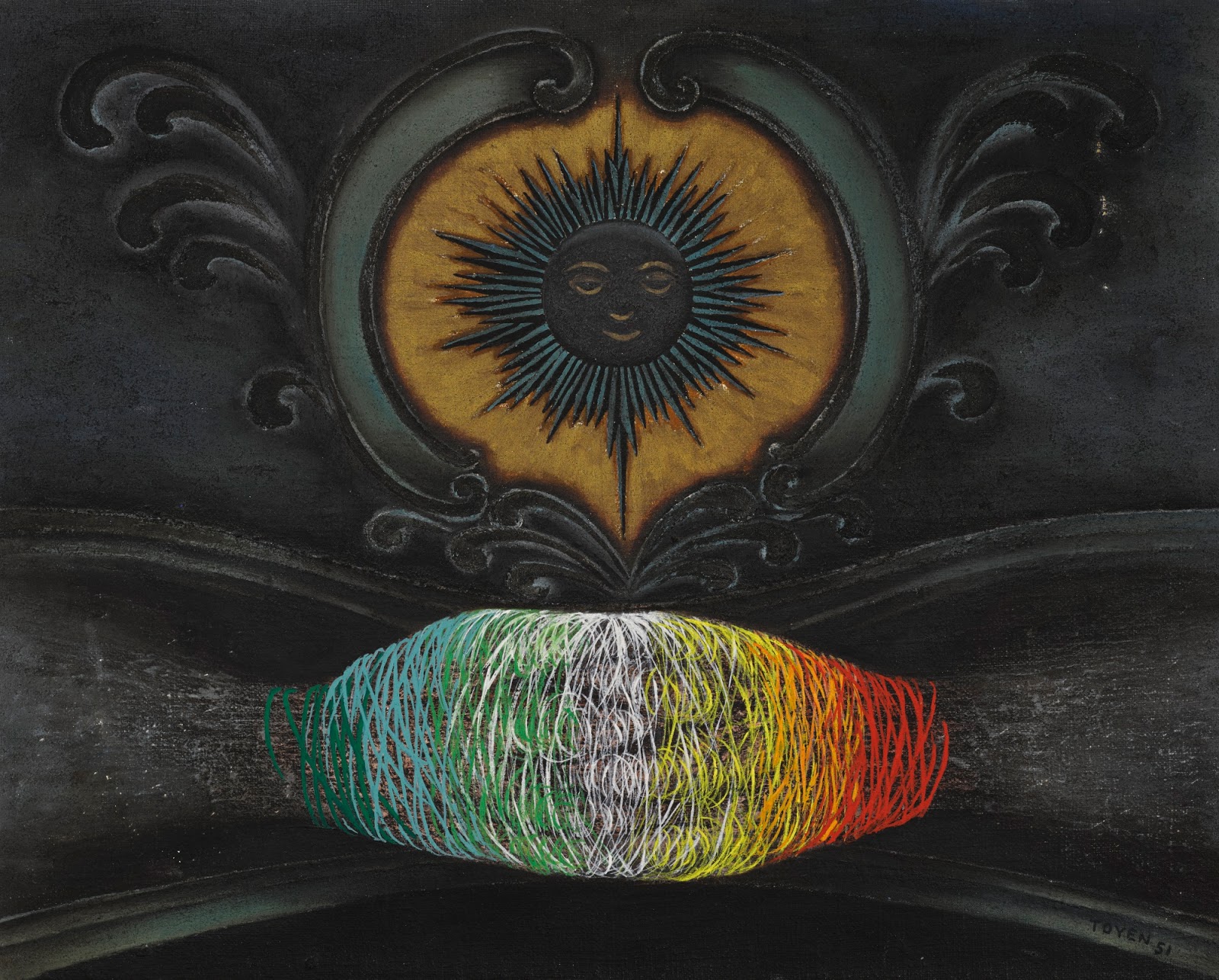 Black Sun-Toyen 1951
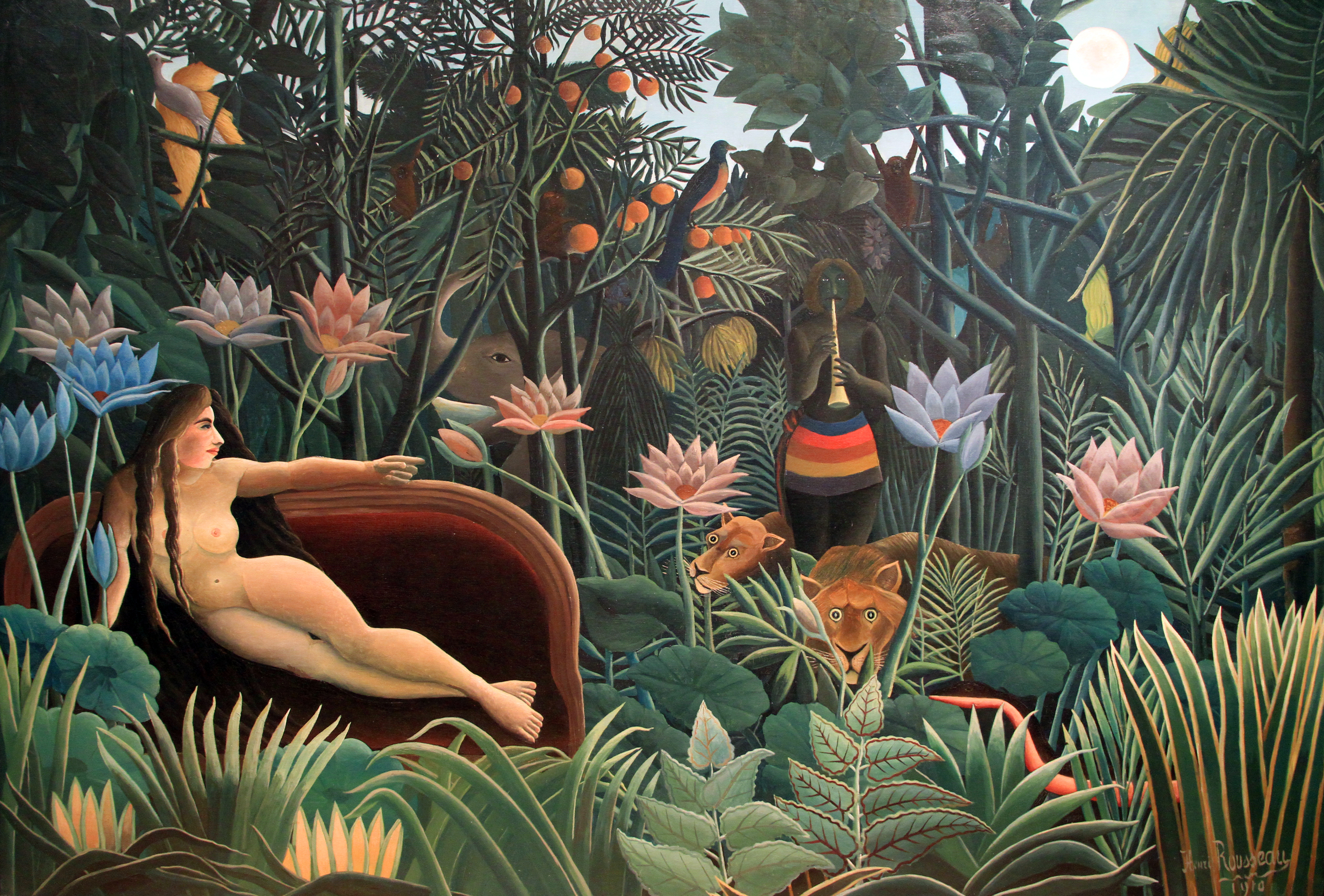 Henri Rousseau: The Dream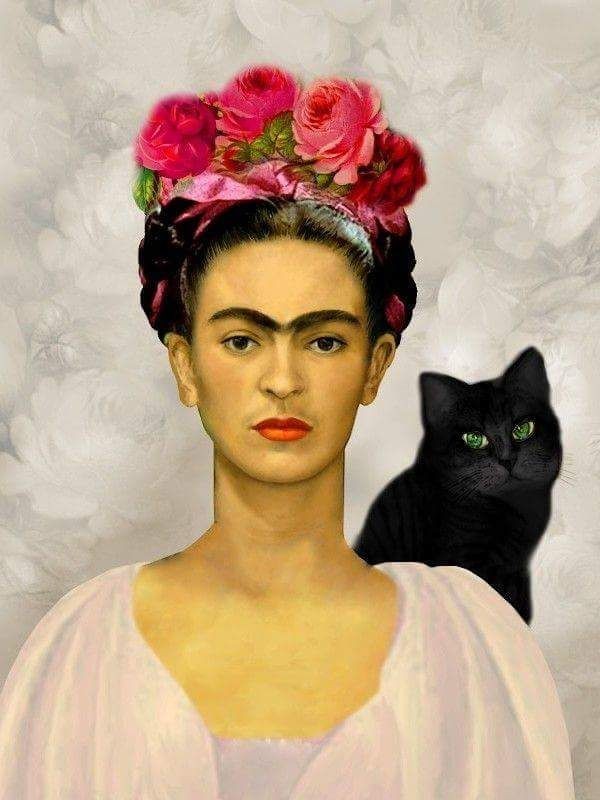


 lampmagician
You must be logged in to post a comment.