Thoth

Gallery

Cakeordeath's avatarcakeordeathsite

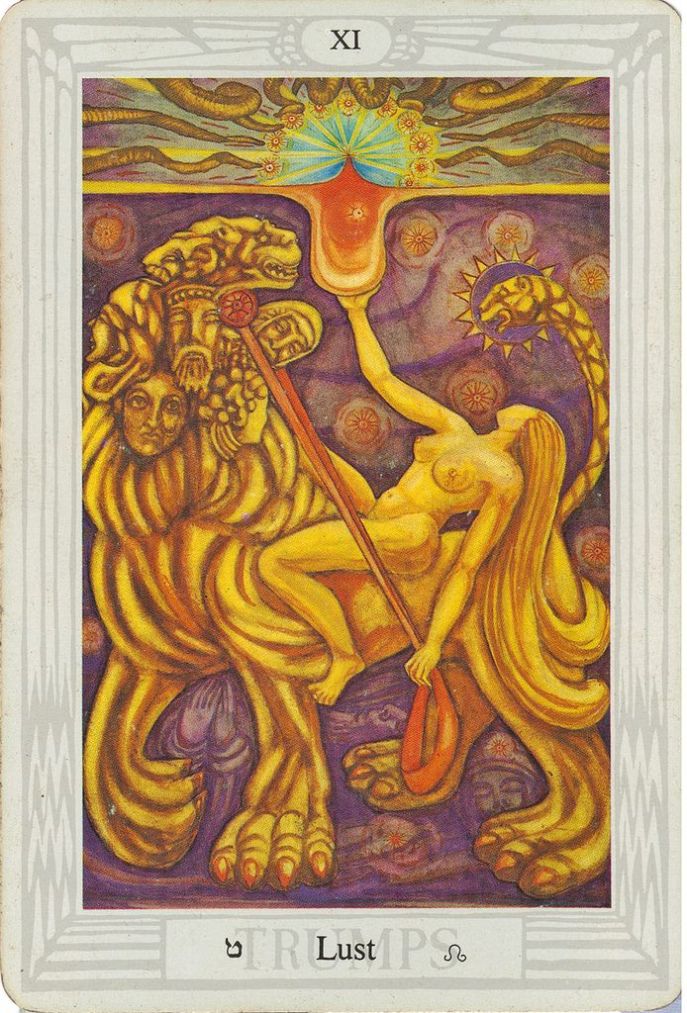
Thoth Tarot-Lady Frieda Harris with instruction by Aleister Crowley 1938-1943 published 1969

One of the most notorious of Tarot decks due to its association with the infamous Aleister Crowley, the Thoth Tarot was designed and painted by Lady Frieda Harris under instruction from the Great Beast. In addition to referencing Crowley’s new religion of Thelema, (Do what you wilt shall be the whole of the Law. Love is the law, love under will), Lady Harris includes elements of Goethe’s theory of colour and Rudolf Steiner’s Anthroposophy in the execution of the project.

In 1937 Crowley had asked his friend the playwright Clifford Bax to find an artist to realise his longstanding ambition of re-designing the Tarot deck along Thelemic lines After two artists failed to show Bax invited Lady Frieda, then aged 60, to met Crowley. Third time around indeed proved to be a charm and they worked together on the deck for 5 years. Crowley initiated Lady Frieda into…

View original post 114 more words

freedom

Standard

House of Heart's avatar

In the sweet summer

below the rusty fasteners of

an old swing I pump the air

with the  spindly legs of childhood,

dream my wide eyed dreams of whirling

pathways to the beckoning sun.

My heart leaps at the sight of a brilliant

rainbow and with small fingers I reach up

to swathe its colors over a blue palette  sky.

Now I know about life, the real truth of it.

Now I know the swing is just freedom.

little girl with freckles

View original post

The Interior Monologue

Standard

As the ape tracked down the tree and lost its sharp teeth and hair, invented the cloth to hide his/her naked body and later, invented the mask to hide his/her naked soul. 🙏💖

etinkerbell's avatare-Tinkerbell

The American psychologist William James, coined the expression stream of consciousness to define the chaotic sequence of thoughts of the conscious mind, a flow, which has no boundaries and cannot be stopped except by sleep. That is the truest, uncensored part of ourselves. When our thoughts become audible words, in fact, we use the filter of convenience and social convention, thus, wearing the mask of propriety, we become a “persona”, which was for modernist artists a less interesting  subject than that unconstrained current, as it lacked in authenticity. Virginia Woolf in her essay Mr Bennett and Mrs Brown says:

Mr. Bennett says that it is only if the characters are real that the novel has any chance of surviving. Otherwise, die it must. But, I ask myself, what is reality? And who are the judges of reality?

Reality, we could say, is, therefore, what hides under the many masks we…

View original post 1,279 more words

Werewolf Folklore

Standard

Nifty Buckles Folklore's avatarNifty Buckles

One of the most feared creatures of the night is the Werewolf.

This fascinating creature the Werewolf is also known as (Old English: werwulf, “man-wolf”) or occasionally lycanthrope /ˈlaɪkənˌθroʊp/ (Greek: λυκάνθρωπος lukánthrōpos, “wolf-person”) is a mythological or folkloric human with the ability to shape-shift into a wolf.

The lycanthrope is a famous concept in European folklore, existing in several variables, which are related by a common development of a Christian interpretation of underlying European folklore formed in the medieval period. From the early modern period, werewolf beliefs expanded to the New World with colonialism.

Belief in werewolves developed in parallel to the belief in witches, in the course of the Late Middle Ages and the Early Modern period. Similar to the witchcraft trials as a whole, the trial of supposed werewolves emerged in what is now Switzerland (especially the Valais and Vaud) in the early 15th century and spread…

View original post 306 more words

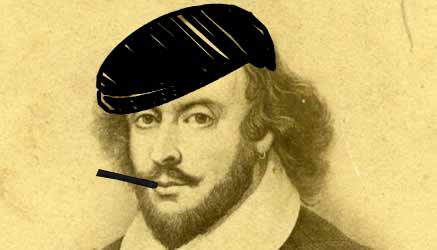
Was Shakespeare Italian and born in Italy?

Standard

etinkerbell's avatare-Tinkerbell

16shakespeare

William Shakespeare is the emblem of English literature for sure, but, you know, every time I read his works he seems so familiar to me, so Italian. This is not only because 15 out 37 of his works are set in Italy, he knows the nature of the Italians so well, that some of his immortal lines mirror perfectly some unchangeable traits of our society. An example? In his famous soliloquy “to be or not to be” , he actually seems to be pondering about committing suicide speculating on life and death, but he truly complains about some aspects of society that have the stamp of the Italian character. First of all ” the law’s delay” (it may take more than ten years to see the conclusion of a trial here and in the end you have spent so much money to pay the lawyers to end up…

View original post 450 more words

The Union of Cupid and Psyche, Part 1/4: Cast of Characters

Standard

MythCrafts Team's avatarMyth Crafts

We have come to use the words “comedy” and “tragedy” very differently than the Greeks, which is who we get those two words from.

For the Greeks, a comedy was any narrative that started darkly – pain, suffering, death, grief – and ended happily – joy, love, marriage, reconciliation, even birth.

A tragedy, on the other hand, ran the opposite direction – from bliss to sorrow, from peace to strife.

Given that definition, the tale of Cupid and Psyche is a comedy.

*

The visual narrative can be found in Greek art dating back to the 4th century B.C.E.; however, we have no extant literary sources until the 2nd century C.E., where it appears as a central chapter in Apuleius’ The Golden Ass. In the same way that his fellow Roman, Ovid, retold (and reinterpreted) Greek myths, this is as close to the source material as we can…

View original post 437 more words

The Union of Cupid and Psyche, Part 2/4, the Banishment and the Villa

Standard

MythCrafts Team's avatarMyth Crafts

In part 1, we met our cast of characters. Now, it’s time to let them play out their parts:

So imagine this: you are the most beautiful princess in the world. Your beauty rivals that of the Goddess of Beauty, Aphrodite.

This has two unfortunate side effects:

First, it has drawn the ire of the Goddess herself.

Second, it means that unlike your two older sisters, no suitors pursue you; they believe themselves unworthy of your affections.

Your father, the King, is troubled that he can’t find you a suitable husband. He wonders if the Gods are offended.

And so he does the most logical thing he can think of: he goes to consult the Oracle of Delphi.

The Sybil has grave news:

“Your daughter is destined to marry a terrible beast, one that even the Gods fear. Take her to a rocky outcropping, high over the seas, and…

View original post 496 more words