
By symbolreader
Haven’t you got the same feeling as I have right now? feeling lazy, uninspired, infertile, just like your brain is absolute empty!? 😕🤪😵 That’s me at this moment and I don’t know why (no wonder; nothing happens in my head!!)
Anyway, I can at least share this excellent read with you; a loss, which can be called a loss of civilization, (like the old Persian history; Persepolis. although it is a wonderful tell, a testament of truth. 🙏💖🙏💖
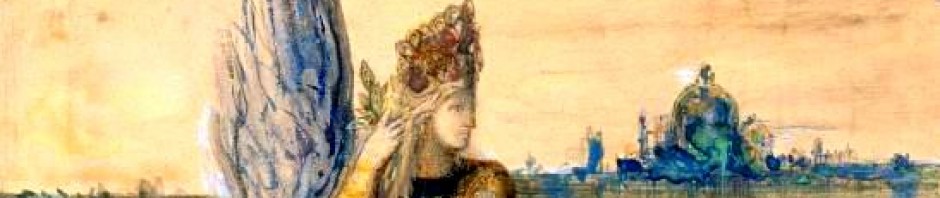
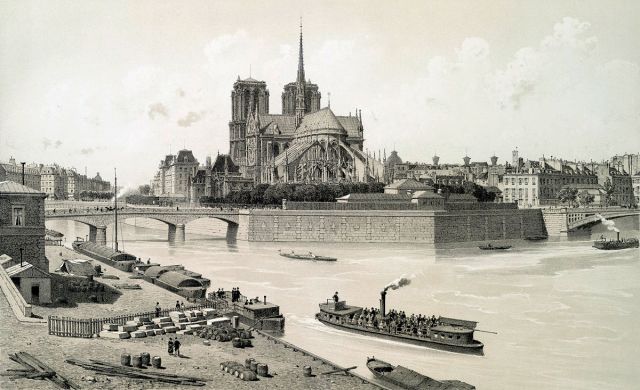
In “Civilization,” a classic TV series of 1969, standing in front of Notre-Dame, Kenneth Clark asked: “What is civilization? I don’t know. I can’t define it in abstract terms — yet. But I think I can recognize it when I see it. He turned toward the Notre-Dame cathedral and added: “And I am looking at it now.” Witnesses say that the people of Paris were mostly looking speechless while a great symbol was engulfed by flames. The reactions throughout the world have been similarly overwhelming. It was perhaps not rational or logical to gasp in horror but so many of us did.
Of all the numerous cathedrals dedicated to the Virgin in Europe, the Parisian one is the most celebrated, being the only one graced with the definite article “the,” signifying unique reference without the need of mentioning its location. In the medieval town, the Gothic cathedral was a spiritual heart of the community. It was designed to last for eternity. “It was an expression of a newly emerging civic consciousness—a result of the rapid growth of medieval towns—providing a focus of artistic and intellectual life in addition to religious services,” says Karen Ralls (1). But the sacred roots of the cathedral reached so much deeper than the current socio-political circumstances. For cathedrals were often built on ancient sacred sites, for example Notre-Dame was built where previously stood the Temple of Isis, and a Druid Goddess Shrine before that.(2)
The very name Gothic, though actually erroneous, suggests something primal and wild. It was used for the first time in the sixteenth century, when Giorgio Vasari disparaged the cathedrals as “monstrous and barbarous, and lacking everything that can be called order.”(3) Vasari believed that the Goths destroyed the symmetrical and beautiful Roman architecture in order to erect coarse and barbarous buildings of the “Gothic” style. Of course, he could not have been more wrong; and yet Notre-Dame is indeed primeval in at least two ways. Firstly, the construction material of its timber roof, which was destroyed in the recent fire, came from the primeval oak forest, which does not exist anymore. As François-René de Chateaubriand wrote in The Genius of Christianity:
“The forests of the Gauls passed into the temples of our fathers, and our woods of oak thus kept their sacred origin. Those vaults chiseled into foliage, those vertical supports that hold up the walls and end abruptly like broken tree trunks, the coolness of the vaults, the shadows of the sanctuary, the dark wings, the secret passages, the low doors, everything reproduces the labyrinths of the woods in the Gothic church; everything evokes religious horror, mystery, and divinity.” (4)
Secondly, as the patroness of the cathedral, Mary evokes the sacred lineage of ancient mother goddesses:
“Thus the cathedral appears to be based on alchemical science, on the science which investigates the transformations of the original substance, elementary matter (Lat. materea, root muter mother). For the Virgin Mother, stripped of her symbolical veil, is none other than the personification of the primitive substance, used by the Principle, the creator of all that is, for the furtherance of his designs.
Finally, in the Ave Regina, the Virgin is properly called root (salve radix) to show that she is the principle and the beginning of all things. ‘Hail, root by which the Light has shone on the world.’” (5)
Indeed, light, along with height, is “the central defining element of the Gothic style” and “all of the features we associate with Gothic architecture – pointed arches, flying buttresses, ribbed vaults, soaring ceilings, stained glass windows, pinnacles and turrets – were developed in the service of the desire to flood the interior space with as much light as possible.”(6) The faithful entered the church from the west, and by walking towards the sanctuary they were facing the direction of the rising sun – from the shadow to the light. Fulcanelli explains:
“As a consequence of this arrangement, one of the three rose windows which adorn the transepts and the main porch, is never lighted by the sun. This is the north rose, which glows on the facade of the left transept. The second one blazes in the midday sun; this is the southern rose, open at the end of the right transept. The last window is lit by the coloured rays of the setting sun. This is the great rose, the porch window, which surpasses its side sisters in size and brilliance. Thus on the facade of a Gothic cathedral the colours of the Work unfold in a circular progression, going from the shadows-represented by the absence of light and the colour black -to the perfection of ruddy light, passing through the colour white, considered as being the mean between black and red.”

The alchemical glass at the Notre-Dame creates an astonishing visual effect. The secrets of its making were never written down and were lost for centuries. The builders of the cathedrals, the master stonemasons, attempted to materialize heaven on earth. They studied their sacred craft in monastic schools, “acquiring those secrets of geometry, design, and engineering that were closely guarded in the lodges.” (7) The glass makers commanded an astonishing number of these chemical tricks, secrets never written down and lost in subsequent centuries. Only in the middle of the nineteenth century, under the inspiration of Eugène Viollet-le-Duc, did the new scientific chemists laboriously analyze the composition of the glass and managed to reconstruct the manner of its making. However, as Winston points out:
“It then became evident that the very accidental nature of the process, the impurities of the ingredients, the lack of uniformity in each sheet of glass – which might be wavy, thick or thin, full of blisters and bubbles – had a great deal to do with the liveliness of the final effect. Glass made according to tested formulae and under controlled temperatures turned out to be a sorry imitation of the real thing.”

P.D. Ouspensky emphasized that the Schools of Masons were temples of spiritual freedom in the otherwise “rude, absurd, cruel, superstitious, bigoted and scholastic Middle Ages.” (8) In these schools “the true meaning of religious allegories and symbols was explained” while esoteric philosophy was studied under cover “because of the growing ‘ heretic-mania’ in the Catholic Church.

This masonic wisdom was lost for a few centuries while Notre-Dame became neglected and almost destroyed, especially during the French Revolution. However, the nineteenth century brought its spectacular revival, partly thanks to Victor Hugo’s Gothic novel “The Hunchback of Notre-Dame.” The already mentioned Eugène Viollet-le-Duc was the architect of the cathedral’s restoration. As Ouspensky remarks, he had a deep understanding of the symbolic significance of Notre-Dame and was able to bring the soul of the Cathedral back to life. He suggested rebuilding the medieval spire, which had been removed in 1786. The same spire actually collapsed in the recent fire.

But perhaps more importantly, Viollet-le-Duc is responsible for the addition of the most iconic elements of the cathedral – its menagerie of gargoyles, chimeras and grotesques. He submitted drawings and photographs of similar elements in other medieval cathedrals. These designs were then carved in stone by Victor Pyanet. In the fourteenth century, when Notre-Dame was finished, its exterior walls were covered by gargoyles, which were designed to ensure drainage. These figures were not long lasting, though. Viollet-le-Duc recreated the original gargoyles and added the chimeras, which were not part of the original Notre-Dame and were not meant to carry off water from the facade. Not many people know that the chimeras were the nineteenth century as purely ornamental elements. Once again Ouspensky seems to capture their spiritual meaning convincingly:
“The gargoyles and other figures of Notre Dame transmit to us the psychological ideas of its builders, chiefly the idea of the complexity of the soul. These figures are the soul of Notre Dame, its different ‘I’s: pensive, melancholy, watching, derisive, malignant, absorbed in themselves, devouring something, looking intensely into a distance invisible to us, as does the strange woman in the headdress of a nun, which can be seen above the capitals of the columns of a small turret high up on the south side of the cathedral. …
The gargoyles and all the other figures of Notre-Dame possess one very strange property: beside them people cannot be drawn, painted or photographed; beside them people appear dead, expressionless stone images.”

Charles Meryon, Le Stryge
Fulcanelli claims that originally the space next to the cathedral was occupied by a large fountain, on which a couplet was carved:
“You, who are thirsty, come hither if, by chance the fountain fails
The goddess has, by degrees, prepared the everlasting waters.”
Why, then, was the whole world so touched by the destruction of Notre-Dame? I think Allan Temko was right when he said:
“In the great moment of the Middle Age, Mary lifted and civilized the entire Western world. In an era of continual male brutality, her emblem, the rose, became the sign of the less brutal woman.”(9)
The symbolic power of Notre-Dame lies in its ability to make us feel connected to the Goddess and through her to the transcendental, spiritual power of the collective unconscious. We will be saved only if we as individuals find a way back to our soul – the inner mystic rose. I am reminded of the young Carl Gustav Jung’s vision of God dropping an enormous turd on a shiny roof of the Cathedral in Basel. He reminisced in Memories, Dreams, Reflections: “I felt an enormous, indescribable relief. Instead of the expected damnation, grace had come upon me… I wept for happiness and gratitude.” The vision perhaps meant that spirituality and redemption can or must be found outside the church walls, away from organized religions. Perhaps this is also the message sent to us by the purifying fires of Notre-Dame. The gargoyles and chimeras keep pointing out with their protruding tongues that there is a vital layer of instinct beneath the veneer of civilization. Fulcanelli reminded us that “the cathedral was the hospitable refuge of all unfortunates.” Like the mother goddess it spread its protective mantle over the poor, the sick, the suffering – all the hunchbacks of the world.
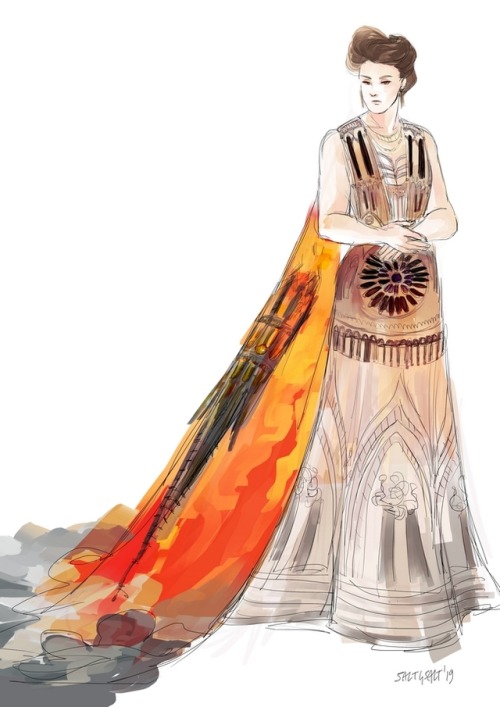
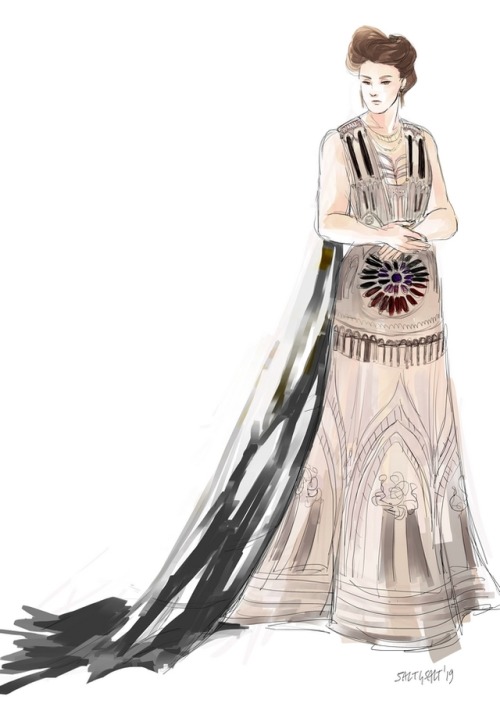
Image via https://salt4salt.tumblr.com/post/184226395927/i-originally-didnt-want-to-do-something-but-here
Footnotes:
1. Karen Ralls, Gothic Cathedrals: A Guide to the History, Places, Art, and Symbolism
2. Richard Winston, Notre-Dame: A History
3. Roland Recht, Believing and Seeing: The Art of Gothic Cathedrals
4. David Spurr, Architecture and Modern Literature
5. Fulcanelli Master Alchemist, Le Mystère des Cathédrales: Esoteric Interpretation of the Hermetic Symbols of the Great Work – A Hermetic Study of Cathedral Construction
6. Robert A. Scott, The Gothic Enterprise: A Guide to Understanding the Medieval Cathedral
7. Richard Winston, Notre-Dame: A History
8. P. D. Ouspensky, A New Model of the Universe
9. Allan Temko, Notre-Dame of Paris


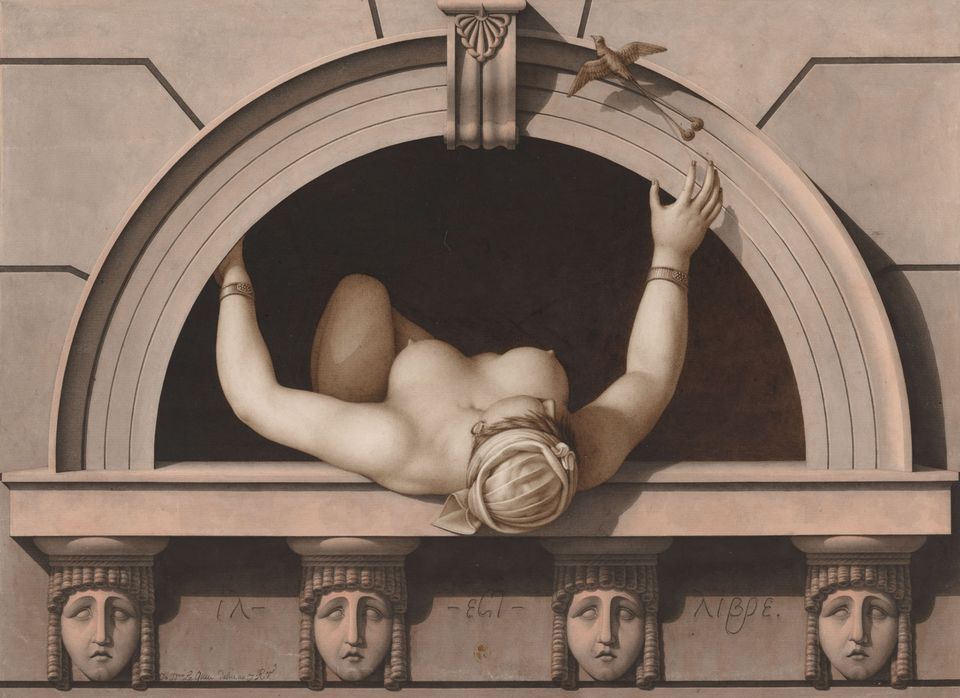 Jean-Jacques Lequeu-Il est libre-1798-1799


 Author Neil Gaiman for Get Caught Reading
 Ghost Stories Magazine circa 1926




 lampmagician
You must be logged in to post a comment.