Let’s have another break in my work to give a short tribute to a great genius in, I would say, all kind of Arts.
Actually, I didn’t know him from Monty Python’s movies first, I knew him by his fascinating TV series; Medieval Lives.
And of course, his proof of concept has been clearly seen in the Python’s films.
I’ve heard that he has cancer and also Alzheimer and now his death can be a salvation for him but it is surely a great loss for the world of Arts. Our world. 😔
I want just to imagine how he and Graham Chapman make an chaotic in heaven there above 🤗❤
Rest in Peace and thanks for the wonderful and joyful moments in our lives 🙏❤🙏❤🙏❤
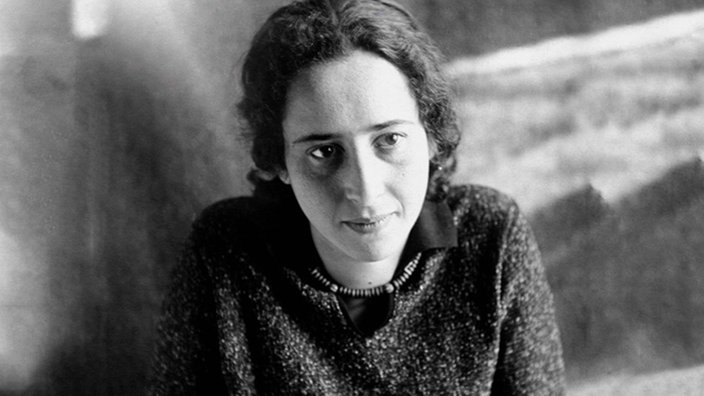
Just look at her, into her eyes if you dare as a man; I’d consider myself! Theses eyes are very dangerous for the muscular, if you have heard about infinity well that’s it. I will never stop you to be drown in, but just to know you’d never want to come back again. 😊👽💖
She is really one of the highest human (actually Hu-Woman) as I can remember ever seen in my memories; her eyes are hypnotizing; aren’t they?
I have actually once noticed her as a genius philosopher but newly I’ve heard about her again in the radio how she made all the Nazi men confused, I’d just thought; there she is; the Goddess. Why not, what have we, humans got less than Gods? In the all holly books it’s written; God made hu-wo-man as reflection her/himself. or as Shakespeare says as Hamlet;
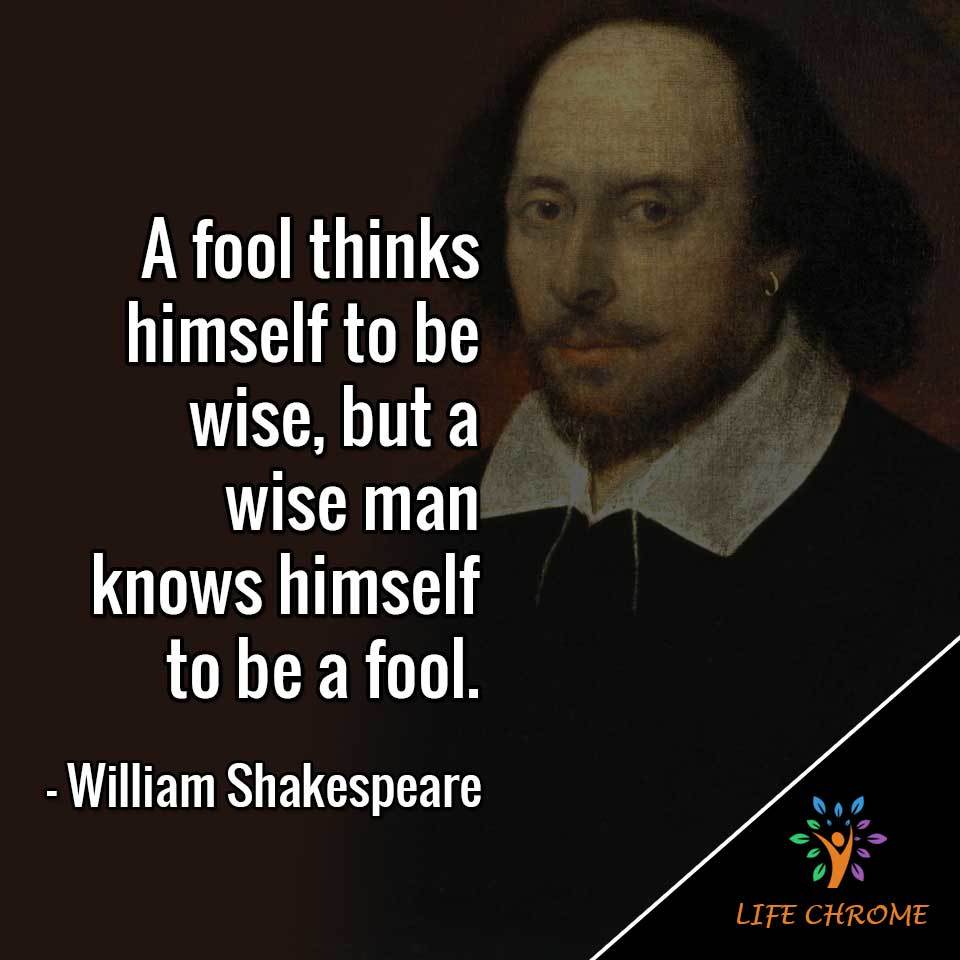
What a piece of work is man, How noble in reason, how infinite in faculty, In form and moving how express and admirable, In action how like an Angel, In apprehension how like a god, The beauty of the world, The paragon of animals. And yet to me, what is this quintessence of dust? Man delights not me; no, nor Woman neither; Hamlet (1599-1602), Act II, Scene 2,)
Anyway, the Women rock, no doubt! here I present a nice article about this magic woman 😊 I hope you’d enjoy 💕🙏💖🙏
Two of the most trenchant and enduring critics of authoritarianism, Hannah Arendt and Theodor Adorno, were also both German Jews who emigrated to the U.S. to escape the Nazis. The Marxist Adorno saw fascist tendencies everywhere in his new country. Decades before Noam Chomsky coined the concept, he argued that all mass media under advanced capitalism served one particular purpose: manufacturing consent.
Arendt landed on a different part of the political spectrum, drawing her philosophy from Aristotle and St. Augustine. Classical democratic ideals and an ethics of moral responsibility informed her belief in the central importance of shared reality in a functioning civil society—of a press that is free not only to publish what it wishes, but to take responsibility for telling the truth, without which democracy becomes impossible.
A press that disseminates half-truths and propaganda, Arendt argued, is not a feature of liberalism but a sign of authoritarian rule. “Totalitarian rulers organize… mass sentiment,” she told French writer Roger Errera in 1974, “and by organizing it articulate it, and by articulating it make the people somehow love it. They were told before, thou should not kill; and they didn’t kill. Now they are told, thou shalt kill; and although they think it’s very difficult to kill, they do it because it’s now part of the code of behavior.”
This breakdown of moral norms, Arendt argued, can occur “the moment we no longer have a free press.” The problem, however, is more complicated than mass media that spreads lies. Echoing ideas developed in her 1951 study The Origins of Totalitarianism, Arendt explained that “lies, by their very nature, have to be changed, and a lying government has constantly to rewrite its own history. On the receiving end you get not only one lie—a lie which you could go on for the rest of your days—but you get a great number of lies, depending on how the political wind blows.”
Bombarded with contradictory and often incredible claims, people become cynical and give up trying to understand anything. “And a people that no longer can believe anything cannot make up its mind. It is deprived not only of its capacity to act but also of its capacity to think and to judge. And with such a people you can then do what you please.” The statement was anything but theoretical. It’s an empirical observation from much recent 20th century history.
Arendt’s thought developed in relation to totalitarian regimes that actively censored, controlled, and micromanaged the press to achieve specific ends. She does not address the current situation in which we find ourselves—though Adorno certainly did: a press controlled not directly by the government but by an increasingly few, and increasingly monolithic and powerful, number of corporations, all with vested interests in policy direction that preserves and expands their influence.
The examples of undue influence multiply. One might consider the recently approved Gannett-Gatehouse merger, which brought together two of the biggest news publishers in the country and may “speed the demise of local news,” as Michael Posner writes at Forbes, thereby further opening the doors for rumor, speculation, and targeted disinformation. But in such a condition, we are not powerless as individuals, Arendt argued, even if the preconditions for a democratic society are undermined.
Though the facts may be confused or obscured, we retain the capacity for moral judgment, for assessing deeper truths about the character of those in power. “In acting and speaking,” she wrote in 1975’s The Human Condition, “men show who they are, reveal actively their unique personal identities…. This disclosure of ‘who’ in contradistinction to ‘what’ somebody is—his qualities, gifts, talents, and shortcomings, which he may display or hide—is implicit in everything somebody says and does.”
Even if democratic institutions let the free press fail, Arendt argued, we each bear a personal responsibility under authoritarian rule to judge and to act—or to refuse—in an ethics predicated on what she called, after Socrates, the “silent dialogue between me and myself.”
Read Arendt’s full passage on the free press and truth below:
The moment we no longer have a free press, anything can happen. What makes it possible for a totalitarian or any other dictatorship to rule is that people are not informed; how can you have an opinion if you are not informed? If everybody always lies to you, the consequence is not that you believe the lies, but rather that nobody believes anything any longer. This is because lies, by their very nature, have to be changed, and a lying government has constantly to rewrite its own history. On the receiving end you get not only one lie—a lie which you could go on for the rest of your days—but you get a great number of lies, depending on how the political wind blows. And a people that no longer can believe anything cannot make up its mind. It is deprived not only of its capacity to act but also of its capacity to think and to judge. And with such a people you can then do what you please.
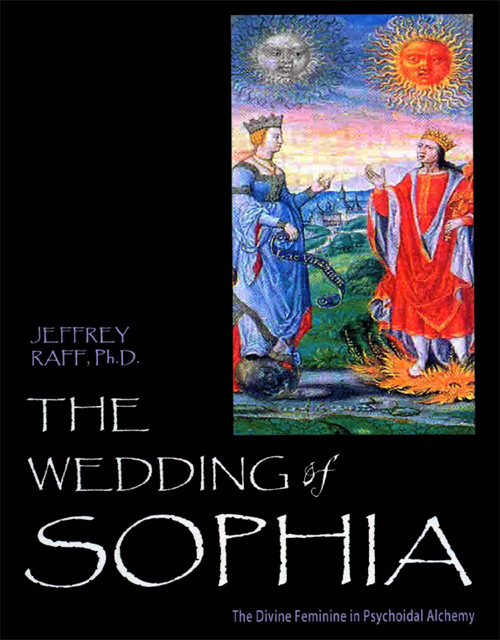
Here please allow me to introduce a fascinating book by a great Psychologist and Jungian analyst Jeffrey Raff PhD; Let’s have a look at the feminine aspect of the Divine 🤗🙏💖
Jeffrey Raff
Author of the acclaimed Jung and the Alchemical Imagination, Jeffrey Raff continues his teachings in psychoidal alchemy with an in-depth look at the feminine aspect of the divine. Sophia is, in the esoteric teachings, the embodiment of Wisdom, the matrix from which God arose, and God’s heavenly consort and mirror. But, as Raff explains, she suffered a fall from this exalted state, corresponding to the obscuration of the feminine archetype in the patriarchal world. Without Sophia, God is not whole. It is our task to work with imagination to reunite Sophia and God. Raff explains the difference between fantasy, a product of the ego, and imagination, which comes from the soul. More importantly, he brings Sophia to life through a vivid analysis of an 800-year-old text,* The Aurora Consurgens*, as well as his personal experience with Sophia and active imagination. This process empowers us to become whole and realize our innate drive to unite with the divine. via Introduction: The Wedding of Sophia The Divine Feminine in Psychoidal Alchemy by Jeffrey Raff series Jung on the Hudson Books
And with my best thanks to the main admin; Craig Nelson 🙏💖
“I love them that love me”, Sophia, goddess of the collective unconscious, goddess of the lumen naturae; (‘For starting is a commitment & broken commitments are never healthy’): “Here it is Sophia speaking as she promises to love any who come to her in love, and the ‘proof of love is the display of the work.’ Those who love do the work. Those who do the work do so for love. Anyone who has even imagined working with [inner] figures or penetrating the mysteries of union with such figures knows that success requires not only grace, but also the greatest of efforts. Thomas also quotes King Alphonsus, who said, ‘This is a true friend who deserteth thee not when all the world faileth thee.’ Such is the devotion required of us when we do [inner] alchemy, for as I have shown, there are few in our world who take spirit seriously, and even fewer who love and work with figures of the [inner world]. As Sophia earlier complained, all desert her and the wisdom of the world denies the existence of Wisdom itself, so that it takes a brave soul to buck collective opinion and do this work. Moreover, it takes sacrifice, for not only does the work require time and energy, it demands that the alchemist forbear control and learn to let the visionary world direct his or her every step. The alchemist does not control the process, nor can he or she direct it to his or her own goals. Instead, God and Sophia have their own agenda: union with each other, and nothing less than that suffices. If necessary, the alchemist must give up his or her own plans and ambitions to seek the goal of the coniunctio: ‘All that a man hath will he give for his soul, that is for this stone.’ This is not a work for the weak-willed or the faint of heart; we must be willing to give up everything for the sake of the Stone or we shall most likely fail. It is very popular these days to emphasize the need for grace, and it is true that we need the help of the inner.. entities to perform this work. Yet, as Sophia said, those that love her, she loves, and love is in the work. We must win the love of Sophia and of the [inner partner] by doing the necessary work, for though they both love from the beginning, they neither can nor will give themselves away cheaply. In my years of teaching, I have witnessed many students drop out and give up the work when the going got tough. Somehow they, and many like them, assume that good intention is the same as accomplishment, or that the spirits owe them something. The work is hard, the rewards are great, but only love supplies the courage and the dedication to see the work through the difficult times. As Thomas concludes, ‘For he who soweth sparingly shall also reap sparingly; and he who is not a partaker of the sufferings shall not be of the consolation.’” Jeffery Raff, Wedding of Sophia (I replaced with ‘inner’ Raff’s use of the term ‘psychoidal’ or ‘ally’, only because those terms are an education unto themselves. By those terms Raff refers to the highest levels achieved in Alchemy, that of the relationship with the ‘outer Stone’, one that truly exists, but outside the psyche, a quasi spiritual/physical entity similar to an angel or Carlos Castaneda’s “Don Juan”.)
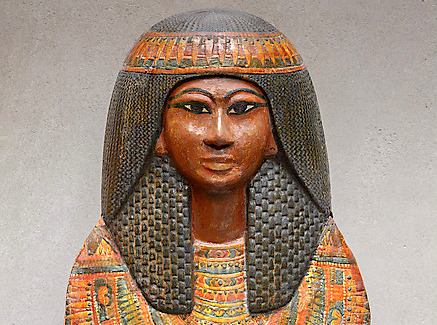
The mummy mask of Khonsu, son of Sennedjem from the Tomb of Sennedjem – TT1 – Deir el-Medina discovery in 1886 Exhibited at the Metropolitan Museum of Art New York – Accession Number: 86.1.4
I’d call it; The Origin! When I look at this Mask, I find how real is it just to show the expression of an ancient face.
This mummy mask is made of painted wood and cardboard. It represents a character with fine features, noble appearance. A magnificent wig “on the back”, textured in relief, advantageously frames her face. The finely braided hair covers most of the forehead and leaves in a gradient towards the shoulders. Two thick strands braided in a more “loose” way are brought along the neck and fall on each side in a completely balanced way. Only the lower part of the pierced ear lobe remains visible. The hairstyle is adorned with a large floral band, which blossoms in warm brown tones drawing towards red.
The face, treated in this same colour is perfectly symmetrical and rather round. The eyebrows, very long and arched, are painted black. The almond-shaped eyes are stretched, and the iris, round and black, stands out against the white of the luminous eye. The line of the eye-shadow extends to the hair. The nose, well-drawn, is of good proportions. The mouth with hemmed lips is closed.
The mummy mask of Khonsu, son of Sennedjem from the Tomb of Sennedjem – TT1 – Deir el-Medina discovery in 1886 Exhibited at the Metropolitan Museum of Art New York – Accession Number: 86.1.4
The neck is decorated with a magnificent ousekh (Usekh or Wesekh) necklace. It alternates a substantial number of rows – more or less wide – of blue, green, red pearls, all in a sumptuous and dazzling “roundness” of tones… It should be noted that during the Ramesside period, “the frame cardboard masks have changed: the rear panel has disappeared and the masks consist of a shell protecting only the head and a rounded and extended front panel “.
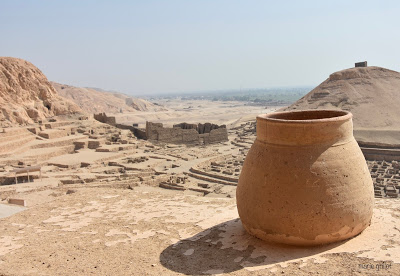
This 48 cm high mask, dating from the 19th dynasty, comes from the tomb of Sennedjem in Deir el-Medineh. This village, which in ancient times was called “Set Maât her imenty Ouaset” (the “Place of Maât (Truth) in the West of Thebes”) was founded at the beginning of the 18th dynasty under the reign of Thutmosis Iᵉʳ. Surrounded by high walls, extended and enlarged several times, notably under the reigns of Thutmosis III and the first Ramessides, it housed the community of artisans who worked on the excavation and decoration of the eternity homes of the Valley of the Kings and the Valley of the Queens. For almost 500 years, “between 40 to 120 households” lived there in stone houses covered with a palm leaf roof, also have places of worship and their own necropolis.
The tomb of Sennedjem – which will be referenced TT1 – was discovered in January 1886 by ‘gournawis’.: Indeed, “in 1886, Salam Abu Duhi, a villager from Gournah, was granted a concession in an area of Deir el-Medineh close to his home. After only a few days of excavations, Salam and three of his friends made a discovery spectacular: at the bottom of a still unexplored burial well, they found a wooden door whose ancient seals were intact. Salam immediately informed Maspero, who happened to be in Luxor for his annual inspection visit. ” (Hidden treasures of Egypt, Zahi Hawass (!) ).
Gaston Maspero’s correspondence with his wife Louise (Gaston Maspero – Letters from Egypt) gives us the extraordinary “live” adventure. So the great Egyptologist wrote to her on February 2, 1886: “They come to get me to go to the mountains: a tomb that we have been working on for eight days has finally been opened. It is a virgin!
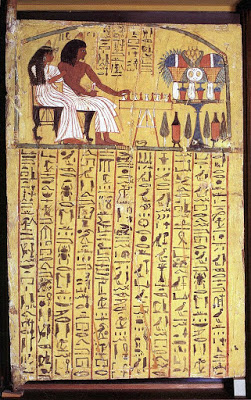
Door of the tomb of Sennedjem – TT1 Deir el-Medina Cairo Egyptian Museum – I 27303
It is a tomb of the XXth dynasty: the wooden door is still in place, and there have already been eleven mummies. “He continued his story on February 3:” The vault is approximately 5 m long by 3 wide. It is vaulted, with a very low vault and painted in the most vivid colours; unfortunately, the paintings and texts are only extracted from the book of the dead. It was filled to the top with coffins and objects: eight adult mummies, two children’s mummies … The mummies are superb, of a beautiful red varnish with very neat representations. ”
Finally, this “family” tomb will turn out to contain twenty bodies: “Nine of them had very beautiful anthropoid coffins, single or double, finely painted and varnished. These are Sennedjem, his wife Iyneferti, his son Khonsou and his wife Tamaket, his other children Parahotep, Taashsen, Ramose, Isis and finally, a little girl named Hathor. Rich funerary furniture accompanied them. ”
Eduard Toda, with objects from the tomb of Sennedjem, on the boat “Bulak” en route to Cairo (1886) Toda Fund Library Museum Víctor Balaguer (Vilanova)
Eduard Toda y Güell, consul general of Spain in Egypt from 1884 to 1886, a friend of Maspero’s, was given the important task of clearing the grave. In the “Bulletin of the French Society of Egyptology” – 1988, Josep Padro reports: “In three days and with seven workers, (Toda) completely searched the tomb and carried out the transfer of its contents onboard the ‘Boulaq’, the vessel of the Antiquities service. Once the transfer was completed, (he) drew up an inventory of the funeral furniture on the boat, with the objects collected and the mummies before his eyes. Toda also took 15 photos himself in the tomb, with the technical assistance of Insinger, which are engraved after the plates which illustrate his memoir; and he copied and translated the hieroglyphic texts, with the help of (Urbain)Bouriant. ”
As for Gaston Maspero, he made a point of clarifying: “It goes without saying that we bought the fellahs half of their money: it cost us 46 guineas. Once we have chosen all that is good for the museum, the sale of mummies and superfluous objects will bring us at least 60 guineas, maybe eighty, who will go to the excavations of Luxor and the Sphinx. It will have been a good deal in all ways, good from the point of view scientific, since it gave us monuments of which we had no specimen, good from the financial point of view, since not only the objects will end up costing us nothing, but, that we will have earned enough money to practice new excavations. ”
This is how objects from the tomb which, in a way, “duplicated” were offered for sale. The Metropolitan Museum of Art, which then constituted its collection of Egyptian antiquities, showed great interest.
So, among the artefacts that went to New York, was this mask, this Khonsu. It has since been exposed there under the reference 86.1.4.
The eternity home of Sennedjem is one of those open to the public in Deir el-Medineh. It is particularly renowned for the beauty of the colourful and particularly well-preserved scenes that adorn its walls.
I wish you all a happy, healthy & peaceful new year at first. 🤗💖
I know this title above is from one of the greatest novels in history by Jane Austen. But I’ve dared to use it here because it is a weak point in human history.
I humbly confess that I began this 2020 with some negative feeling, though, I must say it has nothing to do with the Sylvester and celebration etc. It went all in a wonderfully calm way; I have just no new idea about the human!
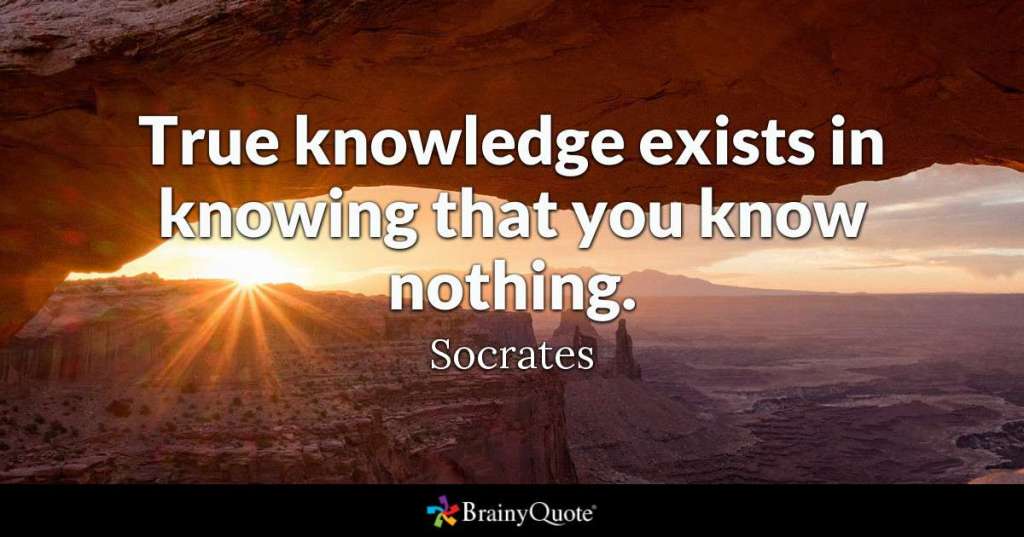
I have always been a humble man and I know that I don’t know. But I think that it is the most important issue; we must be honest to our own heart and with this, we can acknowledge more and more the existence of the truth.
But as I look forward to the new year I can only see another year with all the same people drowned in their same stupidity and foolishness as the years before. Sorry for that, I never want to spoil your mood in this very beginning of the brand new year; I just wanted to open my heart.
And of course, to share this brilliant article (I’m happy there are some to write about this) with you my adorable friends.
Waiting and hoping for a resolution.💖🙏🤗🙏💖
Your visions will become clear only when you can look into your own heart. Who looks outside, dreams; who looks inside, awakes. – C.G. Jung
TOPSHOT – An Iranian woman raises her fist amid the smoke of tear gas at the University of Tehran during a protest driven by anger over economic problems, in the capital Tehran on December 30, 2017.
Students protested in a third day of demonstrations sparked by anger over Iran’s economic problems, videos on social media showed, but were outnumbered by counter-demonstrators. / AFP PHOTO / STR (Photo credit should read STR/AFP/Getty Images)
My dear friends, as I use and abuse 😉 my free time on Saturdays, trying to do my lovely work; writing, to tell you the story of a permanent fight for freedom which has been going on in certain countries since eternal date.
Actually a wonderful genius friend of mine (as I’m proud to mention it) yassyhttps://yassy66.wordpress.com/ brought me to this idea, or better to say she had thrown me in my past when I was in Iran and working as Journalist and an actor in theaters.
That is the question; where are the flowers gone?
It is surely not a usual knowing in the western countries in which, the human rights have been “at least” written and mentioned in their constitution, having any full comprehensive idea about what really happened to the people in the countries with a dictatorship regimes, and especially the thinker ones, the chosen ones?!
I can still remember about the Shah’s regime how my father was under observation because of his favour for Mosaddegh (the Prime minster in the ’50s who stood against the young Shah’s favorite’s position. https://en.wikipedia.org/wiki/Mohammad_Mosaddegh
And also about the so-called Tehran Spring in 1979 during the revolution. In that time my brother and me, we were working with the newspapers, he was writing and I was photographing.
It was a wonderful time in my life, you might not believe it; full of enthusiasm and excitement and creations.
In this time, thanks to the (at least) short time of freedom, we have known many artists in different categories, like movies. One of them was Costa Gavras, https://en.wikipedia.org/wiki/Costa-Gavras
A wonderful director and a great creator, and when we have watched his works, we have just thought; look! the bloody regime showed already the situation on our streets in a movie. It’s because, the Gavras’s movies based on the countries which were under pressure, as we felt in Iran exactly the same. But they never understood this and we have enjoyed it at least in the way of having sympathy.
Here I’d like to share with you my friends, two of his masterworks, of course with the music work of another master; Mikis Theodorakis https://en.wikipedia.org/wiki/Mikis_Theodorakis which goes under the skin I bet!
The first one which we had seen in the movie was the film; Z https://en.wikipedia.org/wiki/Z_(1969_film) and it describes exactly the situation in Iran on the very same date. We were the freedom seekers and the opposites were the regime’s hiring legionnaires.
I tell you; it will never be the same when, you have once experienced it.
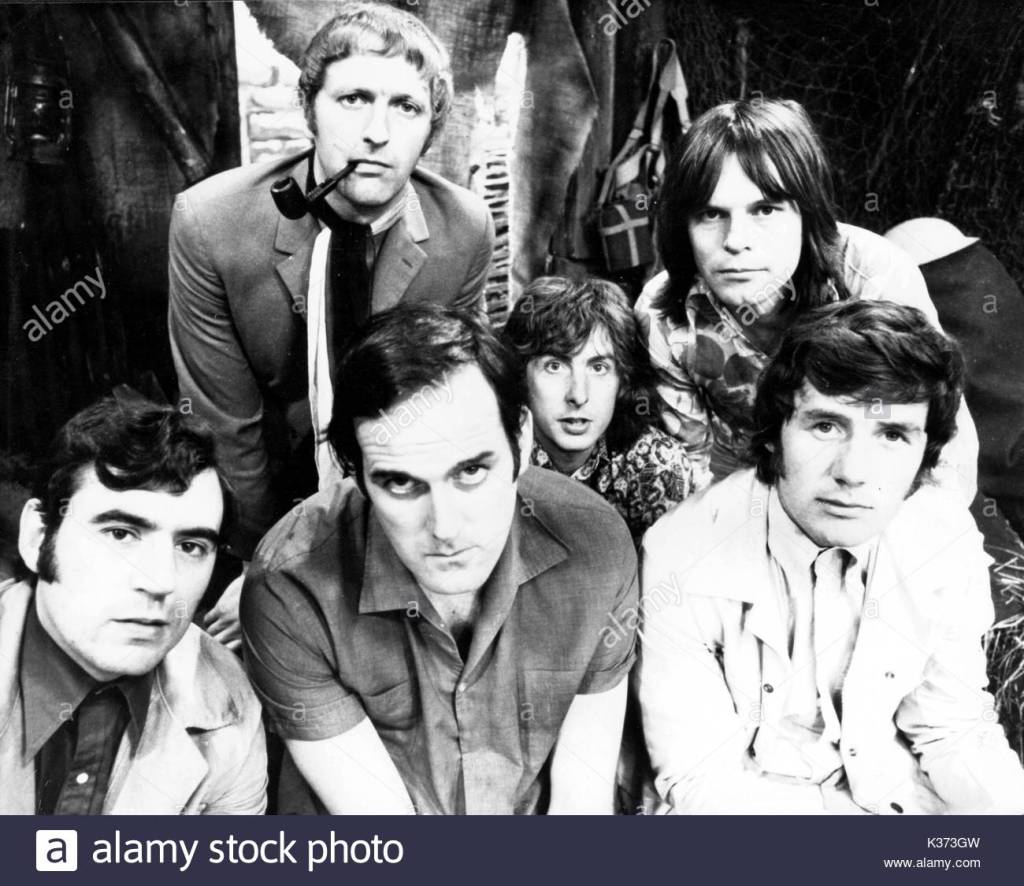
Download this stock image: MONTY PYTHON Terry Jones, Graham Chapman, John Cleese, Eric Idle, Terry Gilliam and Michael Palin – K373GW from Alamy’s library of millions of high resolution stock… alamy.com
There’s hardly any doubt that these masters of satire are known for many. Their works were not only comedies for making the people laugh, but they have also lessons in their humourful satires which we’d learn a lot by them. like this scene;
I love them! And I love how they take their memorial ceremonies on each lost friends, like Graham Chapman who left the group and this Earth after singing this song; Christmas in Heaven in the movie; Meaning of Life. (in heaven every day is Christmas) 🙏💖
The British comedian Graham Chapman delighted in offending people. As a writer and actor with the legendary Monty Python troupe, he pushed against the boundaries of propriety and good taste. When his writing partner John Cleese proposed doing a sketch on a disgruntled man returning a defective toaster to a shop, Chapman thought: Broken toaster? Why not a dead parrot? And in one particularly outrageous sketch written by Chapman and Cleese in 1970, Chapman plays an undertaker and Cleese plays a customer who has just rung a bell at the front desk:
“What can I do for you, squire?” says Chapman.
“Um, well, I wonder if you can help me,” says Cleese. “You see, my mother has just died.”
“Ah, well, we can ‘elp you. We deal with stiffs,” says Chapman. “There are three things we can do with your mother. We can burn her, bury her, or dump her.”
“Dump her?”
“Dump her in the Thames.”
“What?”
“Oh, did you like her?”
“Yes!”
“Oh well, we won’t dump her, then,” says Chapman. “Well, what do you think? We can bury her or burn her.”
“Which would you recommend?”
“Well, they’re both nasty.”
From there, Chapman goes on to explain in the most graphic detail the unpleasant aspects of either choice before offering another option: cannibalism. At that point (in keeping with the script) outraged members of the studio audience rush onto the stage and put a stop to the sketch.
Chapman and Cleese had been close friends since their student days at Cambridge University, and when Chapman died of cancer at the age of 48 on October 4, 1989, Cleese was at his bedside. Out of respect for Chapman’s family, the members of Monty Python decided to stay away from his private funeral and avoid a media circus. Instead, they gathered for a memorial service on October 6, 1989 in the Great Hall at St. Bartholomew’s Hospital in London. When Cleese delivered his eulogy for Chapman, he recalled his friend’s irreverence: “Anything for him, but mindless good taste.” So Cleese did his best to make his old friend proud. His off-color but heartfelt eulogy that evening has become a part of Monty Python lore, and you can watch it above. To see a longer clip, with moving words from Michael Palin and a sing-along of “Always Look on the Bright Side of Life” led by Eric Idle, watch below:
“The serpent is the age-old representative of the lower worlds, of the belly with its contents and the intestines.” – Carl Jung
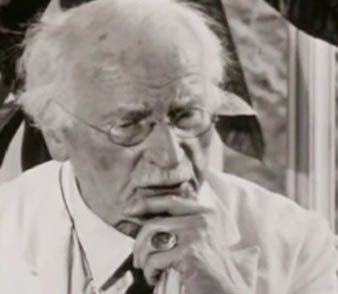
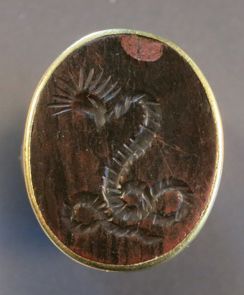
This picture below is the personal ring of the Great Modern Swiss Gnostic, Carl Jung. The image on his ring is of the deity known as Chnoubis.
Jung himself describes the ring in C.G. Jung Speaking: Interviews and Encounters. W.McGuire and R.F.C. Hull page 468:
“It is Egyptian. Here the serpent is carved, which symbolizes Christ. Above it, the face of a woman; below the number 8, which is the symbol of the Infinite, of the Labyrinth, and the Road to the Unconscious. I have changed one or two things on the ring so that the symbol will be Christian. All these symbols are absolutely alive within me, and each one of them creates a reaction within my soul.”
A close up of his ring can be found below.
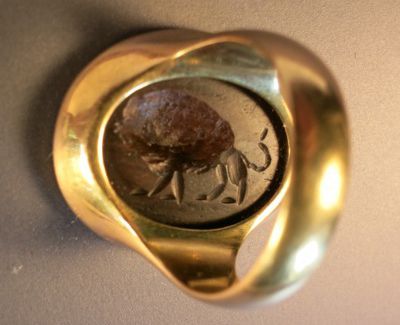
Here is a close up image of the front and back of Jung’s ring below. (Int-Private Coll._Ex-C. G. Jung_s.n.)
This image on the back appears to be of a dog.
Jung had commented on his ring in C.G. Jung, Visions;
“I have a Gnostic ring which is over two thousand years old-a symbol on the inside indicates that it is pre-Christian-and the snake engraved upon it is not hooded, it is more like the coluber natrix, the ordinary water snake which is found here as well as in more southern countries. In inland meadows it is grey, but near the water, it is a very elegant long black snake with yellow moon spots behind the ears, occasionally reaching a length of one meter fifty and quite thick.”
Karl Kerenyi said Jung, who wore the ring almost constantly for 35 years, wore it because he regarded himself as the pope of the gnostics. Barbara Hannah said he wore it to remind himself of personality number two.
“The serpent is an adversary and a symbol of enmity, but also a wise bridge that connects right and left through longing, much needed by our life.” (247)
“Why did I behave as if that serpent were my soul? Only, it seems, because my soul was a serpent…. Serpents are wise, and I wanted my serpent soul to communicate her wisdom to me.” (318) (This comment comes after a long dialogue in active imagination with a great iridescent snake coiled atop a red rock.)
“I have united with the serpent of the beyond. I have accepted everything beyond into myself.” (322)
“If I had not become like the serpent, the devil, the quintessence of everything serpentlike, would have held this bit of power over me. This would have given the devil a grip and he would have forced me to make a pact with him just as he also cunningly deceived Faust. But I forestalled him by uniting myself with the serpent, just as a man unites with a woman.” (322)
“The daimon of sexuality approaches our soul as a serpent.” (353)
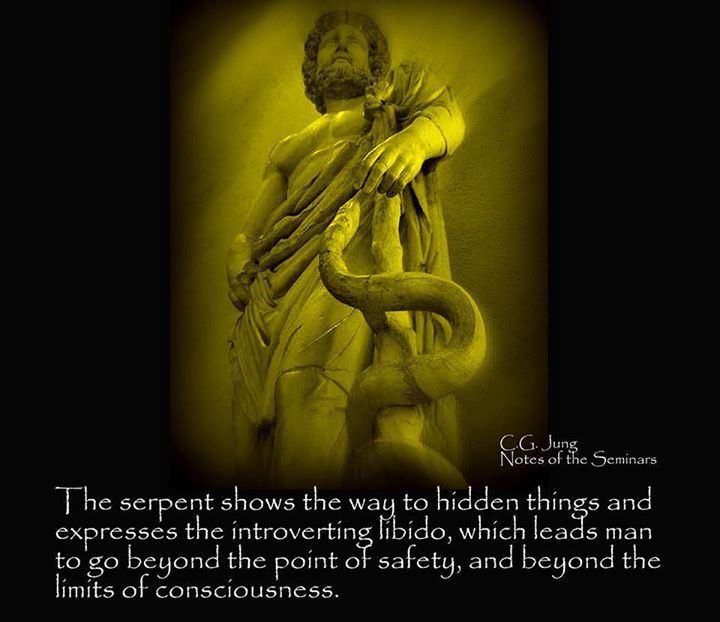
Perhaps the commonest dream symbol of transcendence is the snake, as represented by the therapeutic symbol of the Roman god of medicine Aesclepius, which has survived to modern times as a sign of the medical profession. This was originally a nonpoisonous tree snake; as we see it, coiled around the staff of the healing god, it seems to embody a kind of mediation between earth and heaven. — Carl Jung, Man and His Symbols, page 153
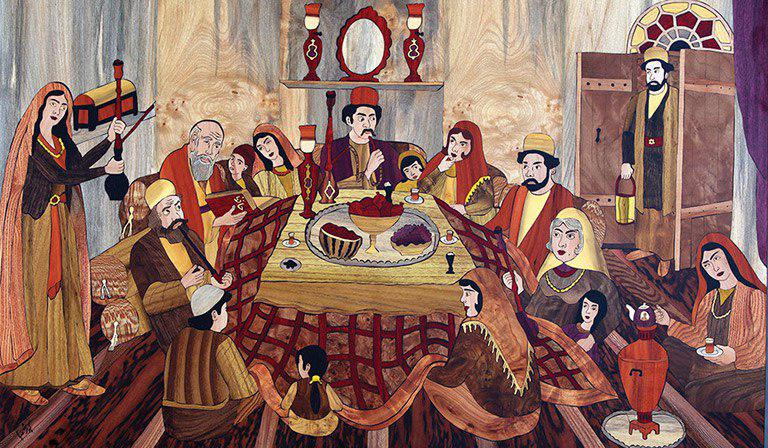
Yes, tonight is another Yalda-Night, the longest night in the year. The Persians celebrate this night as their culture; ( A Person’s culture and nothing to do with the Arabic Islam!) that is an old Persian ceremony.
It has ever always been a family’s ceremony in a completely form; from grandfather-mother to the youngest being.
Anyhow the oldest one of the family; mostly the grand mom, sits at the head of the community (Family) and as “she” scarf the skin of the nuts and pomegranates ( a hard work!) she began to narrate or recount the magnificent fairy tails, and it was always the best of my memories.
The main Mather is not the nuts and not the warm place in which we, all the family, gather together to get warm, it is to spend the longest night together, with having our imaginations circulate and spread. The Fairy-tails are actually real?; “let’s put the question; what is really real!!”















 lampmagician

You must be logged in to post a comment.