Democracy is one of the oldest concepts of a word which still can’t be understood. Honestly, it is indeed a very complicated issue.
If you’ve guessed, you’re right! My motivation to write this post is what happened on Wednesday in the US Capitol in Washington DC. I couldn’t really believe what I was watching on this very evening on the TV screen, first, I thought that it was a report from one of those so-called “the third world counties” in which it happens after an election, and the oppositions don’t want to accept the results and want to storm the Parlement. The story was the same but, it was happening in a country that I’d never expect: The United States of America, one of the oldest countries in the matter of democracy and freedom.
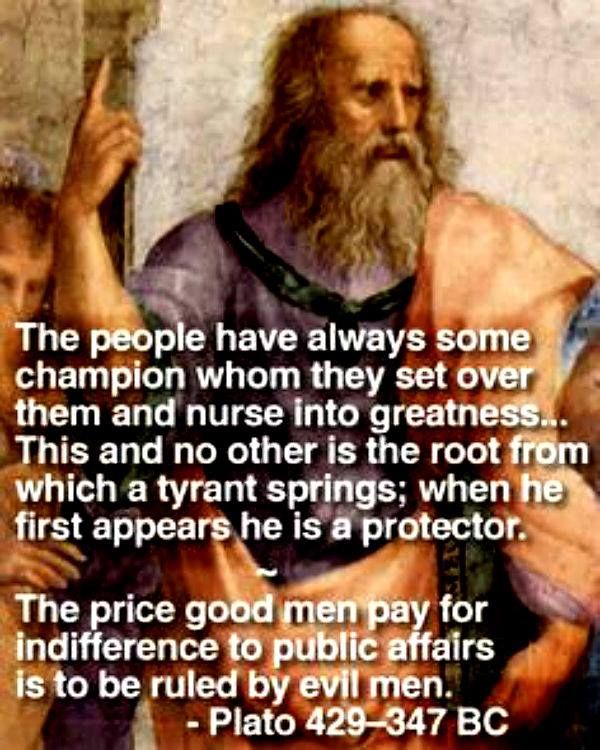
“Democracy is a charming form of government, full of variety and disorder, and dispensing a sort of equality to equals and unequal alike.” Plato
It broke my heart when I saw these all scenes. It shows how fragile we are, I mean we, who try to do the right things; begins with love and not hate, with respect and without prejudge.
Here Dr C. G. Jung described the heart of the matter;
Although, it is not something new, as we can remember through history. In the years 1933-38, The NSDAP had begun with terror to set its violent on power.
And also, I can tell you a lot of such terrors, which in Iran, whenever the call for freedom became louder, there were cudgels to make all silent. We don’t have to forget the terrors by the Islamists, especially in the 21st century. It began with the catastrophic World Trade Centre it was the abuse of western democracy. But, as I am always convinced, it is not all based on one person (Hitler, Stalin, Khamenei, Erdogan, Putin, Viktor Orban, Jarosław Kaczyński, a lot of potentates from African countries, or even Donald Trump, as he wished to be). They are all an idol figure for helpless and ignorant folks, but, as Hannah Arendt has announced after the Eichmann Process. (I have written an article thereabout https://lampmagician.com/2020/10/10/hanna-arendt-a-solitary-genius/ it is because of many other reasons which we might call it all together “The ignorant Mass”. They are all made by us! I think that it is all about education. It helps us to know our environment and subsequently our inner soul, that is a matter of individual.
In fact, Democracy is difficult to progress, and it needs a lot of knowledge to comprehend. Here are three brilliant quotes by Plato:
“Mankind will never see an end of trouble until lovers of wisdom come to hold political power, or the holders of power become lovers of wisdom”
“Dictatorship naturally arises out of democracy, and the most aggravated form of tyranny and slavery out of the most extreme liberty.”
“Beauty of style and harmony and grace and good rhythm depend on simplicity.”
Anyway, we are, without doubt, fragile until, we begin to know and accept our inner soul: the dark side and the bright side. We can afford it for sure. Love wins at the end. 🙏💖💖🙏
On and on the rain will fall Like tears from a star like tears from a star On and on the rain will say How fragile we are how fragile we are
Fascinating Egypt. There is again, an article from this magical and still mysterious country. With heartily thanks to Marie Grillot http://Marie Grillot
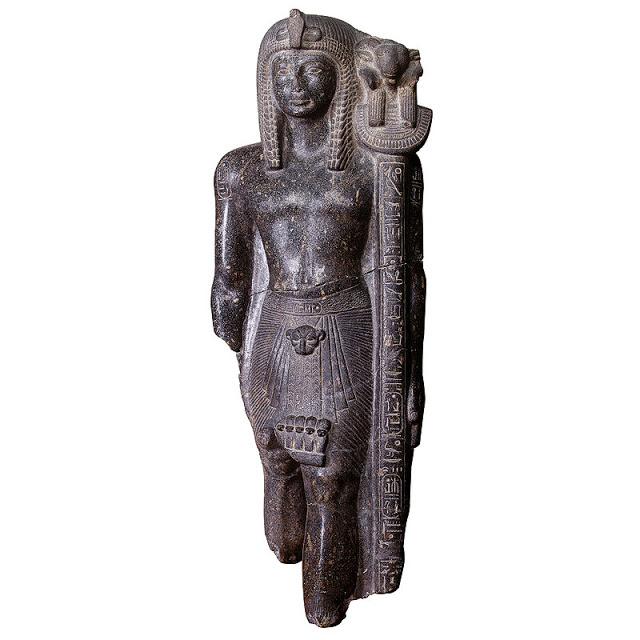
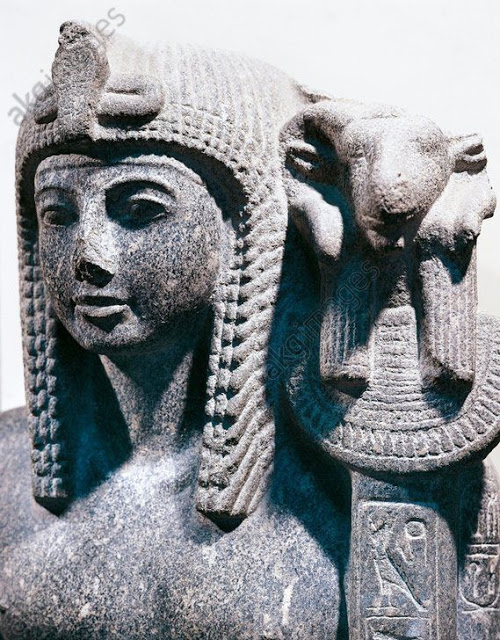
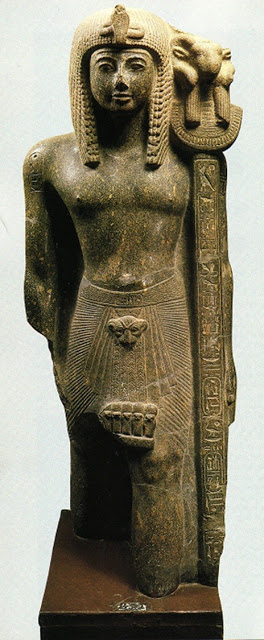
Statue of Ramses III in Amun sign holder – grey granite New Kingdom – XXth Dynasty – Reign of Ramses III Discovered by Georges Legrain, February 10, 1905, in the Hiding place of Karnak K 525 – Cairo Museum: JE 38682 – CG 42150
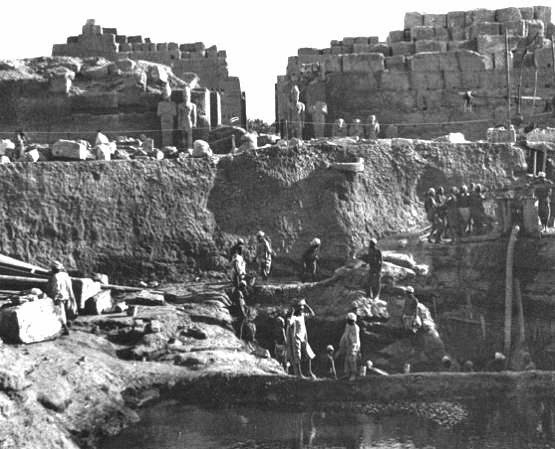
In 1903, Gaston Maspero, director of the Antiquities Service, gave Georges Legrain, at the “Direction des travaux de Karnak”, the instruction to: “excavate a little-known part of the temple, preferably around the sacred lake”. After reflection, he chooses the courtyard of the seventh pylon… Luck or chance? Still, after the discovery of many blocks dating from the Middle and the New Kingdom, by lifting a stele of Seti I, he made, on December 26, an incredible discovery …
This is a pit, 10 to 15 meters deep, full of water, in a way a “deposit” in which were “stored” statues: “voluntarily buried and covered in ancient times”. Their extraction will prove to be very difficult, and very long too since it will continue for no less than five seasons (1903-1907). Gaston Maspero specifies that: “nearly 800 statues and 17,000 bronzes” will be extracted!
On December 26, 1903, Georges Legrain, Director of Works at Karnak discovered, in the courtyard of the seventh pylon, “Karnak’s hiding place” From this pit will be extracted “nearly 800 statues and 17000 bronzes” specifies Gaston Maspero
The Egyptological contribution of this “Hiding place of Karnak” will be considered and truly well documented, thanks to the notes, sketches, surveys and photos of Georges Legrain.
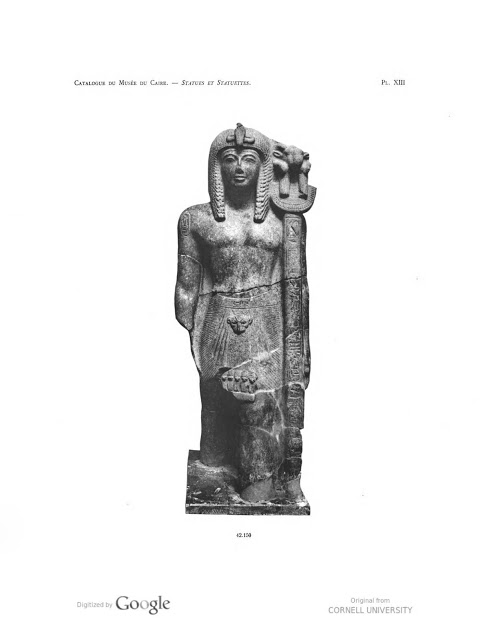
It was on February 10, 1905, that he noted the updating of this statue-bearer of Ramses III “found in numerous adjusted pieces”. The breaks are particularly visible at the waist and under the knees. And, what is even more regrettable is that the lower legs and feet were not found …
1.39 m high, it is carved in the round, with mastery craftsmanship, in a “speckled” grey granite. The sovereign is represented in the attitude of walking, left leg slightly forward. Despite the mutilations, and the shortages, the nobility is there and the port is “royal”!
Statue of Ramses III in Amun sign holder – grey granite New Kingdom – XXth Dynasty – Reign of Ramses III Discovered by Georges Legrain, February 10, 1905, in the Hiding place of Karnak K 525 – Cairo Museum: JE 38682 – CG 42150
The hairstyle is a marvel in its realization, with its locks braided finely on the top of the head, then more loosely around the edges. “The head is covered with a neck cover (of a Taquyah) over which is placed a large wig, with many locks, adorned with a uraeus. The anterior and lower ends of this hairstyle fall to the pecs “specifies the discoverer in” Statues and statuettes of kings and individuals “.
The face is perfectly symmetrical and hardly suffers from the slight mutilation of the nose. The almond-shaped eyes are topped by arched eyebrows. The palate, rather small, does not lack charm. In their “Official Catalog Egyptian Museum of Cairo”, Mohamed Saleh and Hourig Sourouzian deliver this beautiful analysis: “The physiognomy is that of a sovereign in the beauty of youth, the face conforms to the final stage of a Ramesside iconography which will henceforth go on degenerating until the fall of the New Kingdom “.
Statue of Ramses III in Amun sign holder – grey graniteNew Kingdom – XXth Dynasty – Reign of Ramses IIIDiscovered by Georges Legrain, February 10, 1905, in the Hiding place of KarnakGeorges Legrain: K 525 – Cairo Museum: JE 38682 – CG 42150
Even if her waist is slim, the body appears powerful with its broad shoulders and marked pecs. Francesco Tiradritti describes the refined Shendyt thus: “The king wears a sophisticated loincloth, quite common in Ramesside statuary. The tight folds of the fabric converge on the front, where they are covered with a kind of tiny, richly decorated apron. in the centre, a little below the belt is a leopard’s head from which descend four bands which evoke the design of a feather. At the bottom, five uraei have been carved with a solar disk on the head.
Statue of Ramses III in Amun sign holder – grey granite
New Kingdom – XXth Dynasty – Reign of Ramses III
Discovered by Georges Legrain, February 10, 1905, in the Hiding place of Karnak
K 525 – Cairo Museum: JE 38682 – CG 42150
Published here in “Statues and statuettes of kings and individuals”, G. Legrain, Henri Hauthier, 1906
He thus continues his description, focusing on the particular side of the statue: “the sign” or “the standard”. “The left arm supports a standard at the top of which has been placed a ram’s head. It is the emblem of the god Amon-Re, as confirmed by the column of hieroglyphics executed on the pole, on which are also indicated four of the five names of the sovereign. Cartouches with the names of Ramses III are also chiselled on the shoulders and the buckle of the belt. On the left side of the statue, in the space between the left leg and the right, there is represented the image of the crown prince, wearing a ceremonial robe and holding a fan in his hand “
Mohamed Saleh and Hourig Sourouzian specify the role of these statues of such a particular type: “The royal statues holding the sign of a deity are related to the festivals that took place in the temples, during which we walked in procession, the boat and the sacred stake of the god. The king, who is supposed to lead the festival in person, perpetuates this moment by statues carrying signs placed at the entrance of the temples “. So Ramses III donated it to the temple of Karnak …
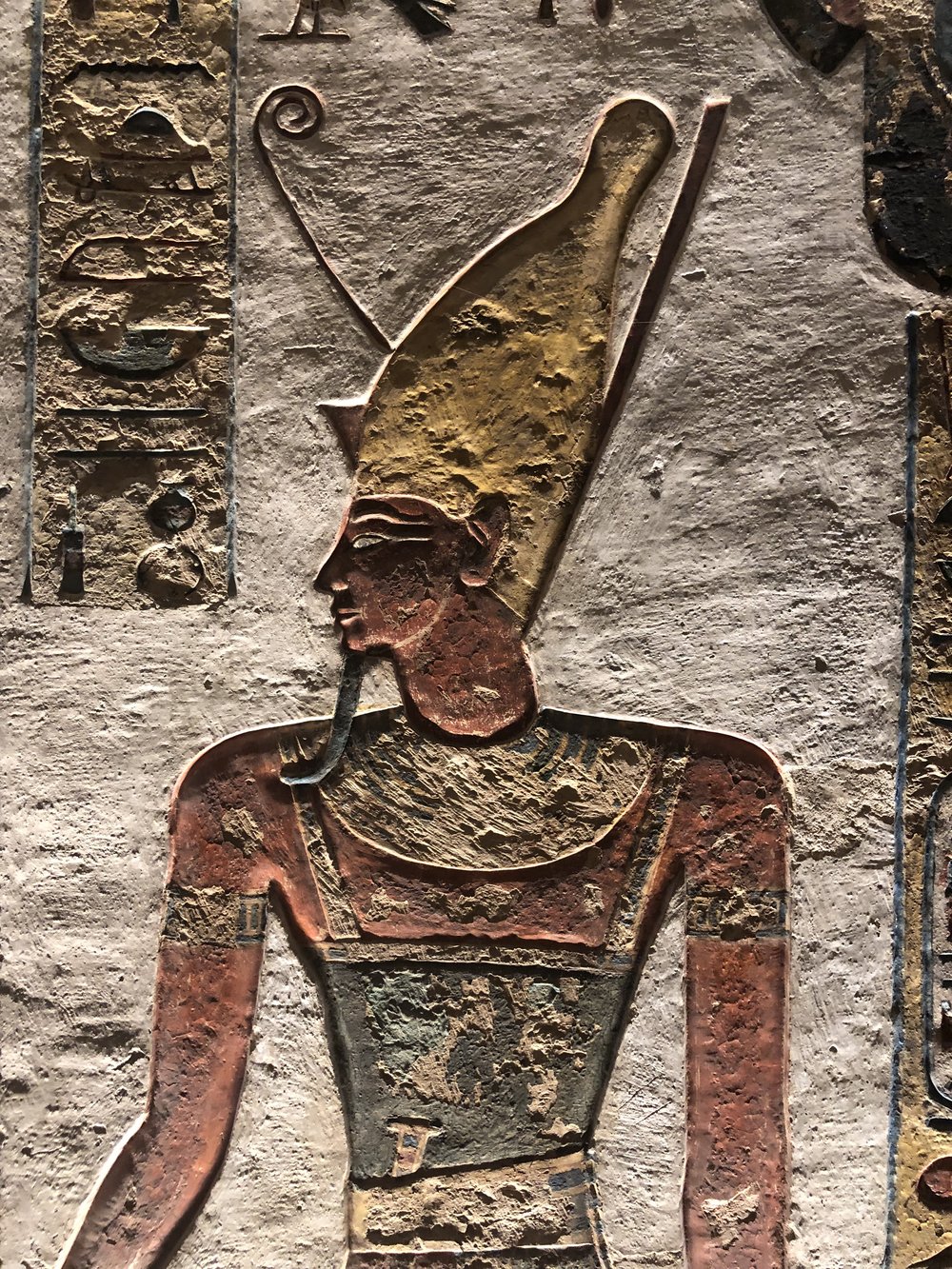
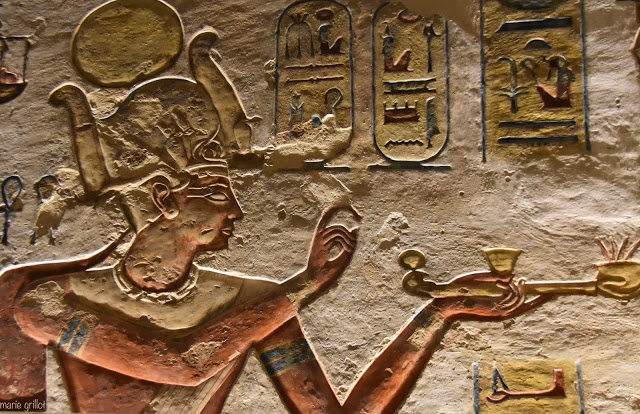
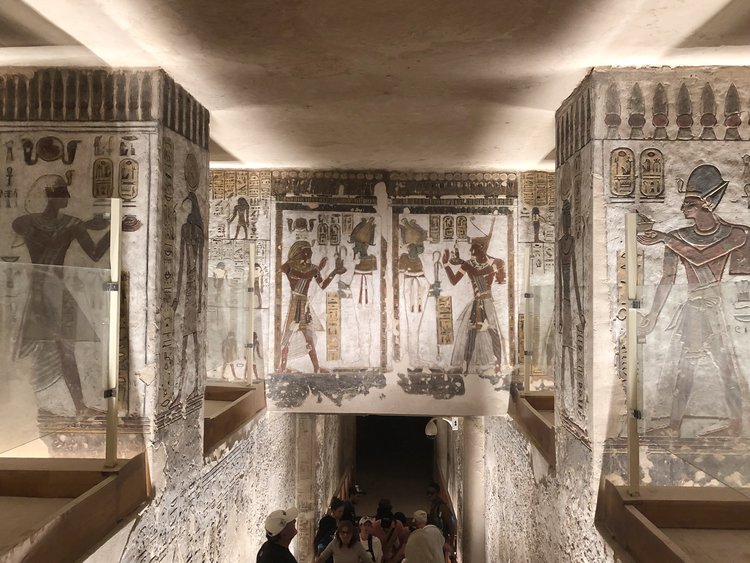
Ramses III represented on the walls of his tomb in the Valley of the Kings – KV 11 – XXth dynasty Tombe de Ramsès III – KV 11XXème dynastie
Succeeding his father Setnakht, founder of the 20th Dynasty, he reigned over the Two Lands from 1186 to 1154 BC, that is to say for more than 31 years. He died, it seems, in his 65th year following a palace conspiracy… His memory remains very present on the west bank of Thebes, by its great temple of millions of years in Medinet Habu, and by its magnificent tomb of the Valley of the Kings (KV 11)…
When it was discovered, this statue was recorded by Georges Legrain K 525 (Cachette de Karnak). Restored and basked, it was recorded in the Journal des Entrées of the Cairo Museum, JE 38682 and in the General Catalog CG 42150.
KV11, one of the largest tombs in Luxor Most tombs have a long, straight corridor — but this one takes a slight turn because it ran into a neighboring burial site!
That is truly a special event when the literature meets (or clashes in? sometimes!) with the movie. Oh yes! I have another movie to present here. 🤓😅🙏💖
This is a novel, written by John Irving. It’s an almost fairytale, full of dreams, sorrow and adventures, and a Bear. It is unconventional, like almost all the good novels!
You know! I think that an artist doesn’t need to be conventional, even must be unconventional.
Here is a short describtion by Wikipedia:
“Based on the novel by John Irving, this unusual comedic drama follows the exploits of the eccentric hotel-operating Berry family. While there are many strange dynamics between the various members of the Berry clan, arguably the most unconventional is the almost incestuous relationship that young, handsome John (Rob Lowe) has with his pretty sister, Franny (Jodie Foster). As the patriarch, Win (Beau Bridges), tries to keep his family together, unexpected events occur, changing them all forever.”
In my opinion, this movie is a masterwork because, as the director Tony Richardson http://Tony Richardson wanted to be faithful to the book, John Irving was complaining, that it might be too faithful! Perhaps he knew his book is very freely and bohemian, therefore, was afraid of a flop. And it became almost a flop but only in the US and not in Europe.
Actually, making movies, based on novels has never been easy, and it comes very rarely that it goes well. I myself was often disappointed when I watched a movie, which made on a novel that I have read before. As we all (the older of course) might remember, Ernest Hemingway couldn’t endure more than a few minutes in the cinema to watch films made from his books and left there angrily. Therefore, I’d prize such filmmakers like Richardson with their faithfulness to books.
This movie was not so successful in the US, as it’s been waiting. It was too unconventional for such a conservative society like of the Americans. Hemingway once wrote: an American, as an individual, is very enjoyable, but in the masses, they are boring or sometimes, even horrible.
Rob Lowe later said “When some studios do get a good movie, a movie that’s different, they kill it. Orion – I hate that studio; I won’t work for them again for all the money in the world – releases Hotel New Hampshire with a cartoon of a bear: people thought they were going to see Garfield the Cat. Then they change it to a bicycle for five: people thought they were going to see the Von Trapp family!!!!
That’s it! I have not a chance to be conversational because of growing up with so many artists all around! This movie is a good one, believe me even with so many stars. You might know that a good-made-of literature movie with stars could be mostly miserable, but this one, despite such wonderful actors, has sealed the goal.
I have found the full movie here if one like to watch it on YouTube. Have a lovely weekend everybody. 🙏💖
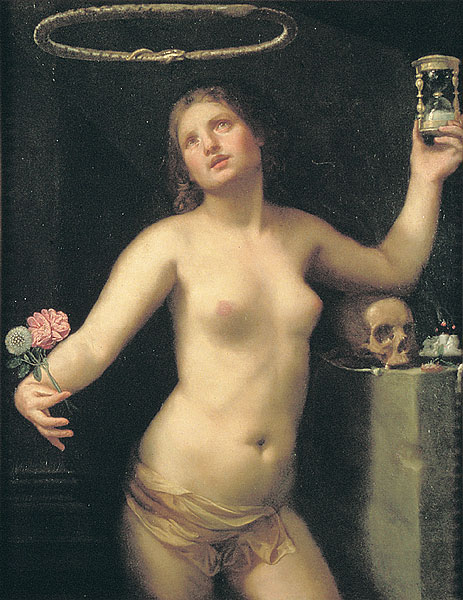
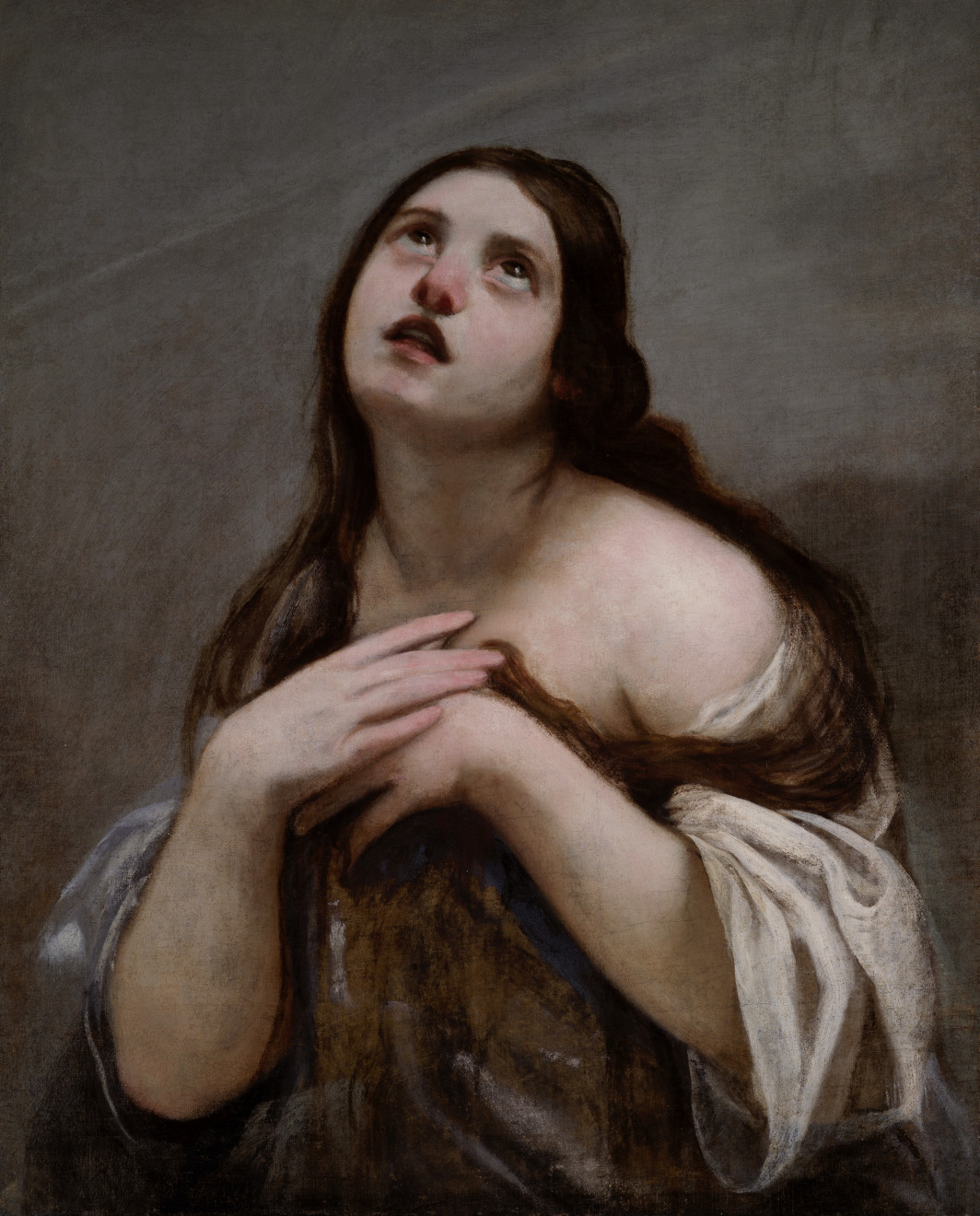
http://17th Century Guido CAGNACCI Allegory of human life [L’Allegoria della vita umana] Unknown Oil on canvas 110 x 86.5 cm [HxW] Private Collection
This Allegory of Human Life is one of the principal paintings in the career of Guido Cagnacci; it was already recognised as such during the 17th century when it was prominently displayed in the Palazzo Magnani in Bologna. When Senator Magnani commissioned Gian Gioseffo Del Sole (1654–1719) to paint a Divine Love as a companion piece, Del Sole’s effort, despite his great talent, faded to insignificance next to Cagnacci’s Allegory (Zanotti 1739, I, p. 306; Pasini 1986, pp. 255–59). Indeed, this buoyant young woman is one of the most realistic and unshamedly erotic nudes ever painted by an Italian old master.What Caravaggio http://Caravaggio had done for the male nude, Cagnacci now accomplished for the female: both painters declined to stylise their naked models. As a twenty-year-old graduate of Guido Reni’s workshop, Cagnacci had gone to Rome at the height of Caravaggio’s revolutionary influence. He was deeply impressed. Not until Courbet in the 19th century do we sense as we do in Cagnacci’s Allegory that the artist’s intention is to transform a portrait of his studio model, posed completely nude, into a work of art.The nude young woman is surrounded by symbols of time’s passage and the decay of all things. The painting would be a straightforward discourse on vanitas — replete with guttering candles, hourglass, flowers, skull, and ruined block of architecture — were it not for the serpent suspended in the air. The snake that devours its own tail to sustain its life is the ouroboros, an ancient symbol of the cyclical regeneration of life out of death. This Allegory of Human Life thus appears to be a unique proposal of an “anti-vanitas”. Instead of the standard lament that “all is for naught”, Cagnacci maintains that feminine pulchritude and fecundity are fundamental to the eternal cycle of creation. John T. Spike.
The painting from the 17th and 18th century in Italy has always fascinated me. There are lots of beautiful Masterworks, which we find them fabulous and admirable every time.
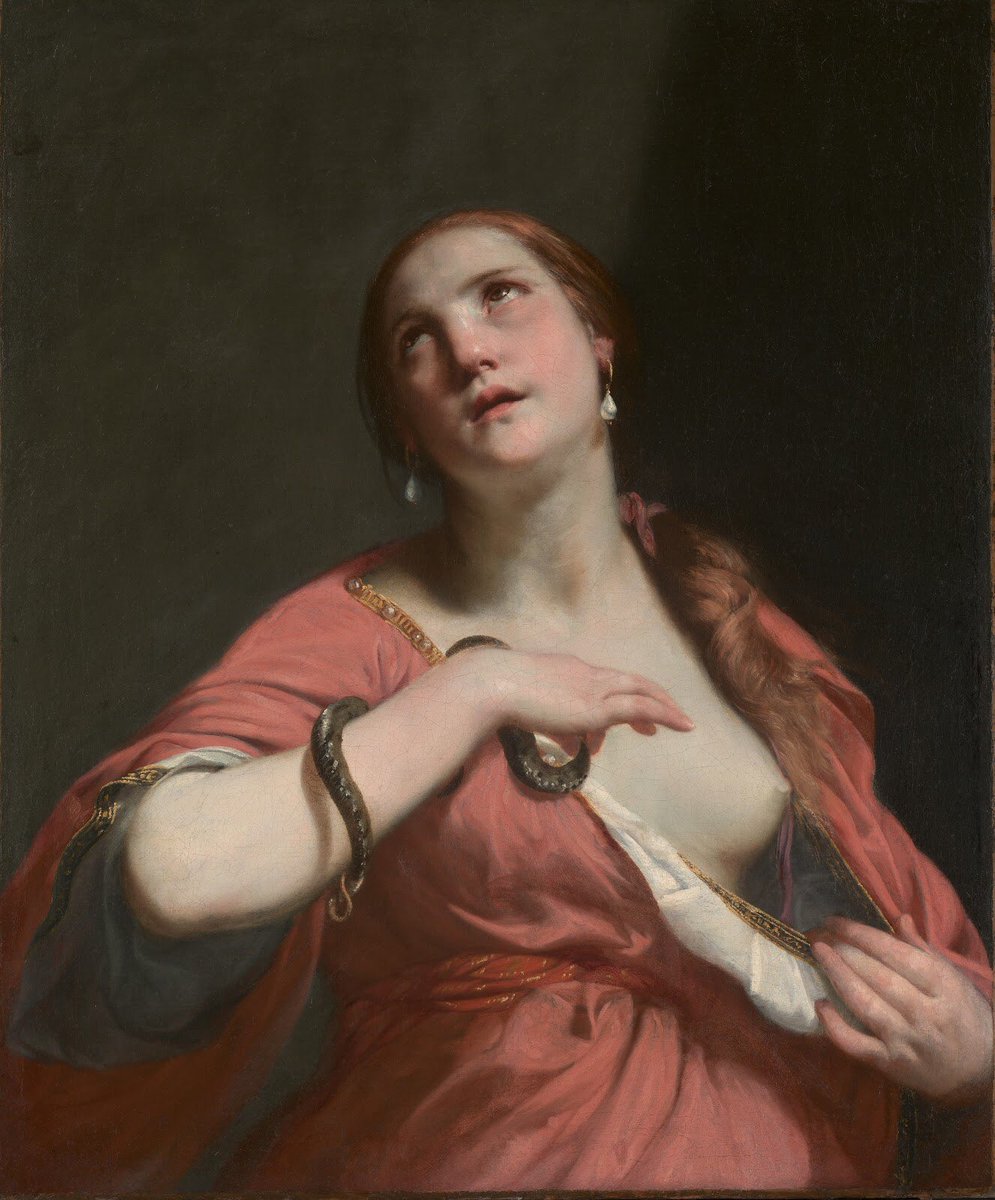
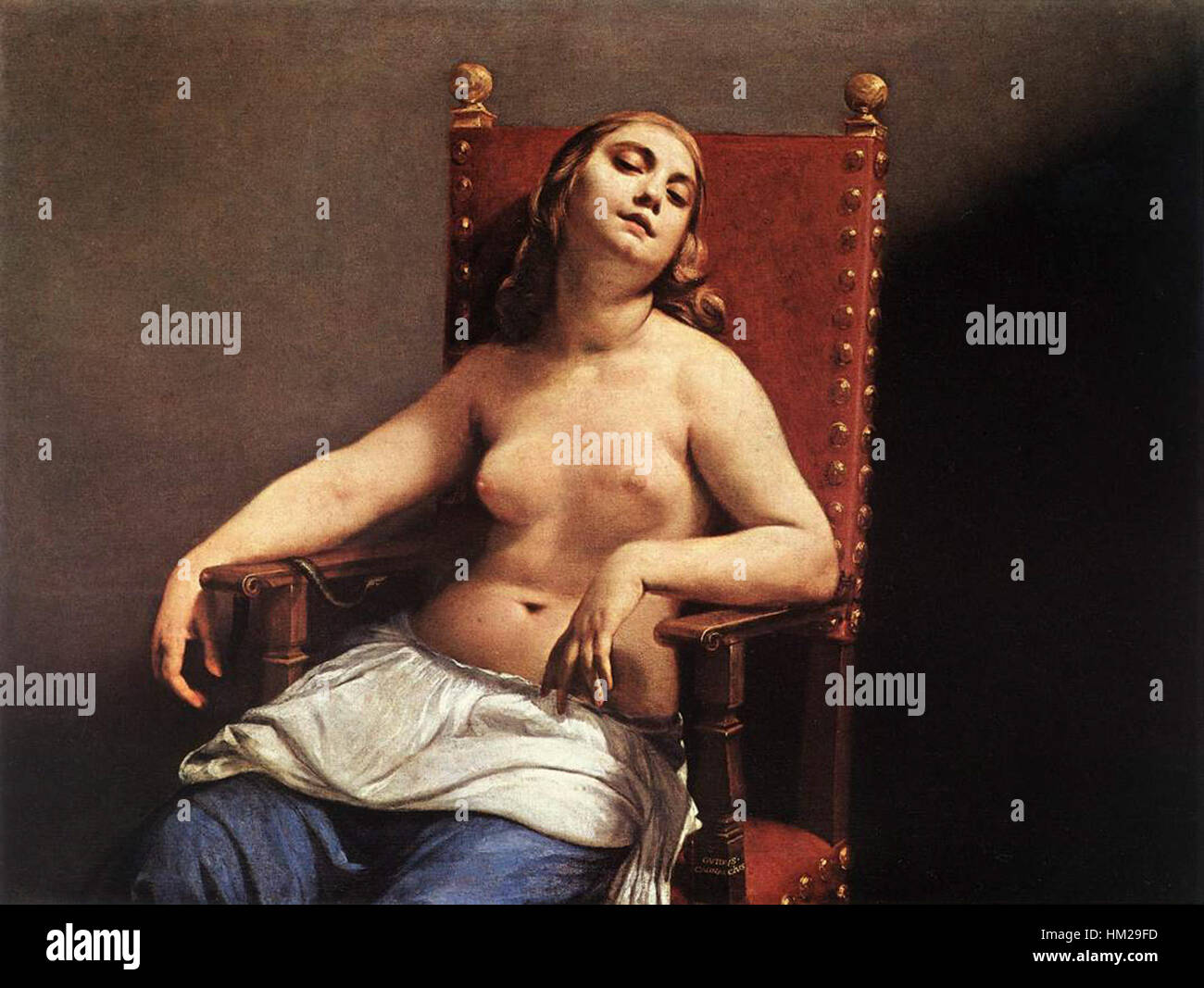
Here is another fascination, Guido Cagnacci. He is one of the Masters in showing inside of the soul (especially women). This inside is sinister; it comes from the dark side of the soul. No wonder that these have often used with the quotation of Dr Carl Gustav Jung. Let’s enjoy it despite its darkness.
Guido Cagnacci was an Italian painter originally from Santarcangelo di Romagna. Associated most readily with the Baroque period, his mature works are characterized by their use of chiaroscuro and their sensual subjects. He was influenced by the masters of the Bolognese School. Wikipedia
It was a year for us all, to carry so much pain, fear and grief. And worst of all, ignorance about ambiguities; the unknown and so many questions remain. But life is spinning continuous, and we are just a part of this huge wheel, in which we’re spinning within.
Tonight, some of us might be in small circles with friends and family, and some of us might be alone. I remember in Silvester 2015, because of some discord, I was left alone. I began to enjoy my solitude, and even I found this quote which helped me a lot.
Anyway, we might don’t know where we are going, but we are on our way.
I wish you all dear friends, happy and healthy new year. Take care and be safe. The show must go on.
My soul is painted like the wings of butterflies. Fairytales of yesterday will grow but never die. I can fly, my friends.
You can surely guess three times 😉😅 but there could only be one of the loveliest writers of all time: Charles Dickens. I think it’s almost known that Charles Dickens is one of my most favourite writers. And I want to present you this movie because this Walt Disney production is not the same as the other many many different versions from the novel.
I’ve coincidentally seen it on the TV magazine some months ago and had recorded to watch it later. But I had got no time, until some days ago I saw it in my recorded list still waiting to be seen. Therefore, I said to my wife; we could watch this film tonight, she agreed. I tell you: I’d never expected that this movie could make me so emotional. The tears almost running on my cheeks as we were watching the movie. My wife was quite shocked as she saw me, but she also knew my feeling about good movies. That is a family habit to enjoy well-made films.
Honestly, it was almost an accepted norm for us (first mother, then Al and me) that we always gladly and with pleasure watched the well-made movies, and had let our feelings run free (mostly from the lacrimal glands). It’d sound strangely for some people somehow, but in any case, we could not get rid of it.
The Christmas Carol is certainly one the best-known Christmas stories which have been ever written and a lot of movies have been made on this novel. But the interesting point is that this version shows how Dickens would come to create such a fascinating tale. It might look like a cliche somehow, but in my opinion, it shows how Dickens had to fight with his dark side to find the bright side of his own soul.
The story is one of the best Christmas stories with no doubt, but in this movie, it shows how fascinating is the imagination by the author himself. I must remember; Mark Twain with his Tom Sawyer & Huckleberry Finn or James Matthew Barrie with his Peter Pan. And here, we see the characters of Dickens’ Christmas Carol are also companion him.
And it moved my heart and wet my eyes when I saw how Dickens is under pressure to finish with his story, it reminded me of my father’s stress. Our mother told us later, after his death, how he had to finish his story late in the evening, as the newspaper courier was waiting to get it to the publisher on time.
That is a well-made movie of this Christmas story, to use Dickens personally, in the role of himself as the main character. I hope you will enjoy. 🙏💖
It was released by Bleecker Street in the United States on 22 November 2017. [4] and in the United Kingdom on 1 December 2017. It received positive reviews from critics. [5]
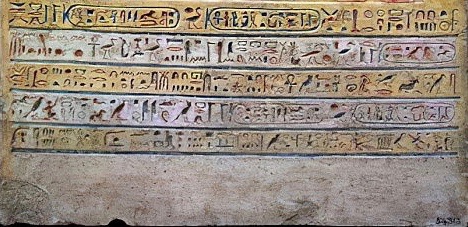
Stele dedicated to the Boukhis bull by Ptolemy V – painted and gilded limestone – Ptolemaic period – Reign of Ptolemy V – year 25 – 181 BC. J.-C. discovered during excavations funded by Sir Robert Mond and conducted by the Egypt Exploration Society in 1929-30, in the Bucheum d’Arment (Hermonthis) Egyptian Museum in Cairo – JE 54313 (museum photo)
It is another fascinating Stele of the history of Egypt, of all human history. and I promise that it’s the last one… this year! 😉 With as always great thanks to Marie Grilott for her brilliant description. Happy holidays and a much better new year.🙏💖
This stele, in painted and gilded limestone, is 72 cm high, 50 cm wide and 14 cm thick. Dated from the Ptolemaic period, it is arched in shape. As Auguste Mariette specified: “Until the XIth Dynasty, the stelae were quadrangular … But from the XIth Dynasty, the stele took the form that it only abandoned on rare occasions. It was rounded off by above as if it were intended to recall the curvature of the sky or that of the lids of sarcophagi “. It also explained its symbolic design: “The top of the stele is supposed to lose itself in the sky. As we descend downwards, we approach the earth. In other words, the stele is divided into three areas. “.
This “Stele dedicated by Ptolemy V to the Boukhis bull” reveals a particularly rich and harmonious chromatic palette combined with very interesting iconography. Its registers are declined differently, but the central part having, it seems, received the greatest attention.
Stele dedicated to the Boukhis bull by Ptolemy V – painted and gilded limestone – Ptolemaic period – Reign of Ptolemy V – year 25 – 181 BC. J.-C. discovered during excavations funded by Sir Robert Mond and conducted by the Egypt Exploration Society, in 1929-30, in the Bucheum d’Arment (Hermonthis) Egyptian Museum in Cairo – JE 54313
The hanger is dominated by a winged sun disk which completely conforms to its shape. Just below is reproduced a composition rich in “symbolism” and symmetry. “In the center of the scene is a scarab supported by a djed pillar flanked by two snakes facing each other and capped with the solar disk; these uraei are surrounded by vertical inscriptions evoking the ‘Great god of Behedet, with multicolored feathers'” analysis Rosanna Pirelli in “The treasures of the Egyptian Museum”. On either side is a seated Anubis, treated hastily; preceded by an emblem and vertical lines of hieroglyphics, he carries a flagellum.
The central part is divided into two “sections”, the most important is linked to the divinity to which the stele is dedicated: the Boukhis bull. He is represented with great precision with precise respect for his anatomy, perfectly reproducing his muscles and his power. Between its horns is placed “its” crown composed of a solar disk with two uraei surmounted by two high feathers: “The bull identified with Ré, bears the epithets ‘living soul’ and ‘herald of Ré'” specify Mohamed Saleh and Hourig Sourouzian (Official Catalog Egyptian Museum in Cairo).
Stele dedicated to the Boukhis bull by Ptolemy V – painted and gilded limestone – Ptolemaic period – Reign of Ptolemy V – year 25 – 181 BC. J.-C. discovered during excavations funded by Sir Robert Mond and conducted by the Egypt Exploration Society, in 1929-30, in the Bucheum d’Arment (Hermonthis) Egyptian Museum in Cairo – JE 54313
His dress, which we imagine soft and lustrous, is painted in gold and the whole stands out against an incredibly bright blue background, offering a striking contrast between the two colors.
“Behind the bull, Montu appears in his usual falcon form, as he was worshipped in Thebes. Opening its wings, the falcon grips a fan and the ring of duration. Associated with Rè-Harakhty, Montou is qualified of ‘great god, Lord of the On of the South’, that is to say, Thebes “(Mohamed Saleh and Hourig Sourouzian). Facing the bull is Pharaoh, in the attitude of walking, left leg forward. Richly dressed and adorned, his body is treated in ocher-red colour. “In front of the altar, King Ptolemy V, standing, offers the sign of the field (Sekbet) to the Boukhis bull. Wearing the blue crown, he wears a ceremonial loincloth with a rigid lap and a bustier; bracelets and a golden necklace adorn his arms, wrists and neck. The seven columns of hieroglyphics carved above the pharaoh mention the names of the god Bukhis, king Ptolemy, his wife Cleopatra and again quote the sun god, Lord of Behedet. A formula of protection and formula of the offering are inscribed, respectively, behind and in front of the pharaoh, “explains Rosanna Pirelli.
Stele dedicated to the Boukhis bull by Ptolemy V – painted and gilded limestone – Ptolemaic period – Reign of Ptolemy V – year 25 – 181 BC. J.-C. discovered during excavations funded by Sir Robert Mond and conducted by the Egypt Exploration Society, in 1929-30, in the Bucheum d’Arment (Hermonthis) Egyptian Museum in Cairo – JE 54313
The lower part of the stele is mostly inscribed. “At the bottom of the stele, a text of five lines, which gives very precise dates, tells us that the Boukhis, who died in the twenty-fifth year of the reign of Ptolemy V and of Cleopatra I, was born in the year 11, and that the duration of his life had been fourteen years ten months and twenty-four days. In fact, this last statement is false: it is easy to redo the calculation oneself and to find that the bull in question did not live only thirteen years ten months and twenty-eight days “analyzes with relevance Jean-Pierre Corteggiani.
The image of the bull, a robust, belligerent, invincible animal endowed with great sexual vigour, was “endorsed” by the pharaohs who did not hesitate to call themselves a “powerful bull”. Thus, as Isabelle Franco specifies: “particular bulls were chosen to become the terrestrial receptacle of certain gods”.
In Memphis, people worshipped Apis, the sacred animal of Ptah; Mnevis, him, was the solar bull of Heliopolis, while the Theban region honoured the Boukhis bull. The sacred animal of the “palladium of Thebes”, it was venerated in the sanctuaries of Tod, Medamoud and Ermant (Hermonthis), as a manifestation of the god Montu.
The selection of the bull by the priests responded to very precise characteristics: it must have a black head and the rest of the coat white. Thus, indicates Dominique Valbelle: “Macrobe (Saturnalia, I, 21) describes it thus: ‘In the town of Hermonthis (Armant), in a magnificent temple of Apollo, they worship a bull, named Bacis, consecrated to the sun and remarkable for the wonderful properties inherent in the nature of the sun. For it is said that its colours change every hour and it is said that its coat is the opposite of that of other animals. That is why it is considered in a way like an image of the sun shining away from the sky.
Aerial view of the Bucheum d’Erment published in “The Bucheum. Vol. I” edited by HW Fairman – MOND Robert – MYERS Oliver H.
This bull, the object of true worship, lived in a “sacred stable” and was especially honoured during the processions of the Valley Festival. At his death, he was mummified and his funeral followed a very precise ritual. To the Seraphim of Memphis corresponded, to Ermant, the Bucheum which was active in the XXXth dynasty in Roman times. These large basements housed the burials of bulls, surrounded in particular by commemorative stelae…
Excavations financed by Sir Robert Mond and carried out by the Egypt Exploration Society, 1929-30 in the Bucheum d’Arment (Hermonthis) – photo EES
The excavations carried out at Erment in 1926 by the Egypt Exploration Society benefited from the financial support of the patron Robert Ludwig Mond. They allowed the discovery of the Bucheum in 1929-1930 and, it is in its ruins that this stele dated to the year 25 of Ptolemy V was found. It has been recorded at the Egyptian Museum in Cairo under the reference: JE 54313.
Official catalogue Egyptian Museum of Cairo, Mohamed Saleh, Hourig Sourouzian, Verlag Philippe von Zabern, 1997
Treasures of Egypt – The Wonders of the Egyptian Museum in Cairo, Francesco Tiradritti
The Egypt of the Pharaohs at the Cairo Museum, Jean-Pierre Corteggiani
Ancient Egypt and its gods, Jean-Pierre Corteggiani, 2007
Dictionary of Egyptian Mythology, Isabelle Franco, 2013
The Bucheum. Flight. I: The history and archaeology of the site. Flight. II: The inscriptions. Flight. III: The plates (complete set). With chapters by TJC Baly, DB Harden, JW Jackson, G. Mattha, and Alan E. Shorter and the hieroglyphic inscriptions edited by HW Fairman
With a little delay but hopefully not too late! I would like to publish my wishes to you yesterday, but I had no time for that! Though I stunned to see how some friends write and post their stories, one after another, and I’d only say; Wow! I know, I need definitely some practices. 😁 I have my reasons for sure.
It is, of course, one of the reasons!
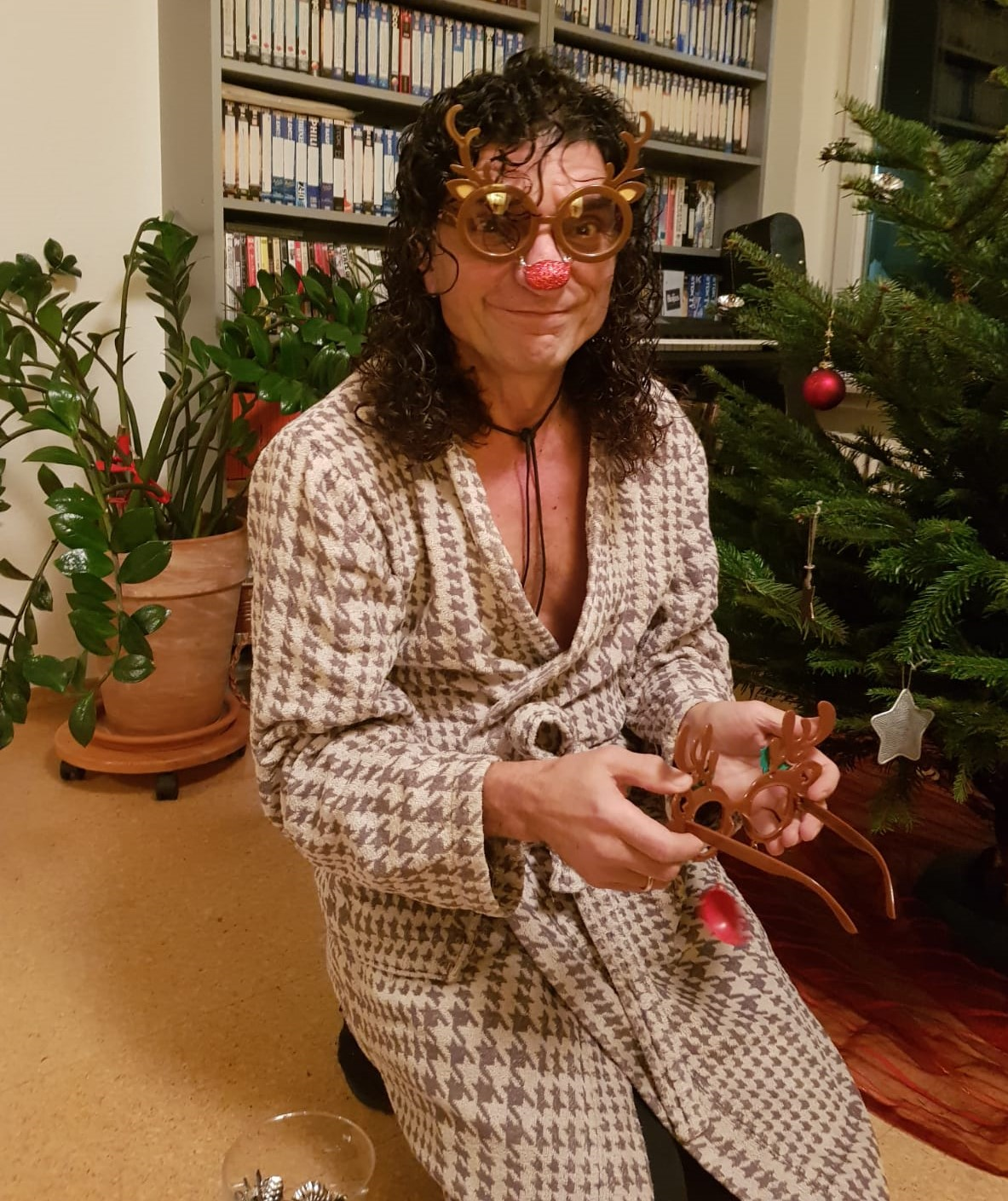
We put up the Christmas tree almost every year. In the past, because of our son, and now for our grandchildren.
Mila is helping me not to get crazy!
The reason for the stress in this year is Corona (what else?), which does not allow us to celebrate in huge numbers, therefore, the family of my wife ( I have no one from my side!) who also is not some few, has planned to divide into some groups to meet in different days (and of course no waiver has been allowed) it meant to me; everyday business!
I didn’t find my red wardrobe 😉🎅😅
Anyway, I hope you have a good time and wish you all peace and health and some leisurely holidays. 💖💕🌹
Georges Antoine Rochegrosse (1859-1938), “Le Satyricon” by Gaius Petronius, 1910
I have coincidentally seen this picture in media and was fascinated. Not only because of the amazing effect on me but also it reminded me of one of the greatest movies of all time: Fellini’s Satyricon.
Georges Antoine Rochegrosse is a French painter. Whom I didn’t know how fascinating one he was.
And Gaius (or Titus) Petronius Arbiter, was a Roman courtier during the reign of Nero. He is generally the one who was probably the author of the Satyricon, a satirical novel, which was written during the Neronian era. The Satyricon, or Satyricon liber, is a Latin work of fiction in a mixture of prose and verse. And as we know, the word Satire comes from this.
<p value="<amp-fit-text layout="fixed-height" min-font-size="6" max-font-size="72" height="80">When I saw this picture I was fully surprised how similarity fits with the actor: Max Born as Giton, and I've been more astounded when I found out that this "young boy" as I'd presumed, is really three years older than me!When I saw this picture I was fully surprised how similarity fits with the actor: Max Born as Giton, and I’ve been more astounded when I found out that this “young boy” as I’d presumed, is really three years older than me!
Federico Fellini was and is one of the greatest film-makers in the world and also one of the geniuses who changed my view in the way of seeing things.
I can remember well when Al and I with two other close friends; Bijan and Nasser (they were a pair: Bijan’s a Bi and Nasser was too young to decide!) who had studied in the College of Beautiful Arts with me, after spending our crazy nights together, as the young boys always do, we had to get off out of bed early in the morning to run to catch the bus for being on time into the cinemas, to see such of these movies in the Film Festivals, which were running once in a while in Tehran.
Those days in the early 70s, there were no videos or cartridges to see the beloved and special art-movies. We had only this opportunity to see such Masterpieces. In the Shah’s time, it was possible. Though, the traces of the scissors of the censorship were visible here and there.
We’ve watched this and the other such as “Art-Movies” so often it was possible; so long as they were running on the big screen every time. And every time we’ve enjoyed more. And Federico Fellini’s Cinecittà was not only a Film Studio for us, but it was also a world, to dream and let it be dreaming.
Finally, something for the background.
A clip from “Ciao, Federico” in which young Max Born, dressed for his role as Giton in Satyricon, sings the Bob Dylan song, Don’t Think Twice, It’s All Right”
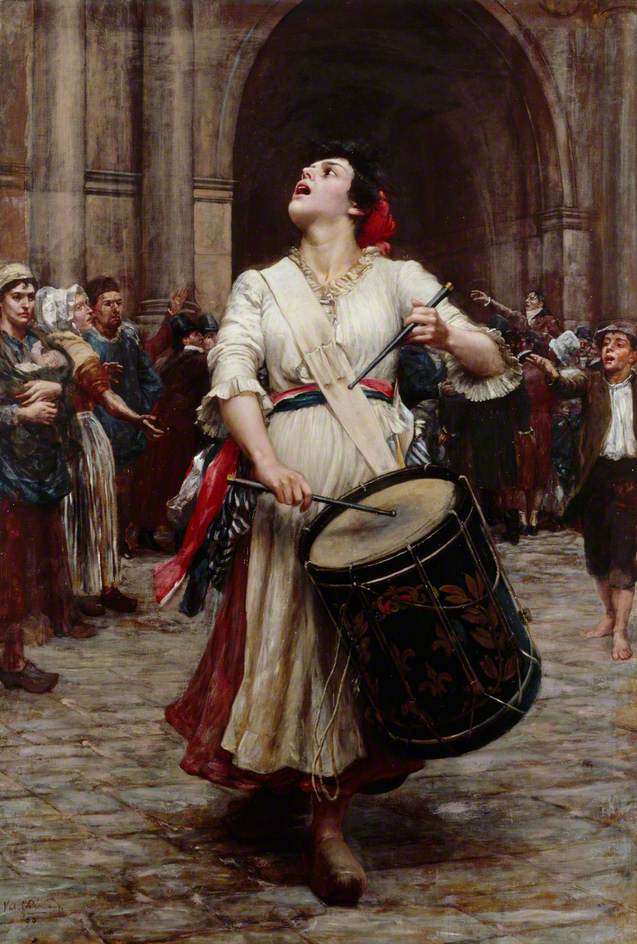
‘Self-Portrait’ (1883) by Valentine Cameron Prinsep
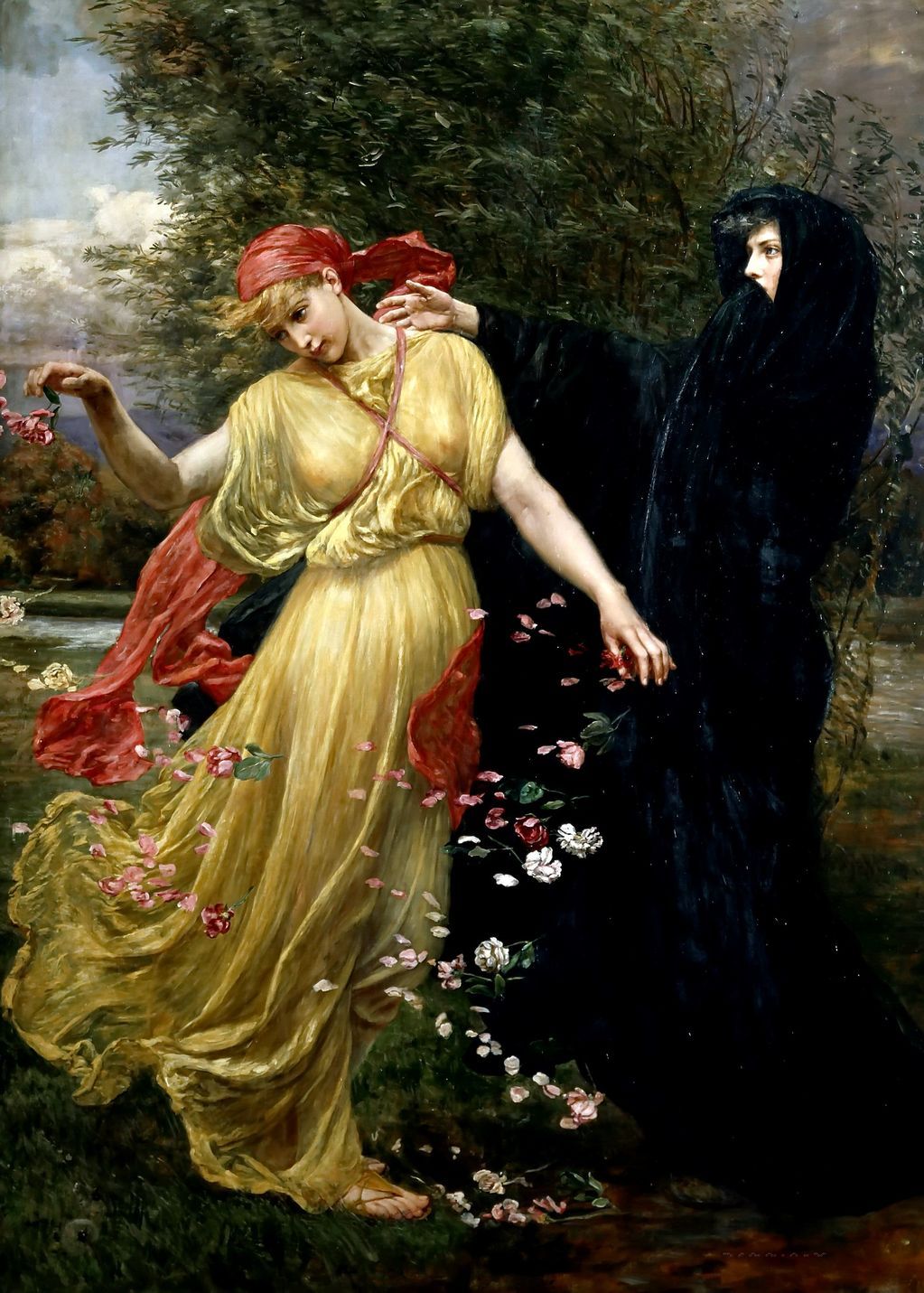
Today, I want to present an amazing and sensational painter; Valentine Cameron Prinsep, under “The Sensual Pre-Raphaelite Art”
At the First Touch of Winter, Summer Fades Away (1897)
The reason is obviously clear when we have a glimpse of his Masterworks. When I, first saw occasionally this painting (s. o.) in the Media with its description, it blew my mind. Of course it seems that I was not alone: our adorable la gentildonna luisa zambrotta (WORDS AND MUSIC AND STORIES) got the same feeling and composed a poem on this seasons substitution: (translated from Italy.🙏💖)
Chills of cold of the morning, darkness that falls quickly, here the touch of Winter drives out a Summer helpless.
Valentine Cameron “Val” Prinsep RA (14 February 1838 / 11 November 1904) was a British painter of the Pre-Raphaelite school. Born in Calcutta, India, he was the second child of Henry Thoby Prinsep, a civil servant of the British Raj. Prinsep travelled in 1856–57 to Helicarnassus (now Bodrum Turkey) for Sir Charles Thomas Newton’s excavation of the ruins.
Il-Barbagianni-The-Owl-1863-
Valentine Cameron Prinsep has a high profile, not only for having been contemporary (and close friend) of big names in the Pre-Raphaelist movement, but also for having been a remarkable artist within said movement himself.
I think there is not a word needed, let’s enjoy some of his great paintings.
The-Gamekeepers-Daughter-1875- Museum of Croydon; (c) Croydon Art Collection; Supplied by The Public Catalogue Foundation


















![Merry Christmas! Happy Christmas companions. - Stock Illustration [45923985] - PIXTA](https://en.pimg.jp/045/923/985/1/45923985.jpg)








 lampmagician
You must be logged in to post a comment.