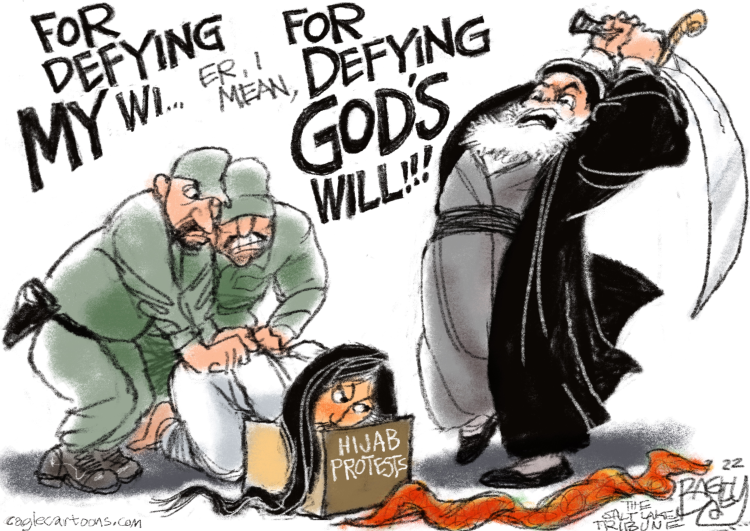
I haven’t written any posts about the Iranian revolution for a long time. But it doesn’t mean that any ending or something big happened. It is because the opposition abroad failed to take an effective post to make a strong front against the Islamic regime. Thanks to a few who felt like great leaders and were focused on being as majestical creatures to shine on and rescue a nation, including @Pahlavi, who had no idea of the aim of this revolution and just in belief that he had been the chosen one! And in the other side, some are good-hearted but inexperienced and can’t choose or take the right way seriously, as the brutal regime does kill these brave youths in front of the @EU, @UNO, and @USA without inhibitions!
In fact, the revolution is caught in a limbo of a mess. The brave young women and men on the streets of Iran are disappointed. They thought as they were fighting with their foust against the regime’s weapons, it would come to help from aboard to reach their goal, namely their freedom and now they feel left alone!
I can imagine the Mullahs regime is not so bad for the lobbyists in the West, Though I must say no! Sorry, I have to dash the hopes of some Western governments which think it is good to keep the dictatorships in the third world to shut up nations and make profits.
Many Iranian people in Western countries are doing their best to help the revolution keep going, and they do it honestly, despite of few lumps who try to make noises to destroy this uprising. But we will conquer; we will never surrender! #IRGCTerrorists
As I talked about this topic in my last part, children have souls with a great capacity of absorbent power with their instinct to pull all the knowledge they can take. I noticed it when I witnessed my son grow up and today when I observed my grandchildren. And you might imagine how my heart breaks as I see the children in Iran can’t experience their adulthood (The execution machine is going on with no stop!). But their souls continue in their comrade’s bodies and are still there to catch the goal.
In part one, I mentioned the necessity of love and passion towards our children, but is it enough? Regina, my wife, is a teacher in a special needs school (förderschule), and there are many disabled children (18 to 20-year-old children!). Of course, I catch up a lot about how her job is going and how many difficulties arise. Apart from brutality from parents, some are too kind to their children. They show no limits and put up with everything, and it causes lots of problems for the teachers.
By Petra Glimmdall. 💖
It might sound hard, but it is a pure fact! Of course, I want to go with something other than Plato and his Utopia. However, it can also be a topic to discuss!
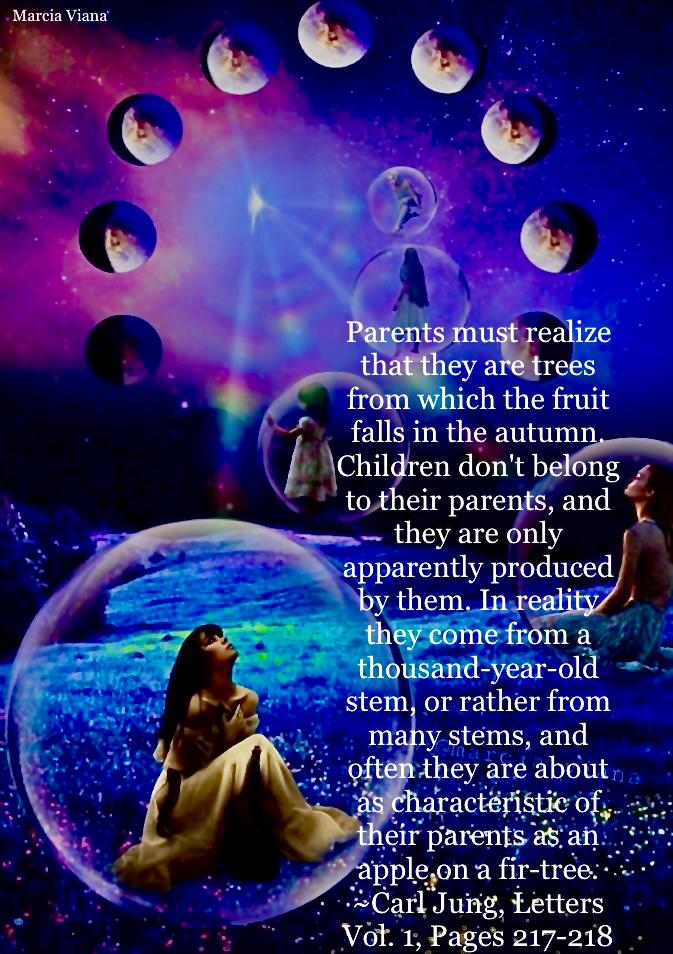
We see then that only giving love is not enough and sometimes even detrimental. I believe the first lesson which we must learn is that our children do not belong among our properties.
Anne Frank can also be considered an example of the child archetype from modern culture – an innocent child who, because her Life was taken away from her by the forces of evil in the world, never had the opportunity to grow up and so in the minds of the world remains ever young and pure.
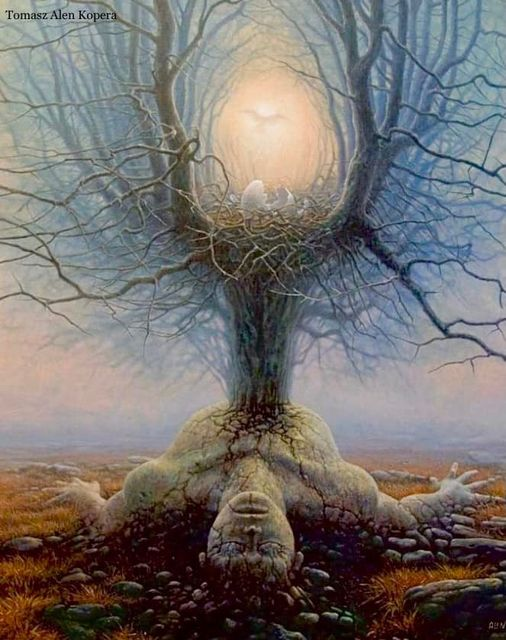
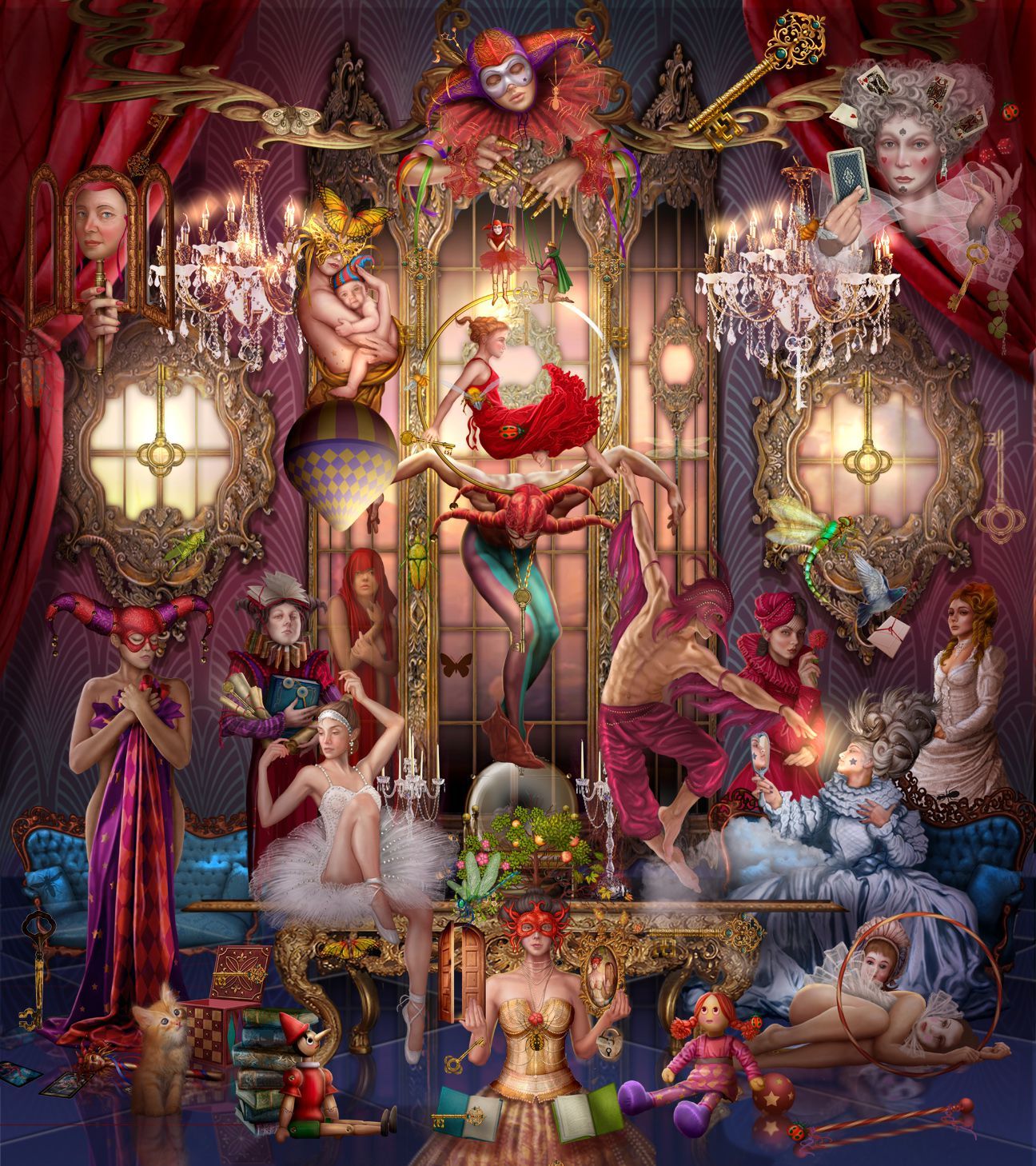
Art: Tomas Alen Kopera
“Your children are not your children. They are the sons and daughters of Life’s longing for itself. They come through you but not from you, and though they are with you, they belong not to you yet. You may give them your love but not your thoughts. For they have their own thoughts. You may house their bodies but not their souls, for their souls dwell in the house of tomorrow, which you cannot visit, not even in your dreams. You may strive to be like them but seek not to make them like you. For Life goes not backwards, nor tarries with yesterday.” ~ Khalil Gibran.
So, let’s read some parts about the ideas and analysis of Dr Jung:
Within each of us, the Innocent is the spontaneous, trusting child that, while a bit dependent, has the optimism to take the journey. The Innocent, fearing abandonment, seeks safety. Their greatest strength is the trust and optimism that endears them to others, so they gain help and support on their quest.
Jung placed the “child” (including the child hero) in a list of archetypes representing milestones in individuation. Jungians exploring the hero myth have noted that “it represents our efforts to deal with the problem of growing up, aided by the illusion of an eternal fiction”. Thus for Jung, “the child is the potential future”, and the child archetype symbolizes the developing personality.
Others have warned, however, of the dangers posed to the parents drawn in by the “divine child” archetype – the belief in the extraordinary potential in a child. The child, idealized by parents, eventually nurtures a feeling of superiority.
Even where affected less acutely, the child archetype may inhibit psychological maturation and result in an adult who is, in essence, “Mama’s darling”. A man will end up with a solid attachment to a mother figure, either real or symbolic, and will lack the ability to form a commitment or be generative. The female version of this, specified as the “puella”, will have a corresponding attachment to her father figure.[Wiki
An infinitely deep look into human’s infinitely unknown!
Here, we look intensively into the soul of the human being—a story “maybe” from all of us. I am sure we all are in search of our being’s purpose, and Gibran tries with this fascinating story to help us, though not necessarily to find it, at least to awaken our unconsciousness to consider it more profound. Therefore, the journey to reach the Self will be a bumpy and troublesome path; we might not know where we are going, but we do are on our path! Do we know it??
The Go-Between!
There lived among the hills a woman and her son, and he was her firstborn and her only child.
And the boy died of fever whilst the physician stood by.
The mother was distraught with sorrow, and she cried to the physician and besought him, saying, “Tell me, tell me, what was it that made quiet his striving and silent his song?”
And the physician said, “It was the fever.”
And the mother said, “What is the fever?”
And the physician answered, “I cannot explain it. It is a thing infinitely small that visits the body, and we cannot see it with the human eye.”
The physician left her. And she kept repeating to herself, “Something infinitely small. We cannot see it with our human eye.”
And in the evening, the priest came to console her. And she wept, and she cried out saying, “Oh, why have I lost my son, my only son, my first-born?”
And the priest answered, “My child, it is the will of God.”
And the woman said, “What is God, and where is God? I would see God that I may tear my bosom before Him and pour the blood of my heart at His feet. Tell me where I shall find Him.”
And the priest said, “”God is infinitely vast. He is not to be seen with our human eye.”
Then the woman cried out, “The infinitely small has slain my son through the will of the infinitely great! Then what are we? What are we?”
At that moment, the woman’s mother came into the room with the shroud for the dead boy, and she heard the words of the priest and also her daughter’s cry. And she laid down the shroud and took her daughter’s hand in her own hand, and she said, “My daughter, we ourselves are the infinitely small and the infinitely great; and we are the path between the two.”
Exhibition “Ramses & the gold of the pharaohs” – Grande Halle de la Villette Paris – April 7 – September 6, 2023 Sphinx of Ramses II offering the microcephalic vase of Amun crystalline sandstone – 19th Dynasty – the reign of Ramses II – JE 38060 and in the background, the Ramesseum, the temple of Millions of Years of Ramesses II on the west bank of Thebes Une expo RII
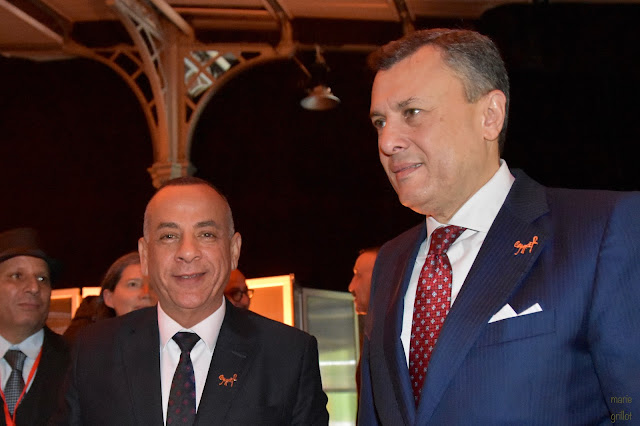
After Houston and San Francisco, the “Ramses & the Gold of the Pharaohs” exhibition arrived in France. It was inaugurated on Thursday, April 6, at La Villette, in the presence of Ahmed Issa, Minister of Tourism and Antiquities; Mostafa Waziri, Head of the Supreme Council of Antiquities; by Alaa Youssef, Ambassador of Egypt to France and Zahi >the Opportu< Hawass, internationally renowned Egyptologist. Dominique Farout, curator of the exhibition and Bénédicte Lhoyer, scientific advisor, presented this exceptional event passionately…
Inauguration of the exhibition “Ramses & the Gold of the Pharaohs” at La Villette, in Paris, on April 6 on the right, Ahmed Issa, Minister of Tourism and Antiquities and, on the left, Mostafa Waziri, Head of the Supreme Council of Antiquities
In fact, 180 artefacts lent by Egypt through its Ministry of Tourism and Antiquities are exhibited in a museography, as aesthetic as it is neat, produced by the World Heritage Exhibition. “Sumptuous decorations surround the artefacts against a backdrop of a personalized musical score. They are accompanied by unique multimedia presentations of the Battle of Kadesh and a virtual mummification”, specifies its general manager John Norman.
From a colossal 2.30 m head of Ramses II (CG 643) from Memphis to the golden amulet of the “Two Mistresses” (JE 85815), which was sewn to the shroud of Psusennes I, from the jewels of the princesses of Dahshur dating from the XIIth dynasty to the ornaments of the Tanite pharaohs of the XXIth dynasty; from the coffin of Sennedjem (JE 27303), craftsman of the Place de Vérité to that of Ramses II (CG 61020); from an ostracon of Ramses IV (CG 25124) to a 108-gram gold earring (CG 52323) found in Abydos, on a mummy that had turned to dust…
Isis and Nephtis depicted on the external coffin of Sennedjem – stuccoed and painted wood – 19th Dynasty from his tomb – TT 1 – at Deir el-Medina – discovered by Salam-Abou-Douy de Gournah and by the Antiquities Service in January-February 1886 registered in the Diary of Entries of the Egyptian Museum in Cairo – JE 27303
So many marvels are revealed throughout a didactic journey, rich in every sense of the term… and where Ramses II, although he is not the one and only centre of interest, occupies a prominent place. …
In the hall stands a reconstruction of his rock temple of Abu Simbel (Lower Nubia). With unique architecture, its façade stands out with four colossi 20 m high: two represent him as king, the other two as his divine nature: Sun of the Princes and Prince of the Two Lands…
Reconstruction of the temple of Ramses II at Abu Simbel (Lower Nubia) with its four colossi on the facade
Everything celebrates the greatness of this sovereign, the third Pharaoh of the 19th Dynasty who reigned over the Double Country for 66 years… A prolific builder, a fine military and political strategist, and an experienced diplomat, he also could ally himself – or rather impose himself – to the priests of Amun. He contributes to his own “legend” by illustrating the glorious facts of his reign on the walls of his temples…
The upper part of a statue of Ramesses Il – Gray granite – New Kingdom – 19th Dynasty reign of Ramses II – 1290-1224 BC. AD – from Tanis – Egyptian Museum in Cairo – CG 616
This Pharaoh also venerates his father, Séthy I, and his mother, Queen Touy, presented here by her seated statue in black granite (JE 37084). He will have many concubines and eleven wives… “The most beautiful of all” will be Nefertari, for whom he will build a temple very close to his in Abu Simbel, as well as a luxurious residence of eternity in the Valley of the Queens (QV 66 ), where the most talented artists will make the perfection of its beauty eternal…
He will have a hundred children… His successor will be his thirteenth son, Merenptah, presented by a magnificent bust (JE 31414 – CG 607) discovered in 1896 in his temple in western Thebes by William Matthew Flinders Petrie.
The upper part of a statue of Merenptah broken at the waist – grey granite painted in red, yellow and blue 19th dynasty – the reign of Merenptah – 1237 – 1226 BC from the second court of his million-year-old temple of West Thebes discovered by William Matthew Flinders Petrie in 1896 – Cairo Museum – JE 31414 – CG 607
Ramses II died at almost 90; he was buried in his “dwelling of eternity” dug in the main wadi of the Valley of the Kings. KV 7, like many tombs in this necropolis, will be looted… Around 1080 BC. BC, the high priests of Amun will shelter the royal mummies. His will first be transferred to the tomb of his father, Séthy I (KV 17).
Four years later, it will be moved, then deposited, with about forty royal remains and their funerary material, in the tomb of Princess Inhâpi. Located south of Deir el-Bahari, this “Cachette des mummies Royales” (DB 320) was discovered in 1871 by the Gournawis, the Abd el-Rassoul brothers, then in 1881 by the Antiquities Department then headed by the Frenchman Gaston Maspero… Ramses II rested in a cedar wood coffin (JE 26214 – CG 61020), which was not originally his…
Cedarwood coffin of Ramses II from Thebes from the royal hiding place of Deir el-Bahari (DB 320) discovered in 1871 by the Abd el-Rassoul family and “rediscovered” by the Service des Antiquités in 1881 Cairo Egyptian Museum – JE 26214 – CG 61020
Forty-seven years ago, for the exhibition “Ramses the Great”, organized from May 15 to October 15, 1976, at the Grand Palais by Christiane Desroches Noblecourt, Egypt had agreed to lend the lid of this coffin. At the same time, on September 26, 1976, the royal mummy resting in the anthropoid tank of this same coffin, placed in a “‘sarcophagus’ of special plexiglass, impervious to ultraviolet rays, and wedged in sterilized polystyrene cushions”, arrived in France. , welcomed like a head of state… She stayed there until May 10, 1977, to be treated by the most outstanding specialists of the time. As a token of the friendship and respect binding our two countries, the Egyptian Government has granted exceptional authorization for the lid of the coffin and its tank to return to Paris for this exhibition… It is in a magnificent space, reproducing a room of the tomb of Séthy I (where let us recall, the mummy had transited), that this set is very respectfully displayed.
As for the tomb of this great Pharaoh, it was severely damaged by the seeping waters. The 25 years of excavations carried out by the French mission of Christian Leblanc have delivered important information, and among them, the certainty that his sarcophagus was made of alabaster like that of Seti I.
The “Ramesside dynasty” lasted until Ramses XI, whose reign ended in total anarchy, which gave rise to the “Third Intermediate Period”. Two “entities” henceforth govern the Double Country: the High Priests of Amun, in the South, in Thebes, whereas, in the Delta, in Tanis, the “tanite” kings settle. This line is founded by Smendès, to whom Amenemnisout will briefly succeed, then Psusennes I, who will reign for 47 years. He will then establish the royal necropolis within the temple’s precincts of Amun. Pierre Montet excavated this site in 1929 and, ten years later, discovered several royal tombs: Osorkon, Psousennes I and II, Amenemopé, Sheshonq, etc.
The face of Pharaoh Amenemopé – gold leaf – surviving upper part of his gilded wooden coffin 21st dynasty – from the Royal Necropolis of Tanis – NRT III – Tomb of Amenemopé discovered by Pierre Montet, April 16, 1940 – Egyptian Museum of Cairo – JE 86059
The “treasures of Tanis” are very widely present at this exhibition: sarcophagi, golden masks, jewels, and sacred and profane dishes… They testify to the richness of the funerary art of this “Thebes of the North”… We will not miss not to be surprised that such discoveries did not have such an important impact as that granted, in 1922, to Tutankhamun… But they took place during the Second World War, and the context was not the most conducive to arousing the ‘interest…
By its stone, gold and silver artefacts, by the history with which they are steeped (from the Middle Kingdom to the Ptolemaic Period), by its reconstructions, by “the immersive virtual reality experience in the temples of ‘Abou Simbel and the tomb of Queen Nefertari”, through the “all public” workshops it offers, this exhibition is not to be missed under any circumstances!
This summer will be a full dating one with lots of birthdays and anniversaries invitations, and a big project for having a new kitchen (the old one is already 25 years old!) I am afraid!!😜 Also no time for any long travel. I must just remember that.😅





So! Let’s Torniamo ai Camarades! As I wrote in the first “Look,” the weather had nothing left to enjoy. Therefore, we got a car and kept travelling all over the island. Regina, my adorable wife, has already picked the places that could be worth seeing.
For example, the Temple of Concordia in the Valle dei Templi in Agrigento on the south coast of Sicily, and the old Greek structures.

And to reach the beautiful sights at the heights.
We drove about five hundred Km, I suppose, and of course, I took the responsibility of driving the car on such curving streets. We rented the car for three days; on the first two days, we drove around the northern and some parts in the south, and on the last day, we went towards Etna.
However, we didn’t get there! Not because of too long distance drive, it was not allowed to get there by own car. We had to reserve places to be brought up there. Therefore, we took a shorter mountain, about 1400 metres high, and drove up and down to enjoy a bit of winter vacation 😁and to the village nearby to buy the famous Pistachio!
As I must hurry to get to a retirement anniversary of a Spanish amigo to say welcome to the club, I finish here this one. May your time be full of peace and happiness. I look for sharing another part in the next, someday. 🙏💖🌹😎
With this part, we reach the end of Dr Jung’s short description of his topic; the Collective Unconscious. (Here are again the latter parts: P1, P2, P3, P4.)
In this, he brings with an example, a very interesting paradigm in the form of an old paranoiac man who sees more than what people might see. In my opinion, Dr Jung tries to tell us that if we look deeper into our Weltanschauung, we can see more, or in other words, we will remember what we’ve forgotten!
In any case, our “personal” bygone life patterns and previous history immensely influence our current lives. If we remember these, we might solve the puzzle of our existence. Here we read this gripping example by Master Jung:
4- An Example
I choose as an example a practical case that, although already published, I will use again because its brevity makes it particularly suitable for illustration. Furthermore, I can add a few remarks that were omitted in the earlier publication (Symbol of Change, CW 5, §§ 149 ff. and § 223, and The Structure of the Soul, CW8, § 317.).
About 1906, I encountered a curious phantasy of a paranoiac who had been incarcerated for many years. The patient had suffered from incurable schizophrenia since his youth. He had attended elementary schools and worked as a clerk in an office. He was endowed with no special gifts, and I myself knew nothing of mythology or archaeology at the time; so the situation was in no way suspicious. One day I found him standing by the window, bobbing his head and squinting at the sun. He asked me to do the same and promised I would see something very interesting. When I asked him what he saw, he was surprised that I couldn’t see myself and said, ‘You see the sun penis – if I move my head from side to side, it moves too, and that’s the origin of the wind.’ Of course, I didn’t quite grasp the strange idea, but I wrote it down in a note. About four years later, during my mythological studies, I discovered a book by Albrecht Dieterich, the well-known philologist, which shed light on that fantasy. This work, published in 1910, deals with a Greek papyrus in the Bibliotheque Nationale in Paris. Dieterich’d believed to have discovered a Mithraic liturgy in part of the text. It comes from the Alexandrian mystic school and agrees in meaning with the ‘Corpus Hermeticum’. In Dieterich’s text, we read the following instructions:
Breathe of the rays, drawing in three times as strong as you can, and you will see yourself lifted up and striding on high so that you think you are in the midst of the air region… the way of the visible Gods will appear through the sun, the God my father; similarly will be visible also the so-called tube, the origin of the ministering wind. For you will see from the disc of the sun like a tube hanging down: in the regions to the west infinitely as an east wind; if the destiny to the regions of the east has the other, you will similarly see the rotation (movement) of the vision to the regions of that one. << Dieterich Eine Mithrasliturgie, 1910, p.6f.>> (As Jung found out later, the 1910 edition is actually the second edition. The book appeared in 1903. The patient had been hospitalized a few years before 1903.)
The text shows the author’s intention to enable the reader himself to experience the version that the author had or at least believes in. The reader is to be introduced to the author’s inner experience or, more likely, to one of those mystical communities that exist to which Philo Ludaeus (or Judaeus) bears witness as a contemporary. Because the fire and sun god invoked here is a figure for which historical parallels can be demonstrated, for example, in close connection with the figure of Christ in Revelation. It is, therefore, a collective conception, as are the ritual acts described, such as imitating animal sounds and so on. This version is thus embedded in a religious context of a clearly ecstatic nature and describes a kind of initiation into the mystical experience of the deity.
Our patient was about ten years older than me. He was megalomaniacal, namely, God and Christ in one. His attitude towards me was benevolent – he liked me as the only person who showed any interest in his fanciful ideas. His delusions were predominantly religious in nature, and when he asked me to squint at the sun like him and rock my head from side to side, he seemed intent on letting me share in his vision. He played the role of the mystical sage, and I was his student. He was even the sun god himself, creating the wind by bobbing his head.
The ritual transformation into divinity is attested by Apuleius in the Isis mysteries in the form of a solar apotheosis. The meaning of the ministering wind is, in all likelihood, that of the procreative spirit (pneuma is wind) that emanates from the sun god into the soul and fertilizes it. The combination of sun and wind occurs frequently in ancient symbolism.
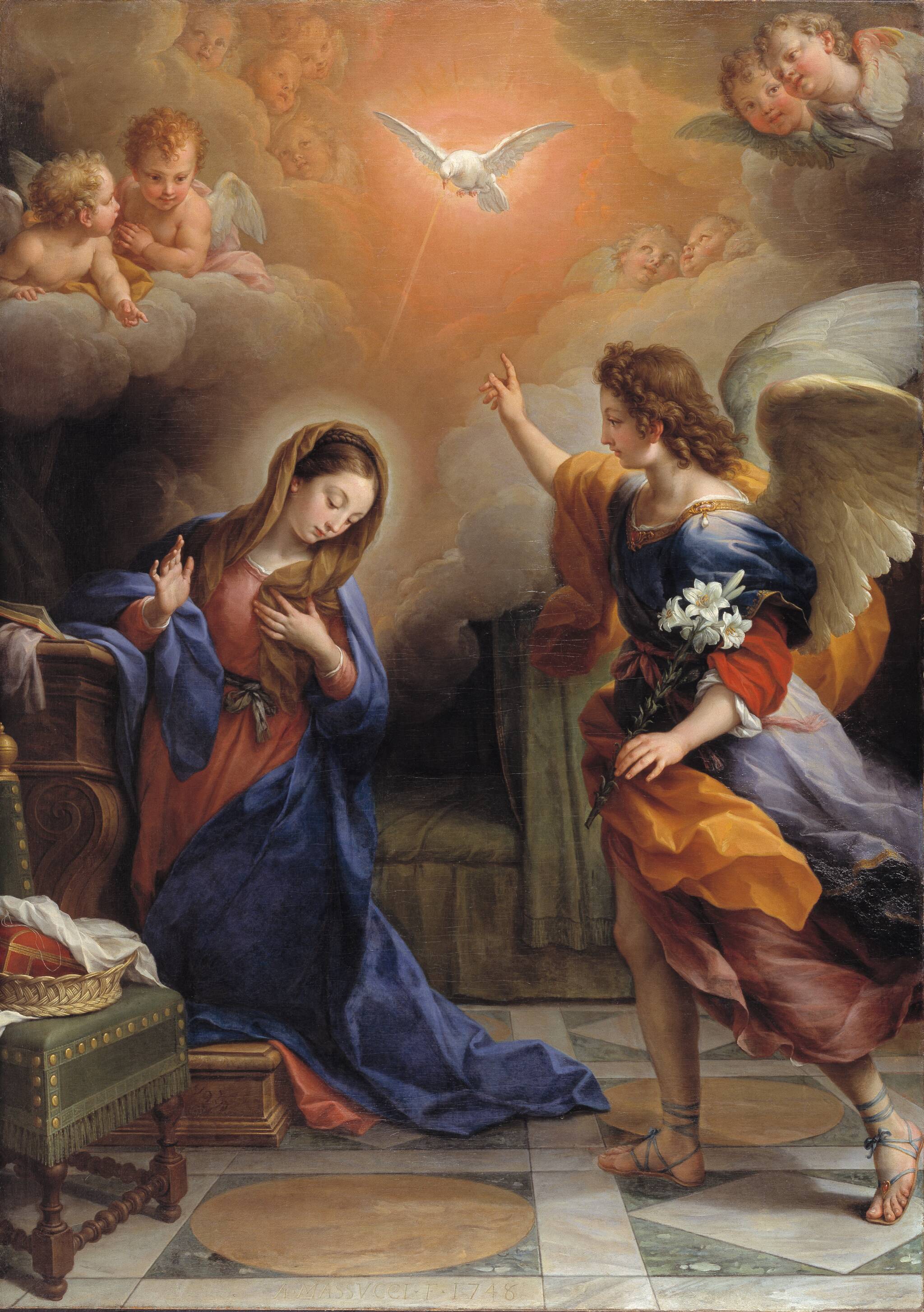
It is now necessary to prove that the two individual cases are not just coincidental coincidences. We must therefore show that the notion of a wind tube associated with God or the sun has a collective existence independent of either of these statements or, to put it another way, that it occurs at other times and places as well. Certain medieval paintings depict the Annunciation with a tubular device reaching from the throne of God to the womb of Mary. Either the dove or the Christ child descends into it. The dove signifies the pollinator, the holy spirit wind.
It is now entirely out of the question that the patient could have had any knowledge of a papyrus published four years later, and it is highly unlikely that his vision would have anything to do with the strange medieval depiction of the Annunciation, even if by some inconceivable accident he ever saw a reproduction of such a painting. The patient had been declared insane in his early twenties. He had never travelled. Such a picture does not hang in any public art gallery in his hometown of Zurich.
I mention this case not to prove the vision of an archetype but to show you the procedure of investigation in the simplest possible form. If we only had such cases, our surveys would be relatively easy, but presenting evidence is actually more complicated. First of all, certain symbols must be isolated clearly enough to be recognizable as all typical phenomena and not just as accidental matter. This is done by examining a set of dreams, say a few hundred, for typical characters and observing their development within the series. With this method, it is possible to detect certain continuities and deviations in one and the same figure. You can choose any character whose behaviour in the dream or dreams gives the impression of being an archetype. If the material at one’s disposal is well observed and plentiful enough, interesting facts about the change that the type has undergone can be ascertained. Not only the type itself but also its variants can be clarified by evidence from comparable mythological material. I described this method of investigation in a paper published in 1935 (Fundamentals for Practical Psychotherapy, CW 16; cf. also Psychology and Alchemy, Part 2, CW 12) and also presented the necessary case material.
Now at the end, I hope I have conveyed this important and essential topic to you with these five sections. I believe that it will help us to find out more about ourselves. I appreciate your interest.🙏💖
To simplify the issue, here is a worth-watching video.😊
On “The concept” of the collective unconscious (1936): Lecture 1936 in the Abernethian Society at St Bartholomew’s Hospital, London, under the title “The Concept of the Collective Unconscious < published in the journal of that hospital, XLIV, London 1936/37, p .46-49 and 64-66. The first edition of the German translation in Collected Works (CW), Volume 9/1, pp. 55-66.
I don’t know about you, but I have spent most of my life thinking about our existence on this planet, the differences between us, humans and nature. What and who drives us, and to where? I wonder if we will ever know. When I read the story of our archaeological, religious, or mythological history, someone in my head tells me we are totally on the wrong path and forgetting something significant! This puzzle is undoubtedly not easy to solve. We might try to find the goal with the help of our dreams and imagination, even from our childhood.
Here, Dr Jung, with the topic: Archetype, nods us a wink toward thinking thereabout:
My thesis, then, is as follows: In addition to our immediate consciousness, which is of a thoroughly personal nature and which we believe to be the only empirical psyche (even if we tack on the personal unconscious as an appendix), there exists a second psychic system of a collective, universal, and impersonal nature which is identical in all individuals. This collective unconscious does not develop individually but is inherited. It consists of pre-existent forms, the archetypes, which can only become conscious secondarily and which give definite form to specific psychic contents. ~Carl Jung, CW 9i, Para 90. (With thanks to Lewis Lafontaine)
So! We have a heritage from our past (comprised of “pre-existence; Archetype), which gives definite form to certain psychic contents; also, the key is the Archetype. Let’s continue reading Dr Jung’s explanation.
3. The Proof Method
We must now turn to the question of how to prove the existence of archetypes. Since archetypes are meant to produce certain mental forms, we must explain where and how to get hold of the material that illustrates those forms. The primary source lies in dreams, which have the advantage of being independent, spontaneous productions of the unconscious psyche and are, therefore, purely natural products unaffected by any conscious intention. By questioning the individual, one can ascertain what motives appear in the dreams, thanks to him. Of course, among those unknown to him, we must exclude all motifs that may be known to him, such as – to return to the Leonardo case – the vulture symbol. We are not sure whether Leonardo obtained this symbol from Horapollo. However, this would have been easily conceivable even for an educated man of his time since the artist was characterised by considerable humanistic knowledge, especially at that time. Therefore, although the bird motif is an archetype par excellence, its occurrence in Leonardo’s imagination would prove nothing, so we have to look for motives that simply could not be known to the dreamer and yet functionally behave in his dream as we know from the functioning of the archetypes from historical sources.
Another source of the necessary material is the so-called “active imagination.” By this, I mean the series of fantasies that deliberate concentration brings into being. I have found that the intensity and frequency of dreams are increased by the presence of intangible and unconscious fantasies, and that when these fantasies are brought into consciousness, the dreams change their character, becoming weaker and less frequent. From this, I have concluded that dreams often contain fantasies which tend toward consciousness. Dream sources are often repressed instincts that have a natural tendency to influence the conscious mind. In cases of this kind, we ask the patient to look at each and every fragment of his fantasy that seems important to him in terms of its so-called context, that is, the related associative material in which it is embedded, until he understands it. It is not a question of free association, as Freud recommended for the purpose of dream analysis, but of working on the fantasy by observing further fantasy material as is naturally ascribed to the fragment.
This is not the place to go into technical explanations of the method. Suffice it to say that the series of fantasies brought to light facilitates the unconscious and represents material rich in archetypal forms. Of course, this method may only be used in specific, carefully selected cases. It is not entirely harmless since it can take the patient too far from reality. A warning against thoughtless use is undoubtedly in place.
Finally and last but not least, the delusions of the mentally ill, the fantasies in trance states and the dreams from early childhood (from the third to the fifth year of life) are available as exciting sources of archetypal material. Any amount of such material is available, but it is not worth it if one fails to track down compelling historical bulwarks. It is not enough, of course, to relate a dream about a snake to the mythical occurrence of the snake; for who could guarantee that the functional meaning of the serpent in the dream is the same as in its mythological framework? Therefore, to draw a valid parallel, it is necessary to know the functional meaning of an individual symbol and then to find out whether the supposedly parallel mythological symbol belongs to the same kind of circumstances and consequently has the same useful meaning. Establishing such facts is not only a matter of lengthy and laborious research but also an ungrateful object of demonstration. Since the symbols should not be taken out of context, one has to present an exhaustive personal as well as a symbol-scientific presentation, which is practically an impossibility in the context of a single lecture. I’ve tried repeatedly, risking putting half my audience to sleep.
To be continued… (Part 5=: An Example) 🤗🙏💖
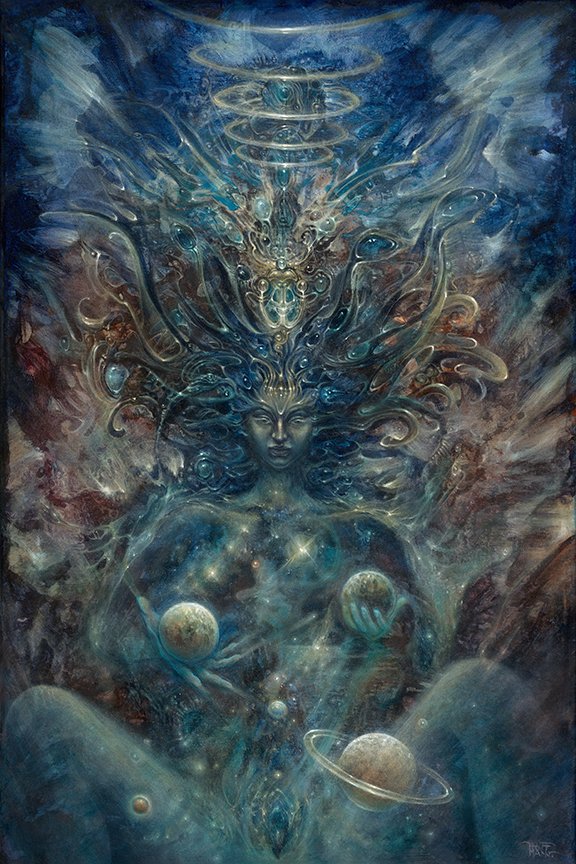
The image at the top: CREATRIX by Martina Hoffmann, 2019, oil on canvas,
Source:
On “The concept” of the collective unconscious (1936): Lecture 1936 in the Abernethian Society at St Bartholomew’s Hospital, London, under the title “The Concept of the Collective Unconscious < published in the journal of that hospital, XLIV, London 1936/37, p .46-49 and 64-66. The first edition of the German translation in Collected Works (CW), Volume 9/1, pp. 55-66.
It seems that this never-ending story (working class heroes) had already begun since the existence of human civilisation. Challenging-Class is not a new thing and does not only belong to our time. It is indeed interesting to know that it was, even in ancient Egyptian, an important issue.
Here we read an excellent reportage by two brilliant Egyptologists and adorable friends of mine: Marie Grillot & Marc Chartier 🙏💖
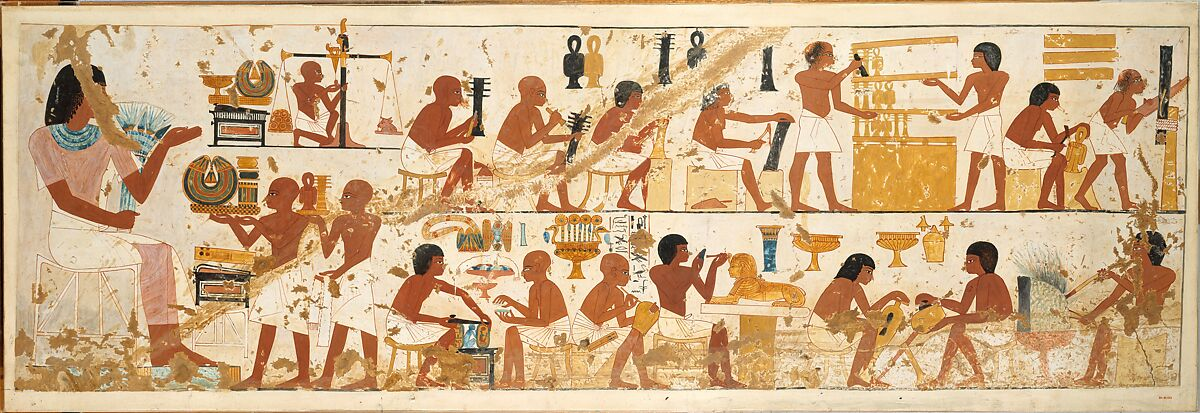
The Image at the top: Metmuseum, Craftsmen, Tomb of Nebamun and Ipuky. New Kingdom
The Ramesseum, the temple of millions of years of Ramses II The Village of Artisans of Deir el-Medina, in Antiquity: “Set Maât her imenty Ouaset” – the “Place of Truth to the West of Thebes.” Workers at work represented on the walls of the tomb of Rekhmiré – TT100 – Theban Necropolis
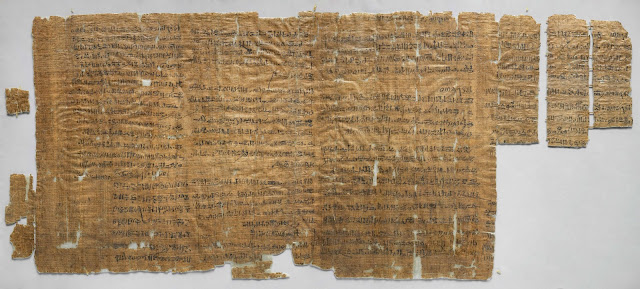
Deir el-Medina, in the year 29 of the reign of Ramses III (circa 1150 BC). The “press” of the time, namely a few ostraca, but above all, a papyrus currently kept in the Egyptian Museum in Turin (Italy), under the “pen” of the scribe Amennakht, reports totally unprecedented social unrest in the ranks workers specialized in the construction of the tombs of the Valley of the Kings and the Valley of the Queens.
The “strike papyrus” of Turin – “Le papyrus de la Grève” – provenant de Deir el-Medineh – Thèbes. Egyptian Museum of Turin – inventory number Cat.1880 (acquired in 1824 for the Bernardino Drovetti Collection)
The discomfort this working class feels is due to the delays brought by the officials of the Royal Treasury to pay them. Indeed, in regular times, the living conditions and remuneration of these workers responsible for the construction and decoration of the monuments and funerary temples of the pharaohs are rather enviable; their food rations (loaves of bread, bags of cereals, measures of beer…) being fixed according to their qualification and their responsibilities. But suddenly, the social process seizes up because supplies are slow to be delivered, and the little that arrives is of poor quality. A collective decision is therefore taken: the work stoppage, as a sign of protest. The first “strike” in history was born!
Artisans at work depicted on the walls of the tomb of Vizier Rekhmire – TT 100 – Theban Necropolis – 18th Dynasty
Addressing whom it may concern, the workers express their demands thus: “We have come here driven by hunger and thirst; there are no clothes, no fat, no fish, no vegetables. Write about this to Pharaoh, our good lord; write to the vizier, our chief, so that we are given something to live on”.
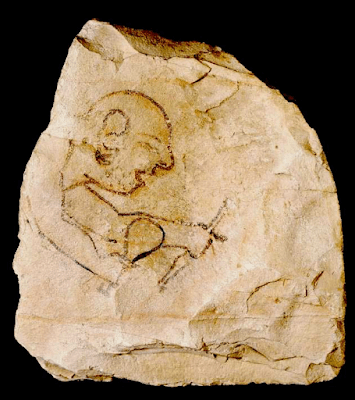
Ostracon representing a stonemason – Limestone – Ramesside period – 1200-1153 BC Fitzwilliam Museum, Cambridge – E.GA.4324a.1943 (museum photo)
As it is still possible to see today in such a context, in all latitudes, this social discontent which manifests itself on the banks of the Nile is grafted onto a much more general malaise: “The political and economic situation of Egypt at the turn of the 12th century BC, Professor Nelson Pierrotti notes, was very unstable. The young King Ramses III had to stem further invasion attempts by a large coalition led by the ‘Sea Peoples’ and contain two Libyan invasion attempts in year 12 of his reign; the Pharaoh left to protect his Syrian possessions. The country will know a new era of prosperity at the end of this warlike period. But, little by little, economic problems call into question the prosperity of the Valley. In the modern sense of the term, that there was an economic crisis may explain part of the events. Pharaoh must replace his viziers. The administration no longer works well. But Ramses makes himself responsible for the situation. A plot to assassinate him, plotted by Tiyi, second royal wife, is even discovered. This idea of decadence has led Egyptologists to see in the episode of the conspiracy, the inevitable culmination of the long reign of Ramses III” (egyptos.net).
Mounted on scaffolding, artisans polish a seated royal colossus of pink granite. Tomb of Vizier Rekhmire – TT 100 – Theban Necropolis – 18th Dynasty
A clarification: when the author writes that “the administration no longer works well”, let us understand that corruption has appeared among civil servants, a symptom of a “disintegration” of Egyptian society, the immediate effect of which is a weakening of the country’s economy.
The ingredients of a strike in the most modern sense of the term are making their first appearance: picketing, confrontations with the forces of order, occupation of premises – key buildings of the central administration, even temples – to “claim salary arrears”, as Professor Christian Leblanc points out; foot-to-foot negotiations, if necessary accompanied by “violent altercations”, to win the case.
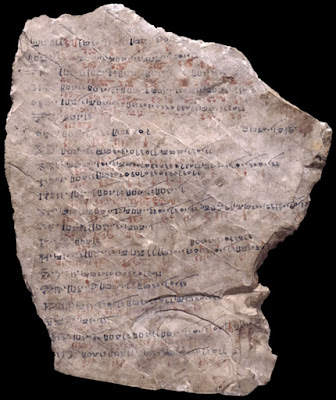
Limestone ostracon: register of absence from work in the year 40 of Ramses II. Only 2 out of 40 workers have never failed. Among the motives, services rendered to others (leader, scribe, colleague) figure prominently. We also find “participation in a drinking party” or “his wife has her period”… (Osirisnet.net) 19th Dynasty – British Museum – EA5634
“Obviously, writes Christian Leblanc, the prosperity of the kingdom which had been that of the time of the great king [Ramses II] had vanished, and in Thebes, on the left bank, the population came to react to the harsh consequences of this economic collapse. To the ambient austerity, imposed and difficult to bear, it responded with strikes and seditions… And so it was that one fine day in the second month of winter 1150 BC, the artisans of Deir -Medineh, destitute and hungry, showed their anger and shouted their grievances at the south gate of the Ramesseum. They demanded fish, vegetables, bread, oil and clothing… in short, as many foodstuffs and products as the surrounding memorials were used to distribute, at regular intervals and as a salary, to those who worked on the construction sites and the domains of the Crown. Although confronted by the police and other officials of the temple, the unfortunate protesters obtained, this time, satisfaction. Still, they were not reassured about the coming payments “(The Memory of Thebes, the Harmattan, 2015).
From promises and momentary satisfactions to new disappointments, the first strike in history lasted several weeks, with new twists over the next two years, despite the change of main interlocutor, Ta, having been invested with the duties of vizier of Upper and Lower Egypt. “We will not leave, the demonstrators tell the necropolis officials. Tell your superiors, when they are with their companions, that we have not only broken down the walls because of hunger, but we have to make an accusation important to formulate because crimes are committed in this place of the Pharaoh.”
“The strikes cease as soon as the payments, even small ones, resume, and they begin again as soon as the delays accumulate again. They recur episodically until around the middle of the reign of Ramses IX” (Dominique Valbelle).
Statuette of the architect Khâ – wood – 18th Dynasty from his tomb (TT 8) at Deir el-Medina discovered on February 15, 1906, by Ernesto Schiaparelli – Egyptian Museum of Turin – S. 8335
“You have to know how to end a strike”: this modern slogan is no doubt also valid for the events that marked the last years of Ramses III. We do not find any indications relating to the end of this first strike in history. But, in the same global context of what are called “social demands,”: “This is the first strike to our knowledge, writes François Daumas, whose history has preserved the memory. The embezzlements have emptied the attics of the state, and we can no longer pay the humble workers. They revolt, refuse to work and remain in their barracks but derive only meagre profits. The administrative balance is distorted. Corruption reigns. And it is significant to note that it was during this period that the looting in the necropolis began. Religious ideas no longer have a hold on minds when stomachs are tormented by hunger.” (“La civilization de l’Egypte pharaonique”, Arthaud, 1971)
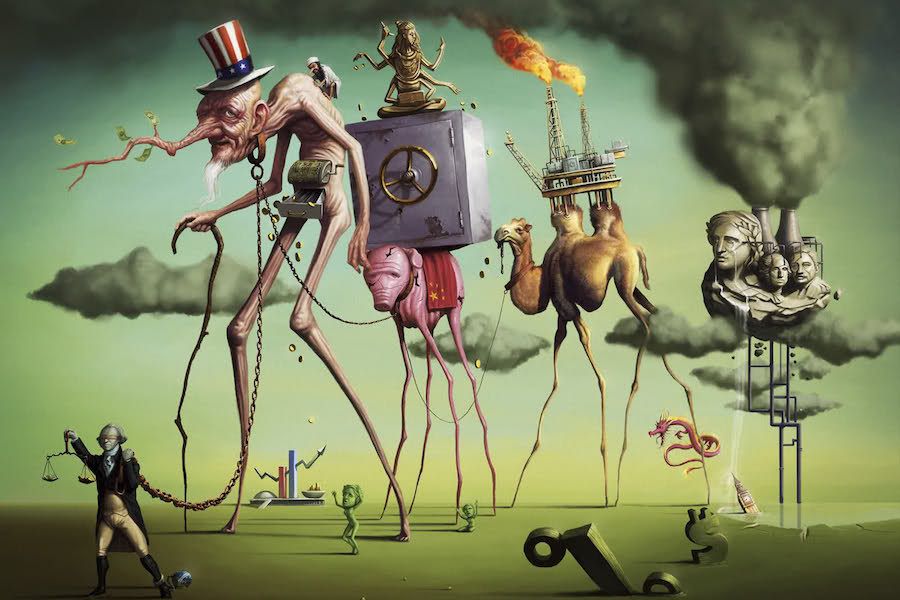
I don’t know if you have as same jargon as we have in Persian: “I feel like a wooden stick with both shitted ends!” Of course, the polite form of it is with both golden ends; anyway, my confusion is enormous. I don’t want to moan again; I just want to let you know that I’m going to visit friends today (alone!) because tomorrow, we have planned to go to Hamburg to see Roger Waters’ concert.I like him as I have always liked Pink Floyd and his way of making music and also his way of thinking. He was almost banned from giving concerts in Germany because he criticized the Israeli government and its handling of Palestine! But democracy and freedom of justice have declined it, giving him the freedom to perform his show.Although I don’t want to get involved in this conflict (in my opinion, both sides have to give in) to ban an artist because they have problems with their past, and their conscience is ridiculous! There is no limit to free speech.Anyway, let’s rock & roll…🤟🖖🥰💖The Image at the top: Oszagh Picture on Canvas – The American Dream by Salvador Dali.
The collective unconscious, as we understand it today, was never a matter of “Psychology”, for before the Christian Church existed, there were antique mysteries, and these reach back into the grey mists of Neolithic prehistory. Carl Jung, CW 9i, para 21. (from Carl Jung Depth Psychology, The Image by Craig Nelson)
Leonardo da Vinci, as we know him as a riddle of all time, painted this tableau like his other works and let us puzzle! Indeed, he is a topic for psychoanalysis, and Freud couldn’t stay immune: in his book; A Childhood Memory Of Leonardo da Vinci, he talks about the motherhood or feminine feeling of Leonardo and examples of his painting with the interpretation of a hidden bird (vulture) in Maria’s garment. Although, it seems that Freud made a mistake, as we read here in this article: (You can also read the whole of Freud’s book)
I put a similar image as the last post, but it is not the same; I will explain! (the first part plz, here)
FREUD’S MOMENTOUS TRANSLATION ERROR Of high importance for Freud’s argumentation is the vulture, which he regards as a mythical symbol of mother love. He cites a childhood memory of Leonardo, but he mistranslates it. The Italian word “nibbio” does not mean vulture, as Freud mistakenly assumes, but means a kite, a bird of prey.
Furthermore, Freud recognises the vulture as a conundrum in a painting by Leonardo. It is an achievement of Freud at all, that conundrums are accepted in a scientific context and, furthermore, even understood as a window into the soul of the artists. Encouraged not least by this, one of Freud’s admirers, the surrealist painter Salvator Dalí, made offensive use of it within the framework of the method of “critical paranoia” that he himself had devised!
The vulture in white outline discovered by Freud’s student Oskar Pfister bumps with the lower end of its tail against the lips of the baby Jesus
Whatever the bird might be or Freud’s assumption about Leonardo’s sexual orientation, it doesn’t matter to Jung. His main point is to analyse if Leonardo wanted to show any dual maternity in this painting. He goes deeper into the meaning of this figure (vulture or kite) with the old interpretation as Greek Pneuma: Wind and Spirit (Geist)
Now let’s keep reading about his analysis.;
2; The psychological meaning of the collective unconscious. (b)
But it is completely out of the question that all people who believe in dual descent actually always had two mothers, or conversely that the few who share Leonardo’s fate would have infected the rest of humanity with their complex. The fact is that one cannot help but assume that the universal occurrence of the fantasy of double birth, and simultaneously with it the fantasy of the two mothers, corresponds to a pervasive human need, which is reflected in this theme. Now, if Leonardo da Vinci really portrayed his two mothers in Saint Anne and Mary – which I doubt – he was merely expressing what untold millions of people before and after him believed. Likewise, the vulture symbol discussed by Freud in that paper only makes this view more plausible. He rightly cites Horapollo’s>Hieroglyphica< as the source of the symbol (Horus Apollo: Selecta hieroglyphica, sive… 1597; cf. Freud: Einekinderinnerung des Leonardo da Vinci, 1910, p. 24 ff.), a book published in was very common at the time. In it, one reads that vultures are only female and symbolically mean the mother; they are conceived by the wind (Greek: pneuma). This word pneuma, mainly under the influence of Christianity, took on the meaning of ‘spirit’. Even in the Pentecostal account, pneuma still has the dual meaning of wind and spirit.
In my opinion, Virgo, conceived by the pneuma, that is, like a vulture. In addition, according to Horapollo, the vulture is also the symbol of Athena, who sprung directly from the forehead of the highest god, was a virgin, and apparently only knew spiritual motherhood. All of this points clearly to Mary and the motif of rebirth.
There is not a shred of evidence that Leonardo could have meant anything else with this picture. If it is correct to assume that he identifies himself with the Christ Child, he is, in all likelihood depicting the double mythical motherhood, but in no case his own personal story. And what about all the other artists who have depicted the same motif? Indeed they didn’t all have two mothers?
Transferring Leonardo’s case to the realm of neuroses, let us assume that the patient has a mother complex and that he suffers from the delusion that the cause of his neurosis is that he really did have two mothers. The personal interpretation would have to admit that he was right, yet, in reality, it would be completely wrong. Then basically, the cause of his neurosis would be the reawakening of the archetype of the double mother, completely independent of whether he had one or two mothers; for, as we have seen, this archetype functions individually and historically without any connection with the relatively rare occurrence of double motherhood.
It is, of course, tempting to assume such a simple and personal cause, but the hypothesis is not only imprecise but thoroughly wrong. To be sure, it is difficult to understand how a double-mother motif—unknown to a physician trained only in medicine—could have had such a determining power that it had the effect of a traumatic state. But when we consider the enormous powers hidden in the mythic realm of humans, the causal significance of the archetypes seems less fantastic. In fact, there are numerous neuroses which indicate disturbances which are to be derived directly from the fact that the patient’s psychic life is devoid of the cooperation of these driving forces. Nevertheless, purely personal psychology, by reduction to personal causes, tries its best to deny the existence of archetypal motives and even seeks to destroy them in personal analysis. I think this is quite a dangerous undertaking. The nature of the involved forces can be better assessed today than twenty years ago. Aren’t we witnessing how a whole, great nation is reviving an archaic symbol, even archaic forms of religion – and how this new emotion affects the individual in a revolutionary and transformative way? The man of the past is alive in us to the degree that we could not have dreamed of before the war, and ultimately what is the fate of great peoples but the summation of the psychic changes of individuals?
Insofar as neurosis is actually only a private matter, namely has its roots solely in personal causes, archetypes play no role at all. But when it is a matter of general incompatibility or some other harmful condition causing neurosis in a relatively large number of individuals, we must assume the presence of archetypes. Since neuroses are, in most cases, not just private affairs but social phenomena, we must also assume the existence of archetypes in most cases: The sort of archetype appropriate to the situation is revived, and as a result, those explosive, and, therefore so dangerous, drivers latent in the archetype spring into action, often with unpredictable results. Yes, there is no evil to which people under the rule of an archetype cannot fall. If, thirty years ago, someone had dared to predict that psychological developments would point in the direction of a resurgence of medieval persecution of the Jews, that Europe would again tremble before the Roman bands of lictors and the marching legions, that the Roman salute could be reintroduced as it was two thousand years ago, and that instead of the Christian cross, an archaic Swastika would bait millions of wars to death—this man would have been denounced as a mystical fool. And today? As startling as it may seem, all this madness is a dreadful reality. Private lives, private motives and causes, and private neuroses have become almost fictional in today’s world. The man of the past, who lived in a world of archaic representations collectives, has risen back to a very visible and painfully real life, not just in a few unbalanced individuals, but in tens of millions.
There are as many archetypes as there are typical situations in life. Endless repetition has imprinted these experiences on the psychic constitution, not in the form of images filled with content, but at first, almost only as forms without content, representing merely the possibility of a certain type of perception and action. When something happens in life that corresponds to an archetype, this is activated, and a compulsion arises, which, like an instinctive reaction, prevails against reason and will or provokes a conflict that becomes pathological, i.e. neurotic grows.
Next part: The proof method 🤗💖
The image at the top: Anna Selbdritt, Leonardo da Vinci, c. 1502-1519, Musée du Louvre – Paris
Source:
On “The concept” of the collective unconscious (1936): Lecture 1936 in the Abernethian Society at St Bartholomew’s Hospital, London, under the title “The Concept of the Collective Unconscious < published in the journal of that hospital, XLIV, London 1936/37, p .46-49 and 64-66. The first edition of the German translation in Collected Works (CW), Volume 9/1, pp. 55-66.























 lampmagician

You must be logged in to post a comment.