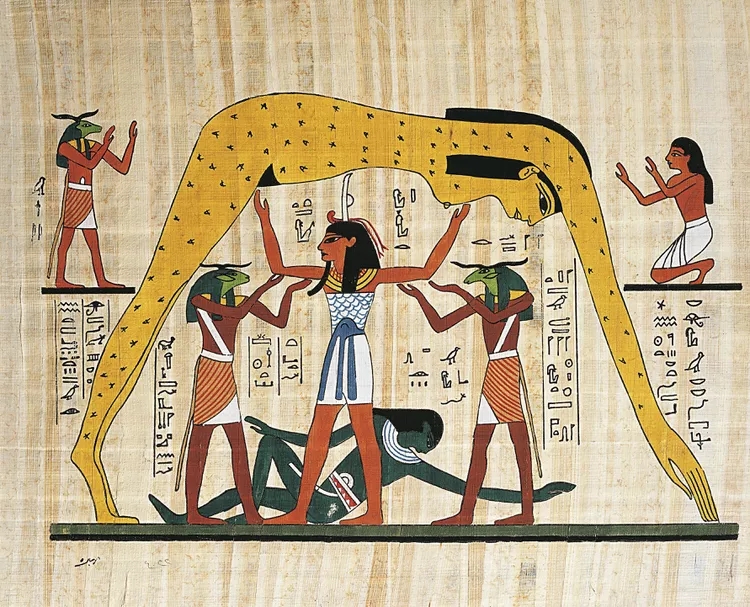
Egyptian civilization. Papyrus. Scene of creation. The sky-goddess Nut, covered with stars, is generated by Geb, the god of the earth. Reconstruction of a fresco from a tomb at Thebes, Valley of the Kings. Cairo, Istituto Del Papiro
As we all know, yesterday marked International Women’s Day, and many posts were published on this topic. I apologize for being late to the celebration; I was until now occupied with my grandson, Ilias! This is the first time I have decided to participate in this acknowledgement match, not just because of a lack of time but because I have some reservations about celebrating a cause on a single day and then forgetting about it for the rest of the year. Perhaps it’s true that those in charge choose to memorialize and celebrate under a specific title to alleviate their guilt instead of resolving the issues. However, I believe in using this special day to awaken their consciousness and galvanize them into action.
How well described Marion Woodman about the core of the issue.
via Petra Glimmdall 🙏💖
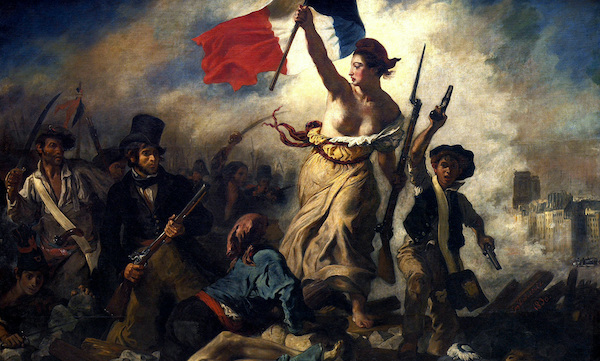
I have frequently written about women’s missing rights and opportunities in society, and I have noticed that progress is being made. A recent example is the approval of a new law by the French parliament to add the right to abortion to their constitution. Bravo! Viva France!
Liberté, Égalité, Fraternité:
The concept is that if we believe in the duality of everything: cold – warm, above – below, bright – dark, woman – man, etc. Then, they not only mutually prove each other’s existence but also complement each other’s evolution. To comprehend these concepts, we should ponder twice (as the Germans say: Nachdenken!). Coldness would hold no significance if we always had everything cold and were unaware of warmth. Similarly, if we were constantly surrounded by brightness without ever experiencing darkness, we would never be able to comprehend the value of brightness. And it would be the same about feminine and masculine: Anima & Animus.
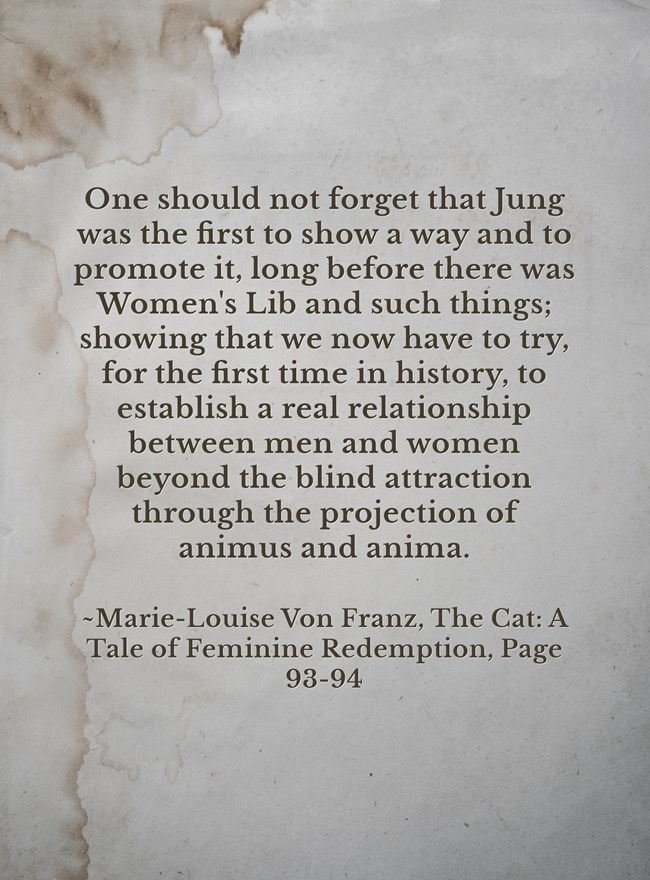
C. G. Jung introduced terms to describe specific functions of the human “soul” and “mind” ( Anima and Animus, Latin). I have published a partitional post about this issue before. Anima names the feminine unconscious factor in a man, while animus applies to the corresponding masculine factor in a woman’s unconscious.
I believe these are suitable lessons that will make us aware of how to help each other along the difficult path towards achieving the goal or the Self. This is how we can help each other because without encountering the other side, we are incomplete!
However, I have to repeat myself sadly, of man’s blindness as his stupid vanity has damaged a perhaps brave new world!
I still keep looking around me and observing my behaviour in life, and I wonder more and more how much obsession overwhelms me! I mean all the effort I use to be perfect. I strive for everything to go flawlessly, to the point where even the slightest mistake is unacceptable. I know it’s crazy, but I fear leaving things incomplete or unfinished as I grow older. Maybe because the mistakes of the past cannot be rectified or compensated?! I’m aware that this may seem almost autistic, and I make a conscious effort to maintain balance in all aspects of my life. However, it’s not an easy feat. Of course, as we age, we tend to become more carefree as we are on the way to kicking the bucket, or better to say, changing the level, we realize that things lose their worth. One positive aspect of ageing is that we become less concerned about things and more carefree.
A few days ago, I suddenly remembered an old movie comedy from decades ago when I was a teenager. Its name was “Kiss Me, Stupid“, an American movie from 1964, directed by the master of comedy, Billy Wilder. The story is about an amateur songwriting team, Barney Cliff Osmond and Orville Ray Walston, who suddenly find a famous musician, Dino Dean Martin, drunk and lost on his way to their gas station and trick him into staying a while so they can get his influence to publish their songs. Orville offers Dino a place to stay but becomes worried when he learns that Dino needs to have sex every night to avoid headaches upon waking up!
He and Barney arrange for Polly the Pistol Kim Novak, a saloon waitress, to pose as Orville’s wife, Felicia Farr and satisfy Dino, but Orville can’t handle it at all.
Anyway, in this movie, the main psycho character, in my opinion, is Orville, who, with his jealousy and obsession with love and his women, screws everything up! I don’t want to give away the entire plot, as you may watch it someday. I just want to say I was very angry with him when I watched this film; his acting to keep everything for himself was unbelievable, but now I have some sympathy for him. Nonetheless, I would never act in his way. I believe he was jealous of Dino for being loved by every woman!
Now that I am at an age where this topic is no longer relevant, I feel that time dashes, and we must make the most of every minute. I recently came across a Persian anecdote in a WhatsApp exchange, and I found it amusing, so I decided to translate and share it with you. Take care, and have a great weekend.🤗🙏💖
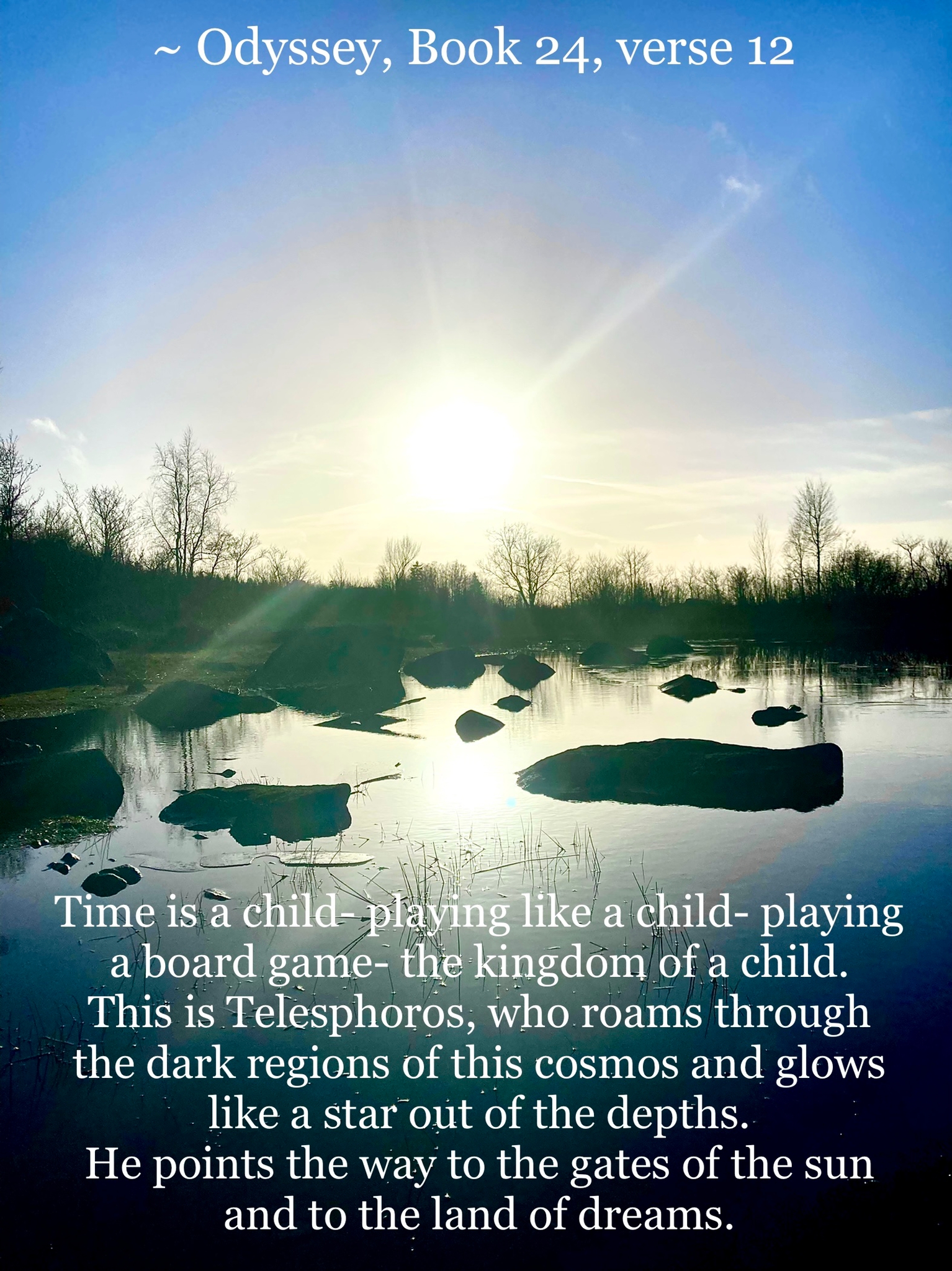
image by crilleb50
Life in a Nutshell.
One day, some old friends who were all 40 years old wanted to make a date to have dinner together. After checking different restaurants, they finally agreed to go to Ali Agha’s restaurant because there are beautiful working maids….!
Ten years later, when they were all 50, they decided to have dinner together again. And after checking different restaurants, they finally agreed to go to Ali Agha’s restaurant because it has delicious food.
Ten years later, at 60, they again decided to have dinner together and finally agreed to go to Ali Agha restaurant because it has a calm and quiet environment.
Ten years later, at 70, they decided to have dinner together again. Finally, after checking different restaurants, they decided to go to Ali Agha restaurant because it has an elevator and a particular way for wheelchairs!
And finally, ten years later, when they were all 80 years old, they decided to have dinner together again. After checking different restaurants, they finally agreed to go to “Ali Agha” restaurant because they all concluded that they had never been there…!!
The advice we get from this story is a clear view of the play of life that is always on the screen! So, use the present time in the best way. 😉
This fascinating jewel is not only a designer piece but a symbol of birth and rebirth! Here is another brilliant article by Marie Grillot about the secret of this magical lotus jewel, which will remain forever.
This pendant comes from the treasure of Princess Mérit (Mereret), whose tomb was found in March 1894 by Jacques de Morgan in the sector of the “northern pyramid” of Dahchour.
Kha and Merit receive offerings on a painted chest from two of their children. By Museo Egizio
Cloisonné gold pendant of a princess of Dahchour
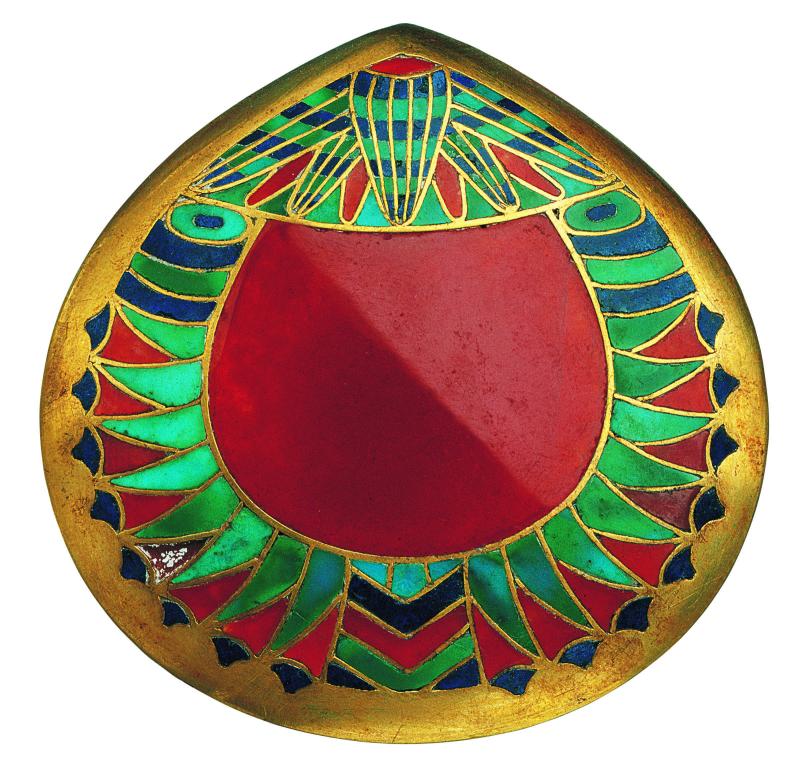
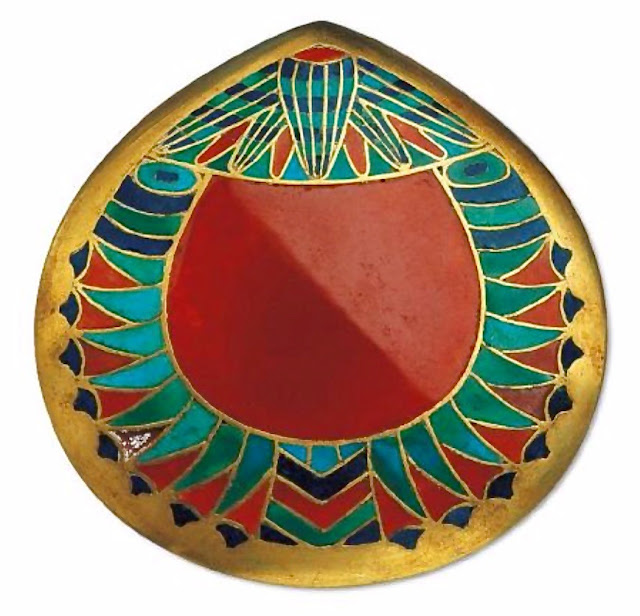
Cloisonné gold pendant of Princess Merit (Mereret) – gold, carnelian, turquoise, lapis lazuli Middle Kingdom – 12th Dynasty – Reigns of Sesostris III and Amenemhat III – 1878 – 1798 BC-AD discovered in his tomb in Dahchour on March 6, 1894, during excavations carried out by Jacques de Morgan Egyptian Museum in Cairo – CG 53070 – JE 30877 – photo of the museum
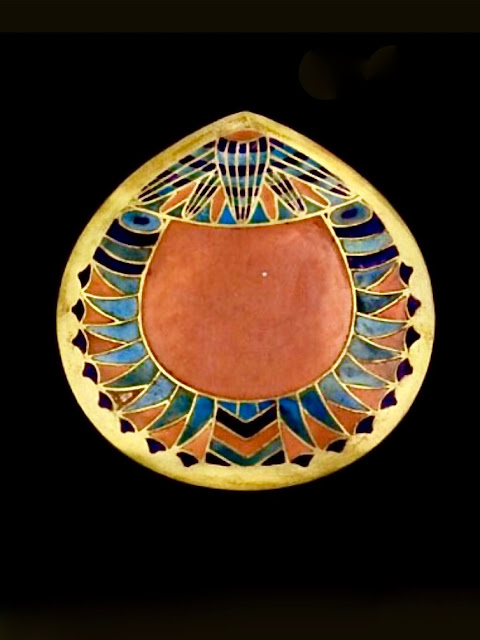
This lovely pendant is made of cloisonné gold, garnished with semi-precious stones. The brilliance that the gems reflect, their perfect execution, and their exceptional state of conservation make it difficult to believe that they are almost… 4000 years old!
It takes the shape of a “convex” shell, the upper part representing an open lotus flower. Its petals, pointing downwards, are made of a delicate and luminous cloisonné composed of turquoise, lapis lazuli and carnelian.
Cloisonné gold pendant of Princess Merit (Mereret) – gold, carnelian, turquoise, lapis lazuli Middle Kingdom – 12th Dynasty – Reigns of Sesostris III and Amenemhat III – 1878 – 1798 BC-AD discovered in his tomb in Dahchour on March 6, 1894, during excavations carried out by Jacques de Morgan Egyptian Museum in Cairo – CG 53070 – JE 30877 published here in “Jewelry and goldsmiths. Booklet 3”, Émile Vernier
“Under this area, the main decoration develops. The middle is occupied by a carnelian of unusual dimensions: 0 m. 021 millimetres high and 0 m. 026 millimeters wide. Its general shape is close to a circle, part of which is cut by the upper area. All around the carnelian, a decoration is developed made, in the axis, of alternating cloisonné chevrons: lapis, carnelian and turquoise, and on each side, curved serrations of turquoise, leaving between them curvilinear triangles in carnelian followed by other small triangles of lapis, then approaching the upper area, alternating bands of lapis and turquoise and ending with an ellipse in turquoise having as its middle a small ellipse of lapis is framed by a fairly wide edge where the gold is bare. The reverse is made of a concave plate of plain gold, where we see a horizontal ring in the upper part, flat and vertically striated,” explains Emile Vernier (Jewelry and goldwork. Booklet 3).
Cyril Aldred’s interpretation follows: “The pendant… is inlaid with a motif inspired by the lotus flower from which is suspended a crown of stylized flower petals, ending in a pendant of three chevrons”.
As for Nigel Fletcher-Jones (“Ancient Egyptian Jewelry”), he specifies that “The pendant was originally suspended from a chain of gold beads to which twenty-six small oyster shells were soldered at regular intervals”.
Cloisonné gold pendant of Princess Merit (Mereret) – gold, carnelian, turquoise, lapis lazuli Middle Kingdom – 12th Dynasty – Reigns of Sesostris III and Amenemhat III – 1878 – 1798 BC-AD discovered in his tomb in Dahchour on March 6, 1894, during excavations carried out by Jacques de Morgan Egyptian Museum in Cairo – CG 53070 – JE 30877 – photo of the museum
This jewel is loaded with symbols and “powers”… Thus, the oyster shell was, for a short period of the Middle Kingdom, an amulet which, according to Carol Andrews (Amulets of Ancient Egypt) “, gave health” and brought well-being to the person who wore it… As for the lotus, which is very present in Pharaonic iconography, it is not only the symbol of birth but also that of rebirth.
The stones used are also loaded with symbolism. In “The Gold of the Pharaohs”, Christiane Ziegler provides these details: “The ‘méfékat’ turquoise was extracted from Sinai where the pharaohs launched mining expeditions. Its luminous colour, evoking the growth of young shoots in spring, was synonymous with vitality and joy. Its presence in the funerary equipment undoubtedly gave the dead the joy of rebirth.” Carnelian, Héréset, “possessed the invigorating virtues of blood”. As for lapis lazuli, she explains to us: “in ancient myths, it constituted the beard and hair of the gods and had virtues comparable to those of turquoise”…
Pyramid of Amenemhat III in Dahchour Photo by Jacques de Morgan published in “Excavations at Dahshur”, 1894
This pendant comes from the treasure of Princess Mérit (Mereret), whose tomb was found in March 1894 by Jacques de Morgan in the sector of the “northern pyramid” of Dahchour.
In his work “Excavations at Dahchour”, published the same year, he relates: “The underground necropolis that I had just opened was therefore not the tomb of the king, but rather the gallery of the princesses, one of the annexes of the tomb principal. Later, I discovered among the treasures the names of the princesses Hathor-Sat and Merit and the titles of a sixth royal daughter on the worm-eaten remains of a wooden box. Then he adds, “Meticulous examination of the floor of the galleries revealed on March 6 a cavity dug in the rock at the foot of sarcophagus C. The ground was loose,e and the worker’s foot sank into the middle of the moving debris. A few blows of the pickaxe revealed its treasures: gold and silver jewels and precious stones were there, piled up in the middle of the worm-eaten fragments of a box where they had once been kept. “
Cloisonné gold pendant of Princess Merit (Mereret) – gold, carnelian, turquoise, lapis lazuli Middle Kingdom – 12th Dynasty – Reigns of Sesostris III and Amenemhat III – 1878 – 1798 BC-AD discovered in his tomb in Dahchour on March 6, 1894, during excavations carried out by Jacques de Morgan Egyptian Museum in Cairo – CG 53070 – JE 30877 published here in “Excavations at Dahshur” by Jacques de Morgan
Georges Legrain, who worked alongside him, was responsible for drawing up the first jewellery catalogue and faithfully reproducing drawings and watercolours. The large number of pieces to be presented will mean that this pendant will be described in a laconic manner: “Bivalve shell decorated with multicoloured stones on its convex part. The main design represents a lotus flower supporting an indefinite red object, from which herbs escape …”
Jacques de Morgan brandishing one of the pieces of Dahchour’s treasure (Princess Khnoumit’s tiara) during its discovery in April 1894 in the funerary complex of Amenemhat II in Dashour (drawing published in “L’Illustration” on May 11, 1895)
We can only subscribe to the words of Pierre Tallet in his work “Sesostris III and the end of the 12th Dynasty”: “One last area where the ending 12th dynasty seems to have particularly excelled is that of jewellery. The royal necropolises of this period thus delivered the first truly important collection of Egyptian jewellery, for the most part, intended for women in the pharaoh’s entourage: jewellery and toiletries from Sat-Hathor-Iounet to El-Lahoun, Mereret… These different lots of Precious objects, where gold, silver and various fine stones such as lapis lazuli, turquoise, amethyst and carnelian abound, give an idea of the splendour in which the royal family lived.
This pendant was registered in the Journal of Entries of the Cairo Museum under the reference JE 30877 and in the General Catalogue CG 53070.
Marie Grillot
Sources:
Excavations at Dahchour, Jacques de Morgan, Berthelot, M. (Marcellin), Legrain, Georges Albert, 1865-1917; Jquier, Gustave, 1868-1946; Loret, Victor, 1859-1946; Fouquet, Daniel https://archive.org/details/fouillesdahcho01morg/page/n213/mode/2up Dahchour excavations: 1894-1895, Jacques de Morgan, Wien 1903, http://digi.ub.uni-heidelberg.de/diglit/morgan1903/0049 Jewellery and goldsmiths. Booklet 3, Number 52640-53171, by Mr. Émile Vernier http://gallica.bnf.fr/ark:/12148/bpt6k57740426/f96.item.r=52859.texteImage Summary list, booklet published in 1894 by M. de Morgan; Excavations at Dahchour, II; Morgan’s catalogue, 1897 by Morgan Jacques. Letter on the latest discoveries in Egypt. In: Reports of the sessions of the Academy of Inscriptions and Belles-Lettres, 38th year, N. 3, 1894. pp. 169-177; https://doi.org/10.3406/crai.1894.70401https://www.persee.fr/doc/crai_0065-0536_1894_num_38_3_70401 Jewellery and goldsmiths. Booklet 3, Number 52640-53171, by Mr. Émile Vernier http://gallica.bnf.fr/ark:/12148/bpt6k57740426/f96.item.r=52859.texteImage The gold of the pharaohs – 2500 years of goldsmithing in ancient Egypt, Catalogue of the summer 2018 exhibition at the Grimaldi Forum in Monaco, Christiane Ziegler Jewels of the Pharaohs, Cyril Aldred, ed Thames & Hudson Ltd. London, 1978 Ancient Egyptian Jewelry: 50 Masterpieces of Art and Design, 2019, Fletcher-Jones, N, The American University in Cairo Press Ancient Egyptian Jewelry, Carol Andrews, Harry N. Abrams, INC., Publishers, 1991 Amulets Of Ancient Egypt, Carol Andrews, published for Trustees of the British Museum by British Museum Press https://archive.org/details/AmuletsOfAncientEgypt_201707 Treasures of Egypt – The wonders of the Egyptian Museum in Cairo, Francesco Tiradritti
And the story continues; the youths’ uprising moves on despite they were executed every cock crowing time: They will never surrender!
Artwork: Renato Guttuso
As hard as this weather is, wait for me
“This time is difficult, wait for me: we will live it out vividly. give me your tiny hand: let us rise up and suffer, let us experience and rejoice.
We are once more the pair who lived in bristling places, in harsh nests in the rock. This time is difficult, wait for me with a basket, with a shovel, with your shoes and your clothes.
Now, we need each other not only for the carnations’ sake, not only to look for honey: we need our hands to wash with and to make fire, and just let the hard times dare to challenge the infinity,
What matter is with you? Regina, my wife, asked me a few days ago. I looked at her with confusion and asked what she meant. She said she was referring to my lack of enthusiasm towards my work; I used to be excitedly busy with my WordPress and would run to my room every morning to write a new story, but she noticed that I had lost that passion lately. After considering this, I had to admit that she was right. I seem to be losing the drive and motivation to create new stories. As I analysed myself, like so often I do, I have noticed that I am (too much) involved in very high themes with such great individuals like Dr Jung, Nietzsche, Gibran, etc., and I feel a bit exhausted, “intermingle with the greats is not everybody’s job!”
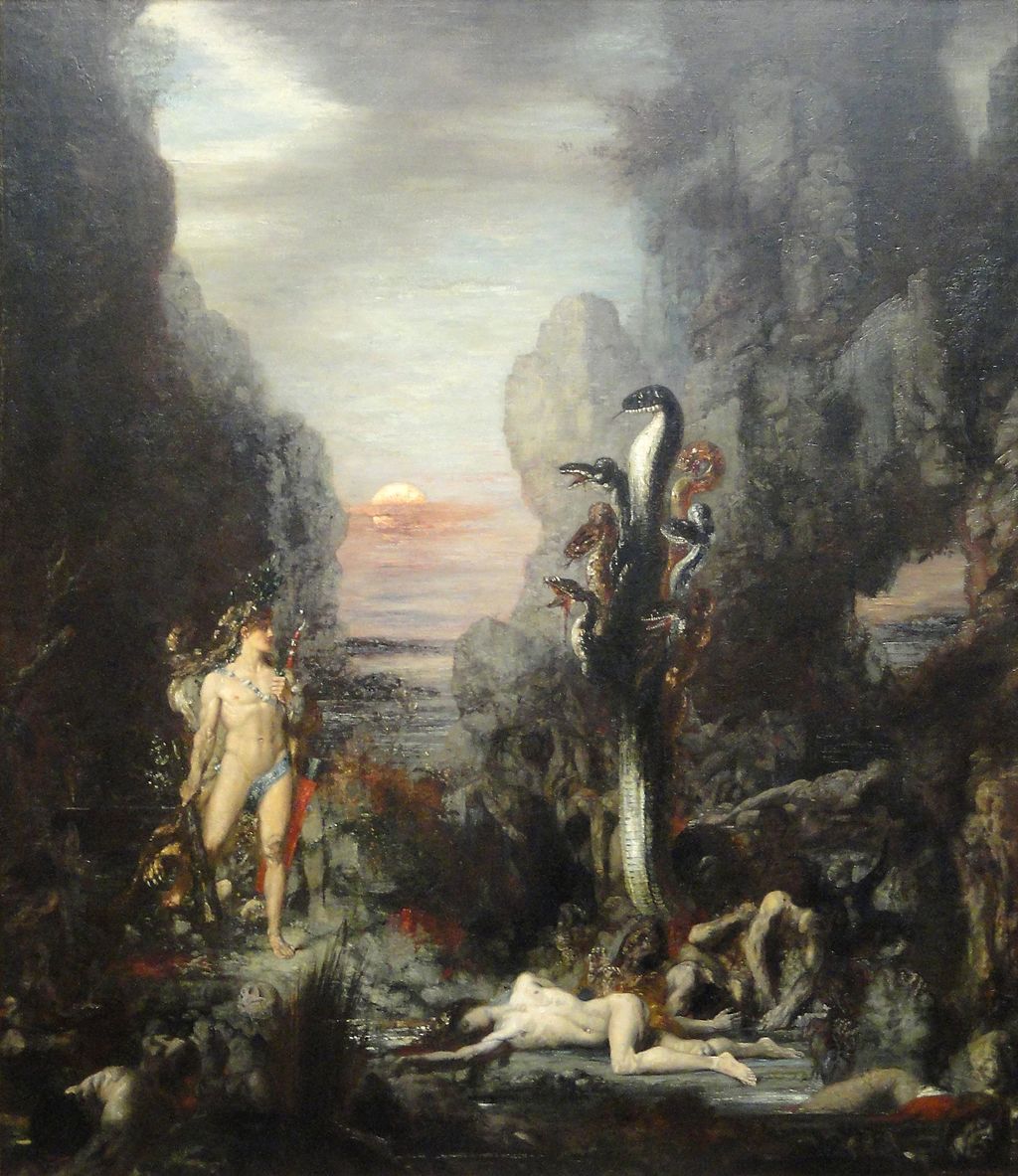
Hercules and the Lernaean Hydra, 1875-1876, by Gustave Moreau – Art Institute of Chicago
I believe that one’s expectations are crucial in determining success. I have noticed that with each article I write, I tend to push myself to do better and aim higher, which might be good. (I must thank YOU, all my lovely friends, who inspired me so much).🙏💖🙏 But, I have also realized that sometimes I may have gone too far, just like Icarus, whose wings melted in the sun’s rays and fell. This is where the book ‘Great Expectations’ by Charles Dickens becomes relevant. We must be honest with ourselves and know where we stand. Ultimately, happiness is not an unachievable goal but a state of inner peace and calmness.
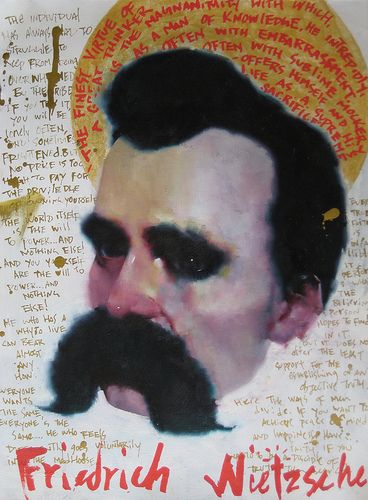
Hence, I decided to come down and take it more easily. Although this new post is from Nietzsche, as I stumbled upon lately, it is a short text and relevant today: losing the child inside us! This child gives us the imagination to have fantasies. Nietzsche noticed it centuries ago, and it is didactic.
The Free Spirit, from Beyond Good and Evil, par. 31, by Friedrich Nitzsche
I had to work on translation to make Nietzsche’s complex grammar more understandable!😉
At a young age, one worships and despises without that art of nuance, which is the best gain in life, and one has to pay a fair amount of punishment for having attacked people and things with Yes and No in this way. Everything is set up so that the worst of all tastes, the taste for the unconditional, is cruelly fooled and abused until people learn to put a little art into their feelings and rather dare to try something artistic, like the right ones do Artists of Life do. The anger and awe that characterizes youth does not seem to rest until it has manipulated people and things so that it can be vented on them – youth is itself something more counterfeit and deceitful. Later, when the young soul, tormented by loud disappointments, finally turns back suspiciously on itself, still hot and wild, even in its suspicion and remorse: How angry they are now, tearing themselves apart impatiently, how taking revenge for their long self-delusion as if they had been voluntary blindness! In this transition, one punishes oneself by distrusting the feelings; one tortures one’s enthusiasm through doubt; one even feels one’s good conscience as a danger, as it were as a self-concealment and a weariness of one’s finer honesty; and above all, they take orientation, fundamentally oriented against ‘youth’. – A decade later, they realize that all of this was still -youth!
I am an orphan, alone; nevertheless, I am found everywhere. I am one but opposed to myself. I am a youth and an old man at one and the same time. I have known neither father nor mother because I have had to be fetched out of the deep like a fish or fell like a white stone from heaven. In woods and mountains, I roam, but I am hidden in the innermost soul of man. I am mortal for everyone, yet I am not touched by the cycle of aeons.
Illustrated by Petra Glimmdall 💖🙏
C. G. Jung, Memories, Dreams, Reflections, p.227. (Bollingen Tower)
I made this part separately to show how instructive Dr Jung is, even though he didn’t want to teach! After describing his dreams, with the last one ending full of hope with him standing in front of a tree bearing leaves but no fruit, which then transforms into sweet grapes full of healing juice, Dr Jung, although humble, shares his wisdom and knowledge from his vast experience. Despite his insistence that he never intends to teach or give lessons, we can appreciate the profound wisdom contained within his words.
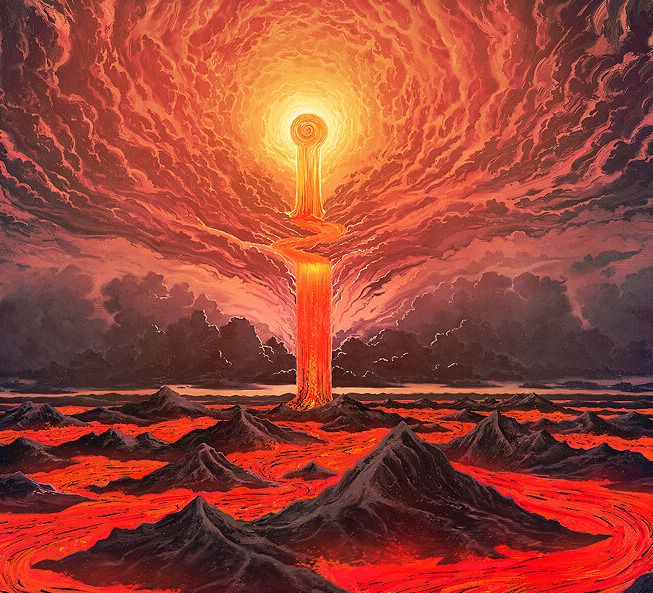
Title image: “Bleeding Light” By Jeffrey Smith.
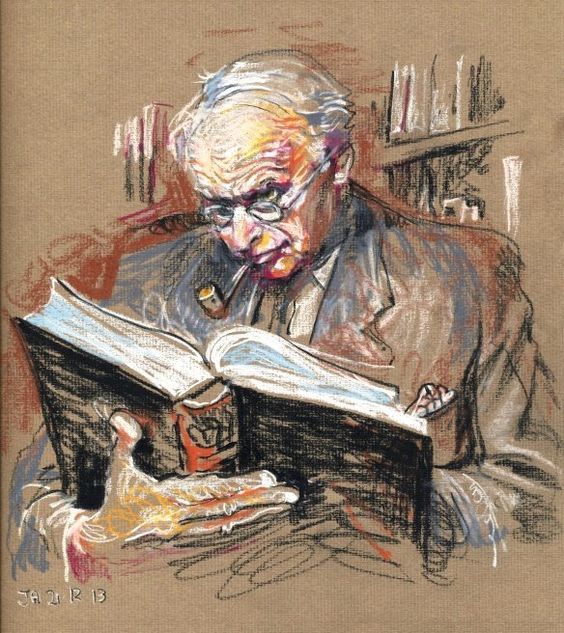
Drawings by Jane Adams
Liber Primus fol.i(v)
In reality, now, it was so: At the time when the great war broke out between the peoples of Europe, I found myself in Scotland, compiled by the war to choose the fastest ship and shortest road home. I encountered the colossal cold that froze everything; I met up with the flood, the sea of blood, and found my barren tree whose leaves the frost had transformed into a remedy. And I plucked the ripe fruit and gave it to you, and I do not know what I poured out for you, what bittersweet intoxicating drink left an aftertaste of blood on your tongues.
Believe me (my friends): It is no teaching and no instruction that I give you. On what basis should I presume to teach you? I provide you with news of this man’s way but not of your own way. My path is not your path; therefore, I / cannot teach you! (CF. the contrast to John 14:6: “Jesus said unto him, I am the way, the truth and the life: no man cometh unto the father but by me.) The way is within us, but not in Gods, nor in teachings, nor in laws. Within us is the way, the truth, and the life.
Woe betide those who live by way of examples! Life is not with them. If you live according to an example, you thus live the life of that example, but who should live your own life if not yourself? So live yourselves. (This is not a law, but notice of the fact that the time of example and law, and of the straight line drawn in advance, has become overripe”p.10)
The signposts have fallen; unblazed trails lie before us. (My tongue shall wither if I serve up laws if I prattle to you about teaching. Those who seek such will leave my table hungry!) Do not be greedy to gobble up the fruits of foreign fields. Do you not know that you yourselves are the fertile acre which bears everything that avails you?
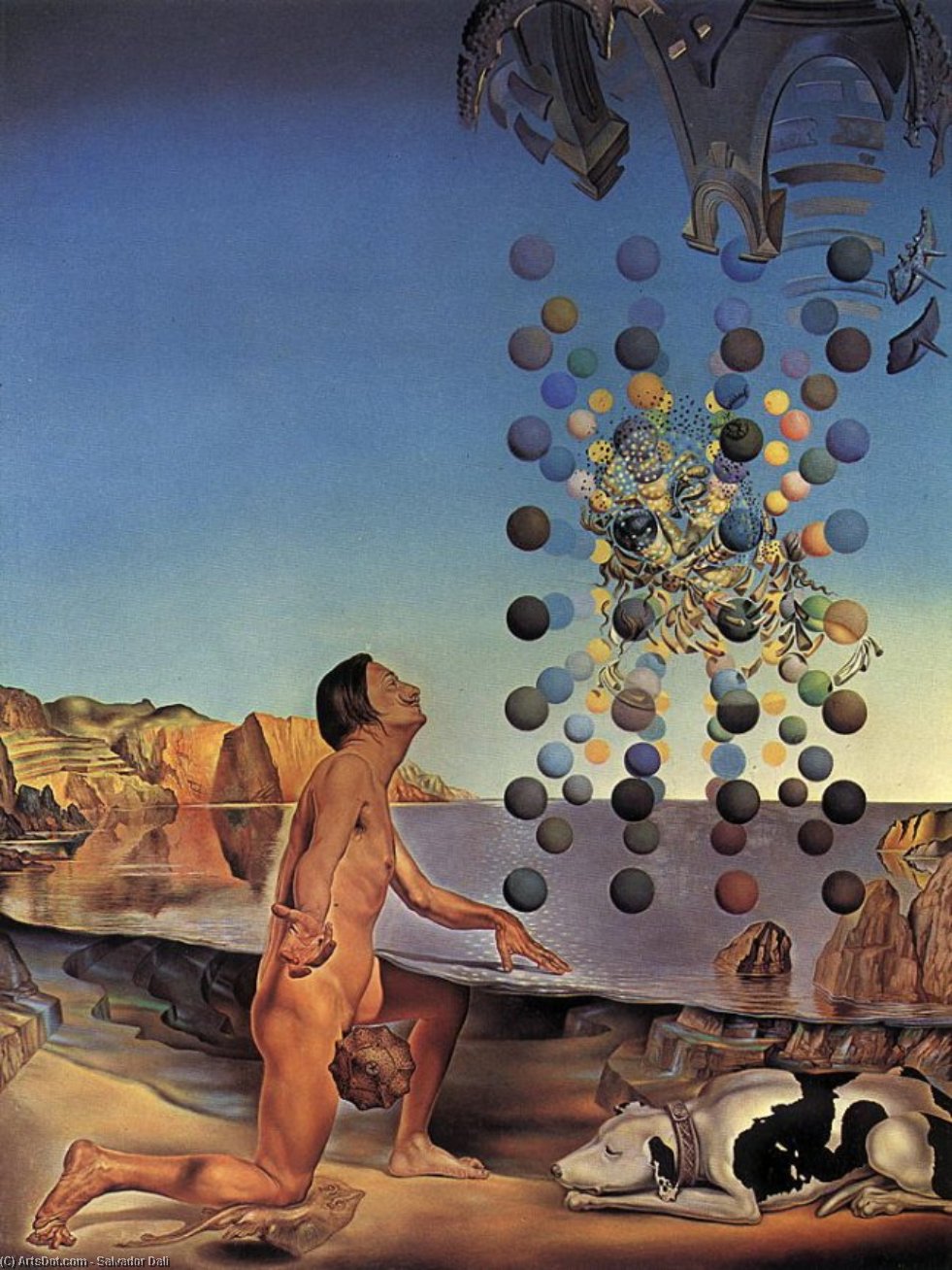
Salvador_dali-self-portrait_1954
Yet, who today knows this? Who knows the way to eternally fruitful climes of the soul? You seek the way through mere appearances, you study books and give an ear to all kinds of opinions. What good is all that? There is only one way, and that is your way. (only one law exists, and that is your law. Only one truth exists, and that is your truth”p.10)
May each go their own way!
I will be no saviour, no lawgiver, no master teacher unto you. You are no longer little children. (One should not turn people into sheep, but sheep into people. The spirit of the depth demands this, who is beyond present and past. Speak and write for those who want to listen and read. But do not run after someone so you do not soil the dignity of humanity- it is a rare good. A sad demise in dignity is better than an undignified healing. Whoever wants to be a doctor of the soul sees people as being sick. He offends human dignity. It is presumptuous to say that man is sick. Whoever wants to be the soul’s shepherd treats people like sheep. He violates human dignity. It is insolent to say that people are like sheep. Who gives you the right to say that man is sick and a sheep? Give them human dignity so they may find their ascendancy or downfall, their way”p. 11)
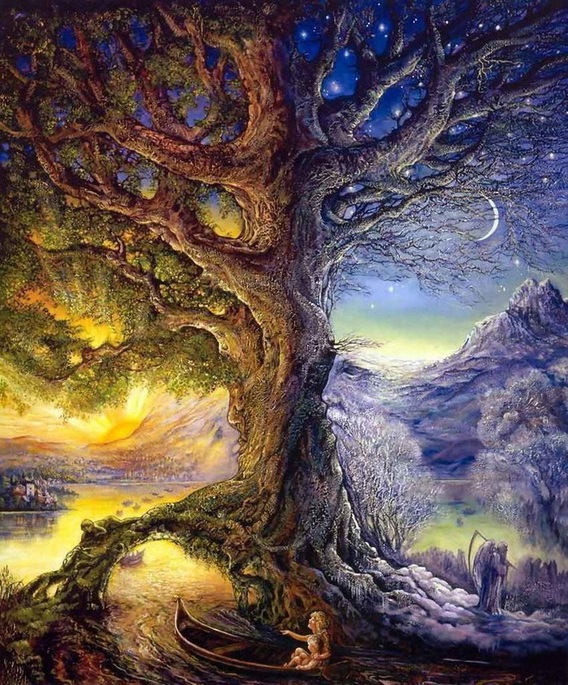
Art by Josephine Wall
Giving laws, bettering, making things easier, has all become wrong and evil. May each one seek out their own way. This way leads to mutual love in the community. Men will come to see and feel the similarity and community of their ways. Laws and teachings held in common compel people to solitude so that they may escape the pressure of undesirable contact, but solitude makes people hostile and venomous.
Therefore, give people dignity and let each of them stand apart so that each may find their own fellowship and love it. Power stands against power, contempt against contempt, love against love. Give humanity dignity and trust that life will find a better way. The one eye of the Godhead is blind, the one ear of the Godhead is deaf, and the order of its being is crossed by chaos. So be patient with the crippleness of the world and do not overvalue its consummate beauty. (This is all, my dear friends, that I can tell you about the grounds and aims of my message, which I am burdened with like the patient donkey with a heavy load. He is glad to put it down!”p.12)
Originally called Pa-ra-mes-su, Ramesses I, was of non-royal birth, born into a noble military family from the Nile Delta region, perhaps near the former Hyksos capital of Avaris. He was the son of a troop commander called Seti. His uncle Khaemwaset, an army officer, married Tamwadjesy, the matron of Tutankhamun’s Harem of Amun, a relative of Huy, the viceroy of Kush, a vital state post. This shows the high status of Ramesses’ family. Ramesses I found favour with Horemheb, the last pharaoh of the tumultuous Eighteenth Dynasty, who appointed the former as his vizier. Ramesses also served as the High Priest of Set – as such, he would have played an important role in restoring the old religion following the Amarna heresy of a generation earlier, under Akhenaten.
Ramses I making an offering before Osiris. Amsterdam. Alland Pierson Museum (Wikipedia)
I once published an article about this amazing Pharaoh (Here), and now we are reading a supplement on this fascinating story.
Here, we will read Marie Grillot‘s excellent description of the mysteries surrounding the mummy of Pharaoh Ramses I.
The image at the top, Egyptian Antiquities: Pharaoh Ramses I (1320-1310 BC), represents burning incense and pouring water at a ceremony. Volume of Ramses I, Valley of the Kings, Egypt (Meisterdrucke)
The tomb of Ramses I and the questions about his mummy…
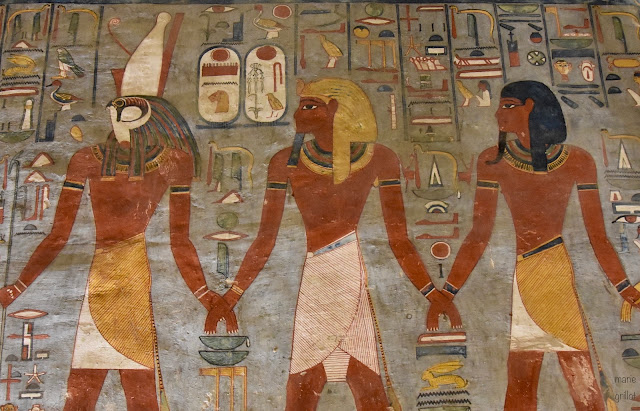
Pharaoh is welcomed into the afterlife by Anubis and Horus Tomb of Ramesses I – Valley of the Kings – KV 16 – 19th dynasty Discovered on October 11, 1817, by Giovanni Battista Belzoni on behalf of Consul Henry Salt
At the beginning of October 1817, Giovanni Battista Belzoni, working on behalf of the British consul Henry Salt, commissioned a team of around twenty fellahs to carry out surveys in the Valley of the Kings. On October 11, while they were at work in the southeastern wadi, their research was crowned by an extraordinary discovery. Belzoni thus relates it in “Journey to Egypt and Nubia”: “Around midday, I was told that the entrance to the tomb discovered the day before had been widened enough for us to enter… I was the first to enter the opening, which had just been made to see if the way was passable. After having traversed a passage thirty-two feet long and eight wide, I descended a staircase of thirty-eight feet and arrived in a room quite large and decorated with beautiful paintings.
Tomb of Ramesses I – Valley of the Kings KV 16 – 19th dynasty Discovered on October 11, 1817, by Giovanni Battista Belzoni on behalf of Consul Henry Salt
The key to reading the hieroglyphs was unknown; its “owner” – Ramesses I – would only be identified a few years later.
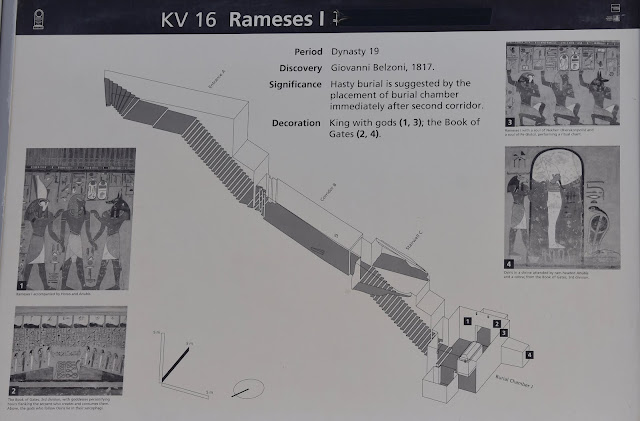
With an area of barely 148 m2, this tomb – referenced KV 16 – is one of the smallest in the necropolis. Its architectural plan is simple and rectilinear, with a stepped entrance followed by a sloping corridor that leads to a second staircase directly serving the burial chamber.
Signage panel with plan of the tomb of Ramesses I – Valley of the Kings KV 16 – 19th dynasty Discovered on October 11, 1817, by Giovanni Battista Belzoni on behalf of Consul Henry Salt
“It is clear that the plan owes much to the tomb of Horemheb (KV 57). This appears particularly in the decorative style, using blue-grey as a background for the scenes and texts. Some think that the same artists were at the origin of these two tombs,” specifies Kent Weeks.
The scenes for which “we have renounced all relief” (Erik Hornung) reveal a high pictorial quality and seduce with their chromatic richness of luminous harmony. The hieroglyphs are of extraordinary finesse, and the king’s cartouches are set against a white background. The lower part of the vignettes is, all around, bordered by two thick bands of colour: the first yellow bordered with black, the second red ocher. Then, the rest of the wall, down to the ground, is painted black. As for the upper part bordering the ceiling, which has not been painted, is composed of a frieze of Khekerous resting on a strip of alternating coloured rectangles.
A priest standing before Osiris prepares to receive Ramses I, led by Horus, Atum and Neith Tomb of Ramesses I – Valley of the Kings KV 16 – 19th dynasty discovered on October 11, 1817, by Giovanni Battista Belzoni on behalf of Consul Henry Salt
“The entrance to the sepulchral chamber is guarded by two figures of the goddess Maat, who welcome the deceased; the king is represented in the presence of the Memphite gods, Ptah and Nefertoum, and the deities of Abydos represented by the pillar-djed of ‘Osiris and the knot of lsis. On the side walls, several scenes from the Book of Doors evoke the Sun’s nocturnal journey. The back wall combines an Osirian scene on the right and a solar scene on the left. Far left, the king is shown in a position of jubilation, surrounded by the Souls of Pé and the Souls of Nekhen, the mythical ancestors of royalty.
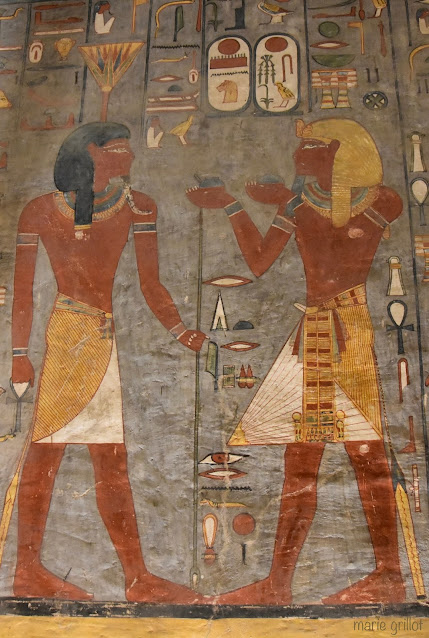
Ramses I facing the god Nefertum Tomb of Ramesses I – Valley of the Kings KV 16 – 19th dynasty Discovered on October 11, 1817, by Giovanni Battista Belzoni on behalf of Consul Henry Salt
The room has three small “annexe” rooms. The one dug into the southwest wall has a very beautiful scene representing Osiris standing between a divinity with the head of a ram and the serpent goddess Nesret, “the fiery breath” (it is, in fact, the Uræus ).
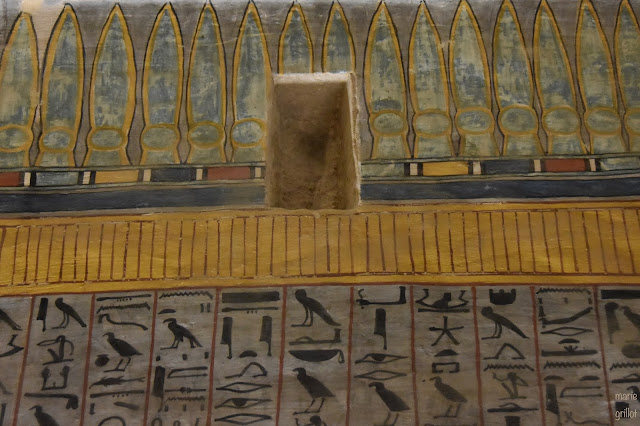
At the height, we note the presence of four small niches intended to accommodate the “magic bricks. “
One of the niches intended to accommodate the “magic bricks.” Tomb of Ramesses I – Valley of the Kings KV 16 – 19th dynasty Discovered on October 11, 1817, by Giovanni Battista Belzoni on behalf of Consul Henry Salt
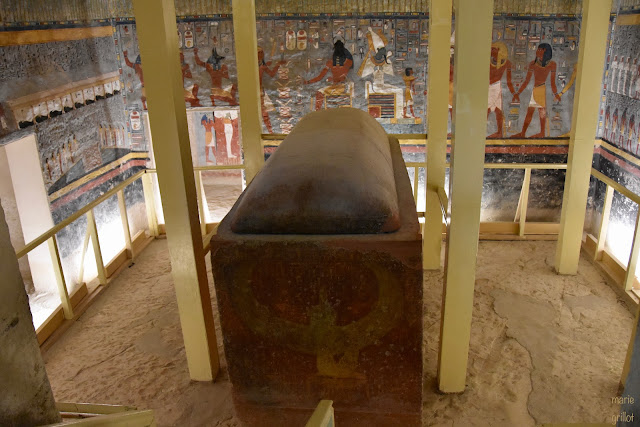
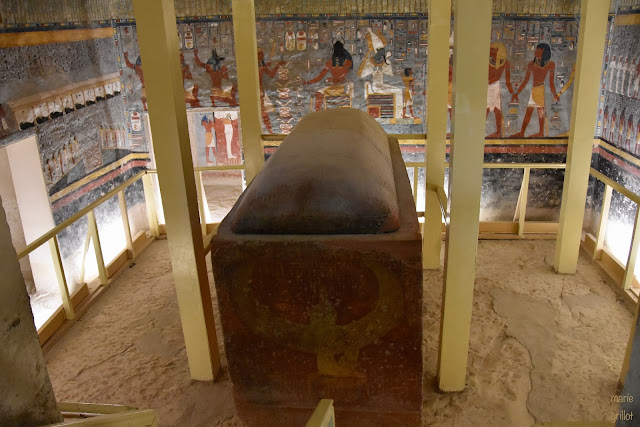
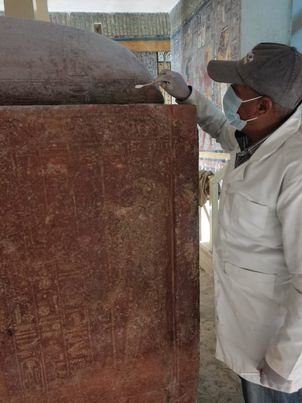
Most of the room is occupied by an imposing red granite sarcophagus. Although damaged during looting, its domed lid is still there. “The sarcophagus was hastily finished, as evidenced by its decoration. Indeed, it is painted yellow, the texts and figures not having had time to be incised. In addition, the representations of the two goddesses, sisters and protectors of their dead brother Osiris are quite clumsily made. As is customary, Isis is at the foot, and Nephthys is at the head of the sarcophagus. The two goddesses stand on the hieroglyphic sign “Noub”, which represents gold”, explains Thierry Benderitter (osirisnet).
The imposing red granite sarcophagus Tomb of Ramesses I – Valley of the Kings KV 16 – 19th dynasty Discovered on October 11, 1817, by Giovanni Battista Belzoni on behalf of Consul Henry Salt
As Ali Reda Mohamed, the site inspector, told us, this tomb, which had been closed since 2008 for restoration by an Egyptian team, was reopened to the public on January 2, 2021.
Upon Khaled el-Enani’s inauguration, the Ministry of Tourism and Antiquities detailed the work carried out: “The floors we” e restored, and the walls were cleaned of bird and bat droppings… The existing inscriptions were also restored and cleaned, and the soot was removed… The sarcophagus also benefited from the care of the restorers, and the lighting system was improved”…
A member of the Egyptian restoration team cleaning the sarcophagus Tomb of Ramesses I – Valley of the Kings – KV 16 – 19th dynasty discovered on October 11, 1817, by Giovanni Battista Belzoni on behalf of Consul Henry Salt reopened to the public after restoration on January 2, 2021 – photo Ali Reda Mohamed
When Pa-Ramessou, a high dignitary and seasoned soldier, was chosen by Horemheb to succeed him, he was already around fifty years old. Around 1306-1307 BC, he became Pharaoh under Ramses I. Thus, this 19th dynasty, initiated by his predecessor, was marked by “the arrival to power of a family from the Delta (Ramses I, Séthy I)” and then marked “the transition to the Ramesside Empire”.
Pa-Ramessou is particularly known for two identical black granite statues representing him “as a scribe, ” discovered by Georges Legrain near the 10th pylon of Karnak on October 25, 1913 (Egyptian Museum in Cairo – JE 44863 – JE 44864).
One of the two granite statues representing Pa-Ramessou as a scribe – future Ramses I discoveries near the 10th pylon of Karnak, October 25, 1913, by Georges Legrain Egyptian Museum in Cairo – JE 44863
According to Manetho, his reign was short: 1 year and four months. This simple observation could explain the modest size of his tomb and its unfinished state.
If, in his account, Belzoni points out that the sarcophagus contained two mummies, these were not the remains of the sovereign…
Indeed, after the looting that occurred in the necropolis, his mummy, like that of Ramses II, would first have passed through the tomb of Sethy I before joining the “hiding place of the royal mummies” (DB 320), where it was placed in the tomb and sheltered by the high priests of Amun during the 21st dynasty. This collective tomb was discovered in Deir el-Bahari by the Abd el-Rassoul family in 1871. The Antiquities Service only became aware of it in July 1881 and then transported all the mummies to the Boulaq Museum.
“Rediscovery”, in July 1881, by the Antiquities Service, of the Cache of the Royal Mummies (DB 320) discovered in 1871 by the Abd el-Rassoul Brothers near Deir el-Bahari
In “The Find of Deir-el-Bahari”, Gaston Maspero thus evokes the successive “displacements” which are “recorded” on the coffins of the sovereigns before their final reburial in DB 320: “The three mummies of the 19th dynasty had a common destiny. The coffins of Seti I and Ramses II bear three identical inscriptions or almost, and which date back to three different periods; what remains of the coffin of Ramses I bears the remains of a hieratic text similar to the second inscription of the text of Seti I”.
What really happened to Ramses I’s mummy? How can we imagine that after these “post-mortem” wanderings, he has not yet found rest? How could it have been sold to an American, then passed through a museum in Ontario before being exhibited at the Michael Carlos Museum in Atlanta?
In 1909, in his “General Catalogue of Egyptian antiquities from the Cairo Museum – Coffins of Royal Hiding Places”, Georges Daressy thus presents, under the ref. CG 61018, the: “Fragment of coffin in the name of Ramses I. Sycamore wood – The original coffin of Ramses I having been destroyed, his mummy had been placed in another coffin of the XXIst dynasty; but this second coffin was it – even broken during the multiple transports of the royal mummies and only two fragments have come down to us: the lid and the head of the vat. The question then arises as to whether the mummy resting inside was indeed that of the sovereign?
On the other hand, in the 1900s, in order to overcome its financial problems, the Cairo Museum did not hesitate to get rid of a number of antiquities; it actually had its own auction room, but from there, it separated from a royal mummy…
The exact scenario still remains an enigma…
Still, in an article dated March 6, 2004, on the Atlanta mummy entitled “Rameses I Mummy Returned to Cairo”, the magazine “World Archeology” reports that: “After three years of intensive investigation into the royal mummy, including X-rays, CAT Scan, radiocarbon dating, computer imaging and other techniques, researchers are 95% certain that this is the mummy of Ramesses I. Arms crossed on the chest indicates that the mummy is indeed royal because this specific position was only reserved for royal characters”…
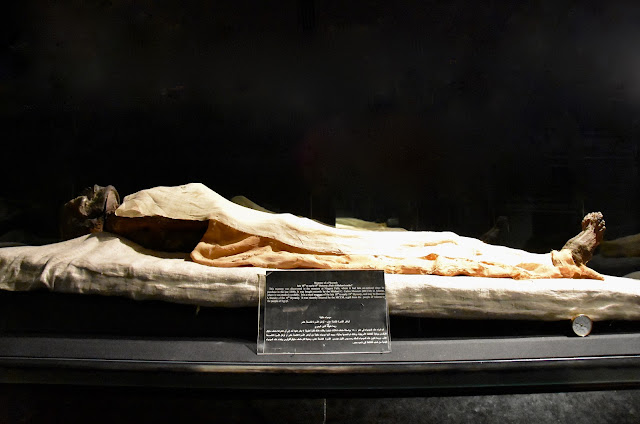
In 2003, through Zahi Hawass, it was finally returned to Egypt… Since March 9, 2004, it has been exhibited at the Louqsor Museum in the room dedicated to the glory of ancient Thebes… On its cartel, however, a doubt remains: “It is a royal mummy from the end of the 18th dynasty – beginning of the 19th. It may be that of Ramses I, founder of the 19th dynasty”…
Mummy attributed to Ramses I exhibited since March 2004 at the Louqsor Museum in the hall to the glory of ancient Thebes
I remember on a cold, foggy evening, as the misty meadow spread in the yard, we sat in the room, listening to Melanie’s song, Leftover Wine, in one of her concerts, which was playing from the cassette recorder. When she had ended her song, the audience clapped, and suddenly, someone shouted, ” We Love You! ” And she said in her extraordinary hoarse voice, ” It is so lovely sometimes somebody says something! “
Melanie Anne Safka Schekeryk, professionally known as Melanie or Melanie Safka, was an American singer-songwriter.
“I don’t know how much you have heard of her or know her songs, but Al and I got to know Melanie during Woodstock. It was probably the most remarkable collection of half a million seekers of love, freedom, and peace who proved it was possible to live all in peace together. And she was one of them.
I left my body’: during Woodstock, turned a 22-year-old nobody into a superstar.
I’m the one I found the birthday of the sun But all things change And I think it’s the birthday of the rain
If I never said goodbye To all that I’ve known I would never be alone But still, I will not cry…
A few days ago, when I saw a ten-by-ten cm announcement in the newspaper about her death, it felt like something had stabbed my heart.”
She was a messenger of love and peace and nothing else throughout her life, and she profoundly impacted our lives, which still lingers in my mind. We had almost all of their songs on cassettes and maybe one or two vinyl records, and she had always warmed our hearts with her beautiful, hoarse and heart-touching voice among her deep-meaning poems.
Although saying goodbye might be the saddest thing, she had sung sad songs often, but her last words were always ” love, ” love, love, and being alive.
“The Saddest Thing”
And the saddest thing Under the sun above Is to say goodbye To the ones you love
All the things that I have known Be came my life my very own But before you know, you say goodbye Oh, good time, goodbye It’s time to cry But I will not weep nor make a scene Just say, “thank you Life for having been.”
And the hardest thing Under the sun above Is to say goodbye to the ones you love No, I will not weep nor make a scene I’m gonna say, “thank you Life for having been.”
And the loudest cry Under the sun above Is to silent goodbye From the ones you love
Let’s not say goodbye to this flower cause she stays with us with her hoarse voice and beautiful poems about the sun, life and love.💖🙏🌹🌻💥🌞
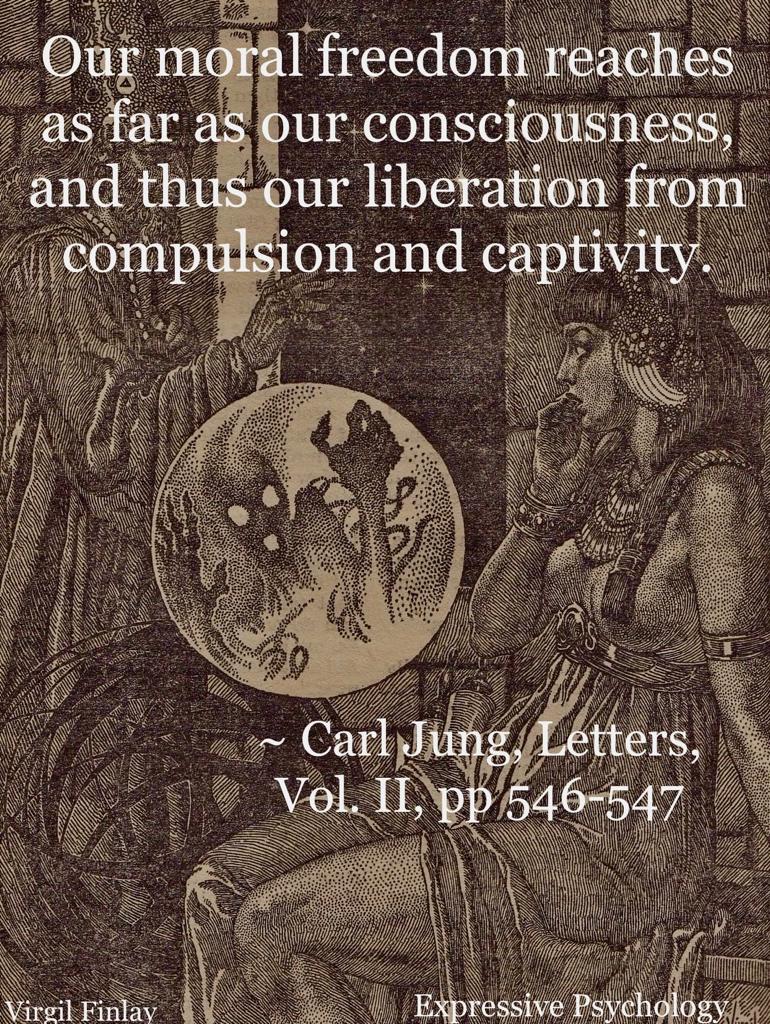
Our moral freedom reaches as far as our consciousness and, thus, our liberation from compulsion and captivity. ~Carl Jung, Letters Vol. II, pages 546-547 (from C.J. Depth Psychology)
By Petra Glimmdall 💖🙏
These days, because of my activities in helping the Iranian people, I have been deeply involved in establishing a fair and just system based on sound laws to help the Iranian people. However, finding a suitable constitution for a young nation (in the term of democracy) is not easy. It is not only the laws that make society fair; every individual must learn how to live in a democratic society.
Understanding freedom depends on the laws and anti-laws we legislate! Kahlil Gibran has an excellent explanation. I hope you enjoy it.
From The Prophet
Painting by Kahlil Gibran 1883-1931 – Tutt’Art@
People of Orphalese, you can muffle the drum, and you can loosen the strings of the lyre, but who shall command the skylark not to sing?
Then the lawyer said, but what of our laws, master? And he answered: You delight in laying down laws, Yet you delight more in breaking them. Like children playing by the ocean who build sand towers with constancy and then destroy them with laughter. But while you build your sand towers, the ocean brings more sand to the shore, and when you destroy them, the ocean laughs with you. Verily, the ocean always laughs with the innocent.
But what of those to whom life is not an ocean, and man-made laws are not sand towers, But to whom life is a rock, and the law a chisel with which they would carve it in their own likeness? What of the cripple who hates dancers? What of the ox who loves his yoke and deems the elk and deer of the forest stray and vagrant thin?
What of the old serpent who cannot shed his skin and calls all others naked and shameless? And of him who comes early to the wedding feast and, when over-fed and tired, goes his way, saying that all feasts are violations and all feasters are lawbreakers?
What shall I say of these save that they, too, stand in the sunlight, but with their backs to the sun? They see only their shadows, and their shadows are their laws. And what is the sun to them but a caster of shadows? And what is it to acknowledge the laws but to stoop down and trace their shadows upon the earth? But you who walk facing the sun, what images drawn on the earth can hold you? You who travel with the wind, what weather vane shall direct your course? What man’s law shall bind you if you break your yoke but upon no man’s prison door? What shall you fear if you dance but stumble against no man’s iron chains? And who is he that shall bring you to judgment if you tear off your garment yet leave it in no man’s path?
People of Orphalese, you can muffle the drum and loosen the strings of the lyre, but who shall command the skylark not to sing?
Peoples and Fatherlands, Para. 242 (Or a word about a common Europe!)
In Iran, I put a lot of value on the West and its people, especially the Europeans. After WWII, the engagement by England and France to make a common Europe, which came to fruition by Germany and France, made me sincerely wish to belong to this intellectual and cultivated community. I had a dream in Iran of seeing people in all of Europe holding books in their hands as they walked on the streets, and yet, when we escaped and arrived in Germany, I realized that it was a dream after all! Great expectations? It might be; in any case, I still had high expectations from European society. But as I followed this beloved idea wholeheartedly, I became increasingly upset. I found those gatherings of the European governments, apart from significant fundamental differences in understanding freedom, a group under solid influence by lobbyists trying to get their own wins on their business.
Long story short, I want to present the opinion of the great philosopher Friedrich Nietzsche here. As we will notice, he recognized, however tough, the problems of this idea and predicted them beforehand.
Translated from “Werke in vier Bänden, Band 3, Jenseits von Gut und Böse”
Call it “civilization”, “humanization”, or “progress,” where the distinction of Europeans is now sought. Let’s simply call it, without praising or blaming, with a personal formula, the democratic movement of Europe: behind all the moral and political backgrounds that are pointed out with such a formula, an enormous philosophical process is taking place that is becoming more and more fluid – the process of similarity between Europeans, their growing detachment from the conditions under which climatically and class-bound races arise, their increasing independence from every particular milieu that for centuries wants to inscribe itself in soul and body with the same demands – i.e. the slow emergence of an essentially supranational and nomadic type of human being who, physiologically speaking, has a maximum of the art of adaptation and – strength as its typical distinction. This process of becoming a European can be delayed in speed by significant relapses. However, perhaps because of this, it gains and grows in intensity and depth – the now still raging Storm and Stress of the “national feeling” belongs here, as does the anarchism that has just emerged -: this process probably leads to results that its naive promoters and eulogists, the apostles of “modern ideas”, least want to count on. The same new conditions under which, on average, a levelling and mediation of people will emerge – a valuable, industrious, multi-purpose and employable herd animal; humans -are highly capable of giving rise to exceptional people with the most dangerous and attractive qualities. While that power of adaptation, which constantly tries out changing conditions and begins a new work with every gender, almost with every decade, does not make the power of the type possible at all, as the overall impression of such future Europeans will probably be that of many talkative, poor-willed and extremely employable jobs that require the master, the commanding one, like daily bread; while the democratization of Europe amounts to the creation of a type prepared for slavery in the finest sense: In individual and exceptional cases, the strong person will have to become stronger and more prosperous than he has perhaps ever been before – thanks to the unprejudiced nature of his training, thanks to the enormous diversity of practice, art and mask. I wanted to say that the democratization of Europe is simultaneously an involuntary event for the breeding of tyrants – the word understood in every sense, including the spiritual one.



















 lampmagician


You must be logged in to post a comment.