Another Glass of Sangria

Standard

Cakeordeath's avatarcakeordeathsite

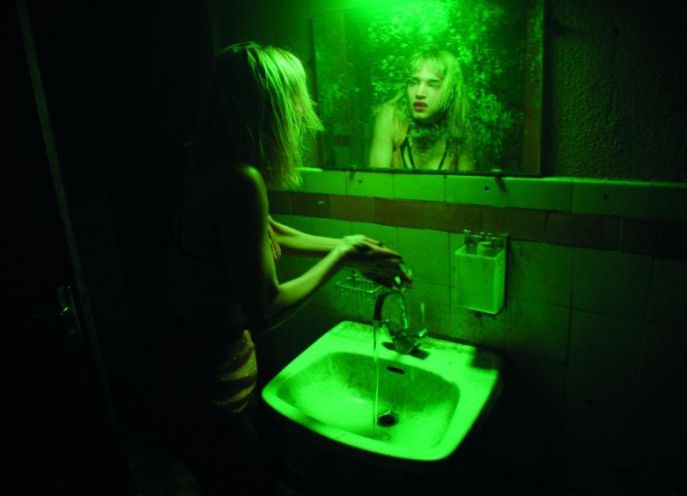
Climax-Gaspar Noé Climax-Gaspar Noé 2018

Near the beginning of Gaspar Noé’s dance-horror movie Climax, we are introduced to the dancers via their audition interviews, which are played on a TV surrounded by VHS titles (it is set in 1996), which include such gonzo avant-garde/horror films as Suspiria, Possession, Salo, Inauguration of the Pleasure Dome and Un Chien Andalou, further signalling (just in case you missed the bloodied body crawling through the snow at the start, and that it is a Noé movie) that what is to follow is going to be a full frontal assault on the senses. Whether you love it or hate it, Climax certainly succeeds as an overwhelming experience.

But before we go down to  Hell, we get a glimpse of Heaven in the extraordinary dance scene. Shot in one very long take, the young and diverse dancers, in their final rehearsal before leaving France to tour America, produce…

View original post 207 more words

A Mermaid’s Dream House, Casa Battlo

Standard

Deborah J. Brasket's avatarDeborah J. Brasket, Author

DSCN4459 (2)

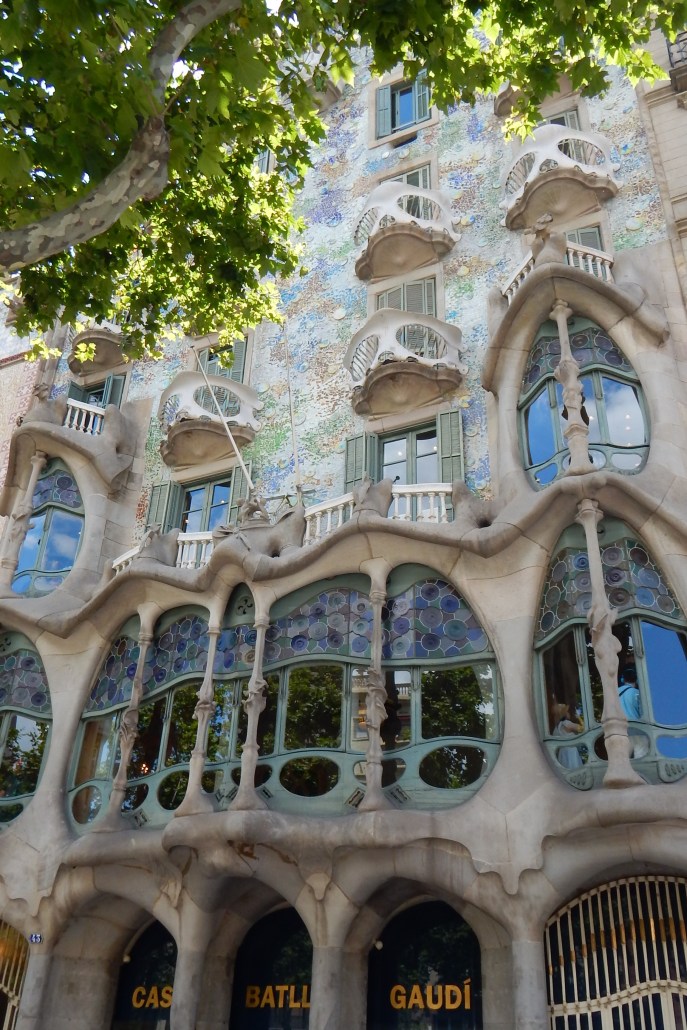
When I stepped inside Antoni Gaudi’s Casa Batllo in Barcelona, I felt like I was back on La Gitana, swimming through the coral beds and sea caves. Mesmerized by the mysterious and fantastic shapes I found at every turn, and dazzled by the kaleidoscopic colors that surrounded me, as if refracted through streams of light.

There are no straight lines in this house that floats upward four floors on spiral stairs. The rooms have no corners, only softly rounded contours, detailed by wisps, curls, and bubbles, as if sculpted by waves and etched with sea-foam. Light streams through every window and down stair shafts and through stained glass.

Follow me from ground floor to roof to see more of Gaudi’s masterpiece. All the photos are my own except where otherwise noted. More photos

Antoni Gaudi (1852-1926) was a Spanish architect from Catalonia. His most famous works, Casa Battlo and…

View original post 110 more words

Tyger Tyger

Standard

Cakeordeath's avatarcakeordeathsite

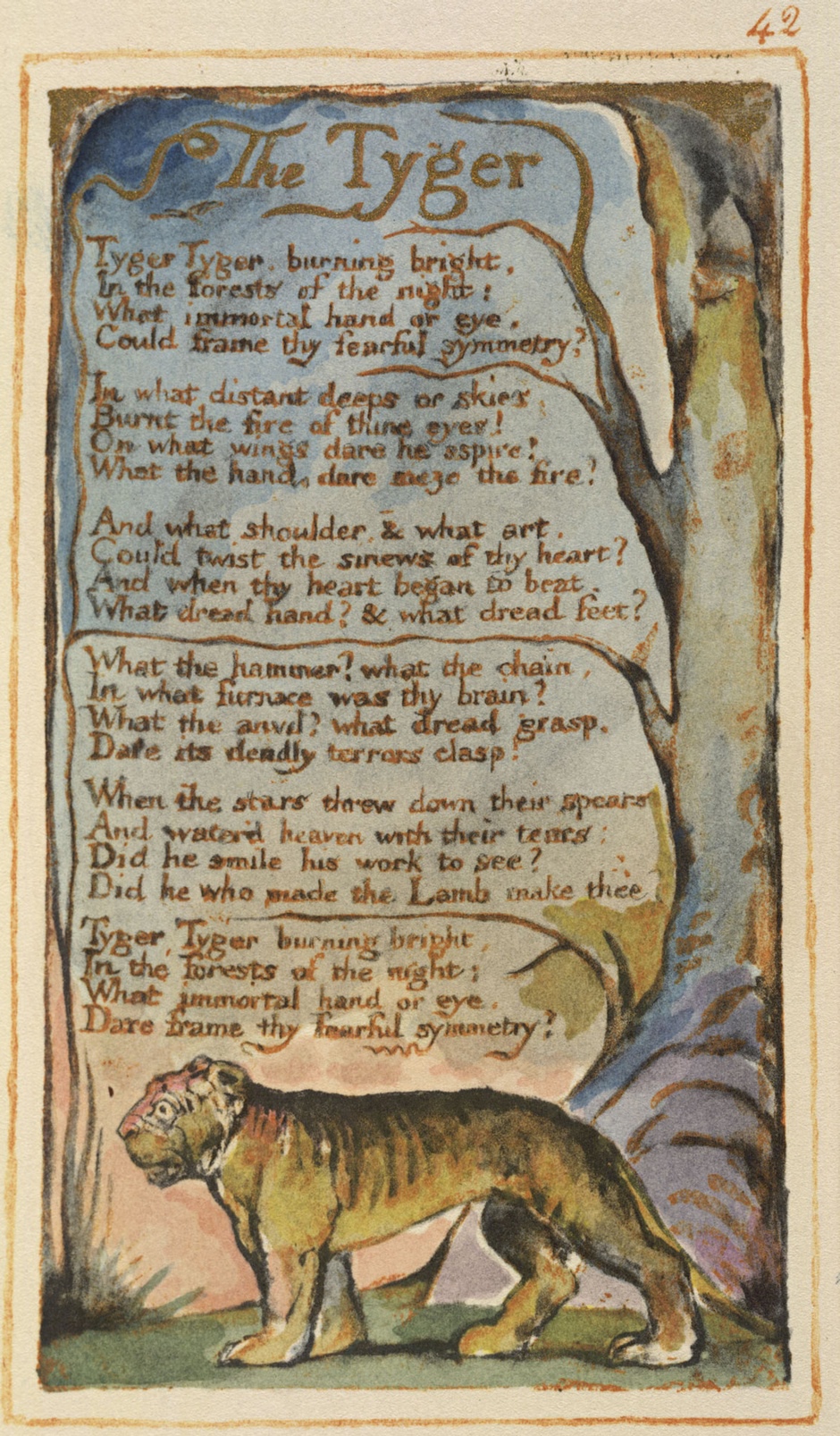
The Tyger, written and illustrated by William Blake The Tyger-Written and Illustrated by William Blake from Songs of Experience 1794

The Tyger which was first published in 1794 in  William Blake’s Songs of Experience  was later merged with Blake’s previous collection of 1789 Songs of Innocence as Songs of Innocence and of Experience, showing the Two Contrary States of the Human Soul. As with all of Blake’s work it was illuminated and printed by himself.

The Tyger is probably the most famous of Blake’s poems and justifiably so. It is a magical distillation of Blake’s major themes and metaphysics in a short poem of six, four line stanzas with a miraculous melding of form and content. It is in my opinion, the one poem in English literature that comes closest to achieving absolute perfection.

At the time of writing tigers would still have possessed a near mythical status. It is possible that Blake may have seen…

View original post 274 more words

Occultistry

Standard

Cakeordeath's avatarcakeordeathsite

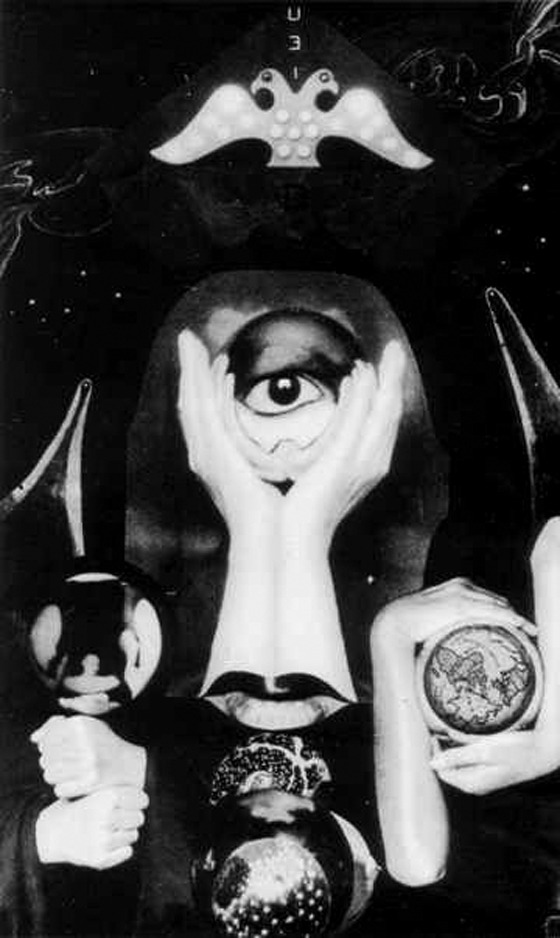
Claude Cahun Claude Cahun

Do I need to spell it out for you?
These words of mine are meant
As a spell neither more or less,
A charm to persuade your sweet self
To surrender in absentia and toto,
Give me the power and I promise,
In fact, swear on all that is unholy
To abuse the privilege you
Have so graciously granted, heedlessly,
Recklessly rushing through all
Of love’s myriad delights and mystery,
Imputing a whole lexicon of desire
In the sections of your shadow
Outlined against the bedroom wall,
In the jutting angles of your legs
For I seek the centre, a still point
Where all yearnings will cease
And desist from transmitting
This urgent ungovernable need
To translate the will divine,
This damnable demonic occultistry
That devours yet is never sated.

View original post

The Marriage of Heaven & Hell

Standard

Cakeordeath's avatarcakeordeathsite

William Blake is the occult artist.  Drawing from the various dissenting and mystical currents that were circulating in late 18th century London he created a personal mythology that is unique in the history of art and literature. As he famously said he must create his own system or be enslaved by another’s man, and Blake followed his own star from beginning to end, never wavering once. Although his later prophetic works are virtually impenetrable, Blake best work (The Songs of Innocence & Expericence; The Marriage of Heaven & Hell, especially the Proverbs of Hell) is incandescent with an unrivalled visionary intensity.

View original post 175 more words

Jung on Alchemy (9): the Coniunctio – part 3 – the Red Stone

Quote

“For, as long as Satan is not integrated, the world is not healed and man is not saved. …

I feel it here that the Master is in his higher point of his genius state.

with great Thanks to symbolreader ❤

by https://symbolreader.net/

via Jung on Alchemy (9): the Coniunctio – part 3 – the Red Stone

Carl Jung: Tarot Cards Provide Doorways to the Unconscious, and Maybe a Way to Predict the Future

Standard

via http://www.openculture.com/

A majestic play cards

jung-and-tarot

As analyst Marie-Louise von Franz recounts in her book Psyche and Matter:

Jung suggested… having people engage in a divinatory procedure: throwing the I Ching, laying the Tarot cards, consulting the Mexican divination calendar, having a transit horoscope or a geometric reading done.

It is generally accepted that the standard deck of playing cards we use for everything from three-card monte to high-stakes Vegas poker evolved from the Tarot. “Like our modern cards,” writes Sallie Nichols, “the Tarot deck has four suits with ten ‘pip’ or numbered cards in each…. In the Tarot deck, each suit has four ‘court’ cards: King, Queen, Jack, and Knight.” The latter figure has “mysteriously disappeared from today’s playing cards,” though, examples of Knight playing cards exist in the fossil record. The modern Jack is a survival of the Page cards in the Tarot. (See examples of Tarot court cards here from the 1910 Rider-Waite deck.) The similarities between the two types of decks are significant, yet no one but adepts seems to consider using their Gin Rummy cards to tell the future.

The eminent psychiatrist Carl Jung, however, might have done so.

As Mary K. Greer explains, in a 1933 lecture Jung went on at length about his views on the Tarot, noting the late Medieval cards are “really the origin of our pack of cards, in which the red and the black symbolize the opposites, and the division of the four—clubs, spades, diamonds, and hearts—also belongs to the individual symbolism.

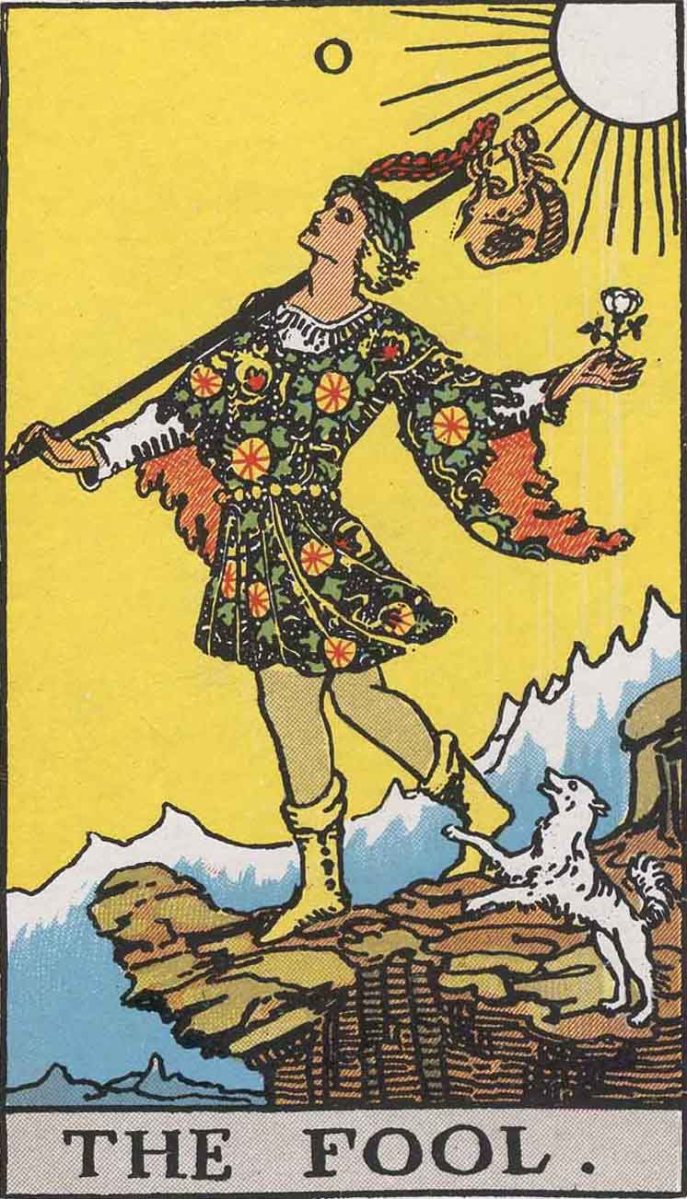
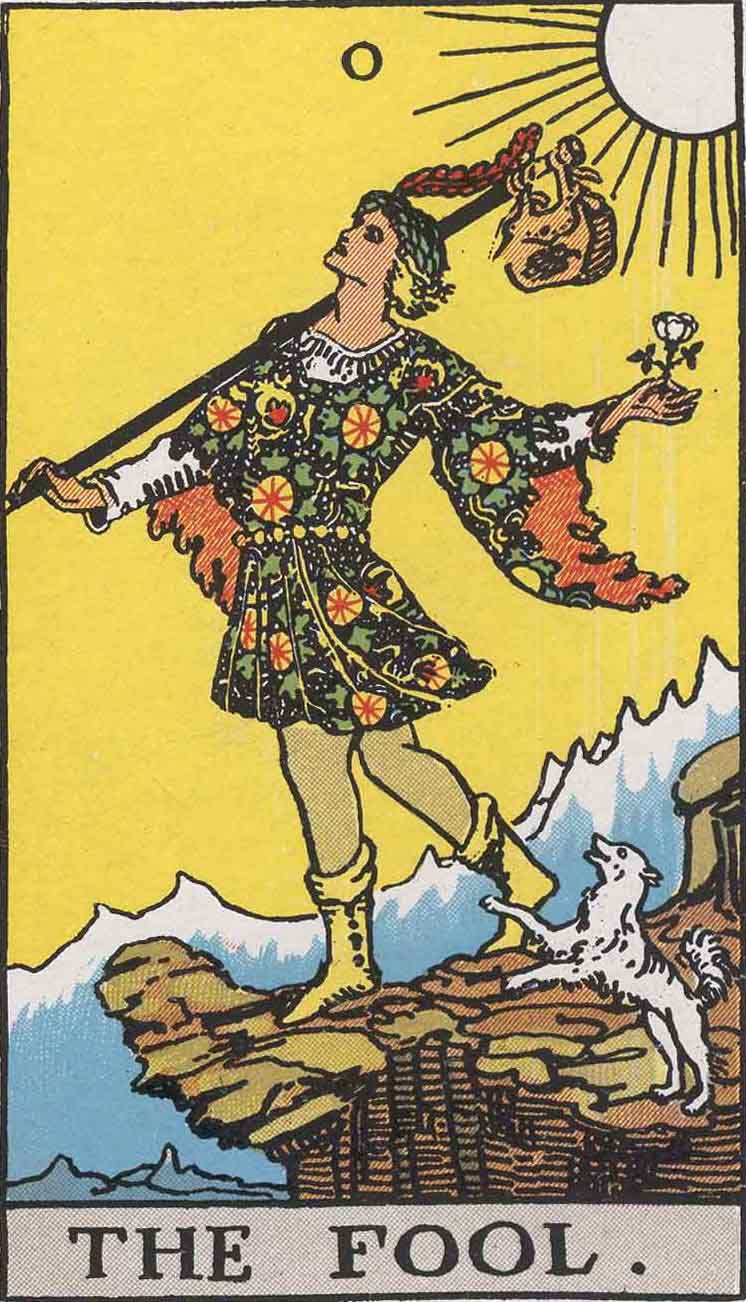
They are psychological images, symbols with which one plays, as the unconscious seems to play with its contents.” The cards, said Jung, “combine in certain ways, and the different combinations correspond to the playful development of mankind.” This, too, is how Tarot works—with the added dimension of “symbols, or pictures of symbolical situations.” The images—the hanged man, the tower, the sun—“are sort of archetypal ideas, of a differentiated nature.”
RWS_Tarot_00_Fool

Thus far, Jung hasn’t said anything many orthodox Jungian psychologists would find disagreeable, but he goes even further and claims that, indeed, “we can predict the future when we know how the present moment evolved from the past.” He called for “an intuitive method that has the purpose of understanding the flow of life, possibly even predicting future events, at all events lending itself to the reading of the conditions of the present moment.” He compared this process to the Chinese I Ching, and other such practices. As analyst Marie-Louise von Franz recounts in her book Psyche and Matter:

Jung suggested… having people engage in a divinatory procedure: throwing the I Ching, laying the Tarot cards, consulting the Mexican divination calendar, having a transit horoscope or a geometric reading done.

Content seemed to matter much less than form. Invoking the Swedenborgian doctrine of correspondences, Jung notes in his lecture, “man always felt the need of finding an access through the unconscious to the meaning of an actual condition, because there is a sort of correspondence or a likeness between the prevailing condition and the condition of the collective unconscious.”

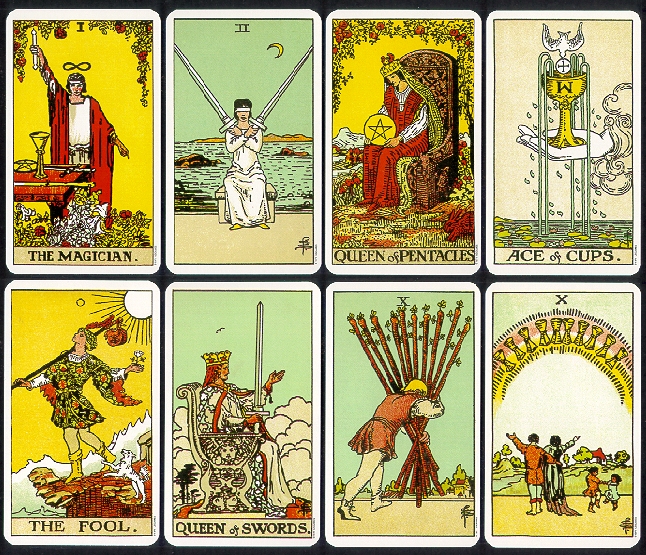
Rider-Waite-1

What he aimed at through the use of divination was to accelerate the process of “individuation,” the move toward wholeness and integrity, by means of playful combinations of archetypes. As another mystical psychologist, Alejandro Jodorowsky puts it, “the Tarot will teach you how to create a soul.” Jung perceived the Tarot, notes the blog Faena Aleph, “as an alchemical game,” which in his words, attempts “the union of opposites.” Like the I Ching, it “presents a rhythm of negative and positive, loss and gain, dark and light.”
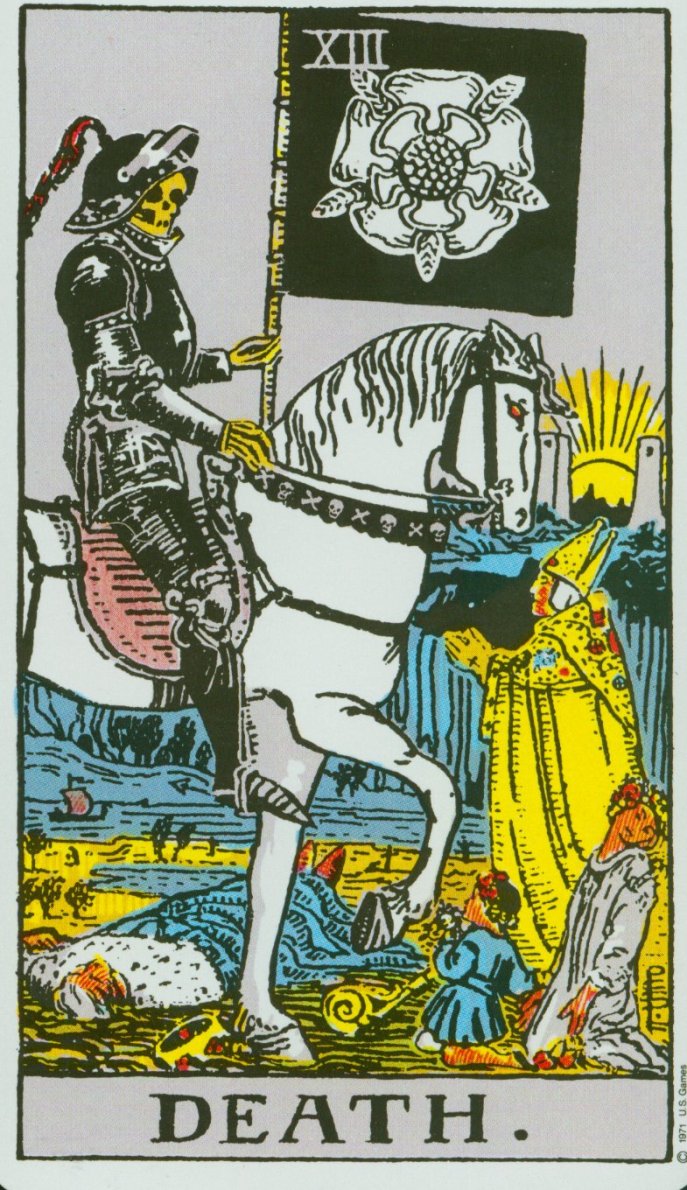
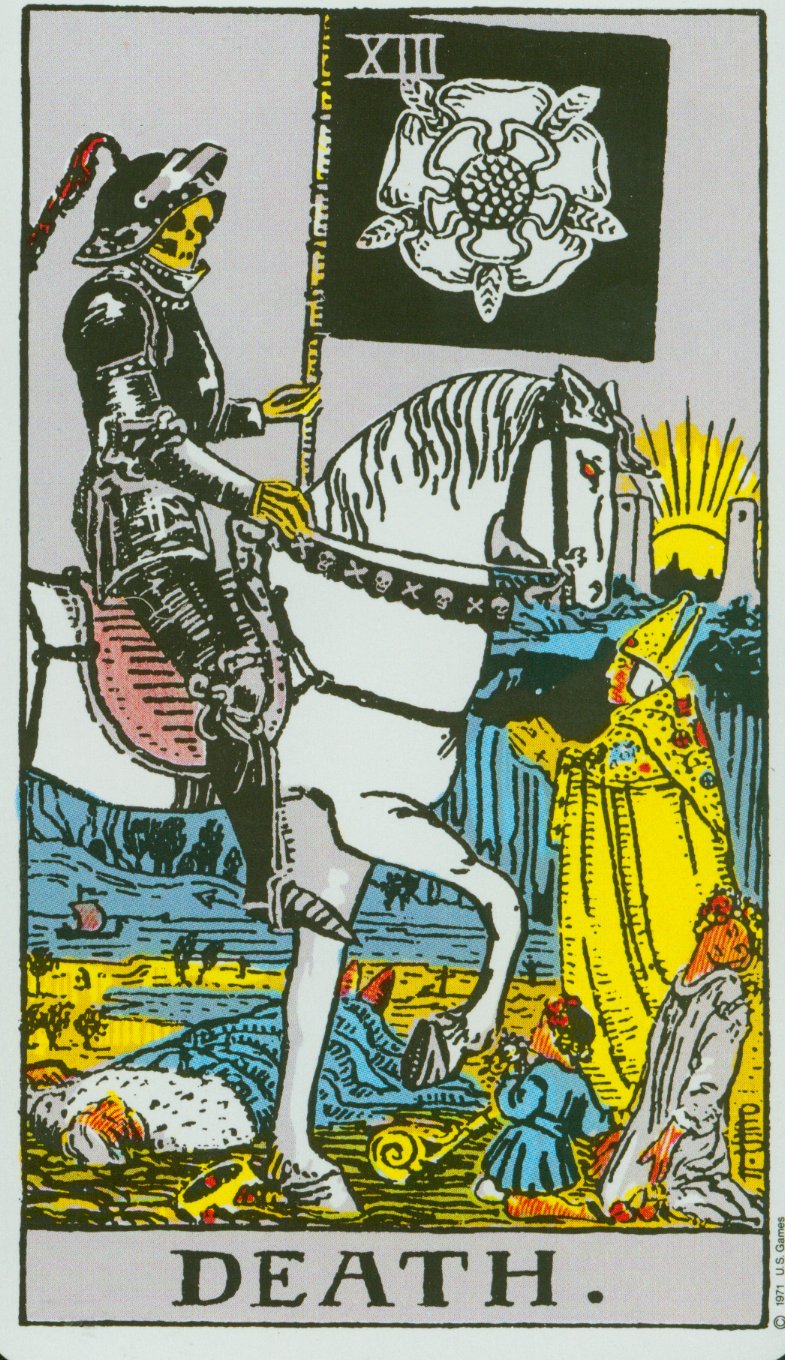
RW-Death

Much later in 1960, a year before his death, Jung seemed less sanguine about Tarot and the occult, or at least downplayed their mystical, divinatory power for language more suited to the laboratory, right down to the usual complaints about staffing and funding. As he wrote in a letter about his attempts to use these methods:

Under certain conditions it is possible to experiment with archetypes, as my ‘astrological experiment’ has shown. As a matter of fact we had begun such experiments at the C. G. Jung Institute in Zurich, using the historically known intuitive, i.e., synchronistic methods (astrology, geomancy, Tarot cards, and the I Ching). But we had too few co-workers and too little means, so we could not go on and had to stop.

Later interpreters of Jung doubted that his experiments with divination as an analytical technique would pass peer review. “To do more than ‘preach to the converted,’” wrote the authors of a 1998 article published in the Journal of Parapsychology, “this experiment or any other must be done with sufficient rigour that the larger scientific community would be satisfied with all aspects of the data taking, analysis of the data, and so forth.” Or, one could simply use Jungian methods to read the Tarot, the scientific community is damned.
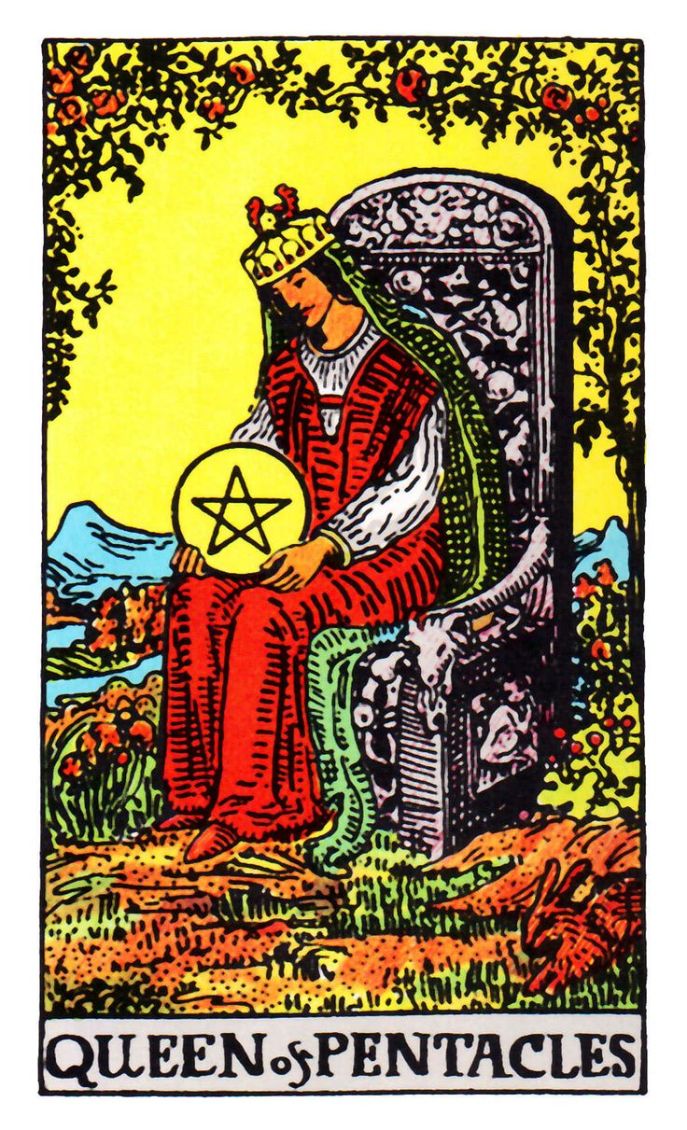
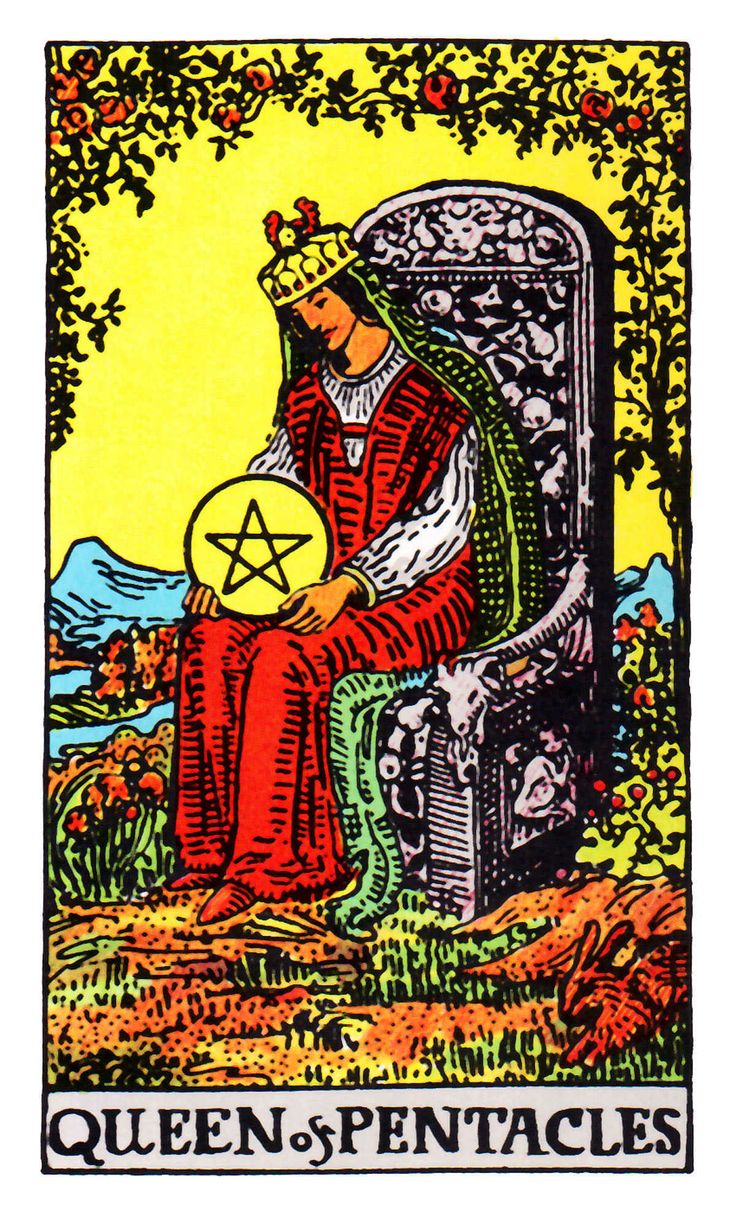
RW-Queen-of-Pentacles

As in Jung’s many other creative reappropriations of mythical, alchemical, and religious symbolism, his interpretation of the Tarot inspired those with mystical leanings to undertake their own Jungian investigations into parapsychology and the occult. Inspired by Jung’s verbal descriptions of the Tarot’s major arcana, artist and mystic Robert Wang has created a Jungian Tarot deck, and an accompanying trilogy of books, The Jungian Tarot and its Archetypal ImageryTarot Psychology, and Perfect Tarot Divination.

You can see images of each of Wang’s cards here. His books purport to be exhaustive studies of Jung’s Tarot theory and practice, written in consultation with Jung scholars in New York and Zurich. Sallie Nichols’ Jung and Tarot: An Archetypal Journey is less voluminous and innovative—using the traditional, Pamela Coleman-Smith-illustrated, Rider-Waite deck rather than an updated original version. But for those willing to grant a relationship between systems of symbols and a collective unconscious, her book may provide some penetrating insights, if not a recipe for predicting the future.

Related Content:

Alejandro Jodorowsky Explains How Tarot Cards Can Give You Creative Inspiration

The Tarot Card Deck Designed by Salvador Dalí

Twin Peaks Tarot Cards Now Available as 78-Card Deck

Josh Jones is a writer and musician based in Durham, NC. Follow him 

The Mystery of Love ~Carl Jung

Standard
 

[I]f we possess a grain of wisdom, we will completely surrender to this unknowable who embraces in love all the opposites. Whatever the learned interpretation may be of the sentence “God is love,” the words affirm the complexio oppositorum of the Godhead.  In my medical experience as well as in my own life, I have again and again been faced with the mystery of love and have never been able to explain what it is.  Like Job, I had to “lay my hand on my mouth.  I have spoken once and I will not answer” (Job 40:4f).  – C.G. Jung

A Less-Mentioned (but Huge) “Ism.”

Standard

Sophia's Children's avatarSophia's Children

Jeff Japp, in his Stuff Jeff Reads blog, muses about another of the super-insidious yet not as often mentioned “isms” ingrained and “toxic-normalized” into our culture, alongside racism and sexism/misogyny, linking what we see now with what Shakespeare wrote about in King Lear.

Jeff writes,

“This is still a part of our society. We all like to think we hold reverence for the elderly, but the fact is that neglect and abuse of the old is rampant. In addition, there is the subtle and insidious elder abuse which manifests as ageism in the workplace. Older workers are routinely passed over in favor of younger candidates, which only adds to the feelings of uselessness and despair that sadly accompany aging all too often.” (full post: link below)

True enough.

Beautiful, powerful, Wise elder woman. PD photo from Yogendra Singh, Pexels.
These kinds of “isms,” issues, and insights…

View original post 429 more words

Under the Sea, a Virtual Art Gallery Showcasing the work of Rob Goldstein

Standard

Wonderful, Colourful Art ❤

Teagan Riordain Geneviene's avatarTeagan's Books

Opening AnnouncementWelcome to my art gallery.  Today the venue is the #steampunk submarine of Cornelis Drebbel, who graciously allowed us into his domain. 

I’m excited to present the artwork of Rob Goldstein, who illustrated Hullaba Lulu.  Please join me for a stroll through the submarine to view his images.

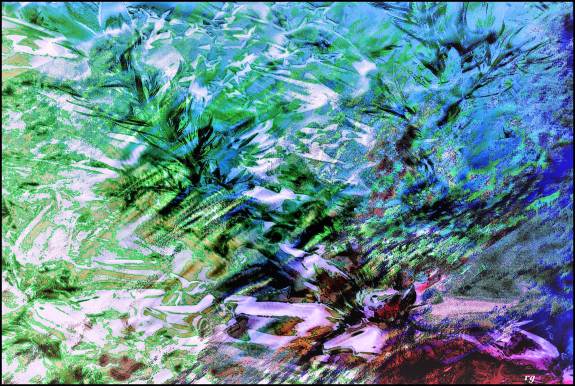
Yes, that’s the first piece of Rob’s art on display ― Sea World.  Isn’t it calming?

Sea WorldSea World

First, we need to go to San Francisco to pick up Rob, the guest of honor.  Cornelis, it feels like we are already under weigh.  I’m surprised you put your book down without a fight.  What was all that clicking about?  What do you mean click you?

Cornelis:  No, click me, not click you. Click Me Happy.”  It’s exciting for me to be able to choose the book’s ending, Teagan.  But I simply couldn’t pick one.  So, I…

View original post 1,718 more words