Did you know that the Scandinavian Vikings visited Newfoundland and Labrador Canada approximately five centuries before John Cabot or Christopher Columbus sailed to North America? Vinland or Wine-land was discovered by Leif Erickson, covered the area from the Gulf of St. Lawrence to the northeastern New Brunswick known for its grapevines, then all the way up to Newfoundland.
Photo below: Reenactment of Viking ships at L’Anse aux Meadows
Vikings were known for their raiding and trading in unknown lands such as L’Anse aux Meadows located at the Northern tip of Newfoundland. In 1960 archaeological artifacts were found there. This site’s discovery and dig was lead by Archaeologist Anne Stine Ingstad with her husband Helge Ingstad. Vineland or Wine-land was written about in the Icelandic Sagas. This site was named an Archaeological and Historical site by the Government of Canada in 1968. Over time, the Vikings left the area due to…
« Un homme n’est jamais si grand que lorsqu’il est à genoux pour aider un enfant. »
“A man is never as big as when he is on his knees to help a child.”
Pythagore(Πυθαγόρας)(né vers – 580 av JC – et mort vers – 495 av JC) est un mathématicien, scientifique et philosophe grec. Ayant quitté son île (Samos), il y revient après des voyages en Egypte mais le tyran Polycrate de Samos le contraint à partir. Il s’installera alors à Cratone, colonie grecque dans le sud de l’Italie pour y fonder une communauté…
Who would have thought a new pair of shoes could cause so much grief? Shoes are a tool for folks that live in Northern climates and keep feet sunburn free in Southern climates. Footwear, at times is vital to a person’s survival. Shoes keep our feet warm, dry and injury free. Evolving over time, shoes became a fashion statement to wear first by royals and wealthy people and later was available to the everyday person.
This story has a moral weaved throughout it vanity may become ones own undoing.
In the past this was one of the seven deadly sins of Christianity and this particular tale reflects this theme throughout. It also has a deeper meaning, craft your own pair of shoes, instead of wearing someone else’s shoes. (pertaining to ones own creativity and instinct.)
In Clarissa Pinkola Estés book “Women Who Run with The Wolves,” on page 222, Dr…
Playing the Part of the Less & Less Blemished Witness Guided Imagery:
All types of meditative guided imagery can fit under the heading of being a ‘less and less blemished witness’, albeit this meditative witnessing is a form of general guided imagery and can be utilized in almost any context or setting.
Being a less and less blemished witness, as unto itself a succinct guided imagery practice as such, is focusing (not thinking) on or about one thing or two or three things, e.g., with regard to witnessing just exactly what one is doing at any given time, ideally nothing more any nothing less. This meditative witnessing is the ‘sword’ (h’ou t’ou) that cuts out, erases thinking and/or cyclical thinking, so that one can eventually learn to genuinely (without fooling oneself) empty one’s mind completely. That said and yin to yang and yang to yin, even if one truly learns…
(FR) On dit dans ma culture que tu es le pilier principale et fondateur qui maintient toute la structure d’une maison, mais ils ne savent pas que tu es plus que ça et les mots ne peuvent et ne pourrons jamais te décrire maman. Ils ne savent pas que tu es le bouclier qui protège et qui défend contre toute menace physique, mental ou émotionnel, tu es l’héroïne et le superman de tes enfants, l’espace entre tes bras est le refuge qui guérit de tous les maux à chaque fois que ton enfant est perdu. Maman, je sais que ton amour inconditionnel et les dogmes des sociétés t’ont fait faire des compromis incommensurables , tu as donné ta jeunesse , tes rêves , ta santé et tout ce que l’humain a de plus précieux ,pour tes enfants et ton foyer et je sais que tu l’as fait et tu le fait sans…
And what art thou, thou idol Ceremony? What kind of god art thou, that suffer’st more Of mortal griefs than do thy worshippers?
William Shakespeare 🙏👍💖
« Vivre c’est souffrir, survivre c’est trouver un sens à sa souffrance. »
« To live is to suffer, to survive is to find some meaning in the suffering. »
« Leben heißt leiden, um zu überleben, um einen Sinn im Leiden zu finden »
Friedrich Nietzsche (1844-1900) a d’abord été professeur (d’origine allemande) de philologie à l’université de Bâle avant de se tourner vers la philosophie. S’il a été peu connu ou reconnu de son vivant, son influence demeure aujourd’hui encore importante. Il a également écrit des œuvres de jeunesse, des poèmes, a été pianiste et compositeur… A partir de 1889, il souffre de démence et meurt en 1900 dans un état mental végétatif. Elisabeth Förster-Nietzsche, sa sœur contribuera à défigurer l’oeuvre de son frère en collaborant au régime nazi. En effet, cette dernière adhérera au NSDAP en 1930. A sa mort en 1935, Hitler se rendra à ses funérailles cherchant ainsi à auréoler…
I must confess that if I have ever like any “ism” I’d rather be Feminist! They are unpredictable!
You know, Men. I mean we all men, we have ruled the world since the religions began to rule and we were so satisfied with our result that we have hidden our heads (and in the same way our brains) in the sand with our regulated, controlled, fixed way of life to settle everything, according to our wish, and thought laughingly; all is the best!
But now, if we really look around us with the opened eyes (opened-minded) we can clearly see what we have failed; to ignore the fear and make something new.
Yes my dear same gender, we have made so many rules for our benefits and missed the point of; “just let it run free”. now there they are; Women and they rock definitely. There here, is one of my most recommended favourites. ❤
There is nothing more to say but enjoy this essential be presented. 🙂 🙂
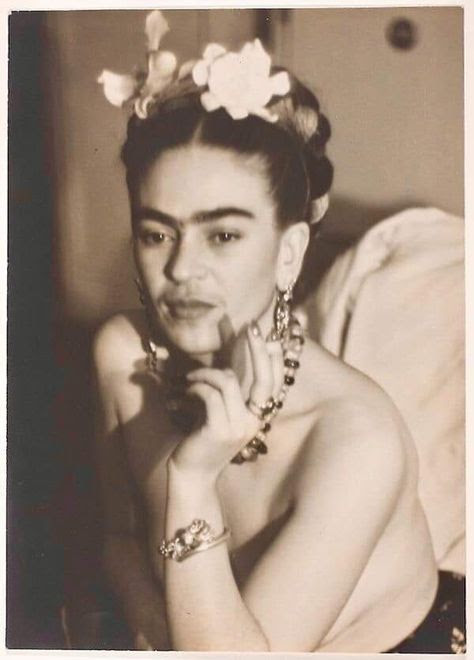
When we admire a famous artist from the past, we may wish to know everything about their lives—their private loves and hates, and the inner worlds to which they gave expression in canvases and sculptures. A biography may not be strictly necessary for the appreciation of an artist’s work. Maybe in some cases, knowing too much about an artist can make us see the autobiographical in everything they do. Frida Kahlo, on the other hand, fully invited such interpretation, and made knowing the facts of her life a necessity.
She can hardly “be accused of having invented her problems,” writes Deborah Solomon at The New York Times, yet she invented a new visual vocabulary for them, achieving her mostly posthumous fame “by making her unhappy face the main subject of her work.”
Her “specialty was suffering”—her own—“and she adopted it as an artistic theme as confidently as Mondrian claimed the rectangle or Rubens the corpulent nude.” Kahlo treated her life as worthy a subject as the respectable middle-class still lifes and aristocratic portraits of the old masters. She transfigured herself into a personal language of symbols and surreal motifs.
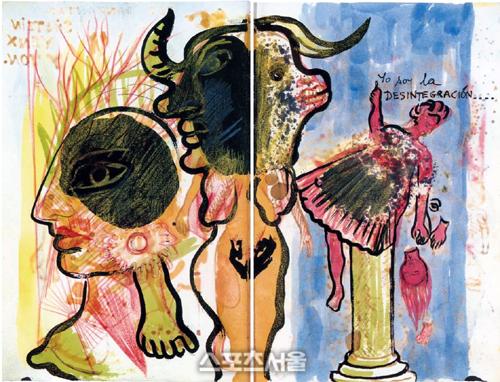
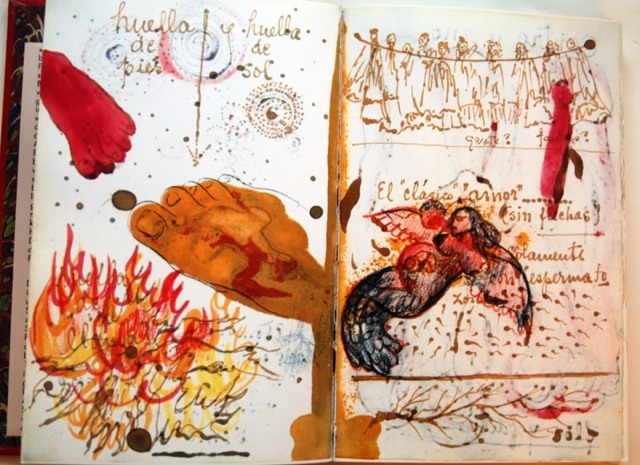
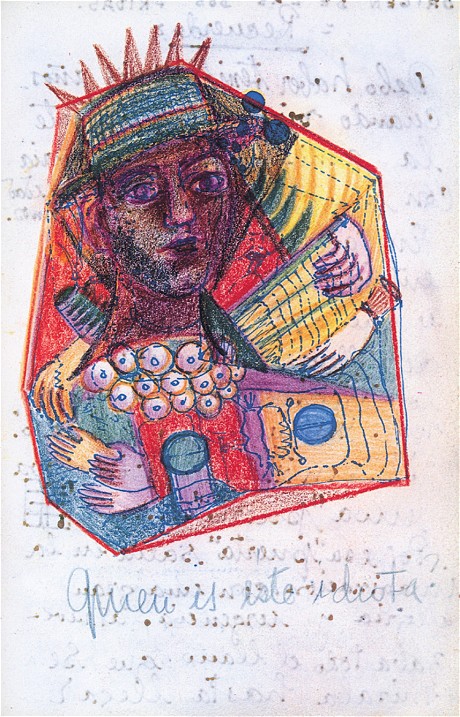
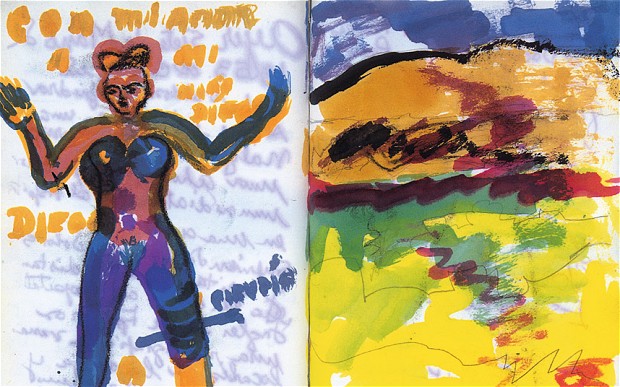
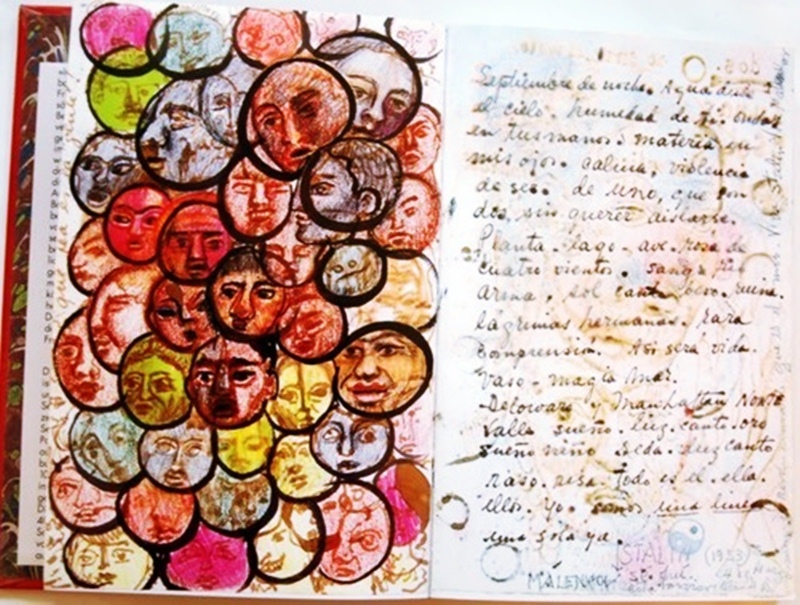
This means we must peer as closely into Kahlo’s life as we are able if we want to fully enter into what Museum of Modern Art curator Kirk Varnedoe called“her construction of a theater of the self.” But we may not feel much closer to her after reading her wildly-illustrated diary, which she kept for the last ten years of her life, and which was locked away after her death in 1954 and only published forty years later, with an introduction by Mexican novelist Carlos Fuentes. The diary was then republished by Abrams in a beautiful hardcover edition that retains Fuentes’ introduction.
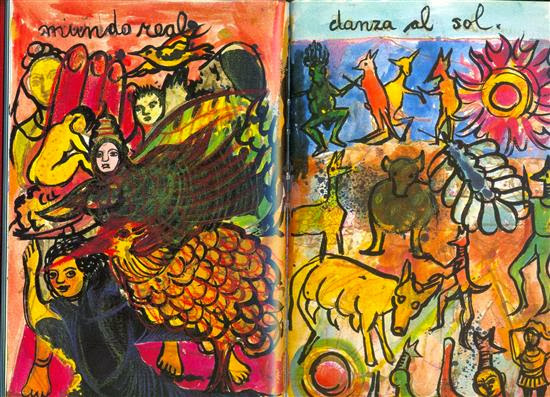
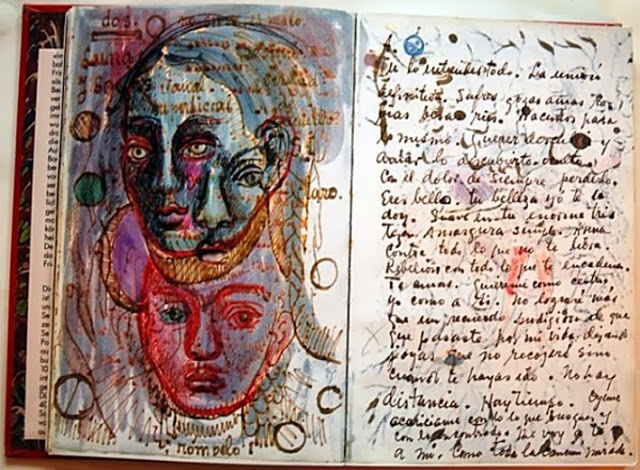
If you’re looking for a historical chronology or straightforward narrative, prepare for disappointment. It is, writes Kathryn Hughes at The Telegraph, a diary “of a very particular kind. There are few dates in it, and it has nothing to say about events in the external world—Communist Party meetings, appointments at the doctor’s or even trysts with Diego Rivera, the artist whom Kahlo loved so much that she married him twice. Instead it is full of paintings and drawings that appear to be dredged from her fertile unconscious.”
This descriptions suggests that the diary substitutes the image for the word, but this is not so—it is filled with Kahlo’s experiments with language: playful prose-poems, witty and cryptic captions, free-associative happy accidents. Like the visual autobiography of kindred spirit Jean-Michel Basquiat, her private feelings must be inferred from documents in which image and word are inseparable. There are “neither startling disclosures,” writes Solomon, “nor the sort of mundane, kitchen-sink detail that captivates by virtue of its ordinariness.” Rather than exposition, the diary is filled, as Abrams describes it, with “thoughts, poems, and dreams… along with 70 mesmerizing watercolor illustrations.”
Kahlo’s diary allows for no “dreamy identification with its subject” notes Solomon, through Instagram-worthy summaries of her dinners or wardrobe woes. Unlike her many, gushing letters to Rivera and other lovers, the “irony is that these personal sketches are surprisingly impersonal.” Or rather, they express the personal in her preferred private language, one we must learn to read if we want to understand her work. More than any other artist of the time, she turned biography into mythology.
Knowing the bare facts of her life gives us much-needed context for her images, but ultimately we must deal with them on their own terms as well. Rather than explaining her painting to us, Kahlo’s diary opens up an entirely new world of imagery—one very different from the controlled self-portraiture of her publicbody of work—to puzzle over.
«Karl Popper:” Falsacionismo y Cisnes Negros “.- Antoni Gaudí:” Parc Güell “.-»
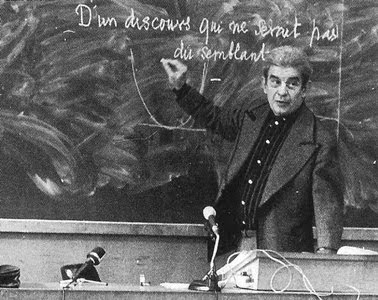
Psychoanalysis: Jacques Lacan: “The Real, the Imaginary and the Symbolic”. “The Imaginary and the Concept of the Other” .-
“The Real, the Imaginary and the Symbolic”:
Lacan explains the subjective constitution as a dynamic structure organized in three registers. The French Psychoanalyst formulated the concepts of the Real, the Imaginary and the Symbolic to describe these three knots of the constitution of the subject. These three registers are imbricated according to the shape of a Borromean knot: The desanudamiento of any of the three causes the untying of the other two. It is another conceptual tool typical of combinatorial topologies, such as the Möbius Band.
Record of the Real
The reality is that which can not be expressed as language, what can not be said, can not be represented, because by representing it, the essence of it is lost, that is, the object itself. Therefore, the Real is always present but continuously mediated by the imaginary and the symbolic.
Record of the Imaginary:
The imaginary is constituted in a process that requires a certain structural alienation, it is the realm of spatial identification that starts in the mirror stage and is instrumental in the development of the psychic agency. It is in this process of formation that the subject can identify his image as the ‘I’, differentiated from the other. What is designated as ‘I’ is formed through what is the other – in other words, from the image in the mirror. It is the primitive form of symbolic thought.
Registration of the Symbolic
The imaginary, or non-linguistic aspect of the psyche, formulates the primitive knowledge of the self, while the symbolic, the term used for linguistic collaboration (coherent verbal language), generates a community-level reflection of the primitive knowledge of the self and creates the first set of rules that govern behaviour and integrate each subject into the culture. It constitutes the most evolved record and is the one that typifies the adult human being. Lacan considers that the language constructs the subject and the human being suffers from this language because it is necessary and gives each subject a heuristic quality (with the symbolic language one thinks, with this language one reasons, with such a language there is communication -symbolic- between the humans).
“The Imaginary and the Concept of the Other”:
What becomes the Subject properly develops through its inception in the Symbolic order, at which time the infant acquires the ability to use language that is, to materialize his desire through speech. In Lacan, the Other is at At the same time the neighbour (each other separately) and the whole set of subjects that constitute the culture and society from the origin of humanity. The Other as a set of subjects that constitute the culture and society is qualified by Lacan of Treasure of the signifiers, that is to say, is of such an entity that each subject separately receives the language; that is why the Lacanian phrase is understood The subject is spoken by the Other and its variation the subject is thought by the Other. From the Other it is that the subject has a language and it is from the Other that the subject thinks (in this Lacan does a modification to the Cartesian cogito, to the cogito ergo sum – I think ergo exists – no one thinks initially from his ego or from his self same, but he does it from what he receives by tradition from the Other). Moreover, as the ego of each subject is constituted from the Other, it also turns out to be the desire installed in each subject, a desire coming from the Other and directed towards the Other, this is summarized in the apothegm(depot): the desire is the desire of the Other. The first vicarious subject or representative of the Other for every subject is his mother. However, the mother is another who will only be effective if the paternal function mediates between her and the child.
Lacan explica la constitución subjetiva como una estructura dinámica organizada en tres registros. El Psicoanalista francés formuló los conceptos de lo Real, lo Imaginario y lo Simbólico para describir estos tres nudos de la constitución del sujeto. Estos tres registros se hallan imbricados según la forma de un nudo borromeo: El desanudamiento de cualquiera de los tres provoca el desanudamiento de los otros dos. Se trata de otra herramienta conceptual típica de la topología combinatoria, como lo es la Banda de Möebius.
Registro de lo Real
Lo real es aquello que no se puede expresar como lenguaje, lo que no se puede decir, no se puede representar, porque al re-presentarlo se pierde la esencia de éste, es…






 lampmagician
You must be logged in to post a comment.