
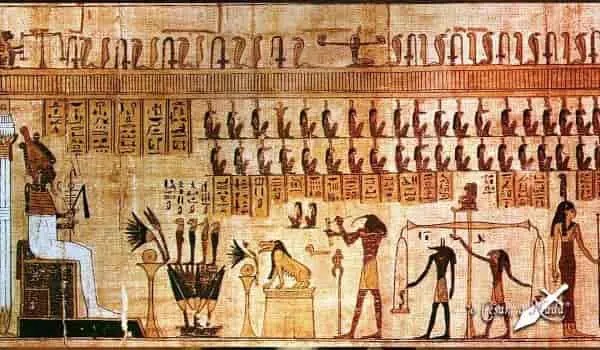
Throughout human history, numerous hints—such as books, signs, or symbols—have sought to reveal the truth or, at the very least, refresh our forgotten memories. However, we often appear too naive or too lazy to make the effort to understand.
Here is one: although we may be able to read and decipher it, we must also discern the underlying meaning—”reading between the lines!”—and therein lies the key!
So, let’s continue engaging and aim to gather more information. Here is Marie Grillot‘s brilliant report on this topic for its purpose!
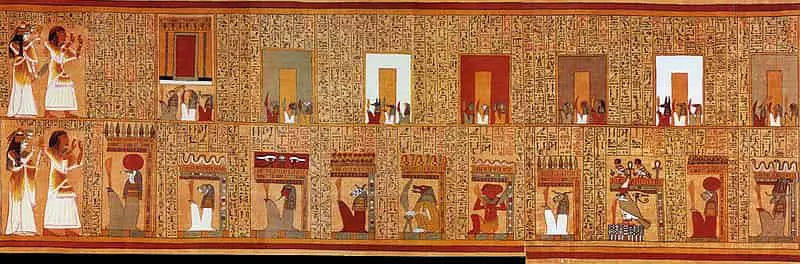
The Book of the Dead by Kha, Architect of the Place of Truth
via égyptophile

New Kingdom – 18th Dynasty – reigns of Amenhotep II, Thutmose IV, Amenhotep III – circa 1425 – 1353 BC
from their tomb – TT 8 – discovered on February 15, 1906, in the necropolis of Deir el-Medina
by Ernesto Schiaparelli and Francesco Ballerini of the Italian Archaeological Mission of the Turin Museum
exhibited at the Museo Egizio in Turin – Inv. No.: Suppl. 8316/03 = Suppl.8438 – museum photo
“In use from the beginning of the New Kingdom to the Roman period, the Book of the Dead, of which a ‘canonical’ version appeared in the Saite period, could be written on leather, on the mummy’s own bandages, on pieces of funerary furniture or, particularly at Deir el-Medina, on the walls of the vault, but it was almost always on a papyrus roll, bearing the name and titles of the deceased, that the various chapters that constituted it succeeded one another. Their titles being written in red ink – the literal meaning of the term ‘rubric’ – these were written in cursive hieroglyphs, in hieratic, then in demotic, and were almost always, especially in the New Kingdom, accompanied by beautiful painted ‘vignettes’ that make the Book of the Dead the oldest illuminated book in the world” indicates Jean-Pierre Corteggiani in “Ancient Egypt and its Gods”.
The “Book of the Dead” was originally called the “Book for going out during the day”. This “recent” name is due to the Egyptologist Richard Lepsius, who, in 1842, while translating a papyrus kept in the Turin Museum, called it “Todtenbuch” (“Book of the Dead”).

New Kingdom – 18th Dynasty – reigns of Amenhotep II, Thutmose IV, Amenhotep III – circa 1425 – 1353 BC
from their tomb – TT 8 -discovered on February 15, 1906 in the necropolis of Deir el-Medina
by Ernesto Schiaparelli and Francesco Ballerini of the Italian Archaeological Mission of the Turin Museum
exhibited at the Museo Egizio in Turin – Inv. No.: Suppl. 8316/03 = Suppl.8438 – museum photo
Paul Barguet, who also made a translation published by Éditions du Cerf, recalls its “divine” genesis: “The god Thoth is said to be the mythical author of the magic formulas of the Book of the Dead (or “Book to go out at/the day”, a title preferred by Jean-Louis de Cénival). Each time a deceased person recites a formula, he is theoretically the author since he reactivates it at the moment of pronunciation. But the formulas of the Book of the Dead were indeed written a very first time. The Egyptian priests identified this first author. In their minds, it was a divinity, not expressly named, but originating from Hermopolis. It would then seem that it was the god Thoth. This first paternity is rarely mentioned in the Book of the Dead, but it exists in the formula sections 30B, 64, 137A and 148″…
This precious collection, intended to ensure the well-being of the deceased and to be a true guide to eternal life, was placed in the tombs of the royal sphere and in those of individuals. It contained prayers for the divinities, religious and magical texts, listed the formulas allowing one to cross the doors to access the afterlife, to be “justified”, to face dangers and threats, to benefit from offerings, to feed oneself, to go out on earth during the day after having, during the night, crossed the underground world of Osiris…
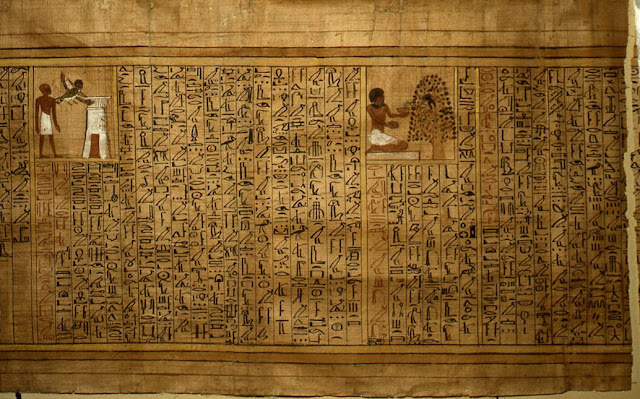
New Kingdom – 18th Dynasty – reigns of Amenhotep II, Thutmose IV, Amenhotep III – circa 1425 – 1353 BC
from their tomb – TT 8 – discovered on February 15, 1906, in the necropolis of Deir el-Medina
by Ernesto Schiaparelli and Francesco Ballerini of the Italian Archaeological Mission of the Turin Museum
exhibited at the Museo Egizio in Turin – Inv. No.: Suppl. 8316/03 = Suppl.8438 – museum photo
In “The Egyptians,” Françoise Dunand and Roger Lichtenberg specify that the one who knows the formulas “will go to earth among the living… He will go out every day, he wants, and return to his tomb without being arrested… Thus, while the body remains in the tomb, the soul, ba (represented as a bird with a human head), is supposed to leave it to wander at will on earth and then find it again”…
The total number of formulas stated is sometimes indicated as 150, 165, or even 194; this difference is probably due to the periods… The copies that have come down to us are not all identical; they vary in fact in the number of formulas as well as in that of the “vignettes”. Thus, Florence Maruejol, the ancient Egyptians, asked “the scribes of the Houses of Life for a choice of chapters. Or it is the scribes themselves who make the selection… The shortest measures 1 or 2 meters in length, the majority reach about fifteen meters, and the longest exceed 25 meters. The chapters are generally illustrated by vignettes drawn in line or painted by an artist who takes over from the scribe”.

New Kingdom – 18th Dynasty – reigns of Amenhotep II, Thutmose IV, Amenhotep III – circa 1425 – 1353 BC
from their tomb – TT 8 – discovered on February 15, 1906, in the necropolis of Deir el-Medina,
by Ernesto Schiaparelli and Francesco Ballerini of the Italian Archaeological Mission of the Turin Museum
exhibited at the Museo Egizio in Turin – Inv. No.: Suppl. 8316/03 = Suppl.8438 – museum photo
The “Book of the Dead” of Kha, architect of the Place of Truth, was found in the tomb he shared with his beloved wife, Merit. Discovered on February 15, 1906, in the northern circus of the necropolis of Deir el-Medina, by Ernesto Schiaparelli and Francesco Ballerini of the Italian archaeological mission of the Turin Museum, it contained more than 500 objects that constitute highly instructive testimonies of the life of a couple of the New Kingdom who had been particularly successful in this ‘microcosm’ that was then the community of artisans.
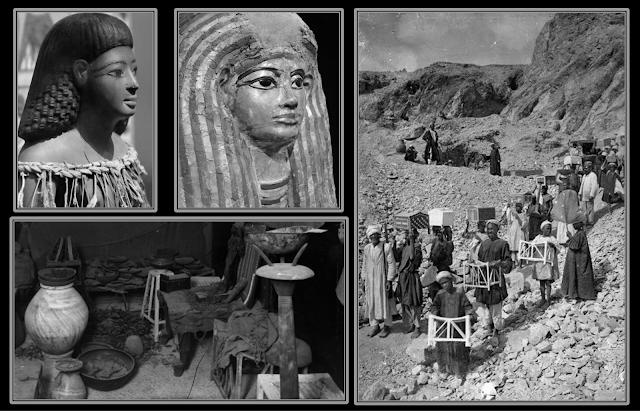
Funeral mask of his wife Merit – painted and gilded stucco cardboard – Museo Egizio Turin, S 8473
Left bottom: The inviolate tomb of Kha and Merit – 18th dynasty – TT 8 Deir el-Medineh – when it was discovered on February 15, 1906,
by the Italian Archaeological Mission of the Turin Museum led by Ernesto Schiaparelli and Francesco Ballerini
Right: Artifacts coming out of the tomb – photos Museo Egizio
Curiously, their “Book of the Dead” was not “rolled up” but was found folded and placed on the intermediate coffin of Kha, who died after his wife. “Composed of 38 sheets of papyrus, stuck together for almost 14 meters in total length… it lists 33 formulas arranged from left to right, often accompanied by abundantly illustrated vignettes. The introductory scene shows Kha and Merit before the god Osiris enthroned under a canopy facing a richly decorated pedestal table; this scene synthesizes the axis around which the concept of death is articulated in ancient Egypt, that is to say the encounter with the god Osiris, sovereign of the world of the dead, whose judgment determines access or not to eternal life” specifies Enrico Ferraris in the “Museo Egizio”…
The following sheets (all 35 centimeters wide) contain other formulas related to the funeral procession, the ritual of opening the mouth, protecting the deceased, amulets, etc.

New Kingdom – 18th Dynasty – reigns of Amenhotep II, Thutmose IV, Amenhotep III – circa 1425 – 1353 BC
from their tomb – TT 8 – discovered on February 15, 1906, in the necropolis of Deir el-Medina
by Ernesto Schiaparelli and Francesco Ballerini of the Italian Archaeological Mission of the Turin Museum
exhibited at the Museo Egizio in Turin – Inv. No.: Suppl. 8316/03 = Suppl.8438 – museum photo
Dated 1425 – 1353 BC, from the reigns of Amenhotep II, Thutmose IV, and Amenhotep III, this “Book of the Dead” was registered in the Museo Egizio – S. 8316/03 = S.8438. In the work cited above, Enrico Ferraris notes “strong formal and sequential analogies with the copy found in the tomb of Yuya and Tuya, parents of Queen Tiye, wife of Amenhotep III, which could suggest the use of a reference model shared by the workshops that wrote these two funerary papyri…
Sources:
Kha’s Book of the Dead Egyptian Museum of Turin – S. 8316/03 = S.8438 https://collezioni.museoegizio.it/it-IT/material/S_8316_03_S_8438/?description=LIBRO+DEI+MORTI+KHA&inventoryNumber=&title=&cgt=&yearFrom=&yearTo=&materials=&provenance=&acquisition=&epoch=&dynasty=&pharaoh= The TT 8 au Museum Egyptian https://collezioni.museoegizio.it/it-IT/search/?action=s&description=&title=&inventoryNumber=&cgt=&yearFrom=&yearTo=&provenance=Deir+el-Medina+%2F+tomba+di+Kha+%28TT8%29&acquisition= Fouilles de Schiaparelli. Documentary fund Francesco Ballerini. CEFB, Come, Italy Jeanne Vandier d’Abbadie, Geneviève Jourdain, Two Tombs of Deir El Médineh, The Chapel of Khâ, The Tomb of the Royal Scribe Amenemopet (1939), MIFAO 73, IFAO, 1939 https://archive.org/details/MIFAO73/page/n5/mode/2up Bertha Porter, Rosalind L. B. Moss, Topographical Bibliography of Ancient Egyptian Hieroglyphic Texts, Reliefs, and Paintings – I. The Theban Necropolis Part 1. Private Tombs, Second edition revised and augmented – Griffith Institute Ashmolean Museum Oxford, 1960 http://www.griffith.ox.ac.uk/topbib/pdf/pm1-1.pdf#page=338 Ernest Scamuzzi, Egyptian Art at the Museum de Turin, Hachette, 1966
Paul Barguet, Le Livre des Morts des anciens Égyptiens, Éditions du Cerf, Paris 1967
Le musée égyptien Turin, Federico Garolla Editore, 1988
Isabelle Franco, Dictionnaire de mythologie égyptienne, Pygmalion 1999
Egypte, le Livres des Morts, version abrégée, traduit de l’égyptien par E. A. Wallis Budge, Hazan, 2001
Nicholas Reeves, Ancient Egypt. The great discoveries, Thames & Hudson, 2002, Les Grandes découvertes de l’Egypte ancienne Editions du Rocher, 2001
Les artistes de pharaon, Deir el Medineh et la Vallée des Rois, Louvre, 2002
Françoise Dunand, Roger Lichtenberg, Les Égyptiens, Éditions du Chêne, 2004
Eleni Vassilika, Trésors d’Art du museo Egizio, Allemandi & Co, 2006
Jean-Pierre Corteggiani, L’Egypte ancienne et ses dieux, Fayard, 2007
Raffaella Bianucci, Michael E. Habicht, Stephen Buckley, Joann Fletcher, Roger Seiler, Lena M. Öhrström, Eleni Vassilika, Thomas Böni, Frank J. Rühli, Shedding New Light on the 18th Dynasty Mummies of the Royal Architect Kha and His Spouse Merit, Mark Spigelman Editor, 2015 https://www.ncbi.nlm.nih.gov/pmc/articles/PMC4511739/ Guide museo Egizio, Franco Cosimo Panini Editions, 2015
Consiglio Nazionale delle Ricerche webtv, a torino per rivivere la scoperta della tomba di kha, 2015 https://www.cnrweb.tv/10146/ Museo Egizio, Fondazione Museo delle Antichità Egizie di Torino, Franco Cosimo Panini Editore, 2016
Ève Gran-Aymarich, Les chercheurs du past 1798-1945 : Aux sources de l’archéologie, CNRS Editions via OpenEdition, 2016 https://books.google.fr/books?id=wIKlDAAAQBAJ&pg=PA1155&lpg=PA1155&dq=schiaparelli+maspero&source=bl&ots=eiKoGLOzaj&sig=Q12 Ot2EYTNn209S0gdRSiKjjG58&hl=fr&sa=X&ved=0ahUKEwi8ivmMjdbRAhWBQBQKHbB2DJoQ6AEIMzAI#v=onepage&q=schiaparelli%20maspero&f=false Florence Maruéjol, L’Egypte ancienne pour les Nuls, First Editions, 2017
Gallica, Le Livre pour sortir au jour or Livre des Morts des Anciens Egypt https://gallica.bnf.fr/accueil/fr/html/le-livre-pour-sortir-au-jour-ou-livre-des-morts-des-anciens-egyptiens
Published 4 weeks ago by Marie Grillot
 lampmagician
It is superb is this. All the best, Mike
LikeLiked by 1 person
Thank you, my wise friend. I truly appreciate your kind words. Sending my heartfelt gratitude, Aladin.
LikeLiked by 1 person
What a fascinating overview of the “Book of the Dead” and its enduring legacy. It’s great to see you posting again, Aladin. I’m so sorry you’re having such a tough start to this year. Hopefully my hilarious ‘red slippers’ escapade brought a chuckle or two! Love and light, Deborah.
LikeLiked by 1 person
It certainly did, my lovely angel! 😉😅
Yes, I endeavour to maintain my presence as much as possible, although I require a lot of time to write an article, as I tire easily. Thank you ever so much for your inspiration. 🙏💖
LikeLiked by 1 person
An interesting article about the book of the Dead Aladin – such a beautiful and intricately made document, thank you. I’m so pleased you’re able to share these pieces again – sending much love and light 😊
LikeLiked by 1 person
Although it is exhausting, I endeavour to do it as it may help me to carry on. Thank you for your lovely and inspiring words, my dear Lin.🤗🙏💖
LikeLiked by 1 person
I love ancient Egypt. I was obsessed with it as a kid. Thanks for sharing this book, Aladin.
LikeLike
That is an excellent subject to be obsessed with! 😉Thank you, as well.💖
LikeLike
Another fantastic installment! I really enjoyed this! Thanks for posting this!
LikeLiked by 1 person
That is fantastic, indeed! Thank you immensely for the inspiration, my friend.
LikeLiked by 1 person
Glad to do it!
LikeLiked by 1 person
Fascinating, Aladin.
Also, I have a smile on my face thinking that “The Book of the Dead” is a guide to going out during the day. It’s like being in 2 worlds at once.
Thank you for this wonderful lesson in Egyptology!
xoxo🌟💙❦❦🌻
LikeLiked by 1 person
Oh, yes, wandering about during the day is my favourite as well, and being in two worlds at once could be an interesting perspective on death! Thank you, my friend.
😉🤙💖🙏
LikeLiked by 1 person
🌟🥰xxoxo
LikeLiked by 1 person