
Translated from volumes published by Lorenz Jung based on the edition “Gesammelte Werke” dtv.de The Symbols of Transformation (1952) and Aion (1950)
Today, I share the final part of the translation of Mana-Personality. It was full of joy for me to learn more and even better from his works because I had to read them word by word to achieve an understandable translation. I hope it was the same for you.
We often wonder why there are so many injustices, differences, and failures in human progress (decline?). Is God flawed? Dr. Jung suggests that God must be imperfect; otherwise, we cannot reach Him.
In the figure of the divine hero, God himself wrestles with his own imperfect, suffering, living creation; he even takes its suffering condition upon himself and, by this sacrificial act, accomplishes the opus magnum of salvation and victory over death.
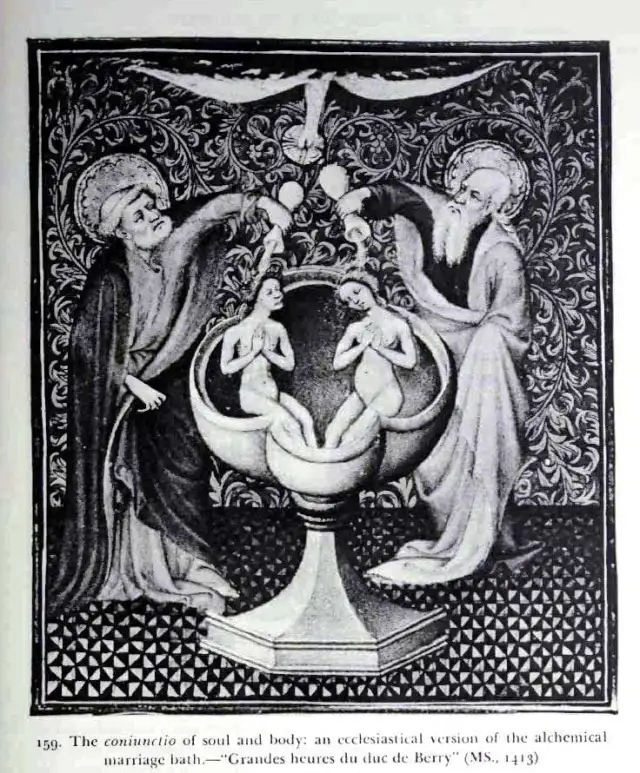
He, instead, talks about the importance of the Self and Individuality.
He personally also admits that his explanation is sensitive to experiences that some may not have practised. He emphasizes:
I am deeply aware that in this work, I have not made any ordinary demands on the understanding of my reader. I have made every effort to smooth the path to understanding. Still, I have not been able to remove one great difficulty, namely the fact that the experiences underlying my explanations are probably unknown to most people and, therefore, strange...
Still, he tries to enlighten us on the matter based on his experiences.
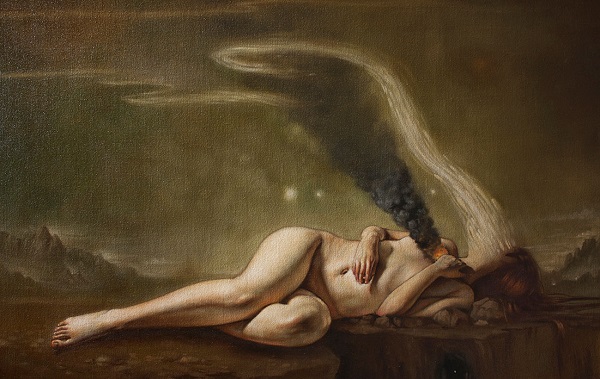
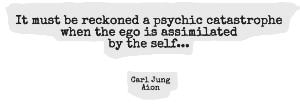
Image credit Carl Jung Depth Psychology
Now, let’s move on to the final chords:
Individuation
The Mana Personality (P9)
The conception of God as an autonomous, psychological content makes God a moral problem – and that is, admittedly, very uncomfortable. But if this problem does not exist, then God is not real either because he does not intervene in our lives anywhere. Then, he is a historical conceptual bogeyman or a philosophical sentimentality.
If we leave the idea of a “divine” out of the equation and speak only of autonomous contents, we may remain intellectually and empirically correct, but we thereby conceal a note that psychologically cannot be missed. If we use the idea of a “divine”, we are thereby aptly expressing the peculiar way in which we experience the effects of autonomous content. We can also use the term “demonic” as long as we do not imply that we have reserved a concrete God somewhere who completely corresponds to our wishes and ideas. However, our intellectual sleight of hand tricks do not help us to create a being according to our wishes in reality, just as the world does not adapt to our expectations. If we, therefore, attribute the effects of autonomous contents with the attribute “divine”, we thereby acknowledge their relative superiority. And this superior is the power that has forced a man of all ages to think of the most unthinkable things and to inflict the greatest suffering on himself in order to do justice to those effects. This power is as real as hunger and fear of death.
The Self could be characterized as a kind of compensation for the conflict between inside and outside. This formulation may not be a lousy fit insofar as the Self has the character of something that is a result, an achieved goal, something that has only gradually come about and has become possible through much effort. Thus, the Self is also the goal of life, for it is the complete expression of the combination of destinies that we call the individual, and not just of the individual human being, but of a whole group in which one completes the other to form the complete picture.

With the sensation of the Self as something irrational, indefinable, to which the ego is not opposed and not subject, but rather attached and around which it rotates, as the earth rotates around the sun, the goal of individuation is achieved. I use the word “sensation” to describe the perceptual character of the relationship between “I” and Self. There is nothing recognizable in this respect because we are unable to say anything about the contents of the Self. The “I” is the only content of the Self that we know. The individualized “I” perceives itself as the object of an unknown and superior subject. It seems to me that the psychological statement reaches its extreme end here because the idea of a Self is in and of itself a transcendent postulate that can be justified psychologically but cannot be proven scientifically. The step beyond science is an absolute requirement of the psychological development described here because, without this postulate, I could not adequately formulate the empirically occurring psychological processes. The Self, therefore, claims at least the value of a hypothesis corresponding to that of the atomic structure. And – should we still be enclosed in an image here – then it is something overwhelmingly alive, the interpretation of which is beyond my capabilities. I do not doubt that it is an image, but one in which we are still contained.
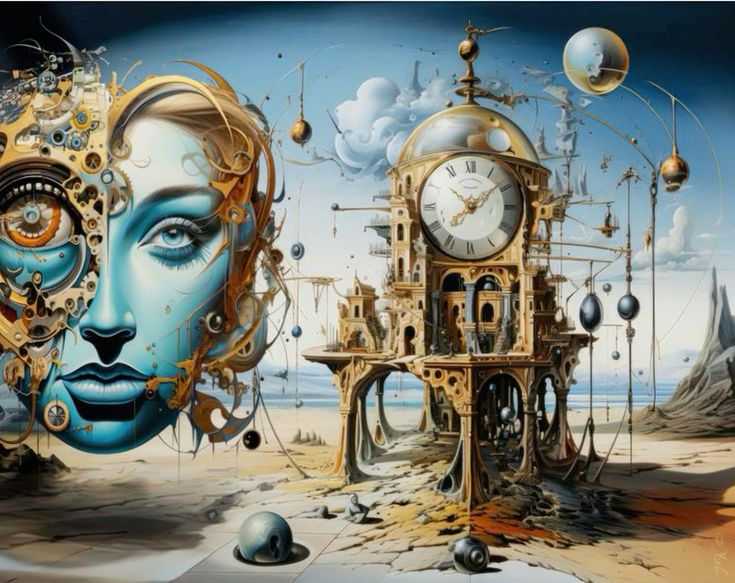
I am deeply aware that in this work, I have not made any ordinary demands on the understanding of my reader. I have made every effort to smooth the path to understanding. Still, I have not been able to remove one great difficulty, namely the fact that the experiences underlying my explanations are probably unknown to most people and, therefore, strange. As a result, I cannot expect my readers to follow all of my conclusions. Although every author naturally enjoys understanding their audience, interpreting my observations is less important to me than pointing out a broad area of experience that has hardly been explored, which I would like to make accessible to many through this book. In this area, which has been so obscure up to now, it seems to me that the answers are recumbent to many puzzles that the psychology of consciousness has never even come close to solving. I do not wish to claim under any circumstances to have formulated these answers definitively. I am, therefore, quite content if my paper can be regarded as a tentative attempt at an answer.
I sincerely appreciate your support and interest. Thank you!🤗🙏💖
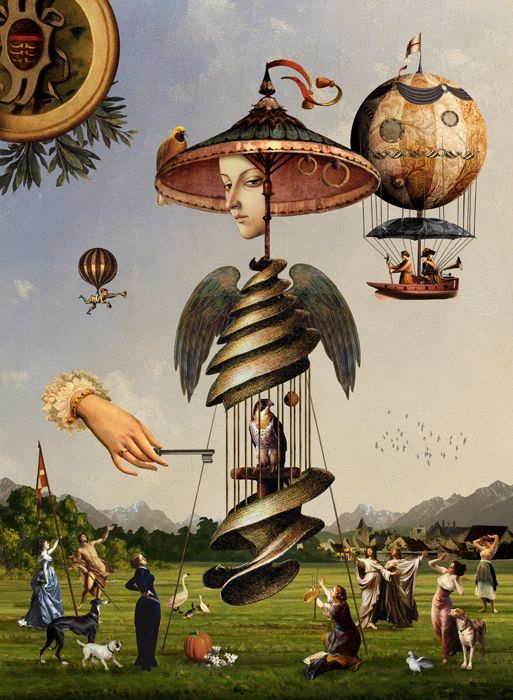
The title image: Maiden Voyage of the Airship Falcon” by Alexei Gurl
 lampmagician
“The Self could be characterized as a kind of compensation for the conflict between inside and outside.” This sentence really stands out for me and helps me in a way I had not considered before … that the Self, to be found within, not only represents our higher wisdom, inner guidance but is working as a compensation to help us with the arduous task of holding the tension of the opposites. Wow, I’ve blown away as I look at the archetypal Self with new eyes.
Thank you Aladin for persevering with such a difficult subject as the Mana Personality. Today, I feel like I’ve been attending a soul workshop with you these past months for each of your nine (the number of completion I note!) has offered me deep insights … opening up my mind, body, spirit and soul in new ways as I revise and update my value and belief system. Thank you so much for sharing Jung and your own magickal light with us. Love and light, Deborah.
LikeLiked by 2 people
That is such a precious honour for me, my loveliest angel, as I think I have achieved some point in reaching the Self. Thank you so much for that. And, as you indeed noticed, Jung fascinatedly compared the “I” and the Self with the moon and the sun! Sending immense gratitude for your kind words and workshop with me.🙏🙏🙏💖💖💖😘
LikeLiked by 2 people
Our lives are a mystery Aladin and you have certainly worked hard to unravel a little of the mystery and articulate it. I look at it all as balance of all of the opposites within and yes, maybe the self is the referee (for want of a better word) in the battle between those opposites as they come into balance.
LikeLiked by 2 people
Thank you, my lovely Lin. You take it absolutely correct; it is a little of a big mystery of our existence, but at least a bit forward. When I read your words, I imagined one, the Self, sitting on a chair and the whole universe turning around her/him. The truth can be even so easy to understand as it looks so difficult. Love and peace.💖🙏🌹
LikeLiked by 1 person
Terrific post! Some of this was over my head but your posts are like a series of college lectures.
LikeLiked by 1 person
Your words give me a great honour, my valuable friend. You made my day; thank you!
LikeLiked by 1 person
You’re very welcome!
LikeLiked by 1 person
Wow and wow again – but that’s also completely over my head too! Love the pictures though.🥰😉
LikeLiked by 2 people
I didn’t want to brag; it wasn’t easy for me either!😅 However, it was worth doing it. Thank you for being here.🥰🙏💖
LikeLiked by 1 person
This is great and preciously written piece, Thank you, Love, nia
LikeLiked by 1 person
Heartfelt thanks for your kind support, lovely Nia.🥰🙏
LikeLiked by 1 person