


This impressive piece is another fascinating treasure, not because of the quantity of it by using jewellery to make it but because of its inner precious spiritual quality.
The scarab beetle was a revered symbol in ancient Egyptian culture, associated with gods like Jepri and Ra. Tutankhamun, an Egyptian pharaoh, had a gold scarab bracelet adorned with precious stones like turquoise and lapis lazuli. The Egypt-museum.com report describes the bracelet as having an incredible design.

Scarab bracelets, resembling scarab beetles, were popular in ancient Egypt. They were made of gold or precious stones and believed to ward off bad luck and evil spirits. Both men and women wore them as stylish jewellery representing spiritual and religious convictions.
Here, we read the story and discovery of this magnificent treasure, which should have belonged to the young Pharaoh, Tutankhamun, by our adorable lady Marie Grillot.
Tutankhamun’s scarab bracelet as a child
via égyptophile

from the tomb of Tutankhamun (KV 62) discovered in November 1922 by Lord Carnarvon and Howard Carter
Carter 269-n – JE 62360 – photo from the Egyptian Museum
According to Howard Carter’s estimate, “at least sixty per cent of the finest ‘unattached’ jewellery had disappeared” from Tutankhamun’s tomb, taken by looters who, in antiquity, violated the tomb on at least two occasions.
As terrible as this observation is, we can only rejoice that two hundred jewels have reached us! Made by the best goldsmiths of the Theban workshops, they fill us with their beauty and originality and captivate us with their luxury and brilliance.

Bracelet decorated with a scarab – gold, lapis lazuli, carnelian, turquoise, quartzite – – New Kingdom – 18th Dynasty
from the tomb of Tutankhamun (KV 62) discovered in November 1922 by Lord Carnarvon and Howard Carter
Carter 269-n – JE 62360 – photo from the Egyptian Museum
Featured here in “Tutankhamun: His tomb and his treasures”, IES Edwards, 1976
The symbolism they carry is omnipresent, whether through the motif represented, the properties of the stone used, or even the magical effectiveness linked to the association of colours, all of which combine and charge them with virtues and protective powers.
This gold bracelet with a lapis lazuli scarab is a beautiful example and particularly moves us. Indeed, its small diameter (5.4 cm) and the signs of wear it bears testify to the fact that the young pharaoh wore it in his youth… And the fact that it also accompanies him in his afterlife is just as moving…
Bracelet decorated with a scarab – gold, lapis lazuli, carnelian, turquoise, quartzite – New Kingdom – 18th Dynasty
from the tomb of Tutankhamun (KV 62) discovered in November 1922 by Lord Carnarvon and Howard Carter
Carter 269-n – JE 62360 – photo from the Egyptian Museum
Featured here in “Discovering Tutankhamun”, Zahi Hawass

“A gold and lapis lazuli scarab crowns this bracelet, which is small enough for the child Tutankhamun to wear. On each side of the scarab are inlaid mandrake fruits with sexual connotations and poppies,” explains Zahi Hawass in “Discovering Tutankhamun.”
In “The Wonders of the Egyptian Museum in Cairo”, Silvia Einaudi gives a beautiful description, of which there is an extract: “A hinge and a clasp join the two semicircles that compose it. Its upper part, whose surface gradually widens, supports a large scarab, whose back, reproduced in the most minor details, is formed of inlaid lapis lazuli set in gold sockets and whose abdomen is entirely gold. The legs are executed with precision and realism: the front legs are provided with a five-pointed rostra, while the hind legs end in hooks. The surface on which the insect is fixed is surrounded by a continuous row of tiny gold grains, bordered on the outside by lapis lazuli, gold, turquoise and carnelian segments. The two parts of the bracelet that surmount the hinge and the clasp are occupied by a delicate composition of inlaid floral motifs, which fills the small trapezoidal space in a balanced way: a yellow quartzite flower is flanked by two carnelian buds; two small gold rosettes separate their stems. The lower part of the bracelet is decorated on the outside with four parallel rows of tiny gold grains.

from the tomb of Tutankhamun (KV 62) discovered in November 1922 by Lord Carnarvon and Howard Carter
Carter 269-n – JE 62360
In “Jewels of the Pharaohs”, Cyril Aldred analyses the floral motif thus: “The two trapezoidal spacers are filled with a floral design of a mandrake fruit flanked by two poppy buds and daisies”.
In “The Gold of the Pharaohs”, Christiane Ziegler gives us details on the materials and fine stones used, allowing us to better decipher the choice made by the goldsmiths during its design…
First of all, gold, whose brilliance brings it closer to that of the sun… Reputed to be unalterable, it is thus assimilated to the flesh of the gods. As for lapis lazuli, she explains: “In ancient myths, it constituted the beard and hair of the gods and possessed virtues comparable to those of turquoise”. Turquoise “méfékat”, with its luminous blue-green colour, evoked: “the growth of young shoots in spring and was synonymous with vitality and joy. Its presence in funeral equipment undoubtedly conferred on the deceased the joy of rebirth”. As for carnelian “Héréset”, it: “possessed the invigorating virtues of blood” and was thus linked to life…

from the tomb of Tutankhamun (KV 62) discovered in November 1922 by Lord Carnarvon and Howard Carter
Carter 269-n – JE 62360
As for the most essential element, the scarab, finely worked in a deep and luminous blue lapis lazuli, is the symbol of renewal, of rebirth. Its representation is persistent in Egyptian jewellery, especially in the young king’s finery.
In her “Dictionary of Egyptian Mythology”, Isabelle Franco specifies, “The scarab is the bearer of a renewed energy which preludes all existence; it presides over the transformations which lead to all maturity. It is the animal attribute of Khepri. The sign of the scarab is used to write the word kheper, which evokes the idea of birth but also of returning.”
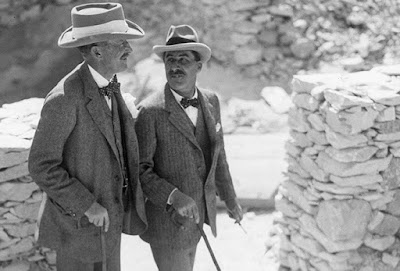
(photo (Harry Burton?) taken between November 1922 and April 1923)
The young king “came back to life” in November 1922, thanks to the perseverance of Howard Carter and Lord Carnarvon, who discovered his tomb in the heart of the Valley of the Kings, finally bringing him out of the oblivion the centuries had left him.

in the wooden box inlaid in the shape of a cartridge (Carter 269 / JE 61490 / GEM 242)
Provenance: The tomb of Tutankhamun (KV 62) discovered in November 1922 by Lord Carnarvon and Howard Carter
The Griffith Institute – Tutankhamun: Anatomy of an Excavation
The Howard Carter Archives – Photographs by Harry Burton
It took seven long weeks to empty the antechamber, and the official opening of the burial chamber took place on February 17, 1923. On that same day, as they continued their extraordinary exploration, they noticed “A low door, on the right, which gave access to another, smaller room. (…) This door had neither been blocked nor sealed. A single glance was enough to make us understand that it was this which contained the real treasures of the tomb …” (Howard Carter)
This bracelet was found in this room, precisely in a dark wooden box in the shape of a cartouche, whose lid reproduces the name of Tutankhamun in a delicate coloured rebus. Harry Burton’s photos, identified as it, are placed on the ground in front and to the left of the gilded wooden naos protected by the four goddesses.
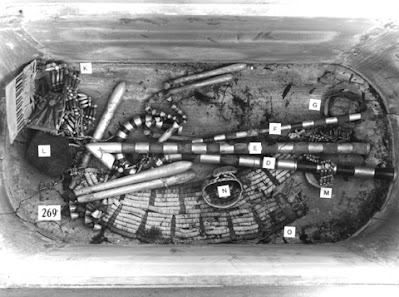
in the wooden box inlaid in the shape of a cartridge (Carter 269 / JE 61490 / GEM 242)
Provenance: The tomb of Tutankhamun (KV 62) discovered in November 1922 by Lord Carnarvon and Howard Carter
The Griffith Institute – Tutankhamun: Anatomy of an Excavation
The Howard Carter Archives – Photographs by Harry Burton
This box, number Carter 269, contained wonders! The various jewels and artefacts it contained received this number, followed by a letter as a reference. Thus, this bracelet received the number “269 n,” and it was then registered in the Journal of Entries of the Cairo Museum JE 62360 … while waiting for the new referencing that will be given to it by the Grand Egyptian Museum, where it will soon be exhibited …
Sources:
Egyptian Museum, Cairo – Tutankhamun’s bracelet with a scarab http://www.globalegyptianmuseum.org/record.aspx?id=15044 Howard Carter, The Tomb of Tutankhamun, Volume 3: The Annex and Treasury, Bloomsbury Academic, 2014 Jean Capart, Tutankhamun, Vromant & Cie Printers-Publishers, 1923 http://gallica.bnf.fr/ark:/12148/bpt6k5611389t/f60.texte Nicholas Reeves, Tutankhamun, life, death and discovery of a pharaoh, Editions Errance, 2003
Christiane Desroches Noblecourt, Tutankhamun and his time, catalogue of the exhibition Petit Palais, Paris, February 17-July 1967, Ministry of State for Cultural Affairs
Christiane Desroches Noblecourt, Life and Death of a Pharaoh, Hachette, 1963
Zahi Hawass, Discovering Tutankhamun, Editions du Rocher, 2015
Zahi Hawass, Tutankhamun, Treasures of the Golden Pharaoh, exhibition catalogue, IMG Melcher Media, 2018
Francesco Tiradritti, Treasures of Egypt – The wonders of the Egyptian Museum in Cairo, Gründ, 1999
Cyril Aldred, Jewels of the Pharaohs, Ed. Thames & Hudson Ltd. London, 1978
Iorwerth Eiddon Stephen Edwards, Tutankhamun: his tomb and his treasures, The Metropolitan Museum of Art, 1977
Christiane Ziegler, The Gold of the Pharaohs – 2500 Years of Goldsmithing in Ancient Egypt, catalogue of the summer 2018 exhibition at the Grimaldi Forum in Monaco,
The Griffith Institute – Tutankhamun: Anatomy of an Excavation – The Howard Carter Archives – Photographs by Harry Burton http://www.griffith.ox.ac.uk/php/am-makepage1.php?&db=burton&view=gall&burt=&card=269&desc=&strt=3&what=Search&cpos=51&s1=imagename&s2=cardnumber&s3=&dno=25 Émile Vernier Egyptian jewellery and jewellery, MIFAO, Cairo, 1907 https://archive.org/details/MIFAO2/mode/2up https://archive.org/details/MIFAO2/page/n1/mode/2up Thomas Garnet Henry James, Howard Carter, The path to Tutankhamun, TPP, 1992
 lampmagician
Wonderful article !
LikeLiked by 1 person
Heartfelt thanks, dear friend. Your kind words are highly appreciated.🤗🙏💖
LikeLiked by 1 person
It truly is a gorgeous bracelet.
I adore all the meanings of the stones.
Amidst the many things I never knew about ancient Egypt, I did know about the Scarab.
Someone gave me an ivory Scarab trimmed in gold when I was in my 20’s. They took the time to explain its significance.
I last remember seeing it since moving where I live now.(24 years ago) I wonder where t is now?
Thank you for this article, Aladin! Most enjoyable.
❦❦🌟🌹🪲
LikeLiked by 1 person
Oh, dear Resa. That stone was perhaps a declaration of love from one of your adorances! 😉 However, it is always nice to know more about the meanings of these stones than to fall in love with their shining glance. Thank you, my friend.🙏🌹💖
LikeLiked by 1 person
Yes, I agree!
“All that glitters is not gold”.
It’s an old saying, that when thought about, holds several meanings.
💖💖😘🌹🌟❦
LikeLiked by 1 person
A sage quote. There exists also with the exact words in German and Persian!!😉👍🙏🦋💖
LikeLiked by 1 person
🤗 🧡😘🤗 🧡😘
LikeLiked by 1 person
How elegant. Love it 😍
LikeLiked by 1 person
I could bet! Thank you, dear, beautiful and elegant Holly. 🥰🙏🤗💖🌹
LikeLiked by 1 person
Thank you dear Aladin, your posts are always food for thought and beautiful to the eye and mind.
LikeLiked by 1 person
Your golden words take me to the sky! I must only keep myself off the sunbeam to not melt my honny feathers away!😉😂 Thank you, dear angel. 🙏💖🦋
LikeLiked by 1 person
Ahh! Such a beautiful message, thank you dear Aladin ❤️
LikeLiked by 1 person
I attempted to give my words the same value as yours, my dear Rene.🤗🙏💖🌹
LikeLiked by 1 person
More so dear Aladin 🌹
LikeLiked by 1 person
💖🌹
LikeLiked by 1 person
Terrifically written! On a related note, did you ever read the 1890s novel titled The Beetle, a horror tale about Egyptian artifacts.
LikeLiked by 1 person
Not yet, but I will look forward to catching it. Thank you so much.🙏👍
LikeLiked by 1 person
You’re very welcome!
LikeLiked by 1 person
Wow what a beautiful bracelet – I love lapis! It always amazes me the artistry of the craftspeople back then, working without the luxuries of modern day tools! Thank you for sharing this and enjoy the rest of your weekend Aladin.
LikeLiked by 4 people
That is true, dear Lin. They made such fascinating art with primitive instruments and their bare hands. Thank you for your kind words, and have a great week ahead.🤗🙏
LikeLiked by 1 person
Thank you for sharing beautiful jewelry. I love the scarabs decorating the bracelets. Some years ago, I loved learning that the scarab beetle was associated with the sun as it rolled balls of dung across the sky. Any Egyptian exhibit I’ve visited included Khepri. I have a painting I did a long time ago with my poorly rendered images of Khepri and his sun ball. It makes me wonder about the value of dung as a fertilizing nutrient in the desert.
LikeLiked by 1 person
The same goes for me. I always wonder what all these insects and creatures really mean. There have to be many more promises behind them! Thank you, dear Elaine, for your lovely little nocturne.🤗🙏
LikeLiked by 1 person