

20th Dynasty, during the reign of Ramesses III, IV and V.
TT 148, the brothers and sisters of Amenemope
Usermaatre Amenemope was an ancient Egyptian pharaoh of the 21st Dynasty who ruled between 1001–992 BC or 993–984 BC. Amenemope wrote The Instruction of Amenemope during ancient Egypt’s late New Kingdom period. The text contains practical maxims and admonitions for leading a good life, similar to other wisdom literature. It’s been noted that Amenemope’s work shares similarities with the Hebrew Book of Proverbs in structure and content, but the nature of their relationship is debated.

Amenemope tomb is notable for being one of only two entirely intact royal burials known from ancient Egypt; the other is that of Psusennes I. However, only the metal objects from the tomb survived.
The chamber is 10.63 meters long, 2.85 meters wide, and 3 meters high at the centre. The rock quality is inferior; three large fissures have caused significant damage. In the past, cracks were filled with mud and fired to even the surface.
Now, let’s read another fascinating Marie Grillot report about this magnificent, gold-shining, divine amulet and its discovery.
On this golden pectoral, Amenemope is facing Osiris
via égyptophile

from his tomb (NRT III) discovered in Tanis by Pierre Montet on April 16, 1940
Egyptian Museum in Cairo – JE 86038
This pectoral is one of only two that accompanied Pharaoh Amenemope for his eternity. A gold plate, square in shape (8.8 x 8.9 cm), is attached to a heavy gold chain with a length of 46 cm, which is relatively original because this type of pendant fits most often a rectangular shape.
Jean Yoyotte explains how the goldsmith designed it: “Two gold sheets of the same size fit together dry, adjusted on a thin filling (cement?), the whole being provided with two welded fluted bails on the edge, small rods are used to fix the chain.
The pectoral decoration resembles the architecture of a temple door, topped by a grooved cornice on which stretches—just like in temples—a representation of the winged sun.
The lower part of the pendant is made up of a frieze of thirteen motifs repeated alternately: the Djed pillar is reproduced seven times, while the Tit loop appears six times.
These protective emblems are associated with Osiris and Isis, respectively.

from his tomb (NRT III) discovered in Tanis by Pierre Montet on April 16, 1940
Egyptian Museum in Cairo – JE 86038
Indeed, the Djed pillar is an Osirian amulet, a symbol of stability, present in Egypt since the most ancient times, while the: “knot of Isis (Tit) is, for its part, assimilated to the blood and the magical power of ‘Isis’ (Isabelle Franco).
The central scene “picture”, evoking a funeral rite, is presented in a frame bordered by a Ramesside frieze. Suppose this scene is prevalent in funerary iconography. In that case, Christiane Ziegler nevertheless explains its originality here: “Of all the pectorals of Tanis, this is the only one to depict the pharaoh. The decor, executed in embossed on the gold leaf, depicts King Amonemope offering incense and a libation to the god of the dead, Osiris. An identical motif is chiselled on the bottom plate.
The pharaoh, wearing a nemes headdress and a front loincloth, is standing in a walking attitude. He is facing Osiris, who is seated on his throne. The god of the underworld, wearing the imposing crown Atef, is represented in his mummified appearance. He clutches the whip and the flail to his chest.

from his tomb (NRT III) discovered in Tanis by Pierre Montet on April 16, 1940
Egyptian Museum in Cairo – JE 86038 – photo of the museum
Amenemope raises his right hand and holds a cassolette of incense in his left. “Between the two partners, a vertical legend specifies that the first is supposed to incense and libation to his father Osiris” (Jean Yoyotte).
In the worship of gods and deities, the fumigation of incense is, along with the libation of water, one of the most important rituals of the pharaonic liturgy. The high function of fumigation was to “restore life through incense supposed to be an emission from the body of Osiris”. This scene is often reproduced on the walls of temples or the walls of tombs, most often performed by a sem priest or by the pharaoh himself…”. It is also important to point out that it is reproduced on one of the walls of the tomb of Amenemope.
Incense, rare in Egypt, was mainly dedicated to worshipping divinities and the pharaoh; it could be frankincense, terebinth, myrrh, styrax, etc. But the most sought after, the most prized, was kyphi, produced by a mixture of 10 to 50 substances. It is worth remembering that “The priests offered Ré three kinds of incense daily, one at sunrise, one at midday and one at sunset.”…
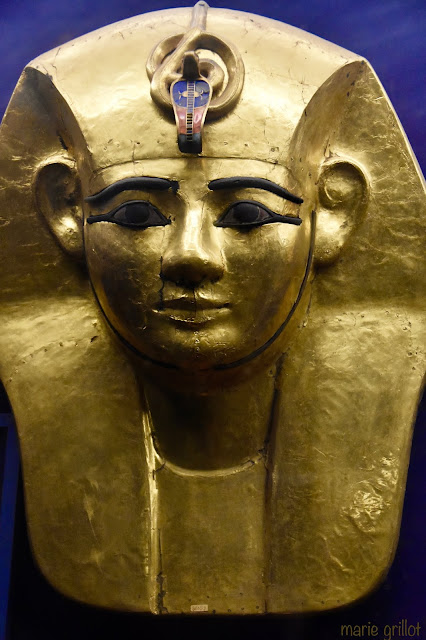
from his tomb (NRT III) discovered in Tanis by Pierre Montet on April 16, 1940
Egyptian Museum in Cairo – JE 86059
Pierre Montet discovered a funerary mask of the pharaoh Amenemop (Amenémopé, Ménémopé, Amonemapit) in Tanis in April 1940. On May 3, 1940, in a truck protected by the army, the treasure of Amenemope took its way to the Egyptian museum there, Tahrir, where the mask will be recorded in the Journal of Entries under the reference JE 86059.
Amenemope is a pharaoh of the 21st Dynasty whose reign, which was exercised from Tanis, is located approximately around 1001-992 BC. In “The Treasures of the Egyptian Museum”, a collective work written under the direction of Francesco Tiradritti, we can read that: “successor of Psusennes I was buried in the tomb of the latter, in a room covered with granite, originally created to accommodate the remains of Moutnedjemet, wife and sister of Psusennes I”.
We can only be surprised that he was buried in a single-room vault even though he has his own burial referenced NRT IV (NRT = Royal Necropolis of Tanis).
Still, his “true” eternal home – the one in which his mummy rested – was discovered in the spring of 1940 by Pierre Montet and his team.
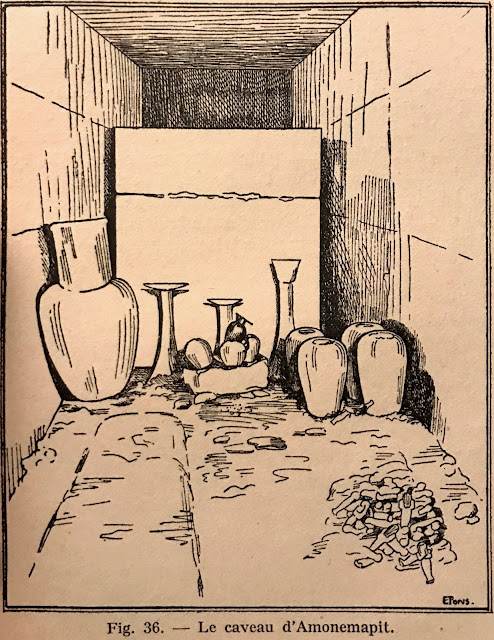
Drawing by E. Pons -Source: Pierre Montet, “Tanis”, Payot, 1942
In “Tanis – Twelve years of excavations in a forgotten capital of the Egyptian Delta”, the discoverer relates this very special day: “The entrance was opened on April 16. His Majesty King Farouk arrived the day before in Sân, where he had to set up a tent city, was present, as well as Mr Canon Drioton, director of the Egyptian Antiquities Service and a young Egyptian Egyptologist, Professor Abou Bekr. The vault was furnished almost like that of Psusennes: at the bottom, a granite sarcophagus; in the front half, the canopic vases, the metal vases, a large sealed jar, funerary statuettes, and a vast gilded wooden chest that had collapsed due to the effects of time and humidity. When these objects had been placed in a safe place, the sarcophagus lid was placed in their location. Much less abundant than Psusennes, the new sovereign was content with a single stone sarcophagus and an anthropoid wooden coffin covered in gold. The wood had been reduced to almost nothing, and the gold plates were removed. It is hardly necessary to say that the mummy suffered enormously. His ornaments, less numerous than those of Psousennès, nevertheless constitute a wonderful collection: a gold mask, two necklaces, two pectorals, two scarabs, hearts of lapis and chalcedony, bracelets and rings, a giant falcon in cloisonné gold with outstretched wings, and canes.
In this troubled period of the Second World War, the artefacts will be brought to safety as quickly as possible. Thus, from May 3, 1940, it was in a truck protected by the army that the Amenemope treasure would travel to the Egyptian museum in Tahrir Square…
The pectoral will be recorded in the Journal des Entries under the reference JE 86038.
Sources:
Gold Pectoral of King Amenemope http://www.globalegyptianmuseum.org/record.aspx?id=15529 Tanis – Twelve years of excavations in a forgotten capital of the Egyptian Delta, Pierre Montet, 1942
Tanis the gold of the pharaohs, exhibition catalogue Paris, National Galleries of the Grand Palais, March 26 – July 20, 1987
The discovery of the Treasures of Tanis, Georges Goyon
Treasures of Egypt – The wonders of the Egyptian Museum in Cairo, Francesco Tiradritti
Tanis: treasures of the pharaohs, Henri Stierlin and Christiane Ziegler, Seuil, 1987
Pharaons – Catalog of the exhibition presented at the Institute of the Arab World in Paris from October 15, 2004, to April 10, 2005
Ancient Egypt and its gods, Jean-Pierre Corteggiani, 2007
Dictionary of Egyptian mythology, Isabelle Franco,
Published December 13th 2019 by Marie Grillot
 lampmagician
Thank you so much for such a well researched and fantastic article. I learned many things I didn’t know🙏
LikeLiked by 1 person
So do I, my lovely Amica. Thank you for your dear support.
LikeLiked by 1 person
My sincere pleasure, caro Aladin 💖
LikeLiked by 1 person
A great post! Thanks!
LikeLiked by 1 person
Thank You, as well, dear friend.🙏🤙
LikeLiked by 1 person
You’re welcome!
LikeLiked by 1 person
I love the ancient Egyptian wisdom and art. Since I won’t get to Egypt in this life, thanks for bringing the power of Egyptian art here. I loved the extensive Egyptian collection in the Metropolitan Museum of Art. Thank you for this beauty.
LikeLiked by 1 person
I thank You, my lovely Ealaine, for your friendship and company. I don’t think I could go to Egypt in this life either, but we may try it in the next one!?😉🤗😘🦋
LikeLike
Your Egyptian artifact articles are always engaging and teaching.
Still, 320 decades of Pharaohs is a long time. It seems to me there must be much that has still not been unearthed.
Aladin, do you think there are still discoveries to be made?
❦❦❦❦❦
LikeLiked by 1 person
I am sure, my dear Resa. It has been over two centuries since they excavated and discovered such treasures. However, the problem is that since these jewels were found, they became available on the market. A group similar to a clan or mafia appeared to control all these happenings. As a result, many honest searchers were kept out. I experienced this even when I was a member of some Egyptian groups!😜
Thank you so much for your kind words.💖🙏🌹
LikeLike