
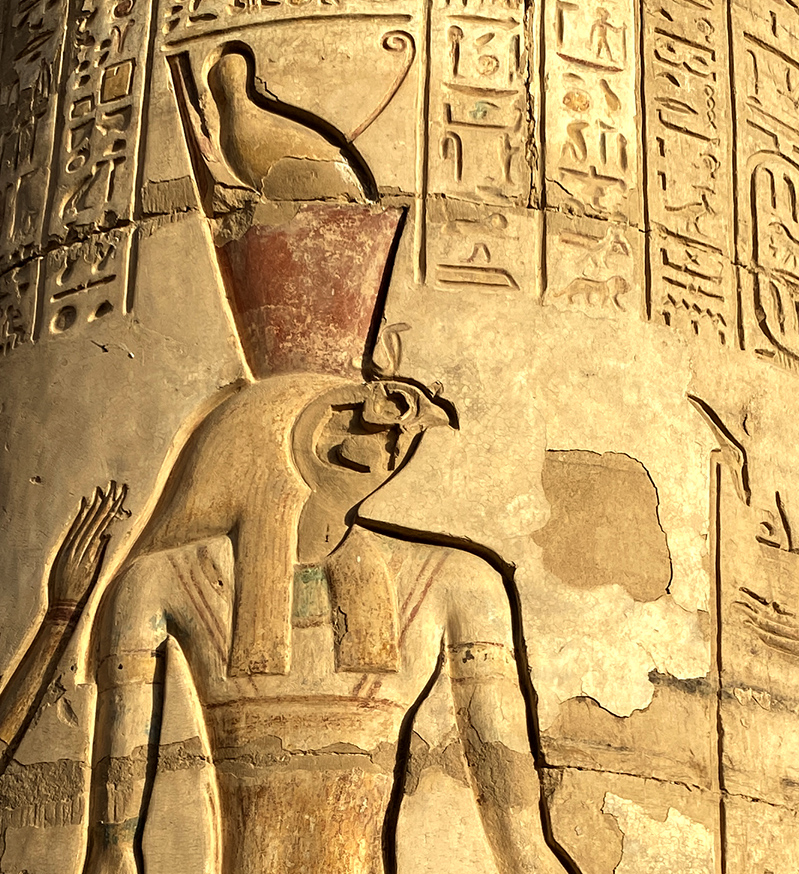
Since Horus was considered the sky, he was also considered to contain the Sun and Moon. Egyptians believed that the Sun was his right eye and the Moon his left and that they traversed the sky when he, a falcon, flew across it.

As the title image shows, Horus is usually depicted as a falcon. But now, the brilliant Marie Grillot shows us a unique image of this deity.
The infant Horus is often pictured on stelae in the act of trampling two crocodiles and holding dangerous animals in his hands. The water poured on these objects, by flowing across their surface covered with magic spells, gained the power of healing whoever drank it from the stings of scorpions and the bites of snakes.
Stele of Horus: the magic that heals
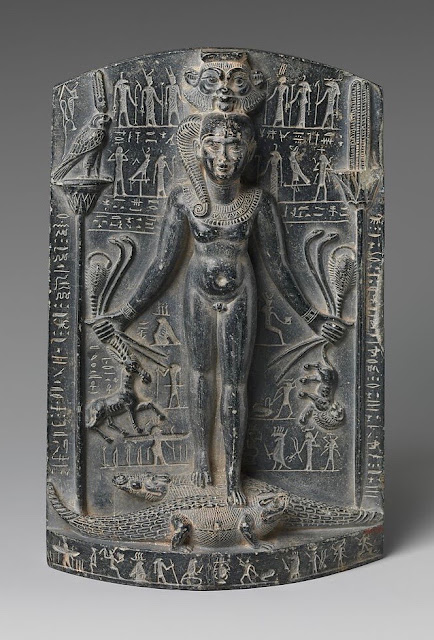
Metropolitan Museum of Art in New York – entry number 20.2.23 – museum photo
via égyptophile
These “magical” steles, representing Horus on crocodiles, found in many museums, are generally dated from the Late Period to the end of the Roman era. “Called ‘Cippus of Horus’, they are usually carved from a hard, black stone, their upper edge is rounded, and they can be briefly described as follows: on the front of the stele, Horus as a child (Harpocrates) is presented in relief. It is standing on two crocodiles, and he holds snakes, scorpions, a lion and a horned animal (ibex?), all these representations being associated with Seth, the god of evil. On the head of Horus is a god,’ The ancient,’ who resembles the god Bes and, with Horus, thus represent the ancient god who perpetually regains his youth and strength,” specifies Wallis Budge in “Amulets & Magic”.
Their size seems to have yet to meet any specific criteria, whether made of soapstone, schist, greywacke, basalt, or sometimes limestone, copper alloy, wood, or even anhydrite.

Department of Egyptian Antiquities of the Louvre Museum – E 20008 – museum photo
Their iconography, as described by Wallis Budge, may vary somewhat, but their highly balanced composition remains. As a child, Horus is represented in the centre, frontally, in high relief; his chubby body is naked. He still wears the side braid from childhood, and often, a uraeus adorns his forehead. In the middle of the arch, just above his head, is the face of a leonine god, grimacing and bearded, comparable to Bes. However, the threatening species that Horus masters with his hands and feet may differ. They are generally “strong and dangerous desert animals (scorpions, snakes, lion, oryx) held by the tail or by their horns. This motif shows the domination of Horus over these powerful animals and the dangers they can represent,” indicates the Metropolitan Museum of Art in New York (presentation notice of the MMA stele 20.2.23).
Their lateral edges are occupied by sacred emblems, such as the lotus of the god Nefertum on the right and a papyrus stem surmounted by a falcon on the left. These elements are sometimes based on the Oak sign, symbolizing eternity.

Cippus of Horus on the Crocodiles – Ptolemaic period – 3rd century BC AD
Brooklyn Museum – entry number 60.73 – museum photo
These steles are inscribed with magical formulas which, to release their healing power, had to be “either immersed in water that the patient drank, thus imbuing themselves with the virtues of the magical texts and the image, or rubbed on the site of the injury.”
Thus, in “Amulets of Ancient Egypt”, Carol Andrews recalls: “We know that they were installed in the precincts of the temples so that water could be poured over them to absorb the magic of their scenes and formulas; “once drunk, the water offered prophylactic protection against the creatures in question or perhaps healed those already bitten or stung.” Thus, “Drinking the water that had been left to flow on the stele was to the benefit of the protection that Isis exercised over her son and brought healing”.
In “Animals and Pharaohs”, Florence Maruejol contextualizes their use thus: “Often worn out, the so-called steles of Horus on the crocodiles were manipulated by magicians who tried to cure their patients”…

Egyptian Museum in Cairo – CG 9401 – on display at NMEC in Fustat
In “The Egyptian Museum in Cairo”, Abeer El-Shahawy recalls that: “magic, prayer and medicine complemented each other in ancient Egypt and people in need, in danger, suffering from illness or disease and illness prayed in front of such stelae. Stele of Horus on the crocodiles – cippi of Horus – schist – Ptolemaic period Egyptian Museum in Cairo – CG 9401
For protection—and perhaps of a “preventive” nature—they were also present in chapels at the start of desert tracks (filled with dangers) and had a special place in homes. We have even found them in collective baths, where the humid environment was certainly conducive to the frequentation of snakes.
They all refer to an episode in the legend of Horus: “Son of Isis and Osiris, the child was raised by his mother in a remote place, the marshes of the Delta, to escape the vengeance of the god Seth who had put his father to death. But, one fine day, young Horus was bitten by a venomous animal: he owed his survival only to the magical practices of his mother, Isis and the god Thoth, who knew the most secret formulas. This miraculous healing was, in a way, a model for all Egyptians and left them a little hope for desperate cases,” explains Christiane Ziegler in “Ancient Egypt at the Louvre” (E 10777).
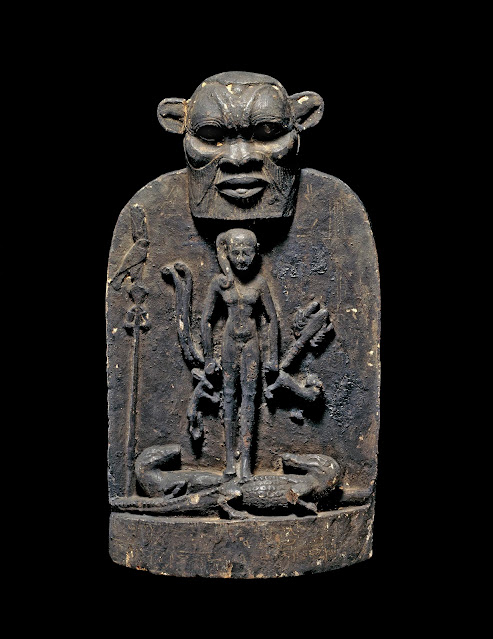
British Museum – inventory number EA60958 – photo © The Trustees of the British Museum
Ancient Egyptian medicine combined scientific knowledge with healing magic. In “The Egyptian Museum in Cairo”, Abeer El-Shahawy recalls that: “magic, prayer and medicine complemented each other in ancient Egypt and people in need, in danger, suffering from illness or disease and illness prayed in front of such stelae.
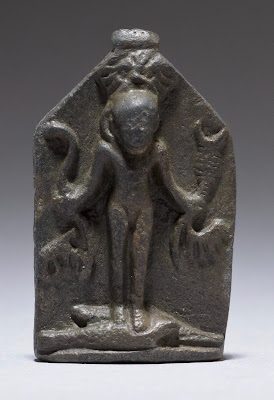
There are also “miniature steles” that one could carry with oneself. The Metropolitan Museum of Art in New York, which has several examples, indicates that these small models were considered “an amulet for magical protection rather than transmitting magic to the water poured over them for drinking”.
Miniature cippus of Horus – magic stele – copper metal
Ptolemaic period – around 332 – 30 BC-AD – MMA New York – entry number: 23.6.19
In his reference study on “The ‘healing’ statues in ancient Egypt”, Pierre Lacau indicates that: “The typical stele of Horus on the crocodiles must therefore be considered as a true repertoire of ‘amulets’ and ‘formulas’ which the Egyptians could have at their disposal against bites; it is an arsenal or a codex containing the most varied weapons or remedies. We can, therefore, understand the extraordinary popularity that it was able to enjoy. All the provinces of Egypt have it used… They could be dedicated in temples, kept at home, or carried on one’s person like an amulet…
These steles testify to the force that magic exerted on the ancient Egyptians. They also reflect the fervour of the power granted to the “Medou-Neter,” the hieroglyphs, which in this specific case turn out to be, according to their etymology, sacred or divine writings.
Sources:
Pierre Lacau, “Healing” statues in ancient Egypt, Monuments and memories of the Eugène Piot Foundation, 1921, 25-1-2 pp. 189-210 https://www.persee.fr/doc/piot_1148-6023_1921_num_25_1_1824
Wallis Budge, Amulets & Magic, London 1930
Georges Posener, Dictionary of Egyptian Civilization, Fernand Hazan, 1959
Jocelyne Berlandini, A stele of Horus on the crocodiles of the superior of the priests of Sekhmet, Padiimennebnesouttaouy, Cahiers de Karnak VI 1973-1977, Cairo, 1980 https://www.academia.edu/3736548/Une_stèle_dHorus_sur_les_crocodiles_du_supérieur_des_prêtres_de_Sekhmet_Padiimennebnesouttaouy Carol Andrews, Amulets of Ancient Egypt, British Museum Press, London, 1994 https://archive.org/details/AmuletsOfAncientEgypt_201707 https://umranica.wikido.xyz/repo/e/ea/Amulets_of_ancient_Egypt.pdf
Guillemette Andreu, Marie-Hélène Rutschowscaya, Christiane Ziegler, Ancient Egypt at the Louvre, Hachette, 1997
Francesco Tiradritti, Treasures of Egypt – The wonders of the Egyptian Museum in Cairo, Gründ, 1999
Abeer El-Shahawy, The Egyptian Museum in Cairo, Matḥaf al-Miṣrī, American Univ in Cairo Press, 2005
Magical stela or cippus of Horus, Metropolitan Museum of Art New York, entry no. 20.2.23 https://www.metmuseum.org/art/collection/search/545766?searchField=All&sortBy=Relevance&ft=horus+stelae&offset=0&rpp=20&pos=12 Miniature cippus of Horus (magical stela), Metropolitan Museum of Art New York, entry no. 23.6.19 https://www.metmuseum.org/art/collection/search/570346 Cippus of Horus on the Crocodiles, Brooklyn Museum – accession number 60.73 https://www.brooklynmuseum.org/opencollection/objects/3684 Stele of Horus, Louvre, E 20008 https://collections.louvre.fr/ark:/53355/cl010006108 Healing statue, Louvre, E 10777 https://collections.louvre.fr/ark:/53355/cl010034902 Cippus, protective magic stela, British Museum, EA60958 https://www.britishmuseum.org/collection/object/Y_EA60958
Posted 16th January 2015 by Marie Grillot
Labels: Bès CG 940 Cippe d’Horus cippi cippus guérisseuse Harpocrate Horus Isis magie piqures scorpions serpents Seth stèle stèle Horus et crocodiles stèle magique Wallis Budge
 lampmagician
Very informative and very knowledgeable
LikeLiked by 1 person
Heartfelt thanks for the appreciation and encouraging words. 🙏💕
LikeLike
Yet another wonderful read for a cold and dreary Saturday afternoon.
I am grateful for your great posts that help me expand my knowledge, as well as for your kindness and precious support, dear Aladin 🙏🤍🙏
LikeLiked by 2 people
I can only turn your kind words back to me to breathe once deeply! Thank you for being with me, my dearest Luisa.🙏🙏💖🌹😘🌟
LikeLiked by 1 person
It is always a real pleasure to read your articles, which I consider a storehouse of knowledge💞
LikeLiked by 1 person
And I have the same from yours, my lovely luisa. 🙏🤗💕🌺😘😘
LikeLiked by 1 person
🙏💞🙏💞🙏
LikeLiked by 1 person
Enlightened post, master Aladin🧞♂️🐍🦜🌞 I am learning more about Ancient Egyptian mythology from reading this. May “Horus” be with you this Easter holiday. Safe travels, and good health Salud!
LikeLiked by 1 person
Oh wow, mate! I had to bend to your adoration for me because I am not the one having such honour you are giving me, my dear friend. However, I take it by heart and wish you a lovely season.
PS: I have two posts of you in my E-Box, which I should read in some quiet corner.😉🙏🙏🖖🌟
LikeLiked by 1 person
Easter blessings to you my dear friend! As always, this is a wonderful post Aladin. Thank you for sharing more of Marie’s ancient Egyptian mysteries! I’m so pleased you share the images too, it helps me learn more about symbolism, especially with those amazing copper healing statues. As copper is the metal that symbolically represents the planet and goddess, Venus, sending you much love and light, Deborah.
LikeLiked by 1 person
Thank you so much, dear Deborah. You have an excellent analysis and picked such fascinating symbols from the images;– with the loveliest wishes to you and yours.🙏🥰🌹
LikeLiked by 1 person
Wonderful! This is a fantastic post!
LikeLiked by 1 person
Gratitude as always, dear friend. 🙏🤙
LikeLiked by 1 person
You’re very welcome!
LikeLiked by 1 person
Fascinating.
Wise that magic had influence on their lives. After all, it’s like a magic that we are here at all.
So…gods are born, and they die. Interesting.
A terrific article Aladin. Thank you for the (my) continuing education on Egyptology!
🥰🌟🤗💐🌺
LikeLiked by 1 person
It is magic, my wise friend. We might better think twice when we observe them. And to know gods live, love, and die is really fascinating!! Thank you, lovely Resa; the school of life has no ending diploma!😎😂🙏🥰💖
LikeLiked by 1 person
No diploma? Maybe that’s why so many are not good at being in life? There’s no end reward. Many people don’t like doing something for nothing.
Just a thought.
❤️❤️❤️xoxo❤️❤️❤️
LikeLiked by 1 person
That is true, my wise friend; though some may seek rewards in quantity, they may not recognize the value of quality rewards. 🙏💖🤙🥰 Also a thought! 😉🤗😘
LikeLiked by 1 person
Yes, an excellent thought! 😉🤗😘xo
LikeLiked by 1 person
Your posts offer much to explore, think about, and look at. Unique and interesting content. Takes me some time to move through them; I do appreciate the process. 🙏🏻
LikeLiked by 1 person
I do appreciate your inspiring words, Michele. Thank you so much for the honour of your presence, beautiful lady, and I wish you a precious holiday season.🙏🙏💖🤗🙏🌹
LikeLiked by 1 person
You’re very kind. Thank you, Aladin. Best to you! 😊
LikeLiked by 1 person
I always like learning something new about Ancient Egyptian places. 😊
LikeLiked by 1 person
You are not alone, my dear Chris. It is always good to learn from this fascinating Egypt! Thank you.🤗👍🙏💕
LikeLiked by 1 person
💛
LikeLiked by 1 person
💛🧡
LikeLike