

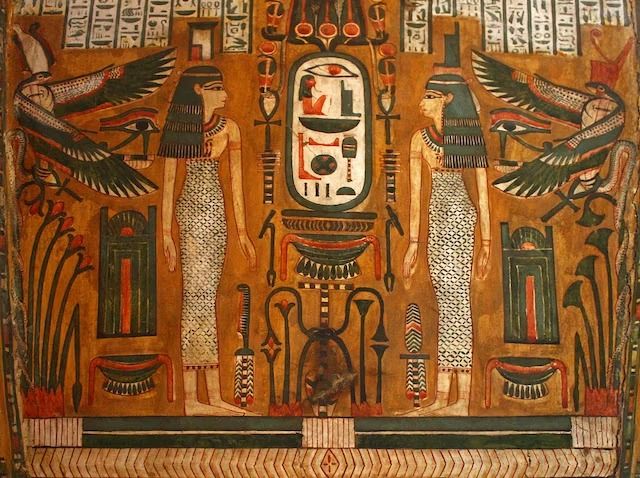
Ancient Egyptian culture recognizes Nephthys, also known as Nebet-Het, as a powerful goddess. She belonged to the Great Ennead of Heliopolis from Egyptian mythology. The myths recognize Nephthys as the daughter of the god Geb and goddess Nut. Mythology pairs the goddess herself with Isis, her sister, in funerary rites.
FRANS VANDEWALLECC BY-NC-SA 2.0 mythopedia
Honestly, I didn’t know much about Isis’s sister. It is always fascinating to learn more about this magical ancient Egypt. With forever thanks to Marie Grillot for her brilliant article about this piece of jewelry.
Nephthys, Divine Mourner
via: égyptophile

Metropolitan Museum of Art, New York – entry number 12.182.23a
(by acquisition in 1912 from Mohammed Mohassib, an antique dealer in Louqsor)
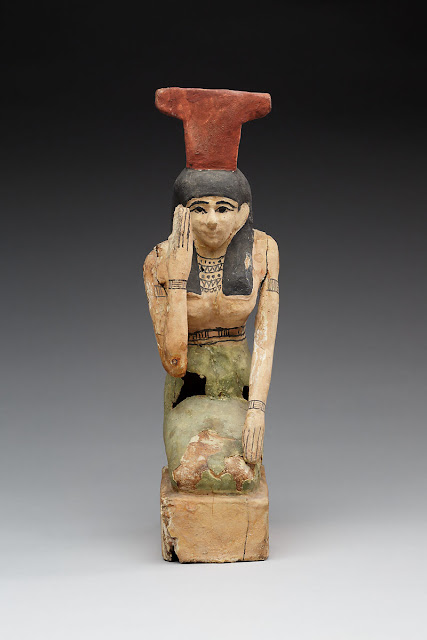
“Isis and Nephthys, the divine mourners, appear many times in tombs in the form of wooden statuettes”, indicates Marcelle Werbrouck in her magnificent work on “The Mourners”. This representation of Nephthys, with a height of 24.5 cm, is actually made of wood, covered with painted gesso. It is from the Ptolemaic period: this dating covers three centuries, from 332 to 30 BC. AD
The goddess kneels on a thick, rectangular base, ideally suited to her size and position. What she wears on her head, represented quite schematically, allows her to be identified. These are the two hieroglyphic signs enabling one to write her name: the ideogram castle (hout) surmounted by the basket (neb).
“The Lady of the Castle is the sister of Osiris, Isis and Seth, and the latter’s wife. During the fight between the two brothers, she was nevertheless the ally of the martyr god and helped Isis to reconstitute his corpse. Anubis is sometimes considered the adulterous son that Osiris would have given him. She appears with her sister near the divine remains, mourning and watching over her…” specifies Isabelle Franco in her “Dictionary of Egyptian Mythology”. Thus, Isis and Nephthys are frequently represented in the funerary context in their specific gestures, such as mourning, weeping, protective goddesses, and participating in the deceased’s rebirth. They are often associated with Neith and Selqet.
Metropolitan Museum of Art, New York – entry number 12.182.23a
(by acquisition in 1912 from Mohammed Mohassib, an antique dealer in Louqsor)
Nephthys wears a black tripartite wig covering most of her forehead but exposing her ears. Her large black eyes, stretched with a thin line of makeup, are topped with slightly arched eyebrows, which match them perfectly. The nose and mouth are briefly represented.
Around her neck hangs an ousekh necklace, the rows and pattern drawn in black. She wears wrist bracelets, armillas (on the humerus) and periscelides (on the ankle), all materialized by black horizontal and vertical lines. Under her bare chest, her green dress is held together by a belt or border, also painted black. The visible areas of the flesh are light yellow in colour.
Her left arm is placed flat on her left thigh while her right is raised in front of her face. The hands are made “in one piece”, and the fingers are defined delimited by black lines. The palm of her right hand is turned towards her; it is a ritual gesture of mourning, one of the postures of mourners.

Metropolitan Museum of Art, New York – entry number 12.182.23a
(by acquisition in 1912 from Mohammed Mohassib, an antique dealer in Louqsor)
Although frozen in silence, this representation lets the lamentations resonate, and the sadness spread… The divine sisters embody the mourner’s par excellence; thus specifies Marcelle Werbrouck, “Isis is the ‘great mourner’, Nephthys the ‘little mourner’. They are also sometimes called the two complainers”.
Near Isis, Nephthys occupies a place as discreet as it is significant. “Always alongside, if not in its shadow, she participates in the rites ensuring the rebirth and protection of the dead god, a use to which an untranslatable epithet – Kheresket” relates, sensitively analyzes Jean-Pierre Corteggiani. He also specifies that: “The discovery of the remains of a temple from the Roman era, at Kômir, not far from Esna, showed that Nephthys could be venerated for herself: a hymn dating from Antoninus the Pious, engraved on the base of the rear wall of this monument which she shares with Anouqis, assimilates her to most of the great goddesses of the pantheon”…
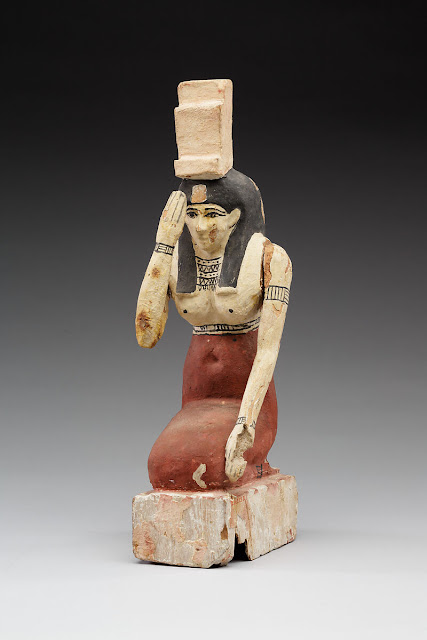
This statue of Nephthys entered the collections of the Metropolitan Museum of Art in New York in 1912, under number 12.182.23a, and that of her “inseparable” sister Isis, under number 12.182.23b. “They were probably placed at each end of the sarcophagus of the deceased as they appear at each end of the body of Osiris”, specifies the Museum.
Metropolitan Museum of Art, New York – entry number 12.182.23b
(by acquisition in 1912 from Mohammed Mohassib, an antique dealer in Louqsor)
They were acquired from Mohammed Mohassib, a well-known antique dealer in Louqsor Square at the time. In his youth, he had been a “donkey boy” in the service of Lady Duff Gordon, who, according to “Who was Who in Egyptology”, had taught him English. After being a seller of antiques “on the run”, he was able, at the beginning of the 1880s, to “settle down” and open a store. The antiques trade was then unregulated and enjoyed a good reputation. Thus, a significant number of artefacts from the Theban region passed through his hands…
Sources:
Mourning Nephthys https://www.metmuseum.org/art/collection/search/551501
Marcelle Werbrouck, Marcelle Baud, The mourners in ancient Egypt, Editions of the Queen Elisabeth Egyptological Foundation, Brussels, 1938
Youri Volokhine, Ritual sadness and funeral lamentations in ancient Egypt, Ritual expressions of sadness and weeping in ancient Egyptian mourning, Revue de l’Histoire des Religions, Armand Colin, OpenEdition Journals, 2008 https://doi.org/10.4000/rhr.6043
Isabelle Franco, Dictionary of Egyptian mythology, Pygmalion 1999
Jean-Pierre Corteggiani, Ancient Egypt and its gods, Fayard, 2007
Morris L. Bierbrier, Who Was Who in Egyptology, London, Egypt Exploration Society, 2012
Mourning Isis https://www.metmuseum.org/art/collection/search/566487
Publié il y a 28th October par Marie Grillot
Libellés: 12.182.23a Mohammed Mohassib 332 à 30 av. J.-C. deuillante Isis Metropolitan Museum of Art de New York Nephthys pleureuse période ptolémaïque
 lampmagician
Well, this week, everywhere I look I’m seeing pairs of opposites and your Egyptian themed post is no exception, Aladin. Whether I’m reading about light and dark twins, cups of joy and sorrow, the feminine and the masculine, war and peace, I’ve encountered many pairs of opposites this week. All great reminders for me to find more balance in my life and myself.
Your post feels like pure synchronicity, so thank you for sharing. And as I wrote in my reply yesterday, the shedding of tears is universally known to be a healing solution, the psychological process of softening. Tears are (symbolic) jewels, and life-giving rain. I write this because these goddesses’ tears of mourning offer us deep wisdom. Love and light, Deborah.
LikeLiked by 1 person
That is a great moment for me to be synchronised and connected with you, my lovely angel. I have read your reply and got the most companionship with your feelings. And how could it be higher to have two divine sisters along with it? Thank you and blessing.🤗🌹🦋💕🙏
LikeLiked by 1 person
These informations were really great. When I was little i was fascinated by Ancient Egypt and their gods and I had some magazine for kids with many insights. Of course they were simplified for a young audience so for me it’s always beautiful to read articles so dettailed.
LikeLiked by 1 person
Great idea, my friend. Your kind comment and visit are much appreciated.🙏
LikeLiked by 1 person
Je suis fascinée par l’Égypte ancienne 🧡
LikeLiked by 1 person
Moi aussi, chérie. Merci beaucoup.🌹💕
LikeLike
This was one of the best breakdowns of this topic I’ve ever read! Great!
LikeLiked by 1 person
I am so obliged, dear friend! Thank you for this great inspiration.
LikeLiked by 1 person
You’re very welcome!
LikeLiked by 1 person
Fascinating – as always! 💛🌻
LikeLiked by 1 person
You Honour me, dearest Chris.🥰😘🙏
LikeLiked by 1 person
Thank you Aladin for another fascinating post – the art from those times never ceases to amaze me at it’s beauty and detail.
LikeLiked by 1 person
That’s true, my dear Lin. We can keep learning from these jewels ever and ever. Thank you.
LikeLiked by 1 person
This is incredible research. You do a fine job pulling everything together. I’ve spent some time learning about Goddesses over the last couple of years, but I did not know anything about Isis’s sister prior to reading your post. 🙏🏻✨
LikeLiked by 1 person
So did I, lovely Michelle. There are many mysteries surrounding this ancient topic. However, I believe the key lies with the Goddesses; we must be aware of this. Thank you, beautiful Lady.🥰🙏🤙💖🙏
LikeLiked by 1 person
Yes, I believe we, as in the collective consciousness, is becoming more aware. ✨😌💞 Thank you for your research and thoughtfulness.
LikeLiked by 1 person
Thanks for today’s lesson Aladin
LikeLiked by 1 person
I am learning beside you, my worthy master. Thank You.
LikeLike
All very interesting about Nephthys & isis. All of the history of ancient Egypt is fascinating.
Still, the raiding of tombs and artifacts is a history on its own. Thank you for including the part about Mohammed Mohassib!
👍🤗⭐️💖
LikeLiked by 1 person
Exactly! I agree, and thanks for your companionship, as always. By the way, I always try to give more information about what I share from Marie Grillot. That helps to widen the knowledge. 😉🤗🙏💖🖖🌹
LikeLiked by 1 person
You are doing a wonderful job in teaching me about Egypt. Whatever yu are doing, you are doing it well! 🤗🙏💖🤗🙏💖
LikeLiked by 1 person
Heartfelt thanks for your inspiration.🙏🙏💖💖🥰🤗🙏
LikeLike