

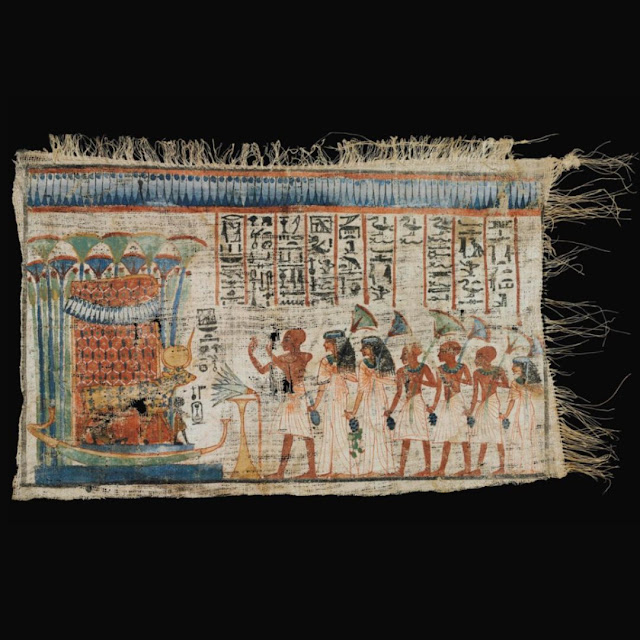
This painted Linen, offered to the goddess Hathor by the priest Tjanefer, weaves together a family history with historical memory. The goddess, shown here in her guise as a cow, shelters in a shrine on the deck of a boat moving through a papyrus marsh. Tjanefer faces her, hands raised in reverence, while three generations of his family, including his wife, children, and mother-in-law, carry gifts for the goddess. Below Hathor’s head is a small figure, identified by a hieroglyphic inscription as the deified Nebhepetre Mentuhotep, founder of the centuries-older Middle Kingdom (ca. 2051–2000 BCE). Like Hathor, Nebhepetre Mentuhotep was honoured with his own cult at Deir el-Bahri, and Tjanefer served as a priest in both.
The superb preservation of the textile allows us to see that it was cut from a larger piece of Linen. The artist then stiffened and smoothed its surface with huntite (an intensely white mineral), sketched the scene in red and black, and used different colours to fill the decorative scheme. (Metmuseum)
Let’s read Marie Grillot‘s brilliant description of the fascinating work of this Artisan’s Masterwork.
A piece of Linen from the priest Tjanefer as an offering to Hathor…
19th Dynasty (c. 1300-1250 BC)
possible provenance: Temple of Hathor at Deir el-Bahari – west bank of Thebes,
acquired in 1906 by Robert de Rustafjaell then, after passing through different collections, entered the Metropolitan Museum of Art in New York in 2022 under number 2022.332 – museum photo
This fine piece of Linen, delicately painted, is 54 cm long and 32 cm wide. The irregular contours signify that it was cut, not very meticulously, from a more significant piece. Its upper part and right side are bordered with fringes: perhaps this is the upper right corner of this votive fabric?
The scene represented there, rich in symbolism, is presented in a rectangular “vignette” whose space is harmoniously composed.
It takes place under a floral garland which features a succession of lanceolate lotus petals pointing downwards. As for its lower part, it is delimited by a black line.
On the left, occupying a third of the surface and most of the height, is the goddess Hathor in her cow form. Standing on an elegant green and gold boat with a curved bow and stern, she is sheltered by a canopy of predominantly red mesh with diamond patterns (which recalls, in particular, the mesh covering the goddess Mehet-Ouret in the tomb of Irynefer). The top of this canopy is decorated with a floral garland of the same type as the previous one.
The sacred cow emerges from the marsh, symbolised by a thicket of tall papyrus, wonderfully treated in soft tones of green and blue. Her gold coat is dotted with black patterns, and she wears her characteristic headdress: cow horns enclosing the solar disk. Above the goddess is inscribed in hieroglyphics: “Hathor, mistress of the sky who is at the head of Thebes”. Under his muzzle stands a figure in a walking attitude, left leg advanced. The painted cartouche in front of him identifies him as Pharaoh Nebhepetre (Montuhotep II). His flesh is black because it is his deified representation. We also find him kneeling under the celestial cow, drinking from its udder.

19th Dynasty (c. 1300-1250 BC)
possible provenance: Temple of Hathor at Deir el-Bahari – west bank of Thebes,
acquired in 1906 by Robert de Rustafjaell, then, after passing through different collections,
entry into the Metropolitan Museum of Art in New York in 2022 under number 2022.332 – museum photo
We can only compare this scene to that of the “chapel of the sacred cow of Hathor” discovered on February 7, 1906, in the temple of Tuthmosis III, in Deir el-Bahari, by Edouard Naville for Egypt Exploration Found ( Egyptian Museum in Cairo – JE 38574 – JE 38575). In “Symbols of Egypt”, Christiane Desroches Noblecourt interprets it as follows: “When buried, the mummified deceased unites with the Great Cow. The little breast-fed child represents the fetus of the celestial placenta. Having accomplished the in the lap of the cow during its gestation, the child will be reborn and therefore appears protected by its celestial ‘mother’, emerging like her from the swamps of the beyond, still all black from the fertilising silt”…
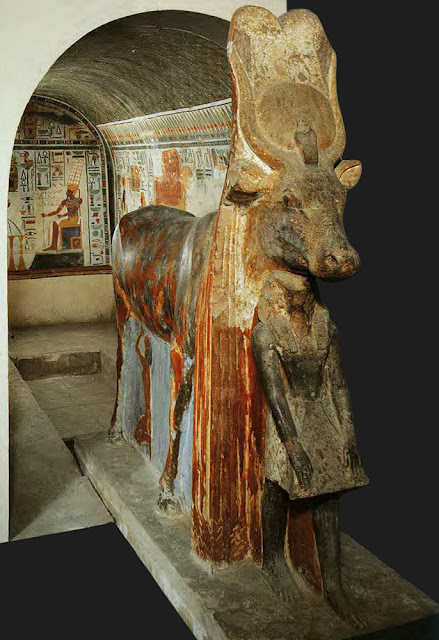
New Kingdom – 18th Dynasty – End of the reign of Tuthmosis III
discovered on February 7, 1906, by Edouard Naville in the temple of Tuthmosis III in Deir el-Bahari
during EEF excavations – Egyptian Museum in Cairo – JE 38574 – JE 38575 – museum photo
Montuhotep II (“Montu is satisfied”) reigned between 2061 and 2010 B.C., and this linen piece is dated to the 19th Dynasty, around 1300 – 1250 BC. It testifies that in Deir el-Bahari, Hathor and the deified pharaoh were jointly honoured. Tjanefer, who dedicated this votive cloth to them, was a priest of both religions. Placed in front of them and at the table of offerings which he dedicates to them, he is accompanied by his family, who stands behind him.
The Metropolitan Museum of Art in New York, where this piece of Linen is exhibited under the number 2022.332, thus describes the “family procession” which occupies two-thirds of the decor, taking place under ten short columns of hieroglyphs identifying the “participants”: “Tjanefer faces Hathor, hands raised in respect, while three generations of his family, including his wife, children and mother-in-law, carry gifts for the goddess.
The priest and his three sons are treated almost identically. Depicted standing, their heads are shaved, and their slim bodies are simply dressed in a pleated white linen loincloth. The sons wear a blue necklace and hold a bunch of grapes in their right hand and a giant papyrus stem in the other. We will observe that if the first and the third are designated by their names, the second, on the other hand, has remained strangely anonymous, as indicated by his quality of “son” by an ample space left empty in the column.

19th Dynasty (c. 1300-1250 BC)
possible provenance: Temple of Hathor at Deir el-Bahari – west bank of Thebes,
acquired in 1906 by Robert de Rustafjaell, then, after passing through different collections,
entry into the Metropolitan Museum of Art in New York in 2022 under number 2022.332 – museum photo
The three women (two behind Tjanefer and one bringing up the rear) are lovely. Their dark wig, which ends in fine braids, is adorned with a blue floral garland, as is the necklace that adorns their neck. Their white, transparent linen dress reveals their anatomy. They also hold a bunch of grapes in their right hand (one of which has leaves), and on their left, the same papyrus stem as the brothers. The whole thing makes up a charming procession, advancing in descending order of size and nicely punctuated by floral touches…
The Metropolitan Museum highlights the “superb conservation of the textile”. It indicates its creation: “The artist stiffened and smoothed its surface with huntite (an intense white mineral); he sketched the scene in red and black and used different colours to complete the decorative scheme.”
What was the role of the destination of this piece of Linen? If “the whole” from which it was detached had reached us, it would obviously be more accessible to interpret and define it… but this information remains unknown…
Nigel Strudwick (“Masterpieces of Ancient Egypt”) states that: “Many types of votive objects were placed in temples throughout Egypt as gifts expressing devotion to deities, which it was hoped would promote their turn the donor…”
The “probable” provenance indicated for this piece of Linen by the Metropolitan Museum is as follows: “site of the temple of Hathor at Deir el-Bahari”; it then entered the collection of Robert de Rustafjaell in 1906.
The work of Edouard Naville (mentioned above), carried out at the beginning of 1906 in the temple of Tuthmosis III, “rightly” delivered “a certain number of fabrics and other votive textiles (as well as numerous other votive objects) linked to the later cult of ‘Hathor, practised there at least from the New Kingdom onwards’ specifies the British Museum which has acquired several. At the same time, the same year, the London museum acquired, from Reverend Chauncey Murch (then a member of the American Presbyterian Mission of Luxor), a linen tunic with an image of Hathor (EA4307)… He did not exclude the possibility “that it could have been discovered during a contemporary clandestine excavation carried out on the same site”…
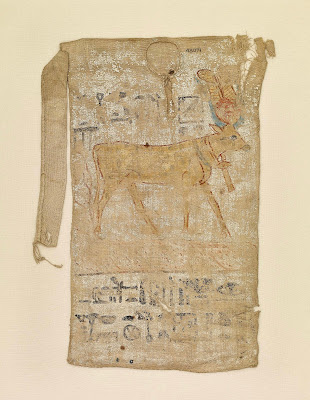
19th Dynasty (c. 1275 BC)
from Deir el-Bahari – British Museum – EA43071 – by acquisition in 1906
with Reverend Chauncey Murch – photo © The Trustees of the British Museum
This could possibly be the case for this magnificent fragment… whose “eventful” history has continued to be written…
Its “first owner”, Robert de Rustafjaell, specifies the Metropolitan, “presented it at Sotheby’s in London in January 1913, then at the Anderson Galleries in New York in November-December 1915, where G. M. Heckscher acquired it, then by the Heckscher Museum of Art, Huntington, Long Island in 1959. It was exhibited at the Dallas Museum of Art between 1993 and 2005, then transferred and sold at Christie’s in 2012 to Hilary David. It entered the collections of the Metropolitan in 2022, thanks to a donation from Liana Weindling”.
Sources:
Painted Linen Depicting the Priest Tjanefer and his family before the Goddess Hathor https://www.metmuseum.org/art/collection/search/591133 Gaston Maspero, Essays on Egyptian art, E. Guilmoto Editor, Paris, 1912? https://archive.org/details/ssaissurlartg00maspuoft Georges Foucart, Note from M. Naville on his discoveries at Deir el Bahari (Egypt), Reports of the sessions of the Academy of Inscriptions and Belles-Lettres, 50th year, N. 2, 1906. p. 110; https://www.persee.fr/doc/crai_0065-0536_1906_num_50_2_71782 Statue of the goddess Hathor in the appearance of a cow and chapel http://www.globalegyptianmuseum.org/record.aspx?id=15118 http://www.globalegyptianmuseum.org/record.aspx?id=15654 .textImage# William C. Hayes, The sceptre of Egypt. A background for studying Egyptian antiquities in the Metropolitan Museum of Art, c. II, The Hyksos period and the New Kingdom (1675-1080 B.C.), New York, 4th revised edition, 1990 https://www.metmuseum.org/art/metpublications/The_Scepter_of_Egypt_Vol_2_The_Hyksos_Period_and_the_New_Kingdom_1675_1080_BC?Tag=&title=&author=&pt=0&tc=%7bAD9356EC-5405-4B7F-8553-AE512ADC84F1%7d &dept=0&fmt=0 Geraldine Pinch, Votive offerings to Hathor, Oxford, 1993 https://www.academia.edu/3645492/_Votive_Practices_with_Geraldine_Pinch_ Fernand Schwarz, The sacred cave, Pharaon magazine, n° 4, http://fernand.schwarz.free.fr/IMG/pdf/Ph4_grotte_sacree_FS.pdf Nigel Strudwick, Masterpieces of Ancient Egypt, London 2006, pp. 208-9
Christiane Desroches Noblecourt, Symbols of Egypt, Le Livre de Poche, 2008
Christian Leblanc, Angelo Sesana, The Beautiful West of Thebes, Imentet Neferet, L’Harmattan, 2022
Miniature linen tunic; painted representation of the Hathor cow and Hieroglyphic text https://www.britishmuseum.org/collection/object/Y_EA43071
 lampmagician
❤
LikeLiked by 1 person
🙏
LikeLike
As always, I’m blown away by Marie’s impressive Egyptian themed posts! Her attention to detail is simply remarkable! She has got to be the best writer on her subject! In other news, I hope you’re feeling much better this week my dear friend as I remember you recently caught a cold, or perhaps it was flu. Hopefully that has all cleared up now. Love and light, Deborah.
LikeLiked by 1 person
Deborah, thank you so much for your kind words. I am recovering, albeit slowly, but hopefully, I will return to my usual self soon. It’s funny how when I try to disregard my age, it seems to become more noticeable!😁 Marie is an exceptional woman, and she’s accomplished so much as an Egyptologist. She’s definitely someone to look up to.💖🙏
LikeLiked by 1 person
Wow I’m amazed at how well preserved and clear the imagery is – and such rich symbolism. Thank you for sharing Aladin – hoping you return to your fully healthy self very soon.
LikeLiked by 1 person
I am striving towards getting better! Thank you, dear Lin, for your kind support.🥰🙏💖
LikeLiked by 1 person
Beautiful.
LikeLiked by 1 person
Thank you, my lovely friend.
LikeLiked by 1 person
Do you think it’s a bull, not a cow? That goes back to the Minoans.
LikeLiked by 1 person
That can be a Bull, but it’s for sure going back to the Minoans. Thank you, dear Lara.🙏💖
LikeLiked by 1 person
Exactly. Some of this symbology is Mithraic. Thank you, dear Aladin.
LikeLiked by 1 person
Fantastic post!
LikeLiked by 1 person
I am grateful as always, my friend. 🙏🤙
LikeLiked by 1 person
Compared to Aladin, my knowledge is limited when it comes to the Egyptian gods like Hathor…
LikeLiked by 1 person
Your knowledge is vast, my dear Brother. Although, there is still much to learn from this magical ancient history.🙏🙏🤗🖖
LikeLiked by 1 person