

As we know with Osiris, Amun-Ra( Amon, Ammon, Amoun, Amen, Amana) is the most widely recorded of the Egyptian gods. Amun was the god who created the universe. Ra was the god of the sun and light, travelling across the sky daily in a burning boat. The two gods were combined into one, Amun-Ra, in the time of the New Kingdom, between the 16th and 11th centuries BCE.

Today, I would like to introduce the statue of Karomama, the “divine worshiper of Amun”. Amun had many worshipers; one of them was Karomama 1st. Here is a brilliant report by Marie Grillot (& Marc Charier) about the story of this treasure.
“Statue of Karomama, “divine worshiper of Amun” in Thebes Bronze inlaid with pink gold, silver, electrum – 22nd dynasty Probably coming from Thebes – Acquired by Jean-François Champollion…
Princess Karomama is the granddaughter of Osorkon I, priestess and the divine consort of Amun.
Let’s read the whole story:
The image at the top: Amun-Re; Ammon; Amon; Amun (Cristalinks)
Karomama, Divine Worshiper, Totally and Eternally “Divine”!

from Thebes – acquired by Jean-François Champollion in Egypt in 1829 from Giovanni (Yanni) of Athanasi
Louvre Museum – N 500
In July 1827, the outline of the Franco-Tuscan expedition to Egypt was put on paper. Jean-François Champollion and Ippolito Rosellini and their teams will have the primary missions of visiting the monuments of ancient Egypt and purchasing objects for the royal collections.
Champollion devoted himself with infinite passion to monuments for 17 months, from July 1828 to December 1829. But he was also keen to bring back numerous objects to enrich the Egyptian antiquities division of the Charles X Museum (future Louvre), inaugurated on December 15, 1827, and of which he was appointed curator.

Karomama, “divine worshiper of Amun” – bronze inlaid with pink gold, silver, electrum – 22nd dynasty
from Thebes – acquired by Jean-François Champollion in Egypt in 1829 from Giovanni (Yanni) of Athanasi
Louvre Museum – N 500
Thus, on December 26, 1829, he wrote to Baron de la Bouillerie: “I have also brought together a collection of selected objects of great interest, among which is a bronze statuette, of exquisite artistry, entirely inlaid in gold, and representing an Egyptian queen of the Bubastide dynasty. It is the most beautiful object of this kind.”
And, in a letter to Rosellini, Champollion explains the acquisition as follows: “This large bronze statuette of the divine worshiper Karomama was part of the collection assembled in Alexandria by Yanni Athanasi, the former collaborator of Salt: I had his beautiful bronze of the queen and a hundred other first-rate pieces for a thousand tari.” Giovanni d’Athanasi was then known and recognized: in 1819, he succeeded Belzoni to the English consul Henry Salt, who appreciated his ability to estimate the quality and value of antiquities and his sense of commerce. Athanasi thus supplied the Salt collections while building a personal collection himself.

from Thebes – acquired by Jean-François Champollion in Egypt in 1829 from Giovanni (Yanni) of Athanasi
Louvre Museum – N 500
This is how the Karomama statue arrived in Paris. It measures 59 cm high and, on the Louvre website, it is presented as follows, under the inventory number N 500: “Walking on a base, barefoot, arms outstretched to shake the sistrums, Karomama is dressed in “a pleated dress close to the body, with ample sleeves. Half-long, the dress is caught in the plumage of the vulture, which slides over the thighs. The short hairstyle fits the face widely. The coiled uraeus emerges from the modius, a small pad on which a crown was originally embedded. A sumptuous goldwork adornment shines on the top of her shoulders and the base of her chest… The inscriptions on the base indicate her identity: “Beloved by Amon-Re, she is his divine spouse, the Divine Adoratrix.”

from Thebes – acquired by Jean-François Champollion in Egypt in 1829 from Giovanni (Yanni) of Athanasi
Louvre Museum – N 500
Today, It is considered one of the most beautiful pieces in the Egyptian Department of Antiquities. She finally overcame this problematic period where, after the admiration aroused upon her arrival, she was placed in a somewhat dark display case, covered with dust and oblivion… to make room for new acquisitions.
In the 1890s, Émile Chassinat (attached to the Department of Egyptian Antiquities) brought her out of her “exile where her happier rivals had relegated her”.
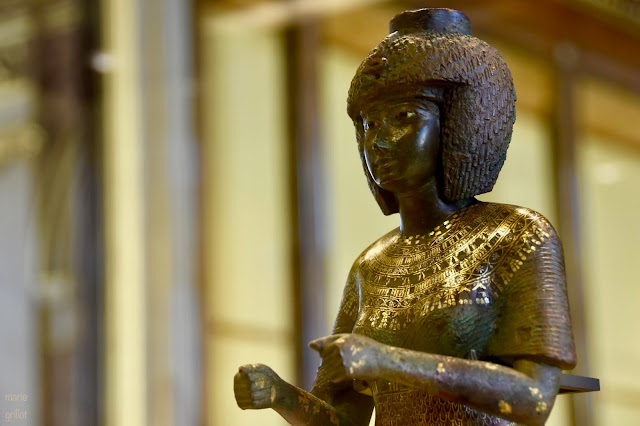
from Thebes – acquired by Jean-François Champollion in Egypt in 1829 from Giovanni (Yanni) of Athanasi
Louvre Museum – N 500
He made an exact analysis entitled “A bronze statuette of Queen Karomama (XXII dynasty)” which appeared in 1897, of which there are some extracts: “Karomama, indeed of mixed blood, Libyan of more or less recent stock, shows a finesse of line, which some will perhaps find dry, which denounces the race and which imitates, so to speak, the classic type of goddesses as the sculptors copied it from generation to generation. Perhaps it has even been embellished here to highlight the queen’s superior essence better… The nose is thin and slightly arched; the widely slit eyes are elongated naturally and not by the artifice of kohol; the mouth is pursed and curled with relatively thin lips, and the accentuated oval of the face changes us from the somewhat tiring banality of the portraits of women that we commonly encounter… She is represented in a conventional pose. Standing, left leg slightly forward, she half extends her arms; the closed fists most probably held two sistrums… The upper chest and part of the arms are hidden by a sizeable five-row necklace where the decorative talent of the damascener is given full display. Each row is made up of different patterns; the last simulates pendants… The electrum, gold and silver combine their colours, a little pale now, with perfect harmony and good taste. Despite the profusion of precious materials, the general impression is excellent; perhaps it was not the same when the work left the hands of the artisan; we cannot affirm it because time has often done things well by attenuating”… “It alone, one could say, of all the bronzes in the Louvre, gives the satisfactory impression of the perfection to which the artists Egyptians had reached all branches of plastics.”
Karomama, “divine worshiper of Amun” – bronze inlaid with pink gold, silver, electrum – 22nd dynasty
from Thebes – acquired by Jean-François Champollion in Egypt in 1829 from Giovanni (Yanni) of Athanasi
Louvre Museum – N 500

Christiane Ziegler (“Tanis the Gold of the Pharaohs”), who studied the inscriptions on the statue, specifies that this magnificent work: “was erected in order ‘to perpetuate the name of the sovereign in the temple of Amun'”. She adds: “Other passages in the text suggest that this effigy of Karomama was originally placed inside one of the multiple chapels built during the Libyan era in the sacred enclosure of the temples of Karnak.”…

Million-year-old temple of Ramesses II, on the west bank of Thebes
carried out in 2014 by the French Archaeological Mission of West Thebes (MAFTO/CNRS-UMR 8220/LAMS)
and the Center for Study and Documentation on Ancient Egypt (CEDAE/CSA)
And as Egypt took its time to reveal its secrets, Karomama returned to the news in 2014.
It is on the west bank of Thebes, on the site of the millions-year-old temple of Ramses II, the Ramesseum, where the French Archaeological Mission of West Thebes (MAFTO/CNRS-UMR 8220/LAMS) and the Center d Study and Documentation on Ancient Egypt (CEDAE/CSA) was carrying out their excavation campaign in 2014, when his tomb was discovered, precisely within the enclosure of the small temple of Touy. In this sector, the excavations were then carried out in cooperation with the Institute of Egyptology of the University of Leipzig, whose team was led by Benoît Lurson, with funding from the Gerda Henkel Foundation.

In “Ramses II and the Ramesseum”, published in 2019, Christian Leblanc provides this valuable information: “In the northern sanctuary, originally reserved apparently for Nefertari, the tomb of Karomama, a divine worshiper of Amun under the 22nd dynasty. Undoubtedly, the granddaughter of Osorkon II, this ‘wife of the god’ who had the rank of queen, is well known to us from the beautiful bronze statuette damascened with gold and silver acquired in Egypt by J .-F. Champollion and since preserved in the Louvre, but also by two canopic vases and some chaouabtis formerly purchased in Gournah by R.C. Lepsius during the Prussian scientific expedition. These funerary remains accessible on the local antique market obviously suggested that the tomb had been desecrated, which was confirmed when it was discovered in 2014. Its last looting, which could date back between 1820 and 1844, was almost systematic since the excavation only delivered a few amulets and fragmentary chaouabtis in glazed frit on which could still be read the quality and the name inscribed in a cartouche of its deceased and insignia owner: ‘The Osiris, the divine worshiper of Amon Karoma(ma) -loved-of-Mout justified'”.

in a cartridge of his deceased: ‘Osiris, the divine worshiper of Amon Karoma (my)-beloved-of-Mout justified'”
discovered at the Ramesseum in 2014 during the MAFTO/CNRS-UMR 8220/LAMS mission
and the Center for Study and Documentation on Ancient Egypt (CEDAE/CSA) – photo by MAFTO
In the bowels of western Thebes, the story of Karomama continues to be written… because, as Christian Leblanc says: “This mysterious priestess who had the rank of queen still has a lot to teach us, particularly about her family ties “…

Sources:
Jean-François Champollion (Champollion the Younger), Letters written from Egypt and Nubia in 1828 and 1829, Didier & Cie Libraires Editeurs, Paris, 1868 http://gallica.bnf.fr/ark:/12148/bpt6k103771z/f1.image.r=Il%20est%20donc%20du%20plus%20haut%20interest%20pour%20l’Espagne%20elle-mère.texteImage
Statue of the divine worshiper of Amon Karomama http://cartelfr.louvre.fr/cartelfr/visite?srv=car_not_frame&idNotice=17845&langue=fr
Émile Chassinat, A bronze statuette of Queen Karomama (22nd dynasty) (Louvre Museum). In: Monuments and memories of the Eugène Piot Foundation, volume 4, fascicle 1, 1897. pp. 15-26; https://www.persee.fr/doc/piot_1148-6023_1897_num_4_1_1146 Elisabeth Delange, Marie-Emmanuelle Meyohas, Marc Aucouturier The statue of Karomama, a testimony of the skill of Egyptian metallurgists in polychrome bronze statuary, Journal of Cultural Heritage, Volume 6, Issue 2, April-June 2005, Pages 99-113 http://www.sciencedirect.com/science/article/pii/S1296207405000348
Benoît Lurson, Claude Obsomer et alii, Lost and found: the Tomb of the Divine Adoratrice Karomama (22nd Dynasty)
From the mother of the king to the wife of the god. The first summary of the results of the excavations of the temple of Touy and the tomb of Karomama // Von der Königsmutter zur Gottesgemahlin. Erste Synthese der Ausgrabungsergebnisse des Tempels von Tuja und des Grabes von Karomama, Safran, 2017 https://www.academia.edu/38735032/ From_the_mother_of_the_king_to_the_wife_of_god._First_synthesis_of_the_results_of_the_excavations_of_the_temple_of_Touy_and_of_the_tombe_of_Karomama_Von_der_Königsmutter_zur_Gottesgemahlin._Erste_Synthese_der_Ausgra bungsergebnisse_des_Tempels_von_Tuja_und_des_Grabes_von_Karomama
Christiane Ziegler, Tanis l’or des pharaons, exhibition catalog Paris, National Galleries of the Grand Palais, March 26 – July 20, 1987
Christian Leblanc, Ramses II and the Ramesseum. From the splendour to the decline of a million-year-old temple, L’Harmattan, 2019
 lampmagician
💙
LikeLiked by 1 person
🙏🦋
LikeLike
Superb blog, Sir
LikeLiked by 1 person
You made my day, Mike, dear Sir. I am much obliged.
LikeLiked by 1 person
As always, an excellent article! Thank you for sharing this post Aladin. I do enjoy Marie’s fine attention to detail and wonderful photographs too. Love and light, Deborah.
LikeLiked by 1 person
She is an extraordinary woman. Humble but with excellent knowledge. Thank you back, lovely Deborah.
LikeLiked by 1 person
💗💗
LikeLiked by 1 person
💖🥰
LikeLike
Thank you Aladin for shedding light on such a beautiful statue of so many precious metals – how could it be hidden away to gather dust!
LikeLiked by 1 person
That is a brilliant work by Marie Grillot; I am always honoured to try to save the world with the help of the feminine! 😉Thank you, dear Lin, for being here.💖
LikeLike
Love all this info, these pics, of Karomama. Excellent post!
LikeLiked by 1 person
That is a great inspiration, my dear friend. Thank you with immense gratitude.🙏
LikeLike
Great! This had me riveted!
LikeLiked by 1 person
One of the best comments! Thank you, mate.🙏🤙
LikeLike
So beautiful. By the time of Amun-Re, the goddesses had less power as the god took central stage. I love this feminine image from that time and learning more about this mysterious priestess. Thank you.
LikeLiked by 1 person
It’s true, dear Elaine! Although the Goddesses in ancient Egypt, like Isis and Hathor, have immense power. Thank you again, dear friend.
LikeLiked by 1 person
more fascinating facts about ancient Egypt.
LikeLiked by 1 person
You know that, Master. 👍🙏✌
LikeLike
This is fascinating. Thank you, Alaedin!
You posts on Egyptian history and history of artifacts are brilliant.
Egypt was for sure a cradle of civilization.
Still, the rich of their story is fraught with slavery and wars.
Mankind has always been most imperfect.
LikeLiked by 1 person
Maybe, or maybe not! The history of Egypt is still shrouded with mystery, and what we read and what remains are influenced mainly by religious historians. We may not still be that mature yet to get the clue! However, your kind words make me very proud. Thank you, my lovely lady.💕🌹🙏💖
LikeLiked by 1 person
You should be proud. You put a lot into these posts. Best to you, dear friend I’ve never met! 💕🌹🙏💖
LikeLiked by 1 person
Maybe sometime somewhere, somehow. 🤗🙏💖💖🫂
LikeLiked by 1 person
Stranger things happen! xoxo
LikeLiked by 1 person