
We are taught various subjects such as chemistry, physics, geography, and geometry during our school years. While I cannot say that geometry was my favourite subject, I must admit that my lack of proficiency in it was not entirely my fault. I struggled to understand it because I did not have a good teacher. However, I had excellent teachers for one or even two semesters and suddenly found myself good enough in geometry. Indeed, I have never thought about where it all comes from! I surely miss those days in which I could learn the fascination of geometry, although it might never be too late!
In part two (Part one here), Dr. Jung explores fascinating ideas on the magic of geometry and its relation to Mandalas. Mandalas are not just circles but also consist of various other geometric shapes.
The Mandala Symbolism (Dream 16) P.2
There are a lot of people there. Everyone walks counterclockwise around the square. The dreamer is not in the middle but on one side. It is said that one wants to reconstruct the gibbon.
The eastern mandala, especially the Lamaist mandala, usually contains a square stupa plan (Fig. 32). If this really means a building can be seen from the bodily executed mandalas. There, with the figure of the square, the idea of the house or temple or an inner, walled room is also given. (Compare ‘city’ and ‘castle’ in the commentary on Dream 10 (see also figs. 7, 36).

Tibetan Mandala Thangka Paintings _ Galactic Resonance
Stupas must always be ritually circumambulated to the right because to turn to the left is evil. Left (sinister) means the unconscious side. Left-hand movement, therefore, implies a movement towards the unconscious, while right-hand movement is ‘correct’ and aims at consciousness. Since, through long practice in the East, these unconscious contents have gradually become definite forms expressing the unconscious, they must, as such, be taken over and retained by consciousness. Yoga proceeds similarly insofar as it is known to us as a fixed practice. It imprints fixed forms on the consciousness. Therefore, its most important Western parallels are the “Exercitia Spiritualia” of Ignatius of Loyola, which also impresses the psyche with the fixed ideas of salvation.

The symbolic city as the earth’s centre represents a temenos with its protective walls arranged in a square. Majer: Viatorium, (Voyager)1651
This practice is “correct” insofar as the symbol still validly expresses the unconscious fact. The psychological correctness of yoga in the East as well as in the West only stops when the unconscious process, which anticipates future changes in consciousness, has developed so far that it shows nuances that are no longer sufficiently expressed with the traditional symbol or no longer entirely with the same are tolerable. To that extent, and only to that extent, can one say that the symbol has lost its ‘correctness’.

The castle protects spirits against diseases. Fludd: Summum Bonom (The highest good), 1629
This process is probably a slow secular shift of the unconscious worldview and has nothing to do with intellectual criticism of the same. Religious symbols are phenomena of life, facts par excellence, and not opinions. Suppose the church has held for so long that the sun rotates around the earth but abandons this point of view in the 19th century. In that case, it can appeal to the psychological truth that for many millions of people, the sun rotates around the earth and first in the 19th century, a more significant number of people attained the security of intellectual functioning to see the evidence of the planetary nature of the earth. Unfortunately, there is only truth with people who recognise it.
The left-handed or runner >circumambulatio< around the square should indicate that the squaring of the circle is passed through on the way to the unconscious; therefore, it is an instrumental passage point that conveys the achievement of an underlying, not yet formulated goal. It is one of those paths to the centre of the non-ego, which was also taken by medieval research, namely in the production of lapis. The ‘Rosarium Philosophorum’ says: ‘Make a circle around man and woman and draw the square out of it and the triangle out of the square. Make a circle, and you will have the philosopher’s stone.’ (Fig. 45; also Fig. 44)
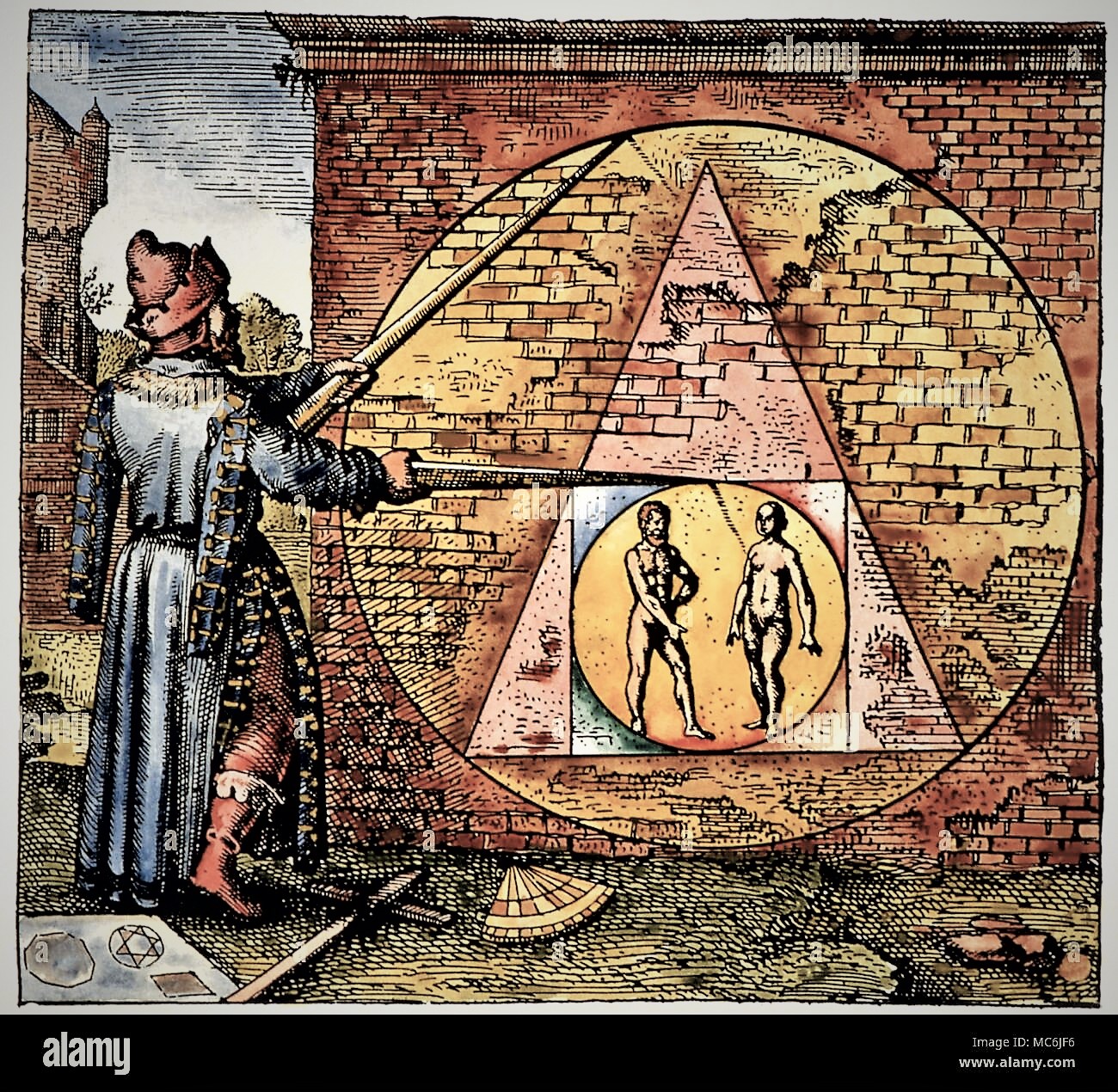
Squaring the circle, combining two genders into a whole. Majer: Scrutinium chymicum, 1687

Squaring the circle: All things stand only in the three / In four, they delight themselves. (Jamsthaler: Viatorium spagyricum, 1625)
(This quote is attributed to Pseudo-Aristotle, but it cannot be found in the ‘Tractatus Aristotelis alchemistae ad Alexandrum Magnum’ [Theatrum chemicum, 1622, vol. 5, p. 880 ff.])
Before taking another break, I’d like to add a footnote extending the abovementioned paragraph. It was a mix of Latin and German, which I take the best of: 🥰🙏💖
“In the Scholia zum (Hermes Trismegistus’ truly golden Treatise on the Secret Stones of the Philosophers with the Scholia of Dominikus Gnosius), it says (p. 43): the secret quadrilateral of the philosophers; In the centre of the square is a circle with radiation. By this, the Scholium explains: Divide your pages into the four elements… and join them into one, and you will have all mastery. = Quote from Pseudo-Aristotle. The circle in the middle is called the “mediator”. The mediator who makes peace between the enemies or (the four) elements; indeed, he is the one who brings about the squaring of the circle. [ p. 44]

Circumambulation has its parallel in the circling of the spirits or the circling distillation, that is, the outer to inner, the inner to outer: and so you would, if the lower and the upper came together in one and the same circle, no longer recognise what was from outer to inner, below, or above; but all would be one in a single circle or vessel. This is, for sure, the true philosophical pelican, and there is no other in the whole world. The adjacent drawing explains this process. The quartering is the “Exterius”: four rivers flowing in and out of the inner “ocean”. (p. 262 f.)

Carl Jung-illustration from The Red Book by C. G. Jung, page 364
With thanks to Lewis Lafontaine
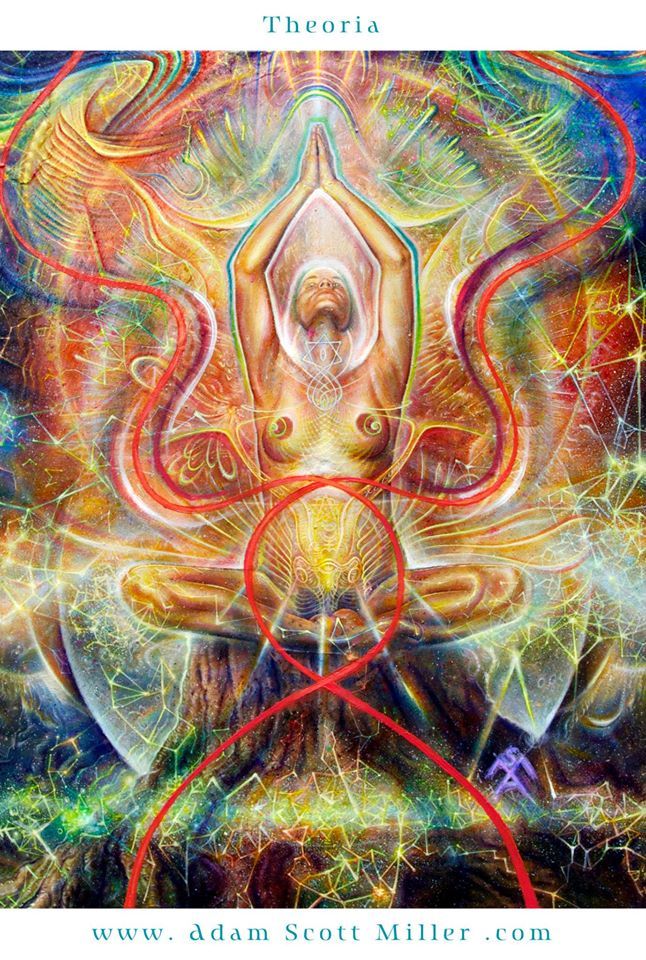
Image at the top: Theoria _ Adam Scott Miller _ sacred Geometry _3
 lampmagician
💜
LikeLiked by 1 person
🥰🙏💖
LikeLike
Heavy stuff!
LikeLiked by 1 person
Your words (accurate recognition!) are worthy, dear sir. It is! Thank you. 🙏
LikeLike
Geometry is fascinating isn’t it?! I once had a dream that I wanted to have a tattoo of a red square with a white circle inside, only I wasn’t ready I told the tattooist at the parlour. I told him I would come back when I am. A dream to ponder on for sure. Love and light, Deborah.
LikeLiked by 1 person
True! Lovely friend. Geometrics is fascinating, and your unique dream is worth pondering, especially your wise decision of being still unprepared. Thank you for telling me about this dream.🤗😘
LikeLiked by 1 person
More Jung…
LikeLiked by 1 person
For me, there is never enough. 😉🤙🙏
LikeLike
For me, geometry is tied closely to astronomy and astrology, partly because my departed husband was an astronomer who loved astrology and our root spiritual teacher was an accomplished astrologer and wrote the book ‘Astronoesis.’
When circumambulating the Dalai Lama’s dwelling, the suggestion was to keep the building on our right. It felt good to walk with the other seekers, but I knew the Dalai Lama would laugh if someone made a big deal about the direction of the circle.
I’m not getting notifications of your blogs, so I’ll try to find out why. Fortunately, I know where to find you even if I’m late.
LikeLiked by 1 person
Oh! Another funny game on WP? However, I want to thank you, my dear and wise Elaine. You can never be late, and I feel honoured to have you by my side.
LikeLiked by 1 person