

The fragments might only be important once they belong to a higher family of undeniable fascination in an old, unique historical land: Egypt. The excavation is part of our ongoing search for historical artefacts that satisfy our curiosity about the past or quench our thirst.

And here is Marie Grillot‘s fascinating reportage on the exciting discovery made by the famous explorer Howard Carter, thanks to Marc Chartier.
Archeology Photograph – Akhenaten, New Kingdom Egyptian Pharaoh by Science Source /
Bas-relief portraying Amenhotep IV (Pharaoh Akhenaten, circa 1360-1342) and Nefertiti.
DEA Picture Library / Getty Images
A Fragment of Akhenaten’s Face; Discovered at Amarna by Howard Carter.
via: égyptophile

Fragment representing the nose and lips of Akhenaten – Limestone – New Kingdom – 18th Dynasty
from the sanctuary of the Great Temple of Aten at Tell el-Amarna – discovered in 1891 during the excavations of W.M.F. Flinders Petrie
on the sector attributed to Lord Amherst and entrusted to Howard Carter – attributed to Lord Amherst when sharing the finds
acquired by Lord Carnarvon at the June 1921 Amherst sale in London – arrived at the Metropolitan Museum of Art in New York
in 1926 by the acquisition of the Collection of late Lord Carnarvon – accession n° 26.7.1395 – photo of the MET
At the end of 1891, William Matthew Flinders Petrie finally obtained from the Antiquities Service, directed by Eugène Grébaut, the concession to excavate the remains of the ancient Akhetaton. “Tell el Amarna is one of the most valuable sites in the history of Egyptian civilization. Perhaps it had a shorter existence than any other city in the country. According to what remains, it seems to have been occupied for only one generation,” specifies the British Egyptologist in the introduction of his volume “Tell el Amarna 1894”.
William Matthew Flinders Petrie – British Egyptologist
(Charlton, Kent, UK, 3-6-1853 – Jerusalem, 18-7-1942)

He began the mission on November 17, 1891, with some workers he had employed at Illahoun. Then, he relates: “At the beginning of January, I had the pleasure of being joined by Mr Howard Carter, who undertook to search certain parts of the city on behalf of Lord Amherst of Hackney”. Howard Carter was then only 17 years old. On Lady Amherst’s recommendation, Percy Newberry hired him as a draftsman copyist for the Egypt Exploration Foundation. Arrived in Egypt in October 1891, he first worked in the tombs of Beni Hassan, then in the temple of Montouhotep in Deir el-Bahari, and this is his third “construction site”.

Portrait of Howard Carter Young, at Swaffam (author and date unknown) – Swaffham Museum
arrived in Egypt in the fall of 1891 at the age of 17, he became famous, discovering in November 1922, Tutankhamun’s tomb
(London 9-5-1874 – 2-3-1939)
He will be assigned the sector of the great temple and will make some great discoveries there… Among them, this limestone fragment represents a small part of a face: the nose and the lips. According to the Metropolitan, it was unearthed either “in the dumps south of the sanctuary of the Great Temple of Aten or in the sanctuary itself”.
The analysis of W.M.F. Petrie and the wording under illustration No. 15 of the work quoted above was initially attributed to the great royal wife: “Queen Nefertythi also had a very marked personality. Her portraits are as recognizable as those of ‘Akhenaton. Of the many fine stone statues in the temple, a fragment of a nose and lips preserves a brilliant portrait for us (I, 15). The liveliness and force of the work are unequalled at any other period in Egypt; it lacks the naive naturalness of early productions, but its conventions are all put to best use; the slight exaggeration of the edges of the lips gives a clarity and sharpness of shadow, which is most pleasing”.
Fragment representing the nose and lips of Akhenaten – Limestone – New Kingdom – 18th Dynasty
from the sanctuary of the Great Temple of Aten at Tell el-Amarna – discovered in 1891 during the excavations of William Matthew Flinders Petrie
on the sector attributed to Lord Amherst and entrusted to Howard Carter – attributed to Lord Amherst when sharing the finds
acquired by Lord Carnarvon at the June 1921 Amherst sale in London – arrived at the Metropolitan Museum of Art in New York in 1926
by acquisition from the Collection of the late Lord Carnarvon – accession no. 26.7.1395
presented here, below under n° 15, by W.M.F. Petrie in “Tell el Amarna 1894.”
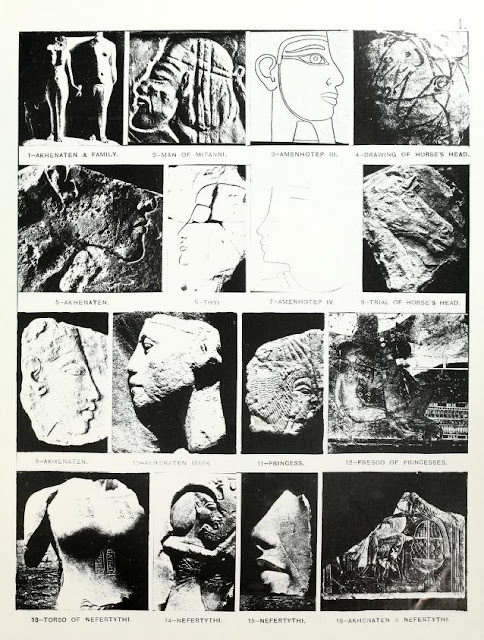
However, many years later, a better knowledge of the Amarna sculpture combined with the study of statues of Akhenaten discovered later allowed us to attribute this portrait to him without any doubt. Even though this fragment is only 8.1 cm high and 6.3 cm wide, even in the absence of this disproportionate and prognathic chin, even if eyes had to be stretched and surmounted by a drooping eyelid it only remains the birth of the right eye, its characteristics, its morphology does not deceive. This long and straight nose, which is joined by two wrinkles starting from the nostrils to the lips at the same time, fleshy, thick, protruding and drooping, the particular design of this mouth signs the identity of the son of Amenhotep III and Tiyi. The Metropolitan Museum of Art in New York affirms it thus: “This fragment is attributed to Akhenaten. The inner corner of the eye is visible next to the nose. Although there is little to distinguish many representations of the king and queen, especially relatively early in the Amarna years, the particularly long line along the nose and lips and the curvy upper lip support this identification”.

Fragment representing the nose and lips of Akhenaten – Limestone – New Kingdom – 18th Dynasty
from the sanctuary of the Great Temple of Aten at Tell el-Amarna – discovered in 1891 during the excavations of William Matthew Flinders Petrie
on the sector attributed to Lord Amherst and entrusted to Howard Carter – attributed to Lord Amherst when sharing the finds
acquired by Lord Carnarvon at the June 1921 Amherst sale in London – arrived at the Metropolitan Museum of Art in New York
in 1926 by developing the Collection of late Lord Carnarvon – accession n° 26.7.1395 – photo of the M.E.T.
The mission of W.M.F. Petrie will end at the end of March, and two months will be necessary to “pack” all the discoveries. These are 162 boxes that he will take to the Giza museum.
During the division of the finds, this fragment was attributed to the person who had financed the area of excavations where it had been found. The same will be valid for many other artefacts; thus, one will be able to read later that: “Lord Amherst of Hackney had the third private collection of Egyptian antiquities, constituted largely in payment for the excavations that this rich English patron subsidized, in particular at Tell el-Amarna”.
from the sanctuary of the Great Temple of Aten at Tell el-Amarna – discovered in 1891 during the excavations of William Matthew Flinders Petrie
on the sector attributed to Lord Amherst and entrusted to Howard Carter – attributed to Lord Amherst when sharing the finds
acquired by Lord Carnarvon at the June 1921 Amherst sale in London – arrived at the Metropolitan Museum of Art in New York in 1926
by acquisition from the Collection of the late Lord Carnarvon – accession no. 26.7.1395
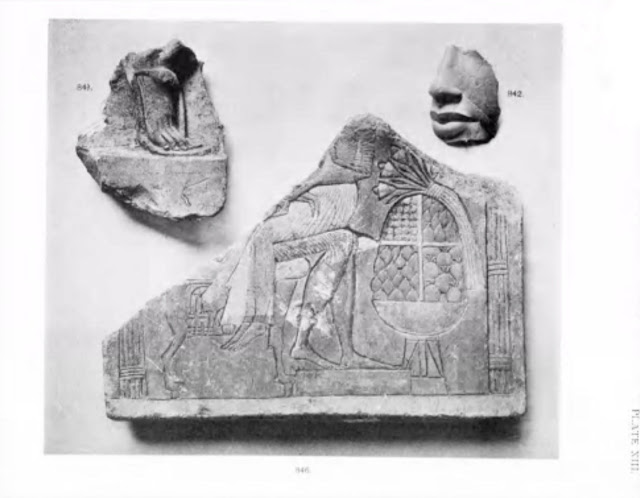
presented here under n° 842 of the “Catalogue of the Amherst collection of Egyptian and Oriental antiquities” – June 1921
Thirty years later, during the “Amherst Sale”, which will take place from June 13 to 17, 1921, at Sotheby’s London, it will be offered at auction under the number 842. Acquired by Lord Carnarvon, he will lend it for the first art exhibition Egyptian organized in London the following year. In the “Catalogue of an Exhibition of Ancient Egyptian Art. London: Burlington Fine Arts Club”, Percy Newberry will describe it under n° 40a “NOSE AND MOUTH, white calcareous limestone. From the Plate VI. head of a statue of Queen Nofretete “.

from the sanctuary of the Great Temple of Aten at Tell el-Amarna – discovered in 1891 during the excavations of William Matthew Flinders Petrie
on the sector attributed to Lord Amherst and entrusted to Howard Carter – attributed to Lord Amherst when sharing the finds
acquired by Lord Carnarvon at the June 1921 Amherst sale in London – arrived at the Metropolitan Museum of Art in New York in 1926
by acquisition from the Collection of the late Lord Carnarvon – accession no. 26.7.1395
presented here under n° 40a of the “Catalogue of an Exhibition of Ancient Egyptian Art. London: Burlington Fine Arts Club”, 1922
Six years after Lord Carnarvon died in Cairo on April 5, 1923, his widow, Lady Almina, put her extensive collection of antiquities up for sale. Thanks to the generosity of Edward S. Harkness, the Metropolitan Museum of Art in New York acquired it in 1926 for the sum of $145,000…
This is how this magnificent fragment, admirably representative of Amarna art, arrived at the New York Museum, registered under 26.7.1395.
Sources:
The nose and lips of Akhenaten https://www.metmuseum.org/art/collection/search/544710?searchField=All&sortBy=Relevance&ft=amarna&offset=0&rpp=40&pos=16
Petrie, William Matthew Flinders, Sir 1894. Tell el Amarna (London, 1894). 1894. London, pl. 1 no. 15. https://archive.org/details/tellelamarna00petr
Newberry, Percy E. and H. R. Hall 1922. Catalogue of an Exhibition of Ancient Egyptian Art. London: Burlington Fine Arts Club, p. 63 B, pl. 11. https://archive.org/details/catalogueofexhib00burlrich
Catalogue of the Amherst collection of Egyptian and Oriental antiquities, which will be sold by auction by Messrs. Sotheby, Wilkinson & Hodge (Sir Montague Barlow, K.B.E., L.L.D., M.P. G. D. Hobson, M.A., and Major F. W. Warre, O.B.E., M.C.), auctioneers of literary property & works illustrative of the fine arts, at their extensive galleries, 34 & 35 New Bond Street, W. (1), on Monday, the 13th, of June 1921, and four following days at one o’clock precisely Sotheby’s https://bibliotheque-numerique.inha.fr/viewer/50379/?offset=#page=2&viewer=picture&o=bookmarks&n=0&q=
Lythgoe, Albert M. 1927. “The Carnarvon Egyptian Collection.” In The Metropolitan Museum of Art Bulletin, vol. 22, no. 2 (February)
“The Reign of the Sun Akhnaton and Nefertiti”, Catalog of the exhibition organized by the Ministers of Culture at the Royal Museums of Art and History, Brussels, January 17 – March 16, 1975, Dik van Bommel
Who Was Who in Egyptology, Bierbrier M., London, Egypt Exploration Society
 lampmagician
🖤🤍
LikeLiked by 1 person
🙏🤗🌹💖💖
LikeLike
Another outstanding post on Egyptian history and archaeology! You outdid yourself once again with so much fascinating information
LikeLiked by 1 person
Wow, dear Luisa, you really made my day! Your words are truly inspiring to me. Thank you. 🙏🤗
LikeLiked by 1 person
You’re more than welcome 🙏🌹🙏
LikeLiked by 1 person
Aladdin, can you get into my Paradise Oniric with the new password ?
LikeLiked by 1 person
Yes, lovely friend. Thank you. 🙏🥰💖
LikeLiked by 1 person
💯
LikeLiked by 1 person
Much appreciated!🥰
LikeLiked by 1 person
Wonderful!
LikeLiked by 1 person
Thank you, my friend. 🙏🤙🖖
LikeLiked by 1 person
You’re more than welcome!
LikeLiked by 1 person
Here’s hoping these fragments don’t wind up in a museum that has staff who sell them off to the highest bidder, as has happened in the British Museum!
LikeLiked by 1 person
Amen! I agree, my friend. These treasures are worth seeing by everyone.
LikeLike
So interesting. I’m always fascinated by the Egyptian sense of beauty and how much has been saved even as so much was lost and destroyed. Thanks for sharing this.
LikeLiked by 2 people
You say that, dear Elaine. I appreciate your kindness.
LikeLiked by 1 person
Some fantastic finds! Thank you for the virtual museum tour.
LikeLiked by 1 person
It is fascinating indeed. Thank you, beautiful lady, for your participation.🥰🙏
LikeLiked by 1 person
Thank you! 🌞
LikeLiked by 1 person
This is a fascinating read, Alaedin.
I know of Queen Nefertythi, but not Akhenaton.
I saw a program about 10 years ago that said many artifacts that were taken from Egypt have been returned, or will be returned.
One of the curators was concerned that Egypt does not have the resources to protect these artifacts.
I did see the King Tut exhibit many years ago. It was unsatisfying in that there was no lingering to really look at the artifacts.
Also, everything was encased in sealed glass displays, with temperature and humidity controlled. Again, difficult to really get a good look.
It’s like being in a throng of thousands to see the Pope whiz by in his popemobile.
I went in memory of my ardently devoted grandmother.
💖🌺😊
LikeLiked by 1 person
Lol! However, I am not really sure if these artefacts will also be safe in Egypt; dictator regime: corruption! Nevertheless, your support pushes me forward! 😉 Thank you.🥰💖🙏🖖💖
LikeLike