

I must honestly say that I was deeply concerned about whether I should share this post because I wasn’t sure if you feel bored with it, though I am convinced that it is worth enough, as I read it several times (in German!) to get the point. However, I am sure you will like it because here, Dr. Jung’s analysis of a dream using a unique blend of Geometry and Mathematics, among the wisdom of Alchemy and the Mandala symbol, is genuinely fascinating. We can never deny that Alchemy is one of the most intriguing methods in our history to unravel the puzzles of the unknown.
Although the ancient practice of alchemy focused on transforming metals into gold, it was also for finding a universal cure for the disease and discovering a means of prolonging life. It was popular in the ancient world, from China and India to Greece, and eventually made its way to Egypt. In the 12th century, it was revived in Europe by translating Arabic texts into Latin. Actually, the word “Alchemy” comes from chēmeia, which probably came from the phrase chyma (“fluid”), derived from the verb chein, meaning “to pour.” It then passed to Arabic, which added its definite article al- (“the”) to the Greek root. The word then passed from Latin to French before coming to English. Some other words derived from Arabic also retain the al- in English, such as algebra, algorithm, and alcohol; in fact, the transformative liquid constantly sought through experimentation by alchemists is another word with the Arabic al- prefix: elixir.
Medieval European alchemists made valuable discoveries in mineral acids and alcohol, which led to the development of pharmacology and modern chemistry. Although the gold-making processes of alchemists were ultimately discredited, it wasn’t until the 19th century.
The image above: William Blake’s “Newton.”
(It is a demonstration of his opposition to the ‘single-vision’ of scientific materialism; here, Isaac Newton is shown as a ‘divine geometer’) (1795)
Here, we will read an excellent description by Carl Jung, which also includes Latin text, in which I had to admit my ignorance and learn more of an old but extensive language!
The Mandala Symbolism (Dream 16) P. 1
The short version of the dream:
There are a lot of people there. Everyone walks counterclockwise around the square. The dreamer is not in the middle but on one side. It is said that one wants to reconstruct the gibbon.

Squaring the circle: All things stand only in the three / In four, they delight themselves. (Jamsthaler: Viatorium spagyricum, 1625)
Here, the square appears for the first time. He should emerge from the circle utilizing the four persons. (This will be confirmed later.) The problem of squaring the circle occupied the minds of the Middle Ages, as did Lapis, the ‘tinctura rubea’ (‘red dye’) and the ‘Aurum Philosophicum’ (Philosophical gold.). The squaring of the circle is a symbol of >opus alchymicum< (Fig. 44) in that it dissolves the initial, chaotic unity into the four elements and then reassembles them into a higher unity. Unity is represented by the compass and the four elements by the square. The production of one out of the four took place through a process of distillation or sublimation, which proceeded in a “circular” form; that is, the distillate was subjected to various distillations (cf.: Paracelsus as a spiritual phenomenon, CW13, §§185 ff). So that the ‘soul’ or ‘spirit’ was drawn out in its purest form. As a rule, the result is referred to as the quintessence, which is by no means the only name of whom that was always hoped for and never succeeded in being ‘one’. As the alchemists say, it has >a thousand names<, like the ‘materia prima’. Heinrich Khunrath says about the circular distillation in his >Confession<: Through circumrotation or circular philosophical circulation of the quaternarii… in turn, are brought to the highest and of all purest simplicity or naivety… Monadis Catholicae plusquamperfectae (More than perfect Catholic monads)… From the impure coarse one becomes a purest subtle one… ( Khunrath: From hylealic, that is… chaos, 1597, p. 204 f). Souls and spirit must be separated from the body, equivalent to death: >Therefore, Paulus Tarsensis also says: Cupio dissolvi, et esse cum Christo (I desire to be dissolved and to be with Christ). Therefore, my dear philosopher, you must have here the spirit and soul Magnesiae (“Magnesia” of the alchemists has nothing to do with Magnesia (MgO). In Khunrath (ibid., p. 161) it is materia –caelestis atque divina-, i.e the –materia lapidis philosophorum-, the arcane or transformative substance.)

Squaring the circle, combining two genders into a whole. Majer: Scrutinium chymicum, 1687
The spirit (respectively spirit and soul) is the ternarius (trinity), which is first separated from its body and, after its purification, infused into it again. (Khunrath: ibid, p. 203 f.) The body is obviously the fourth. Therefore, Khunrath refers to the pseudo-Aristotle quote (ibid. p. 207.), where the circle arises from the triangle in the square.
(A figurative depiction of this motif by Majer: Scrutinium chymicum, Emblema 21. Majer, however, understands Ternarius differently (cf. Fig. 45). He says (p. 63): >Similiter volunt Philosophi quadrangulum in triangulum ducendum esse, hoc est, corpus, spiritum & animam, que tria intrinis coloribus ante rubedinem praeviis apparent, utpote corpus seu terra in Saturni nigredine, spiritus in lunari albedine, tanquam aqua, anima sive aer insolari citrinitate. Tum triangulus perfectus erit, sed hic vicissim in circulum mutari debet, hoc est, rubedinem invariabilem.<: {>Even so, do the philosophers assert that the square must become the triangle, that is, body, mind, and soul, which appear in three colours prior to redness, viz., the body or earth in Saturnian blackness, the mind in moonlike white, as Water, skin or air yellow like the sun. Then, the triangle will be completed, but it must, in turn, be turned into a circle, that is, into unchanging redness. <} The fourth here is fire, an everlasting one.)
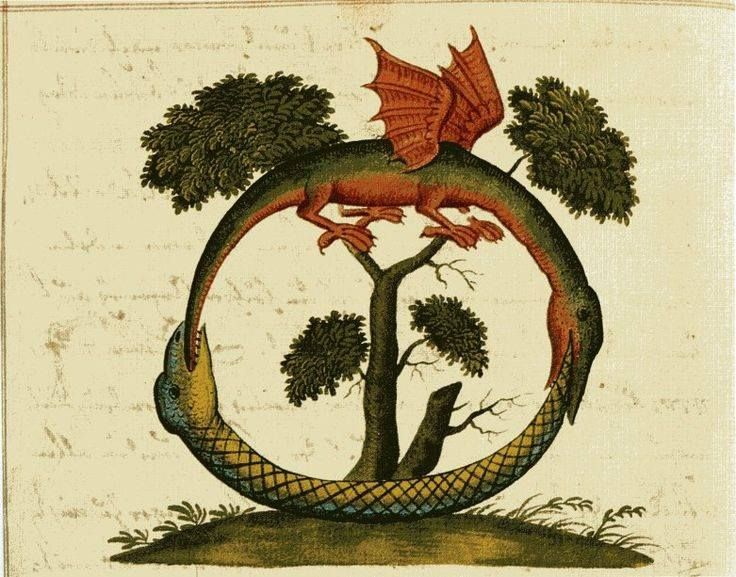
Along with the Ouroboros, the dragon eating itself from the tail, this circular structure represents the basic alchemical mandala.
Let us pause to regain our composure! I will resume soon.😉🤗💖🙏
 lampmagician
I definitely needed the pause to regain composure, but wasn’t bored!! ❤️
LikeLiked by 1 person
You made me happy, dear Crystal. Wonderful! Thank you for your support. 🙏🤗❤️
LikeLiked by 1 person
Not bored, but overwhelmed. My root teacher loved Alchemy and Jung’s Alchemical Studies, but he took a slow pace and that was decades ago. I’ll come back to this piece taking it in small bites. Thank you for bringing me back to this ground of Jung.
LikeLiked by 1 person
Your words are much worth to me, my dear, adorable teacher. Thank you!
LikeLiked by 1 person
More Jungian theories!!!
LikeLiked by 1 person
Much honoured and appreciated, Brother.🙏✌
LikeLike