

After overcoming some challenges and obstacles, I’m excited to return to my routine and begin by sharing a post on Egypt. I’m grateful for the support of the British Museum and my close friends, Marie Grilott and Marc Chartier.
Wooden Funerary Stele of Deniuenkhonsu
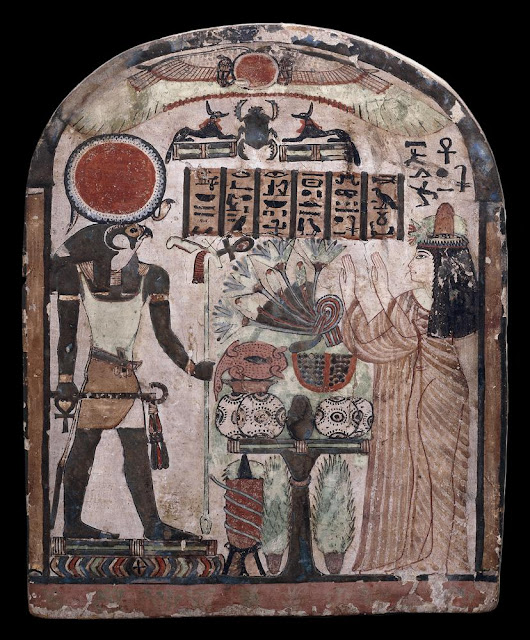
Third Intermediate Period – Probable Provenance: Thebes
British Museum EA27332- museum photo © The Trustees of the British Museum
Deniuenkhonsou wears a long, imposing wig adorned with a floral garland, a perfume cone and a lotus flower. Her ample pleated dress is transparent enough to reveal the folds of flesh on her stomach and hips as well as her rather plump thighs. Deniuenkhonsu worships a falcon-headed god named Ra-Horakhty-Atum, a composite god or synthesis of the main sun gods. His attributes confirm the inclusive character of this figure: in addition to the sun disk surrounded by a cobra on his head and the “ankh” sign in one hand, he holds a crozier and a flail, generally associated with Osiris and the sceptre, which he holds in his other hand is crowned with the feather of Ma’at and another “ankh”. Solar imagery dominates the arch of the stele. Under a blue border representing the sky, the winged solar disk, supported by the scarab, rises from its nocturnal journeys to the underworld, symbolized by the two figures of the jackal god, Anubis. Offerings include lotuses; plucked and gutted poultry; a bowl of grapes (?); round, decorated loaves of bread; under the table, two mounted lettuces and a pot of beer put on a stand and rolled up with a lotus stem. The lower edge of the stele consists of a reddish band bordered by a row of tiny green plants. Since red and pink were used to represent desert land, unlike the black land of the Nile Valley, it must represent a strip of desert dotted with plants.
This stele was made for a woman named Deniuenkhonsou, a musician of Amun and the wife of Ankhkhonsu.
In painted sycamore wood, this stele is 33 cm high, 27 cm wide and 4 cm thick; its weight is 1.302 kg. Dated to the Third Intermediate Period, it could come from Thebes. ; it was acquired by the British Museum in 1896.
SOURCES: Notice and information from the British Museum
The little + of Egyptophile:
Auguste Mariette specifies, “Until the XIth dynasty, the stelae are quadrangular… But from the XIth dynasty, the stele takes the form it no longer abandons except on rare occasions. It is rounded by en high as if intended to recall the curvature of the sky or that of the sarcophagi lids.”
He also sheds this “general” light on the symbolic design of the steles: “The top of the stele is supposed to be lost in the sky. As we descend downwards, we approach the earth. In other words, the stele is divided into three zones.”
The Lovely Wooden Female Figure

end of the 18th – beginning of the 19th dynasty – 1300 – 1275 BC. J.-C.
British Museum EA32772 – museum photo © The Trustees of the British Museum
Depicted in the pure style of the late 18th and early 19th Dynasties, this woman wears a long ceremonial wig that wraps around her shoulders. Each chunky lock is crimped, individually braided and tied at the tip. Two shorter locks frame her face. Her large tiara is gold, rendered here in yellow paint. The lotus flower that adorns her forehead, the stems of which seem to cross above her head at the back of the ribbon, was probably “artificial” unless it was an integral part of the tiara. Her dress is a large rectangular piece of linen, pleated and transparent, wrapped around her body with a fringed edge on the front. Another pan is brought over the left shoulder and arm, and a knot on the right under the chest holds the whole thing in place. The woman’s left foot is missing, but – unusually – her two accessories have been preserved. She holds a lotus flower in her dangling right hand and a bouquet of flowers, skilfully “stacked” in her left.
This painted wooden statuette, dating from the beginning of the 19th dynasty, is 33 cm high. Its ancient provenance is unknown. It was part of Robert Hay’s collection and entered the British Museum in 1868.
SOURCES: Notice and information from the British Museum
The little + of Egyptophile:
Robert Hay (1799-1863), endowed with a comfortable fortune, was a Scottish painter, draftsman and collector. He spent more than ten years of his life in Egypt and Nubia, raising monuments. He notably collaborated with Joseph Bonomi, Owen Brown Carter, Frederic Catherwood, Edward William Lane, or even George Oskins, an antiquarian who, in particular, said: “The ‘Hay group’ most often stayed in the hypogeum of Ramses IV …”
The decorations of the Theban tombs of Hay’s expedition are – it seems (they are unfortunately not yet published) – among the most delicious and the most precise!
Five hundred twenty-nine pieces from the collection of antiquities he had built up were sold to the British Museum for the sum of £1,000 after his death.
Ostracon Representing a Maternity Scene

19th or 20th dynasty – 1295 -1069 BC. J.-C.
British Museum EA8506 – museum photo © The Trustees of the British Museum
This is a sketch for a mural depicting a young woman seated under a vine-covered arbour nursing a baby. With her hair tied atop her head, she appears naked except for a veil (or is that a scarf to carry the child?), elaborate sandals, jewellery, and a belt. Its upholstered stool has a particular shape.
Below is the fragmentary representation of a servant, whose earring and partially shaved hairstyle suggest her Nubian origin: she holds out a mirror and a kohl tube with her applicator stick.
As the same vine leaves surround her, it is likely that she is also under the pavilion, presenting these objects to the young mother, who retired under the arbour, takes care of her newborn, and regains her strength. It is perhaps in the purification phase.
This ostracon, dated to the 19th or 20th dynasty, is 16.70 cm high, 16.70 cm wide and 8.90 cm thick. It came from Deir el-Medina and was acquired by the British Museum in 1843 when Somerset Lowry-Corry, 2nd Earl of Belmore, put up for sale the collection he had built up during his stay and his excavations. in Egypt in 1816-1818.
SOURCES: Notice and information from the British Museum
The little + of Egyptophile:
The ostraca (in the singular: ostracon) are shards, shards or fragments of limestone, or even terracotta, which were, in antiquity, used by artists as graphic supports for their “essays”. The papyrus was indeed then too expensive and reserved for more ‘noble’ uses… Thus, these “ostraca”, which they found in profusion in the sides of the mountain, were the support on which they worked their preparatory sketches, on which they practised, started again, before reaching excellence and finally being admitted to work in situ in the royal tombs.
They come mostly from this place, which in antiquity was called Set Maât her imenty Ouaset – the Place of Truth to the west of Thebes – and today known as the village of artisans of Deir el-Medina. The excavation of its “Grand Puits” by Bernard Bruyère in 1948-1949 made it possible to find more than 5000 ostraca!
Shell-Shaped Pendant With the Name of Sesostris III

XII Dynasty – 1985 – 1785 BC. J.-C.
British Museum EA65281 – museum photo © The Trustees of the British Museum
This shell-shaped amulet is made of a thin gold leaf, pressed onto a mould and inscribed with the name Sesostris III in a cartouche. The interior is strongly concave. The suspension ring had come loose and was repositioned without much care.
Certain peculiarities in the “spelling” of the inscription cast doubt on its authenticity; however, this does not invalidate the authenticity of this piece because this type of shell, not inscribed, was common as an amulet during the Middle Kingdom.
Natural oyster shells with royal names may have been a military decoration. The shell represented here is probably of the species ‘Avicula (Meleagrina) margaritacea’.
This 5 cm high and 4.5 cm wide pendant was bequeathed to the British Museum in 1939 by Sir Robert Ludwig Mond.
SOURCES: Notice and information from the British Museum
The little + of Egyptophile:
Robert Ludwig Mond (1867 – 1938) was a wealthy chemical industrialist. Following a meeting in London with Percy E. Newberry, he went to Egypt in 1901. It was the beginning of a passion to which he would henceforth devote most of his leisure time and a good part of his fortune. The “Who was Who in Egyptology” states: “In 1902, he undertook to clear and record the Theban tombs and discovered new ones. He personally supervised excavations in 1902-5 and 1923-6; for these works, he was assisted by Newberry, Carter, E.J. Mackay, Emery, Frankfort, F.W Green, Weigall, Yeivin and others”… For nearly 40 years, his resources enabled him to take charge of the costly cleanings and restorations of several tombs and landmarks…
Fragmentary Bust of a Woman

Nineteenth Dynasty – British Museum EA37887
Museum photo © The Trustees of the British Museum
The figure wears a long, heavy wig with a lotus stem placed on the top of the head; the flower blooms on the forehead, slightly above the central parting of the hair. On the wig is a decorated headband unless it is a tiara. Strands of hair, individualized, were braided up to shoulder height, then doubled on each side, with other braids separated but tighter and shorter at the tip. She wears a large and wide pearl necklace made up of several rows that go up high on the neck. She holds her left arm crossed over her body, with a sistrum in her left hand. On the left wrist, we notice the patterned sleeve of his garment, which also covers the left arm and shoulder. His face is round and fleshy, with large eyes and thick arched eyebrows. There appears to be an incised line above the right eye to indicate a fold of flesh, which is not clearly marked on the left side. The nose is long and slender, with a small cupid’s bow visible above the upper lip. The lips are thick, with the left outer corner slightly higher than the right side. On the back are the remains of an inscribed pillar with two wide columns of text, the right edge now damaged and the lower part of the two columns lost.
In addition to the lack of the lower body and right side, the fingertips of the left hand and the nose are damaged.
Although this is not known to depict a royal or elite woman, it has been suggested that using this dark, hard stone may indicate that the statue was likely intended for a temple rather than a funerary setting (Russmann 2001). Early sources also report the provenance of this statue as Thebes (Budge 1922; though “unproven” in PM VIII; Russmann 2001).
This bust, dated from the 19th dynasty, is 31 cm high (34 with the base), 18 cm wide and weighs 14.30 kg. It was acquired by the British Museum in 1853 from London art and antique dealer Harry Osborn Cureton.
SOURCES: Notice and information from the British Museum
The little + of Egyptophile:
The initials “PM” cited in the questioning relating to the statue’s provenance refer to the “Porter & Moss”, which owes its name to its two primary authors: Bertha Porter and Rosalind Moss. The colossal work they have produced is thus presented by the Griffith Institute for which they worked: “The Topographical Bibliography of Hieroglyphic Texts, Statues, Reliefs and Paintings of Ancient Egypt (also known as Porter & Moss) is an essential and comprehensive reference resource for Egyptologists, presenting and analyzing published and unpublished information on ancient Egyptian monuments. The first seven volumes are topographically arranged and cover the whole of Egypt and regions beyond, including Nubia (southernmost modern Egypt and northern Sudan). Volume VIII deals with the important body of material in museums and private collections without provenance.”
Fragmentary Limestone Stele With Akhenaten
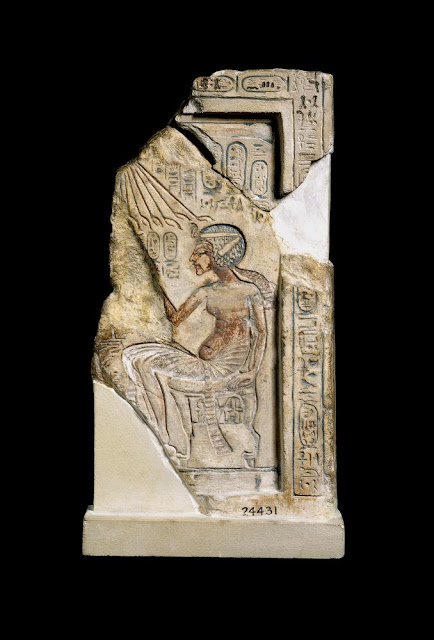
XVIIIth dynasty – Reign of Akhenaton
British Museum EA24431 – museum photo © The Trustees of the British Museum
Akhenaten sits casually on a low-backed padded chair with side struts in the shape of the ancient royal symbol for the unification of Upper and Lower Egypt, which is partly hidden by the long sash of his pleated kilt. The disc of Aten was above him, in the centre of the stele. The hands at the ends of his spokes are stretched out to bless his self-proclaimed son. One of Akhenaton’s hands is raised, apparently towards a small figure in front of him, who could be one of the six daughters he had with Nefertiti. It is almost certain that the whole scene showed Nefertiti sitting across from her husband and probably some of their daughters as well. Akhenaten’s name is written in cartouches in front of his face. The delicacy of the features and the round chest prompted some of the first observers to suggest that this represented Nefertiti (whose name appears with that of Akhenaten in the inscriptions on the frame). Still, they’re just a toned-down version of his lean, oddly androgynous physique. Specific details, such as his large eyes with heavy lids, suggest that the stele dates from the end of his reign. He is depicted with a short, round, curly wig, which is unusual for this ruler. This fragment is reconstructed by reassembling two broken pieces. Traces of paint are still visible: blue on the king’s wig, the hieroglyphs and the dividing lines, and red on the king’s body, the ribbons, the belt and the cushion.
This fragmentary painted limestone stele is 28 cm high, including its base, and 14.7 cm wide. It comes from excavations in 1932 in Amarna by the Egypt Exploration Society, which then donated to the British Museum.
SOURCES: Notice and information from the British Museum
The little + of Egyptophile:
Amenhotep IV is the son of Amenhotep III and Queen Tiyi. He ascended the throne of the Double Country on his father’s death around 1349 BC. J.-C. He left Thebes to build a new city: Akhetaton – the horizon of Aten – today Tell el-Amarna. As for Nefertiti, she is at his side from year 4 to year 14 of his reign, which will last 17 years.
And with regard to this very particular “Amarna” art, Georges Bénédite wrote in 1906: “In El-Amarna everything changes, and realism reigns supreme. If we want to see what the resources of Egyptian art could be, freed from all obstacles, what his observant and satirical genius was to give, and his intimate sense of expression, that’s where you have to go.”…
Series of “Ones” of the summer of 2021
 lampmagician
L’art égyptien est fascinant, votre chronique est super intéressante
LikeLiked by 1 person
L’art égyptien est fascinant, en effet! Merci beaucoup pour l’appréciation. Vous êtes un grand artiste. 🤗💖🙏
LikeLike
In all the years I’ve lived in England, only once did I go to the British Museum. I went wanting to see the Anglo-Saxon jewelry.
LikeLiked by 1 person
I was in London only once for three days, and couldn’t get there. Actually, my brother and I were there to track down Charles Dickens’s footprints! 😉
LikeLike
I’m glad you’re back to Egyptian art: I found this post really fascinating💙
LikeLiked by 1 person
Thank you, my faithful friend. I try to get up again. 💖🙏🌹🥰
LikeLiked by 1 person
You’re more than welcome❣️
LikeLiked by 1 person
Fascinating! I have been to the British Museum several times when I used to live in UK. The best bit was always the Ancient Egyptian place.
LikeLiked by 1 person
I can imagine, my dear Chris. It must be fascinating. 😉🤗🙏Everything is okay with you?
LikeLiked by 1 person
I am okay. I am getting better, but it is still a long way to go. Thank you so much, Aladin 😊💛🤗
LikeLiked by 1 person
Not since my teenage years have I visited this incredible museum in London but your post urges me to go again, soon! Thank you Aladin for sharing another one of Marie’s fabulous Egyptian themed posts, like Luisa, I’ve missed them in recent weeks. Love and light, Deborah.
LikeLiked by 1 person
Thank you so much, my angel, for letting me know about my effect!😉 Having such a Museum on the corner must be a great opportunity. Love to you.🤗🥰🙏💖
LikeLiked by 1 person
These are some beautiful pieces Aladin, thank you for posting them. I love the fragmentary bust of a woman, how smooth and time worn she is….looks like a trip to London needs to be made!
LikeLiked by 1 person
Indeed! Thank you for your warm comment. The bust is also my favourite. 😊 I hope I could come with you to the Museum.😅🙏💖
LikeLike