

It has always been a mystery why the Egyptians painted their gods or pharaohs from the side, not the front. Although the whole face is more beautiful, maybe painting the entire face needs twice as much as painting the profile! Is it the reason why? I don’t think so.
Here is an article with the same question and may have some answers!
From Radio France, via Égypte-actualités’s post. With special thanks to Marc Chartier.
The image on top: from To refresh the memory.
Why do Egyptians always draw in profile?
The characters presented on the Egyptian monuments are always aside. Although depicting people from the front was also possible in ancient Egypt, we only remember subjects in profile. Explanations.
Everyone has in mind the drawings on the walls of the tombs of the pharaohs, on the wine jars or any other object accompanying the kings on their journey after death—humans, cats, horses, chariots, everyone aside, painted from their best side.
First, Let’s correct what our memories tell us: the Egyptians did not draw only in profile. They also knew how to draw people and animals from the front and three-quarters. However, the vast majority of objects that have come down to us or brought up from the sands by Egyptologists are decorated with hieroglyphs, in other words writing from the time of the pharaohs. So-called pictorial writing is made of drawings where the subjects of a scene or a story are systematically represented in profile.
Then a problem arises because the drawing in profile gives less detail than a representation of the face; the Egyptians, therefore, developed bypass techniques to reveal elements and replace perspective.
With hieroglyphs, “there is no time, no space.”
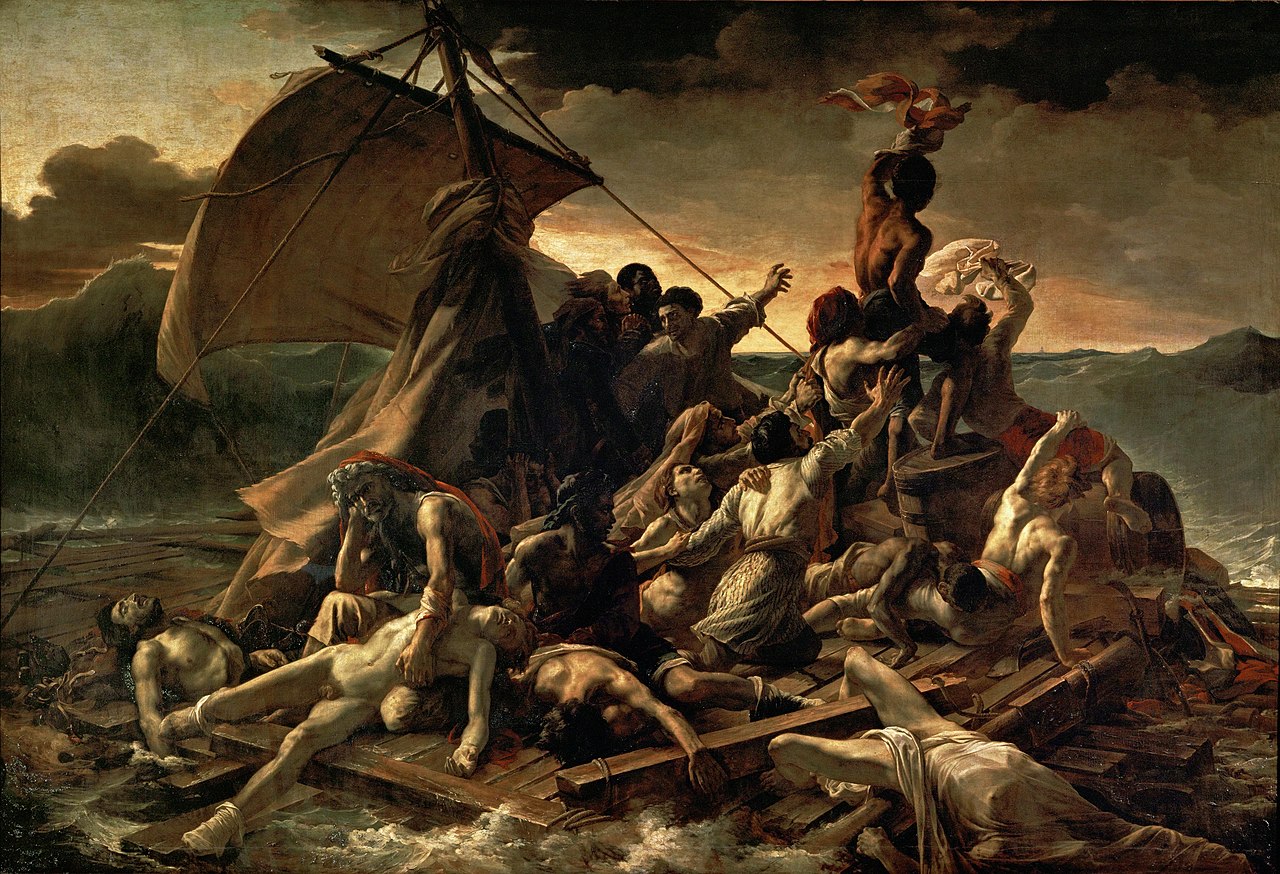
A vanishing point defines perspective; it is about showing depth, that the world we see is not flat, and that there are several planes, allowing space and time to evolve from one another. For example, if we observe the painting The Raft of the Medusa: the gaze sweeps over a rickety boat (which, well, enhanced by its sail is reminiscent of a pyramid), and then the eyes follow the characters from front to back, following an arm raised above all and end up falling on a boat far, far away. The story is told: the raft, the castaways, the hope of the ship. We travel through space and seize the time.
On a drawing executed from the side, perspective does not exist: Egyptologists then speak of respective. The Egyptians used this method not for lack of technique but because there was no space or time. With hieroglyphs, “there is no time, there is no space; we are everywhere and all the time” reminds us of Bénédicte Lhoyer. Egypt is eternal there. It is defined as such on objects adorned with hieroglyphs, perceived as such by the person who admires them.

In this world of respective immutable history, the Egyptians juxtaposed another technique to transcribe movement and time: elements are painted from the front on subjects from the side, thus making visible what was invisible. For example, an eye appears from the front on a face in profile; it can then be represented wide open to signify that the character is doing something. A torso will also be defined from the front, and the chest will be sideways, even if it means not completely respecting the human anatomy.
The scribe then uses the limbs to signify always more things: a forward left leg translates function and social status, and showing the two legs together for a lady means that she does not need to work, so she is of high rank. The position of the arms, of what can be held in the hands, also has a specific meaning. A character can, like the boxes of a comic book, come back several times on the same wall or a series of papyri to describe each significant moment of the story of his life.

Let’s summarize. Why did the Egyptians always draw in profile?
To tell the truth, the Egyptians drew in profile the first intention. Then they added facial elements: the writing in hieroglyphs to transcribe the eternity of the Egyptian people, the details of the face to feed the story and bring context to the scene represented.
The question of Egyptian drawings is addressed in the program “Les p’titsboats” of June 04, 2023, asked by Jezabel, to whom Bénédicte Lhoyer, Doctor in Egyptology and lecturer at the École du Louvre, replied.
Experts also answer the following questions: Who says the name of metro stations, a person or a robot? Why do lions have manes? Or why is the red carpet red?
 lampmagician
💛💛💛
LikeLiked by 1 person
🥰🥰💖🙏🙏
LikeLike
A fascinating article indeed! Thank you for sharing this one Aladin. I also found myself deeply engrossed in seeking the answer to this question. In other news, I hope your kitchen re-fit is going well. Love and light, Deborah.
LikeLiked by 1 person
Thank you, my angel. I will make a short report on our kitchen progress. 😉🙏🥰💖
LikeLiked by 1 person
I found this post extremely interesting: it answered a question that I have often asked myself too
LikeLiked by 1 person
Then one of the many puzzles is solved! 😉😅 Thank you, lovely Luisa. 🤗🙏🥰💖
LikeLiked by 1 person
Oh yes, solved thanks to you💙💙💙
Happy Saturday afternoon, dear Aladin
LikeLiked by 1 person
You too, mia cara Amica. 🙏💖💖😘😘🌹
LikeLiked by 1 person
This is fascinating, Aladin. Thank you. Jeanie
>
LikeLiked by 1 person
I am the one who feels fulfilled by your words. Love to you, Jeane 🙏🙏💖
LikeLike
Very interesting and informative!
LikeLiked by 1 person
Thank you, dear friend. Much appreciated. 🙏🤙
LikeLiked by 1 person
You’re very welcome!
LikeLiked by 1 person
This is fascinating, Aladin. This profile perspective is so noticeable when we spend time looking at Egyptian paintings or sculpture. As the first identifying image shows, Bes, protector of women and children, is drawn full face. Hathor, an ancient great Egyptian Cow Goddess is also shown full face in many sculptures, including one I love in Boston. Much appreciated!
LikeLiked by 1 person
Of course, we can find some paintings of full-face in ancient Egypt, but as we know, most are in profile form. Thank you, dear Elaine. 🙏💖
LikeLiked by 1 person
I did observe the prolific use of profile in the Egyptian hieroglyphs, but never questioned why.
My instincts told me, although not in any specificity, what you have shared here today.
Thank you, Alaedin! ✍️💓
LikeLiked by 1 person
True! An old saying goes: follow your stink! 😉Thank You, dear Resa, for your kind support. 🤗🙏💖
LikeLiked by 1 person
Considering when they were done, producing an effigy in profile was probably the height of Egyptian fashion.
LikeLiked by 1 person
That is an interesting opinion. Thank you for that, Brother. 🙏🤙
LikeLike
Reblogged this on Have We Had Help? and commented:
More Egyptian peculiarities explained…
LikeLiked by 1 person
Very detailed post – enjoyed reading this!
LikeLiked by 1 person
I’m glad to know that you enjoyed it. Thank you for stopping by.
LikeLiked by 1 person
You are much appreciated. Thank You!🙏
LikeLike