I just wanna thank you all my friends and followers here for accepting me, a nobody! in this wonderful circle with so many known and great writers and artists. I was and has been always a humble person in my life, as the life learned me so, and therefore, it is a huge luck and happiness to be accepted in such an amazing intellectual community.
As I watched this video, something pushed me to share it here with you. In my opinion, Queen is not a normal music band, it’s a unicum! as I hear them for the first time, I couldn’t put them in any categories in the music world. they’re unique for me, they’re Queen!
PS; I’m excitingly waiting to see the new movie about Freddie Mercury’s life. 🙂
The “biopic” has delivered dramatic retellings of famous figures’ lives since the very earliest days of cinema. We hunger, it seems, to see more-or-less-faithful approximations of our idols stride across the screen, enacting events witnessed by millions and those hidden away from everyone. In the case of popular musicians, these tend to involve epic alcohol and drug use, tumultuous love affairs, stadium-sized triumphs and the crushing defeats of falling out of cultural favour. Such scenes can prove difficult to recreate convincingly, especially the music and signature moves of world famous stars.
Condensing lifetimes into marketable narrative films that hit typical Hollywood beats also involves taking a fair amount of license. And as a spate of articles like “Everything Bohemian Rhapsody Got Wrong About Freddie Mercury’s Life” testify, the new biopic about Queen singer Freddie Mercury, played in the film by Rami Malek, twists or totally changes key events in Mercury’s life. The film re-imagines, for example, how Mercury met his band members, his girlfriend Mary, and Jim Hutton, his longtime and final partner.
And, oddly, it imagines Mercury telling Queen about his HIV diagnosis during rehearsals for their 1985 Live Aid appearance, which it stages as a reunion, showing the band as having been on hiatus while members pursued solo projects. The truth, however, is that Mercury didn’t receive his diagnosis until 1987, and his bandmates weren’t fully aware of his illness until 1989. And when the band came together to perform at Live Aid, they had just toured the world in support of their 1984 album The Works.
Such distortions are a little perplexing given that Brian May and Roger Taylor served as creative consultants, sitting in on set during the production. The film has been also been accused of “straightwashing” Mercury’s sexuality and glossing over his roots and religion. You’ll have to evaluate the merits of these charges for yourself, but the case remains that if we want to know what Mercury’s life was really like, we need to supplant the entertaining fiction with the even more compelling truth.
The video above helps in some small part to fill gaps in our knowledge of Mercury’s last years, editing together interviews, TV clips, and performance footage. Although Mercury was very sick during this period, you would hardly have known it, and most of the people around him didn’t. He continued to write and record, working hard on Queen’s last album, Innuendo, released in the final year of his life.
We learn that his closest friends, colleagues, and band members were in denial, “right up to the last minute,” as Brian May says, about the severity of his disease. “We sort of refused to know” how bad it was, May admits. Mercury himself pushed the knowledge away, immersing himself in his music to keep going. “The sicker Freddie got,” says Roger Taylor, “the more he seemed to need to record to give himself something to do, you know, some sort of reason to get up… so it was a period of fairly intense work.”
Mercury’s early death was tragic, but he met it heroically. And though his bandmates struggled to face the truth, they rallied around him in support, both in life and in death. When the tabloid press viciously slandered and attacked him, May and Taylor went on television to defend their friend. “He had a very responsible attitude to everyone that he was close to and he was a very generous and caring person to all the people that came through his life and more than that you can’t ask,” said May in a 1991 interview appearance after Mercury passed away. “I tell you we do feel absolutely bound to stick up for him,” added Taylor, “because he can’t stick up for himself anymore, you know?”
William Blake: The Great Red Dragon and the Woman Clothed in Sun
<<There’s no doubt that we all have both sides (the shadow and bright side) in us, the fact is we must try not to ignore the unwilling one and give our best to know it. the great heroes are they who have no fear to acknowledge them both >>
Jung: On the demonic dynamism of the Shadow in mass movements…
It is a frightening thought that man also has a shadow side to him, consisting not just of little weaknesses and foibles, but of a positively demonic dynamism.
The individual seldom knows anything of this; to him, as an individual, it is incredible that he should ever in any circumstances go beyond himself.
But let these harmless creatures form a mass, and there emerges a raging monster, and each individual is only one tiny cell in the monster’s body so that for better or worse he must accompany it on its bloody rampages and even assist it to the utmost.
Having a dark suspicion of these grim possibilities, the man turns a blind eye to the shadow-side of human nature.
Blindly he strives against the salutary dogma of original sin, which is yet so prodigiously true.
Yes, he even hesitates to admit the conflict of which he is so painfully aware.
the anima, speaking in vision: I am the flower of the field, the lily of the valley, I am the mother of fair love, knowledge & sacred hope. I am very beautiful without taint. I am the law in the priest, the word in the prophet, the counsel in the sage. I can kill and bring to life, and there is no one who can deliver anything out of my hand.
The amazing Sue Vincent recently hosted me at her Daily Echo blog. We were talking about superstitions and I shared some from my youth. I had a great time at Sue’s and I hope you’ll click over to visit her.
I expect the townsfolk in fictional Atonement, TN would tend to be superstitious. How could they be otherwise with all the strange goings on and supernatural beings?
The first writing advice I heard was something I took to heart ― Write what you know. When I wrote Atonement, Tennessee I followed that guidance and created a fictional southern town where the urban fantasy takes place. Of course, the second novel, Atonement in Bloom, is also set there.
I made it a very small, rural town so some of the manners and personalities I grew up with would not seem out of place. The townsfolk…
A rare gift comes to the writer when the story and its mixed tape of music ka-chunk and transform. No longer is the music merely the writer’s atmosphere, her source of ambience while storytelling. Oh no. The music is the heroine. The music is the villain. The music is the tension. The music is the scene.
This happened to me during 2010’s National Novel Writing Monthwhen I first began drafting Fallen Princeborn: Stolen. At the time I was only using instrumental music for storytelling, while music like The Who’s Quadropheniahelped me survive the piles of grading in my dropbox. The month had barely started, so I was early in the story of Charlotte and her sister leaving their abusive family in the Dakotas for Wisconsin. Their coach bus breaks down in the middle of nowhere. Another peculiar bus appears with far-too-friendly good Samaritans, and despite Charlotte’s suspicions…
Born in Dublin, Ireland, 1967, Celine has spent the majority of her working life in the film business, and her career as a classical feature character animator spanned over seventeen years, before she became a full-time writer. I am honored to spend this week and next sharing her thoughts on world-building, research, character, audience, and hooks.
First, let’s talk about the imagination behind the worlds. I see on your biography you spent years in film and animation. What drew you to visual storytelling as a profession before written storytelling? How does your work as an animator influence the way you write today?
Illustration of Chris and Wynter from Poison Throne
From the moment I could hold a pencil I was always either drawing or writing. In terms of satisfaction, I don’t think there’s a dividing line between the two disciplines for me. But at different stages in my life…
“The destroying of the huluppu tree meant that human beings could no longer count on Inanna and the World Tree to maintain the cycle of life and death. Instead, they were now facing a terrifying, linear world.”
‘Fanning the Furnace’ Guided Imagery Meditation Chi Kung
Tan Tien Breathing is also known as Fanning the Furnace Breathing, Lower Heaven Breathing, or Field of Elixir Breathing. These names refer to a type of ages-old guided imagery chi kung (chi kung/qigong means breathing in congruence with effort or in time with movement). The most common title that I’ve come to utilize is Fanning the (sparkling) Furnace.
In this tradition (Tao Chan/Ming Chia), it is said that there are two tan tien points/portals. With regard to the ‘real’ tan tien, it is located just behind the navel/CV-8 acupoint (also known as the sea of chi). This point is approximately two and one-half inches (two and one-half cun – e.g., personal thumb-widths – per one’s own body mapping) above the ‘curculatory’ tan tien/CV-5 acupoint (CV is the common abbreviation for the central vessel in acupressure/TCM/traditional Chinese medicine theory).
I’ve been always fascinated by the Serpent in the old testament; as a messenger or signpost for getting knowledge., opening the secret doors. here Dr Jung explains it in a wonderful way.
For the Naassenes Paradise was a quaternity parallel with the Moses quaternio and of similar meaning.
Its fourfold nature consisted of the four rivers, Pison, Gihon, Hiddekel, and Phrat.
The serpent in Genesis is an illustration of the personified tree numen; hence it is traditionally represented in or coiled around the tree.
It is the tree’s voice, which persuades Eve—in Luther’s version—that “it would be good to eat of the tree, and pleasant to behold that it is a lusty tree.”
In the fairytale of “The Spirit in the Bottle,” Mercurius can likewise be interpreted as a tree numen.
In the Ripley “Scrowle” Mercurius appears as a snake in the shape of a Melusina descending from the top of the Philosophical Tree (“tree of knowledge”).
The tree stands for the development and phases of the transformation process, and its fruits or flowers signify the consummation of the work.
In the fairytale, Mercurius is hidden in the roots of a great oak-tree, i.e., in the earth.
For it is in the interior of the earth that the Mercurial serpent dwells. ~Carl Jung, CW 9, Aion, Page 235, Para 372.






 This happened to me during 2010’s
 Born in Dublin, Ireland, 1967, Celine has spent the majority of her working life in the film business, and her career as a classical feature character animator spanned over seventeen years, before she became a full-time writer. I am honored to spend this week and next sharing her thoughts on world-building, research, character, audience, and hooks.
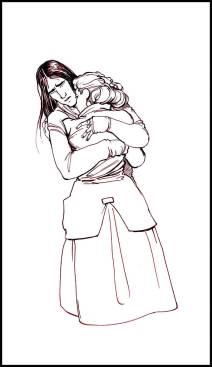 Illustration of Chris and Wynter from Poison Throne

 lampmagician
You must be logged in to post a comment.