►Greek Mythology: “Metamorphoses” by Ovid / “Flowers and Plants in some Greek Myths II” 🌹.-

Gallery

Aquileana's avatar⚡️La Audacia de Aquiles⚡️

metamorphoses-ovid

flowers-and-plants-in-greek-myths2

guarda_griega1_3-1-1 (1)

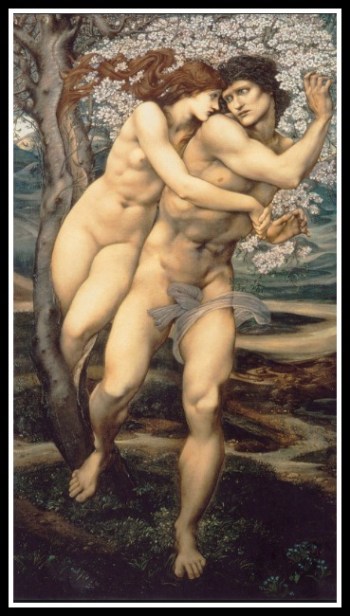
"The Tree of Forgiveness." by Edward Burne-Jones. 19th century. “The Tree of Forgiveness.” by Edward Burne-Jones. 19th century.

guarda_griega1_3-1-1 (1)

_________________________________________________________________

⇒“Metamorphoses” by Ovid:

"Metamorphoses" by Ovid. Illustration by George Sandys. 1632. “Metamorphoses” by Ovid. Illustration by George Sandys. 1632.

In my previous post, I have mentioned Ovid´s book “Metamorphoses”as a key source of Greek Mythology. 

“Metamorphoses” is a narrative poem in fifteen books by the Roman poet Ovid, completed in 8 CE.

It is a “mock-epic” poem, written in dactylic hexameter, the form of the great epic poems of the ancient tradition, such as “The Iliad” and  “The Odyssey.

This poem describes the creation and history of the world, incorporating many classical myths.

Love and hubris are main topics in Ovid´s “Metamorphoses”. 
Unlike the predominantly romantic notions of Love, Ovid considered love more as a dangerous, destabilizing force.
However, there is an explanation for this attitude: during the reign of Augustus, the Roman emperor during Ovid’s time, major attempts were made to regulate morality by creating legal and illegal forms of love, by encouraging marriage…

View original post 1,894 more words

►Greek Mythology: “Zeus and Callisto” / Poetry: “Poem Challenge”.-

Gallery

Aquileana's avatar⚡️La Audacia de Aquiles⚡️

zandc

guarda_griega1_3-1-1 (1)

 “Jupiter and Callisto” by François Boucher. In this painting Jupiter (Zeus) takes the form of Artemis/Diana (1759).

guarda_griega1_3-1-1 (1)

____________________________________________________________

Callisto (also known as Parrhasia)  was a daughter of the Arkadian King Lykaon and a hunting companion of the goddess Artemis (Also known as Cynthia, roman equivalent: Diana).

Callisto’s themes are instinct and flexibility. Her symbols are a bear, a willow branch and the constellation Ursa Minor.

Callisto wanted to preserve her virginity for as long as she remained in the company of the Huntress- Goddess.

“Callisto once belonged to the sacred circle of Hamdryades and huntress Diana (Artemis). She touched the goddess’ bow : `This bow I touch,’ she cried, `Be a witness to my virginity.’ Cynthia (Artemis) praised her, and said : `Keep the pledge you vowed and you will be my companions’ princeps. [Ovid, “Fasti” 2. 155 ff. (Roman poetry C1st B.C. to C1st A.D.)].~

But later on, she was…

View original post 1,573 more words

►Greek Mythology: “Narcissus and Echo” (Interpretation and Psychoanalytical Corollaries)⭐️.-

Gallery

Aquileana's avatar⚡️La Audacia de Aquiles⚡️

narcissus and echo1

guarda_griega1_7

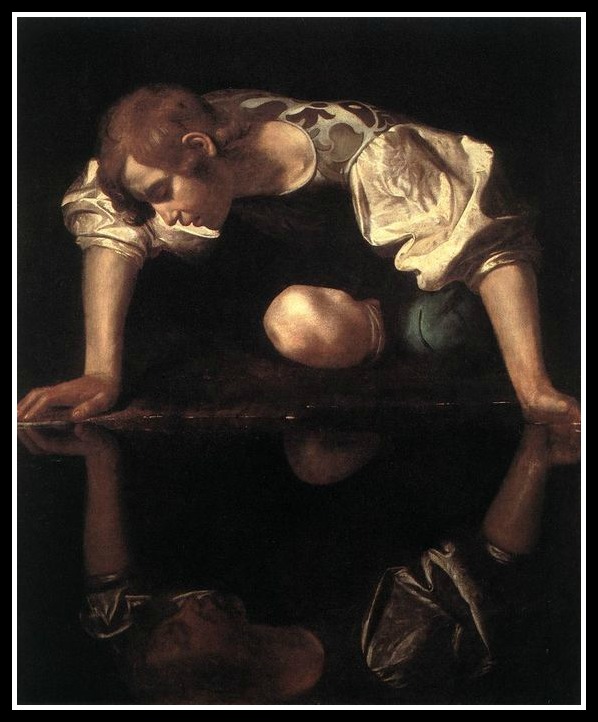
"Narcissus" by Caravaggio. 1597. “Narcissus” by Caravaggio. 1597.

guarda_griega1_3-1-1-1 (1)

_______________________________________________________________________________________________________________________

The classic version of this myth is by Ovid, found inBook III of his Metamorphoses (Lines 339/508)

Echo was an Oread or Orestiad, meaning a type of nymph that lived in mountains, valleys, and ravines. The Oreads were associated with Artemis, the goddess of hunting.

Zeus used to  loved consorting with Goddess and nymphs. Hera, became suspicious, towards Zeus for his many affairs.

Though vigilant, whenever she was about to catch him, Echo distracted her with lengthy conversations.

When at last Hera realized the truth, she cursed Echo. To punish her, Hera took away her most valuable possession: her voice.

Hera permitted Echo only to reply in foolish repetition of another’s shouted words. Thus, all Echo could do was mimic the words of the speaker.

Sometime after being cursed, Echo spied a young man, Narcissus, while he was out hunting deer with his companions.

View original post 1,809 more words

►Greek Mythology: “Mnemosyne” / “Collaboration with Resa McConaghy and Christy Birmingham” 💫.-

Gallery

Aquileana's avatar⚡️La Audacia de Aquiles⚡️

mnemosyne1

guarda_griega1_7

“Mnemosyne” by Dante Gabriel Rossetti (1881) .- “Mnemosyne” by Dante Gabriel Rossetti (1881) .-

guarda_griega1_7

____________________________________________________________________________________________________________

Mnemosyne/ Μνημοσύνη (Roman equivalent: Moneta(0)) was a Titaness, goddess of Memory (1) and the inventor of Words (2)

Mnemosyne was also a goddess of time. She represented the rote memorisation required, before the introduction of writing, to preserve the stories of history and sagas of myth. She was the daughter of Uranus (Heaven) and Gaia (Earth). Uranus and Gaia were the parents of the first generation of Titans, consisting of twelve elder gods/goddesses, being Mnemosyne included among them.

____________________________________________________________________________________________________________

Genealogy of the Olympians in Greek mythology, Mnemosyne among them.- Genealogy of the Olympians in Greek mythology, Mnemosyne among them.-

____________________________________________________________________________________________________________
She was also lover of the Ruler of Gods, Zeus
After Zeus led the war against the Titans and established himself as the leader of the Olympians, he feared that, even though he might be immortal, his great victories and decisions might soon be forgotten.

Longing for a…

View original post 2,230 more words

►Philosophy: “Beauty, according to Plato” / Mythology: “Some Greek Myths, based on Beauty”⭐ .-

Gallery

Aquileana's avatar⚡️La Audacia de Aquiles⚡️

plato beauty

guarda_griega1_3-1-1

Symadro39

guarda_griega1_3-1-1 (1)

____________________________________________________________________________________________________________________

According to Plato, Beauty was an idea or Form of which beautiful things were consequence.

Beauty by comparison begins in the domain of intelligible objects, since there is a Form of beauty. The most important question is: what do all of these beautiful things have in common?. To know that is to know Beauty.

The Theory of Forms maintains that two distinct levels of reality exist: the visible world of sights and sounds that we inhabit and the intelligible world of Forms that stands above the visible world and gives it being. For example, Plato maintains that in addition to being able to identify a beautiful person or a beautiful painting, we also have a general conception of Beauty itself, and we are able to identify the beauty in a person or a painting only because we have this conception of Beauty in the abstract…

View original post 2,133 more words