► “Greek Myths and Graffiti Murals”: “Collaboration With Resa McConaghy”:

Gallery

Aquileana's avatar⚡️La Audacia de Aquiles⚡️

“Greek Myths and Graffiti Murals”: “Collaboration With Resa McConaghy”:
_____________________________________________________________________________________

⇒About This Post. Abstract:

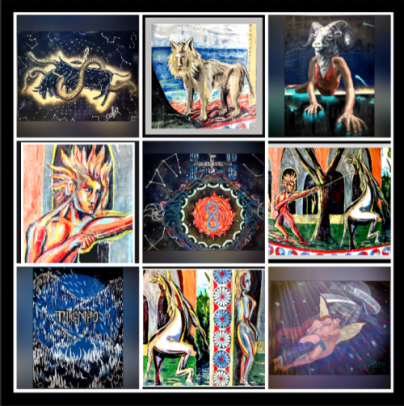
The following article is composed of two sections, each one of them including murals from Argentina and Canada, respectively. This post aims to analyze with a with a free, but still judiciously, well-founded criteria how certain mythological greek themes and characters might be recurrent, despite time and even against it.

As Resa and I found some graffitis which seemed to have mythological and even philosophical equivalents we decided we wanted to try to show those connections. Resa´s mural is from the University of Toronto (Toronto, Canada) whilst mine are from The Planetarium (Palermo, Buenos Aires, Argentina). With that being said, we just wanted to say that, after finding many similarities, we are quite pleased with the outcome. Both of, Resa and I believe the convergences are striking. And being so, they broaden and deepen the…

View original post 1,978 more words

Greek Mythology: “Aphrodite, Hephaestus, Ares and her Other Lovers”.-

Gallery

Aquileana's avatar⚡️La Audacia de Aquiles⚡️

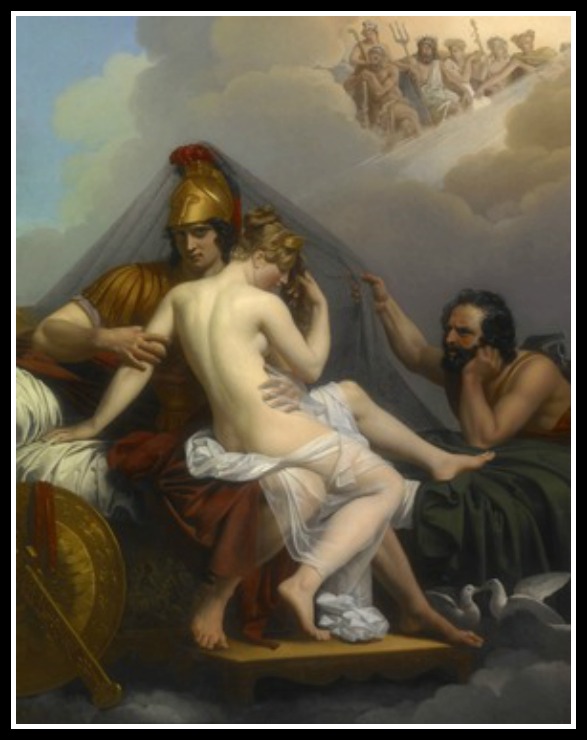
►Greek Mythology: “Aphrodite, Hephaestus, Ares and her Other Lovers”:

guarda_griega1_3

"Mars and Venus Surprised by Vulcan" by Joachim Wtewael. (1601). “Mars and Venus Surprised by Vulcan” by Joachim Wtewael. (1601).

guarda_griega1_3

_____________________________________________________________________________________________

Hephaestus (Roman equivalent: Vulcan), the smith and craftsman of the gods, was married to Aphrodite (Roman equivalent: Venus), the goddess of love and beauty.

It was not a good  marriage because Aphrodite was as an unfaithful wife.

But Hephaestus also cheated her, for example with Athena, the Greek goddess of reason, intelligent activity, arts and literature.

Aphrodite most notable lovers were the gods Ares (God of War. Roman equivalent: Mars),Dionysius, Greek God of Wine and Fertility,  Hermes, (Greek God of herds and herald of the gods. Roman equivalent: Mercury), Zeus (King of Gods. Roman equivalent: Jupiter), Nerites (A young Sea-God who was the very first love of Aphrodite). Poseidon (Greek God of the Sea. Roman equivalent: Neptune), and the mortal, Adonis, who was Myhrra’son

View original post 593 more words

►Greek Mythology: “Hephaestus” / “Collaboration with Holly Rene Hunter” 🔥.-

Gallery

Aquileana's avatar⚡️La Audacia de Aquiles⚡️

►Greek Mythology: “Hephaestus”  /

“Collaboration with Holly Rene Hunter”:

“The Fall Of Hephaestus” by C. Van Poelenburg. 17th century.

_____________________________________________________________________________

Hephaestus(Roman equivalent: Vulcan)  was the Greek god of fire, metal work, blacksmiths and craftsmen.

According to Homer’s  “Iliad”, Hephaestus was born of the union of Zeusand Hera. In another tradition, attested by Hesiod, Hera bore Hephaestus alone.

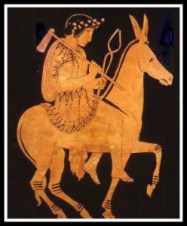
Hephaestus. Attic Red Figure. 430 – 420 BC.

Hesiod tells us in “Theogony”, that in order to get even with Zeus for solely bringing about the birth of Athena, Hera produced the child Hephaestus all on her own.

Though Hesiod’s version seems to be the one that is most commonly accepted among readers, its content greatly alters our understanding of the birth of Athena. The ancient texts unequivocally state that it was Hephaestus who released the goddess from the head of Zeus by cracking the god’s…

View original post 1,352 more words

►Greek Mythology: “Artemis´ Dual Archetype” / “Collaboration with Resa McConaghy and Mirjana M. Inalman”🌛🏹.-

Gallery

Aquileana's avatar⚡️La Audacia de Aquiles⚡️

►Greek Mythology: “Artemis´Dual Archetype” / “Collaboration with Resa McConaghy and Mirjana M. Inalman”🌛🏹. 

artemis-goddess

guarda_griega1_2-1

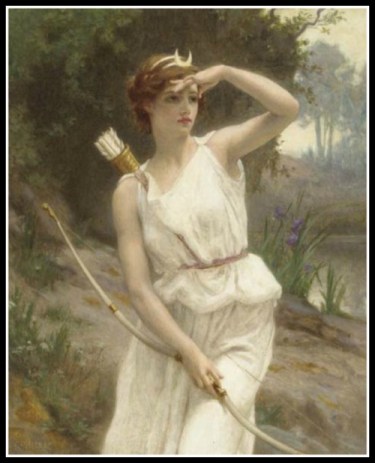
"Diana, The Huntress" by Guillaume Seignac. 19th century. “Diana, The Huntress” by Guillaume Seignac. 19th century.

guarda_griega1_2-1

_______________________________________________________________

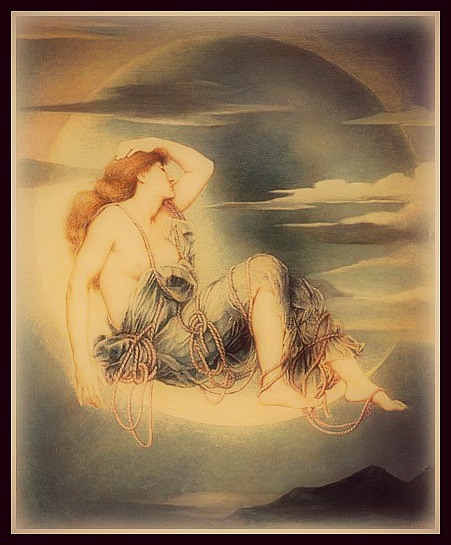
Artemis(Roman Equivalent: Diana) is often depicted in two ways: as a huntress goddess and as the goddess of the Moon. 

Artemis/Diana by Jean-Antoine Houdon (18th century) Artemis/Diana by Jean-Antoine Houdon (18th century)

Artemis was the first-born child of Zeus and Leto. Her mother was forbidden by jealous Hera to give birth anywhere on the earth but the floating island of Delos provided her sanctuary. Immediately after her birth, Artemis helped her mother deliver Apollo for which she is sometimes called a goddess of childbirth.

Her twin brother Apollo was similarly the protector of the boy child. Together the two gods were also bringer of sudden death and disease: Artemis targeted women and girls, Apollo men and boys.
Artemis was officially the goddess of the Hunt, but because the Titans had fallen, the Titan Selene

View original post 1,946 more words

►Greek Mythology: “The Nereids, Fifty Sea Nymphs”.-

Gallery

Aquileana's avatar⚡️La Audacia de Aquiles⚡️

►Greek Mythology: “The Nereids, Fifty Sea Nymphs”:

guarda_griega1_3-1 (1)

"A Mermaid" by John William Waterhouse (1900). “A Mermaid” by John William Waterhouse (1900).

guarda_griega1_3-1 (1)

___________________________________________________________________________

The Nereids were fifty goddesses of the sea, daughters of Nereus (eldest son of Pontus, the Sea and Gaia, the Earth) and Doris (an Oceanid and Sea Nymph). They were sisters of  Nerites (a young minor sea god).

They Nereids were the patrons of sailors and fishermen, who came to the aid of men in distress.

Individually they also represented various facets of the sea, from salty brine, to foam, sand, rocky shores, waves and currents, in addition to the various skills possessed by seamen.

They often accompany Poseidon, the god of the sea, and can be friendly and helpful to sailors fighting perilous storms.

The Nereids were depicted in ancient art as beautiful young maidens, sometimes running with small dolphins or fish in their hands, or else riding on the…

View original post 861 more words

►Greek Mythology: “The Sirens, Muses of the Lower World”.-

Gallery

Aquileana's avatar⚡️La Audacia de Aquiles⚡️

►Greek Mythology: “The Sirens, Muses of the Lower World”:

guarda_griega1_3-1

"Odysseus and the Sirens" by Herbert James Draper, (1909). “Odysseus and the Sirens” by Herbert James Draper, (1909).

guarda_griega1_3-1

________________________________________________________________________

The Sirens were sea nymphs who lured sailors to their death with a bewitching song.

They parents were River Achelous and the Muse Melpomene (Pseudo-Apollodorus)For Euripides, they were virgin daughters of Gaia (the Earth). 

Their number is variously reported as between two and five.
In the “Odyssey”, Homer says nothing of their origin or names, but gives the number of the Sirens as two  on an island in the western sea between Aeaea and the rocks of Scylla.

 Hesiod says that they were three and that their names were Thelxiope or Thelxinoe, Molpe and Aglaophonos.

They are mantic creatures like the Sphinxwith whom they have much in common, as they also were believed to combine women and birds in various ways.
In early Greek…

View original post 1,154 more words

►Greek Mythology: “The Muses” / Poem: “Erato, the Greco-Muse of Love Poetry”, by Eva Xanthopoulos⭐️✔️.-

Gallery

Aquileana's avatar⚡️La Audacia de Aquiles⚡️

the muses1

guarda_griega1_7

"Apollo and the Muses" by Baldassarre Peruzzi. 1523. “Apollo and the Muses” by
Baldassarre Peruzzi. 1523.

guarda_griega1_7

______________________________________________________________________________________________________

The Muses were the Greek goddesses of inspiration in literature, science and the arts.

Before the Classical idea of the nine Muses, Pausanias tells us of three Muses, different altogether from the nine we know. They were: Melete, or Practice. Mneme, or Memory and Aeode, or Song

It was only later, with Hesiod that the idea of Nine Muses showed up.

According to it, they were the daughters of Zeus and MnemosyneZeus and Mnemosyne slept together for nine consecutive nights, thus birthing the nine Muses.

Μnemosyne gave the babies to Nymph Eufime and Apollo (God of Light, Eloquence, Poetry and Fine Arts). When they grew up they showed their tendency to the arts, taught by God Apollo himself.
Apollo brought them to the big and beautiful Mount Elikonas, where the older Temple of Zeus used to be. Ever…

View original post 1,111 more words

►Greek Mythology: “Hermes” / Poem at La Poesía no Muerde: “Tempus Fugit” 🌟.-

Gallery

Aquileana's avatar⚡️La Audacia de Aquiles⚡️

hermes0

guarda_griega1_3-1-1

“Mercury” by Evelyn De Morgan. 1873 “Mercury” by Evelyn De Morgan. 1873.

guarda_griega1_3-1 (1)

_______________________________________________________________________________________________________________________________________________________

(Roman name: Mercury) was the messenger of the Gods.

It was Hermes´duty to guide the souls of the dead down to the underworld, which is known as a psycho pomp.

Carl Jung often speaks of Hermes as psycho pomp, spiritual friend, or personal guide.

He says: “From the earliest times, Hermes was the psycho pomp of the alchemists, their friend and counselor, who leads them to the goal of their work. He is like a teacher mediating between the stone and the disciple… To others the friend appears in the shape of Christ or Khidr or a visible or invisible guru, or some other personal guide or leader figure”. (Carl Jung, Archetypes and the Collective Unconscious. 1934–1954. Vol.9 Part 1. CW 9I, para. 283).

One of his most famous regular roles was as as God of Crossroads, leader of souls to the river…

View original post 2,219 more words

►Greek Mythology: “The Gorgons”.-

Gallery

Aquileana's avatar⚡️La Audacia de Aquiles⚡️

the gorgons

guarda_griega1_3-1-1-1 (1)

Perseus and Medusa by Benvenuto Cellini, (1554). Perseus with the head of Medusa. Details. Perseus and Medusa by Benvenuto Cellini, (1554). Perseus with the head of Medusa. Details.

guarda_griega1_3-1-1 (1)

_______________________________________________________________________________________________________________________

In Greek Mythology, the Gorgons were three monsters, daughters of Echidna and Typhon. Their names were Stheno (“forceful”), Euryale (“far-roaming”), and the most famous of them, Medusa (“ruler”).  Although the first two were immortal, Medusa was not, and she was slain by the demigod and hero Perseus.

It was said that their  appearance would turn anyone who laid eyes upon it to stone. The name “Gorgon”  is Greek, being derived from “gorgos” and translating as “terrible” or “dreadful”.

Hesiod in his “Theogony” imagines the Gorgons as three sea daemons and makes them the daughters of two sea deities.

Homer speaks only of one Gorgon, whose head is represented in “The Iliad”as fixed in the centre of the aegis (meaning a mirrored shield) of Athena, the Greek Goddess of Wisdom,  and whose counterpart was a device on the shield…

View original post 1,085 more words

►Greek Mythology: “Pegasus, The Winged Horse”🐎.-

Gallery

Aquileana's avatar⚡️La Audacia de Aquiles⚡️

PEGASUSHEADER

guarda_griega1_7

Bellerophon, Pegasus and Khimaira. Kylix Laconian Black Figure. Ca 570 - 565 BC. Bellerophon, Pegasus and Khimaira. Kylix Laconian Black Figure. Ca 570 – 565 BC.

guarda_griega1_7

_________________________________________________________________________________________________

Pegasus was a Hippoi Athanatoi, meaning an immortal horse of the Gods. he was a winged horse which sprang forth from the neck of the Gorgon Medusawhen she was beheaded by the hero Perseus. 

When Perseus struck off the head of Medusa, with whom Poseidon had once had intercourse in the form of a horse or a bird, there sprang forth from her Chrysaor and the horse Pegasus.

Chrysaor (meaning “Golden Sword”) was usually represented as giant, but may also have been conceived of as a winged boar.

As to Pegasus, he obtained that because he was believed to have made his appearance near the sources (pêgai) of Oceanus.

Liz Greene calls the winged horse the bridge between opposites: “An earthy creature which has the power to ascend into the spiritual realm”

View original post 735 more words