Art / Mythology: “The Loggia of Psyche” (Frescoes Based on the Myth Of Eros and Psyche).-

Gallery

Aquileana's avatar⚡️La Audacia de Aquiles⚡️

►Art / Mythology: “The Loggia of Psyche” at The Villa Farnesina

(Frescoes Based on the Myth Of Eros and Psyche):

guarda_griega1_3

;;; “The Loggia of Psyche” (Villa Farnesina, Rome. 16th Century).

guarda_griega1_3

_______________________________________________________________________________________________

The Villa Farnesina is placed in the Trastevere area of Rome on the Via della Lungara along the river Tiber.

It was designed by Baldassare Perluzzi between 1508 and 1512 for the banker, Agostino Chigi who was in love with his mistress Francesca Ordeaschi to whom he finally married in 1519.

After Chigi, the villa was purchased by the Farnese family and connected by a bridge across the Tiber to the huge Palazzo Farnese on the opposite bank.

The walls related to the Loggia of Phsyche were frescoed by several noted artists, most importantly Raphael, but it’s the ceiling that illustrates Psyche and Eros’ story.  

Scholars suggest that the story cycle alludes to Chigi’s own life, and his recent…

View original post 1,032 more words

►Mythology: “Psychopomps, Border Crossers and Guiders of Souls”🌟.-

Gallery

Amazing ❤❤

Aquileana's avatar⚡️La Audacia de Aquiles⚡️

►Mythology: “Psychopomps, Border Crossers and Guiders of Souls”🌟:

“Souls on the Banks of the Acheron”, by Adolf Hirémy-Hirschl. 1898

____________________________________________________________________________________

⇒♦ Introduction. Definition of Psychopomp and Sketch of this post:

A Psychopomp is a god, spirit, or demon who is responsible for guiding the spirits of the dead on their journey to the underworld. His role is not to judge the deceased, but simply to provide safe passage. The word comes from the Greek   ψυχοπομπός, which means “conductor of souls.” Psycho– (ψυχο) originally meant “of, or relating to the soul,” while pomps (πομπός) meant “guide” or “conductor.”

Classical examples of a Psychopomp are the ancient Egyptian god Anubis, the Greek ferryman CharonHermes and Hecate, the Roman god Mercury (equivalent: Hermes in Greek Mythology) and Archangel Gabriel in the Catholic religion, to name the most important ones.

Firstly, in the first section (I), let´s look at some examples of Psychopomps in Mythology.

View original post 2,257 more words

Dreams of Desire 63 (Utamaro)

Gallery

Cakeordeath's avatarcakeordeathsite

Lovers-in-the-upstairs-room-of-a-teahouse-from-Poem-of-the-Pillow-1788-by-Kitagawa-Utamaro[1] Kitagawa Utamaro-Lovers in the Upstairs Room of a Teahouse 1788 The Meiji Restoration in 1868 opened Japan’s ports again to foreign trade after 200 years of international isolation. Soon Japanese art and artefacts found their way to Paris and London which resulted in a craze known as Japonisme. Ukiyo-e, particularly the works of the masters, Hokusai, Hiroshige and Kitagawa Utamaro, would have a profound effect upon the first of all modern art movements, Impressionism.

Utamaro was renowned for his psychologically astute portraits of courtesans. Employing sophisticated compositional techniques of partial views, striking mannerism and subtle gradients of light and shade, Utamaro was collected by many luminaries of Impressionism and Post-Impressionism, notably Degas, Gaugain and Toulouse-Lautrec. The serenity of his female studies were clearly a major influence on the ground-breaking female artist Mary Cassett.

Utamaro, like every ukiyo-e artist produced a large body of shunga. His sensitivity to female beauty combined…

View original post 18 more words

Greek Mythology: “The Moirae” (“The Three Fates”).-

Gallery

Aquileana's avatar⚡️La Audacia de Aquiles⚡️

►Greek Mythology: “The Moirae” (“The Three Fates”):

guarda_griega1_3 (1)

"The Triumph of Death", or "The Three Fates". Flemish tapestry (probably Brussels, 1510-1520). “The Triumph of Death”, or “The Three Fates”. Flemish tapestry (probably Brussels, 1510-1520).

guarda_griega1_3 (1)

______________________________________________________________________________

In Greek Mythology The Moirae or Moirai (in Greek Μοῖραι, meaning the “apportioners”, often called The Fates), were the three white-robed personifications of  Destiny (Roman equivalent: Parcae, “sparing ones”). They assigned to every person his or her fate or share in the scheme of things. 

Their number became fixed at three: Clotho, (spinner), Lachesis (allotter) and Atropos (unturnable).

Clotho (“spinner”) spun the thread of life from her distaff onto her spindle. Her Roman equivalent was Nona, (the ‘Ninth’), who was originally a goddess called upon in the ninth month of pregnancy.

Lachesis (“allotter” or drawer of lots) measured the thread of life allotted to each person with her measuring rod. Her Roman equivalent was Decima  (the ‘Tenth’).

Atropos (or Aisa, “inexorable” or “inevitable”) was the…

View original post 602 more words

The Restless Times, Issue 7

Gallery

► “Metis in Ancient Greece”: “Collaboration with José Cervera”💫 .-

Gallery

Aquileana's avatar⚡️La Audacia de Aquiles⚡️

► “Metis in Ancient Greece”:

“Collaboration with José Cervera”💫:

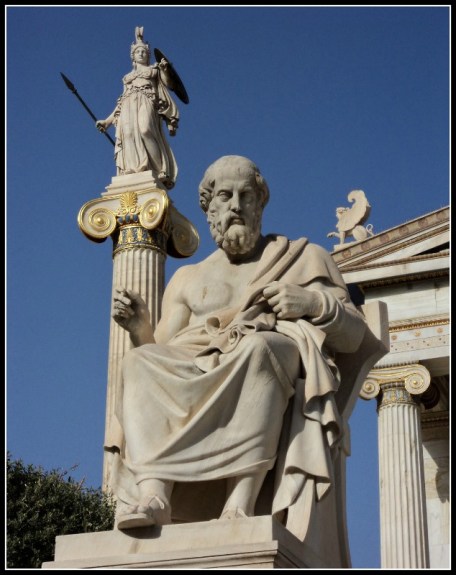
Statue of the Greek philosopher Plato (c. 428 B.C.-348 B.C.). Behind him, the Goddess of Wisdom, Athena. Modern Academy of Athens.

______________________________________________________________

Summary:

This article is divided into three sections.

The First section presents Metisas a character, a Titan Goddess.

Being swallowed by Zeus (his cousin and husband), Metis would succumb to the same fate that Cronus´children, as indicated in the Second section.

The Third section will categorize different types of Knowledge, in Ancient Greece; Metis, among them. In that same section, the post will highlight how the word Metis acquired different meaning, changing from the name of the Goddess (Metis, the  Oceanid Titaness & Zeus´cousin and wife) to refer to a type of Intelligence (Practical wisdom). Thus, Metis was considered to cover all cognitive processes that were necessary for man in order to face adverse or confrontational situations against powerful adversaries, often in unstable and complex environments…

View original post 1,723 more words

Blessings…

Gallery

►Mythology: “Dogs in Several Myths” 🐕 / “Collaboration with Brenda Davis Harsham” 💫.-

Gallery

Aquileana's avatar⚡️La Audacia de Aquiles⚡️

Mythology: “Dogs in Several Myths”🐕:

“Collaboration with Brenda Davis Harsham💫”

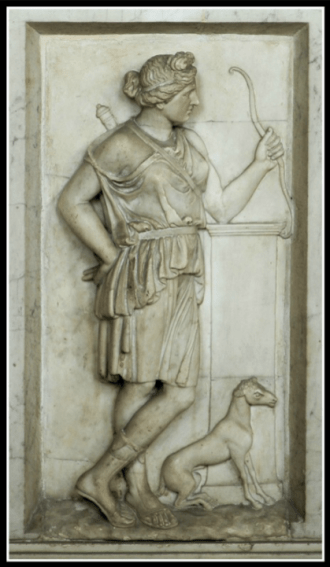
Artemis & Dog. Roman copy of the 1st cent. CE after a Greek original, 4th cent. BCE. Rome, Vatican Museums.

________________________________________________________________________________________

Introduction:

The dog is the first domesticated animal, and is symbolically associated with loyalty and vigilance, often acting as guardian and protector. Dogs are portrayed as guides and companions, hence the notion of “man’s best friend.”

Dogs almost always appear in a positive light. Native American legends generally portray the dog as the symbol of friendship and loyalty. The Joshua Athapascans believe that dogs were the first beings made by their creator-figure, Xowala’ci. The Jicarilla Apache, on the other hand, tell the story of God Black Hactcin, who first created a dog and then made man as a companion for the dog.  

In Irish Mythology, dogs were the traditional guardian animals of roads and crossways…

View original post 2,254 more words

Dreams of Desire 56 (Bob Carlos Clarke)

Gallery

Cakeordeath's avatarcakeordeathsite

89[1] Bob Carlos Clarke-Vanessa and Vicky Kissing 2002 Born into a fading aristocratic dynasty in Cork, Ireland, Bob Carlos Clarke was frequently referred to as ‘Britain’s answer to Helmut Newton’  (see Dreams of Desire 55 (Helmut Newton) for his provocative nude portraits which often featured the subjects wearing rubber and latex and involved in scenes suggestive of sado-masochistic ritual. Along with Newton he is the best exemplifier of what was known disparagingly as ‘porno-chic’.

After an unhappy childhood spent in boarding school in England Clarke had a hard time re-adjusting to 60’s Ireland, as he wryly noted in the introduction to his book Shooting Sex  (2002), “The first decade was OK, but later it was no place for a libidinous adolescent, particularly a withdrawn Protestant boy in a land where all the hot talent was Roman Catholic and strictly off-limits” and he moved to England in 1970 where he became…

View original post 161 more words

►Mythology: “Asclepius, God of Medicine”/”Poem at @LapoesianomuerD”/”BA Myth’s-Trees at @resalis”

Gallery

Aquileana's avatar⚡️La Audacia de Aquiles⚡️

asclepius

guarda_griega1_3-1-1 (1)

“The Offering to Asclepius” by Pierre Narcisse Guerin (1803).

guarda_griega1_3-1-1 (1)

______________________________________________________________________________________

“Gentle Asclepius, that craftsman of new health for weary limbs and banisher of pain, the godlike healer of all mortal sickness”.
[Pindar, Pythian Ode 3. 5 ff. C5th BC].

Asclepius (Roman equivalent: Aesculapius) was the son of Apollo and a mortal woman named Coronis.

While Coronis was with Apollo, she became enamoured with Ischys, an Arcadian, and Apollo was informed of this by a raven, which he had set to watch her, or, according to Pindar, by his own prophetic powers.

Apollo sent his own sister, Artemis to kill Coronis. Presumably, Artemis destroyed Coronis in her own house at Lacereia in Thessaly.

According to Ovid, it was Apollo himself who killed Coronis and Ischys.

When the body of Coronis was to be burnt, Apollo, or, according to others Hermes, the messenger of the Gods…

View original post 1,350 more words