
Galleries
Icarus´Fall: “The Myth. Symbolism and Interpretation”.-
Gallery
►Icarus´Fall: “The Myth. Symbolism and Interpretation”:
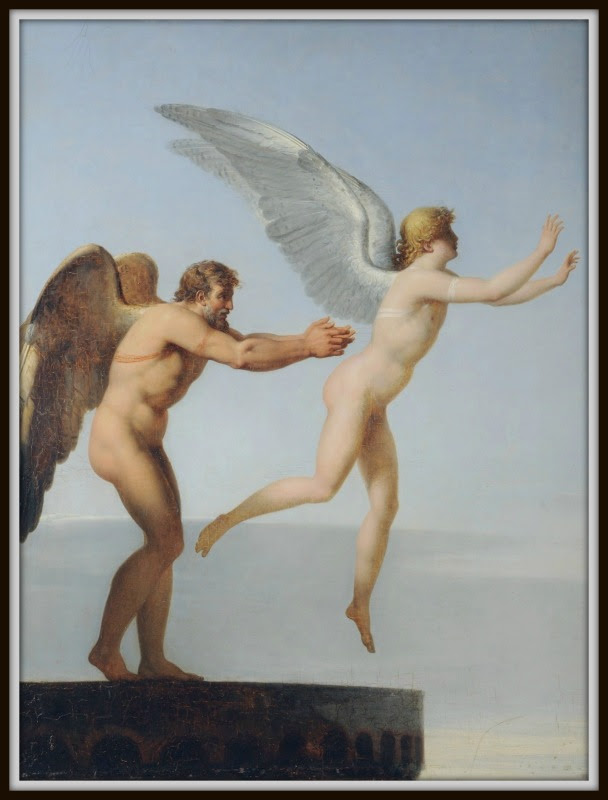 “Icarus and Daedalus”, by Charles Paul Landon.-
_______________________________________________________________________________________
►Icarus´Fall: “The Myth”:
Icarus’s father Daedalus, an athenian craftsman, built the Labyrinth for King Minos of Crete near his palace at Knossos to imprison the Minotaur, a half-man, half-bull monster born of his wife and the Cretan bull. Minos imprisoned Daedalus himself in the labyrinth because he gave Minos’ daughter, Ariadne, a or ball of string in order to help Theseus , the enemy of Minos, to survive the Labyrinth and defeat the Minotaur.
Daedalus fashioned two pairs of wings out of wax and feathers for himself and his son. Daedalus tried his wings first, but before taking off from the island, warned his son not to fly too close to the sun, nor too close to the sea, but to follow his path of flight.
If he were to do so, Daedalus explained, the wax that held his wings together…
View original post 631 more words
Ostana
Gallery
Ba mhór an onóir dom inniu glacadh le duais liteartha Ostana na hIodáile, ar son mo chuid leabhair Résheoid, Dúlasair agus Oighear.
What a joy it was to be awarded an Ostana literary award today, in recognition of my 3 books in Irish: Résheoid, Dúlasair and Oighear.
Buíochas ó chroí le m’aistritheoir Valentina Musmeci, agus le mo chairde nua go léir in Ostana. La ringrazio tanto!
My gratitude to my translator, Valentina Musmeci, and to all my new friends in Ostana.
Roinnt grianghraf thíos – some photos below, including poets Bob Holman (USA) and Juan Gregorio Regino (Nación Mazateca, México).
Bella Italia!
Subversion of the Image
Gallery
 The Birds Are Following You-Paul Nouge-Subversion des Images 1968
In late 1929-early 1930 the poet, photographer, theoretician and co-founder of the Belgian Surrealist Group Paul Nougé created a series of 19 photographs that were collected and published as Subversion des Images in 1968. The series lives up to the title, subverting and questioning perception in the manner of his friend and fellow co-founder Rene Magritte, who is featured in several of the images.
Greek Mythology: “Nemesis, the Goddess of Revenge”.-
Gallery►Greek Mythology: “Nemesis, the Goddess of Revenge”:

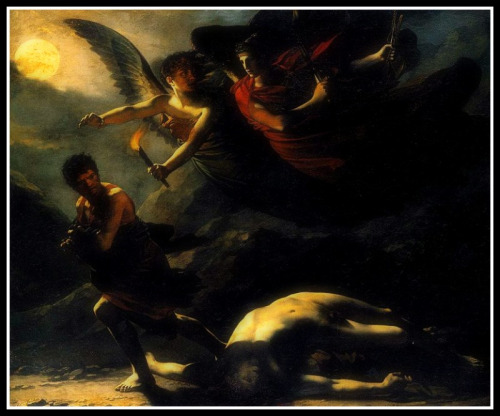 “Justice and Divine Vengeance Pursuing Crime” by Pierre-Paul Prud’hon. (1808).

_____________________________________________________________________________
Nemesis (In Greek νέμειν némein, meaning “to give what is due” was the spirit of divine retribution against those who succumb to Hubris (arrogance before the gods).
She was also known as Rhamnusia. Another name for her was Adrasteia, meaning “the inescapable.”
Nemesis directed human affairs in such a way as to maintain equilibrium.
Her name means she who distributes or deals out.
She was related to the ideas of righteous anger, due enactment, or devine vengence.
The Greeks personified vengeful fate as a remorseless goddess: the goddess of revenge and righteous indignation.
Happiness and unhappiness were measured out by her, care being taken that happiness was not too frequent or too excessive.
Nemesis has been described as the daughter of Zeus.
But, according to Hesiod, she was a child of Erebus and Nyx
View original post 394 more words
► “Tarot and Archetypes” / “Collaboration with Resa McConaghy” 💢.-
GalleryExcellent read! Thank You ❤❤
Illustrating the Divine Marquis
Gallery The Voyeur-Clovis Trouille 1960
The controversial life and work of the Marquis De Sade, the man so diabolical he was called divine, is still the subject of much debate between apologists who defend him as the apostle of total freedom, and his detractors who view him as a vile libertine possessed with an over-weening feudal sense of entitlement and a virulent misogyny. The question that Simone De Beauvoir nervously asked in 1951, ‘Must We Burn Sade?‘, is still no closer to being answered satisfactorily. But maybe it will never be, as the challenge De Sade lays down is an impossible one.
Regardless of De Sade’s ambiguous position in culture, what is not in doubt is the influence he possessed over the Surrealist movement. Andre Breton name checks the Marquis in the Surrealist Manifesto and he is included in the Pope of Surrealism‘s Anthology of Black…
View original post 178 more words
►Tarot: “Minor Arcana” 🦎.-
Gallery►Tarot: “Minor Arcana” 🦎:

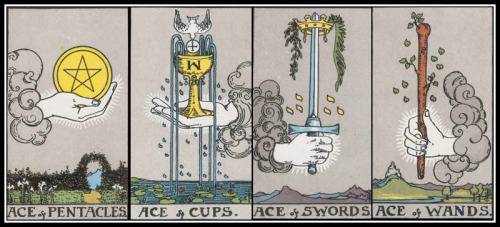 The Four Aces of the Minor Arcana. Tarot deck: Rider,Waite & Smith.

_______________________________________________
►Major and Minor Arcana:
As we have seen in the first post of this series (Tarot: “Most Relevant Generalities / Major Arcana”), a Tarot deck has 78 cards, consisting of two types of cards: Major and Minor Arcana. The Major Arcana (analysed in-depth here), consists of 22 cards, without suits. The Minor Arcana are the remaining 56 suit cards. In this post we´ll analyze the Minor Arcana cards, using the classic Rider-Waite deck.
When used for divination the Major Arcana are traditionally more significant, but the Minor Arcana are what allow Tarot readers to understand the subtleties and details that surround the major events and signifiers in a Tarot spread; in general, the Major Arcana represent large turning points and the Minor Arcana represent the day-to-day insights.
The Minor Arcana comprise four…
View original post 2,954 more words
►Tarot: “Most Relevant Generalities / Major Arcana”🗝️.-
Gallery►Tarot:
“Most Relevant Generalities / Major Arcana” 🗝️:

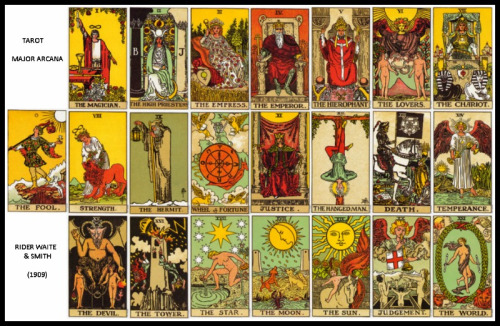 The twenty-two cards of the Arcana Major. Tarot deck: Rider,Waite & Smith.

►Introduction and Sketch of this Post:
This is the first post of the series on “Tarot”.
Firstly, in section 1), I´ll present an overview of the story of Tarot, its use for divination purposes, tarot spreads, cards´positions (upright or reversed), total number of cards, division into two categories: Major and Minor Arcana.
In the second section (2) of this post, I´ll assess in-depth the Major Arcana.
For that purpose, I´ll use the classic Rider-Waite deck, illustrated by Pamela Colman-Smith, which has been continually printed since 1909. Hence, it is easy to find in Bookstores or online nowadays.
Let´s keep in mind that the Major Arcana cards are somehow related to Carl Jung’s archetypes. They are “patterns”, inherent part of the Collective Unconscious. These cards symbolise the process…
View original post 4,600 more words
 lampmagician
You must be logged in to post a comment.