Savage Negation

Gallery

Cakeordeath's avatarcakeordeathsite

Francis Picabia-Women with Bulldog 1941-1942 Francis Picabia-Women with Bulldog 1941-1942

Francis Picabia constantly perplexes and undermines artistic expectations. A wealthy, hedonistic playboy with great personal charm, Picabia also possessed a notoriously acerbic wit and personified the savage negation at the heart of Dada.

Picabia’s career spanned many movements across continents, but is best remembered for his involvement with Marcel Duchamp, Man Ray and Arthur Craven in the creation of New York Dada and his mechanomorphic drawings from 1915 onwards. Always on the move and with entry to every fashionable social circle, Picabia moved to Barcelona then to Zurich for the remainder of WWI. Asked to describe his impressions of the War, Picabia remarked that he was bored to hell. After WWI he moved back to Paris and participated in further Dada shenanigans with Tristan Tzara and Andre Breton, contributing ferocious manifestos for Dada events which he watched from private boxes with the mistress…

View original post 353 more words
The Queen of the Lesser Lands

Gallery

Cakeordeath's avatarcakeordeathsite

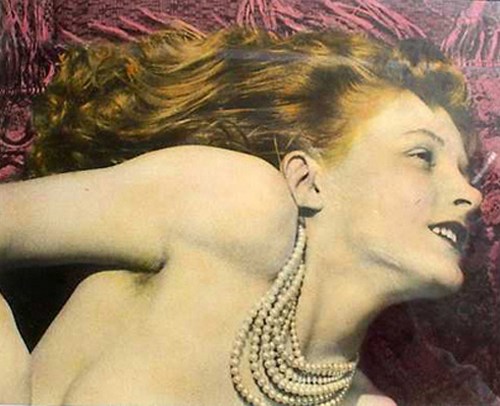
Marie Von Bruenchenhein-Eugene Von Bruenchenhein circa 1945 Marie Von Bruenchenhein-Eugene Von Bruenchenhein circa 1945

The self taught artist Eugene Von Bruenchenhein worked in a variety of mediums including painting, drawing, sculpture (using chicken bones) and photography, all of which adorned the modest house in Milwaukee, Wisconsin that he lived in for forty years with his wife and muse, Marie.

Eugene’s marriage to Evelyn Kalka in 1943 (he re-named her Marie) seemed to have ignited a creative spark. Over the next two decades he would photograph Marie thousand of times, as a pin-up girl, tropical tourist, vixen, Madonna. Bedecked with pearls, clunky fetish heels, lurid leopard prints against florid wall coverings, Marie looks wistfully upwards, awkward and gauche. The photographs are simultaneously curiously innocent and charged with an subterranean current of obsessional eroticism. Marie at times seems like a harbinger of Cindy Sherman, assuming and thereby questioning a number of manufactured female roles.

Eugene was convinced that he…

View original post 40 more words

Dreams of Desire 51 (Erwin Blumenfeld)

Gallery

Cakeordeath's avatarcakeordeathsite

erwin-blumenfeld-nude-1939-via-invaluable1 Erwin Blumenfeld-Nude 1939 Erwin Blumenfeld was one of the most celebrated fashion photographers of the 20th Century, renowned for his vivid and innovative colour photography that graced the cover of Vogue more times than any other photographer before or since. He was also a member of the German avant-garde, a close friend ofthe savage Berlin Dadaist Georg Grosz (seeEclipse of the Sun) whose techniques of photo-montage and collage he used throughout his career. His discovery of Man Ray shaped his earlier black and white nude photography leading Blumenfeld toexperiment with solarisation and double exposure.

With Hitler’s rise to power, Blumenfeld, a Jew, moved to Paris in 1936where he was discovered by Cecil Beaton who got him a job at French Vogue, however he was soon on the move again with the Nazi invasion of France, this time to America. In the United States he continued his connection with…

View original post 43 more words

►Greek Mythology: “The Harpies, Winged Bird Monsters”.-

Gallery

Aquileana's avatar⚡️La Audacia de Aquiles⚡️

►Greek Mythology: “The Harpies, Winged Bird Monsters”:

guarda_griega1_3-1

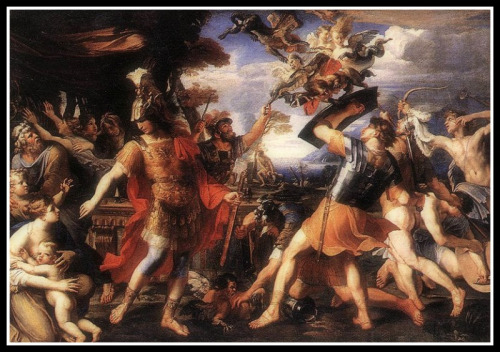
"Aeneas and his Companions Fighting the Harpies" by François Perrier (17th century). “Aeneas and his Companions Fighting the Harpies” by François Perrier (17th century).

guarda_griega1_3-1

_____________________________________________________________________

In Greek Mythology, a harpy was a female monster in the form of a bird with a human face.

They were  the spirits of sudden, sharp gusts of wind.

They were known as the hounds of Zeus and were sent by him to snatch away people and things from the earth.

The harpies were also they were agents of punishment who abducted people and tortured them on their way toHades’ domains. Like the Erinyes, the harpies were employed by the gods as instruments for the punishment of the guilty.

They seem originally to have been wind spirits. Their name means “snatchers”.

Aeschylus in The “Eumenides” (Third part of “The Oresteia”) referred to them as ugly winged bird-women. 

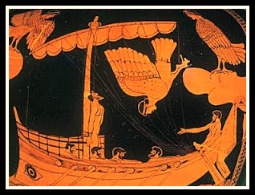
Odysseus-SirensLater Greeks transformed Harpies into Sirens, which can be seen in depictions of Odysseus on his…

View original post 633 more words

Greek Mythology: “Hecate, Goddess of Crossroads” / Literature: D.G. Kaye’s New Book: “Words We Carry”.-

Gallery

Aquileana's avatar⚡️La Audacia de Aquiles⚡️

►Greek Mythology: “Hecate, Goddess of Crossroads”:

►Literature: D.G. Kaye’s New Book: “Words We Carry”:

guarda_griega1_3

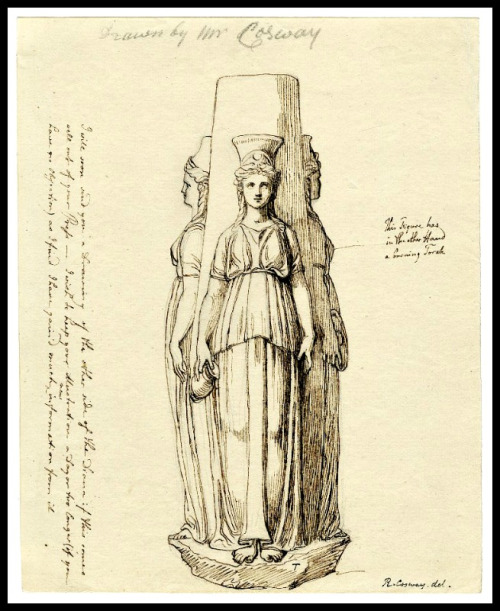
Hecate by Richard Cosway. Pen and brown ink with traces of graphite underdrawing. “Hecate” by Richard Cosway. Pen and brown ink with traces of graphite underdrawing. Early 19th century.

guarda_griega1_3

____________________________________________________________________________________________________

Hecate ( In Greek“influence from afar”) was the Goddess of  Crossroads, Magic, Witchcraft, The Night, Ghosts and Necromancy. 

According to the most common tradition, Hecate was a daughter of Persaeus and Asteria, whence she is also known as Perseis. Hecate’s Roman equivalent was Trivia.

She was most often shown holding two torches or a key and in later periods depicted in triple form.

Hecate has always been a deity with strong lunar associations.

She was sometimes portrayed as wearing a glowing headdress of stars, while in other legends she was described as a “Phosphorescent Angel” of the Underworld.

Hecate was associated with borders, city walls, doorways, crossroads and, by extension, with realms outside or beyond the…

View original post 900 more words

Love of Shadow

Gallery

ewitsoe's avatarErik Witsoe

“How can I be substantial if I do not cast a shadow? I must have a dark side also If I am to be whole.”
C.G. Jung

Light and shadows. One and the other. Both together. We all cast them (hopefully) and maybe I am a bit more aware with how mine falls from time to time. I love to chase the light and catch the beauty of the sunrise and sunset, but more than that, I love the shadows that are cast in the hours of low sun and in virtual darkness, out in the city, in the forest, or at home. I always have, and with the camera I have found a way to worship the ground they fall on. Wherever we travel.

I was recently asked about this “Shadow love” and thought I would, in my own way give you a little bit about what I…

View original post 539 more words

Visionary Noir

Gallery

Fascinating ❤

Cakeordeath's avatarcakeordeathsite

gr194-odilon-redon-1840-1916-i-saw-above-the-misty-outline-of-a-human-form-1896[1] Haunted-Odilon Redon 1896 From 1870 to the turn of the century the French Symbolist artist Odilon Redon worked almost exclusively in the medium of charcoal drawing and lithographs. Redon called this extraordinary body of work his noirs. Throughout his career Redon’s expressed intent was to place ‘the logic of the visible at the service of the invisible’,  an aesthetic doctrine that strongly resonated with the Surrealists. Straddling that perilous hinterland between dream, hallucination and otherworldly visions, the noirs present a haunting, nocturnal world that is forever sliding into nightmare.
It was the publication of the bible of Decadence A Rebours by JK Huysmans  in 1884 that Redon found fame. The archetypal world-weary Decadent Des Esseintes collects and describes in great detail Redon’s lithographs. After 1900 Redon turned to pastels and oils in paintings that reflected his interest in Buddhism and Japanese art and that became increasingly abstract in his latter years.

View original post

Chambre Close

Gallery

Cakeordeath's avatarcakeordeathsite

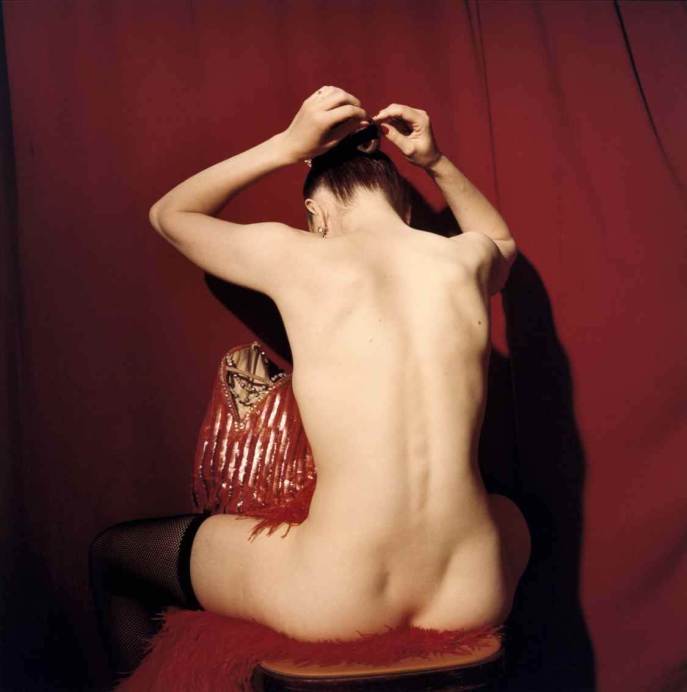
Bettina-Rheims-Chambre-Close-4th July 1991 Paris Bettina-Rheims-Chambre-Close-4th July 1991 Paris

Chambre Close is the collaboration between the writer Serge Bramly and the photographer Bettina Rheims. The elegant and cultured tone of the confessions of Mister X, an amateur photographer and voyeur who lures models back to shabby hotel rooms to engage in acts of ‘visual adultery’ is contrasted against the clinical detachment and raw intimacy of Rheims colour images.

Rheims is justly renowned for her studies of female nudes. As she herself notes, “I love flesh. I am a photographer of the skin.”

View original post

Cosmic Hotels

Gallery

Cakeordeath's avatarcakeordeathsite

719b175c87467af7ba5ce403b23a45d51[1]

The shy, reclusive and self taught maker of shadow boxes and experimental films, Joseph Cornell , rarely left New York State, with the exception of a few college years in Andover, Mass, spending most of his life in a modest house in the beautifully named Utopia Parkway, Queens, caring for his mother and disabled brother. His artwork is filled with a yearning for the unobtainable ; birds with their freedom of flight, glamorous movie stars and ballerinas as the source of passionate, platonic romances and especially travel to the most luxurious and wondrous locations.

Hotels are a common feature of his shadow boxes, miniature visions of rest stops and trysting places for artistic, mythological and astrological archetypes as they travel through the starry Empyrean and the wastes of infinity.

View original post

Greek Mythology: “The Charites” (“The Three Graces”).-

Gallery

Aquileana's avatar⚡️La Audacia de Aquiles⚡️

Greek Mythology: “The Charites” (“The Three Graces”):

guarda_griega1_3 (1)

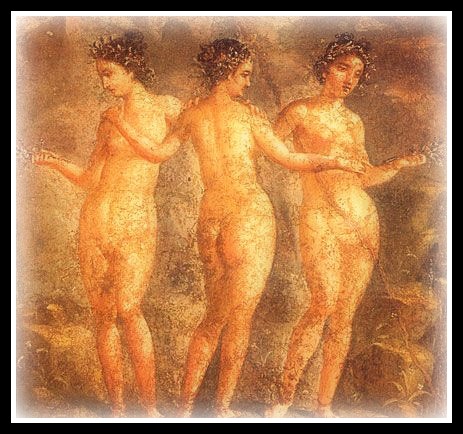
Fresco from Pompeii, House of Titus Dentatus Panthera, ca 65 -79 AD; Museo Archeologico Nazionale di Napoli - Three Graces Fresco from Pompeii, House of Titus Dentatus Panthera, ca 65 -79 AD; Museo Archeologico Nazionale di Napoli – Three Graces

guarda_griega1_3

_________________________________________________________________________________________________

The Charites (Three Graces) were reputed to be the essence of beauty, charm, and grace and were associated with the Nine Muses, who presided and inspired arts and sciences. 

The Charites were three goddesses, who were sisters between them: Aglaia (Αγλαια Brightness), Euphrosyne (Ευφροσυνη Joyfulness), and Thalia  (Θαλια Bloom). 

The character and nature of the Charites are sufficiently expressed by the names they bear: they were conceived as the goddesses who gave festive joy and enhanced the enjoyments of life

Pindar, Olympian Ode 14“Kharites (Charites, Graces) three . . . Euphrosyne, lover of song, and Aglaia (Aglaea) revered, daughters of Zeus the all-highest . . . with Thalia, darling of harmony.”

They are said to be daughters…

View original post 647 more words