A Kohl Tube, Sky-Blue Deity; A Divine Gift For An Eternal Beauty!

Standard

This is a deep blue glazed faience kohl tube. A column is inlaid with light blue on one side of the cylinder. This inscription is placed within a light blue frame. It reads, “The Good God, Lord of the Two Lands, Neb ma’at-re (Amenhotep III). The Kingdom, Wife Tiy, granted life.” A shallow indentation forms a border at the bottom of the tube. Condition: Small cracks at the bottom; blue glaze missing on half of the “neb” sign.
Here is another fascinating story by the brilliant lady Marie Grillot of a deity tube to help compare to divine beauty.

A kohol tube in the names of Amenhotep III and his daughter and wife Satamon…

via égyptophile
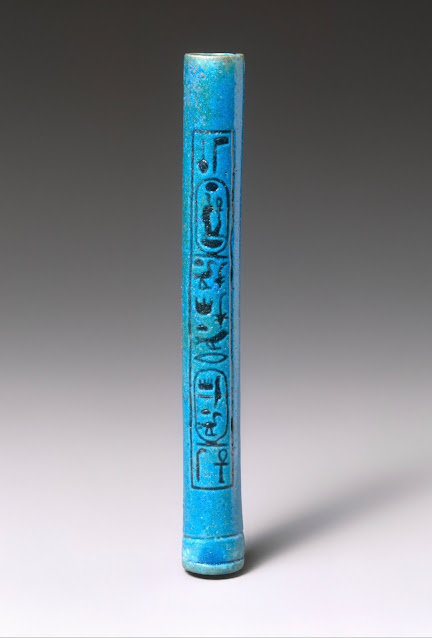
Kohl tube of Satamon, daughter and the great royal wife of Amenhotep III – earthenware – 18th dynasty
formerly in the collection of Reverend William MacGregor – acquired by Lord Carnarvon at Sotheby’s London in 1922
arrived at the Metropolitan Museum of Art in New York in 1926 by acquisition from the Carnarvon Collection – entry number 26.7.910

This delicate and elegant Egyptian earthenware kohol tube is 14.4 cm high and has a diameter of 1.8 cm. For Jeanne Vandier d’Abbadie (“Egyptian toilet objects at the Louvre Museum”), it was during the New Kingdom that kohol vases or pots which had varied shapes “were very often replaced by kohol tubes. This new form would have been introduced into Egypt under the reign of Tuthmosis III by the Asians. Indeed, it sometimes happens, from this time on, that the servants who assist the lady in her toilet have the Syrian type… These young foreigners hand their mistress the kohol tube into which the stylus is immersed…”

Originally, this tube was a simple Nile reed – hence sometimes its name “flute” -in the hollow of which the makeup was placed. For the wealthier classes of society, artisans were inspired by this natural element. They reproduced it more “luxurious” with more precious materials, ivory, for example, or, in this case, earthenware.
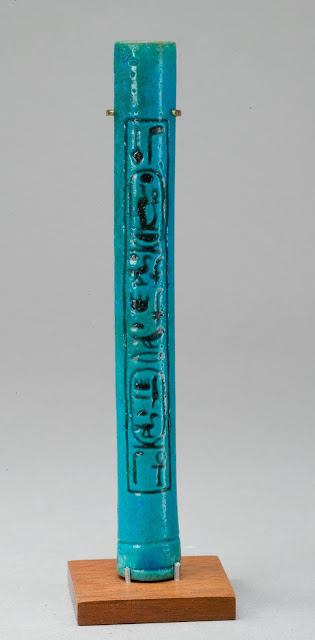
Kohl tube of Satamon, daughter and the great royal wife of Amenhotep III – earthenware – 18th dynasty
formerly in the collection of Reverend William MacGregor – acquired by Lord Carnarvon at Sotheby’s London in 1922
arrived at the Metropolitan Museum of Art in New York in 1926 by acquisition from the Carnarvon Collection – entry number 26.7.910

In ancient times, kohol was the makeup product par excellence; it was inseparable from the concept of beauty, intimately linked to the enhancement of the gaze. Its use has thus transcended these stretched eyes surrounded by black, which, even today, disturbs and fascinates. Made from powdered galena, it not only highlighted the intensity of the “Egyptian” gaze but also had, in this country where the light is so bright, the reverberation so intense, and the sun so burning, a protective function of the eye.

It was applied using a fine stylus – or stick. With a rounded head and a blunt tip, it could be made of hematite, wood (like ebony), ivory, and sometimes bronze or copper. No stylus is presented with this tube; one can imagine it has disappeared. Likewise, nothing indicates the presence or absence of a small “accommodation” fitted inside to store it. The sealing is also absent: in the more “rustic” models, it was done by a plug of fabric or wood.

Kohl tube of Satamon, daughter and the great royal wife of Amenhotep III – earthenware – 18th dynasty
formerly in the collection of Reverend William MacGregor – acquired by Lord Carnarvon at Sotheby’s London in 1922
arrived at the Metropolitan Museum of Art in New York in 1926 by acquisition from the Carnarvon Collection – entry number 26.7.910

In “Amenhotep III, the Sun Pharaoh”, Arielle P. Kozloff provides technical information on its creation: “The colour of the tube is medium blue, which suggests a copper base. This colour was used more frequently towards the end of the reign of Amenhotep III and during the Amarna period, unlike the cobalt-based blues that the king preferred. The dark-coloured inscription is undoubtedly cobalt-based.”

If the object is well made, the vertical inscription presented in a rectangle delimited by a black line in a column of delicate hieroglyphs is precious. Christiane Ziegler (“Queens of Egypt”) translates it thus: “The good god Nebmaâtre [Amenhotep III]; the king’s daughter, the Great Royal Wife Satamon, may she live.” She adds, “We noticed that the king’s name always accompanies that of the woman in his family mentioned on the kohol tubes.”

When we mention the wife of Amenhotep III, we immediately think of Queen Tiyi… Satamon (“The Daughter of Amon”) was the eldest daughter of Tiyi and Amenhotep III. However, explains Christian Leblanc in “Queens of the Nile”: “She distinguished herself especially towards the end of the reign of Amenhotep III by herself becoming the wife of her own father”.

Due to our current morality and contemporary conception of the family, understanding and admitting such a union is often tricky. However, well attested since at least the Middle Kingdom, this incest could only exist in the royal and divine world for reasons of an eminently sacred nature. Ordinary mortals did not practise it.

Relief depicting Satamon from the funerary temple of Amenhotep III
Petrie Museum, London – UC 14373 – museum photo

“The role of princesses was so important that two of them, Satamon and Isis, became ‘Great Royal Wives’ during the last decade of the reign, which in no way diminishes the status of Queen Tiya. Indeed, the “Theological model of divine families on which that of the king’s family was modelled favoured the adoption of different generations of women. Was Hathor not simultaneously mother, wife and daughter of the god Ra?” (Arielle P. Kozloff). Thus, different museums hold kohol tubes, identical or close to that of Satamon, with the names of Tiyi, of course, and Isis.

Its current history is found in the 20th century in the collection of Reverend William MacGregor (1848-1937). This vicar is a “prominent member of the Egypt Exploration Society and the Institute of Archeology of the University of Liverpool. He patronised numerous excavations, notably those undertaken by Naville, Garstang, and Petrie, for which he frequently and actively participated in the field. His remarkable collection of antiquities is unprecedented compared to any other private collection in England, Europe or America” was then specified in the introduction to the sales catalogue when he decided to separate it. One thousand eight hundred objects will be auctioned at Sotheby’s London from June 26 to July 6, 1922.

Reverend William MacGregor, vicar, prominent member of the Egypt Exploration Society, Institute of Archeology, University of Liverpool and patron of many excavations
(Liverpool, 16-5-1848 – Tamworth, 26-2-1937)

Satamon’s kohol tube, presented under lot 255, will be acquired by another great collector, Lord Carnarvon. The same year, it was among the artefacts lent by the British aristocrat for the “Exhibition of Ancient Egyptian Art” at the Burlington Fine Arts Club in London. Percy Newberry, responsible for writing the catalogue, describes it as follows under number 17: “Kohol tube – blue glazed earthenware -, with a vertical line of hieroglyphs in black, giving the names of Amenhotep III and the great royal wife, Sat-amon'”.

Lord Carnarvon died in Cairo on April 5, 1923, shortly after the discovery of Tutankhamun’s tomb. According to a codicil to his will, intended for his wife, Lady Almina, he had expressed his suggestions on the future of his collection in case she had to part with it, which she did, putting Howard Carter in charge of the negotiations.

Lord Carnarvon – George Edward Stanhope Molyneux Herbert, 5th Earl of Carnarvon
(Highclere – RU – 26-6-1866 – Continental-Savoy Hotel, Cairo, Egypt – 5-4-1923)
and his wife, Lady Almina

Thanks to the generosity of Edward S. Harkness, the Metropolitan Museum of Art in New York acquired it in 1926 for $145,000.

This is how this kohol tube bearing the names of Amenhotep III and Satamon arrived in the great New York Museum collections: it was registered under entry number 26.7.910.

Marie Grillot

Sources:

Kohl Tube Inscribed for Amenhotep III and Princess Sitamun https://www.metmuseum.org/art/collection/search/544512 Catalogue of the MacGregor collection of Egyptian antiquities, Sotheby, Wilkinson & Hodge, auction catalogue, sale dates: 26-30 June and 3-6 July 1922, London, 1922 https://www.abebooks.fr/edition-originale/Catalogue-MacGregor-collection-Egyptian-antiquities-Sotheby/31411328486/bd Percy Edward Newberry, Harry Reginald Hall, Catalogue of an Exhibition of Ancient Egyptian Art, London: Burlington Fine Arts Club, p. 34 no. 17, 1922 https://archive.org/details/catalogueofexhib00burlrich Rev William MacGregor https://www.tamworthheritagetrust.co.uk/articles/rev-william-macgregor Jeanne Vandier d’Abbadie, Egyptian toilet objects at the Louvre Museum, editions of the national museums, Paris, 1972
William C. Hayes, Scepter of Egypt II: A Background for the Study of the Egyptian Antiquities in the Metropolitan Museum of Art: The Hyksos Period and the New Kingdom (1675-1080 B.C.), Cambridge, Mass., The Metropolitan Museum of Art, p. 257, fig. 155, 1959
Christian Leblanc, Nefertari, “L’aimee-de-Mout”, Editions du Rocher, 1999 (pp. 185-186 on incest practised in the royal sphere)
Amenhotep III, the sun pharaoh, Meeting of National Museums, 1993
Christiane Ziegler, Queens of Egypt, Somogy éditions d’art, Grimaldi Forum, 2008
Christian Leblanc, Queens of the Nile, The Library of the Introuvables, 2009
Morris L. Bierbrier, Who Was Who in Egyptology, London, Egypt Exploration Society, 2012
Pierre Tallet, 12 queens of Egypt who changed history, Pygmalion, 2013

 Published January 6 ago by Marie Grillot
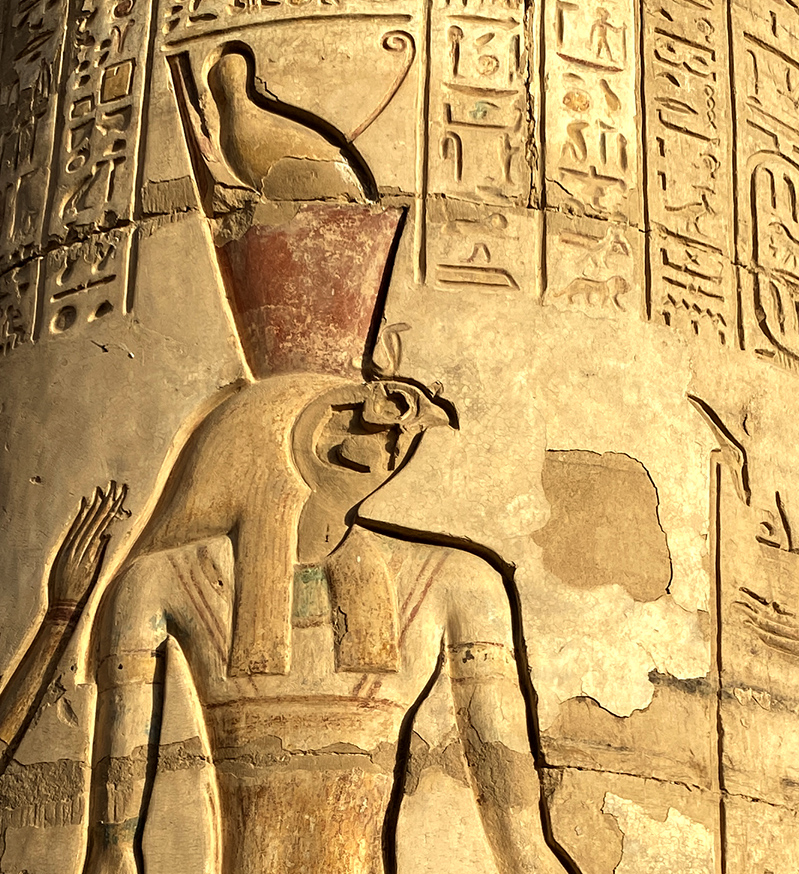
Horus, the Deity Symbol of Protection, Health and Restoration

Standard
Relief of Horus at Kom Obo Temple

Since Horus was considered the sky, he was also considered to contain the Sun and Moon. Egyptians believed that the Sun was his right eye and the Moon his left and that they traversed the sky when he, a falcon, flew across it.

Ägyptische Sammlung Johannes Gutenberg-Universität Mainz Foto: © JGU / Stefan F. Sämmer, http://www.samphoto.de, +49 163 7343300

As the title image shows, Horus is usually depicted as a falcon. But now, the brilliant Marie Grillot shows us a unique image of this deity.

The infant Horus is often pictured on stelae in the act of trampling two crocodiles and holding dangerous animals in his hands. The water poured on these objects, by flowing across their surface covered with magic spells, gained the power of healing whoever drank it from the stings of scorpions and the bites of snakes.

Stele of Horus: the magic that heals

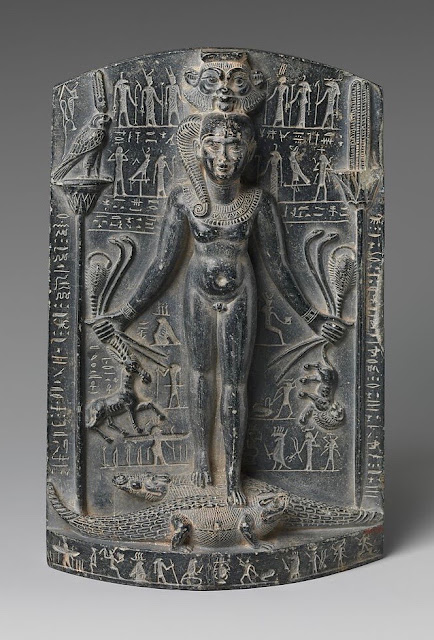
Magic stele or “Cippus of Horus” – chlorite schist – Ptolemaic period – around 332-280 BC AD
Metropolitan Museum of Art in New York – entry number 20.2.23 – museum photo

via égyptophile

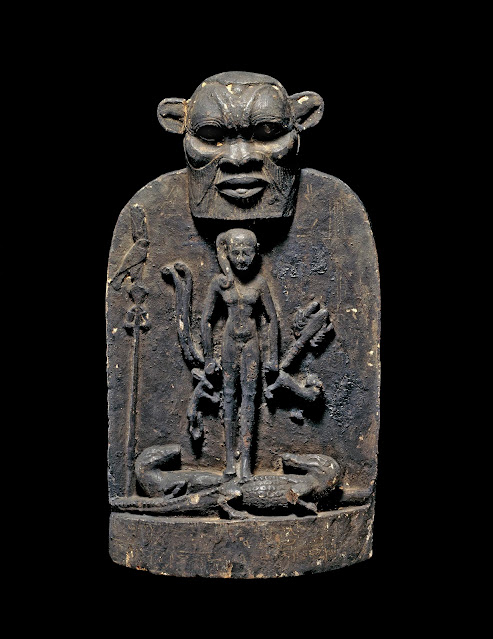
These “magical” steles, representing Horus on crocodiles, found in many museums, are generally dated from the Late Period to the end of the Roman era. “Called ‘Cippus of Horus’, they are usually carved from a hard, black stone, their upper edge is rounded, and they can be briefly described as follows: on the front of the stele, Horus as a child (Harpocrates) is presented in relief. It is standing on two crocodiles, and he holds snakes, scorpions, a lion and a horned animal (ibex?), all these representations being associated with Seth, the god of evil. On the head of Horus is a god,’ The ancient,’ who resembles the god Bes and, with Horus, thus represent the ancient god who perpetually regains his youth and strength,” specifies Wallis Budge in “Amulets & Magic”.

Their size seems to have yet to meet any specific criteria, whether made of soapstone, schist, greywacke, basalt, or sometimes limestone, copper alloy, wood, or even anhydrite.

Horus controlling harmful animals – magic stele – stone – Ptolemaic period, 332 – 30 BC
Department of Egyptian Antiquities of the Louvre Museum – E 20008 – museum photo

Their iconography, as described by Wallis Budge, may vary somewhat, but their highly balanced composition remains. As a child, Horus is represented in the centre, frontally, in high relief; his chubby body is naked. He still wears the side braid from childhood, and often, a uraeus adorns his forehead. In the middle of the arch, just above his head, is the face of a leonine god, grimacing and bearded, comparable to Bes. However, the threatening species that Horus masters with his hands and feet may differ. They are generally “strong and dangerous desert animals (scorpions, snakes, lion, oryx) held by the tail or by their horns. This motif shows the domination of Horus over these powerful animals and the dangers they can represent,” indicates the Metropolitan Museum of Art in New York (presentation notice of the MMA stele 20.2.23).

Their lateral edges are occupied by sacred emblems, such as the lotus of the god Nefertum on the right and a papyrus stem surmounted by a falcon on the left. These elements are sometimes based on the Oak sign, symbolizing eternity.

Cippus of Horus on the Crocodiles – Ptolemaic period – 3rd century BC AD
Brooklyn Museum – entry number 60.73 – museum photo

These steles are inscribed with magical formulas which, to release their healing power, had to be “either immersed in water that the patient drank, thus imbuing themselves with the virtues of the magical texts and the image, or rubbed on the site of the injury.”

Thus, in “Amulets of Ancient Egypt”, Carol Andrews recalls: “We know that they were installed in the precincts of the temples so that water could be poured over them to absorb the magic of their scenes and formulas; “once drunk, the water offered prophylactic protection against the creatures in question or perhaps healed those already bitten or stung.” Thus, “Drinking the water that had been left to flow on the stele was to the benefit of the protection that Isis exercised over her son and brought healing”.

In “Animals and Pharaohs”, Florence Maruejol contextualizes their use thus: “Often worn out, the so-called steles of Horus on the crocodiles were manipulated by magicians who tried to cure their patients”…

Stele of Horus on crocodiles – cippi of Horus – schist – Ptolemaic period
Egyptian Museum in Cairo – CG 9401 – on display at NMEC in Fustat
In “The Egyptian Museum in Cairo”, Abeer El-Shahawy recalls that: “magic, prayer and medicine complemented each other in ancient Egypt and people in need, in danger, suffering from illness or disease and illness prayed in front of such stelae. Stele of Horus on the crocodiles – cippi of Horus – schist – Ptolemaic period Egyptian Museum in Cairo – CG 9401

For protection—and perhaps of a “preventive” nature—they were also present in chapels at the start of desert tracks (filled with dangers) and had a special place in homes. We have even found them in collective baths, where the humid environment was certainly conducive to the frequentation of snakes.

They all refer to an episode in the legend of Horus: “Son of Isis and Osiris, the child was raised by his mother in a remote place, the marshes of the Delta, to escape the vengeance of the god Seth who had put his father to death. But, one fine day, young Horus was bitten by a venomous animal: he owed his survival only to the magical practices of his mother, Isis and the god Thoth, who knew the most secret formulas. This miraculous healing was, in a way, a model for all Egyptians and left them a little hope for desperate cases,” explains Christiane Ziegler in “Ancient Egypt at the Louvre” (E 10777).

Cippus, protective magic stela – wood – Late period
British Museum – inventory number EA60958 – photo © The Trustees of the British Museum

Ancient Egyptian medicine combined scientific knowledge with healing magic. In “The Egyptian Museum in Cairo”, Abeer El-Shahawy recalls that: “magic, prayer and medicine complemented each other in ancient Egypt and people in need, in danger, suffering from illness or disease and illness prayed in front of such stelae.

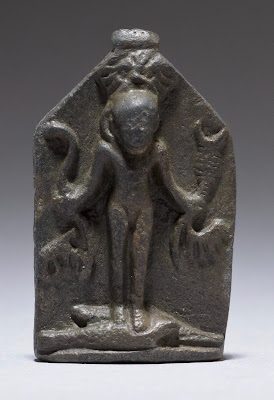
There are also “miniature steles” that one could carry with oneself. The Metropolitan Museum of Art in New York, which has several examples, indicates that these small models were considered “an amulet for magical protection rather than transmitting magic to the water poured over them for drinking”.

Miniature cippus of Horus – magic stele – copper metal
Ptolemaic period – around 332 – 30 BC-AD – MMA New York – entry number: 23.6.19

In his reference study on “The ‘healing’ statues in ancient Egypt”, Pierre Lacau indicates that: “The typical stele of Horus on the crocodiles must therefore be considered as a true repertoire of ‘amulets’ and ‘formulas’ which the Egyptians could have at their disposal against bites; it is an arsenal or a codex containing the most varied weapons or remedies. We can, therefore, understand the extraordinary popularity that it was able to enjoy. All the provinces of Egypt have it used… They could be dedicated in temples, kept at home, or carried on one’s person like an amulet…

These steles testify to the force that magic exerted on the ancient Egyptians. They also reflect the fervour of the power granted to the “Medou-Neter,” the hieroglyphs, which in this specific case turn out to be, according to their etymology, sacred or divine writings.

Marie Grillot

Sources:

Pierre Lacau, “Healing” statues in ancient Egypt, Monuments and memories of the Eugène Piot Foundation, 1921, 25-1-2 pp. 189-210 https://www.persee.fr/doc/piot_1148-6023_1921_num_25_1_1824

Wallis Budge, Amulets & Magic, London 1930
Georges Posener, Dictionary of Egyptian Civilization, Fernand Hazan, 1959
Jocelyne Berlandini, A stele of Horus on the crocodiles of the superior of the priests of Sekhmet, Padiimennebnesouttaouy, Cahiers de Karnak VI 1973-1977, Cairo, 1980 https://www.academia.edu/3736548/Une_stèle_dHorus_sur_les_crocodiles_du_supérieur_des_prêtres_de_Sekhmet_Padiimennebnesouttaouy Carol Andrews, Amulets of Ancient Egypt, British Museum Press, London, 1994 https://archive.org/details/AmuletsOfAncientEgypt_201707 https://umranica.wikido.xyz/repo/e/ea/Amulets_of_ancient_Egypt.pdf

Guillemette Andreu, Marie-Hélène Rutschowscaya, Christiane Ziegler, Ancient Egypt at the Louvre, Hachette, 1997
Francesco Tiradritti, Treasures of Egypt – The wonders of the Egyptian Museum in Cairo, Gründ, 1999
Abeer El-Shahawy, The Egyptian Museum in Cairo, Matḥaf al-Miṣrī, American Univ in Cairo Press, 2005
Magical stela or cippus of Horus, Metropolitan Museum of Art New York, entry no. 20.2.23 https://www.metmuseum.org/art/collection/search/545766?searchField=All&sortBy=Relevance&ft=horus+stelae&offset=0&rpp=20&pos=12 Miniature cippus of Horus (magical stela), Metropolitan Museum of Art New York, entry no. 23.6.19 https://www.metmuseum.org/art/collection/search/570346 Cippus of Horus on the Crocodiles, Brooklyn Museum – accession number 60.73 https://www.brooklynmuseum.org/opencollection/objects/3684 Stele of Horus, Louvre, E 20008 https://collections.louvre.fr/ark:/53355/cl010006108 Healing statue, Louvre, E 10777 https://collections.louvre.fr/ark:/53355/cl010034902 Cippus, protective magic stela, British Museum, EA60958 https://www.britishmuseum.org/collection/object/Y_EA60958

Posted 16th January 2015 by Marie Grillot
Labels: Bès CG 940 Cippe d’Horus cippi cippus guérisseuse Harpocrate Horus Isis magie piqures scorpions serpents Seth stèle stèle Horus et crocodiles stèle magique Wallis Budge

Howard “Indi” Carter

Standard

Howard Carter, a British archaeologist born on May 9, 1874, in Swaffham, Norfolk, England, is known for his significant contribution to Egyptology. In 1922, he discovered the most complete tomb of King Tutankhamun, which remains one of the most celebrated and richly endowed discoveries in the history of Egyptology. Carter passed away on March 2, 1939, in London.

Here is the story of his accidental discovery of one of the ancient heritages, as we might know it from the acts of the adventurers, with heartfelt thanks to the brilliant Marie Grillot.

The pic at the top via The Collector.

Carter finds a grave under his horse’s hoof!

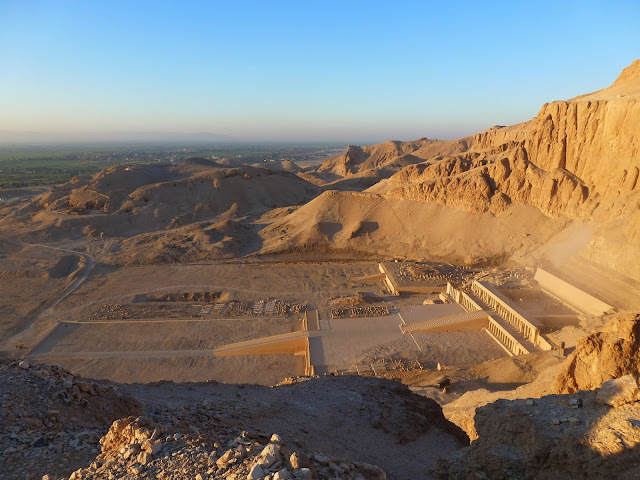
The tomb called “Bab el-Hossan” discovered in 1900 by Howard Carter, is, in fact, a cenotaph of Montouhotep II: its location (pit), in front of his funerary temple, is visible in the middle-left of this photo (photo Daniel Lefèvre)

via égyptophile

It was in October 1891 that Howard Carter arrived in Egypt to work as a draftsman and copyist for Percy Edward Newberry at the Egypt Exploration Foundation. Then, from 1893, still for the EEF, but this time under the direction of Edouard Naville, he copied the bas-reliefs of Deir el-Bahari intended to illustrate the Egyptologist’s work “The Temple of Deir el-Bahari”.
In this context, the one who, in November 1922, will emerge from oblivion, Tutankhamun will make, in an entirely fortuitous manner, his first discovery…
This “adventure” will stretch over two years and is worthy of Indiana Jones! It began in November 1898, on an exceptionally grey and rainy day in the Theban necropolis and the rocky cirque of Deir el-Bahari.

Carter is concerned about the impact of these rains on the temple murals. So, he decides to go to the site “with his colleague Charles Sillem” to observe and estimate potential damage.

The tomb called “Bab el-Hossan” discovered in 1900 by Howard Carter, is, in fact, a cenotaph of Montouhotep II:
its location (pit) is visible here

While he is in front of the temple of Montouhotep, his horse’s foot sinks into a hole… and they both fall! Carter gets up and hastens to examine what caused the fall. “Looking in the small hole formed there, I saw the traces of stonework”, he relates.

He was very intrigued and then opened up to Edouard Naville. As this sector is not in the area of his concession, he attaches little importance to it and does not encourage him to carry out other investigations.

For his part, Howard Carter will not forget this place; he promises to return there to further the research.

To do this, he knows that he must wait for his professional situation to evolve, which will happen quickly. Indeed, in 1899, Gaston Maspero, back at the head of the Antiquities Service, appointed him general inspector of monuments in Upper Egypt.

The following year, finally feeling free to carry out his first “independent” excavation, Howard Carter returned to the site and saw his intuition confirmed: it was indeed a burial! The work to clear what will be known as “Bab el-Hossan” (the horse’s grave) will prove gigantic!

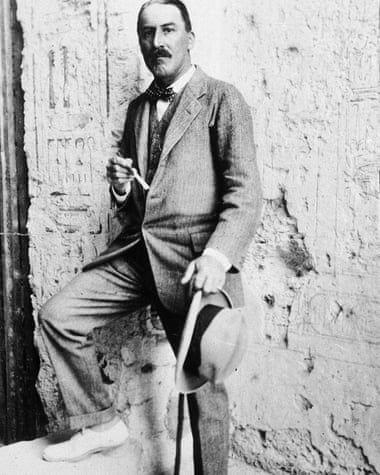
Portrait of a young Howard Carter (author and date unknown)

The opening, which will have to be enlarged, leads to a corridor dug into the rock, 17 meters deep, leading to a sealed door. The clearing carried out with a large team that nevertheless takes turns tirelessly takes an incredible amount of time.

Behind the door, Carter encounters a new 150-meter corridor leading to a large room. Inside, draped, wrapped, and wrapped in linen, is a giant statue!

A well leads to a second chamber located around thirty meters lower. In it, Carter finds vases, pots, and boat models. In another well, a wooden chest bears the name of a pharaoh. This inscription will allow the statue to be identified.

Statue of Montouhotep II – painted sandstone – from his cenotaph located under his temple of Deir el-Bahari
discovered in 1900 by Howard Carter in what is generally referred to as: “Bab el-Hossan.”
Egyptian Museum in Cairo – JE 36195

It is made of painted sandstone and is 1.38 m high and 0.47 m wide. It represents Montouhotep II, ruler of the 11th dynasty. He sits on his throne, wearing the red crown of Lower Egypt and the white habit of jubilee (sed). His broad face, full lips, and a false beard are black.

Its eyes are painted white with black pupils. His hands are black, and his arms are crossed on his chest in the Osiriac position. His legs, also black, are very thick, even disproportionate. In their “Official Catalog of the Egyptian Museum in Cairo,” Mohamed Saleh and Hourig Sourouzian put forward this interesting hypothesis about the colour of its complexion: “It seems that the statue was painted black before burying it.”

As for Rosanna Pirelli (“The Wonders of the Egyptian Museum in Cairo”), she analyzes this particular representation of the sovereign as follows: “This is a strong and hieratic image of the second unifier of the pharaonic state after Menes. The statue symbolizes the double nature of the pharaoh who, during his lifetime, embodies the falcon god Horus, the mighty conqueror, while in death, he is identified with Osiris, the sovereign of the deceased.

Statue of Montouhotep II – painted sandstone – from his cenotaph located under his temple of Deir el-Bahari
discovered in 1900 by Howard Carter in what is generally referred to as: “Bab el-Hossan.”
Egyptian Museum in Cairo – JE 36195 – photo of the museum

Did Howard Carter discover the tomb of the great pharaoh? Mohamed Saleh and Hourig Sourouzian say, “The statue of Montouhotep had been ritually buried in a vault under the terrace (of his temple) and which seems to have been the initial tomb of the king, before having been transformed into a cenotaph. The entrance from this vault opened into the forecourt of the funerary monument of Montouhotep.”

Montouhotep II (“may Montu be satisfied”) reigned between 2061 and 2010 BC. AD. He led an important policy of cultural and commercial restoration.

Location of the temple of Montouhotep (partly ruined today)
in the rocky cirque of Deir el-Bahari

His funerary complex located at Deir el-Bahari was, perhaps, according to the hypothesis put forward by Edouard Naville, a temple with a double terrace topped by a small pyramid. Today, it is primarily degraded and cannot be visited. However, it can be seen from the temple of Hatshepsut, or better yet, an overview of it from the path linking Deir el-Bahari to Deir el-Medineh, which overlooks it.

This statue, “found under the hoof of a horse,” is exhibited at the Cairo Museum (JE 36195). It represents a magnificent example of the renaissance of Egyptian art from the beginning of the Middle Kingdom…

It is important to point out that, in “Howard Carter, The Path to Tutankhamun”, T.G.H. James tells us that this discovery had not been up to what Howard Carter had expected… “His disappointment was deep enough in itself, but worse still, it was increased by the fact that he had committed the stupidity to inform Lord Cromer, the British Consul General, who actually held power in Egypt, suggesting that it was possible that a tomb, possibly royal, had been found. As Maspero wrote to Naville: ‘ ‘He announced his discovery too early to Lord Cromer. Lord Cromer came to witness his success and is now in despair, having been unable to show him anything of what he had predicted. I console him as best I can because “He’s a really good boy, and he does his duty very well.”

Unfortunately, this experience led Nicholas Reeves to say in “Ancient Egypt: The Great Discoveries” that Carter then decided that, for any possible future discovery, he would wait until he was absolutely sure of what he had found before making the announcement. For Tutankhamun, he adopted this strategy:”…

Marie Grillot

Sources:
Herbert Eustis Winlock, Excavations at Deir El Bahri 1911-1931, The Macmillan Company, New York, 1942 https://archive.org/details/Winlock_Deir_El_Bahari_1911-1931 Thomas Garnet Henry James, Howard Carter, The path to Tutankhamun, TPP, 1992 https://archive.org/stream/HowardCarterThePathToTutankhamunBySam/Howard+Carter+The+Path+to+Tutankhamun+By+Sam_djvu.txt

Nicholas Reeves, Richard H. Wilkinson, The Complete Valley of the Kings, The American University in Cairo Press, 1996
Mohamed Saleh, Hourig Sourouzian, Official Catalogue of the Egyptian Museum in Cairo, Verlag Philippe von Zabern, 1997
Francesco Tiradritti, Treasures of Egypt – The wonders of the Egyptian Museum in Cairo, Gründ, 1999
Nicholas Reeves, Ancient Egypt. The Great Discoveries, Thames & Hudson, 2002, The Great Discoveries of Ancient Egypt Editions du Rocher, 2001
National Geographic Guide, The Treasures of Ancient Egypt at the Egyptian Museum in Cairo, 2004
The Egyptian Museum in Cairo, Abeer El-Shahawy, Matḥaf al-Miṣrī, American Univ in Cairo Press, 2005
Statue of King Mentuhotep the Second http://www.globalegyptianmuseum.org/record.aspx?id=14914 The Egyptian Museum in Cairo, Abeer El-Shahawy, Matḥaf al-Miṣrī

Rocky cirque of Deir el Bahari: on the right, the temple of Hatshepsut; set back, barely visible, the temple of Thoumosis III, and to the left, the temple of Menthouhotep in the courtyard of which Bab El-Hossan was found – photo taken from the Luxor City Facebook page.

Published June 21 2014, by Marie Grillot
Labels: bab el-hossan Carter Deir_el-Bahari hossan the tomb of the horse Montouhotep naville

Cloisonné Gold Pendant, a Timeless Lotus Flower!

Standard

This fascinating jewel is not only a designer piece but a symbol of birth and rebirth!
Here is another brilliant article by Marie Grillot about the secret of this magical lotus jewel, which will remain forever.

This pendant comes from the treasure of Princess Mérit (Mereret), whose tomb was found in March 1894 by Jacques de Morgan in the sector of the “northern pyramid” of Dahchour.

Kha and Merit receive offerings on a painted chest from two of their children.
By Museo Egizio

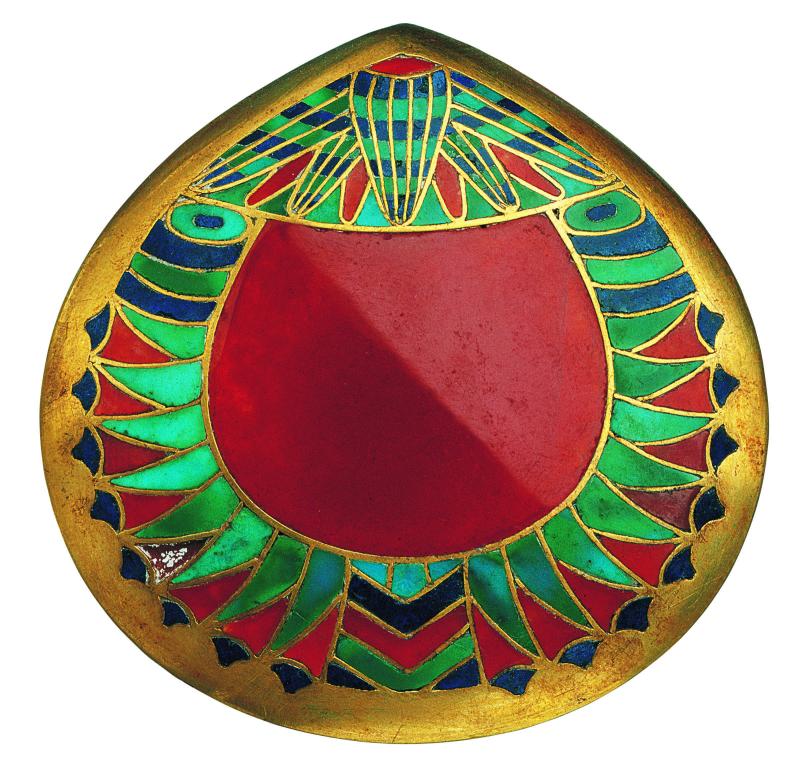
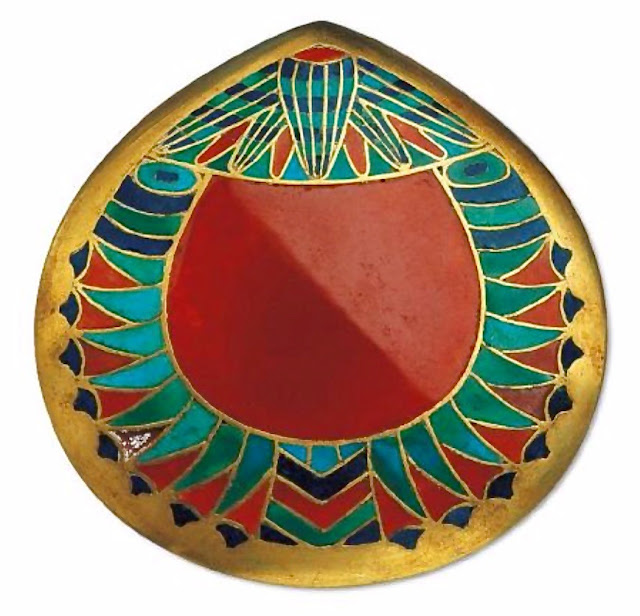
Cloisonné gold pendant of a princess of Dahchour

Cloisonné gold pendant of Princess Merit (Mereret) – gold, carnelian, turquoise, lapis lazuli
Middle Kingdom – 12th Dynasty – Reigns of Sesostris III and Amenemhat III – 1878 – 1798 BC-AD
discovered in his tomb in Dahchour on March 6, 1894, during excavations carried out by Jacques de Morgan
Egyptian Museum in Cairo – CG 53070 – JE 30877 – photo of the museum

via égyptophile

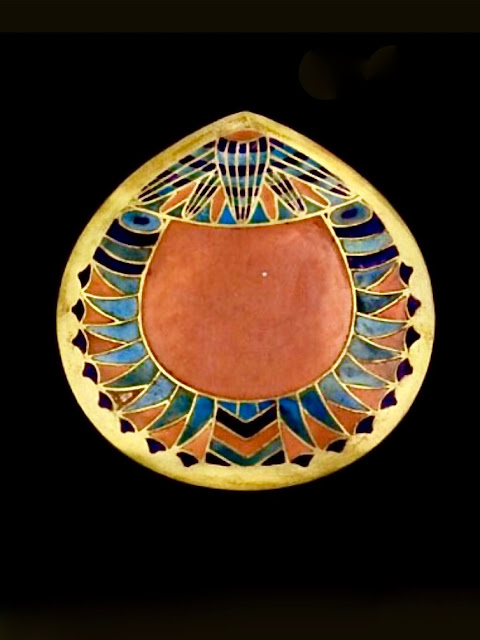
This lovely pendant is made of cloisonné gold, garnished with semi-precious stones. The brilliance that the gems reflect, their perfect execution, and their exceptional state of conservation make it difficult to believe that they are almost… 4000 years old!

It takes the shape of a “convex” shell, the upper part representing an open lotus flower. Its petals, pointing downwards, are made of a delicate and luminous cloisonné composed of turquoise, lapis lazuli and carnelian.

Cloisonné gold pendant of Princess Merit (Mereret) – gold, carnelian, turquoise, lapis lazuli
Middle Kingdom – 12th Dynasty – Reigns of Sesostris III and Amenemhat III – 1878 – 1798 BC-AD
discovered in his tomb in Dahchour on March 6, 1894, during excavations carried out by Jacques de Morgan
Egyptian Museum in Cairo – CG 53070 – JE 30877
published here in “Jewelry and goldsmiths. Booklet 3”, Émile Vernier

“Under this area, the main decoration develops. The middle is occupied by a carnelian of unusual dimensions: 0 m. 021 millimetres high and 0 m. 026 millimeters wide. Its general shape is close to a circle, part of which is cut by the upper area. All around the carnelian, a decoration is developed made, in the axis, of alternating cloisonné chevrons: lapis, carnelian and turquoise, and on each side, curved serrations of turquoise, leaving between them curvilinear triangles in carnelian followed by other small triangles of lapis, then approaching the upper area, alternating bands of lapis and turquoise and ending with an ellipse in turquoise having as its middle a small ellipse of lapis is framed by a fairly wide edge where the gold is bare. The reverse is made of a concave plate of plain gold, where we see a horizontal ring in the upper part, flat and vertically striated,” explains Emile Vernier (Jewelry and goldwork. Booklet 3).

Cyril Aldred’s interpretation follows: “The pendant… is inlaid with a motif inspired by the lotus flower from which is suspended a crown of stylized flower petals, ending in a pendant of three chevrons”.

As for Nigel Fletcher-Jones (“Ancient Egyptian Jewelry”), he specifies that “The pendant was originally suspended from a chain of gold beads to which twenty-six small oyster shells were soldered at regular intervals”.

Cloisonné gold pendant of Princess Merit (Mereret) – gold, carnelian, turquoise, lapis lazuli
Middle Kingdom – 12th Dynasty – Reigns of Sesostris III and Amenemhat III – 1878 – 1798 BC-AD
discovered in his tomb in Dahchour on March 6, 1894, during excavations carried out by Jacques de Morgan
Egyptian Museum in Cairo – CG 53070 – JE 30877 – photo of the museum

This jewel is loaded with symbols and “powers”… Thus, the oyster shell was, for a short period of the Middle Kingdom, an amulet which, according to Carol Andrews (Amulets of Ancient Egypt) “, gave health” and brought well-being to the person who wore it… As for the lotus, which is very present in Pharaonic iconography, it is not only the symbol of birth but also that of rebirth.

The stones used are also loaded with symbolism. In “The Gold of the Pharaohs”, Christiane Ziegler provides these details: “The ‘méfékat’ turquoise was extracted from Sinai where the pharaohs launched mining expeditions. Its luminous colour, evoking the growth of young shoots in spring, was synonymous with vitality and joy. Its presence in the funerary equipment undoubtedly gave the dead the joy of rebirth.” Carnelian, Héréset, “possessed the invigorating virtues of blood”. As for lapis lazuli, she explains to us: “in ancient myths, it constituted the beard and hair of the gods and had virtues comparable to those of turquoise”…

Pyramid of Amenemhat III in Dahchour
Photo by Jacques de Morgan published in “Excavations at Dahshur”, 1894

This pendant comes from the treasure of Princess Mérit (Mereret), whose tomb was found in March 1894 by Jacques de Morgan in the sector of the “northern pyramid” of Dahchour.

In his work “Excavations at Dahchour”, published the same year, he relates: “The underground necropolis that I had just opened was therefore not the tomb of the king, but rather the gallery of the princesses, one of the annexes of the tomb principal. Later, I discovered among the treasures the names of the princesses Hathor-Sat and Merit and the titles of a sixth royal daughter on the worm-eaten remains of a wooden box. Then he adds, “Meticulous examination of the floor of the galleries revealed on March 6 a cavity dug in the rock at the foot of sarcophagus C. The ground was loose,e and the worker’s foot sank into the middle of the moving debris. A few blows of the pickaxe revealed its treasures: gold and silver jewels and precious stones were there, piled up in the middle of the worm-eaten fragments of a box where they had once been kept. “

Cloisonné gold pendant of Princess Merit (Mereret) – gold, carnelian, turquoise, lapis lazuli
Middle Kingdom – 12th Dynasty – Reigns of Sesostris III and Amenemhat III – 1878 – 1798 BC-AD
discovered in his tomb in Dahchour on March 6, 1894, during excavations carried out by Jacques de Morgan
Egyptian Museum in Cairo – CG 53070 – JE 30877
published here in “Excavations at Dahshur” by Jacques de Morgan

Georges Legrain, who worked alongside him, was responsible for drawing up the first jewellery catalogue and faithfully reproducing drawings and watercolours. The large number of pieces to be presented will mean that this pendant will be described in a laconic manner: “Bivalve shell decorated with multicoloured stones on its convex part. The main design represents a lotus flower supporting an indefinite red object, from which herbs escape …”

Jacques de Morgan brandishing one of the pieces of Dahchour’s treasure (Princess Khnoumit’s tiara)
during its discovery in April 1894 in the funerary complex of Amenemhat II in Dashour
(drawing published in “L’Illustration” on May 11, 1895)

We can only subscribe to the words of Pierre Tallet in his work “Sesostris III and the end of the 12th Dynasty”: “One last area where the ending 12th dynasty seems to have particularly excelled is that of jewellery. The royal necropolises of this period thus delivered the first truly important collection of Egyptian jewellery, for the most part, intended for women in the pharaoh’s entourage: jewellery and toiletries from Sat-Hathor-Iounet to El-Lahoun, Mereret… These different lots of Precious objects, where gold, silver and various fine stones such as lapis lazuli, turquoise, amethyst and carnelian abound, give an idea of the splendour in which the royal family lived.

This pendant was registered in the Journal of Entries of the Cairo Museum under the reference JE 30877 and in the General Catalogue CG 53070.

Marie Grillot

Sources:

Excavations at Dahchour, Jacques de Morgan, Berthelot, M. (Marcellin), Legrain, Georges Albert, 1865-1917; Jquier, Gustave, 1868-1946; Loret, Victor, 1859-1946; Fouquet, Daniel https://archive.org/details/fouillesdahcho01morg/page/n213/mode/2up Dahchour excavations: 1894-1895, Jacques de Morgan, Wien 1903, http://digi.ub.uni-heidelberg.de/diglit/morgan1903/0049 Jewellery and goldsmiths. Booklet 3, Number 52640-53171, by Mr. Émile Vernier http://gallica.bnf.fr/ark:/12148/bpt6k57740426/f96.item.r=52859.texteImage Summary list, booklet published in 1894 by M. de Morgan; Excavations at Dahchour, II; Morgan’s catalogue, 1897 by Morgan Jacques. Letter on the latest discoveries in Egypt. In: Reports of the sessions of the Academy of Inscriptions and Belles-Lettres, 38th year, N. 3, 1894. pp. 169-177; https://doi.org/10.3406/crai.1894.70401 https://www.persee.fr/doc/crai_0065-0536_1894_num_38_3_70401 Jewellery and goldsmiths. Booklet 3, Number 52640-53171, by Mr. Émile Vernier http://gallica.bnf.fr/ark:/12148/bpt6k57740426/f96.item.r=52859.texteImage The gold of the pharaohs – 2500 years of goldsmithing in ancient Egypt, Catalogue of the summer 2018 exhibition at the Grimaldi Forum in Monaco, Christiane Ziegler Jewels of the Pharaohs, Cyril Aldred, ed Thames & Hudson Ltd. London, 1978 Ancient Egyptian Jewelry: 50 Masterpieces of Art and Design, 2019, Fletcher-Jones, N, The American University in Cairo Press Ancient Egyptian Jewelry, Carol Andrews, Harry N. Abrams, INC., Publishers, 1991 Amulets Of Ancient Egypt, Carol Andrews, published for Trustees of the British Museum by British Museum Press https://archive.org/details/AmuletsOfAncientEgypt_201707 Treasures of Egypt – The wonders of the Egyptian Museum in Cairo, Francesco Tiradritti

Posted December 21 2021, by Marie Grillot

Labels: CG 53070 – JE 30877 Dachour Dashour de Morgan expo Ramsès II 2023 fouilles 1894 Jacques de Morgan la villette Mereret Merit Mérit or clloisonnée pendeentif

The Mystery of Ramses I’s Mummy.

Standard

Originally called Pa-ra-mes-su, Ramesses I, was of non-royal birth, born into a noble military family from the Nile Delta region, perhaps near the former Hyksos capital of Avaris. He was the son of a troop commander called Seti. His uncle Khaemwaset, an army officer, married Tamwadjesy, the matron of Tutankhamun’s Harem of Amun, a relative of Huy, the viceroy of Kush, a vital state post. This shows the high status of Ramesses’ family. Ramesses I found favour with Horemheb, the last pharaoh of the tumultuous Eighteenth Dynasty, who appointed the former as his vizier. Ramesses also served as the High Priest of Set – as such, he would have played an important role in restoring the old religion following the Amarna heresy of a generation earlier, under Akhenaten.

Ramses I making an offering before Osiris. Amsterdam. Alland Pierson Museum (Wikipedia)

I once published an article about this amazing Pharaoh (Here), and now we are reading a supplement on this fascinating story.

Here, we will read Marie Grillot‘s excellent description of the mysteries surrounding the mummy of Pharaoh Ramses I.

The image at the top, Egyptian Antiquities: Pharaoh Ramses I (1320-1310 BC), represents burning incense and pouring water at a ceremony. Volume of Ramses I, Valley of the Kings, Egypt (Meisterdrucke)

The tomb of Ramses I and the questions about his mummy…

via égyptophile

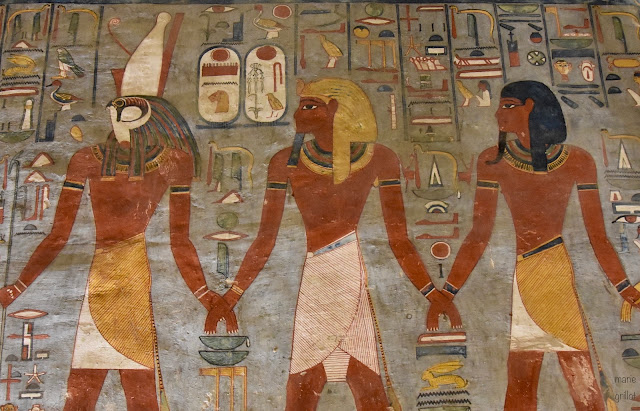
Pharaoh is welcomed into the afterlife by Anubis and Horus
Tomb of Ramesses I – Valley of the Kings – KV 16 – 19th dynasty
Discovered on October 11, 1817, by Giovanni Battista Belzoni on behalf of Consul Henry Salt

At the beginning of October 1817, Giovanni Battista Belzoni, working on behalf of the British consul Henry Salt, commissioned a team of around twenty fellahs to carry out surveys in the Valley of the Kings. On October 11, while they were at work in the southeastern wadi, their research was crowned by an extraordinary discovery. Belzoni thus relates it in “Journey to Egypt and Nubia”: “Around midday, I was told that the entrance to the tomb discovered the day before had been widened enough for us to enter… I was the first to enter the opening, which had just been made to see if the way was passable. After having traversed a passage thirty-two feet long and eight wide, I descended a staircase of thirty-eight feet and arrived in a room quite large and decorated with beautiful paintings.

Tomb of Ramesses I – Valley of the Kings KV 16 – 19th dynasty
Discovered on October 11, 1817, by Giovanni Battista Belzoni on behalf of Consul Henry Salt

The key to reading the hieroglyphs was unknown; its “owner” – Ramesses I – would only be identified a few years later.

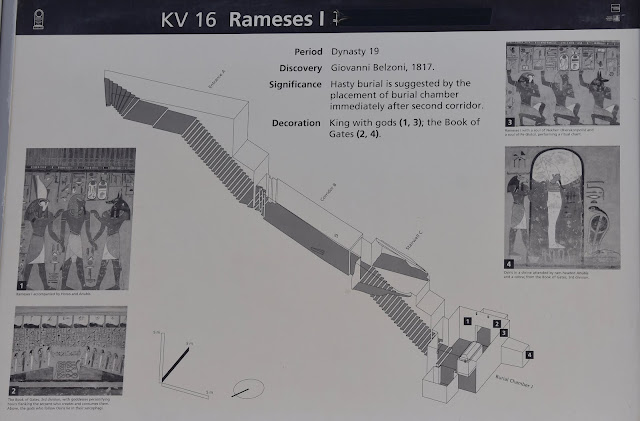
With an area of barely 148 m2, this tomb – referenced KV 16 – is one of the smallest in the necropolis. Its architectural plan is simple and rectilinear, with a stepped entrance followed by a sloping corridor that leads to a second staircase directly serving the burial chamber.

Signage panel with plan of the tomb of Ramesses I – Valley of the Kings KV 16 – 19th dynasty
Discovered on October 11, 1817, by Giovanni Battista Belzoni on behalf of Consul Henry Salt

“It is clear that the plan owes much to the tomb of Horemheb (KV 57). This appears particularly in the decorative style, using blue-grey as a background for the scenes and texts. Some think that the same artists were at the origin of these two tombs,” specifies Kent Weeks.

The scenes for which “we have renounced all relief” (Erik Hornung) reveal a high pictorial quality and seduce with their chromatic richness of luminous harmony. The hieroglyphs are of extraordinary finesse, and the king’s cartouches are set against a white background. The lower part of the vignettes is, all around, bordered by two thick bands of colour: the first yellow bordered with black, the second red ocher. Then, the rest of the wall, down to the ground, is painted black. As for the upper part bordering the ceiling, which has not been painted, is composed of a frieze of Khekerous resting on a strip of alternating coloured rectangles.

A priest standing before Osiris prepares to receive Ramses I, led by Horus, Atum and Neith
Tomb of Ramesses I – Valley of the Kings KV 16 – 19th dynasty
discovered on October 11, 1817, by Giovanni Battista Belzoni on behalf of Consul Henry Salt

“The entrance to the sepulchral chamber is guarded by two figures of the goddess Maat, who welcome the deceased; the king is represented in the presence of the Memphite gods, Ptah and Nefertoum, and the deities of Abydos represented by the pillar-djed of ‘Osiris and the knot of lsis. On the side walls, several scenes from the Book of Doors evoke the Sun’s nocturnal journey. The back wall combines an Osirian scene on the right and a solar scene on the left. Far left, the king is shown in a position of jubilation, surrounded by the Souls of Pé and the Souls of Nekhen, the mythical ancestors of royalty.

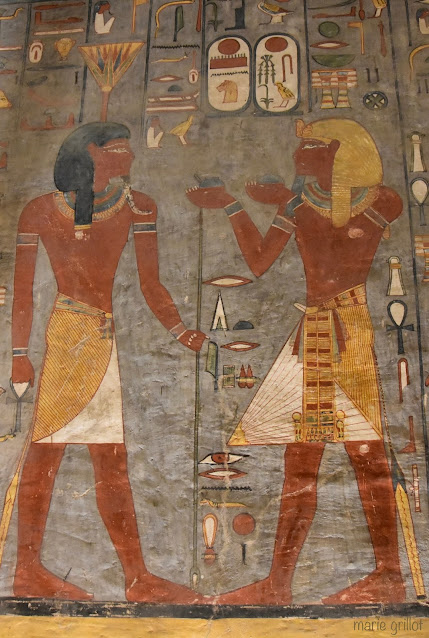
Ramses I facing the god Nefertum
Tomb of Ramesses I – Valley of the Kings KV 16 – 19th dynasty
Discovered on October 11, 1817, by Giovanni Battista Belzoni on behalf of Consul Henry Salt

The room has three small “annexe” rooms. The one dug into the southwest wall has a very beautiful scene representing Osiris standing between a divinity with the head of a ram and the serpent goddess Nesret, “the fiery breath” (it is, in fact, the Uræus ).

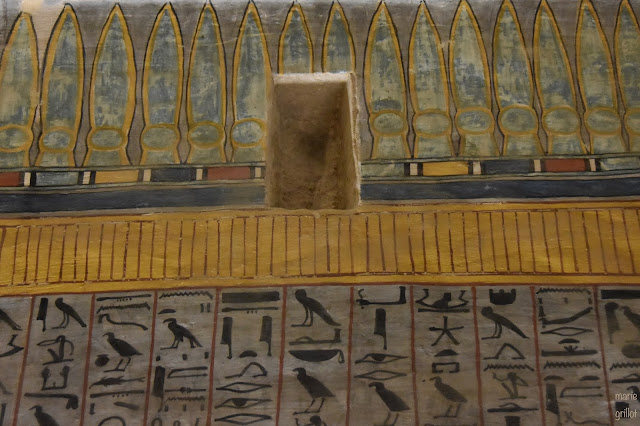
At the height, we note the presence of four small niches intended to accommodate the “magic bricks. “

One of the niches intended to accommodate the “magic bricks.”
Tomb of Ramesses I – Valley of the Kings KV 16 – 19th dynasty
Discovered on October 11, 1817, by Giovanni Battista Belzoni on behalf of Consul Henry Salt

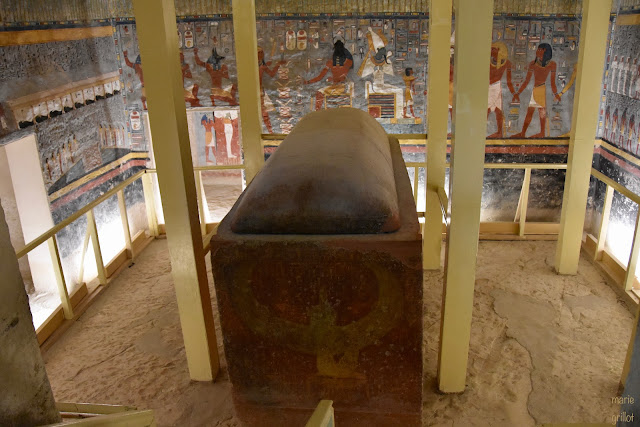
Most of the room is occupied by an imposing red granite sarcophagus. Although damaged during looting, its domed lid is still there. “The sarcophagus was hastily finished, as evidenced by its decoration. Indeed, it is painted yellow, the texts and figures not having had time to be incised. In addition, the representations of the two goddesses, sisters and protectors of their dead brother Osiris are quite clumsily made. As is customary, Isis is at the foot, and Nephthys is at the head of the sarcophagus. The two goddesses stand on the hieroglyphic sign “Noub”, which represents gold”, explains Thierry Benderitter (osirisnet).

The imposing red granite sarcophagus
Tomb of Ramesses I – Valley of the Kings KV 16 – 19th dynasty
Discovered on October 11, 1817, by Giovanni Battista Belzoni on behalf of Consul Henry Salt

As Ali Reda Mohamed, the site inspector, told us, this tomb, which had been closed since 2008 for restoration by an Egyptian team, was reopened to the public on January 2, 2021.

Upon Khaled el-Enani’s inauguration, the Ministry of Tourism and Antiquities detailed the work carried out: “The floors we” e restored, and the walls were cleaned of bird and bat droppings… The existing inscriptions were also restored and cleaned, and the soot was removed… The sarcophagus also benefited from the care of the restorers, and the lighting system was improved”…

A member of the Egyptian restoration team cleaning the sarcophagus
Tomb of Ramesses I – Valley of the Kings – KV 16 – 19th dynasty
discovered on October 11, 1817, by Giovanni Battista Belzoni on behalf of Consul Henry Salt
reopened to the public after restoration on January 2, 2021 – photo Ali Reda Mohamed

When Pa-Ramessou, a high dignitary and seasoned soldier, was chosen by Horemheb to succeed him, he was already around fifty years old. Around 1306-1307 BC, he became Pharaoh under Ramses I. Thus, this 19th dynasty, initiated by his predecessor, was marked by “the arrival to power of a family from the Delta (Ramses I, Séthy I)” and then marked “the transition to the Ramesside Empire”.

Pa-Ramessou is particularly known for two identical black granite statues representing him “as a scribe, ” discovered by Georges Legrain near the 10th pylon of Karnak on October 25, 1913 (Egyptian Museum in Cairo – JE 44863 – JE 44864).

One of the two granite statues representing Pa-Ramessou as a scribe – future Ramses I
discoveries near the 10th pylon of Karnak, October 25, 1913, by Georges Legrain
Egyptian Museum in Cairo – JE 44863

According to Manetho, his reign was short: 1 year and four months. This simple observation could explain the modest size of his tomb and its unfinished state.

If, in his account, Belzoni points out that the sarcophagus contained two mummies, these were not the remains of the sovereign…

Indeed, after the looting that occurred in the necropolis, his mummy, like that of Ramses II, would first have passed through the tomb of Sethy I before joining the “hiding place of the royal mummies” (DB 320), where it was placed in the tomb and sheltered by the high priests of Amun during the 21st dynasty. This collective tomb was discovered in Deir el-Bahari by the Abd el-Rassoul family in 1871. The Antiquities Service only became aware of it in July 1881 and then transported all the mummies to the Boulaq Museum.

“Rediscovery”, in July 1881, by the Antiquities Service, of the Cache of the Royal Mummies (DB 320)
discovered in 1871 by the Abd el-Rassoul Brothers near Deir el-Bahari

In “The Find of Deir-el-Bahari”, Gaston Maspero thus evokes the successive “displacements” which are “recorded” on the coffins of the sovereigns before their final reburial in DB 320: “The three mummies of the 19th dynasty had a common destiny. The coffins of Seti I and Ramses II bear three identical inscriptions or almost, and which date back to three different periods; what remains of the coffin of Ramses I bears the remains of a hieratic text similar to the second inscription of the text of Seti I”.

What really happened to Ramses I’s mummy? How can we imagine that after these “post-mortem” wanderings, he has not yet found rest? How could it have been sold to an American, then passed through a museum in Ontario before being exhibited at the Michael Carlos Museum in Atlanta?

In 1909, in his “General Catalogue of Egyptian antiquities from the Cairo Museum – Coffins of Royal Hiding Places”, Georges Daressy thus presents, under the ref. CG 61018, the: “Fragment of coffin in the name of Ramses I. Sycamore wood – The original coffin of Ramses I having been destroyed, his mummy had been placed in another coffin of the XXIst dynasty; but this second coffin was it – even broken during the multiple transports of the royal mummies and only two fragments have come down to us: the lid and the head of the vat. The question then arises as to whether the mummy resting inside was indeed that of the sovereign?

On the other hand, in the 1900s, in order to overcome its financial problems, the Cairo Museum did not hesitate to get rid of a number of antiquities; it actually had its own auction room, but from there, it separated from a royal mummy…

The exact scenario still remains an enigma…

Still, in an article dated March 6, 2004, on the Atlanta mummy entitled “Rameses I Mummy Returned to Cairo”, the magazine “World Archeology” reports that: “After three years of intensive investigation into the royal mummy, including X-rays, CAT Scan, radiocarbon dating, computer imaging and other techniques, researchers are 95% certain that this is the mummy of Ramesses I. Arms crossed on the chest indicates that the mummy is indeed royal because this specific position was only reserved for royal characters”…

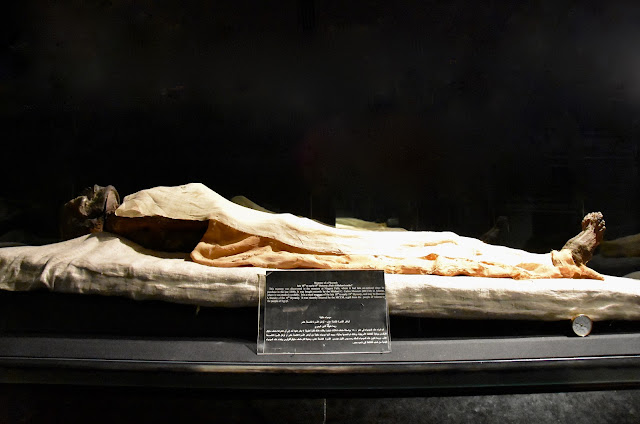
In 2003, through Zahi Hawass, it was finally returned to Egypt… Since March 9, 2004, it has been exhibited at the Louqsor Museum in the room dedicated to the glory of ancient Thebes… On its cartel, however, a doubt remains: “It is a royal mummy from the end of the 18th dynasty – beginning of the 19th. It may be that of Ramses I, founder of the 19th dynasty”…

Mummy attributed to Ramses I exhibited since March 2004 at the Louqsor Museum
in the hall to the glory of ancient Thebes

Marie Grillot

Sources:
Giovanni Battista Belzoni, Journey to Egypt and Nubia, Pygmalion, 1979
Kent Weeks, Illustrated Guide to Luxor, Tombs, Temples and Museums, White Star Publishers 2005
Kent Weeks, The Valley of the Kings, The Tombs and Funerary Temples of Western Thebes, Gründ, Paris, 2001.
Alberto Siliotti, The Valley of the Kings, guide to the best sites, Gründ, 1996
Nicholas Reeves, Richard H. Wilkinson, The Complete Valley of the Kings, Thames and Hudson, 1997
Claude Obsomer, Ramses II, Pygmalion, 2012
Pierre Tallet, Frédéric Payraudeau, Chloé Ragazzolli, Claire Somaglino, Pharaonic Egypt, history, society, culture, Armand Colin, 2019
Porter & Moss, Topographical Bibliography of Ancient Egyptian hieroglyphic texts, reliefs and paintings, Second Edition, Volume II, p. 534-535, Griffith Institute, Ashmolean Museum, Oxford, 1994
Theban mapping project                  https://thebanmappingproject.com/tombs/kv-16-rameses-i Ramses I – KV 16 – Thierry Benderitter, osirisnet.net           https://www.osirisnet.net/tombes/pharaons/ramses1/ramses1_01.htm             Georges Legrain, At the Harmhabi pylon in Karnak (Xth pylon), ASAE 14, 1914, p. 13-44 https://archive.org/details/annalesduservice14egypuoft/page/12/mode/2up           Gaston Maspero, The Find of Deir-el-Bahari. Twenty photographs, by M. E. Brugsch, French printing house F. Mourès & Cie, Cairo, 1881            https://gallica.bnf.fr/ark:/12148/btv1b8626666s/f1.item?fbclid=IwAR2kq2S6I6J4p5Sgs1J__8cR1XKUhIsnOFeTohkBxXme-lg1UEr9NZs4hSs#     

Elisabeth David, Gaston Maspero, The Gentleman Egyptologist, Elisabeth David, Pygmalion, 1999
World Archeology, Rameses I Mummy Returned to Cairo, March 6, 2004,        https://www.world-archaeology.com/world/africa/egypt/rameses-i-mummy-returned-to-cairo/    Luc Gabolde, Royal mummies in search of identity, Egypt, Africa & Orient, 2005      https://hal.science/hal-01895058/document            

Cairo Museum No. 61001-61044, Coffins from the royal hiding places, Cairo Print. from the French Institute of Oriental Archaeology, 1909
https://archive.org/details/DaressyCercueils1909

Publié il y a 17th February 2021 par Marie Grillot

Libellés: Belzoni DB 320 JE 44863 KV 16 momie musée de l’Ontario Musée de Louqsor Pa-Ramessou Ramsès I Ramsès Ier Vallée des Rois

Stele of the Serpent King (Stela of Djet)

Standard

It is unimaginable that this Stele is over five thousand years old. Thanks to human curiosity and the joy of discovery, fascinating artefacts continued to appear.

Djet, also known as Wadj and Zet, was the fourth pharaoh of the First Dynasty and Djer’s successor. Djet’s Horus name means “Horus Cobra” or “Serpent of Horus. “.

Here, we read the story of this huge ancient stele by brilliant Marie Grillot, which shows humans merging with the divines.

The title image: Wikipedia

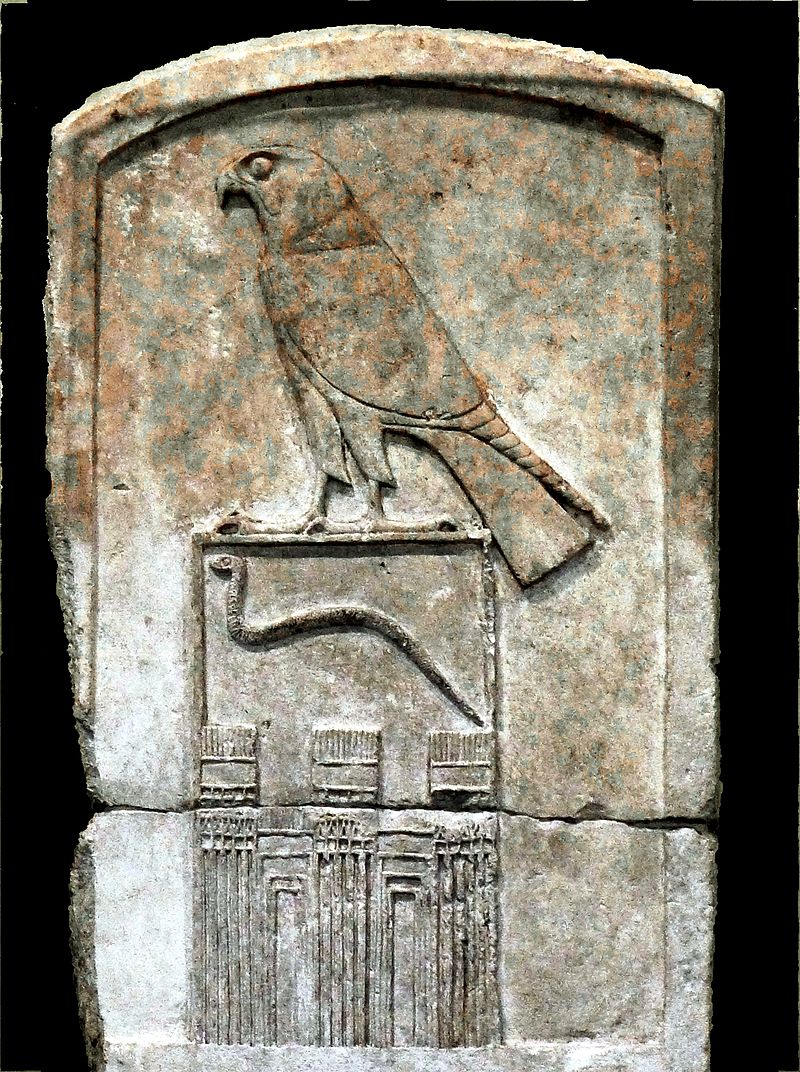
At the Louvre, the stele of Djet, the “Serpent King”

via: égyptophile

Stele of the Serpent King – limestone – circa 3100 – 2900 BC – discovered at Abydos, in the royal tomb (“Z”) of Djet
Necropolis of El-Araba el-Madfouna – Oumm el-Qaab – by Émile Amélineau during the excavations of 1895 – 1896
Department of Egyptian Antiquities of the Louvre Museum E 11007
(by acquisition in November 1904 in Drouot of lot 303 of the Amélineau sale)
photo © 2023 Louvre Museum / Maurice Chuzeville

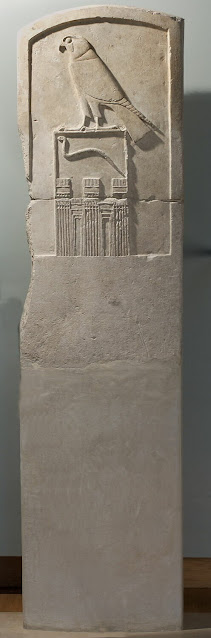
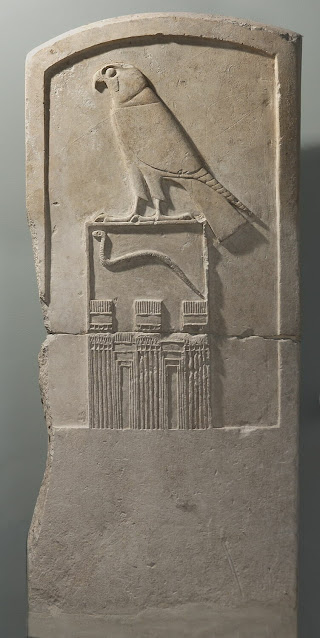
This large limestone stele, with a current height of 1.43 m and a width of 0.65 m, is one of the oldest monuments in the Egyptian department of the Louvre Museum.

It is dated 3100 – 2900 BC. It comes from the tomb of one of the founding sovereigns of the 1st dynasty and thus bears witness, with elegance and sobriety, to a page of history 5000 years old.

It was discovered in 1895 – 1896 by Émile Amélineau. This Egyptologist, a graduate of the École Pratique des Hautes Études where his teachers included Gaston Maspero and Eugène Grébaut, and also a member of the French Archaeological Mission in Cairo, returned to Egypt in November 1895 to carry out research excavations on a site that he does not yet know… “It was not without great apprehension that I agreed to go and excavate the necropolis of Abydos: the shadow of the great Mariette seemed to guard it against any rash attempt, and I knew, having read his works, that he had searched it for eighteen years. From then on, I wondered what I could discover in such circumstances because I had never been to Abydos… Therefore, I set to work with ardour, and he relates this ardour I preserved during the five months that “the campaign lasted, despite many setbacks and disappointments ” in “The New Excavations of Abydos”.

“Map of the Abydos necropolis, according to Mariette” – published by Émile Amélineau in
“New excavations of Abydos … full account of the excavations
description of the monuments and objects discovered” in 1899

In the necropolis of El-Araba el-Madfouna, “Oumm el-Qaab” (the “Mother of jugs” or “Mother of pots”), of which Jacques de Morgan had granted him the concession, he brought numerous tombs to light – with the help of more than 450 workers! – and several royal burials from the “Thinite” period (- 3100 – 2700 BC). “To the west of the large hill, almost perpendicular to the tomb of Osiris and in the first line”, he relates, he discovers that of the one he will identify as “the Serpent King, whom others have called Dja, or even Djet”. Son and successor of Djer, he was the fourth sovereign of the 1st dynasty and the father of Den, to whom he left power.

This royal tomb – later referenced as “Z” – notably contained this stele, broken into three pieces. “The lower fragment, undecorated, must have been left on site. The stele, which measured 2.50 meters or 2.60 meters in its original state, was significantly more slender. Sculpted in relief on a recessed background, the name of the sovereign is written, one of his names rather, since the kings of the time generally had two,” specifies Jean-Louis de Cenival in “A century of French excavations in Egypt, 1880 -1980”.

Stele of the Serpent King – limestone – circa 3100 – 2900 BC – discovered at Abydos, in the royal tomb (“Z”) of Djet
Necropolis of El-Araba el-Madfouna – Oumm el-Qaab – by Émile Amélineau during the excavations of 1895 – 1896
Department of Egyptian Antiquities of the Louvre Museum E 11007
(by acquisition in November 1904 in Drouot of lot 303 of the Amélineau sale)
published by Émile Amélineau in “The new excavations of Abydos, Report of the excavations of Abydos, 1896-1898”)

In “Ancient Egypt at the Louvre”, Christiane Ziegler makes this enlightening reading: “The sovereign image of a large falcon dominates that of a snake framed by the enclosure of a fortress; the whole reads like a royal name, the name of the Serpent King. The falcon is the personification of the god Horus, protector of royalty. The serpent is the hieroglyph reading DJ or the sign used to write the name of the cobra. The enclosure is the image of the palace, with its raw brick walls reminiscent of a fortress with defence towers; the walls, pierced with high doors, present a succession of projections and recesses crowned with a cornice “.

For Georges Bénédite (“The so-called stele of the Serpent King” ): “It is logical to consider the building illustrated by the serekh as the residence of the Double, that is to say, the Tomb”… In “The Serekh as an Aspect of the Iconography of Early Kingship”, Alexandra A. O’Brien gives us these precious explanations: “The serekh is a way of writing the king’s name. It is generally made up of three elements: at the bottom, a part of the facade in a niche; above, a panel on which the king’s name is written; and, seated on it, a falcon. This is the ‘classic’ model. Sometimes, the falcon is joined by a Sethian animal, replaced by another, completely absent, or joined by a second falcon. This may seem like a simple motive, as the implication of each element is quite easy to explain. The facade of the niches probably represents a large building associated with the king – his palace perhaps or his tomb, and either would serve to represent the wealth, power and authority of the monarch”…

Stele of the Serpent King – limestone – circa 3100 – 2900 BC – discovered at Abydos, in the royal tomb (“Z”) of Djet
Necropolis of El-Araba el-Madfouna – Oumm el-Qaab – by Émile Amélineau during the excavations of 1895 – 1896
Department of Egyptian Antiquities of the Louvre Museum E 11007
(by acquisition in November 1904 in Drouot of lot 303 of the Amélineau sale)
photo © 2002 Louvre Museum / Christian Décamps

During these three excavation missions from 1895 to 1898, Émile Amélineau discovered hundreds, even thousands of artefacts. According to the legislation in force (law on antiquities of 1891), they were distributed between Egypt and the “digger” during a “division carried out in Abydos under the supervision of Jquier, who replaced Morgan, who was bedridden at this period”, specifies Marc Étienne in “Émile Amélineau (1850-1915). The misunderstood scholar”.

Émile Amélineau, Egyptologist
(La Chaize-Giraud – Vendée, 28-8-1850 – Châteaudun – Eure-et-Loir – 12-1-1915)

The missions have been financed by a company of shareholders (bankers, collectors, etc.), and they expect a fair return on their investments… On his return to France, Émile Amélineau is responsible for selling the artefacts to be able to compensate them. But, faced with the difficulties encountered and the sales deadlines, which promise to be long, he will be forced to reimburse the investors, thus becoming the owner of all the objects brought back. The transactions he then pursued, notably with the Louvre to which he hoped to sell the entire collection, for obscure reasons, did not succeed… Finally, the Egyptologist decided to put his collection up for public sale at the Hôtel Drouot in Paris on November 3 and 4, 1904… “Due to the clauses of the shareholders’ company, three groups were formed by the remains unearthed during the excavations; this is what Amélineau designated in 1904 in the preface to the sales catalogue by the terms ‘first, second and third collection’, designating respectively the product of the excavations of the campaigns of winter 1895 – spring 1896, winter 1896 – spring 1897 and finally winter 1897 – spring 1898 (Amélineau sale, 1904)” specifies Marc Étienne.

Stele of the Serpent King – limestone – circa 3100 – 2900 BC – discovered at Abydos, in the royal tomb (“Z”) of Djet
Necropolis of El-Araba el-Madfouna – Oumm el-Qaab – by Émile Amélineau during the excavations of 1895 – 1896
Department of Egyptian Antiquities of the Louvre Museum E 11007
(by acquisition in November 1904 in Drouot of lot 303 of the Amélineau sale)
photo © 2002 Louvre Museum / Christian Décamps

At this sale, the Louvre Museum will acquire this stele of King Serpent, presented under number 303. Thus, it will enter its collections under inventory number E 11007.

Marie Grillot
sources:

Stele of the Serpent King                           https://collections.louvre.fr/ark:/53355/cl010012035   

Émile Amélineau, The new excavations of Abydos, Report of the excavations of Abydos, 1896-1898, Imprimerie A. Burdin, Angers, 1896  https://archive.org/details/lesnouvellesfoui00am/page/n5/mode/2up

Émile Amélineau, Mission Amélineau. The new excavations of Abydos, 1895-1896, full report of the excavations, description of the monuments and objects discovered (September 1, 1898) https://gallica.bnf.fr/ark:/12148/bpt6k58048302/f438.item.r=jeu

Émile Amélineau, New excavations of Abydos … full report of the excavations, description of the monuments and objects discovered, Ernest Leroux Editeur, Paris, 1899 https://archive.org/details/nouvellesfouille00amel/page/n11/mode/2up  

Amélineau sale – Egyptian antiquities found in Abydos. Ivories, carved wood, enamelled earthenware, amulets, scarabs, funerary statuettes, gold and bronze objects, flint, terracotta, and pottery, various sculptures, hard stone vases and cups, steles, tables, and fragments with hieroglyphic inscriptions, etc. Hôtel Drouot Paris, February 8-9, 1904     https://gallica.bnf.fr/ark:/12148/bpt6k1247688b/f6.item

Émile Amélineau, The new excavations of Abydos 1897-1898, Ernest Leroux Editor, Paris, 1905 https://gallica.bnf.fr/ark:/12148/bpt6k58048302/f438.item.r=jeu

Georges Bénédite, The so-called stele of the Serpent King (Louvre Museum), Monuments and memories of the Eugène Piot Foundation, volume 12, fascicle 1, 1905. pp. 5-18  https://doi.org/10.3406/piot.1905.1260              https://www.persee.fr/doc/piot_1148-6023_1905_num_12_1_1260

Christiane Desroches Noblecourt, Jean Vercoutter, A century of French excavations in Egypt, 1880 – 1980, cat. exp. (Paris, Musée d’Art et d’Essai, Palais de Tokyo, May 21 – October 15, 1981), Cairo, French Institute of Oriental Archeology (IFAO), 1981, p. 6, illus. p. 6, no. 2                   Alexandra A. O’Brien, The Serekh as an Aspect of the Iconography of Early Kingship, Journal of the American Research Center in Egypt                             Flight. 33, 1996, pp. 123-138 (16 pages) https://www.jstor.org/stable/40000610

Guillemette Andreu, Marie-Hélène Rutschowscaya, Christiane Ziegler, Ancient Egypt at the Louvre, Paris, Hachette, 1997, p. 43; 250-251                                Marc Etienne, Émile Amélineau (1850-1915). The misunderstood scholar, Archéonil, 17, 2007, p. 27-38, p. 30, fig. 4 https://www.persee.fr/doc/arnil_1161-0492_2007_num_17_1_929

Publié il y a 29th December 2023 par Marie Grillot
Libellés: 1895-1896 1904 3100 – 2900 av. J.-C. Abydos Den Djer Djet Drouot dynastie I E 11007 El-Araba el-Madfouna lot 303 Louvre Oumm el-Qaab stèle roi Serpent thinite tombe “Z” Émile Amélineau

A Journey to Samos and Other Nuisance! P. 2

Standard

I don’t know about you, my dear friends, but for me, time is running like a rabbit trying to get its latest carrot! The latest week was the worst: first, I visited a lawyer, maybe to get more pension from the state because mine is below the existential limit, but no chance because my adorable wife still is working, and it must be enough for both of us! And next to it, my beloved page, which I made to send my WP articles to Facebook, doesn’t belong to me any more! I have no idea why it is so, but you, who are on FB, know it happens daily! Anyway, I try to keep silent and calm! What else can I do?
Of course, I’ll gladly accept if somebody has an idea for Facebook’s issue!

So! Now, let’s travel to the Ilias territories, Samos. This trip was different from the previous ones. First, as Regina told me, we had an occasion to spend our vacation in Samos; I was happy because I am always happy to be in Greece, as it might be my actual land. But there were some rumours about foreigners on the island. With the foreigner, I mean the big European problem with the refugees from all around the world towards Europe.

As I wrote in the first part, I was a bit worried about the conflict between rich and poor, though I prepared myself for every kind of conflict. I said once that I fully understand their situation, but I am a man of comprehensiveness and take the issues as they are. Anyway, we arrived at the equipment, and the first encounter was at the beach, where some families of these refugees were present. I only needed some eye contact to show them what was happening there. It was for me not the best, but it must be so, for they were, as I assumed, not enough cultured to understand the matter.

As I mentioned, I was also a refugee. But I knew where I was, what I was, why I was somewhere else, and how to handle it. That is the point, the main point of our existence! And I am happy to have known this.


Whatever, it repeated itself several times. Once, a few boys even stole our care items from a bag. They said they were thirsty, but there was only sunscreen inside! You might imagine it was unpleasant for me, but I had to react to these idiotic acts. So! Enough talking; let’s enjoy the pictures.







The Heraion of Samos:

The territories of the Heraion of Samos were a large sanctuary to the goddess Hera on the island of Samos, Greece, 6 km southwest of the ancient city of Samos (modern Pythagoreion).




And a blue street you might love as blue as it is!



And some more… Have a lovely time, thanks.✌🙏🌹💥💖

Oops! I think there could be some more in the future! Cheers.😉🤗

The Ba-Bird And Its Secret!

Standard

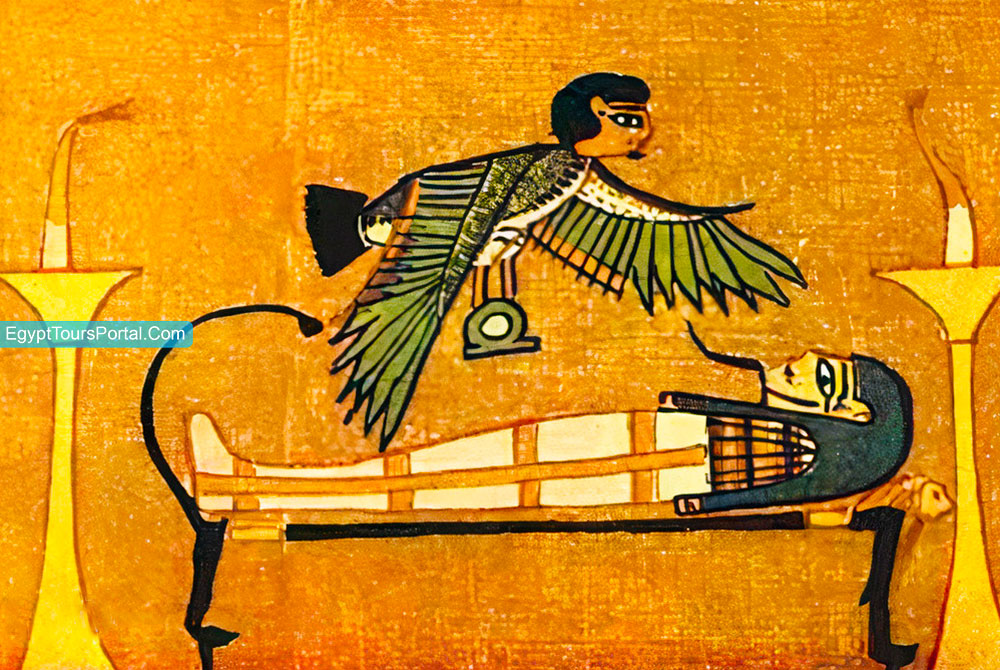
3 Elements to the Egyptian concept of the soul: Ka, Ba, and Akh .___ ((Ka)) is the life force or spiritual double of the person. The royal Ka symbolized a pharaoh’s right to rule___((Ba)) is represented as a human-headed bird that leaves the body when a person dies.___((Akh)) was a concept of the dead that varied over the long history of ancient Egyptian belief, was associated with thought, but not as an action of the mind; rather, it was intellect as a living entity.

“May it see my corpse; may it rest on my mummy, Which will never be destroyed or perish.” PAPYRUS OF ANI, New Kingdom, Dynasty XVIII, Collection of The British Museum.

Our topic in this article is the Ba, the master of soul and body, and we have the chance to read an excellent interview by Marie Grillot with brilliant Michèle Juret and an introduction of her book about the secret of this bird and all we can get to know about it.
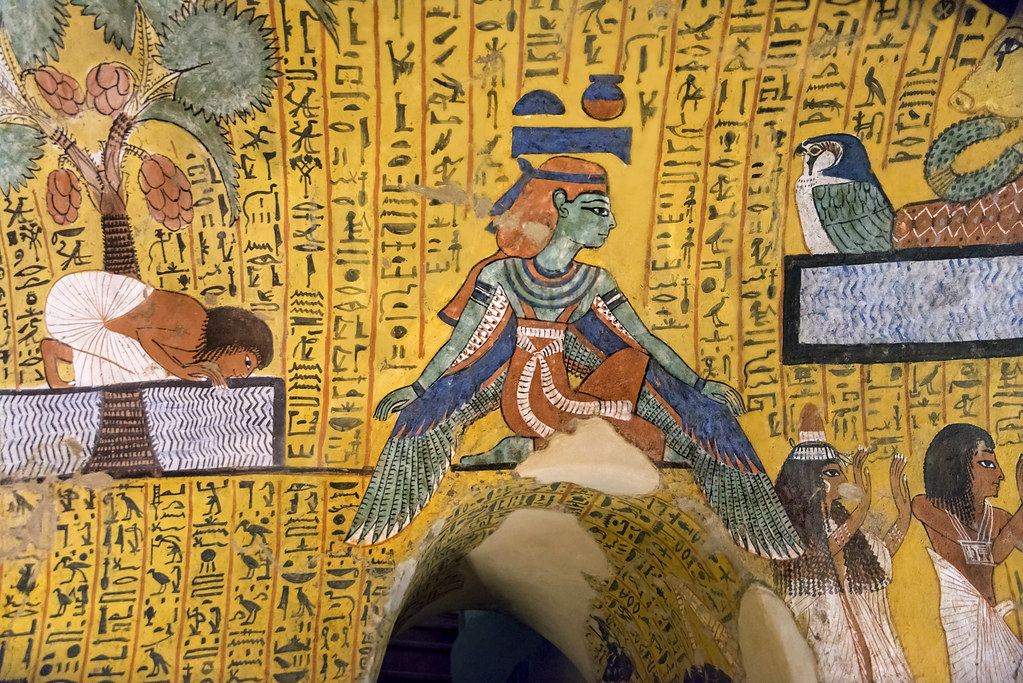
Tomb of Irynefer Deir el-Medina (Flickr)

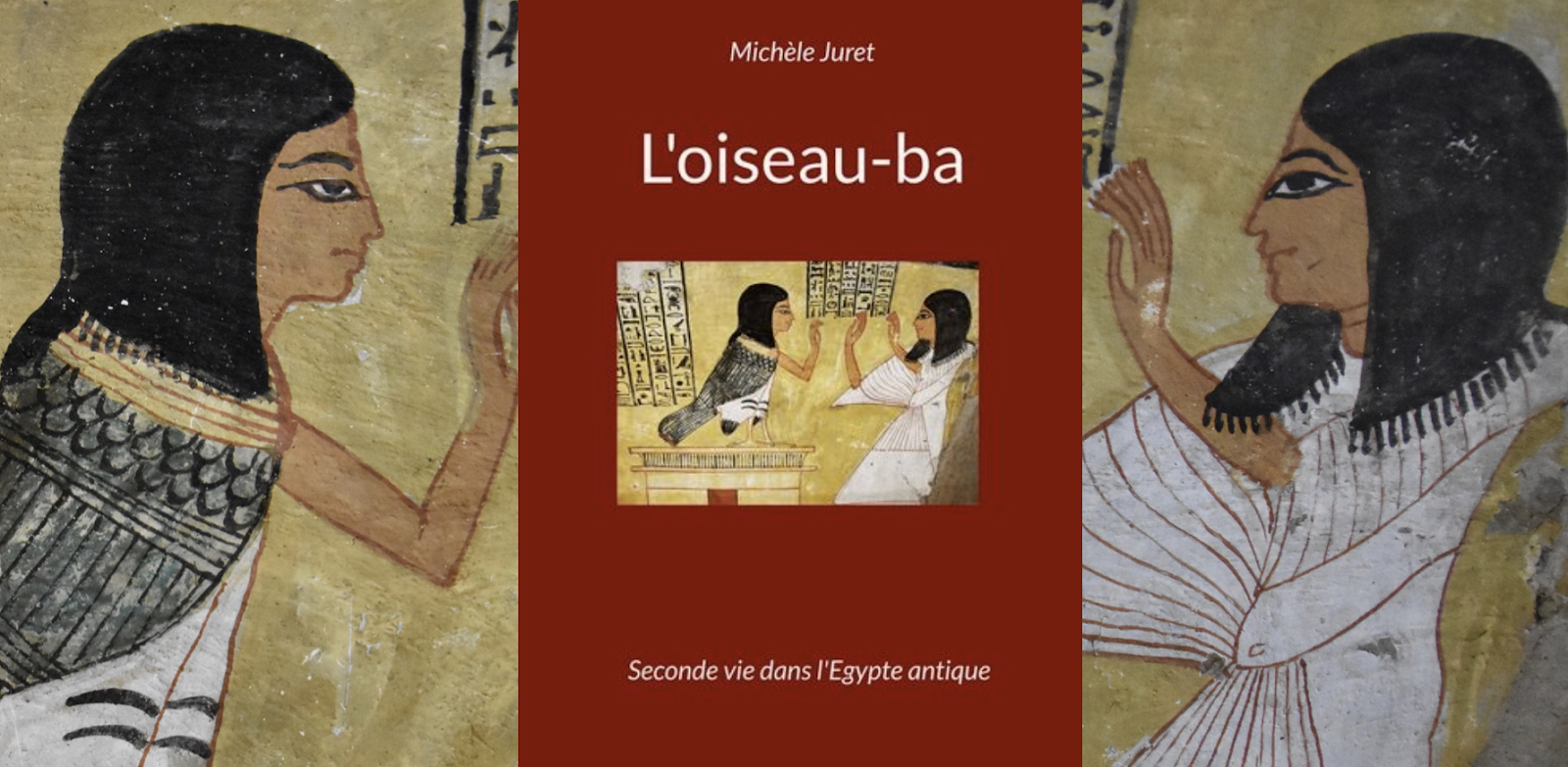
“The ba-bird, second life in ancient Egypt”: the new work by Michèle Juret

via: égyptophile

Inherkaou and his “ba”, represented in the burial chamber of the tomb of this team leader for the Master of the Deux-Terres
TT 359 – Deir el-Medina – 20th dynasty – Ramses III Ramses IV
“The ba-bird, Second Life in Ancient Egypt” by Michèle Juret – published by Books on Demand

A graduate of the École du Louvre and curator of the Montgeron Museum, Michèle Juret is notably “the” biographer of the Egyptologist Etienne Drioton, the last French director of the Egyptian Antiquities Service.

With her new publication: “The Ba-bird, Second Life in Ancient Egypt”, she devotes herself to a theme that is particularly dear to her since it was, from 2002, the subject of her research dissertation. Driven by her interest and passion for this entity flying “between two worlds”, she has never stopped researching and “taming” its multiple and diverse representations… Evoked in several chapters of the “Book of the Dead”, the ba-bird is found on the walls of tombs, on coffins, papyri, steles, statues, offering tables, or even on pectorals and amulets…
As meticulously as it is applied, this well-documented study allows us to understand better this conception of “ba” so intimately – and specifically – linked to ancient Egypt…

Michèle Juret, author of “The Ba-bird, Second Life in Ancient Egypt”
published by Books on Demand in May 2022

MG-EA: To understand what a “ba-bird” is, we must certainly first understand the importance of this “ba” entity in the conception of the personality of the ancient Egyptians.

Michèle Juret: First of all, I would like to thank you, Marie Grillot, for this interview, which allows us to discuss the essentials of this work, namely the observation of the iconography of the ba in the light of the funerary texts.
As you say, it is first necessary to understand the importance of this fundamental entity, a guarantee of survival.

For the ancient Egyptians, the individual is made up of various elements:
The body, immobilized by death, will remain in the grave.
Ka, the vital force, draws its energy from food.
The Akh, celestial spirit, magical power, can be beneficial or evil.
The shadow will enjoy a certain independence.
We commonly translate the ba by the word soul, although the concept is much more complex. An important element is that it is of divine nature. The Alter-ego of the deceased is essential to his survival.

MG-EA: The ba-bird generally presents itself as a composite, anthropo-cephalous being, that is to say, with a human head and a bird’s body: when did it appear, in this form, in the iconography?

Michèle Juret: This half-avian/half-human appearance is the culmination of a slow evolution. From the Old Kingdom, the king’s ba, named in the Pyramid Texts, appears in hieroglyphic writing as a wader with a loop at the base of the neck. In Middle Kingdom texts, it is seen as a bird with the head of the living (human) without this image appearing in the writing. Finally, some amulets and masks decorated with feathers date from this period, and then the rishi sarcophagi will become milestones towards this figure of an anthropo-cephalous bird that we will commonly encounter from the New Kingdom onwards.

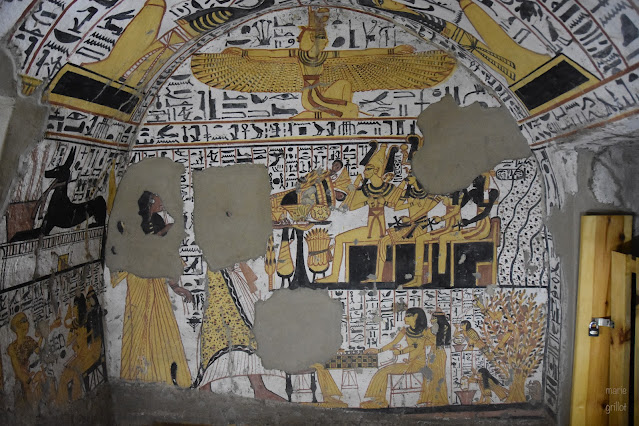
Irynefer and her “ba”, represented in the burial chamber of the tomb of this servant in the Place of Truth.
TT 290 – Deir el-Medina – 19th dynasty – Ramesses II

MG-EA: Indispensable to the survival of the being that death has immobilized the ba-bird, he enjoys total freedom… He can enter and leave the grave in, you write, “a moving interdependence with the deceased”? He thus becomes the guarantor of his “post-mortem” future?

Michèle Juret: Indeed, Le ba enjoys total freedom. He will be able to leave the tomb, climb into Ra’s boat, benefit from its rays, drink the regenerating water of the tree goddess, benefit from the food offerings… Every evening, he will rejoin the body of his deceased; their survival depends on their reunion… Observing this iconography transports us into an almost magical world. We follow the entity in its daily comings and goings, alone or accompanying its deceased, maintaining its own life through food offerings or providing this food for the deceased’s ka. Finally, it unites with it in an interdependent guarantee of survival.

Bird-ba of Youya – painted limestone – 18th dynasty – from his tomb KV 46
Cairo Museum – CG 51176

MG-EA: Evoked and invoked in several chapters of the Book of the Dead, associated with the cycle of the sun, it is itself endowed with several “becomings”?

Michèle Juret: Yes, in fact, several futures are possible for him. We have just mentioned the best and most probable, the second life as an alter-ego of the deceased. Let us remember that the post-mortem fate of the ancient Egyptians is complex. A solar destiny will allow him to follow Ra in his boat or a stellar one among the stars, and finally, an Osirian destiny will allow him to cultivate the fields of Ialou. How can we reconcile these notions, which seem contradictory? The ba-bird becomes the answer to this question and the link between these different post-mortem futures. His destiny is divine.

But he could be led towards another destiny linked to that of the heart, a very important element.

The texts also evoke the presence of the ba at the weighing of the heart, a scene of judgment also called psychostasis. In chapter 125 of the Book of the Dead, it is attested through Thoth’s words: “I have examined the heart of Osiris Ani while his ba presents himself, stands as a witness about him…” In the vignette from this papyrus, we see the ba-bird witnessing this judgment. Its future is linked to that of the heart. The Book of Caves gives a version of its annihilation if the heart is declared guilty. While this would be separated from the deceased and thrown into one cauldron, the ba and the shadow would be thrown into another. The deceased would be among the damned, those who no longer have a soul. Like that of the body, the destiny of the ba is linked to that of the heart key of life.

“Birds-ba” represented at the bottom right of this scene from the burial chamber of the tomb of Nebenmâat.
servant of the Place of Truth – TT 219 – Deir el-Medina – 19th dynasty

MG-EA: Your research, targeted on the “ba-birds” of individuals from the New Kingdom, was based on a vast literature and the study of numerous of their representations: their iconography is rich and evolving, and the location where they take place, always full of meaning?

Michèle Juret: Yes, as you say, these representations are loaded with meaning. It was important to bring the iconography closer to the funerary texts. There, we find the reading keys. The analysis of the documentation fully reflects the different situations they express. Furthermore, the location of certain scenes on the tombs’ walls was not chosen randomly but determined according to the theme evoked.

MG-EA: You not only studied their adornments and hairstyle, but to refine their description and relate them to existing species, you also had to develop ornithological talents?

Michèle Juret: Ornaments and hairstyles allowed me, in some instances, to put forward a possible desire to identify with the deceased.
Furthermore, observing the bodily appearance of these birds, another aspect of this study, highlighted different options in the choice of species depending on the chapters of the Book of the Dead that they illustrate. This observation proved fascinating, and I ventured to put forward some hypotheses. Unfortunately, I didn’t have the “ornithologist talents” you mentioned. A specialist from the Natural History Museum helped me a lot with this identification.

Raya and his “ba”, represented in the tomb of this Fourth Prophet of Amon
TT 159 – Dra Abou el-Naga – 19th dynasty

MG-EA: Would you not be tempted, now, to take an interest in the “ba-birds” of the pharaohs and queens?

Michèle Juret: Obviously, it’s a subject that also deserves to be addressed. In this study, I was tempted to quickly evoke the ba-bird of Tutankhamun and especially that of Queen Nefertari, an extraordinary example. On the one hand, its extremely composite body appearance combines both falconiform and anseriform characteristics, two birds with solar connotations. On the other hand, its profile, resembling that of the queen and its crown, the remains of a vulture surmounted by the modius, reinforce this idea of a desire to identify the ba-bird with its deceased.

Nefertari and her “ba”, represented in the antechamber of the queen’s tomb
TT 66 – Deir el-Medina – 19th dynasty – Ramesses II

This iconography fully reflects the importance of the ba in the Egyptian’s concerns for his post-mortem future. It will also be able to completely replace itself and become, in its place, as a substitute, the active element. Survival is in him. This is perfectly expressed on the stele of Neferhotep, which caught the attention of Etienne Drioton…

Comments collected by Marie Grillot
Michèle Juret, The ba-bird, second life in ancient Egypt.”
188 pages – Publisher: Books on Demand
Publication date: 12.05.2022                         https://www.bod.fr/librairie/loiseau-ba-michele-juret-9782322420131?fbclid=IwAR1z_prPOSx43ielkTm-o03OaqR-FWrdg6Ky9eBk1Zdyh1eOqSVOI0NMiuU

Published 6th October 2022 by Marie Grillot
Anuket, The Patron Deity of the Nile River

Standard

As we continue researching the precious heritages of ancient Egypt, we find more and more feminine Myths of the Goddesses!
Here is another one: Anuket, Anouket, Anukis, the Goddess of Nil.

Anuket (or Anukis, her Greek name) is a Nubian goddess, represented as a lady with a crown of feathers or reeds, with a sceptre, and the well-known ankh of Ancient Egyptian culture. Her name means “she who embraces”, and she was venerated in Sehel and Elephantine. Cairo

Anuket, in Egyptian religion, is the patron deity of the Nile River. Anuket is usually depicted as a beautiful woman wearing a crown of reeds and ostrich feathers and accompanied by a gazelle. She was initially a Nubian deity.

Here, we read an article about a beautiful emblem of this fascinating Goddess by the brilliant Marie Grillot.
I wish everybody a leisurely and peaceful Merry Christmas.💖🌹🥰

This emblem of Anouket in the Louvre attests to her cult in Deir-Medineh

via égyptophile

“Two-faced” emblem of Anouket (Anoukis) – painted wood (tamarisk and shea) – 19th dynasty (around 1295 – 1186 BC)
from Deir el-Medineh – Department of Egyptian Antiquities of the Louvre Museum – N 3534
by acquisition of the Salt Collection in 1826 (Salt n°559) – © 2006 Musée du Louvre / Christian Décamps

Associated with the god Khnum and the goddess Satis, Anouket (Anoukis) is the third divinity of the triad of the First Cataract, or Elephantine triad. She is generally presented as “the daughter of the divine couple” or even “the wife of the god”.

In “Ancient Egypt and its Gods”, Jean-Pierre Corteggiani specifies that one of her titles is: “Mistress of To-Seti, that is to say of Nubia; she is sometimes called the Nubian, although there is no evidence that it actually originated in this region, one of its functions is to guard the southern border of Egypt… And he adds, “As a text from the temple of Edfu clearly explains, if it is up to Satis, assimilated to Sothis, to raise the beneficial flow, it falls to Anoukis (Anouqis) the equally essential task of reduce and thus allow, after the flood has receded, seeds to germinate and vegetation to grow on the land released by the waters.” Therefore, it depends on the food and subsistence of an entire people, a whole country… This can explain the reason for the spread of its cult towards the north, notably to Deir el-Medineh, where it was probably introduced “by the workers who worked in the granite quarries of Aswan.

“Two-faced” emblem of Anouket (Anoukis) – painted wood (tamarisk and shea) – 19th dynasty (around 1295 – 1186 BC)
from Deir el-Medineh – Department of Egyptian Antiquities of the Louvre Museum – N 3534
by acquisition of the Salt Collection in 1826 (Salt n°559) – © 2006 Musée du Louvre / Christian Décamps

Between the high walls of “Set Maât her imenty Ouaset” (“the Place of Truth to the west of Thebes”, today’s Deir el-Medineh), they lived between 60 and 120 families dedicated to digging and decorating tombs of royal necropolises. They had stone houses covered with palm leaf roofs, their own necropolis, and places of worship. Amon, Ptah, Meretseger, and Hathor were celebrated there, but other divinities also had their place. Indeed, as Guillemette Andreu points out in “The Artists of Pharaon”, “Khnoum and his two consorts, Satis and Anoukis, enjoyed great favour in the community, without us knowing if a particular sanctuary was built for them. Likely, one of the numerous devotional chapels located north of the site was occasionally used as a place of worship, but these cults appear essentially private and domestic.

“Two-faced” emblem of Anouket (Anoukis) – painted wood (tamarisk and shea) – 19th dynasty (around 1295 – 1186 BC)
from Deir el-Medineh – Department of Egyptian Antiquities of the Louvre Museum – N 3534
by the acquisition of the Salt Collection in 1826 (Salt n°559)
published here by Dominique Valbelle in BIFAO 75, 1975

This “two-faced” emblem of Anouket made “For the ka of the servant in the Place of truth, Pached, acquitted”, testifies to this cult. On the other hand, in their “Guide to Deir el-Medina”, Guillemette Andreu and Dominique Valbelle recall that “the procession of the emblem of Anouqet is represented in the chapel of the tomb of the team leader Neferhotep”.

Two things are striking in the representations of Anouket: her very particular headdress, we will come back to it, and, more strikingly, her resemblance to Hathor. “As D. Valbelle has shown, this object, whose appearance evokes that of a hathoric sistrum, illustrates a syncretism between Ânouket of Elephantine and Hathor of Diospolis Parva in the context of a local cult in Deir el- Medineh” recalls Christophe Barbotin in “Egyptian statues of the New Kingdom”.

“Two-faced” emblem of Anouket (Anoukis) – painted wood (tamarisk and shea) – 19th dynasty (around 1295 – 1186 BC)
from Deir el-Medineh – Department of Egyptian Antiquities of the Louvre Museum – N 3534
by acquisition of the Salt Collection in 1826 (Salt n°559) – © 2006 Musée du Louvre / Christian Décamps

It is made from tamarisk wood, is 27.5 cm high and 13.5 cm wide, and rests on a shea tree base. The support, comparable to a fluted column, is surrounded by horizontal lines. The head surmounts it – in fact, two heads, reproduced identically, “back to back” – of the Goddess. Her face takes the shape of a diamond with rounded contours. The widest part is at the level of the cow’s ears and the thinnest at the chin level. Her large eyes, stretched with a line of makeup, are painted black with a large dark iris, which leaves little space for the white of the eye. They are topped over their entire length by very arched eyebrows, hollow and encrusted with a black material. The nose is flat, and the mouth with drooping corners displays a slight difference on the two sides, one of the upper lip being thinner. The left side of one of the two faces is marked with a long and painful scar.

“Two-faced” emblem of Anouket (Anoukis) – painted wood (tamarisk and shea) – 19th dynasty (around 1295 – 1186 BC)
from Deir el-Medineh – Department of Egyptian Antiquities of the Louvre Museum – N 3534
by acquisition of the Salt Collection in 1826 (Salt n°559) – © 2006 Musée du Louvre / Christian Décamps

Anouket’s main attribute, which makes her immediately identifiable, is her high and generous headdress made of ostrich feathers. Christophe Barbotin precisely describes this: “The mortar, painted red with vertical white lines, is topped with feathers with traces of blue and red paint (seven feathers on each side, three on each edge). It is placed on a black-painted cap visible at the top of each face but not on the sides. The top of the feathers constitutes a perfectly flat surface.

“Two-faced” emblem of Anouket (Anoukis) – painted wood (tamarisk and shea) – 19th dynasty (around 1295 – 1186 BC)
from Deir el-Medineh – Department of Egyptian Antiquities of the Louvre Museum – N 3534
by acquisition of the Salt Collection in 1826 (Salt n°559) – © 2006 Musée du Louvre / Christian Décamps

This Anouket emblem dates from the 19th dynasty (c. 1295 – 1186 BC). It arrived at the Louvre Museum in 1826 through the acquisition by Charles X – for the sum of 250,000 francs – of the collection of the British consul Henry Salt. Jean-François Champollion will also go to Livorno to draw up a descriptive inventory of the 4014 objects, this one bearing the number 559. In his “Descriptive note of the Egyptian monuments of the Charles X Museum” (1827), he will present it under A.136, “Painted wood. Symbolic head of the goddess Anouké”. Today, it is exhibited in the Sully wing, in room 336, dedicated to the Nile, under inventory number N 3534.

Marie Grillot
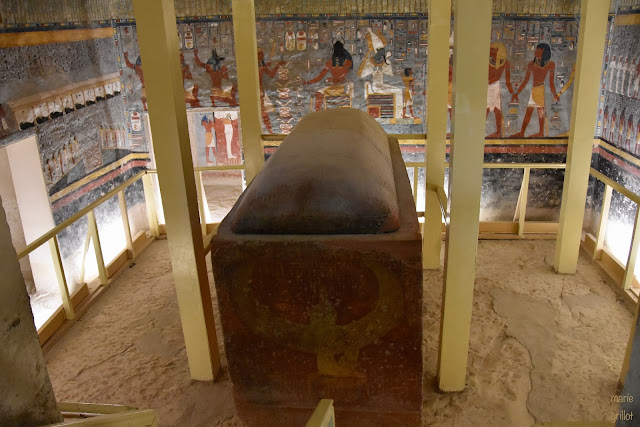
Sources:

Anouket Emblem https://collections.louvre.fr/ark:/53355/cl010024883              Jean-Pierre Corteggiani, Ancient Egypt and its gods – Illustrated dictionary, Fayard 2007
Sylvie Guichard, Jean-François Champollion, Descriptive notice of the Egyptian monuments of the Charles 87-88, illus. p. 88, A. 136
Guillemette Andreu, The artists of Pharaon. Deir el-Medina and the Valley of the Kings, RMN; Brepols, 2002, p. 273, ill. p. 272, no. 221a                                 -Andreu, Guillemette; Valbelle, Dominica, Guide to Deir el-Medina. A village of artists, Cairo, French Institute of Oriental Archeology (IFAO), 2022, p. 150, fig. 131                     – Barbotin, Christophe, Egyptian statues of the New Kingdom, 1, Royal and divine statues, [Louvre Museum, Paris], Paris, Louvre éditions / éditions Khéops, 2007, p. 146-147, figs. 1-15 p. 238-241, no. 85
Dominique Valbelle, Testimonies of the New Kingdom on the cults of Satis and Anoukis at Elephantine and at Deir el-Médineh, Bulletin of the French Institute of Oriental Archeology (BIFAO), 75, 1975, p. 123-145,                                           https://www.ifao.egnet.net/bifao/75/7/, p. 141-145, figs. 7, pl. XXI-XXIIII, Doc. 10          Jean-François Champollion, Descriptive notice of the Egyptian monuments of the Charles X Museum, Paris, Imprimerie de Crapelet, 1827, p. 7, A.136      https://gallica.bnf.fr/ark:/12148/bpt6k1040365n

Publié il y a 15th October par Marie Grillot
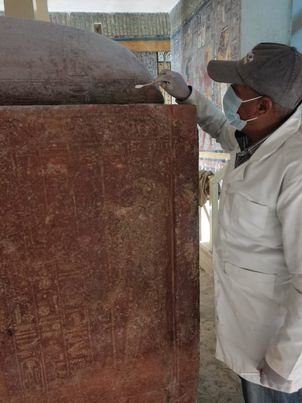
Libellés: 1826 Anoukis bois Collection Salt Deir el-Medineh Emblème; Anouket karité Louvre N 3534 Salt n°559 tamaris