I think this platform is a great space to express feelings, and, as my dear friend and excellent writer Shehanne Moore advises, I allow my thoughts to flow openly.
As you might have guessed, I am currently at a loss for words! My mind feels cluttered, and I struggle to focus as I normally would. The situation in Iran is deteriorating, and additionally, the responses from Western audiences, whether Iranian or not, lead to more confusion.
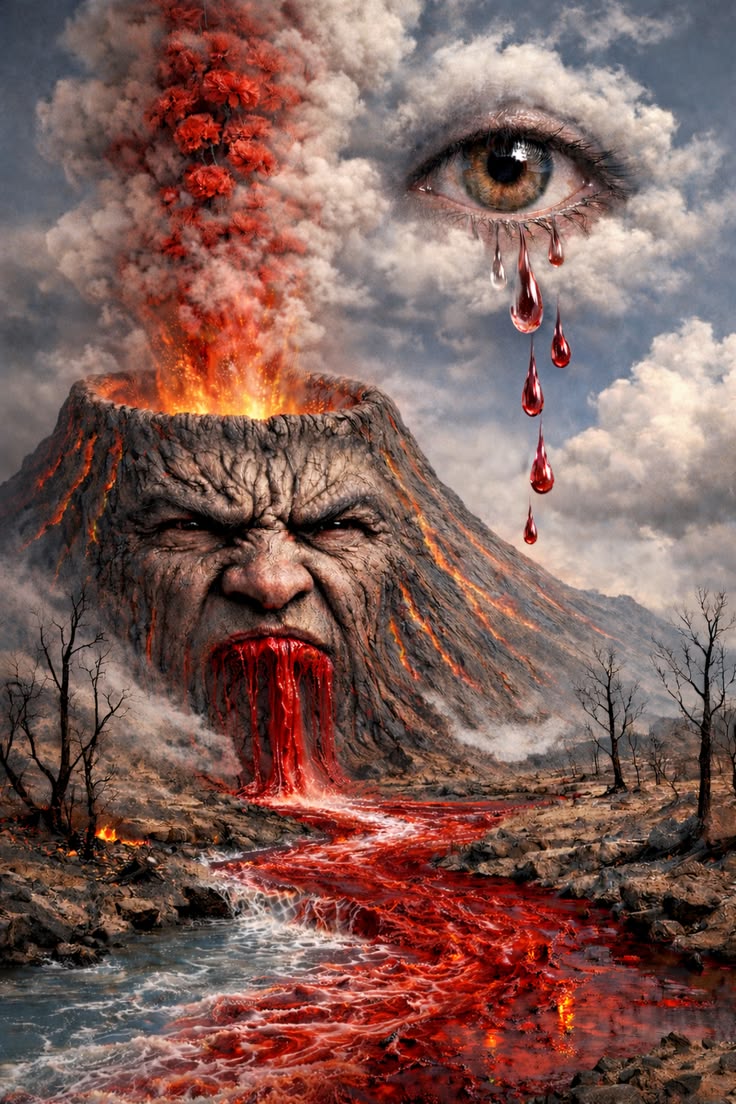
This surreal piece shows a volcano with an angry face, erupting with floral smoke and blood across a barren landscape. An eye above sheds tears that turn into blood, symbolising both creativity and destruction. Flowers representing beauty and fantasy are destroyed by lava and blood. I chose this image to express my fleeting feelings about the current state of the world.
Many people call for peace, but they often lack a clear understanding of or haven’t deeply considered what has been happening in Iran over the years. Simply saying “stop the war” is insufficient, as it raises the question: which war do they mean? I am referring to two wars: one that is ongoing now, and another that the regime has been waging against the Iranian people for many decades.
Of course, I don’t judge everyone equally. I have honest friends deeply concerned about innocent lives, such as the over a hundred schoolgirls killed at their school at the conflict’s start. Wars inevitably cause innocent casualties. The scenes in Gaza following Israeli strikes are truly unforgettable! But I see no difference between dying from regime bullets or American and Israeli bombs. There may be a point where bombing foreigners could help end this suffering.
The Iranian people find themselves in a dilemma. Naturally, they do not want war, but at the same time, they oppose this murderous regime. As a result, they are trying to endure this terrifying situation. I remember vividly when I lived in Iran, those days of conflict with Iraq. In those days, or rather, those nights, Al, some friends, and I would gather together in one of our friends’ flats and play cards all night long, until the bombs started falling. Simply put, we did not want to die in our sleep!
It felt like a lottery; the question was, who would win next? One could either win or lose; there was no draw!
People in Iran are taking similar actions now; what else can they do? But those who live in freedom and peace, presenting themselves in an intellectual and civilised manner, say that war must be stopped! And I still ask: “Which war are they referring to!”?
Ultimately, I recognise that the situation centres on money and power, and I can only hope that the Iranian people are on the advantageous side. 💖🙏
I believe in them more than they believe in themselves. Franz Kafka
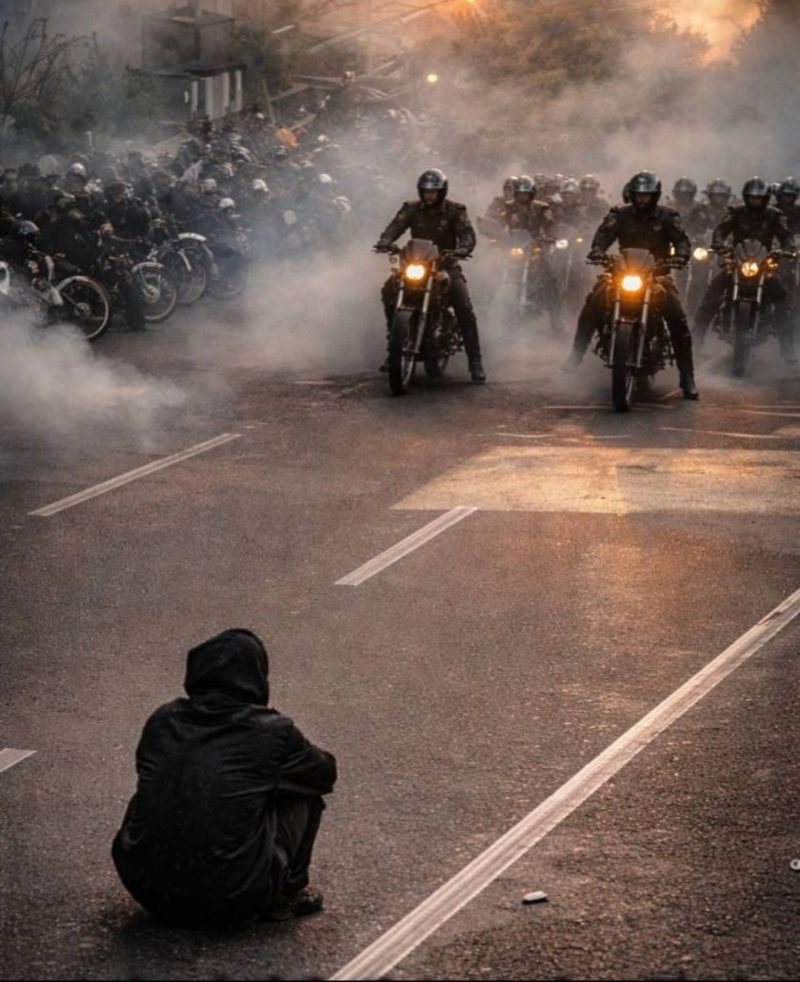
I stayed silent throughout these days, despite the pain in my heart. With my wet, excited eyes, I observed the events in Iran. I saw large crowds of young people, both girls and boys, demonstrating courageously and risking their lives—more than during the last forty years of uprisings—fighting against the Mullahs’ regime tyranny for freedom. But what a dream! As I heartbreakingly knew, the influential figures behind the scenes never allowed a free Iranian state to emerge, and they employ the same tactics as they did with the 1953 coup against the Mossadegh government.
From the beginning of the Mullah regime’s rule, I realised it was simply another Western invention. It appeared different: instead of backing America, it called for its death, but ultimately, the result was the same- control was maintained! And unfortunately, I see the West, with their puppet loudmouth as the front, trying to install another puppet in power in Iran to keep control and reap benefits.
That’s unfortunate: so much bloodshed without any reward! Willy Brandt, the former German Chancellor, once asked: ‘Must one practise democracy, or should one dare to embrace it?’ The real question is: practising for how long and at what cost? Certainly, friends and activists outside Iran may disagree or be hesitant to agree with my perspective. I understand that my view is blunt and unsettling, but the truth is undeniably tough to face.
I didn’t want to dwell on these disappointing events, but when my dear friend Resa asked how I felt, I decided to write a few words, and I leave it to you to judge the role of the great politicians in power. Also, I don’t want to share many photos or videos as they can deeply affect anyone who watches them. 🙏
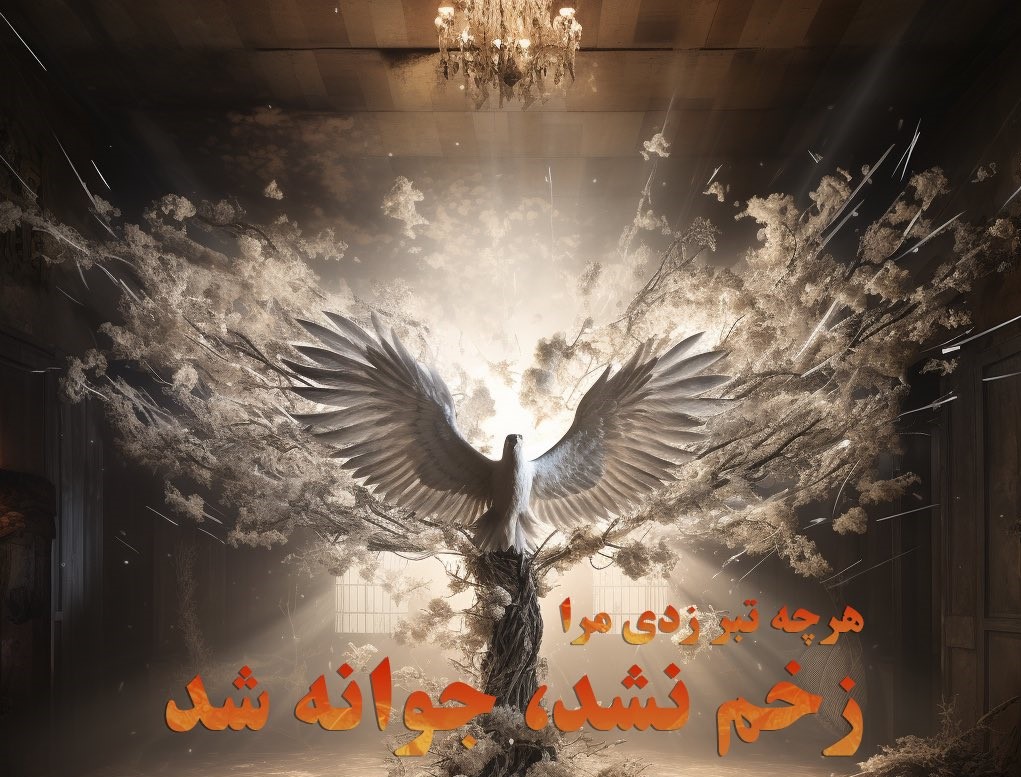
Whatever you shot me, it left no scar; it sprouted!
Many events are happening worldwide, but most are disheartening: millions of refugees, wars, hunger, uncertainty, and executions. However, I want to focus on the last one and have to, again, urge the world to put an end to it. It appears there is a systematic plan to eliminate the young—those full of hopes, dreams, and potential. They represent the future of Iran, brimming with creativity and energy, and they are at risk of being destroyed.
via Euronews
I don’t want to hurt my friends, but it appears that a brutal regime in the Middle East aims to massacre the youth and destroy the wealth of ancient and precious folk and their country!
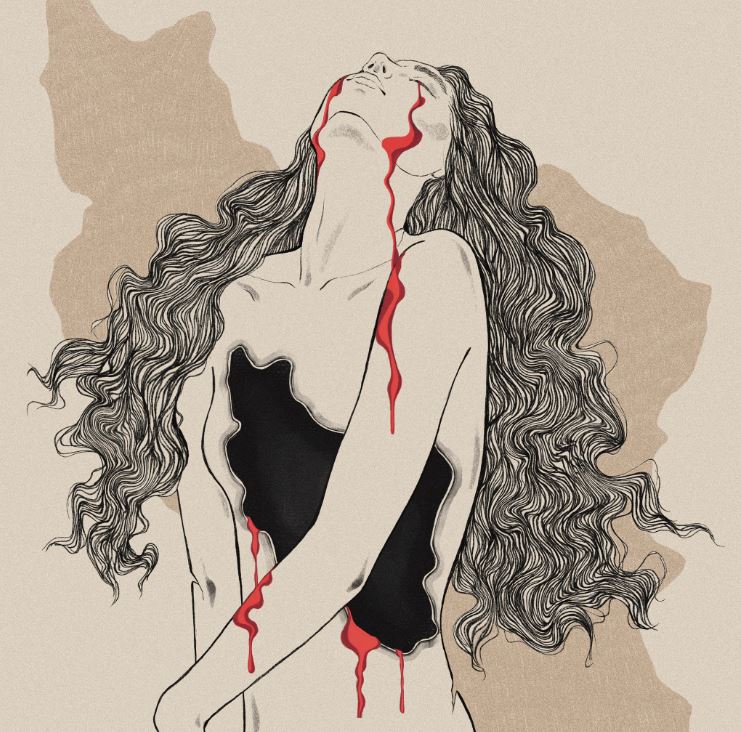
Iran-hair, via Ruth Millington: ‘For my brave Iranian sisters’ by r0yart @_r0yart
The Islamic Regime searches for them on purpose to get them, jail them, and execute them. Prisons, including special facilities for political prisoners, are present in the political history of many countries. In Iran, one such prison is known as Evin. It should have been demolished after the fall of the Shah; however, the mullahs found it to be much more advantageous for their purposes.
Woman-Life-Freedom- via Amnesty International
I have often mentioned that global superpowers benefit from having a chaotic regime or a wild dog in that region, like the Mullah Regime. They maintain control over those countries through fear, hoping that the West will take action against this threat. But how long should it go until no common sense remains there? And then, Westerpower engages another favourite doll to work with?!
Azadeh’ [Ah-Z-ah-d eh] (Persian: آزاده) ‘Meaning: She who is Free’ by Luna @lunaleonis
I believe you are as muddled as I am; what can we do? I just shout to the world: Stop this terrifying terror against humanity and our outstanding youth!
We might only keep praying for the lives of those who want their right to live, which is their inalienable right. The right to live in freedom!
Last week, I came across this song by Joan Baez and found it so pertinent to the topic because she always sang for the people who fought for their rights. #Woman_Life_Freedom!💖✊🙏
“There But For Fortune”
Joan Baez
Show me the prison, show me the jail Show me the prisoner whose life has gone stale And I’ll show you a young (wo)man With so many reasons why And there but for fortune, go you or I…
Show me the alley, show me the train Show me the hobo who sleeps out in the rain And I’ll show you a young (wo)man With so many reasons why And there but for fortune, go you or I, mm, mm
Show me the whiskey, stains on the floor Show me the drunkard as he stumbles out the door And I’ll show you a young (wo)man With so many reasons why And there but for fortune go you or I…
Show me the country where the bombs had to fall Show me the ruins of the buildings, once so tall And I’ll show you a young land With so many reasons why And there but for fortune go you and I, you and I.
Out of the darkness, through the open window of Birth, human life comes to the earth; it dwells for a while before our eyes into the darkness, and then, through the open window of Death, it vanishes out of sight. Annie Besant
This post may serve as a brief introduction to a significant revolution in a fledgling nation striving for its freedom and the right to lead a happy and healthy life. I decided to write this article because, in my latest post, I mentioned a short note about women and their fight for their rights in Iran, and one of my adorable friends, Petra Glimmdall, asked me to write a more extensive article about this happening.
I’ve written about this topic onceortwice before! However, I’ll do my best to provide more details about one of the most widespread, laborious, and challenging struggles for freedom faced by the people of a vast country with a rich history. They have come a long way in their quest for rights but have not yet achieved their goal.
Iran has a long history of uprising, starting with the Persian Constitutional Revolution at the beginning of the twentieth century (1905-11), which could hold on but annihilated and oppressed by Reza Khan Pahlavi‘s ambition and selfishness (1925), up to the nationalize Iran’s oil industry under Dr Mossadegh‘s government (1951-53), which has been collapsed by Mohammad Reza Pahlavi’s coup d’état, until 1979 the revolution against Shah’s regime which Islamic treacherous Mullahs had stolen. Now we see there is no end to this!
However, this time, the heart of the issue is women who hold the head of the rope in their hands, and these protests represent the first uprising led by women.
New Yorker Women in Iran, Illustration by Roshi Rouzbehani
The Women’s Life Freedom Movement in Iran started in September 2022 after the tragic death of Mahsa (Jina) Amini. She was a young Iranian woman who was arrested by the morality police for not wearing her hijab correctly and found dead in the hospital a few days later.
In fact, the Iranian uprising began in 2009 during the so-called Green Movement. This occurred after the presidential election that year, and the people felt deceived by the extremists in front of the regime, although it was a pretext to rebel against them.
Even then, there was a woman who fanned the flame of the Green Movement revolution: Neda Agha-Soltan, an Iranian student of philosophy, who was participating in the protests with her music teacher and was walking back to her car when she was fatally shot in the upper chest.
It took some months then after the Islamic Regime brutally suppressed the revolution by banning international media, cutting off the internet for a week and killing more than one thousand and five hundred protestors.
This time, however, it has been ongoing for about two years, and it seems to be gaining momentum because, in my opinion, it is under the banner of Women, Life, and Freedom. It is not just for the Iranian people but for all people (especially women) around the world.
Honestly, I am a pessimist, not specialized in the Iranian future, but rather in the human condition as a whole. I have some theories that some might consider conspiratorial! However, I believe that for many decades, the actions in Iran, particularly the Islamic Regime, have been under the control of great powers like the USA and other interested authorities. I’m just trying to reason: How can it be that a regime that is unpopular and hated from within and is subjected to constant sanctions from outside remains in power so calmly and shows no weakness?! The West certainly supports this.
Significant changes will occur in the Near and Middle East when the time comes. When is this time? It is when weapons factories achieve good sales, when Putin’s regime becomes weak (though Putin shouldn’t go away!), and when peace is restored. At that point, it will be time for a regime change in Iran. These are my predictions!
Do you smile like the Rose at loss and gain? For the Rose, though its petals may be torn and asunder, it still smiles on, and it is never cast down. Maulana Jalaluddin Rumi
Finally, to help you understand the core of this uprising, I’m showing you an example named Nika, Nika Shakarami. She is one of many victims of this injustice and brutality—a girl, as you can see in this short video, with lots of dreams, full of hopes and a joyful heart and soul. She was one of the first victims of the Mahsa (Jina) revolution, possibly because of their optimism in believing the uprise would soon win.
Here is a new report of her brutal death, which BBC broadcasted:
I have added two more videos about the history of the Iranian uprising to provide you with additional fundamental information.
I believe I have mentioned this before, but I want to reiterate that I understand everyone faces different challenges in life, and nothing is easy. While I value every thought and acknowledgement, I would appreciate your sympathy and empathy, my dear friends. May the justice win at last! 🙏💖🙏✊
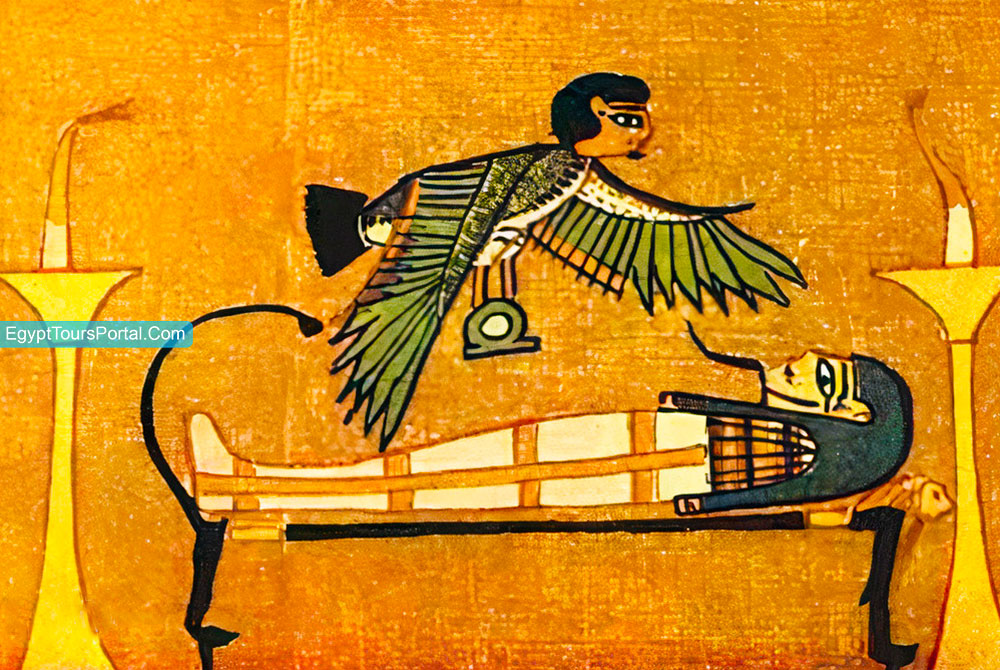
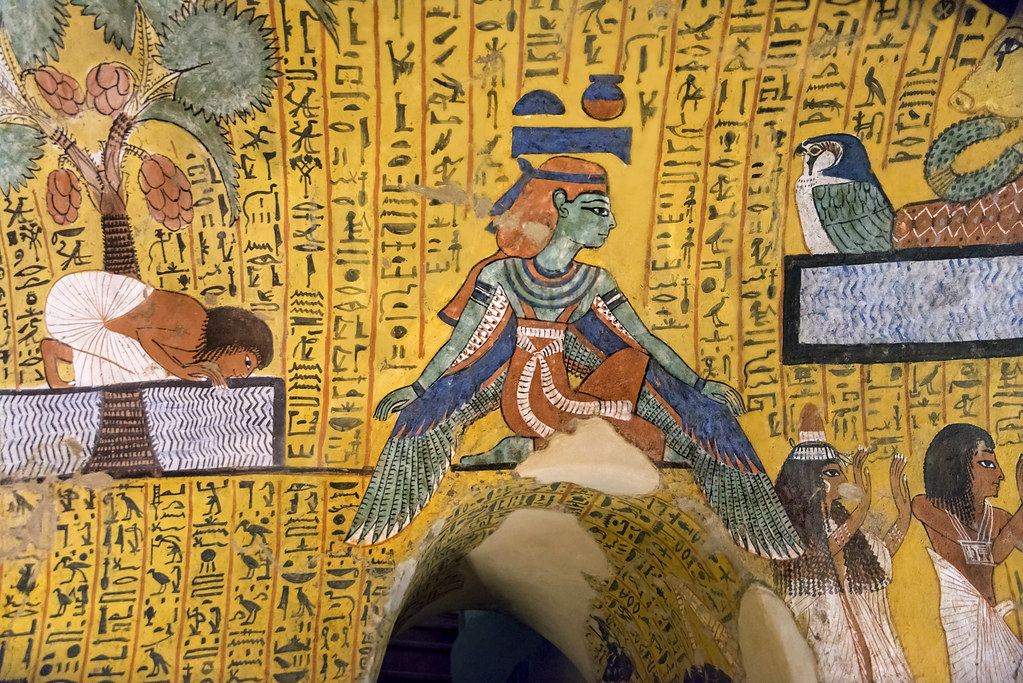
3 Elements to the Egyptian concept of the soul: Ka, Ba, and Akh .___ ((Ka)) is the life force or spiritual double of the person. The royal Ka symbolized a pharaoh’s right to rule___((Ba)) is represented as a human-headed bird that leaves the body when a person dies.___((Akh)) was a concept of the dead that varied over the long history of ancient Egyptian belief, was associated with thought, but not as an action of the mind; rather, it was intellect as a living entity.
“May it see my corpse; may it rest on my mummy, Which will never be destroyed or perish.” PAPYRUS OF ANI, New Kingdom, Dynasty XVIII, Collection of The British Museum.
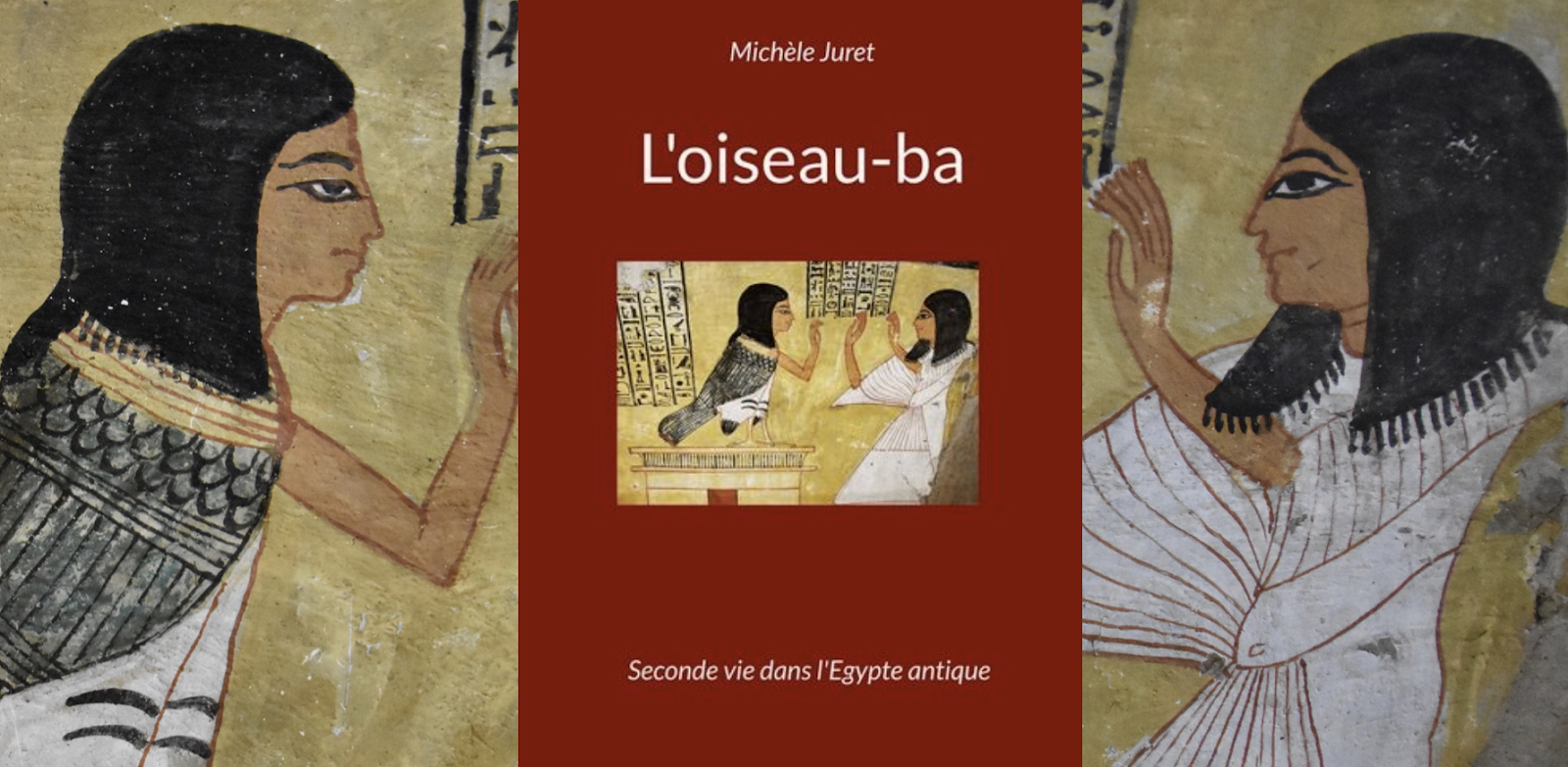
Our topic in this article is the Ba, the master of soul and body, and we have the chance to read an excellent interview by Marie Grillot with brilliant Michèle Juret and an introduction of her book about the secret of this bird and all we can get to know about it.
Inherkaou and his “ba”, represented in the burial chamber of the tomb of this team leader for the Master of the Deux-Terres TT 359 – Deir el-Medina – 20th dynasty – Ramses III Ramses IV “The ba-bird, Second Life in Ancient Egypt” by Michèle Juret – published by Books on Demand
A graduate of the École du Louvre and curator of the Montgeron Museum, Michèle Juret is notably “the” biographer of the Egyptologist Etienne Drioton, the last French director of the Egyptian Antiquities Service.
With her new publication: “The Ba-bird, Second Life in Ancient Egypt”, she devotes herself to a theme that is particularly dear to her since it was, from 2002, the subject of her research dissertation. Driven by her interest and passion for this entity flying “between two worlds”, she has never stopped researching and “taming” its multiple and diverse representations… Evoked in several chapters of the “Book of the Dead”, the ba-bird is found on the walls of tombs, on coffins, papyri, steles, statues, offering tables, or even on pectorals and amulets… As meticulously as it is applied, this well-documented study allows us to understand better this conception of “ba” so intimately – and specifically – linked to ancient Egypt…
Michèle Juret, author of “The Ba-bird, Second Life in Ancient Egypt” published by Books on Demand in May 2022
MG-EA: To understand what a “ba-bird” is, we must certainly first understand the importance of this “ba” entity in the conception of the personality of the ancient Egyptians.
Michèle Juret: First of all, I would like to thank you, Marie Grillot, for this interview, which allows us to discuss the essentials of this work, namely the observation of the iconography of the ba in the light of the funerary texts. As you say, it is first necessary to understand the importance of this fundamental entity, a guarantee of survival.
For the ancient Egyptians, the individual is made up of various elements: The body, immobilized by death, will remain in the grave. Ka, the vital force, draws its energy from food. The Akh, celestial spirit, magical power, can be beneficial or evil. The shadow will enjoy a certain independence. We commonly translate the ba by the word soul, although the concept is much more complex. An important element is that it is of divine nature. The Alter-ego of the deceased is essential to his survival.
MG-EA: The ba-bird generally presents itself as a composite, anthropo-cephalous being, that is to say, with a human head and a bird’s body: when did it appear, in this form, in the iconography?
Michèle Juret: This half-avian/half-human appearance is the culmination of a slow evolution. From the Old Kingdom, the king’s ba, named in the Pyramid Texts, appears in hieroglyphic writing as a wader with a loop at the base of the neck. In Middle Kingdom texts, it is seen as a bird with the head of the living (human) without this image appearing in the writing. Finally, some amulets and masks decorated with feathers date from this period, and then the rishi sarcophagi will become milestones towards this figure of an anthropo-cephalous bird that we will commonly encounter from the New Kingdom onwards.
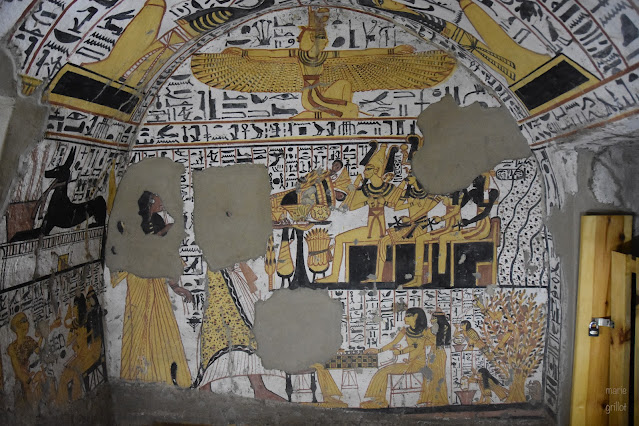
Irynefer and her “ba”, represented in the burial chamber of the tomb of this servant in the Place of Truth. TT 290 – Deir el-Medina – 19th dynasty – Ramesses II
MG-EA: Indispensable to the survival of the being that death has immobilized the ba-bird, he enjoys total freedom… He can enter and leave the grave in, you write, “a moving interdependence with the deceased”? He thus becomes the guarantor of his “post-mortem” future?
Michèle Juret: Indeed, Le ba enjoys total freedom. He will be able to leave the tomb, climb into Ra’s boat, benefit from its rays, drink the regenerating water of the tree goddess, benefit from the food offerings… Every evening, he will rejoin the body of his deceased; their survival depends on their reunion… Observing this iconography transports us into an almost magical world. We follow the entity in its daily comings and goings, alone or accompanying its deceased, maintaining its own life through food offerings or providing this food for the deceased’s ka. Finally, it unites with it in an interdependent guarantee of survival.
Bird-ba of Youya – painted limestone – 18th dynasty – from his tomb KV 46 Cairo Museum – CG 51176
MG-EA: Evoked and invoked in several chapters of the Book of the Dead, associated with the cycle of the sun, it is itself endowed with several “becomings”?
Michèle Juret: Yes, in fact, several futures are possible for him. We have just mentioned the best and most probable, the second life as an alter-ego of the deceased. Let us remember that the post-mortem fate of the ancient Egyptians is complex. A solar destiny will allow him to follow Ra in his boat or a stellar one among the stars, and finally, an Osirian destiny will allow him to cultivate the fields of Ialou. How can we reconcile these notions, which seem contradictory? The ba-bird becomes the answer to this question and the link between these different post-mortem futures. His destiny is divine.
But he could be led towards another destiny linked to that of the heart, a very important element.
The texts also evoke the presence of the ba at the weighing of the heart, a scene of judgment also called psychostasis. In chapter 125 of the Book of the Dead, it is attested through Thoth’s words: “I have examined the heart of Osiris Ani while his ba presents himself, stands as a witness about him…” In the vignette from this papyrus, we see the ba-bird witnessing this judgment. Its future is linked to that of the heart. The Book of Caves gives a version of its annihilation if the heart is declared guilty. While this would be separated from the deceased and thrown into one cauldron, the ba and the shadow would be thrown into another. The deceased would be among the damned, those who no longer have a soul. Like that of the body, the destiny of the ba is linked to that of the heart key of life.
“Birds-ba” represented at the bottom right of this scene from the burial chamber of the tomb of Nebenmâat. servant of the Place of Truth – TT 219 – Deir el-Medina – 19th dynasty
MG-EA: Your research, targeted on the “ba-birds” of individuals from the New Kingdom, was based on a vast literature and the study of numerous of their representations: their iconography is rich and evolving, and the location where they take place, always full of meaning?
Michèle Juret: Yes, as you say, these representations are loaded with meaning. It was important to bring the iconography closer to the funerary texts. There, we find the reading keys. The analysis of the documentation fully reflects the different situations they express. Furthermore, the location of certain scenes on the tombs’ walls was not chosen randomly but determined according to the theme evoked.
MG-EA: You not only studied their adornments and hairstyle, but to refine their description and relate them to existing species, you also had to develop ornithological talents?
Michèle Juret: Ornaments and hairstyles allowed me, in some instances, to put forward a possible desire to identify with the deceased. Furthermore, observing the bodily appearance of these birds, another aspect of this study, highlighted different options in the choice of species depending on the chapters of the Book of the Dead that they illustrate. This observation proved fascinating, and I ventured to put forward some hypotheses. Unfortunately, I didn’t have the “ornithologist talents” you mentioned. A specialist from the Natural History Museum helped me a lot with this identification.
Raya and his “ba”, represented in the tomb of this Fourth Prophet of Amon TT 159 – Dra Abou el-Naga – 19th dynasty
MG-EA: Would you not be tempted, now, to take an interest in the “ba-birds” of the pharaohs and queens?
Michèle Juret: Obviously, it’s a subject that also deserves to be addressed. In this study, I was tempted to quickly evoke the ba-bird of Tutankhamun and especially that of Queen Nefertari, an extraordinary example. On the one hand, its extremely composite body appearance combines both falconiform and anseriform characteristics, two birds with solar connotations. On the other hand, its profile, resembling that of the queen and its crown, the remains of a vulture surmounted by the modius, reinforce this idea of a desire to identify the ba-bird with its deceased.
Nefertari and her “ba”, represented in the antechamber of the queen’s tomb TT 66 – Deir el-Medina – 19th dynasty – Ramesses II
This iconography fully reflects the importance of the ba in the Egyptian’s concerns for his post-mortem future. It will also be able to completely replace itself and become, in its place, as a substitute, the active element. Survival is in him. This is perfectly expressed on the stele of Neferhotep, which caught the attention of Etienne Drioton…








 lampmagician
You must be logged in to post a comment.