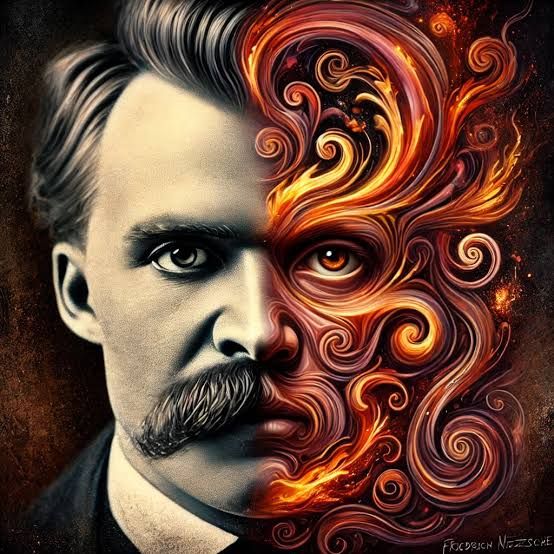
Friedrich Nietzsche’s Political View; A Look at the State.

Standard

Recently, I saw a critical performance of Richard Wagner on German TV about his racism, presented by an Italian or Spanish artist whose name I have forgotten. However, this reminded me of Nietzsche’s distancing himself from Wagner due to his disgust towards specific individuals, even though Nietzsche was in love with his sister, Cosima. (The reason may also be that Nietzsche had a very close relationship with a man named Paul Rée, who was Jewish.)
For Nietzsche, the Tribschen period was far from idyllic. It was challenging as he constantly tested himself to meet Wagner’s expectations. He began writing his first book while regularly visiting the Wagners’ home in Tribschen, anxious about whether his work would satisfy Wagner. This era was marked by aspiration, vulnerability, and self-testing for Nietzsche. He was essentially an apprentice to a genius, experiencing a vital rite of passage in his creative journey.

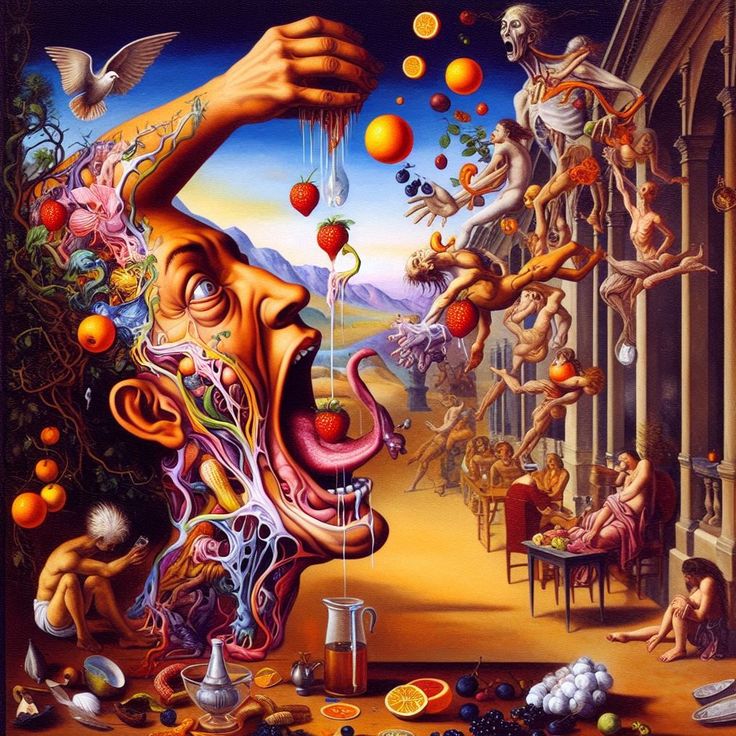
Free AI Art
(On the top: Surreal Abstract Painting.)

Neither Nietzsche nor Wagner understood one another realistically. Nietzsche saw Wagner as a benevolent father but felt disappointed by his egotism. Conversely, Wagner viewed Nietzsche as a loyal son who became a rebellious thinker. Both pursued psychological needs that overshadowed their friendship and intimacy.

Anyway, I found two paragraphs I’ve translated from one of his books, Menschliches, Allzumenschliches (Human, All Too Human). I present them to you because I believe they are very relevant to our “political” society today.
From the Book “Human, All Too Human”, Volume One

(No. 458) Guiding Spirits and their Tools.

We see great statesmen and generally all those who have to use many people to carry out their plans, sometimes proceed in this way, sometimes in that way: either they select very finely and carefully the people who suit their plans and then give them relatively great freedom because they know that the nature of these chosen people will lead them to where they themselves want them to go, or they choose poorly, even take what comes to hand, but form something suitable for their purposes out of every ton. This last type is the more violent; it also requires submissive tools, its knowledge of human nature is usually much less, and its contempt for human nature is greater than that of the first-mentioned minds. Still, the machine they construct generally works better than the machine from the workshop of the former.

Spiral to the Hole

(No. 460) The Great Man of the Masses.

The recipe for what the masses call a great man is easy to give. Whatever the circumstances, get them something they find very pleasant, or first put it into their heads that this and that would be very pleasant, and then give it to them. But not immediately at any price: you have to fight for it with the greatest effort or seem to be fighting for it. The masses must have the impression that there is a powerful, even indomitable willpower; at least, it must seem to be there. Everyone admires a strong will because no one has it, and everyone says to themselves that if they had it, there would be no limits to them and their egoism. If it turns out that such a firm will achieve something that the masses find very pleasant, people admire it once again and wish themselves luck instead of listening to the wishes of its greed. Moreover, he has all the qualities of the masses: the less they are ashamed of him, the more popular he is. So, He is violent, jealous, exploitative, scheming, flattering, grovelling, conceited (narcissist) or anything, depending on the circumstances.


A brief update: My challenging circumstances remain the same, but I’m relieved that my boss has exited the hospital. His blood tests are standard, yet he still cannot return to work. Therefore, I must continue managing things as the acting boss!
I am always grateful for your support and companionship, and I wish you all a lovely weekend.🙏💖


“Celebrating a New Birthday, While Still Embracing the Good Old Days.”

Standard

Jai guru deva, OM (Nothing’s Gonna Change My World!)

Foreword!
This year is a leap year, which makes the Gregorian calendar a bit confusing compared to the Persian calendar. While the Persian calendar also includes a leap year, the extra day falls at the end of the last month of the Persian year and marks the end of (next) winter. In contrast, the extra day in the Gregorian calendar has already transitioned by February, when we reached the leap year.
After researching, I discovered that my brother Al’s birthday is tomorrow. Unfortunately, I won’t have time to celebrate it then. So, I’ve decided to post this celebration today, and I’m sure Al won’t mind!

If we consider earthly time, he would be seventy-two; however, if one leaves the earth, time (and place)—at least in this variant—will no longer exist. However, as I still hear these tiktoks of the erosive passage of earthy time and count them, I return to these events to refresh my memories.

One of the memories that lingers in my mind is undoubtedly the Beatles. We grew up with them, and I clearly remember how, in the early sixties, we eagerly collected every new poster of theirs to hang on our room walls. This was somewhat unusual in Iran then, as most other youths listened to Iranian music. So, in our own way, we were odd!!!

Later, one of their songs, “Two Of Us,” became one of our favourites because it was about the “two” of us. I believe every lost child wants to find their way back home.

And I still hold onto those memories, learning from his wisdom; he was always a few steps ahead of me.

Honestly, I didn’t plan to post anything this weekend because I didn’t have time to come up with an idea. However, Al’s birthday inspired me to write a post. Additionally, tomorrow marks the anniversary of John Lennon’s shooting, so I’ve combined these two events in my thoughts. I believe Al and John share many points in common.

May their souls rest in peace.
Nothing’s gonna change your worlds!
Happy earthy birthday, dear peculiar brother.

The Way We Go!

Standard
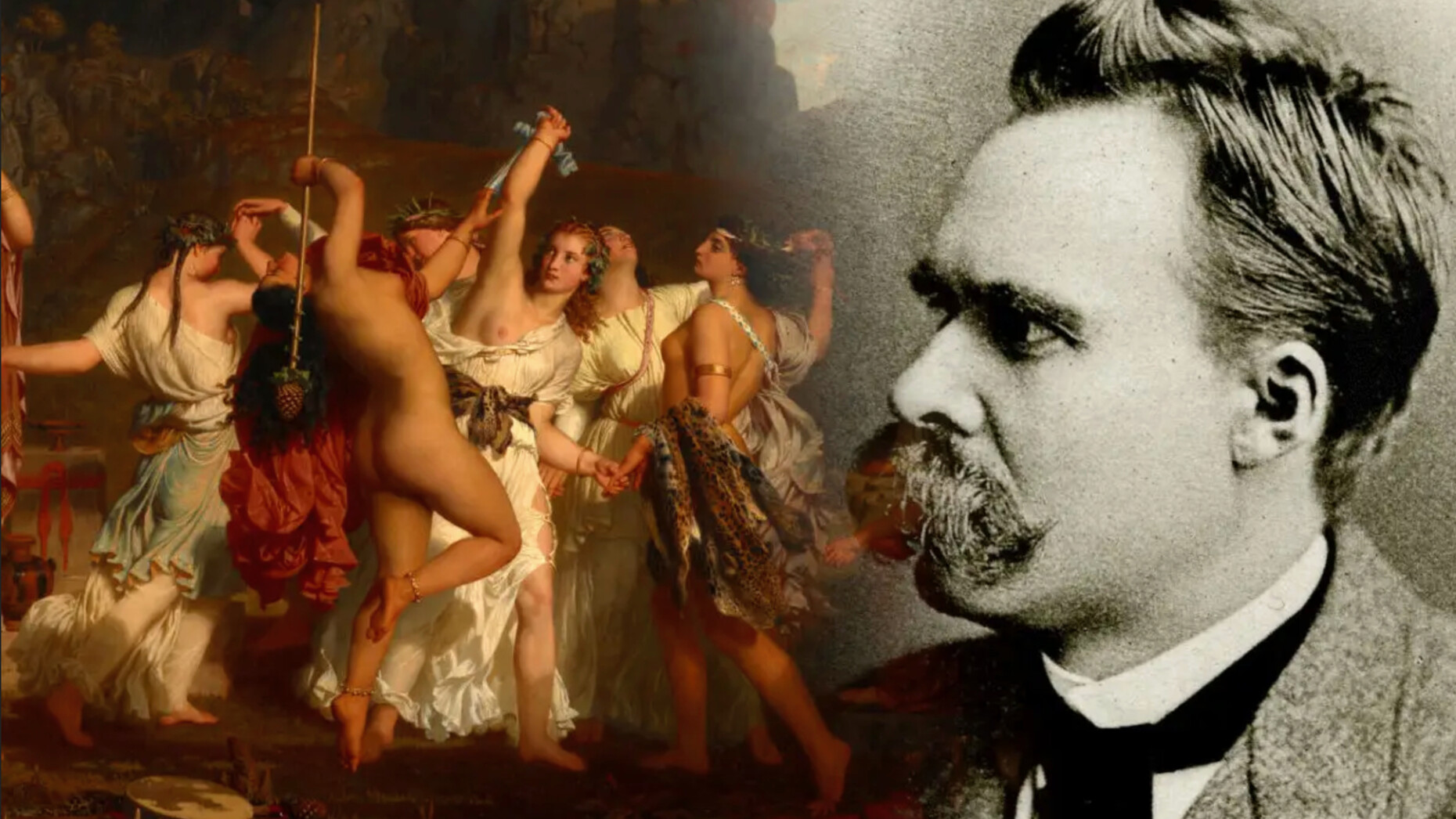
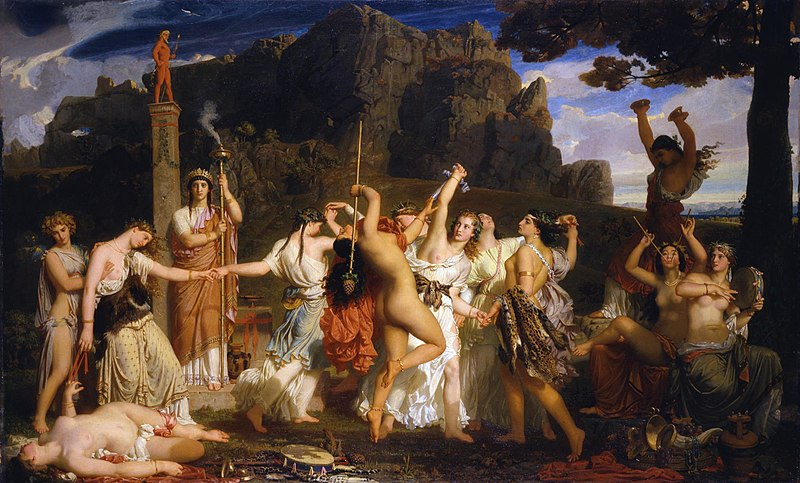
The Dance of the Bacchants, by Charles Gleyre and Friedrich Nietzsche (Artwork: Mark Rothko)

Recently, I read a post on FB from a good friend, Scott D. Smith, about how we might have to get through Nietzsche to understand Dr. Jung better! I agree totally; though Dr. Jung’s works are not philosophical but psychological, Nietzsche has an immense influence on Jung’s doctrine work and his psychological analysis in general.

Nietzsche admired Greece and Greek mythology, often quoting Schopenhauer and using Hegelian ideas to discuss art. He connected ancient Greek tragedy with Richard Wagner’s opera. Let’s see what he meant by Dionysian.

Dionysus, the Greek god of wine and music, is associated with the Dionysian, a state of self-forgetting where individuals unite with others and nature. According to Nietzsche, the Apollonian and the Dionysian are essential to art creation. Dionysian art, particularly music, represents madness and drunkenness, appealing to primal human desires and mystical unity with nature.
In “The Birth of Tragedy” (1872), Nietzsche introduced the terms Apollonian and Dionysian to describe contrasting forces in art. The Apollonian represents a calm, rational art, while the Dionysian embodies intense emotion and ecstasy. Nietzsche believed these forces could come together to create a unique art form, as seen in the Greek tragedies of Aeschylus and Sophocles.

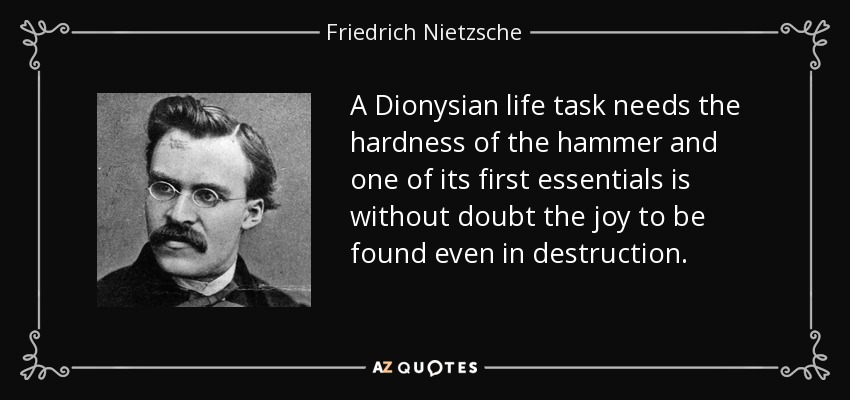
“The saying Yes to life even in its strangest and hardest problems; the will to life, rejoicing over its inexhaustibility even in the very sacrifice of its highest types – that is what I call Dionysian.”

Charles Gleyre La Danse des bacchantes. Wikimedia
The Dance of the Bacchantes, the last painting by Gleyre exhibited publicly in Paris (at the Salon of 1849)

I believe his thoughts are timeless, as humans almost permanently experience the same failures based on ignorance. Here he speaks:

“Now we see the struggle, pain, the destruction of appearances as necessary because
of the abundance of countless forms pressing into life because of the boundless
fecundity of the world will…That primal Dionysian delight experienced even in
the presence of pain is common to music and tragic myth.”
“Dionysian art wants to convince us of the eternal delight of existence… Now
struggle, pain, and destruction… are seen as necessary…Despite terror and pity
we rejoice in living not as individuals but as part of the life force with whose
procreative lust, we have become one.”
“the world is becoming and perishing, creation and destruction, without any
moral content, in eternal innocence.”
“Now, sure of united victory,
We celebrate the feast of feasts:
Friend Zarathustra has come, the guest of guests!
Now the world is full of laughter, the gruesome curtain is rent,
The wedding day has come for light and darkness.”
Nietzsche: Disciple of Dionysus

Sometimes, our strengths push us so far that we can no longer bear our weaknesses and decline from them.

Of course, we happen to predict this way out, but we can’t change anything. And then we become cruel in that which we ought to guard within ourselves, and our greatness makes us barbarous.

This experience, which we are ultimately forced to pay for with our lives, symbolizes bad people’s effect on others and their time.

With the best they possess—they have within themselves—with that which only they can accomplish, they destroy too many weak, uncertain, unformed, and hesitant beings with the best they have and thus become harmful.

And it can even happen that they do nothing but cause harm because this oldest part of themselves is suddenly emptied, so to speak, only by beings who suffocate their logic and individuality in a glass of strong drink.

And they get drunk to such a point that they can’t help but break their whole body – hands, legs – in all the ways that their drunkenness will lead them.

Source: kwize

‘Man is evil‘ – all the wisest have told me that to comfort me. Ah, if only it were still true today! For evil is man’s best strength. ‘Man must become better and more evil’ – thus, I teach. The most evil is necessary for the “Übermensch’s” best. It may have been good for that preacher of the little people to suffer and be burdened by man’s sin. But I rejoice in great sin as my great consolation. – But such things are not said for long ears. Neither does every word suit every mouth. These are subtle, remote things: sheep’s hooves should not reach for them!” Thus Spoke Zarathustra:

Let us think of the idea in its most terrible form: “existence as it is, without meaning or purpose, but inevitably returning, without a finale into nothingness: ‘the eternal return’. That is the extreme form of nihilism: nothingness (the ‘senseless’) eternal!”

And here, I add one of his poems, Last Will, translated from German.

Last Will

To die thus,
as I once saw him die -,
the friend who cast divine lightning and glances
into my dark youth.
Mutinous and deep,
a dancer in battle -,
the most cheerful among warriors,
the most difficult among victors,
Fate resting upon his doom, hard, thoughtful, premeditated –
trembling that he had won,
rejoicing that he had won while dying –
commanding as he died-
and he commanded that man should destroyed…
To die thus,
as I once saw him die:
Victorious, Destroying…

Thank you, as always, for your presence and stopping by. Have a peaceful weekend, everybody.🙏💖✌

Khalil Gibran on Love

Standard

There have been many attempts to define the extraordinary feeling of love, but it is not an easy task. I know that, as I have also grappled with it repeatedly. Here, I would like to present Khalil Gibran’s approach. I hope you will enjoy it.🙏💖

The illustration on the top by Jeramondo Djeriandi

From The Prophet

Love gives naught but itself
and takes naught but from itself.
Love processed not nor would it be possessed;
For love is sufficient unto love.

Khalil Gibran Speaks of Love

Then said Almitra, Speak to us of Love.
And he raised his head and looked upon
the people, and there fell a stillness upon
them. And with a great voice he said:
When love beckons to you, follow him,
Though his ways are hard and steep.

And when his wings enfold you yield to him,
Though the sword hidden among his pinions may wound you.
And when he speaks to you believe in him,
Though his voice may shatter your dreams as
the north wind lays waste the garden.

For even as love crowns you so shall he crucify you.
Even as he is for your growth so is he for your
pruning.
Even as he ascends to your height and
caresses your tenderest branches that quiver in the
sun,
So shall he descend to your roots and shake
them in their clinging to the earth.

Like sheaves of corn he gathers you unto himself.
He threshes you to make you naked.
He sifts you to free you from your husks.
He grinds you to whiteness.
He kneads you until you are pliant;

And then he assigns you to his sacred
fire, that you may become sacred bread for
God’s sacred feast.

All these things shall love do unto you
that you may know the secrets of your
heart, and in that knowledge become a
fragment of Life’s heart.

But if in your fear you would seek only love’s peace
and love’s pleasure,
Then it is better for you that you cover
your nakedness and pass out of love’s
threshing-floor,
Into the seasonless world where you shall laugh,
but not all of your laughter,
and weep, but not all of your tears.

Love gives naught but itself and takes naught but from itself.
Love possesses not nor would it be possessed;
For love is sufficient unto love.

When you love you should not say,
“God is in my heart,” but rather, “I am
in the heart of God.”
And think not you can direct the course
of love, for love, if it finds you worthy,
directs your course.

Love has no other desire but to fulfil itself.
But if you love and must needs have desires, let these be your desires:
To melt and be like a running brook that
sings its melody to the night.
To know the pain of too much tenderness.
To be wounded by your own understanding of love;
And to bleed willingly and joyfully.
To wake at dawn with a winged heart
and give thanks for another day of loving;
To rest at the noon hour and meditate
love’s ecstasy;
To return home at eventide with gratitude; And then sleep to with a prayer for the beloved in your heart and a song of praise
upon your lips.

The True History!

Standard

In the history of humanity, we can find many cases that were cover-ups and manipulated in favour of the ruling authority. I recall someone once saying: ‘In every battle, if you lose, you are a criminal. But if you win, you are a hero! Now that AI has become more prevalent, manipulation in our society has become much easier. I wonder whether the recent technological advancements result from human ingenuity or if there is an extraterrestrial influence at work!? To put it bluntly, I sometimes feel that all this technical progress in the hands of human beings is akin to giving a carrot juicer to a five-year-old child!

“Until lions have their historians, tales of the hunt shall always glorify the hunters.” Or the winner takes it all!

We will not define or reach the truth until we examine every issue in depth and consider both sides. It would be wise to observe beyond the events, to read between the lines, and not allow ourselves to be seduced by the brilliance of the stronger ones. Never believe the hype. Never trust a rumour! We must rely on our own awareness through our experiences. I have encountered numerous online instances where verses, quotes, or thoughts have been manipulated or attributed to great thinkers who never actually expressed them. It is just abusing the name of a great personality just to make a multiple share on the web!

As Ernest Hemingway once said, meeting Americans individually or personally is amazing, but they are terrible and even dangerous in one mass.

As Dr. Jung says, Thinking is difficult; therefore, let the herd pronounce judgment!

These can constantly appeal to ordinary, everyday facts known to everyone. Still, the instinct for wholeness requires, for its evidence, a more highly differentiated consciousness, thoughtfulness, reflection, responsibility, and sundry other virtues. Therefore, it does not commend itself to the relatively unconscious man driven by his natural impulses because, imprisoned in his familiar world, he clings to the commonplace, the obvious, the probable, and the collectively valid, using his motto: “Thinking is difficult, therefore let the herd pronounce judgment!” It is an enormous relief to him when something that looks complicated, unusual, puzzling and problematical can be reduced to something ordinary and banal,
especially when the solution strikes him as surprisingly simple and somewhat droll. –Carl Jung, Flying Saucers: A Modern Myth of Things Seen in the Sky, p. 48

This quote is also an example of how things get turned around, which may explain the misappropriation. He has never said, “Thinking is difficult; that’s why most people judge.” But this latter became famous and therefore accepted because it has been repeated countless times! However, referring to the quote itself says to think twice and keep questioning before concluding.

Numerous misattributed quotes are circulating online, and one of them is, “Sometimes a cigar is just a cigar.” Contrary to popular belief, Sigmund Freud never actually said that. It’s important to note that it’s challenging to verify the authenticity of quotes online; Abraham Lincoln humorously stated, “The problem with quotes on the Internet is that it is hard to verify their authenticity.”!!

This African proverb is used to describe how dominant groups inscribe power through historical narrative metaphorically. We can see the unfairness in the world despite the access to social media and the questionable accuracy of the information shared. Those in power often have the upper hand. The dominant voice is heard and believed.

One must have tough skin to survive! I prefer to avoid all deception and manipulation and conceal myself behind a strong and unaffected mask to be protected. Or to be so wise as Rumi, keep going and sing your song like a bird.

As a Russian proverb says: Trust is good, but control is better!! Have a leisurely weekend.🙏🖖💕🥰🌹

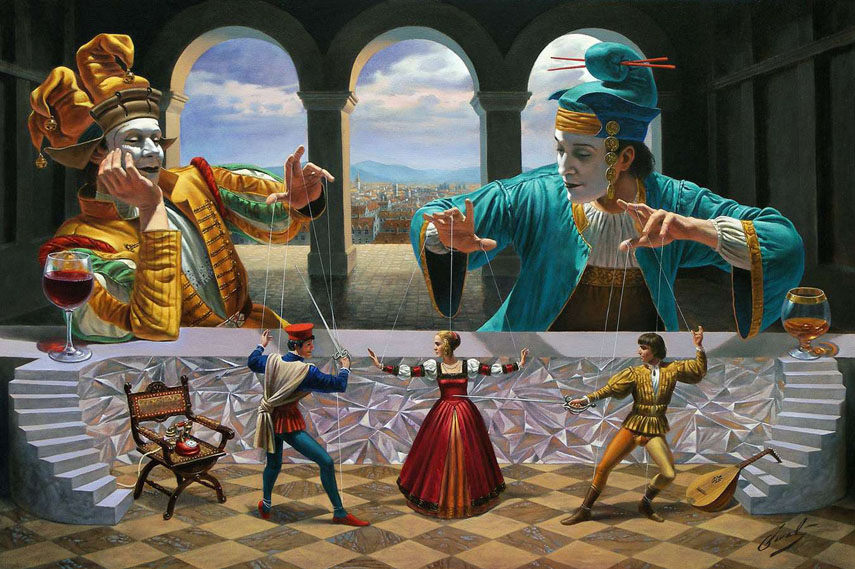
The Play of Life in Act One…

Standard

I still keep looking around me and observing my behaviour in life, and I wonder more and more how much obsession overwhelms me! I mean all the effort I use to be perfect. I strive for everything to go flawlessly, to the point where even the slightest mistake is unacceptable. I know it’s crazy, but I fear leaving things incomplete or unfinished as I grow older. Maybe because the mistakes of the past cannot be rectified or compensated?! I’m aware that this may seem almost autistic, and I make a conscious effort to maintain balance in all aspects of my life. However, it’s not an easy feat. Of course, as we age, we tend to become more carefree as we are on the way to kicking the bucket, or better to say, changing the level, we realize that things lose their worth. One positive aspect of ageing is that we become less concerned about things and more carefree.

A few days ago, I suddenly remembered an old movie comedy from decades ago when I was a teenager. Its name was “Kiss Me, Stupid“, an American movie from 1964, directed by the master of comedy, Billy Wilder. The story is about an amateur songwriting team, Barney Cliff Osmond and Orville Ray Walston, who suddenly find a famous musician, Dino Dean Martin, drunk and lost on his way to their gas station and trick him into staying a while so they can get his influence to publish their songs. Orville offers Dino a place to stay but becomes worried when he learns that Dino needs to have sex every night to avoid headaches upon waking up!

He and Barney arrange for Polly the Pistol Kim Novak, a saloon waitress, to pose as Orville’s wife, Felicia Farr and satisfy Dino, but Orville can’t handle it at all.

Anyway, in this movie, the main psycho character, in my opinion, is Orville, who, with his jealousy and obsession with love and his women, screws everything up! I don’t want to give away the entire plot, as you may watch it someday. I just want to say I was very angry with him when I watched this film; his acting to keep everything for himself was unbelievable, but now I have some sympathy for him. Nonetheless, I would never act in his way. I believe he was jealous of Dino for being loved by every woman!

Now that I am at an age where this topic is no longer relevant, I feel that time dashes, and we must make the most of every minute. I recently came across a Persian anecdote in a WhatsApp exchange, and I found it amusing, so I decided to translate and share it with you. Take care, and have a great weekend.🤗🙏💖

image by crilleb50

Life in a Nutshell.

One day, some old friends who were all 40 years old wanted to make a date to have dinner together. After checking different restaurants, they finally agreed to go to Ali Agha’s restaurant because there are beautiful working maids….!

Ten years later, when they were all 50, they decided to have dinner together again. And after checking different restaurants, they finally agreed to go to Ali Agha’s restaurant because it has delicious food.

Ten years later, at 60, they again decided to have dinner together and finally agreed to go to Ali Agha restaurant because it has a calm and quiet environment.

Ten years later, at 70, they decided to have dinner together again. Finally, after checking different restaurants, they decided to go to Ali Agha restaurant because it has an elevator and a particular way for wheelchairs!

And finally, ten years later, when they were all 80 years old, they decided to have dinner together again. After checking different restaurants, they finally agreed to go to “Ali Agha” restaurant because they all concluded that they had never been there…!!

The advice we get from this story is a clear view of the play of life that is always on the screen!
So, use the present time in the best way.
😉