

I must confess I dream of such an encounter with a divine goddess, and I should not be a king!
This relief adorns the well-preserved tomb of King Seti I (KV17) in the Valley of the Kings. Hathor, Lady of the West, welcomes Seti and presents her menat necklace as a symbol of protection. Her wig is adorned with cow horns, her sacred animal, and a solar disk indicating her status as Ra’s daughter. The hieroglyphic text above identifies her using a falcon symbol in a temple, reading Hwt-Hr, meaning ‘House of Horus’.
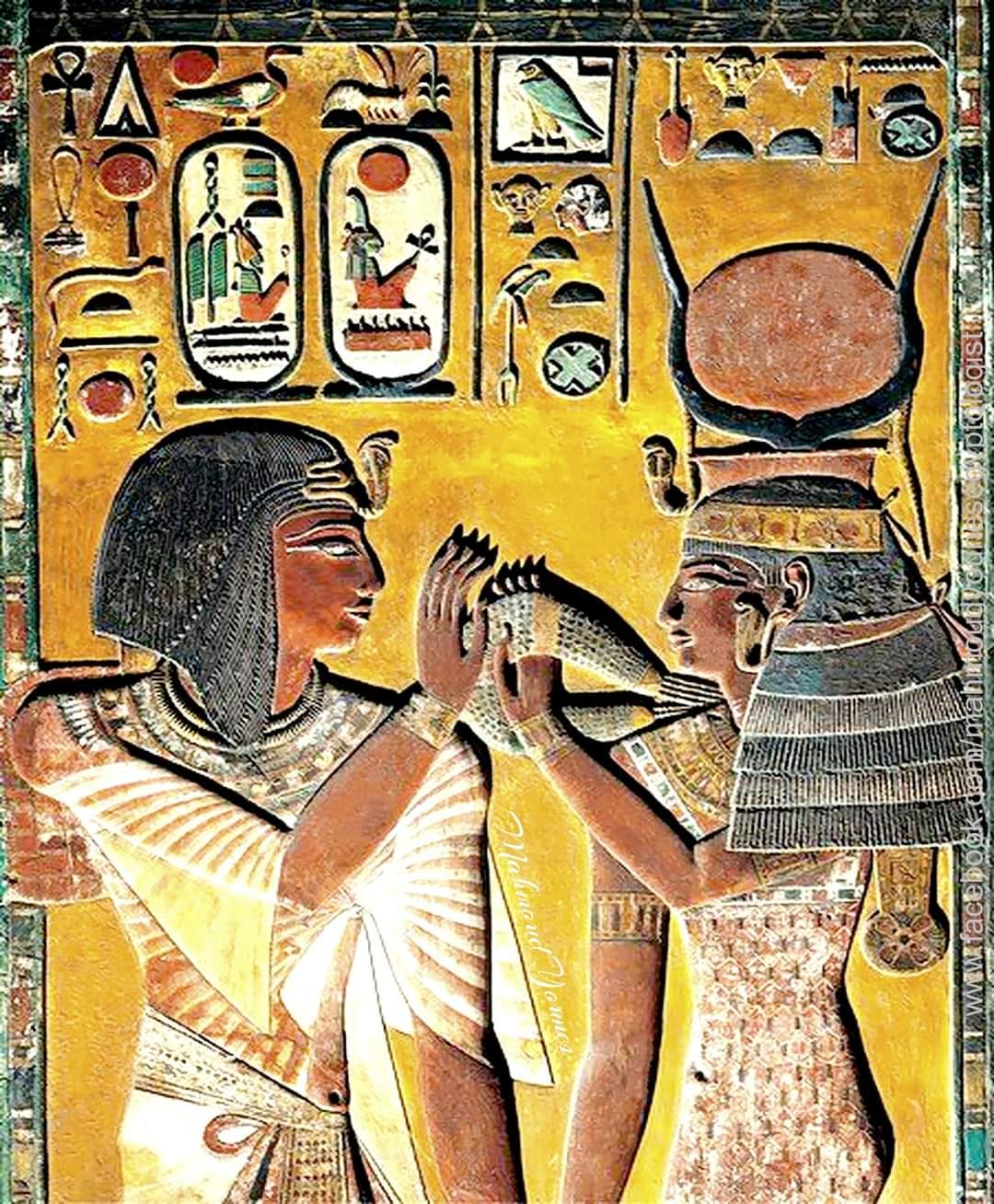
We read a splendid description of this enchanting and divine encounter by the exceptional Marie Grillot. Enjoy!
Hathor and Seti I: a divine and royal face-to-face!
via Egyptophile

découverte le 18 octobre 1817 dans la Vallée des Rois par Giovanni Battista Belzoni
Département des Antiquités égyptiennes du Musée du Louvre – Champollion n°1 – B 7 – N 124 – CC 243 – rapporté par Jean-François Champollion
lors de l’Expédition franco-toscane (1828-1829) – © 2017 Musée du Louvre, Dist. GrandPalaisRmn / Christian Décamps
What intensity, what symbiosis in this divine and royal face-to-face! This “painting” of fine painted limestone, 226.5 cm high and 105 cm wide, brings together the goddess Hathor and Seti I under the sign of the sky – and elegance. As Christiane Ziegler so aptly points out in “Ancient Egypt at the Louvre”: “The scene is treated with the refinement characteristic of the time of Seti I: careful bas-relief, the richness of warm colours, transparency of pleats, the perfection of details for the stone-encrusted front or the pearl net adorning the divine tunic whose motifs take up the names of Seti I.”
This dress, punctuated with geometric patterns and bordered with alternating-coloured rectangular braid, magnificently highlights the slender body of Hathor, “patron saint of the Theban necropolis.” Ravishing finery adorns her neck and limbs: a gorget, bracelets, armillae, periscelides, all in perfect taste. Her earring caresses her cheek in the shape of an upright serpent (not without announcing the one Nefertari wore in several representations of her tomb). Her face, of absolute purity, is illuminated by a stretched eye, surrounded by kohol and surmounted by an eyebrow which corresponds precisely to the stretching of the line of eyeshadow… Her “ruffled” vertically striated wig is available in two tones. It is enhanced with a gold-coloured headband above the forehead and, a little lower down, with this red ribbon tied on the nape of the neck so particular to goddesses. Her head is surmounted by a simple mortar in the centre, which is stuck in two cow horns enclosing the solar disk. On the other side stretches a cobra, whose head can be seen on the front and the tail on the back.
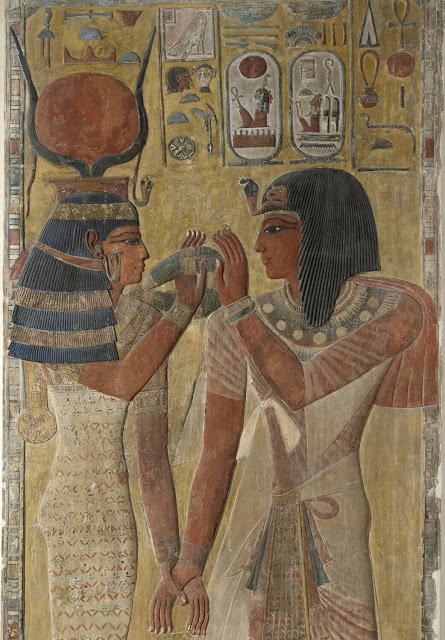
discovered on October 18, 1817, in the Valley of the Kings by Giovanni Battista Belzoni
Department of Egyptian Antiquities of the Louvre Museum – Champollion No. 1 – B 7 – N 124 – CC 243 – brought back by Jean-François Champollion
during the Franco-Tuscan Expedition (1828-1829) – © 2017 Musée du Louvre, Dist. GrandPalaisRmn / Christian Décamps
Seti I, son of Ramses I, the second king of the 19th Dynasty, who reigned over the Dual Land for eleven years, is depicted in full ceremonial dress. His magnificent black wig is encircled by the rearing cobra with its coiled body. His feet are shod with gold sandals. His clothing is made of the finest linen, and his loincloth features a superb front. Bordered with ribbons are composed of vertical bands with a herringbone pattern and ends with a frieze surrounded by two cobras.
His right arm is stretched along his body, and his hand clasps the goddess’s left hand. “One will notice the very Egyptian symmetry of the composition and the unusual gesture of the joining hands” (Christiane Ziegler, “Ancient Egypt at the Louvre”). His left arm is bent, and his hand thus reaches the height of Hathor’s, who, making the same gesture, extends her menat necklace towards him as a sign of protection.
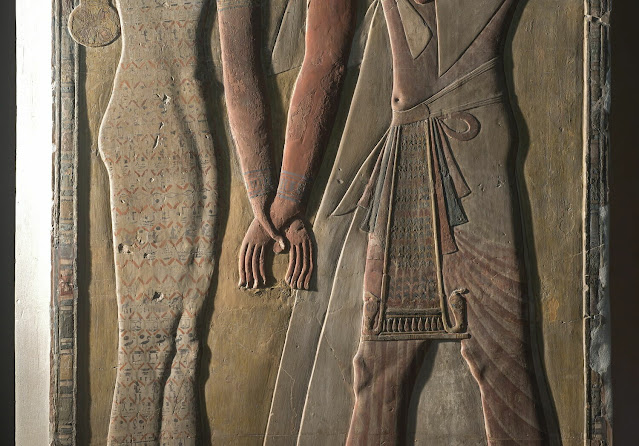
discovered on October 18, 1817, in the Valley of the Kings by Giovanni Battista Belzoni
Department of Egyptian Antiquities of the Louvre Museum – Champollion No. 1 – B 7 – N 124 – CC 243 – brought back by Jean-François Champollion
during the Franco-Tuscan Expedition (1828-1829) – © 2017 Musée du Louvre, Dist. GrandPalaisRmn / Christian Décamps
“The menat is a necklace with a counterweight, both an ornament and a musical instrument. Specific to the goddess Hathor, it served to transmit her fluid. The counterweight is clearly associated with the idea of rebirth and transition rites, while the gesture is clearly jubilee,” analyze Christiane Ziegler and Jean-Luc Bovot in “Art and Archaeology, Ancient Egypt.” This magnificent relief comes from the entrance to the fourth corridor (the transition point to the underworld) of the pharaoh’s tomb. Giovanni Battista Belzoni unearthed it in the Valley of the Kings on October 18, 1817. It extends 137 m into the Theban mountain via seven long corridors serving 10 rooms! It is certainly one of the most beautiful and “completely” decorated in the royal necropolis. C’est aussi l’une de celles où la qualité des peintures atteint la plus haute perfection… Le découvreur est subjugué par la beauté de ce qui s’offre à ses yeux : “Je jugeai, par les peintures du plafond et par les hiéroglyphes en bas-relief que l’on distinguait à travers les décombres que nous étions maîtres de l’entrée d’une tombe magnifique”. La clé de lecture des hiéroglyphes n’étant pas encore résolue, il est alors impossible de savoir à qui appartient cette demeure d’éternité. Ainsi, dans un premier temps sera-t-elle appelée “tombe Belzoni” ou encore “tombe de l’Apis”, en référence à la “carcasse de taureau embaumé avec de l’asphalte” qui y fut trouvée. C’est bien plus tard qu’elle sera attribuée au père de Ramsès II puis référencée KV 17.
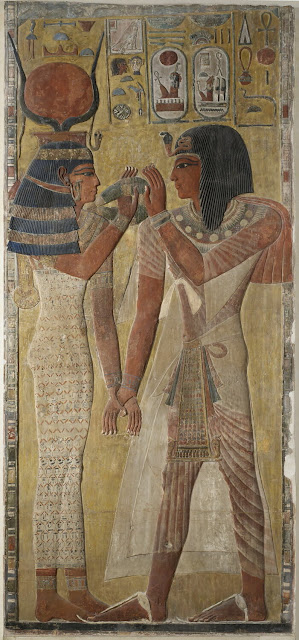
discovered on October 18, 1817, in the Valley of the Kings by Giovanni Battista Belzoni
Department of Egyptian Antiquities of the Louvre Museum – Champollion No. 1 – B 7 – N 124 – CC 243 – brought back by Jean-François Champollion
during the Franco-Tuscan Expedition (1828-1829) – © 2017 Musée du Louvre, Dist. GrandPalaisRmn / Christian Décamps
With the invaluable help of Alessandro Ricci, Giovanni Battista Belzoni documented the most beautiful scenes from the hypogeum. He exhibited them, starting in May 1821, at the Egyptian Hall Piccadilly in London and then 1822 at the Chinese Baths in Paris.
Jean-François Champollion, who was among the visitors, was apparently left “speechless with admiration” when he visited the “larger-than-life main room”… It was at about the same time, on September 14, 1822, that the brilliant code-breaker exclaimed, “I HAVE MY CASE”! After years of work, he had just understood the extremely complex principle of Egyptian writing, which was at once ideographic, alphabetic and phonetic… On September 27, in his famous “Letter to Mr. Ironside”, he presented the results of his research to the Academy of Inscriptions and Belles-Lettres.
Seven years later, in 1829, while he was in the Valley of the Kings with the Franco-Tuscan Expedition, he could finally enter the tomb… “In the tomb of Sety I, J.-Fr. Champollion and I. Rosellini could not resist, faced with the beauty but also the risk of seeing them amputated or destroyed, to have two painted bas-reliefs detached from the embrasures of a corridor door, which would be shared, upon their return, by the Louvre (B7/N124) and Florence (inv. no. 2468) museums. These panels, of extraordinary finesse, represent the king standing in the company of the goddess Hathor,” specifies Christian Leblanc in his “Regards croisés sur la civilisation égyptienne”. In her “Champollion”, Karine Madrigal recalls that: “To justify this act, Champollion explains to his friend Dubois that he ‘dared, in the interest of art, to carry a profane saw into the coolest of all the royal tombs of Thebes'”…
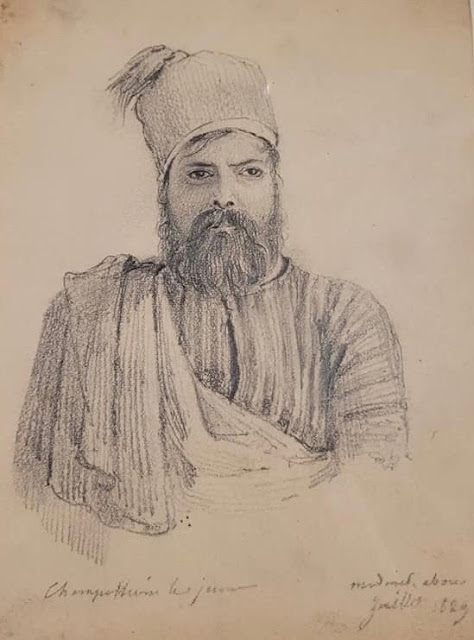
(Figeac, December 23, 1790 – Paris, March 4, 1832)
Portrait depicting him in Egyptian dress, painted by Salvatore Cherubini in Medinet Habu, July 1829
Acquired by the Champollion Museum in Vif in June 2022
This is how this bas-relief will take the “path” to France. Jean-François Champollion will personally oversee its transport and loading in Alexandria. “On November 8, the twenty or so crates of antiquities and the sarcophagus intended for the Charles X Museum were placed in a safe place in the holds of the Astrolabe” (Alain Faure, “Le savant déchiffré”). Under the command of Verninac de Saint Maur, the corvette left the port on December 6, 1829, to sail towards the French coast. It docked in Toulon on December 23. The corvette transported the precious objects to Le Havre, where a barge finally took them to the great Parisian museum via the Seine.
Sources:
Relief of Seti I and Hathor https://collections.louvre.fr/ark:/53355/cl010009693 Jean-François Champollion, Monuments of Egypt and Nubia: plates / based on drawings executed on site under the direction of Champollion the Younger, and the handwritten descriptions he wrote, published under the auspices of Mr Guizot and Mr Thiers, Ministers of Public Instruction and the Interior, by a special commission composed of Messrs. Silvestre de Sacy, Letronne, Biot, Champollion-Figeac, Paris, Didot, 1845, plate 251 Champollion the Younger, Letters Written from Egypt and Nubia in 1828 and 1829, Publisher Didier, Paris, 1868 http://gallica.bnf.fr/ark:/12148/bpt6k103771z/f345.item.r=septembre%201829.texteImage Jacques Vandier, Summary Guide to the Louvre Museum, The Department of Egyptian Antiquities, Éditions des Musées Nationaux, Paris, 1961, p. 20
Bertha Porter, Rosalind L.B. Moss, Topographical Bibliography of Ancient Egyptian Hieroglyphic Texts, Reliefs, and Paintings, 1.2, The Theban Necropolis. Royal Tombs and Smaller Cemeteries, Oxford, At the Clarendon Press, 1964, p. 539 http://www.griffith.ox.ac.uk/topbib/pdf/pm1-2.pdf Giovanni Battista Belzoni, Journey to Egypt and Nubia, Pygmalion, 1979
Jean Lacouture, Champollion, A Life of Enlightenment, Grasset, 1988
Jean-Jacques Fiechter, Harvest of the Gods, Julliard, 1994
Guillemette Andreu, Marie-Hélène Rutschowscaya, Christiane Ziegler, Ancient Egypt at the Louvre, Louvre Museum, Hachette, Paris, 1997, p. 137-140
Guillemette Andreu, Patricia Rigault, Claude Traunecker, The ABCs of Ancient Egypt, Paris, Flammarion, 1999, p. 51
Christiane Ziegler, Sophie Labbé-Toutée, Pharaoh, Exhibition Catalogue, Paris, Arab World Institute, 15-10-2004 – 10-4-2005, Paris, Flammarion, 2004, p. 261
Alain Faure, Champollion, the Scholar Deciphered, Fayard, 2004
Christiane Ziegler, Jean-Luc Bovot, Small Manuals from the École du Louvre, Art and Archaeology, Ancient Egypt, École du Louvre, Réunion des Musées Nationaux – Grand Palais, 2011, p. 227
Sylvie Guichard, Jean-François Champollion, Descriptive Notice of the Egyptian Monuments of the Charles X Museum, Paris, Louvre Editions – Editions Khéops, Paris, 2013, p. 51
Christian Leblanc, Crossed Perspectives on Egyptian Civilization, Selected Pages of Archaeology and History, L’Harmattan, Paris, 2024 https://www.editions-harmattan.fr/catalogue/livre/regards-croises-sur-la-civilisation-egyptienne/76432 Karine Madrigal, Champollion, Ellipses, 2024
Theban Mapping Project – KV 17 – Sety I https://thebanmappingproject.com/tombs/kv-17-sety-i
 lampmagician
You must be logged in to post a comment.