
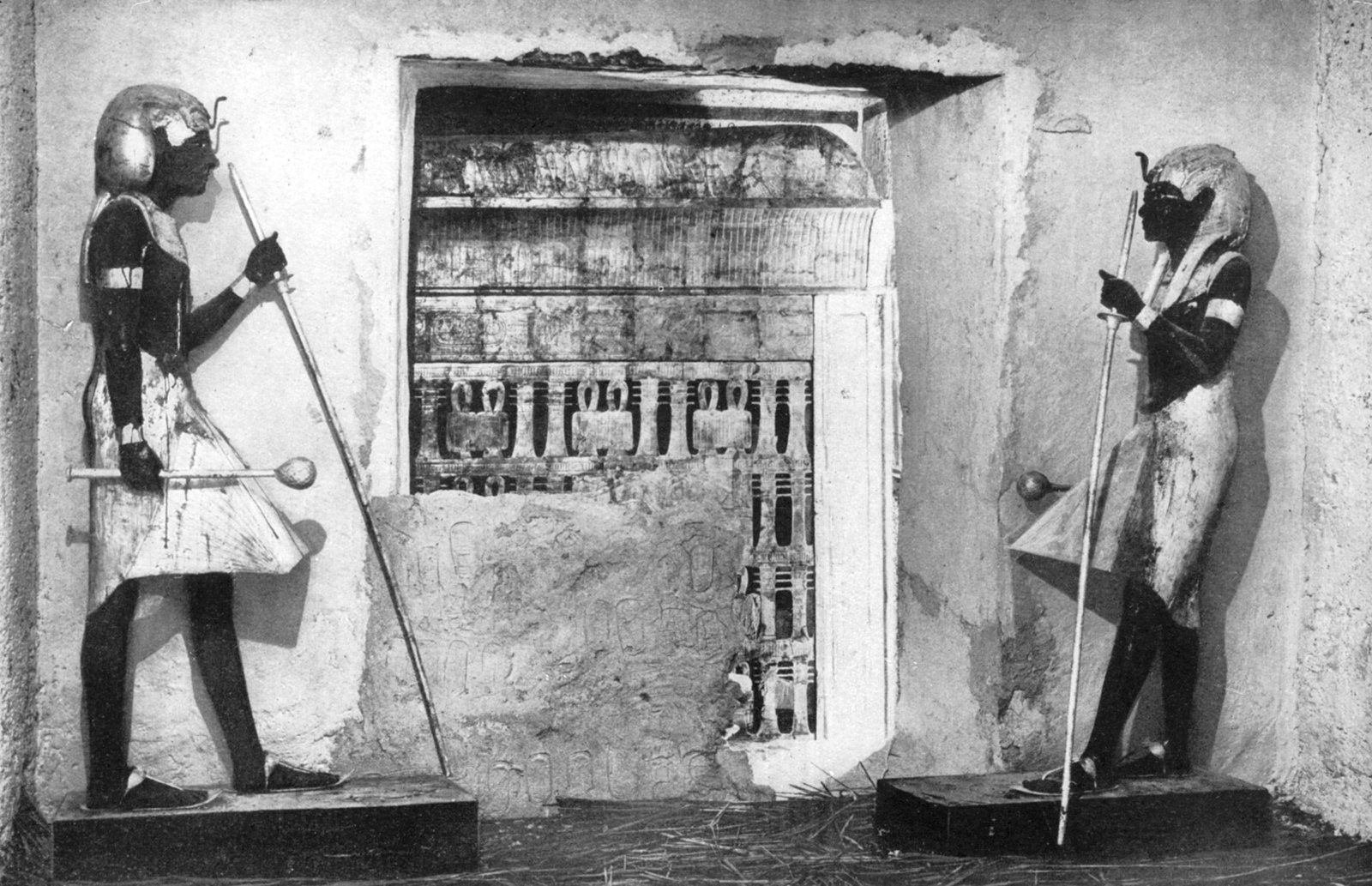
The burial chamber was below ground and housed and protected the body and spirit. The mortuary chapel was above ground and was accessible to visitors who would perform rites and make offerings of food and drink for the dead person.
Egyptian burial chambers resembled secret galleries meant to remain unseen, filled with stunning artwork for an elite audience—the gods. Art could transport individuals, connecting the mortal and the immortal, freeing them from the silence of death.
Tomb art was sacred and magical, controlling chaotic forces threatening universal order. Whether mass-produced or commissioned, painting, sculpture, carving, and writing upheld order by invoking the gods to ensure safe passage and eternal sustenance for the deceased in the afterlife. Tombs in ancient Egypt

However, despite all this, here is a brilliant article by Marie Grillot about an undamaged treasure of ancient Egypt.
The Golden Mask of General Oundebaounded
via: égyptophile

Discovered in his tomb (NRT III) in Tanis in 1946 by Pierre Montet and his team
Egyptian Museum, Cairo – JE 87753
The untouched tomb of General Oundebaounded was discovered in Tanis in 1946 by the team of Pierre Montet, known as “The Man from Tanis. “
It was Pierre Lézine, an architect newly arrived on the mission, who noticed a particular spot in the tomb of Psusennes I where the thickness of a wall appeared abnormal.
Under the initially sceptical eye of his colleagues, he undertook additional surveys that confirmed his intuitions.
In “The Discovery of the Treasures of Tanis”, Georges Goyon recounts: “It was then that a tiny room appeared, with no exit, containing, intact, as if embedded in its socket, a beautiful pink granite sarcophagus. The limestone walls were covered with brightly coloured paintings depicting ritual scenes and inscriptions.” This sarcophagus would turn out to be a ‘re-use’: having initially been dedicated to a priest of Amun of Thebes, it had been modified for its new ‘occupant’…

Pierre Montet explains: “The Oundebaounded vault contained only the sarcophagus and the four canopic jars. Everything was in the sarcophagus. The mummy, dressed in its finery, was first enclosed in a silver coffin, and this in a gilded wooden coffin. When the gilded wooden coffin had been introduced into the granite basin, three paterae and a cup were placed on the lid, as well as a sword, a sceptre, and several walking sticks. The extreme humidity that reigns throughout the necropolis caused the complete destruction of everything made of wood. The gilded wooden coffin was nothing more than a pile of dead leaves. The silver coffin itself was partly eaten away.”

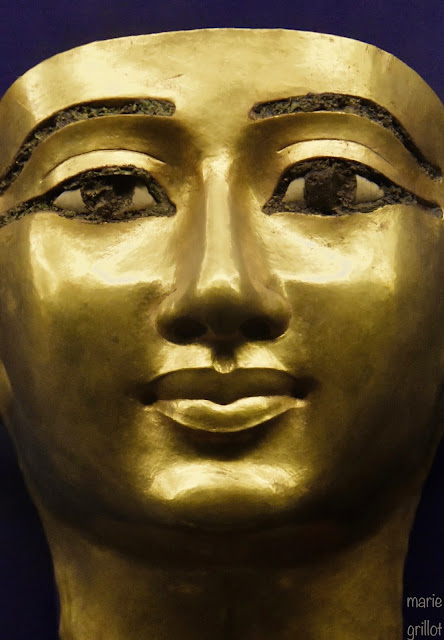
On his face was this magnificent mask, reminiscent of Sheshonq II’s. 22 cm high, it is carved from a thick sheet of gold and decorated with glass paste inlays. In ancient Egypt, gold was imbued with power: this metal was not only assimilated to the flesh of the gods, but it was also supposed to ensure the protection of the deceased.

Discovered in his tomb (NRT III) in Tanis in 1946 by Pierre Montet and his team
Egyptian Museum, Cairo – JE 87753
In “The Wonders of the Egyptian Museum in Cairo,” Silvia Einaudi gives this beautiful description: “The mask covered the face, neck, and ears of the sovereign, and stopped at the forehead where six perforated tabs allowed it to be attached to the mummy’s head. The eyes, miraculously intact, are made of glass paste of different colours inserted into the metal cavities: white for the eyeball and black for the pupil. The eyebrows and the outline of the eyes were made using the same technique. The nose is almost perfectly shaped. The lips are narrow and full. The ears are not symmetrical, and the left is more prominent than the right. The mask is an idealised portrait of Oundebaounded, depicted as a young man with a serene and tranquil expression, underlined by a barely marked smile.
Examination of the General’s mummy revealed that he had joined the Ialou Fields when he was about fifty years old. Georges Goyon specifies that he was: “of slender build, perhaps of Nubian race, as evidenced by the long bones and relatively small head.”

Discovered in his tomb (NRT III) in Tanis in 1946 by Pierre Montet and his team
Exhibited at the Egyptian Museum in Cairo – JE 87742
For eternity, he was surrounded by gold jewellery, amulets, precious dishes (among them the magnificent patera with swimmers), statuettes, … all of an extreme quality and a wealth worthy of a pharaoh… Who was he to enjoy such recognition?
The name of this close government associate was not unknown to the mission members, as several of his funerary statuettes, made of bronze and earthenware, had been found, as early as 1939, near the sarcophagus of the Pharaoh Sheshonq. Furthermore, a sword bearing his name had also been deposited near Psusennes.
Georges Goyon presents him to us thus: “He was not a person of royal blood, but a high priest of Khonsu and Chief of the Archers of Pharaoh. He was also invested with the important title of Superior of the Prophets-of-all-the-gods, which seemed to correspond to that of minister of worship. It was King Psusennes I who had elevated him to these high functions…. One of his most curious titles was that of “Sole-appointed-to-the-praise-of-the-great”, whose duty was to present the holders to the king during the reward ceremonies.”
Discovered in his tomb (NRT III) in Tanis in 1946 by Pierre Montet and his team
Egyptian Museum, Cairo – JE 87753
One can imagine the aura Oundebaounded must have held at court, and thus understand why he was buried so close to the sovereigns…
The entire treasure contained in his tomb was sent shortly after, under police escort, to the Cairo Museum. The funerary mask was recorded in the Journal of Entries under reference JE 87753.
It is interesting to note that Pierre Montet reports that statuettes – ushabtis – bearing the General’s name were found on the antiques market. “Sixteen servants were nevertheless soon recovered in the trade… In total, we currently know of around forty listed in other Institutes and private collections.”
Sources:
Georges Goyon, The Discovery of the Treasures of Tanis, 1987
Tanis: Gold of the Pharaohs, exhibition catalogue, Paris, Galeries nationales du Grand Palais, March 26 – July 20, 1987
Francesco Tiradritti, Treasures of Egypt – The Wonders of the Egyptian Museum in Cairo
National Geographic, Treasures of Ancient Egypt at the Cairo Museum
Posted on 23rd May 2017 by Unknown
 lampmagician
You must be logged in to post a comment.