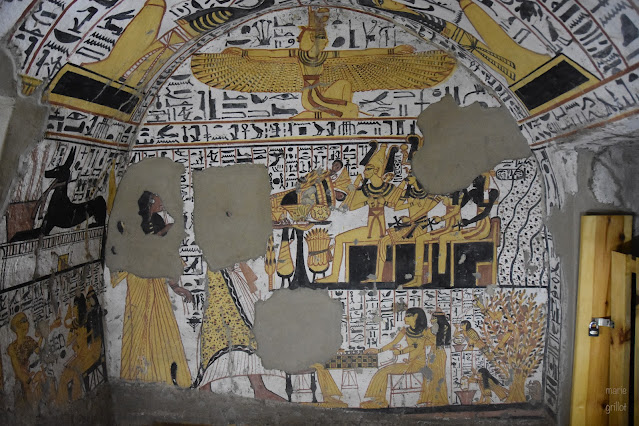
A Magnificent Divine Falcon to Protect Wise Amenemopé’s Treasures.

Standard

Usermaatre Amenemope was an ancient Egyptian pharaoh of the 21st Dynasty who ruled between 1001 and 992 BC or 993 and 984 BC. His tomb is one of only two entirely intact royal burials known from ancient Egypt, the other being that of Psusennes I. “His Instruction” (That is about thirty chapters (more than ten commands!)) is a literary work from ancient Egypt, most likely composed during the Ramesside Period. It contains thirty chapters of advice for successful living, attributed to the scribe Amenemope, son of Kanakht, as a legacy for his son.
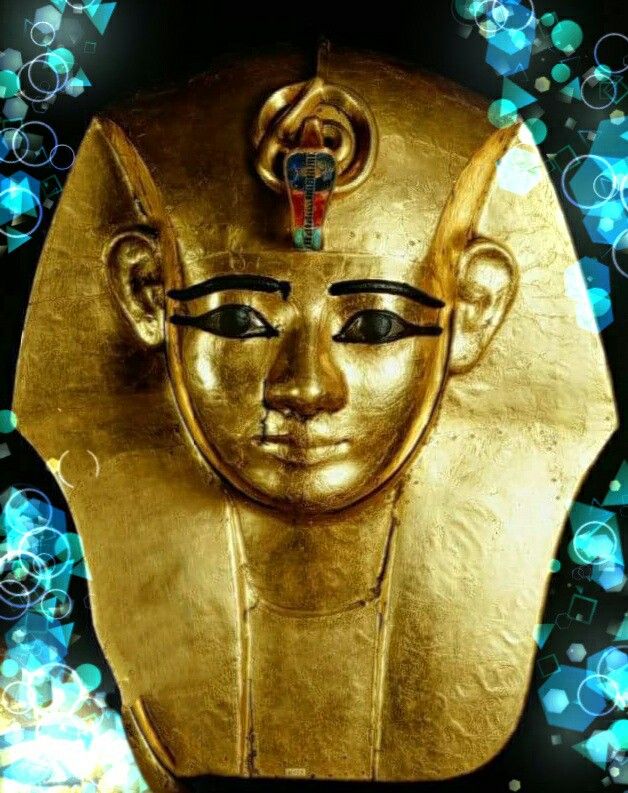
Treasure of Tanis, the golden mortuary mask of Pharaoh Amenemope. Egypt Musem

The pharaohs of Egypt were associated with Horus since the pharaoh was considered the earthly embodiment of the god. From around 3100 BCE, he was given a memorable royal “Horus name.” The falcon, representing divine kingship, symbolized the king as the earthly manifestation of Horus.

Here is the captivating story, by the brilliant Marie Grillot, of this incredible discovery.💖🙏

A falcon carrying Amenemopé’s cartridges in its talons

Via égyptophile

Falcon pendant – gold and cloisonné glass paste
21st Dynasty – reign of Amenemopé (c. 1000 BC)
from Tanis, the tomb of Amenemopé – NRT III – discovered by Pierre Montet on April April 16
on display at the Egyptian Museum in Cairo – JE 86036 (museum photo)

In May 1929, the Egyptian government awarded Pierre Montet the concession for Tanis, now known as “Sân el-Hagar”, which lies in the “Tanitic branch” of the Nile Delta, over 100 km northeast of Cairo.

In 1722, Père Sicard identified this city as the ancient Tsa’ani” (“Tso’an” in Hebrew, “Tjaani” for the Copts, Greekized as “Djanet”). The scholars of the Commission d’Egypte partially excavated it, first by Jean-Jacques Rifaud (on behalf of consul Drovetti) and then by Auguste Mariette.
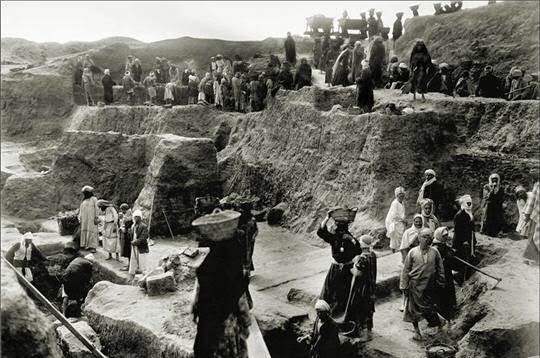
Pierre Montet’s excavations at Tanis

Its ruins, covering more than 400 hectares, witness its “activity” from the Old Kingdom to Roman times. However, the rulers of Dynasties XXI to XXIII marked its golden age by choosing it as their religious and funerary capital. By mirror effect, it became the “Thebes of the North”…

Pierre Montet’s team, summarily installed on this isolated and desolate site, worked with patience and perseverance for around ten years before the time came for the “rewards”. It was inaugurated in March 1939 with the discovery of the tomb of Chechonq II… From then on, the necropolis would yield many other treasures…

Elevation view of tomb NRT III containing the tombs of Psusennes I, his wife Moutnedjemet,
then their son Amenemopé, another son of king Ânkhefenmout, the king’s chief general Oudjebaoundjed,
and in the antechamber, the sarcophagus of Sheshonq II – Royal Necropolis of Tanis

Thus, in “Tanis – Twelve years of excavations in a forgotten capital of the Egyptian Delta”, the Egyptologist Pierre Montet recounts the extraordinary day of the discovery of the tomb of Pharaoh Amenemopé: “The entrance was opened on April April 16). His Majesty King Farouk, who had arrived the day before in Saan, where he had erected a city of tents, was present, as was Canon Drioton, Director of the Egyptian Antiquities Service, and a young Egyptian Egyptologist, Professor Abou Bekr. The vault was furnished in much the same way as that of Psousennès: a granite sarcophagus at the bottom, canopic vases, metal vases, a large sealed jar, funerary statuettes and a vast gilded wooden chest that had collapsed due to the effects of time and humidity in the front half. Once these objects had been safely removed, the sarcophagus lid was placed in their place. Much less opulent than Psousannes, the new ruler had made do with a single stone sarcophagus and a wooden anthropoid coffin lined with gold. Wood was reduced to almost nothing. The gold plates were removed. Needless to say, the mummy had suffered enormously. His ornaments, less numerous than those of Psousennès, nevertheless constitute a wonderful collection: a gold mask, two necklaces, two pectorals, two scarabs, lapis and chalcedony hearts, bracelets and rings, a large cloisonné gold falcon with outstretched wings…”.

Falcon pendant – gold and cloisonné glass paste
21st Dynasty – reign of Amenemopé (c. 1000 BC)
from Tanis, the tomb of Amenemopé – NRT III – discovered by Pierre Montet on April April 16
on display at the Egyptian Museum in Cairo – JE 86036 (museum photo)

The hawk, which seems to soar powerfully into the sky, is 10.5 cm high and 37.5 cm wide. The head and legs are in gold, while the rest of the body is in gold cloisonné with pâte de verre in shades of green, perfectly simulating the shimmer of the feathers.

In “Les trésors du musée égyptien”(The Treasures of the Egyptian Museum), Silvia Einaudi describes it as follows: “The falcon is depicted in flight with its wings spread. The head, turned to the left, is made of solid gold. The beak, eye, neck and decorative motif on the cheek are in dark pâte de verre. The raptor’s wings, body and tail are executed using the cloisonné technique: glass paste in delicate shades of pink and green is inlaid with gold, giving life to a simple polychromy. The wing feathers radiate outwards, forming two rows.
On the other hand, the body is decorated with a teardrop motif that continues right down to the tail. The legs, also in solid gold, hold the ‘shen’ signs, a symbol of eternity, to which two gold plates bearing the sovereign’s name are attached. The hieroglyphs inside the cartouches are executed in coloured glass paste inlaid with gold. The plate on the right bears the pharaoh’s coronation name: ‘Usermaatra Setepenamon, beloved of Osiris and Ro-Setau (Memphis necropolis)’; on the left, his birth name: ‘Ménémopé Meramon, beloved of Osiris, lord of Abydos'”.
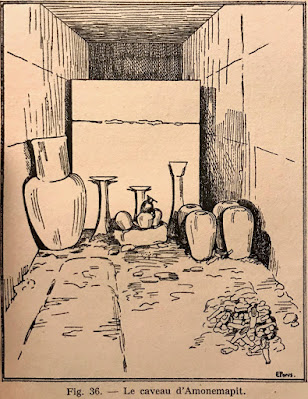
Amenemopé’s vault at its opening – Drawing by E. Pons
Source: Pierre Montet, “Tanis”, Payot, 1942

Amenemopé, pharaoh of the 21st Dynasty, reigned from Tanis around 1001-992 BC. The successor of Psusennes I, he was, as the book mentioned above states: “buried in the latter’s tomb, in a granite-covered room originally created to house the remains of Moutnedjemet, wife and sister of Psusennes I”. We can only wonder why this small vault was chosen as his burial place when he “had” his own tomb referenced NRT IV (NRT = Nécropole Royale de Tanis).
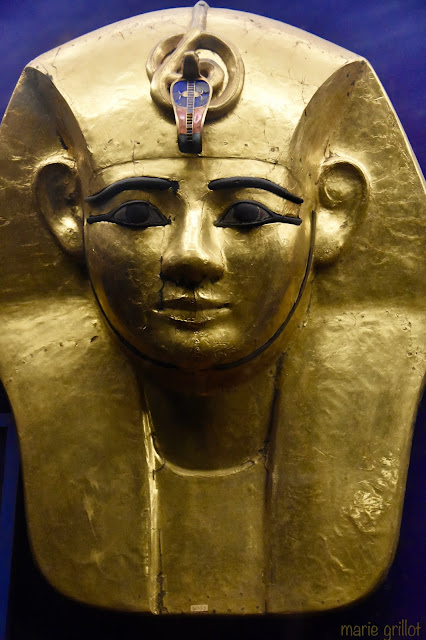
Face of the pharaoh Amenemopé – gold leaf (upper surviving part of his gilded wooden sarcophagus)
21st Dynasty – reign of Amenemopé (c. 1000 BC)
from Tanis, the tomb of Amenemopé – NRT III – discovered by Pierre Montet on April April 16
on display at the Egyptian Museum in Cairo – JE 86059

On May 3, May 3, in a truck protected by the army, Amenemopé’s treasure made its way to the Egyptian Museum in Tahrir Square. The falcon-shaped pendant was registered in the Journal des Entrées under reference: JE 86036.

As for Pierre Montet’s team, the dramatic events of the Second World War forced them to end their quest for the past of Tanis and turn their attention to the tragic present. Excavations will not resume until the end of the conflict…

Marie Grillot

Sources : 

The Hawk of King Amenemope http://www.globalegyptianmuseum.org/record.aspx?id=15530 Pierre Montet, Tanis – Twelve years of excavations in a forgotten capital of the Egyptian Delta, Payot, Historical Library, 1942
Pierre Montet, The royal necropolis of Tanis according to recent discoveries, Reports of the Academy of Inscriptions and Belles-Lettres sessions, 89th year, N. 4, 1945. pp. 504-517, Perseus https://www.persee.fr/doc/crai_0065-0536_1945_num_89_4_77901 Georges Goyon, The discovery of the treasures of Tanis, Pygmalion, 1987
Jean Yoyotte, Tanis l’or des pharaons, exhibition catalog Paris, National Galleries of the Grand Palais, March 26 – July 20, 1987, Association Française d’Action Artistique, 1987
Henri Stierlin, Christiane Ziegler, Tanis Trésors des pharaons, Seuil, 1987
Francesco Tiradritti, Treasures of Egypt – The wonders of the Egyptian Museum in Cairo, Gründ, 1999
Pharaons – Catalog of the exhibition presented at the Institute of the Arab World in Paris, from OctobeOctober 15 to April April 10, IMA, Flammarion, 2005

Posted 5th MaMarch 5by Marie Grillot
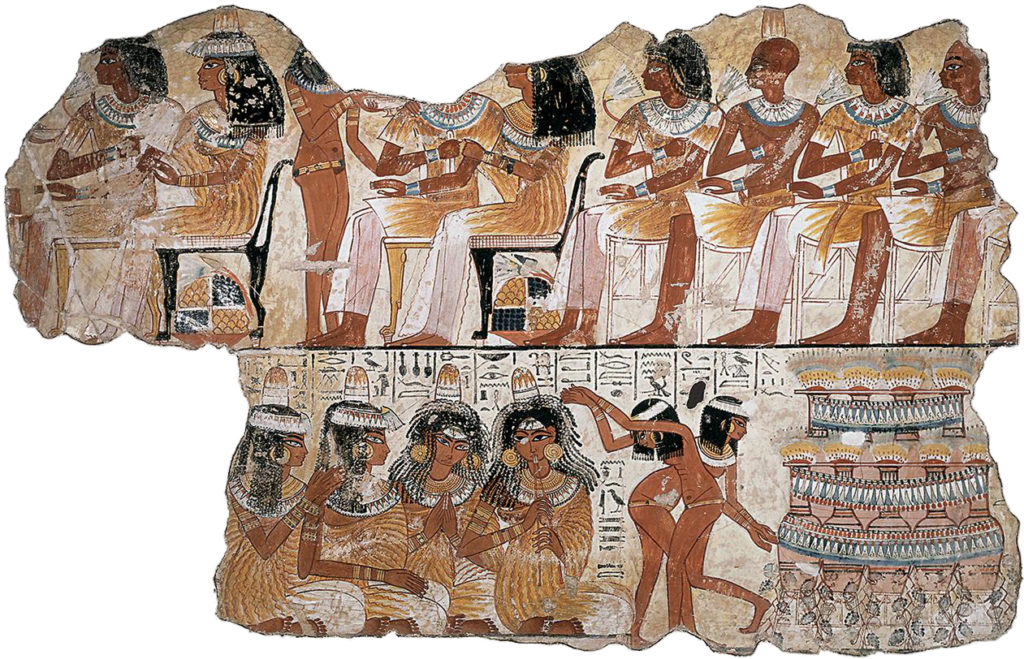
Let’s Drink a Divine Brewed Beer by Goddesses. Cheers!

Standard
Banquet scene from the tomb chapel of Nebamun, 14th century BC. Its imagery of music and dancing alludes to Hathor. Source: Wikimedia Commons.

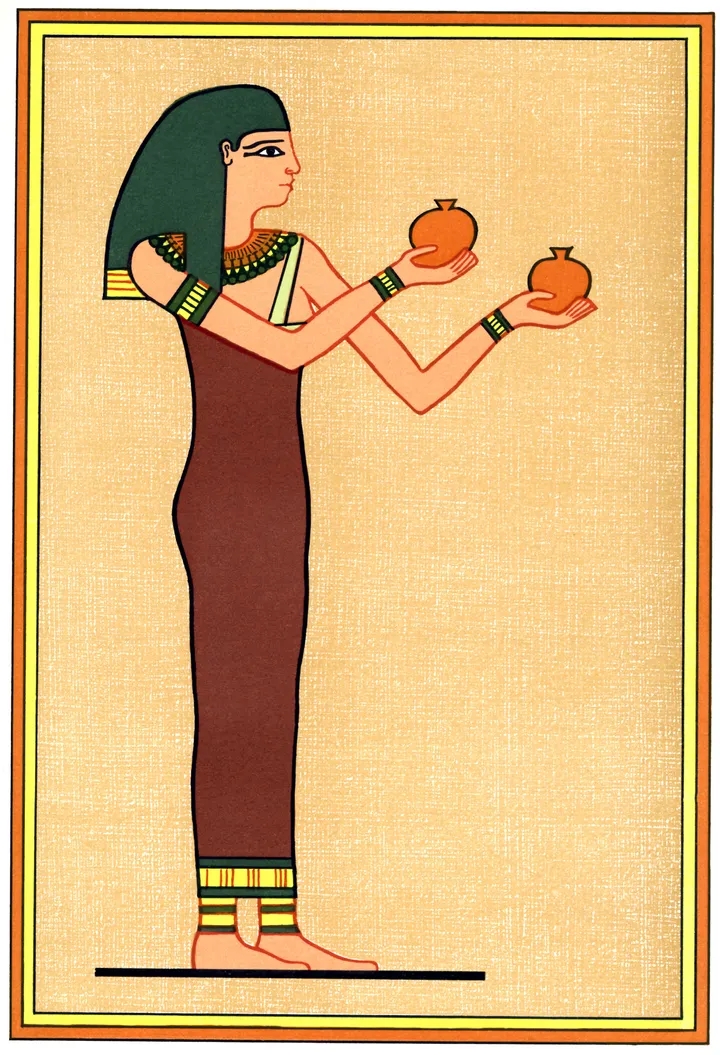
Honestly, when I first saw the statue of the woman below in the main article, I thought it depicted a woman washing clothes in a jar. But as I read the article, I had to admit my failure: she actually makes beer! It is funny that many men, such as in Germany, think beer is a man’s business. Then look! Here we go; in ancient Egypt, the women, and even the Goddesses, brewed beers.

Yes! It is fascinating to know that there was more than one beer Goddess in ancient Egypt: Nephthys (She was associated with mourning, the night/darkness, service (specifically temples), childbirth, the dead, protection, magic, health, embalming, and beer.) The others were Menqet (The Egyptians worshipped the Goddess of beer, Menqet, and celebrated sun God Ra’s daughter, Sekhmet, whose bloodthirsty ways were calmed by beer. According to Egyptian mythology, Menqet was the Goddess of beer and ruled over the Place of Reeds.) and Tenenet (Tjenenyet), as both latter mentioned in this article.

We read here the description of this amazing story by brilliant Marie Grillot and Marc Chartier. Cheers!!

Beer Brewer for Eternity…

via égyptophile

Statuette of a woman preparing beer – painted limestone – 5th dynasty
discovered in 1931 in the mastaba of Mersou-ankh in Giza
by Professor Sélim Bey Hassan on behalf of the Antiquities Service
Egyptian Museum in Cairo – JE 66624

In 1931, while continuing the excavations undertaken in 1929 on behalf of the Antiquities Service in the sector concerning: “the ascending routes of the Pyramid of Chephren to the north and the Pyramid of Mycerinus to the south”, Professor Sélim Bey Hassan discovers the mastaba of Mersou-ankh.

Plan of the Cairo University excavations at the Giza site

The mastaba of this chief of the Rà-wèr domains will turn out to contain numerous statues.

Among them is that of this brewer, discovered in serdab no. 1, facing a triple statue representing the tomb’s owner.

It is made of painted limestone and stands 28 cm high. It represents a woman leaning over a large jar. She wears a black, mid-length wig, while her natural hair forms a fringe on her forehead. The face is generous, the cheeks are full, the eyes and eyebrows are marked with black, the nose is wide, and the mouth seems to be smiling. A necklace in blue and white tones adorns her neck.

Her breasts are exposed, and the light-coloured, almost transparent garment she wears begins at the waist and goes down to below the knee.

Statuette of a woman preparing beer – painted limestone – 5th dynasty
discovered in 1931, in the mastaba of Mersou-ankh in Giza, by Professor Sélim Bey Hassan
on behalf of the Antiquities Department – Egyptian Museum in Cairo – JE 66624 – museum photo

The arms are relatively robust, and the hands are not visible. They are busy kneading the dough in the sieve placed on the pottery jar. “She kneads the ingredients used to make beer in the Old Kingdom, namely barley loaves, water and date liqueur,” explains Rosanna Pirelli in “Treasures of Egypt – The Wonders of the Egyptian Museum in Cairo.

To understand the method of production, we refer to the information provided in Thierry Benderitter’s description of certain scenes of the mastaba of Ty in Saqqara on his indispensable site, Osirisnet.net, and to Sylvia Couchoud’s sDynastyeer in Pharaonic Egypt.

Statuette of a woman preparing beer – painted limestone – 5th dynasty
discovered in 1931, in the mastaba of Mersou-ankh in Giza, by Professor Sélim Bey Hassan
on behalf of the Antiquities Department – Egyptian Museum in Cairo – JE 66624

The base ingredient is sprouted barley. “It is crushed in flat-bottomed containers with a mortar and filtered using increasingly fine sieves. Wheat flour is added. With this mixture, once moistened, oblong pieces of dough are made and poured into hot moulds until the crust is golden while ensuring that the inside remains raw and that the malt enzymes are not destroyed. The half-cooked bread is then crumbled in a bowl and mixed with a sweet liquid obtained with dates. The mixture is kneaded, stirred, filtered with a large strainer and collected in jugs where it will ferment. When the fermentation is finished, the beer obtained is transferred into amphorae closed with a. plug of straw and damp clay, or with a small plate and a little plaster.”

Four types of beers have been referenced: zythum (literally “barley wine,” a widely used light beer), Dizythum (a double beer), Carmi (a sweet beer), and Korma (a ginger beer).

Jean-Pierre Corteggiani (“Ancient Egypt and its gods”) specifies the importance of beer in ancient Egypt: “Personified by the goddesses Tenemet and Menqet, who are responsible for brewing it, beer plays a significant role in the divine world. It is obviously part of the offerings made to the gods and goddesses, particularly Hathor, since, like wine, it can induce intoxication.

The goddesses Menqet and Tenenet are responsible for brewing beer.

Menqet is often represented with two jugs in her hands, associated with Âqyt, who personifies bread. With bread, it’s beer – not wine! – which the Egyptians wished to have for eternity.

The deceased wished not to lack anything in his afterlife… Thus, as we can read in the “Official Catalog of the Egyptian Museum in Cairo”: “the figurines of servants at work reproduce in the round themes previously developed in bas relief. The statuary of the tombs is enriched by a small world of brewers, millers, pastry chefs, potters or butchers, who continue their daily service in the tomb. Generally of a mediocre style, these figurines are nevertheless quite expressive and represent their professional practice well. The first known limestone models date back to the 4th Dynasty, but the vast majority occurred in the 5th.

Statuette of a woman preparing beer – painted limestone – 5th dynasty discovered in 1931, in the mastaba of Mersou-ankh in Giza, by Professor Sélim Bey Hassan
on behalf of the Antiquities Department – Egyptian Museum in Cairo – JE 66624

This brewer is displayed at the Egyptian Museum in Cairo under the reference JE 66624.

Marie GrillotMarc Chartier

Sources:
Statuette of a Female Brewer http://www.globalegyptianmuseum.org/record.aspx?id=14885 Statuette of a woman preparing beer https://egyptianmuseumcairo.eg/emc/artefacts/old-kingdom-serving-statues/ Francesco Tiradritti, Treasures of Egypt – The Wonders of the Egyptian Museum in Cairo
Mohamed Saleh, Hourig Sourouzian, Official Catalogue of the Egyptian Museum in Cairo, Verlag Philippe von Zabern, 1997
Jean-Pierre Corteggiani, Ancient Egypt and its gods, Fayard, 2007
National Geographic, Treasures of Ancient Egypt at the Cairo Museum
Beer: a drink known in ancient Egypt https://egyptophile.blogspot.com/2016/04/la-biere-une-boisson-connue-et-deifiee.html

Horus, the Deity Symbol of Protection, Health and Restoration

Standard
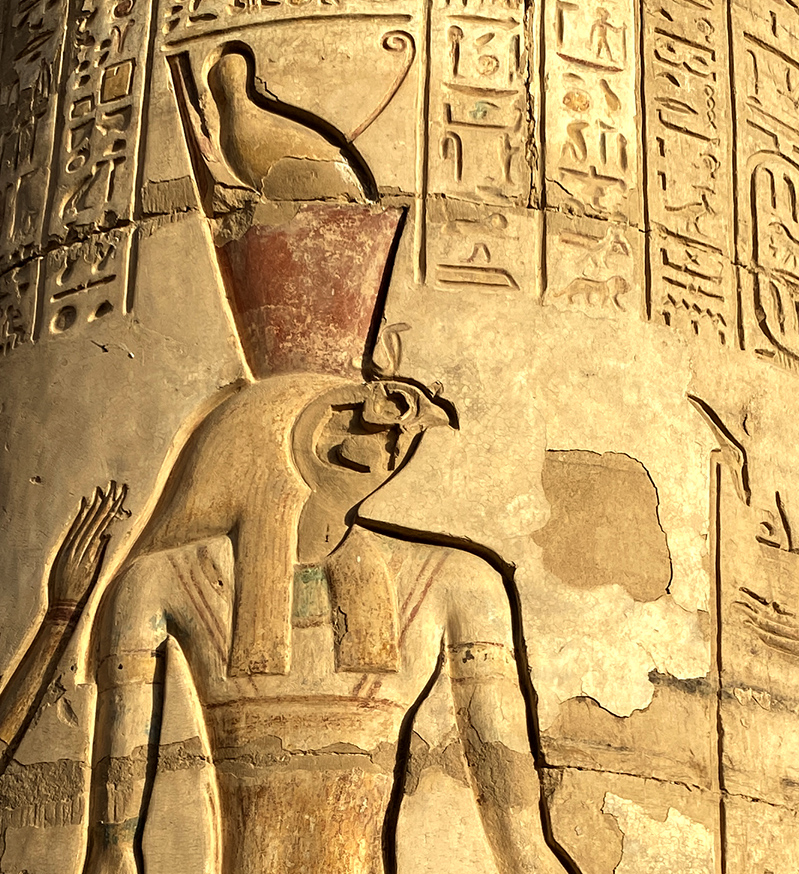
Relief of Horus at Kom Obo Temple

Since Horus was considered the sky, he was also considered to contain the Sun and Moon. Egyptians believed that the Sun was his right eye and the Moon his left and that they traversed the sky when he, a falcon, flew across it.

Ägyptische Sammlung Johannes Gutenberg-Universität Mainz Foto: © JGU / Stefan F. Sämmer, http://www.samphoto.de, +49 163 7343300

As the title image shows, Horus is usually depicted as a falcon. But now, the brilliant Marie Grillot shows us a unique image of this deity.

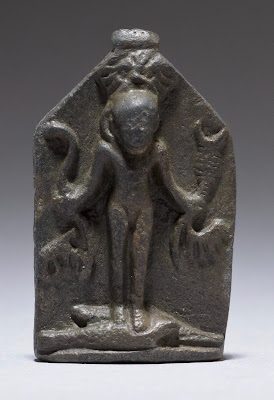
The infant Horus is often pictured on stelae in the act of trampling two crocodiles and holding dangerous animals in his hands. The water poured on these objects, by flowing across their surface covered with magic spells, gained the power of healing whoever drank it from the stings of scorpions and the bites of snakes.

Stele of Horus: the magic that heals

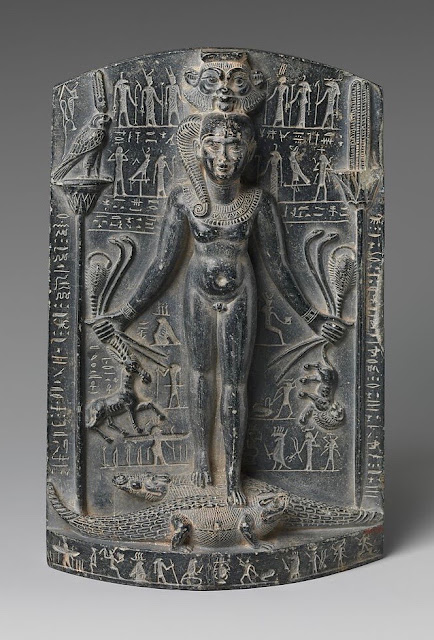
Magic stele or “Cippus of Horus” – chlorite schist – Ptolemaic period – around 332-280 BC AD
Metropolitan Museum of Art in New York – entry number 20.2.23 – museum photo

via égyptophile

These “magical” steles, representing Horus on crocodiles, found in many museums, are generally dated from the Late Period to the end of the Roman era. “Called ‘Cippus of Horus’, they are usually carved from a hard, black stone, their upper edge is rounded, and they can be briefly described as follows: on the front of the stele, Horus as a child (Harpocrates) is presented in relief. It is standing on two crocodiles, and he holds snakes, scorpions, a lion and a horned animal (ibex?), all these representations being associated with Seth, the god of evil. On the head of Horus is a god,’ The ancient,’ who resembles the god Bes and, with Horus, thus represent the ancient god who perpetually regains his youth and strength,” specifies Wallis Budge in “Amulets & Magic”.

Their size seems to have yet to meet any specific criteria, whether made of soapstone, schist, greywacke, basalt, or sometimes limestone, copper alloy, wood, or even anhydrite.

Horus controlling harmful animals – magic stele – stone – Ptolemaic period, 332 – 30 BC
Department of Egyptian Antiquities of the Louvre Museum – E 20008 – museum photo

Their iconography, as described by Wallis Budge, may vary somewhat, but their highly balanced composition remains. As a child, Horus is represented in the centre, frontally, in high relief; his chubby body is naked. He still wears the side braid from childhood, and often, a uraeus adorns his forehead. In the middle of the arch, just above his head, is the face of a leonine god, grimacing and bearded, comparable to Bes. However, the threatening species that Horus masters with his hands and feet may differ. They are generally “strong and dangerous desert animals (scorpions, snakes, lion, oryx) held by the tail or by their horns. This motif shows the domination of Horus over these powerful animals and the dangers they can represent,” indicates the Metropolitan Museum of Art in New York (presentation notice of the MMA stele 20.2.23).

Their lateral edges are occupied by sacred emblems, such as the lotus of the god Nefertum on the right and a papyrus stem surmounted by a falcon on the left. These elements are sometimes based on the Oak sign, symbolizing eternity.

Cippus of Horus on the Crocodiles – Ptolemaic period – 3rd century BC AD
Brooklyn Museum – entry number 60.73 – museum photo

These steles are inscribed with magical formulas which, to release their healing power, had to be “either immersed in water that the patient drank, thus imbuing themselves with the virtues of the magical texts and the image, or rubbed on the site of the injury.”

Thus, in “Amulets of Ancient Egypt”, Carol Andrews recalls: “We know that they were installed in the precincts of the temples so that water could be poured over them to absorb the magic of their scenes and formulas; “once drunk, the water offered prophylactic protection against the creatures in question or perhaps healed those already bitten or stung.” Thus, “Drinking the water that had been left to flow on the stele was to the benefit of the protection that Isis exercised over her son and brought healing”.

In “Animals and Pharaohs”, Florence Maruejol contextualizes their use thus: “Often worn out, the so-called steles of Horus on the crocodiles were manipulated by magicians who tried to cure their patients”…

Stele of Horus on crocodiles – cippi of Horus – schist – Ptolemaic period
Egyptian Museum in Cairo – CG 9401 – on display at NMEC in Fustat
In “The Egyptian Museum in Cairo”, Abeer El-Shahawy recalls that: “magic, prayer and medicine complemented each other in ancient Egypt and people in need, in danger, suffering from illness or disease and illness prayed in front of such stelae. Stele of Horus on the crocodiles – cippi of Horus – schist – Ptolemaic period Egyptian Museum in Cairo – CG 9401

For protection—and perhaps of a “preventive” nature—they were also present in chapels at the start of desert tracks (filled with dangers) and had a special place in homes. We have even found them in collective baths, where the humid environment was certainly conducive to the frequentation of snakes.

They all refer to an episode in the legend of Horus: “Son of Isis and Osiris, the child was raised by his mother in a remote place, the marshes of the Delta, to escape the vengeance of the god Seth who had put his father to death. But, one fine day, young Horus was bitten by a venomous animal: he owed his survival only to the magical practices of his mother, Isis and the god Thoth, who knew the most secret formulas. This miraculous healing was, in a way, a model for all Egyptians and left them a little hope for desperate cases,” explains Christiane Ziegler in “Ancient Egypt at the Louvre” (E 10777).

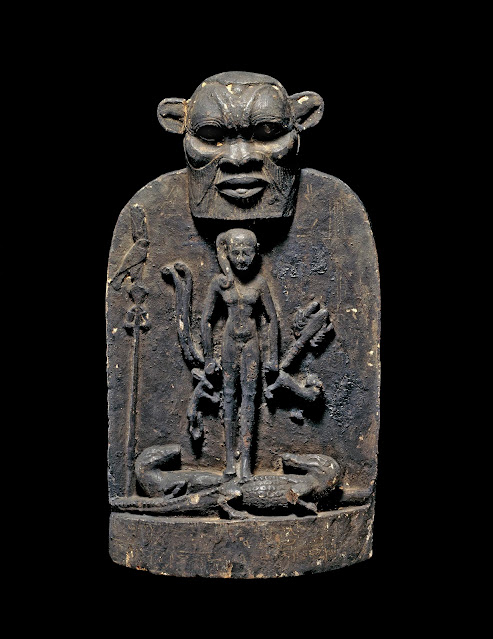
Cippus, protective magic stela – wood – Late period
British Museum – inventory number EA60958 – photo © The Trustees of the British Museum

Ancient Egyptian medicine combined scientific knowledge with healing magic. In “The Egyptian Museum in Cairo”, Abeer El-Shahawy recalls that: “magic, prayer and medicine complemented each other in ancient Egypt and people in need, in danger, suffering from illness or disease and illness prayed in front of such stelae.

There are also “miniature steles” that one could carry with oneself. The Metropolitan Museum of Art in New York, which has several examples, indicates that these small models were considered “an amulet for magical protection rather than transmitting magic to the water poured over them for drinking”.

Miniature cippus of Horus – magic stele – copper metal
Ptolemaic period – around 332 – 30 BC-AD – MMA New York – entry number: 23.6.19

In his reference study on “The ‘healing’ statues in ancient Egypt”, Pierre Lacau indicates that: “The typical stele of Horus on the crocodiles must therefore be considered as a true repertoire of ‘amulets’ and ‘formulas’ which the Egyptians could have at their disposal against bites; it is an arsenal or a codex containing the most varied weapons or remedies. We can, therefore, understand the extraordinary popularity that it was able to enjoy. All the provinces of Egypt have it used… They could be dedicated in temples, kept at home, or carried on one’s person like an amulet…

These steles testify to the force that magic exerted on the ancient Egyptians. They also reflect the fervour of the power granted to the “Medou-Neter,” the hieroglyphs, which in this specific case turn out to be, according to their etymology, sacred or divine writings.

Marie Grillot

Sources:

Pierre Lacau, “Healing” statues in ancient Egypt, Monuments and memories of the Eugène Piot Foundation, 1921, 25-1-2 pp. 189-210 https://www.persee.fr/doc/piot_1148-6023_1921_num_25_1_1824

Wallis Budge, Amulets & Magic, London 1930
Georges Posener, Dictionary of Egyptian Civilization, Fernand Hazan, 1959
Jocelyne Berlandini, A stele of Horus on the crocodiles of the superior of the priests of Sekhmet, Padiimennebnesouttaouy, Cahiers de Karnak VI 1973-1977, Cairo, 1980 https://www.academia.edu/3736548/Une_stèle_dHorus_sur_les_crocodiles_du_supérieur_des_prêtres_de_Sekhmet_Padiimennebnesouttaouy Carol Andrews, Amulets of Ancient Egypt, British Museum Press, London, 1994 https://archive.org/details/AmuletsOfAncientEgypt_201707 https://umranica.wikido.xyz/repo/e/ea/Amulets_of_ancient_Egypt.pdf

Guillemette Andreu, Marie-Hélène Rutschowscaya, Christiane Ziegler, Ancient Egypt at the Louvre, Hachette, 1997
Francesco Tiradritti, Treasures of Egypt – The wonders of the Egyptian Museum in Cairo, Gründ, 1999
Abeer El-Shahawy, The Egyptian Museum in Cairo, Matḥaf al-Miṣrī, American Univ in Cairo Press, 2005
Magical stela or cippus of Horus, Metropolitan Museum of Art New York, entry no. 20.2.23 https://www.metmuseum.org/art/collection/search/545766?searchField=All&sortBy=Relevance&ft=horus+stelae&offset=0&rpp=20&pos=12 Miniature cippus of Horus (magical stela), Metropolitan Museum of Art New York, entry no. 23.6.19 https://www.metmuseum.org/art/collection/search/570346 Cippus of Horus on the Crocodiles, Brooklyn Museum – accession number 60.73 https://www.brooklynmuseum.org/opencollection/objects/3684 Stele of Horus, Louvre, E 20008 https://collections.louvre.fr/ark:/53355/cl010006108 Healing statue, Louvre, E 10777 https://collections.louvre.fr/ark:/53355/cl010034902 Cippus, protective magic stela, British Museum, EA60958 https://www.britishmuseum.org/collection/object/Y_EA60958

Posted 16th January 2015 by Marie Grillot

Labels: Bès CG 940 Cippe d’Horus cippi cippus guérisseuse Harpocrate Horus Isis magie piqures scorpions serpents Seth stèle stèle Horus et crocodiles stèle magique Wallis Budge

Jean-François Champollion, The Finder of the Key of Ancient Egypt Language.

Standard

Jean-François Champollion, a genius who discovered the code of the ancient Egyptian language, also known as Champollion le jeune, was a French philologist and orientalist known primarily as the decipherer of Egyptian hieroglyphs and a founding figure in the field of Egyptology. He is one of the most valuable personalities who helped humanity- along with great support from his brother Jacques-Joseph Champollion- to take a big step towards understanding the human past.

Rosetta stone~ British Museum, London ~ photo by Gloria Bolton

Just imagine these words (holography) written on this vast stone were not decipherable. But now we are not illiterate anymore!

Here, we read an exciting introduction by Marie Grillot about a brilliant Egyptologist and her research on this genius of decoding ancient language.
PS: I wish there could also be a translated clip!

Jean-François Champollion in Egypt: an interview with Karine Madrigal

via; égyptophile

Jean-François Champollion, “The Younger”, decipherer of hieroglyphs, founder of Egyptology
Figeac, December 23, 1790 – Paris, March 4, 1832
Portrait representing him in Egyptian clothing, made by Salvatore Cherubini in Medinet Habou,
in July 1829 – acquired by the Musée Champollion de Vif in June 2022
“Jean-François Champollion in Egypt”: an interview with Egyptologist Karine Madrigal (centre)
directed and filmed in Malqatta by Marie Grillot & Pascal Pelletier
To discuss “Jean-François Champollion in Egypt”, it is in Louqsor that we found the Egyptologist Karine Madrigal…

Since July 2010, she has been studying the 60 volumes of archives of the Champollion brothers deposited in the Departmental Archives of Isère. Through this incredibly rich source, nothing that links the two brothers is foreign to her…

On the one hand, Jacques-Joseph Champollion-Figeac, the eldest, and on the other, Jean-François Champollion, known as “the young one”. Twelve years separate them, Jacques-Joseph will be the godfather of his younger brother and… his pygmalion… He will help and assist him in his education, studies, research, and obsessive quest to understand writing from ancient Egypt.

The Champollion “brothers”: Jean-François Champollion “the Younger” on the left and Jacques-Joseph Champollion “Figeac” on the right
Paintings by Victorine-Angélique-Amélie de Rumilly were exhibited at the Musée de Vif in Isère.

This hard work led to the presentation, on September 27, 1822, at the Académie des Inscriptions et Belles-Lettres in Paris, of his famous “Letter to Mr. Dacier”, which would be the founding act of the decipherment of hieroglyphs and, by the same, will sign the birth of a new discipline, Egyptology…

Jean-François was then 32 years old… In 1824, he was sent on a mission to the Turin Museum to establish the catalogue of the Drovetti Collection. Then, he returned to Italy in 1826 to appraise the Salt Collection. There, he met Ippolito Rosellini, who became his student and disciple. On May 15, 1826, he was appointed curator of the Egyptian section of the Charles X Museum (future Louvre Museum).

But what he wants more than anything is to go to Egypt to carry out a scientific mission… and this project will finally come to fruition…

The Franco-Tuscan Expedition, sponsored by Charles X and the Grand Duke of Tuscany, left Toulon on July 31, 1828, aboard “L’Eglé” and landed on the Egyptian coast on August 18, 1828. It is managed on the French side by Jean-François Champollion and on the Tuscan side by Ippolito Rosellini…

From July 1828 to December 1829, they explored the various ancient sites, from Alexandria to Abu Simbel and even as far as Wadi Halfa… During these eighteen months, the fourteen members – “scholars and technicians” – will have to learn to live and work together… As for the famous decipherer discovering his “promised land”, he finds himself surprised that his deciphering system works “in situ” and on monuments from all periods…

The Franco-Tuscan expedition to Egypt – Jean-François Champollion, seated, centre
and standing to his left holding a sketch, Ippolito Rosellini
Painting by Giuseppe Angelli © National Archaeological Museum of Florence – 19th century, between 1834 and 1836

Thanks to Karine Madrigal’s excellent knowledge, combined with her passion and her undeniable talent as a “storyteller”, it is with joy that we relive, with her, this great and rich adventure from the beginnings of Egyptology…

This interview, prepared and produced by Marie Grillot, was filmed by Pascal Pelletier for Guinée-nouvelles and the Association for the Safeguarding of the Ramesseum (ASR). It was filmed at the French Archaeological Mission of Thebes West house in Malqatta, which Christian Leblanc was kind enough to make available… You can view it by clicking on the photo below:

              Published 4 weeks ago by Marie Grillot
Libellés: expédition franco-Toscane Ippolito Rosellini Jacques-Joseph Champollion Figeac Karine MadrigalJean-François Champollion Lettre à M. Dacier

The Ba-Bird And Its Secret!

Standard

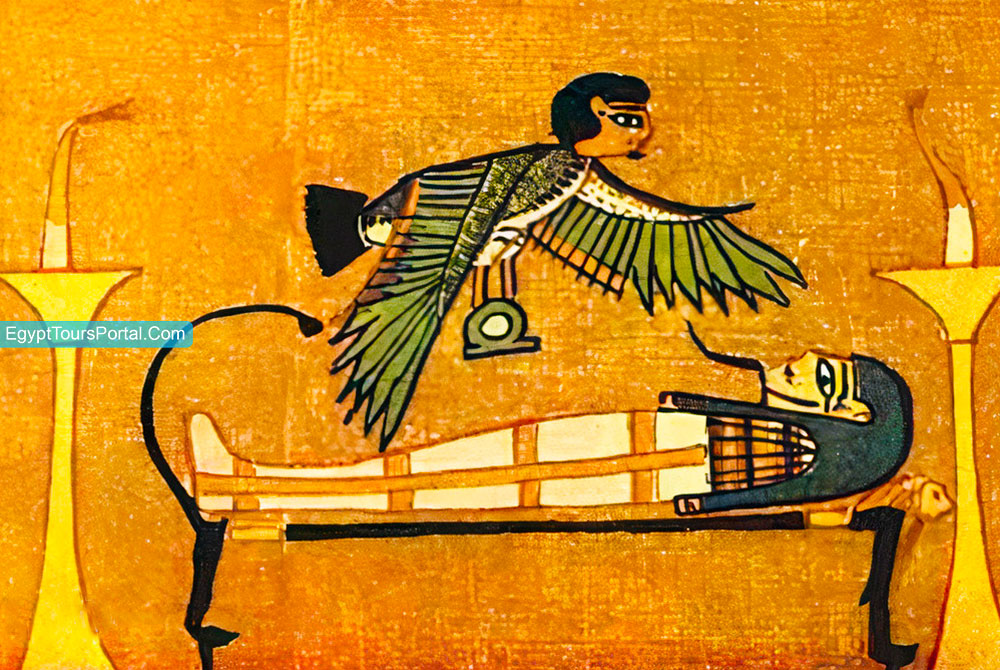
3 Elements to the Egyptian concept of the soul: Ka, Ba, and Akh .___ ((Ka)) is the life force or spiritual double of the person. The royal Ka symbolized a pharaoh’s right to rule___((Ba)) is represented as a human-headed bird that leaves the body when a person dies.___((Akh)) was a concept of the dead that varied over the long history of ancient Egyptian belief, was associated with thought, but not as an action of the mind; rather, it was intellect as a living entity.

“May it see my corpse; may it rest on my mummy, Which will never be destroyed or perish.” PAPYRUS OF ANI, New Kingdom, Dynasty XVIII, Collection of The British Museum.

Our topic in this article is the Ba, the master of soul and body, and we have the chance to read an excellent interview by Marie Grillot with brilliant Michèle Juret and an introduction of her book about the secret of this bird and all we can get to know about it.
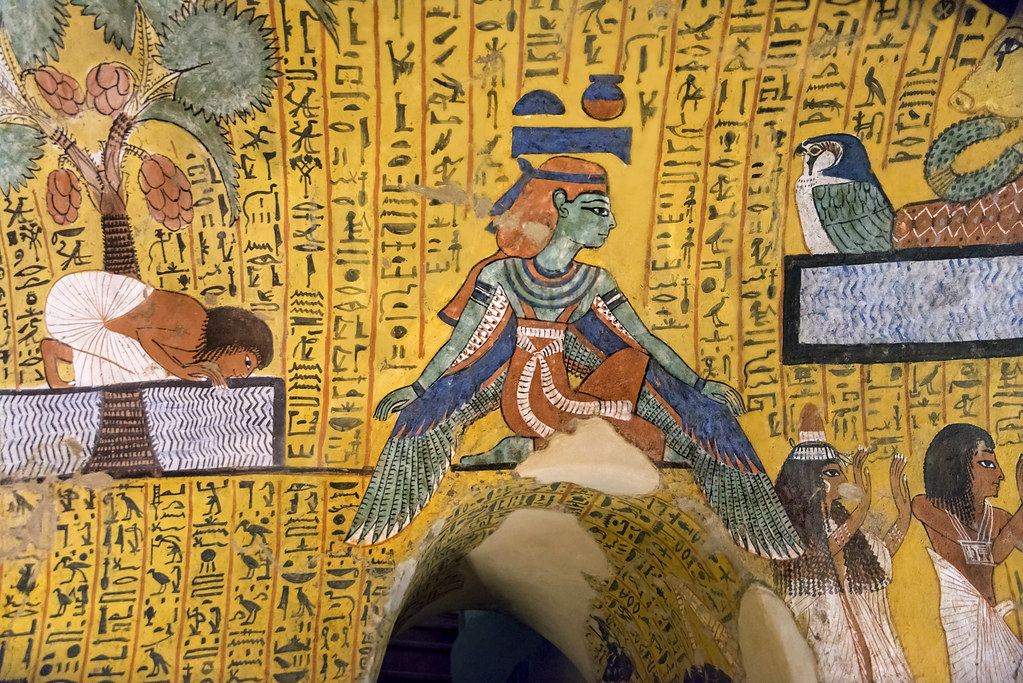
Tomb of Irynefer Deir el-Medina (Flickr)

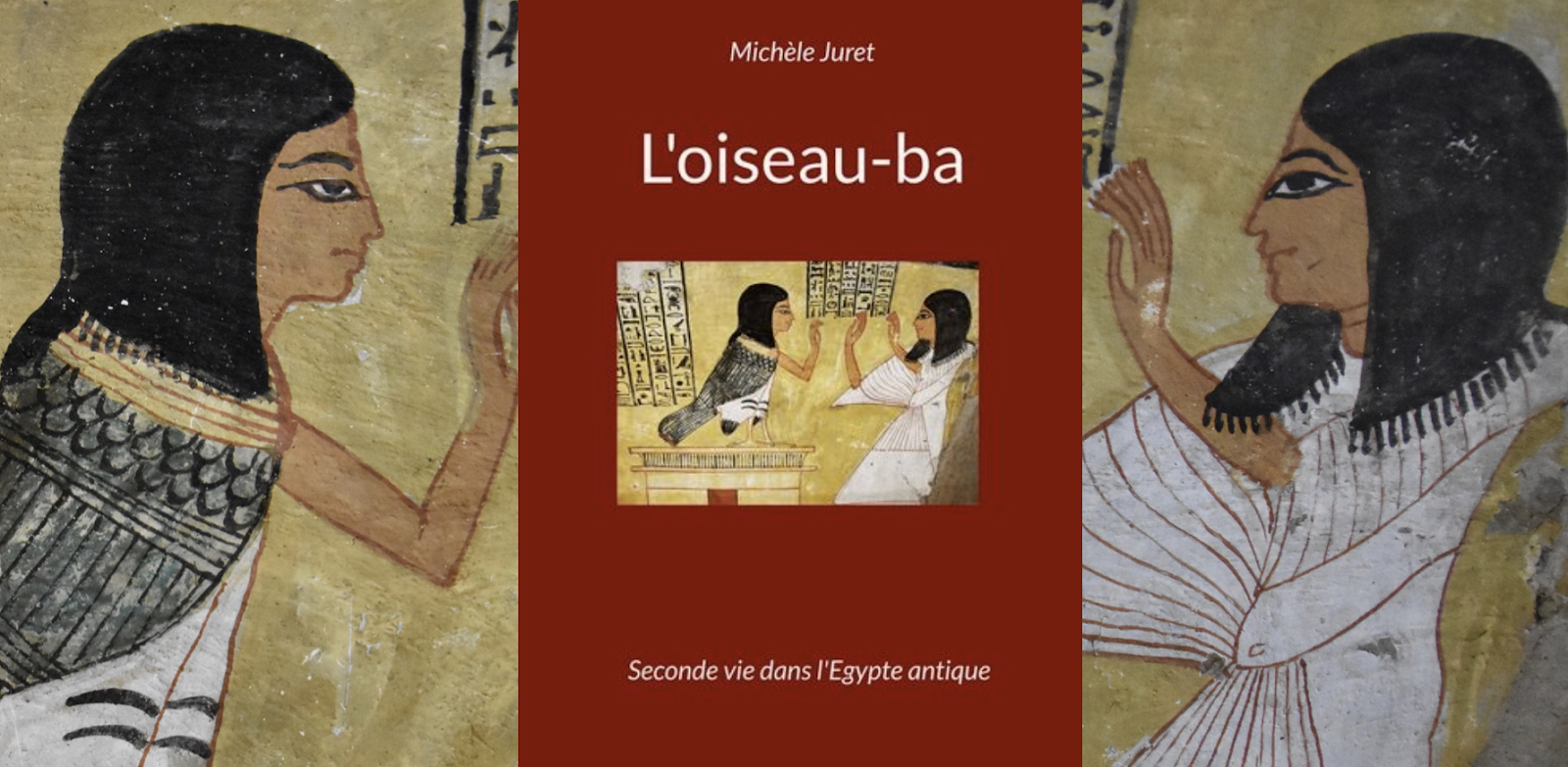
“The ba-bird, second life in ancient Egypt”: the new work by Michèle Juret

via: égyptophile

Inherkaou and his “ba”, represented in the burial chamber of the tomb of this team leader for the Master of the Deux-Terres
TT 359 – Deir el-Medina – 20th dynasty – Ramses III Ramses IV
“The ba-bird, Second Life in Ancient Egypt” by Michèle Juret – published by Books on Demand

A graduate of the École du Louvre and curator of the Montgeron Museum, Michèle Juret is notably “the” biographer of the Egyptologist Etienne Drioton, the last French director of the Egyptian Antiquities Service.

With her new publication: “The Ba-bird, Second Life in Ancient Egypt”, she devotes herself to a theme that is particularly dear to her since it was, from 2002, the subject of her research dissertation. Driven by her interest and passion for this entity flying “between two worlds”, she has never stopped researching and “taming” its multiple and diverse representations… Evoked in several chapters of the “Book of the Dead”, the ba-bird is found on the walls of tombs, on coffins, papyri, steles, statues, offering tables, or even on pectorals and amulets…
As meticulously as it is applied, this well-documented study allows us to understand better this conception of “ba” so intimately – and specifically – linked to ancient Egypt…

Michèle Juret, author of “The Ba-bird, Second Life in Ancient Egypt”
published by Books on Demand in May 2022

MG-EA: To understand what a “ba-bird” is, we must certainly first understand the importance of this “ba” entity in the conception of the personality of the ancient Egyptians.

Michèle Juret: First of all, I would like to thank you, Marie Grillot, for this interview, which allows us to discuss the essentials of this work, namely the observation of the iconography of the ba in the light of the funerary texts.
As you say, it is first necessary to understand the importance of this fundamental entity, a guarantee of survival.

For the ancient Egyptians, the individual is made up of various elements:
The body, immobilized by death, will remain in the grave.
Ka, the vital force, draws its energy from food.
The Akh, celestial spirit, magical power, can be beneficial or evil.
The shadow will enjoy a certain independence.
We commonly translate the ba by the word soul, although the concept is much more complex. An important element is that it is of divine nature. The Alter-ego of the deceased is essential to his survival.

MG-EA: The ba-bird generally presents itself as a composite, anthropo-cephalous being, that is to say, with a human head and a bird’s body: when did it appear, in this form, in the iconography?

Michèle Juret: This half-avian/half-human appearance is the culmination of a slow evolution. From the Old Kingdom, the king’s ba, named in the Pyramid Texts, appears in hieroglyphic writing as a wader with a loop at the base of the neck. In Middle Kingdom texts, it is seen as a bird with the head of the living (human) without this image appearing in the writing. Finally, some amulets and masks decorated with feathers date from this period, and then the rishi sarcophagi will become milestones towards this figure of an anthropo-cephalous bird that we will commonly encounter from the New Kingdom onwards.

Irynefer and her “ba”, represented in the burial chamber of the tomb of this servant in the Place of Truth.
TT 290 – Deir el-Medina – 19th dynasty – Ramesses II

MG-EA: Indispensable to the survival of the being that death has immobilized the ba-bird, he enjoys total freedom… He can enter and leave the grave in, you write, “a moving interdependence with the deceased”? He thus becomes the guarantor of his “post-mortem” future?

Michèle Juret: Indeed, Le ba enjoys total freedom. He will be able to leave the tomb, climb into Ra’s boat, benefit from its rays, drink the regenerating water of the tree goddess, benefit from the food offerings… Every evening, he will rejoin the body of his deceased; their survival depends on their reunion… Observing this iconography transports us into an almost magical world. We follow the entity in its daily comings and goings, alone or accompanying its deceased, maintaining its own life through food offerings or providing this food for the deceased’s ka. Finally, it unites with it in an interdependent guarantee of survival.

Bird-ba of Youya – painted limestone – 18th dynasty – from his tomb KV 46
Cairo Museum – CG 51176

MG-EA: Evoked and invoked in several chapters of the Book of the Dead, associated with the cycle of the sun, it is itself endowed with several “becomings”?

Michèle Juret: Yes, in fact, several futures are possible for him. We have just mentioned the best and most probable, the second life as an alter-ego of the deceased. Let us remember that the post-mortem fate of the ancient Egyptians is complex. A solar destiny will allow him to follow Ra in his boat or a stellar one among the stars, and finally, an Osirian destiny will allow him to cultivate the fields of Ialou. How can we reconcile these notions, which seem contradictory? The ba-bird becomes the answer to this question and the link between these different post-mortem futures. His destiny is divine.

But he could be led towards another destiny linked to that of the heart, a very important element.

The texts also evoke the presence of the ba at the weighing of the heart, a scene of judgment also called psychostasis. In chapter 125 of the Book of the Dead, it is attested through Thoth’s words: “I have examined the heart of Osiris Ani while his ba presents himself, stands as a witness about him…” In the vignette from this papyrus, we see the ba-bird witnessing this judgment. Its future is linked to that of the heart. The Book of Caves gives a version of its annihilation if the heart is declared guilty. While this would be separated from the deceased and thrown into one cauldron, the ba and the shadow would be thrown into another. The deceased would be among the damned, those who no longer have a soul. Like that of the body, the destiny of the ba is linked to that of the heart key of life.

“Birds-ba” represented at the bottom right of this scene from the burial chamber of the tomb of Nebenmâat.
servant of the Place of Truth – TT 219 – Deir el-Medina – 19th dynasty

MG-EA: Your research, targeted on the “ba-birds” of individuals from the New Kingdom, was based on a vast literature and the study of numerous of their representations: their iconography is rich and evolving, and the location where they take place, always full of meaning?

Michèle Juret: Yes, as you say, these representations are loaded with meaning. It was important to bring the iconography closer to the funerary texts. There, we find the reading keys. The analysis of the documentation fully reflects the different situations they express. Furthermore, the location of certain scenes on the tombs’ walls was not chosen randomly but determined according to the theme evoked.

MG-EA: You not only studied their adornments and hairstyle, but to refine their description and relate them to existing species, you also had to develop ornithological talents?

Michèle Juret: Ornaments and hairstyles allowed me, in some instances, to put forward a possible desire to identify with the deceased.
Furthermore, observing the bodily appearance of these birds, another aspect of this study, highlighted different options in the choice of species depending on the chapters of the Book of the Dead that they illustrate. This observation proved fascinating, and I ventured to put forward some hypotheses. Unfortunately, I didn’t have the “ornithologist talents” you mentioned. A specialist from the Natural History Museum helped me a lot with this identification.

Raya and his “ba”, represented in the tomb of this Fourth Prophet of Amon
TT 159 – Dra Abou el-Naga – 19th dynasty

MG-EA: Would you not be tempted, now, to take an interest in the “ba-birds” of the pharaohs and queens?

Michèle Juret: Obviously, it’s a subject that also deserves to be addressed. In this study, I was tempted to quickly evoke the ba-bird of Tutankhamun and especially that of Queen Nefertari, an extraordinary example. On the one hand, its extremely composite body appearance combines both falconiform and anseriform characteristics, two birds with solar connotations. On the other hand, its profile, resembling that of the queen and its crown, the remains of a vulture surmounted by the modius, reinforce this idea of a desire to identify the ba-bird with its deceased.

Nefertari and her “ba”, represented in the antechamber of the queen’s tomb
TT 66 – Deir el-Medina – 19th dynasty – Ramesses II

This iconography fully reflects the importance of the ba in the Egyptian’s concerns for his post-mortem future. It will also be able to completely replace itself and become, in its place, as a substitute, the active element. Survival is in him. This is perfectly expressed on the stele of Neferhotep, which caught the attention of Etienne Drioton…

Comments collected by Marie Grillot

Michèle Juret, The ba-bird, second life in ancient Egypt.”
188 pages – Publisher: Books on Demand
Publication date: 12.05.2022                         https://www.bod.fr/librairie/loiseau-ba-michele-juret-9782322420131?fbclid=IwAR1z_prPOSx43ielkTm-o03OaqR-FWrdg6Ky9eBk1Zdyh1eOqSVOI0NMiuU

Published 6th October 2022 by Marie Grillot