The Ancient Craftsmanship and Artisans’ Fine Woodwork.

Standard
The lifelike statue of Ka’aper the Scribe is the oldest life-size wooden statue from Ancient Egypt.

Today, I am sharing this invaluable fine art from ancient Egypt with you. Kaaper or Ka’aper (fl. c. 2500 BC), also commonly known as Sheikh el-Beled, was an ancient Egyptian scribe and priest who lived between the late 4th and early 5th Dynasties. Although his rank was not among the highest, he is well known for his famously exquisite wooden statue. A wooden statue of a woman, commonly considered to be Kaaper’sKa’aper wife, also came from the same mastaba (CG 33). Wiki.
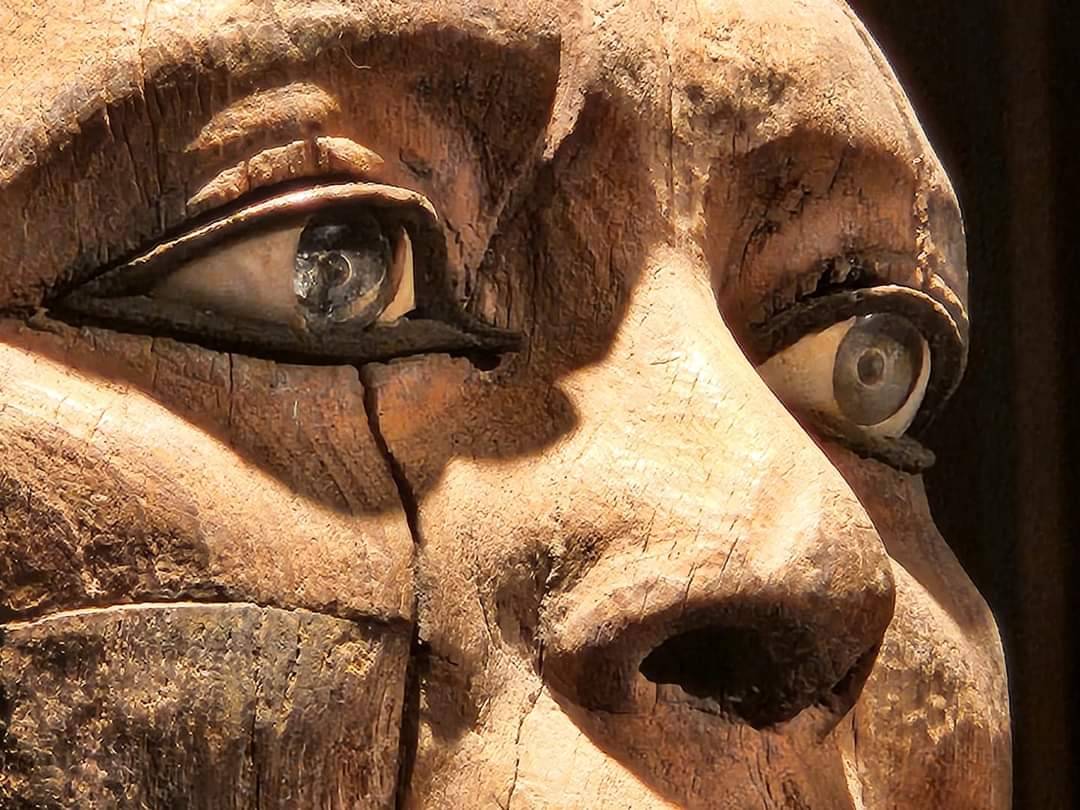
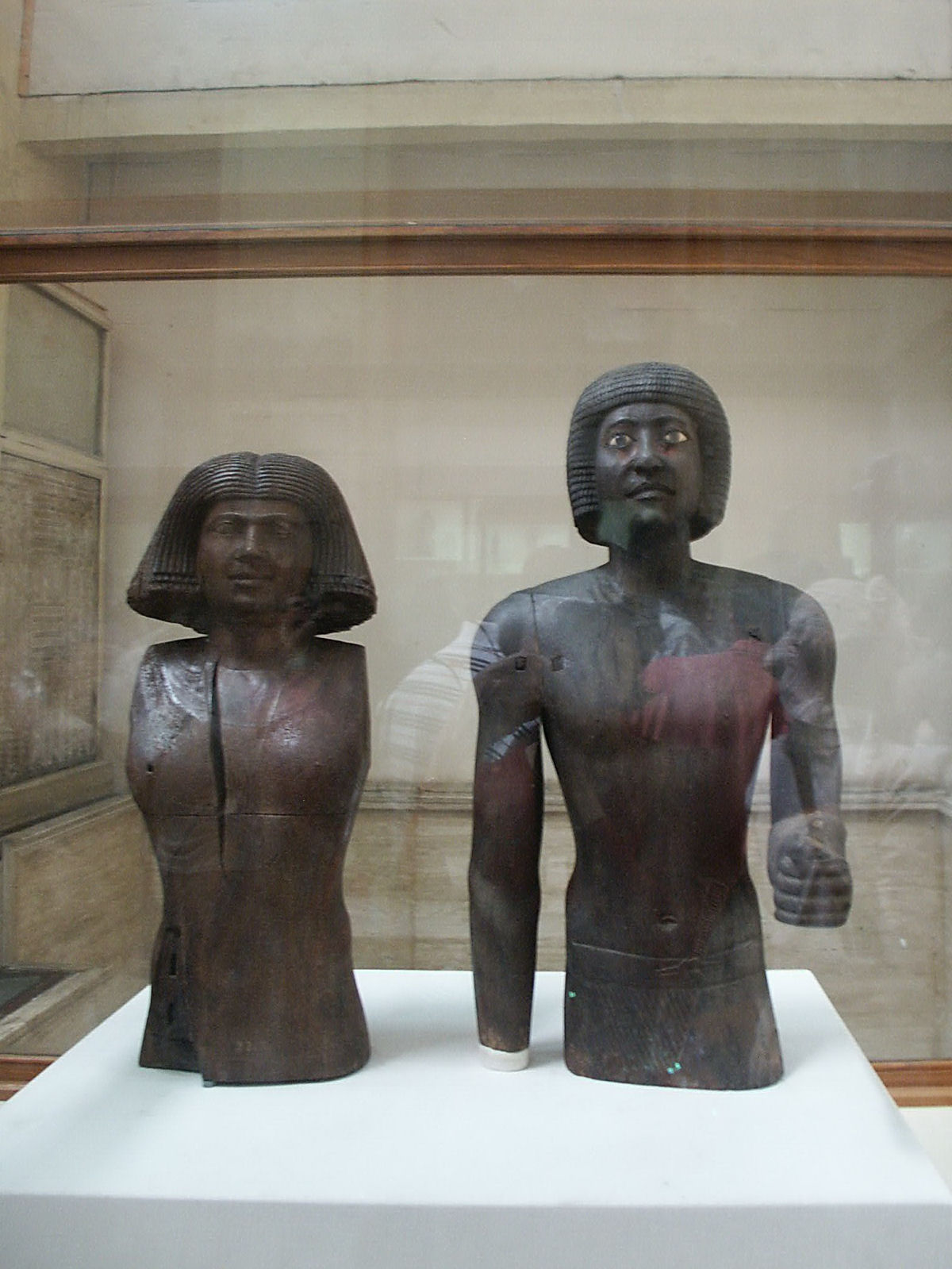
Although the statue of that priest is famous enough, there is another tiny masterpiece: a statue of a woman, a noble lady, from the same mastaba. This is also a wooden statue, commonly considered to be Kaaper’s wife (CG 33).

Here is a report by the brilliant Marie Grillot about the delicate artistry of this statue. Enjoy reading, and Merry Christmas!

Ka-Aper’s wife: a noble lady of the Old Kingdom …

via égyptophile

Statue of the wife of Ka-âper (Kaaper – Sheikh el-beled) – wood – Old Kingdom – 5th Dynasty (2513 – 2506 BC)
discovered by Auguste Mariette in 1860 at Saqqara, in the Mastaba C8
Egyptian Museum of Cairo CG 33 – photo of the museum

Wooden statuary was only beginning at the end of the 4th Dynasty, and this Statue is undoubtedly among the very first referenced female representations…

Carved in the round, dark brown wood, it was initially covered with a “fine patina of painted stucco”, which has now disappeared.

The face of the noble lady is rather round; her eyes are stretched, and her mouth is closed.

She wears a mid-length hairstyle covering her ears. As Mohamed Saleh and Hourig Sourouzian explain in their “Official Catalogue of the Egyptian Museum in Cairo”, it is “streaked with locks that end in small curls, and divided by a middle parting”. They also specify that “this wig is commonly found in female representations of the Old Kingdom”.

Statue of the wife of Ka-âper (Kaaper – Sheikh el-beled) – wood – Old Kingdom – 5th Dynasty (2513 – 2506 BC)
discovered by Auguste Mariette in 1860 at Saqqara, in the Mastaba C8
Egyptian Museum of Cairo CG 33 – photo of the museum

Her neck is adorned with a wide necklace of the usekh type, with some traces of colour remaining. The torso, with its marked chest, is thin and straight. Amputated by the upper limbs, it stops at the base of the shoulders. The statues were, in fact, made in several parts, and, in this case, the arms were added and attached to the bust using tenons. We can observe this “assembly” on multiple examples of wooden statuary…

The legs are also missing, but her attitude shows that she was depicted standing.
She is wearing a long, tight dress held up by two wide, sculpted straps “slightly projecting”.

The wood, with its visible veins, has worked and cracked over the course of more than 4,500 years. In particular, we notice an apparent crack that goes down from the neck to the navel and two more discreet ones, starting from the top of the skull towards the chin and the other from the left eye towards the chin. At the level of the right groin, we also note a considerable lack of triangular shape.

Despite these injuries, this lady retained the nobility and dignity pertaining to her rank, and the sculptor took care to render and respect her.

Wooden statues of Ka-Aper – Sheikh el-beled and his wife – Old Kingdom – 5th Dynasty (2513 – 2506 BC)
discovered in 1860 by Auguste Mariette at Saqqara in Mastaba C8
Egyptian Museum of Cairo – CG 34 and CG 33

In the “Guide du visiter au musée de Boulaq” (1883), Gaston Maspero describes it as number 1044: “Statue of a woman of which only the head and the torso remain. It was discovered in the same tomb as the Statue of Sheikh el-beled and is said to represent this character’s wife. In any case, it was wonderful and could be compared with Sheikh el-beled if it were not unfortunately so mutilated.”

Auguste Mariette, then the director of Egyptian antiquities, discovered the two statues in Saqqara in 1860.

Excerpt from the book: “Les Mastabas de l’ancien empire”, Paris, 1889, Mariette Auguste, Maspero, Gaston
concerning the discovery of the wooden statues of Ka-âper (Kaaper) – Sheikh el-beled – and his wife
discovered by Auguste Mariette in 1860 at Saqqara, in the Mastaba C8 Egyptian Museum of Cairo CG 34 and CG 33

In the book Les Mastabas de l’ancien Empire, published in 1889 and co-signed with Gaston Mapero, he presents the site and details the circumstances of the discovery.

“The oldest, the most extensive, the most important of the necropolises of Memphis is the one to which the village of Saqqara gave its name. The necropolis of Saqqara is located in the middle of the sand, just at the point where the desert begins and where the cultivated land ends; it is a sandy plateau which dominates by about forty meters the green plain extended at its feet. At the top of the plain, we find the necropolis…” He will uncover a huge number of tombs and mastabas there.

Excerpt from the book: “Les Mastabas de l’ancien Empire”, Paris, 1889, Mariette Auguste, Maspero, Gaston
concerning the discovery of the wooden statues of Ka-âper (Kaaper) – Sheikh el-beled – and his wife
discovered by Auguste Mariette in 1860 at Saqqara, in the Mastaba C8 Egyptian Museum of Cairo CG 34 and CG 33

Among these latter is the one that will be referenced, C 8 (the letter C corresponds to those of the second half of the 5th dynasty), discovered near the pyramid of Userkaf.

It will turn out to belong, according to Mariette’s transcription, to Khou-hotep-her (Ka-âper – Kaaper), a high official, chief priest. He was responsible for reciting prayers for the deceased in the temples and mortuary chapels where he officiated during the 5th dynasty (2465 -2458 BC).

“It was at the bottom of niche B, belonging to the small room, that the precious wooden statue was found… The head, the torso, and even the stick were intact, but the legs and the base were irremediably rotten, and the statue was only standing because of the sand which pressed on it from all sides. At the door C. of the small room, in the sand, and overturned in the place where it had obviously been thrown, was the other wooden statue,” he relates.

Statue of Ka-âper (Kaaper) – Sheikh el-beled – sycamore wood – Old Kingdom – 5th Dynasty (2513 – 2506 BC)
discovered by Auguste Mariette in 1860 at Saqqara, in the Mastaba C8
Egyptian Museum of Cairo CG 34

The statue of Ka-âper is so realistic that, upon discovery, the workers struck by its resemblance to the “chief of their village” gave it the name “Sheik el-beled”. It is undoubtedly one of the most emblematic statues of the Fifth Dynasty… That of his wife, because of her “amputations”, will remain more “confidential” and will not know the notoriety of her famous spouse…

It is exhibited at the Egyptian Museum in Cairo, Tahrir Square, under reference CG 33.

Marie Grillot

Sources:

Gaston Maspero, Visitor’s Guide to the Boulaq Museum, 1883 edition, Typ. Adolphe Holzhausen, Vienna, 1883 https://gallica.bnf.fr/ark:/12148/bpt6k6305105w.texteImage Auguste Mariette, Gaston Maspero, The Mastabas of the ancient empire, Paris, 1889 http://digi.ub.uni-heidelberg.de/diglit/mariette1889/0033?sid=02fcf46a77d8eaf4a9cd67e6974f1cc1 Ludwig Borchardt, General catalogue of Egyptian antiquities from the Cairo Museum – Statuen und Statuetten von Königen und Privatleuten im Museum von Kairo, Nr. 1-1294, Berlin Reichsdruckerei, 1911 https://archive.org/details/statuenundstatue53borc Gaston Maspero, Essays on Egyptian Art, E. Guilmoto Editeur, Paris, 1912? https://archive.org/details/essaissurlartg00maspuoft https://archive.org/stream/essaissurlartg00maspuoft/essaissurlartg00maspuoft_djvu.txt Gaston Maspero, Ancient History of the Peoples of the Classical Orient. I, Librairie Hachette et Cie, Paris, 1895-1899 http://gallica.bnf.fr/ark:/12148/bpt6k6134639f/f8.item.r=beled.langFR Elisabeth David, Mariette Pacha 1821-1881, Pygmalion, 1994
Mohamed Saleh, Hourig Sourouzian, Official Catalogue of the Egyptian Museum in Cairo, Verlag Philippe von Zabern, 1997

A Little Princess on a Scented Bottle.

Standard

Perfume has a rich history in human culture, such as ancient Persia, which dominated the perfume trade for decades. This civilization is known for inventing non-oil-based perfumes, and the Persian nobility valued fragrances highly, with kings having unique “signature scents” reserved exclusively for them. Ancient Persia had many perfume-making workshops where people experimented with various distillation processes and scents.

“Khosrow & the Page” (Perhaps from the 7th century)

In Ancient Egypt, the elite highly valued perfume oils and fragrances. The god Nefertem, associated with perfume, is often depicted with water lilies, a key ingredient in ancient scents.

“Rise like Nefertum from the lotus to the nostrils of Ra, and come forth upon the horizon each day”.

Perfumes were created by distilling natural ingredients in non-scented oils, resulting in fruity, woodsy, or floral aromas. Notable figures like Queen Hatshepsut and Queen Cleopatra enjoyed these fragrances, using them for baths and personal grooming. It is rumoured they took perfumes to their graves.

Here is the story of finding a tiny but precious perfume bottle from ancient Egypt, written by Marie Grillot, with heartfelt gratitude.🙏💖

An Amarna princess on a vase-shaped perfume bottle: Hes.

via égyptophile

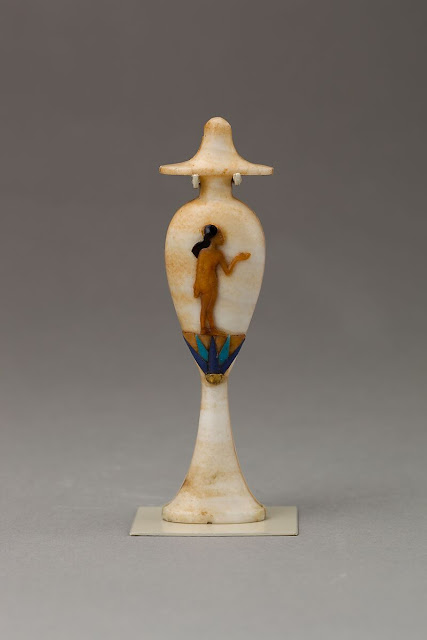
Perfume bottle in the form of a hes vase with the representation of princess
travertine (Egyptian alabaster), carnelian, obsidian, gold, coloured glass inlays
New Kingdom – 18th Dynasty – reign of Akhenaten (1353 – 1336 BCE)
Metropolitan Museum of Art, New York – accession number 40.2.4. (by acquisition from the Carter Estate in London in 1940) – museum photo

This delightful perfume bottle, in the form of a “Hes”( meaning “praise” or “favour) vase, is 10.8 cm high, 3 cm wide and has a diameter of 1.9 cm. According to some sources, it is made of calcite (Egyptian alabaster or travertine), with a decoration made of carnelian, obsidian, gold and coloured glass. In “Scepter of Egypt II”, William C. Hayes details its manufacturing technique thus: “The conical stopper was here cut in one piece with the pot itself. Since its tiny neck would have been too small to allow the insertion of a drilling tool, the bottle was made in two vertical halves, hollowed out and carefully joined with an orange resin glue”.

Perfume bottle in the form of a hes vase with the representation of princess
travertine (Egyptian alabaster), carnelian, obsidian, gold, coloured glass inlays
New Kingdom – 18th Dynasty – reign of Akhenaten (1353 – 1336 BCE)
Metropolitan Museum of Art, New York – accession number 40.2.4. (by acquisition from the Carter Estate in London in 1940) – museum photo

Its charming appearance is enhanced by the presence, on one side, of a princess’s representation in inlays. Seen in profile, it reveals a naked, slim and youthful body. Her partially shaved skull displays on one side the “braid of childhood”; thick and black, it is thrown back. One leg is advanced, and she is in the apparent walking position. One arm hangs along the body, while the other displays a bent elbow and an outstretched hand, palm open. “The elegant gesture of the princess seems to signify a sign of greeting: standing on a lotus flower according to traditional symbolism, she embodies rebirth and rejuvenation”, analyzes Dorothea Arnold in “The Royal Women of Amarna”. Indeed, the ancient Egyptians considered the lotus as “the initial flower” and “the symbol of the birth of the divine star”.

For Egyptologist Valérie Angenot: “The gesture of the little princess, the hand outstretched in a cup, is stereotypical of the gestures of princesses since the time of Hatshepsut. It denotes the attitude of a child who wants to attract someone’s attention and address them by gently pulling their chin towards her. At Tell el-Amarna, the gesture is attested about fifteen times on the walls of private tombs, administrative monuments such as the king’s audience hall, steles, perhaps seal impressions, as well as on this vase. It exclusively features princesses, mostly to show that they interact or chat among themselves during long official ceremonies, which one imagines is tedious for young children. But we can also see them making this gesture in their interaction with their parents or even with the uraeus hanging from their foreheads. At Deir el-Bahari, Hatshepsut addresses the god Amon, her father, on whose knees she stands as a child. We must, therefore, imagine an elliptical interlocutor for this vase. Various reliefs show Akhenaten and Nefertiti performing a libation to the Aten with similar vases (but often adorned with a spout, 𝘯𝘦𝘮𝘴𝘦𝘵). Therefore, the ‘person’ to whom this little princess emerging from a solar lotus is addressing herself would be none other than the god Aton, whose honour the ritual would be simulated using this artificial vase. It is remarkable that we still find the same stereotypical gesture of the cupped hand sketched by one of the two Amarna ‘kings’ on the famous Berlin stele of Captain Pasi (ÄM 17813).”

Perfume bottle in the form of a hes vase with the representation of princess
travertine (Egyptian alabaster), carnelian, obsidian, gold, coloured glass inlays
New Kingdom – 18th Dynasty – reign of Akhenaten (1353 – 1336 BCE)
Metropolitan Museum of Art, New York – accession number 40.2.4. (by acquisition from the Carter Estate in London in 1940) – museum photo

The details of its morphology, such as the elongation of the skull, the shape of the face, and the marked belly, attribute it to the Amarna period… William C. Hayes gives this sensitive description: “The naked figure of the young girl – which seems to come straight out of one of the scenes preserved in relief at Tell el-Amarna – is delicately carved in a thin sliver of carnelian, the back of which has been hollowed out to fit exactly the curved surface of the vase. The hair of the figure, topped with the characteristic heavy side lock, is a piece of polished obsidian or black glass beautifully worked and skillfully fitted. Spears and triangles of purple glass (imitation lapis lazuli) and polished carnelian have been joined together to form the lotus flower on which the figure stands, and at the base of the flower, a spot of sparkling yellow has been provided by a piece of thin gold plate.”

This precious artefact dates to the New Kingdom, the 18th Dynasty, the reign of Akhenaten (1353 – 1336 BC). It is in the Metropolitan Museum of Art in New York, where it has been registered under the accession number 40.2.4, with the “ancient provenance”: “possibly Thebes.” As for its “recent provenance,” it is “speaking”: “Howard Carter Collection, acquired from the Carter estate in London in 1940.”

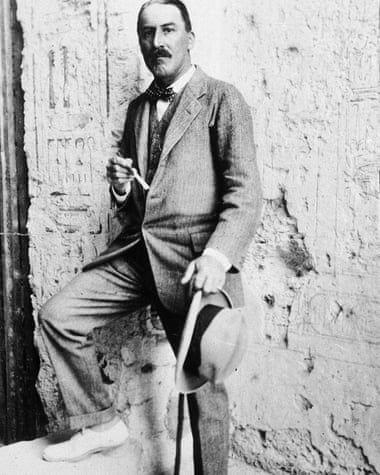
Portrait of Howard Carter, author and date unknown
(London 9-5-1874 – 2-3-1939)
Draughtsman and Egyptologist, discoverer, in November 1922 with Lord Carnarvon, of the tomb of Tutankhamun

Howard Carter, painter and designer, Egyptologist, collector, and discoverer with Lord Carnarvon of the tomb of Tutankhamun in 1922, died in London on March 2, 1939. In his will (drawn up on July 14, 1931), he had designated his niece Phyllis Walker as heir to the majority of his assets, stipulating that, for all matters concerning the sale of Egyptian antiquities, she should refer to the executors he had appointed: Harry Burton and Bruce Ingram. The latter, noting in his apartment the presence of artefacts from the tomb of Tutankhamun, opted for restitution to Egypt. On March 22, 1940, Phyllis Walker wrote to Etienne Drioton, director of Egyptian antiquities, to organize this “return”. This is how around twenty artefacts will be returned, via diplomatic bag, to King Farouk… before joining the Tahrir Museum…

Howard Carter
Draughtsman and Egyptologist, discoverer, in November 1922 with Lord Carnarvon, of the tomb of Tutankhamun
With his niece Phyllis Walker, who will be his primary heir

Returning to this point in “Howard Carter, The Path to Tutankhamun”, Thomas Garnet Henry James confides: “A further comment on this sensitive subject is that the antiquities in his possession at his death, after the extraction of the Tutankhamun objects, were valued by Messrs Spink at £1093. This was certainly a low estimate, as was often the case in estate matters, but it indicates the relatively modest nature of his private collection…”

Thus, in this inventory carried out on June 1, three months after the discoverer’s death, by the London art dealers Spink & Son of St James’s Street (“Spink list”), this bottle bears the number 55.

Of course, the question arises as to whether it is linked to the young pharaoh’s funerary treasure…

Thomas Garnet Henry James’s opinion is as follows: “It can be said that any fine small object dating from the 18th Dynasty which appeared in a private collection or on the market in the 1920s and 1930s was almost systematically attributed to the tomb of Tutankhamun”…

Lord Carnarvon and Howard Carter, discoverers of Tutankhamun’s tomb in 1922 (KV 62)

As for Marc Gabolde, he draws up, in his excellent “Tutankhamun”, published by Pygmalion in 2015, a list of “Objects possibly coming from the tomb of Tutankhamun and not found (somewhere else) in Egypt”. This calcite bottle in the shape of a libation vase (hs) appears there with the following information: “The quality of the work and the materials, as well as the date that can be assigned to the object thanks to the iconography of the inlaid figure, leave little doubt that it could come from the tomb of Tutankhamun. The figure of the princess is incompatible with the time of Amenhotep III, and the royal tomb of Amarna has not provided similar objects, especially in such a state of preservation”…

Marie Grillot

Sources:

Perfume bottle in the shape of a hes-vase inlaid with the figure of a princess https://www.metmuseum.org/art/collection/search/543992 William C. Hayes, Scepter of Egypt II: A Background for the Study of the Egyptian Antiquities in the Metropolitan Museum of Art: The Hyksos Period and the New Kingdom (1675-1080 B.C.), Cambridge, Mass.: The Metropolitan Museum of Art, 1959. p. 314; p. 317, fig. 199 https://archive.org/details/in.gov.ignca.28841 https://www.metmuseum.org/en/met-publications/the-scepter-of-egypt-vol-2-the-hyksos-period-and-the-new-kingdom-1675-1080-bc #115 Thomas Garnet Henry James, Howard Carter, The path to Tutankhamun, TPP, 1992 https://archive.org/stream/HowardCarterThePathToTutankhamunBySam/Howard+Carter+The+Path+to+Tutankhamun+By+Sam_djvu.txt Dorothea Arnold, The Royal Women of Amarna: Images of Beauty from Ancient Egypt, Metropolitan Museum of Art New York, 1996, fig. 115, p. 116. https://books.google.fr/books?id=sGLFwVkljQMC&pg=PR12&lpg=PR12&dq=Harkness+edward+queen+Tiye&source=bl&ots=MulVu6vNW S&sig=zL2tg-zHcQ2Ia-ra5NSPtbXaYtE&hl=fr&sa=X&ved=0ahUKEwjl5ua_oY7KAhWCQxoKHX_qBXYQ6AEIMjAC#v=onepage&q=yellow&f=false Nicholas Reeves, Howard Carter’Collection of Egyptian and Classical antiquities, The Spink List, (Chief Of Seers: Egyptian Studies in Memory of Cyril Aldred), Editor: Kegan Paul, 1997 https://books.google.fr/books?id=K_Ill17K2wsC&pg=PA243&lpg=PA243&dq=ivory+figure+of+a+dog+(ear+chipped)&source=bl&ots=dsAnFliI3O&sig=PWT4Cg8cicNIiajywtVJsYZQkX0&hl=fr&sa=X&ved=2ahUKEwiIgPiwsYngAhUpzoUKHRJxDn0Q6AEwB3oECAcQAQ#v =onepage&q=ivory%20figure%20of%20a%20dog%20(ear%20chipped)&f=false Isabelle Franco, Dictionary of Egyptian Mythology, Pygmalion, 1999
Nicholas Reeves, Tutankhamun, life, death and discovery of a pharaoh, Editions Errance, 2003
Marc Gabolde, Tutankhamun, Pygmalion, 2015

The Riddles of Ancient Egypt Continue fascinatingly as an Eternal Mystery!

Standard

In ancient Egypt, there were eleven pharaohs named Ramesses, one of whom was Ramses II, known as The Great. This title likely stemmed from his lengthy reign of 66 years and his famous association with Moses.

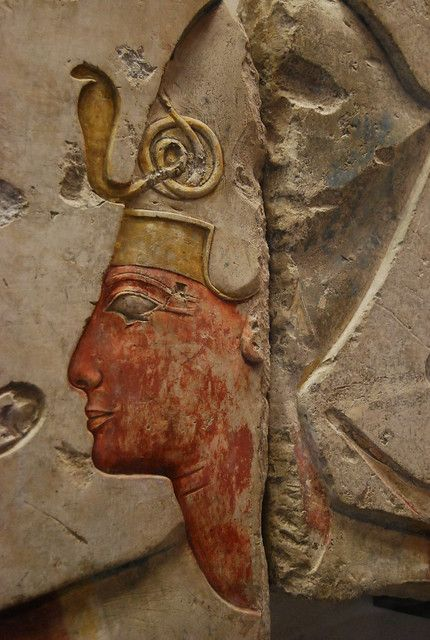
Ramses II
Photo by konde on flickr
|Detail from a relief. King Ramses II, among the gods, the relief comes from the small temple built by King Ramses II at Abydos. In the relief, Ramesses II is crowned by the goddess Nekhbet in the form of a vulture. And Ramses II is introduced with the gods. 19th Dynasty, Abydos B 10, B 11, B 12, B 13, B 14. Louvre Museum

Perhaps his secrets are boundless and still awaiting discovery. We gain a deeper understanding of these mysteries thanks to Frédéric Payraudeau and the insightful interview by the brilliant Marie Grillot.🙏💖

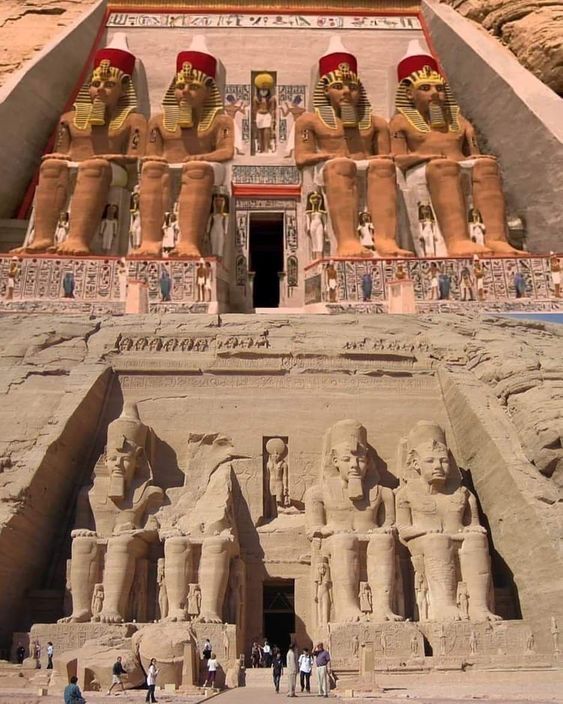
Another view of the facade of the Great Temple of the Bringing the past into focus and making it relatable for all!

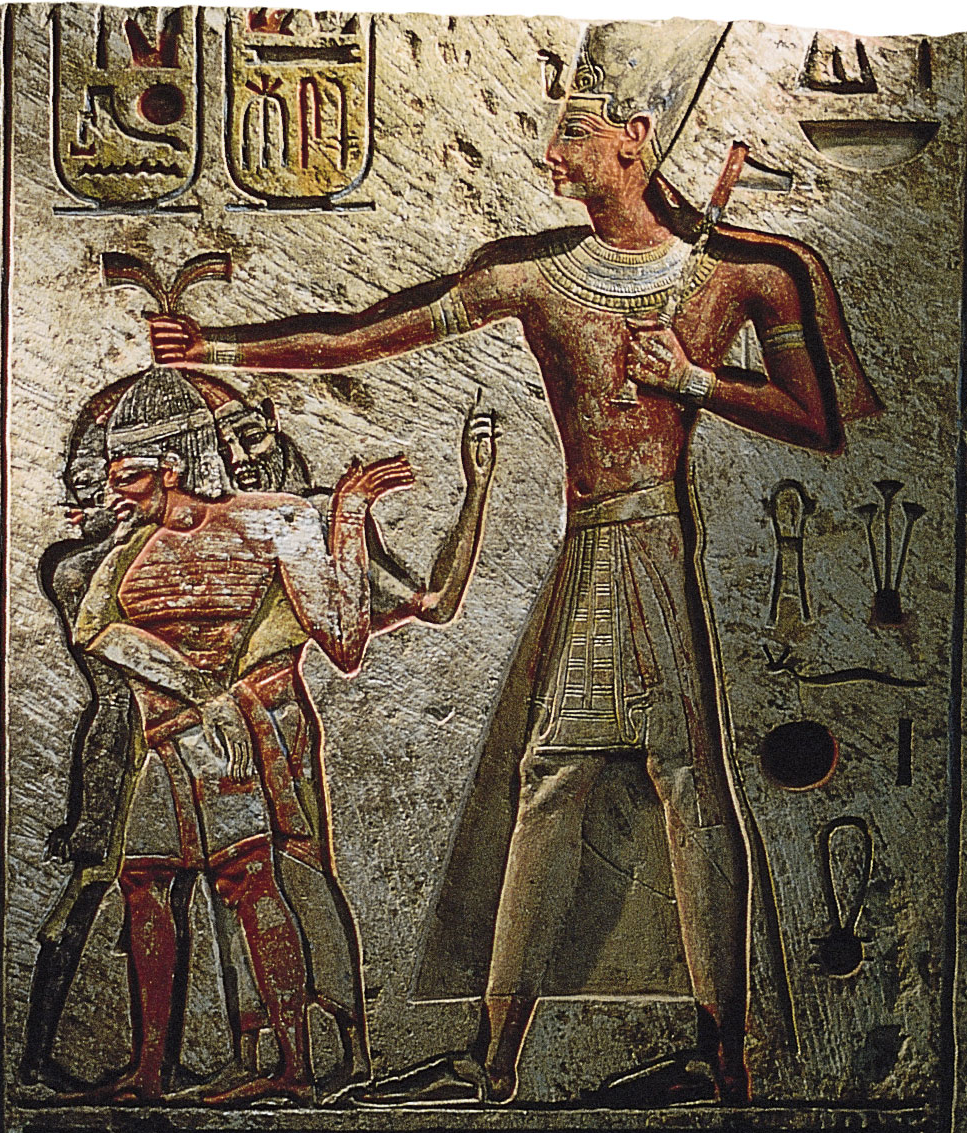
“Image credit at the top: A relief of Ramesses II from Memphis showing him capturing enemies: a Nubian, a Libyan and a Syrian, c. 1250 BC. Cairo Museum. (CC BY-SA 4.0, Wikipedia)”

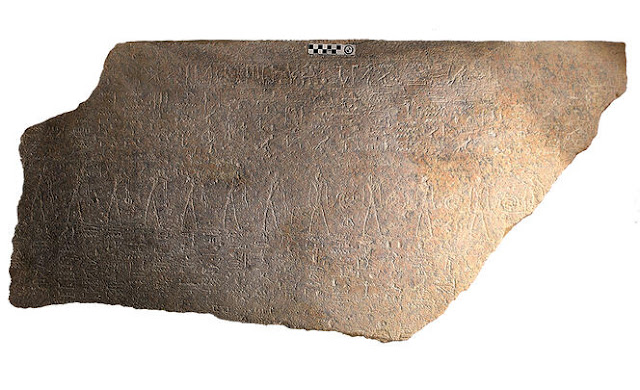
Frédéric Payraudeau’s research reveals the existence of a granite sarcophagus of Ramesses II

via égyptophile

Frédéric Payraudeau, Egyptologist (photographed here by G.Lenzo in the tomb of Osorkon II in Tanis), identified in 2024
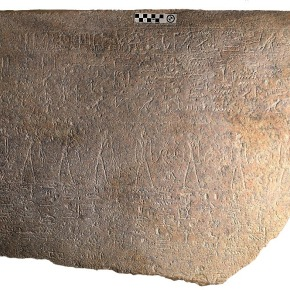
this fragment of granite sarcophagus (in the centre – photo Kévin Cahail) was found in Abydos in 2009
as belonging to the original sarcophagus of Ramses II
on the right, a relief of a monument representing Ramses II located in Tanis

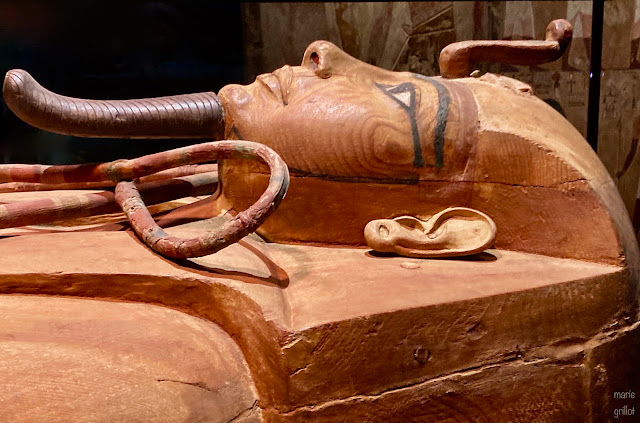
Of the funerary equipment of Ramses II, we are incredibly familiar with the anthropoid coffin made of cedar wood (Cairo Museum – JE 26214 – CG 61020), found in the Royal Cachette of Deir el-Bahari (DB 320) in 1871/1881 which, although having preserved its mummy, did not belong to him… It is less well known that hundreds of fragments of his calcite sarcophagus, smashed by looters, were found in his tomb in the Valley of the Kings (KV 7) by Christian Leblanc, revealing that he had benefited from the same type of sarcophagus as his father Sety I (exhibited at Sir John Soane’s Museum in London)… In recent months, thanks to the acuity of the research carried out by the Egyptologist Frédéric Payraudeau, we have discovered that the man who reigned over the Dual Country for 66 years possessed a granite sarcophagus in which the calcite one must have been placed. A new “approach” to the royal burials of the early Ramesside era is emerging as a new page of post-Rameside history, with its reuses, can be read in palimpsests…

Anthropoid coffin made of cedar wood in which the mummy of Ramses II was reburied in the 21st dynasty
Found in the Royal Cachette of Deir el-Bahari (DB 320), discovered in 1871 by the Abd el-Rassoul Family
and “rediscovered” in 1881 by the Antiquities Department – registered at the Egyptian Museum in Cairo – JE 26214

MG-EA: Frédéric Payraudeau, Egyptologists produce numerous scientific studies each year. How did you become interested in the one concerning a fragment of a granite sarcophagus, 1.70 m long and 8 cm thick, discovered in 2009 by the Egyptian archaeologist Ayman Damrani in the paving of a Coptic monastery in Abydos?

FP: It turns out that this large sarcophagus fragment was reused by the high priest of Amun Menkheperre of the 21st Dynasty, a period that has been at the heart of my research on the Third Intermediate Period for a long time. So, I naturally became interested in the article publishing the monument in 2017. It was in itself a great discovery, indicating in particular that the tomb of the high priest must be in Abydos.

Frédéric Payraudeau, Egyptologist, identified in 2024 this fragment of granite sarcophagus
Found in Abydos in 2009, as belonging to the original sarcophagus of Ramses II – Photo Kévin Cahail

MG-EA: Was it the type of hieroglyphic inscriptions, the presence of a cartouche, or the quality of the material that caught your attention? And, since you had never had this fragment in your hands, what elements could you work on? What was your study approach?

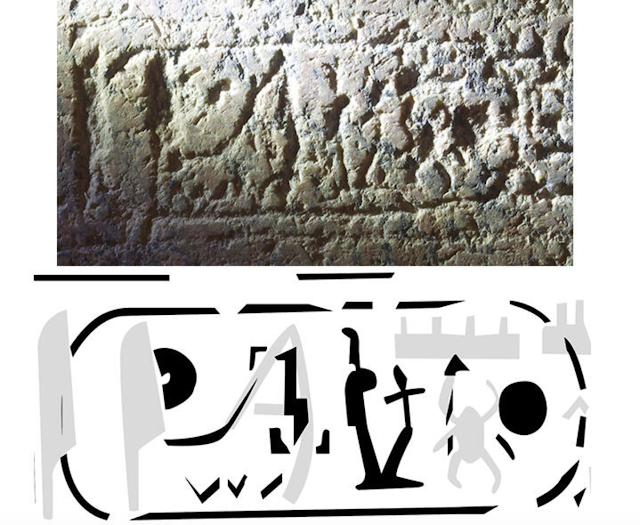
FP: The piece was fascinating and of such quality that it necessarily belonged to the elite, as my Egyptian and American colleagues had seen, but I was not satisfied with the reading of the texts. It must be said that engraving on granite when poorly preserved, is very difficult to understand when there is a superposition of texts. I worked first on the photos of the article itself, then, to eliminate any uncertainty, on working photographs that Kevin Cahail very kindly sent me. The engraving of the cartouche first was then sure, and the reading of the coronation name of Ramses II followed.

Photo of the cartouche engraved on the fragment of the sarcophagus (by Kevin Cahail)
Drawing of the cartouche of Ramses II overprinted with the name of the high priest Menkheperrê (by Frédéric Payraudeau)

MG-EA: This sarcophagus was reused by the high priest Menkheperrê during the 21st dynasty. Is his “biography” well documented?

FP: The high priest Menkheperrê is a well-known character. In the second half of the 11th century BC, he was the pontiff of Amon and general-in-chief of Upper Egypt for almost half a century under the reign of his brother Psusennes, the pharaoh in Tanis. In Karnak, he notably restored the temple enclosure.

Frédéric Payraudeau, Egyptologist, identified in 2024 this fragment of granite sarcophagus found in Abydos in 2009 as belonging to the original sarcophagus of Ramses II – photo Kévin Cahail

MG-EA: At the end of the Ramesside period marked by the pillaging of the tombs of the Valley of the Kings, the high priests of Amun restored and then sheltered the royal mummies in hiding places to protect them… Can we imagine that, a century later, their successors came to “help themselves” to the funerary furniture that remained “in situ”? Why and how did they come to reuse certain sarcophagi, even if it was far from their burial place (and in Tanis, do you know anything about it)?

It is much worse than that: the high priests organized part of the looting of the necropolis. Thefts by bands of looters from the ordinary people were a pretext for intervening at the very end of the reign of Ramses XI in the Valley of the Kings. The desire to protect the royal mummies went hand in hand with appropriating the treasures that had not yet been looted. The workers of Deir el-Medina, whose ancestral role was to dig and decorate the royal tombs, saw their activities reoriented towards exploiting the riches of the Valley of the Kings. We still have traces of this just before the pontificate of Menkheperrê, under his other brother Masaharta, who sent a team to the Valley “to look for gold for the high priest”. By the time Menkheperre’s teams came to recover the sarcophagus of Ramesses II and one of those of Merenptah for himself and Psusennes, these two tombs had already been emptied mainly by the previous high priests. The appropriation of these prestigious objects, whose names of the first owners were not entirely erased, was a way of connecting with this prestigious past. This craze for the Ramesside period is also visible in Tanis, where the city was built, at the same time, using materials taken from the abandoned Piramesses.

The lid of the sarcophagus of Merenptah – pink granite – 19th dynasty
reused for Psusennes I – 21st dynasty – found in his tomb in Tanis (NRT III) by Pierre Montet in February 1940 – Egyptian Museum, Cairo – JE 87297.2

MG-EA: Ramses II himself had “reused” many statues, engraving his name and correcting the features of his predecessors… His sarcophagus, taken from the “gold chamber” of his tomb, was thus “reused” 200 years after he died for a high priest… And then a fragment was found in a Coptic place of worship: history repeats itself, or even perpetuates itself?

FP: Ancient Egypt extensively practised reuse, not only for economic but often also for cultural or political reasons. Should we recall that most of Tutankhamun’s treasures, including the famous golden mask, previously belonged to the queen who preceded him on the throne? According to their module, the columns in the eastern sector of Tanis date from the Old Kingdom. They were reused by Ramses II in a sanctuary of Piramses, then transported to Tanis and re-engraved under Osorkon II before being moved to where we admire them today in the Late Period or after. So, yes, we would be wrong to think that ancient objects only had one life.

Marie Grillot performed and released the interview for Egypt-news and Egyptophile.

Frédéric Payraudeau is an Egyptologist, lecturer at Sorbonne University, director of the French Mission of the Excavations of Tanis (MFFT)* and vice-president of the French Society of Egyptology. He is the author of numerous works, including “L’Egypte et la vallée du Nil. Tome 3: Les époques tardives …”, published by PUF

We sincerely thank him for agreeing to dedicate this interview to us despite his schedule and the start of the new mission in Tanis.

A Holy Beetle for a Young Pharaoh’s Divine Fortune

Standard

This impressive piece is another fascinating treasure, not because of the quantity of it by using jewellery to make it but because of its inner precious spiritual quality.

The scarab beetle was a revered symbol in ancient Egyptian culture, associated with gods like Jepri and Ra. Tutankhamun, an Egyptian pharaoh, had a gold scarab bracelet adorned with precious stones like turquoise and lapis lazuli. The Egypt-museum.com report describes the bracelet as having an incredible design.

Via Meisterdrucke


Scarab bracelets, resembling scarab beetles, were popular in ancient Egypt. They were made of gold or precious stones and believed to ward off bad luck and evil spirits. Both men and women wore them as stylish jewellery representing spiritual and religious convictions.

Here, we read the story and discovery of this magnificent treasure, which should have belonged to the young Pharaoh, Tutankhamun, by our adorable lady Marie Grillot.

Tutankhamun’s scarab bracelet as a child

via égyptophile

Bracelet decorated with a scarab – gold, lapis lazuli, carnelian, turquoise, quartzite – New Kingdom – 18th Dynasty
from the tomb of Tutankhamun (KV 62) discovered in November 1922 by Lord Carnarvon and Howard Carter
Carter 269-n – JE 62360 – photo from the Egyptian Museum

According to Howard Carter’s estimate, “at least sixty per cent of the finest ‘unattached’ jewellery had disappeared” from Tutankhamun’s tomb, taken by looters who, in antiquity, violated the tomb on at least two occasions.

As terrible as this observation is, we can only rejoice that two hundred jewels have reached us! Made by the best goldsmiths of the Theban workshops, they fill us with their beauty and originality and captivate us with their luxury and brilliance.

Bracelet decorated with a scarab – gold, lapis lazuli, carnelian, turquoise, quartzite – – New Kingdom – 18th Dynasty
from the tomb of Tutankhamun (KV 62) discovered in November 1922 by Lord Carnarvon and Howard Carter
Carter 269-n – JE 62360 – photo from the Egyptian Museum
Featured here in “Tutankhamun: His tomb and his treasures”, IES Edwards, 1976

The symbolism they carry is omnipresent, whether through the motif represented, the properties of the stone used, or even the magical effectiveness linked to the association of colours, all of which combine and charge them with virtues and protective powers.

This gold bracelet with a lapis lazuli scarab is a beautiful example and particularly moves us. Indeed, its small diameter (5.4 cm) and the signs of wear it bears testify to the fact that the young pharaoh wore it in his youth… And the fact that it also accompanies him in his afterlife is just as moving…

Bracelet decorated with a scarab – gold, lapis lazuli, carnelian, turquoise, quartzite – New Kingdom – 18th Dynasty
from the tomb of Tutankhamun (KV 62) discovered in November 1922 by Lord Carnarvon and Howard Carter
Carter 269-n – JE 62360 – photo from the Egyptian Museum
Featured here in “Discovering Tutankhamun”, Zahi Hawass

“A gold and lapis lazuli scarab crowns this bracelet, which is small enough for the child Tutankhamun to wear. On each side of the scarab are inlaid mandrake fruits with sexual connotations and poppies,” explains Zahi Hawass in “Discovering Tutankhamun.”

In “The Wonders of the Egyptian Museum in Cairo”, Silvia Einaudi gives a beautiful description, of which there is an extract: “A hinge and a clasp join the two semicircles that compose it. Its upper part, whose surface gradually widens, supports a large scarab, whose back, reproduced in the most minor details, is formed of inlaid lapis lazuli set in gold sockets and whose abdomen is entirely gold. The legs are executed with precision and realism: the front legs are provided with a five-pointed rostra, while the hind legs end in hooks. The surface on which the insect is fixed is surrounded by a continuous row of tiny gold grains, bordered on the outside by lapis lazuli, gold, turquoise and carnelian segments. The two parts of the bracelet that surmount the hinge and the clasp are occupied by a delicate composition of inlaid floral motifs, which fills the small trapezoidal space in a balanced way: a yellow quartzite flower is flanked by two carnelian buds; two small gold rosettes separate their stems. The lower part of the bracelet is decorated on the outside with four parallel rows of tiny gold grains.

Bracelet decorated with a scarab – gold, lapis lazuli, carnelian, turquoise, quartzite – New Kingdom – 18th Dynasty
from the tomb of Tutankhamun (KV 62) discovered in November 1922 by Lord Carnarvon and Howard Carter
Carter 269-n – JE 62360

In “Jewels of the Pharaohs”, Cyril Aldred analyses the floral motif thus: “The two trapezoidal spacers are filled with a floral design of a mandrake fruit flanked by two poppy buds and daisies”.

In “The Gold of the Pharaohs”, Christiane Ziegler gives us details on the materials and fine stones used, allowing us to better decipher the choice made by the goldsmiths during its design…

First of all, gold, whose brilliance brings it closer to that of the sun… Reputed to be unalterable, it is thus assimilated to the flesh of the gods. As for lapis lazuli, she explains: “In ancient myths, it constituted the beard and hair of the gods and possessed virtues comparable to those of turquoise”. Turquoise “méfékat”, with its luminous blue-green colour, evoked: “the growth of young shoots in spring and was synonymous with vitality and joy. Its presence in funeral equipment undoubtedly conferred on the deceased the joy of rebirth”. As for carnelian “Héréset”, it: “possessed the invigorating virtues of blood” and was thus linked to life…

Bracelet decorated with a scarab – gold, lapis lazuli, carnelian, turquoise, quartzite – New Kingdom – 18th Dynasty
from the tomb of Tutankhamun (KV 62) discovered in November 1922 by Lord Carnarvon and Howard Carter
Carter 269-n – JE 62360 

As for the most essential element, the scarab, finely worked in a deep and luminous blue lapis lazuli, is the symbol of renewal, of rebirth. Its representation is persistent in Egyptian jewellery, especially in the young king’s finery.

In her “Dictionary of Egyptian Mythology”, Isabelle Franco specifies, “The scarab is the bearer of a renewed energy which preludes all existence; it presides over the transformations which lead to all maturity. It is the animal attribute of Khepri. The sign of the scarab is used to write the word kheper, which evokes the idea of ​​birth but also of returning.”

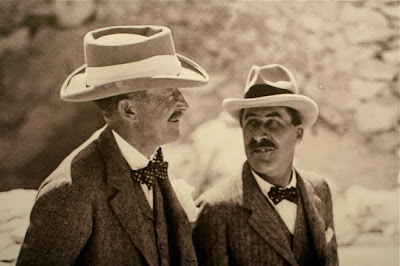
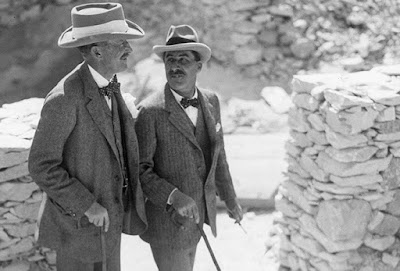
The discoverers of Tutankhamun’s tomb: Lord Carnarvon (left) and Howard Carter, near KV 62
(photo (Harry Burton?) taken between November 1922 and April 1923)

The young king “came back to life” in November 1922, thanks to the perseverance of Howard Carter and Lord Carnarvon, who discovered his tomb in the heart of the Valley of the Kings, finally bringing him out of the oblivion the centuries had left him.

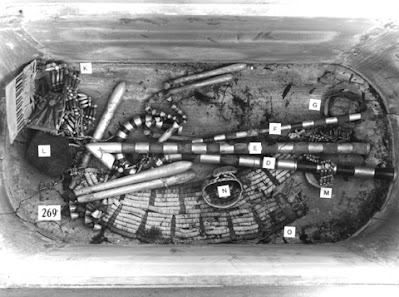
The bracelet decorated with a lapis lazuli scarab (Carter 269-n – JE 62360) was
in the wooden box inlaid in the shape of a cartridge (Carter 269 / JE 61490 / GEM 242)
Provenance: The tomb of Tutankhamun (KV 62) discovered in November 1922 by Lord Carnarvon and Howard Carter
The Griffith Institute – Tutankhamun: Anatomy of an Excavation
The Howard Carter Archives – Photographs by Harry Burton

It took seven long weeks to empty the antechamber, and the official opening of the burial chamber took place on February 17, 1923. On that same day, as they continued their extraordinary exploration, they noticed “A low door, on the right, which gave access to another, smaller room. (…) This door had neither been blocked nor sealed. A single glance was enough to make us understand that it was this which contained the real treasures of the tomb …” (Howard Carter)

This bracelet was found in this room, precisely in a dark wooden box in the shape of a cartouche, whose lid reproduces the name of Tutankhamun in a delicate coloured rebus. Harry Burton’s photos, identified as it, are placed on the ground in front and to the left of the gilded wooden naos protected by the four goddesses.

The bracelet decorated with a lapis lazuli scarab (Carter 269-n – JE 62360) was
in the wooden box inlaid in the shape of a cartridge (Carter 269 / JE 61490 / GEM 242)
Provenance: The tomb of Tutankhamun (KV 62) discovered in November 1922 by Lord Carnarvon and Howard Carter
The Griffith Institute – Tutankhamun: Anatomy of an Excavation
The Howard Carter Archives – Photographs by Harry Burton

This box, number Carter 269, contained wonders! The various jewels and artefacts it contained received this number, followed by a letter as a reference. Thus, this bracelet received the number “269 n,” and it was then registered in the Journal of Entries of the Cairo Museum JE 62360 … while waiting for the new referencing that will be given to it by the Grand Egyptian Museum, where it will soon be exhibited …

Marie Grillot

Sources:

Egyptian Museum, Cairo – Tutankhamun’s bracelet with a scarab http://www.globalegyptianmuseum.org/record.aspx?id=15044 Howard Carter, The Tomb of Tutankhamun, Volume 3: The Annex and Treasury, Bloomsbury Academic, 2014 Jean Capart, Tutankhamun, Vromant & Cie Printers-Publishers, 1923 http://gallica.bnf.fr/ark:/12148/bpt6k5611389t/f60.texte Nicholas Reeves, Tutankhamun, life, death and discovery of a pharaoh, Editions Errance, 2003
Christiane Desroches Noblecourt, Tutankhamun and his time, catalogue of the exhibition Petit Palais, Paris, February 17-July 1967, Ministry of State for Cultural Affairs
Christiane Desroches Noblecourt, Life and Death of a Pharaoh, Hachette, 1963
Zahi Hawass, Discovering Tutankhamun, Editions du Rocher, 2015
Zahi Hawass, Tutankhamun, Treasures of the Golden Pharaoh, exhibition catalogue, IMG Melcher Media, 2018
Francesco Tiradritti, Treasures of Egypt – The wonders of the Egyptian Museum in Cairo, Gründ, 1999
Cyril Aldred, Jewels of the Pharaohs, Ed. Thames & Hudson Ltd. London, 1978
Iorwerth Eiddon Stephen Edwards, Tutankhamun: his tomb and his treasures, The Metropolitan Museum of Art, 1977
Christiane Ziegler, The Gold of the Pharaohs – 2500 Years of Goldsmithing in Ancient Egypt, catalogue of the summer 2018 exhibition at the Grimaldi Forum in Monaco,
The Griffith Institute – Tutankhamun: Anatomy of an Excavation – The Howard Carter Archives – Photographs by Harry Burton http://www.griffith.ox.ac.uk/php/am-makepage1.php?&db=burton&view=gall&burt=&card=269&desc=&strt=3&what=Search&cpos=51&s1=imagename&s2=cardnumber&s3=&dno=25 Émile Vernier Egyptian jewellery and jewellery, MIFAO, Cairo, 1907 https://archive.org/details/MIFAO2/mode/2up https://archive.org/details/MIFAO2/page/n1/mode/2up Thomas Garnet Henry James, Howard Carter, The path to Tutankhamun, TPP, 1992

Holy Was The Birth in The Holy Egypt

Standard

Of course, every holy book and religious ritual teaches that giving birth and having offspring is a highly important human act on this earth. No wonder, then, that it would go in the same way in ancient Egypt.

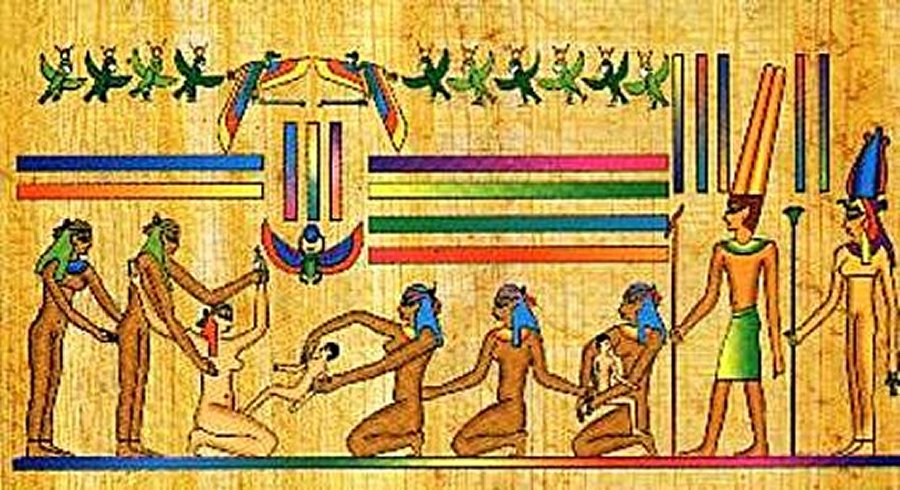
Most ancient Egyptian women laboured and delivered their babies on the cool roof of the house or in an arbour or confinement pavilion, a structure of papyrus-stalk columns decorated with vines.

isis_giving_birth, via Canada.inc

In the Yogi method, the best way to bear a child is in the water! I believe if we let the newborn child into the water immediately, they would feel happy and free and could more easily grasp their changing world perception.

Childbirth scene, Kom Ombo Temple, partial relief
Photo by G. Blanchard (2006)
via Visualizing Birth

The standard childbirth practice in ancient Egypt has long been known from papyrus texts. It looked more natural as the woman delivered her baby while squatting on two large bricks, each colourfully decorated with scenes to invoke the magic of gods for the health and happiness of mother and child.

Let’s read this interesting report by the brilliant Marie Grillot about an enchanting find and the story of constant upspring in Old Egypt!

On this ostracon, a maternity scene more than 3000 years old…

via égyptophile

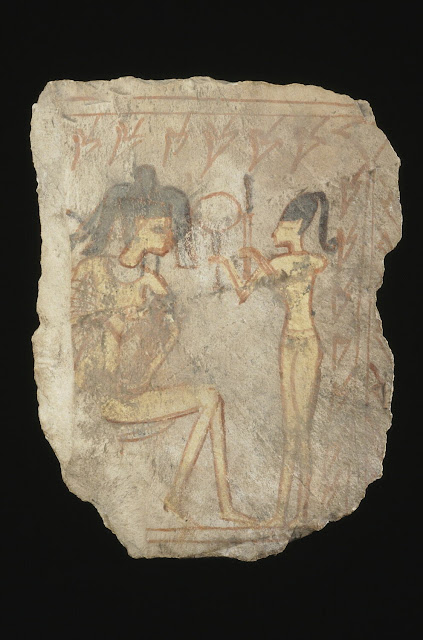
Figured ostracon representing a mother breastfeeding her child and her servant – limestone – 19th – 20th dynasty – from Deir el-Medineh
Department of Egyptian Antiquities of the Louvre Museum – E 25333 (previously at the Fouad I Agricultural Museum in Cairo
then in the collection of Moïse Lévy de Benzion, then in that of Robert Streitz, who donated it to the Parisian Museum in 1952)
photo © 2002 Louvre Museum / Georges Poncet

Several figured ostraca* from Deir el-Medineh illustrate this extraordinary, touching moment of motherhood, more precisely of the mother breastfeeding her newborn. The gesture, the tenderness, and the concentrated attention paid to the nurturing function remain immutable across the centuries.

This scene, dating from the 19th – 20th dynasty, is reproduced on a piece of limestone 15 cm high and 11.7 cm wide. The three characters are drawn in red ocher while their complexion is painted in yellow ocher and their hair in black.

It takes place in a beautiful plant setting, under a canopy, supported by columns (only one is visible on the right, the left part being lacunar), covered with lanceolate leaves of bindweed or convolvulus. “The leaves of bindweed have a symbolic meaning with a sexual connotation: they are often present in scenes relating to love and the renewal of life”, explains Anne-Mimault-Gout (“Les artistes de Pharaon”).

Figured ostracon representing a mother breastfeeding her child and her servant – limestone – 19th – 20th dynasty – from Deir el-Medineh
Department of Egyptian Antiquities of the Louvre Museum – E 25333 (previously at the Fouad I Agricultural Museum in Cairo
then in the collection of Moïse Lévy de Benzion, then in that of Robert Streitz, who donated it to the Parisian Museum in 1952)
photo © 2002 Louvre Museum / Georges Poncet

Emma Brunner-Traut calls this kiosk “the birthing arbour” and thinks “that it was a temporary building, raised in the open air for the moment of childbirth and that the mother remained there for 14 days until her purification”…

This birth pavilion sheltered the difficult hours of suffering inherent in childbirth, just as it witnessed the intense emotion linked to the miracle of giving life… Its aim was also, most certainly, to benefit the young, give birth calmly, rest and protect her, as well as the child, from potential external risks or dangers. In “Carnets de Pierre”, Anne-Mimault Gout evokes the interesting idea that: “These pavilions were perhaps the ancestors of the mammisis of the Greco-Roman temples, the birth chapels”.

Sitting on a curved stool equipped with a comfortable cushion, the mother is shown, turned to the right and naked, adorned only with a large necklace. Her body, leaning forward, seems to envelop and protect the infant she is breastfeeding. Unfortunately, the time has partly tarnished and erased its representation…

Figured ostracon representing a mother breastfeeding her child and her servant – limestone – 19th – 20th dynasty – from Deir el-Medineh
Department of Egyptian Antiquities of the Louvre Museum – E 25333 (previously at the Fouad I Agricultural Museum in Cairo
then in the collection of Moïse Lévy de Benzion, then in that of Robert Streitz, who donated it to the Parisian Museum in 1952)
photo © 2002 Louvre Museum / Georges Poncet

Her undone, untamed hairstyle —typical of that of women giving birth in ancient Egypt—attracts the eye. The hair raised in a totally anarchic manner on the head probably reflects the fact that during these extraordinary days, all the attention was focused on the child, to the detriment of the care given to his physical appearance…

As if to remind her that her new role as the mother should not make her forget her femininity, the young servant in front of her hands her a mirror and a kohol case. These toiletry accessories are, according to Anne Mimault-Gout, “charged with an erotic connotation linked, through beauty, to rebirth”. Young, his thin, slender body is naked. Her hair is tied in a ponytail on the top of her head, falling in a pretty curl over her shoulder. For J. Vandier d’Abbadie, “this hairstyle and the pronounced elongation of the profile evoke the iconography of Syro-Palestinian divinities – in particular, Anat and Astarte -, that is to say, that these young girls with high heads would be young asian maids”…

Figured ostracon representing a mother breastfeeding her child and her servant – limestone – 19th – 20th dynasty – from Deir el-Medineh
Department of Egyptian Antiquities of the Louvre Museum – E 25333 (previously at the Fouad I Agricultural Museum in Cairo,
then in the collection of Moïse Lévy de Benzion, then in that of Robert Streitz, who donated it to the Parisian Museum in 1952)
published here in Jeanne Vandier d’Abbadie “Deux ostraca figurés”, BIFAO, 1957 (p. 21-34, p. 22-23, fig. 2)

In her fascinating study “Postpartum purification and relief rites in ancient Egypt” (all of whose rich analyses, unfortunately, cannot be cited here), Marie-Lys Arnette returns to the rites represented on these figurative ostraca of the Ramesside period representing “gynoecium scenes”, as J. Vandier d’Abbadie calls them… “The actions that these scenes depict are indeed rites since they are very close formally to the representations of offerings made to the dead or the gods and follow the same codes: The beneficiary is seated while the officiant approaches them, standing and holding the objects they are about to offer in their hands. These scenes concern the period following birth, and the rites which appear there must allow the purification and aggregation of the mother. It is a question of representing the reliefs, the sequence we can attempt to restore – in a necessarily incomplete manner because the analysis depends on scant documentation”…

These representations are very precious because they are among the only ones that allow us to understand the intimacy of women… But what was their goal? E. Brunner-Traut, in particular, “suggests seeing ex-votos there. We can indeed consider these objects as having been used, in one way or another, in cults linked to fertility, but it is impossible to specify this use further”…

Figured ostracon representing a mother breastfeeding her child and her servant – limestone – 19th – 20th dynasty – from Deir el-Medineh
Department of Egyptian Antiquities of the Louvre Museum – E 25333 (previously at the Fouad I Agricultural Museum in Cairo,
then in the collection of Moïse Lévy de Benzion, then in that of Robert Streitz, who donated it to the Parisian Museum in 1952)
published here in Jacques Vandier d’Abbadie “Catalogue of figured ostraca of Deir el Médineh” II.2, n°2256-2722, IFAO, Cairo, 1937

This ostracon, which comes from Deir el-Medineh, is described by Jacques Vandier d’Abbadie in his “Catalogue of figured ostraca, 1937” under the number 2339. It is indicated as having previously been at the Fouad I Agricultural Museum in Cairo. It was then found in the collection of Moïse Lévy de Benzion, owner of a famous store in Cairo, who then offered it at auction under number 36 of his sale on March 14, 1947, in Zamalek. Robert Streitz, a Belgian architect based in Cairo, then purchased it. He kept it for several years before donating it in 1952 to the Department of Egyptian Antiquities of the Louvre Museum. It was registered there under the inventory number E 25333.

Marie Grillot

*Ostraca (singular: ostracon): Shards, silver or fragments of limestone, or even terracotta, which were, in antiquity, used by artisans to practice. This type of “support”, which they found in abundance on the sides of the mountain, allowed them to make and redo their drawings or writings until they reached excellence and were finally admitted to work “in situ” in the residences of ‘eternity.

They are generally classified into two categories: inscribed (hieroglyph, hieratic, demotic, etc.) or figured (drawing, sculpture).

Sources:

Figured ostracon – E 25333 https://collections.louvre.fr/ark:/53355/cl010004032 Jacques Vandier d’Abbadie, Catalog of figured ostraca of Deir el Médineh II.2, n°2256-2722, IFAO, Cairo, 1937 https://archive.org/details/DFIFAO2.2/page/n1/mode/2up Bernard Bruyère, Report on the excavations of Deir el Médineh (1934-1935). Third part. The village, public dumps, the rest station at the Valley of the Kings pass, Cairo, Printing office of the French Institute of Oriental Archeology (IFAO), (Excavations of the French Institute of Oriental Archeology = FIFAO; 16), p. 131-132, 1939 https://ia600606.us.archive.org/30/items/FIFAO16/FIFAO%2016%20Bruyère%2C%20Bernard%20-%20Le%20village%2C%20les%20discharges%20public%2C%20la%20station%20de %20rest%20du%20col%20de%20la%20valley%20des%20kings%20%281939%29%20LR.pdfEmma Brunner-Traut, Die altägyptischen Scherbenbilder (Bildostraka) der Deutschen Museen und Sammlungen, Franz Steiner, Wiesbaden, 1956 Jeanne Vandier d’Abbadie, Two figured ostraca, Bulletin of the French Institute of Oriental Archeology (BIFAO), 1957, p. 21-34, p. 22-23, fig. 2, IFAO, Cairo, 1957 https://archive.org/details/DFIFAO2.2 https://archive.org/details/DFIFAO2.2/page/n69/mode/2up Emma Brunner-Traut, Egyptian Artists’ Sketches. Figured ostraka from the Gayer-Anderson Collection in the Fitzwilliam Museum Cambridge, Cambridge, 1979

The donors of the Louvre, Paris, Musée du Louvre, 1989

Perfumes and cosmetics in ancient Egypt, exhibition catalogue, Cairo, Marseille, Paris, 2002, p. 99, 139, ESIG, 2002

Anne Minault-Gout, Stone notebooks: the art of ostraca in ancient Egypt, p. 36-37, Hazan, 2002

Guillemette Andreu, The artists of Pharaon. Deir el-Medina and the Valley of the Kings, exhibition catalog, Paris, Turnhout, RMN, Brepols, p. 113, no. 53, 2002

Guillemette Andreu, The Art of Contour. Drawing in ancient Egypt, exhibition catalog, Somogy éditions d’Art, p. 320, ill. p. 320, no. 168, 2013

Marie-Lys Arnette, Postpartum purification and relief rites in ancient Egypt, Bulletin of the French Institute of Oriental Archeology (BIFAO), 114, 2015, p. 19-72, p. 30-31, fig. 2, IFAO, Cairo 2015

Hanane Gaber, Laure Bazin Rizzo, Frédéric Servajean, At work, we know the craftsman… of Pharaon! A century of French research in Deir el-Medina (1917-2017), exhibition catalogue, Silvana Editoriale, p. 36, 2017

Tutankhamun: The Most Short-Term and Mysterious Pharaoh!

Standard
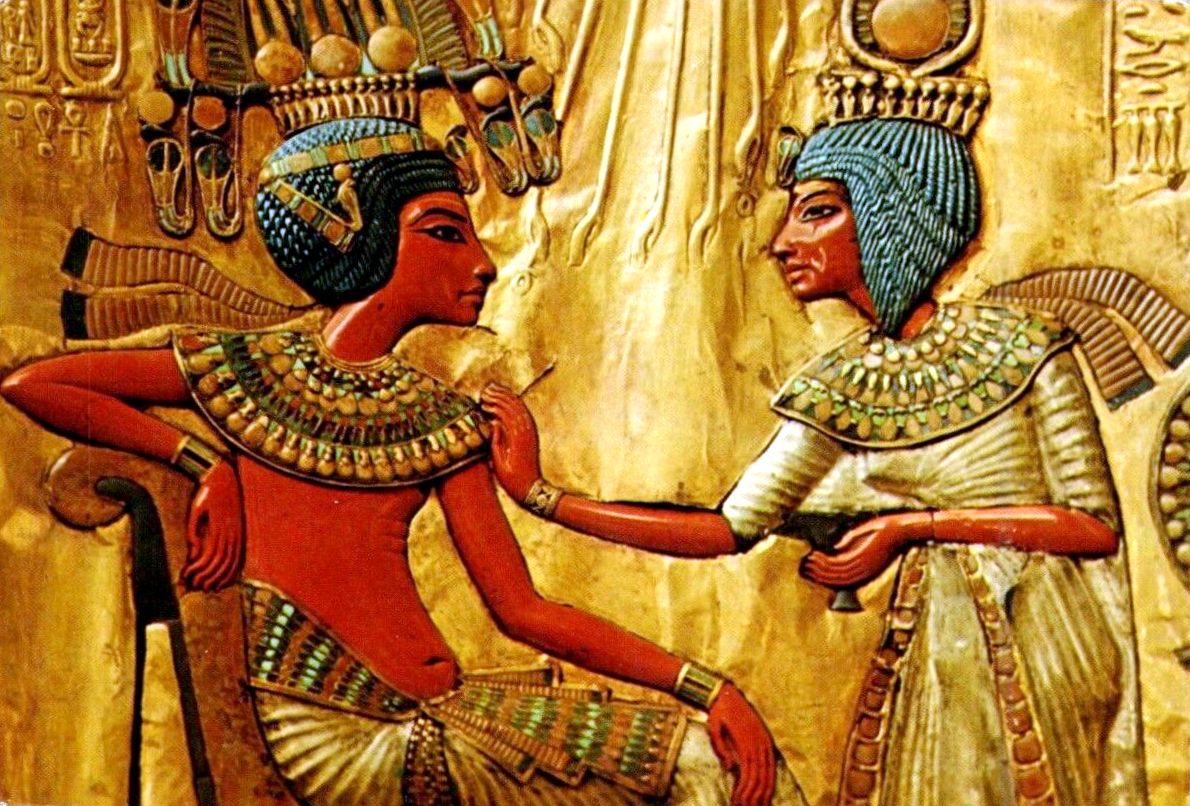
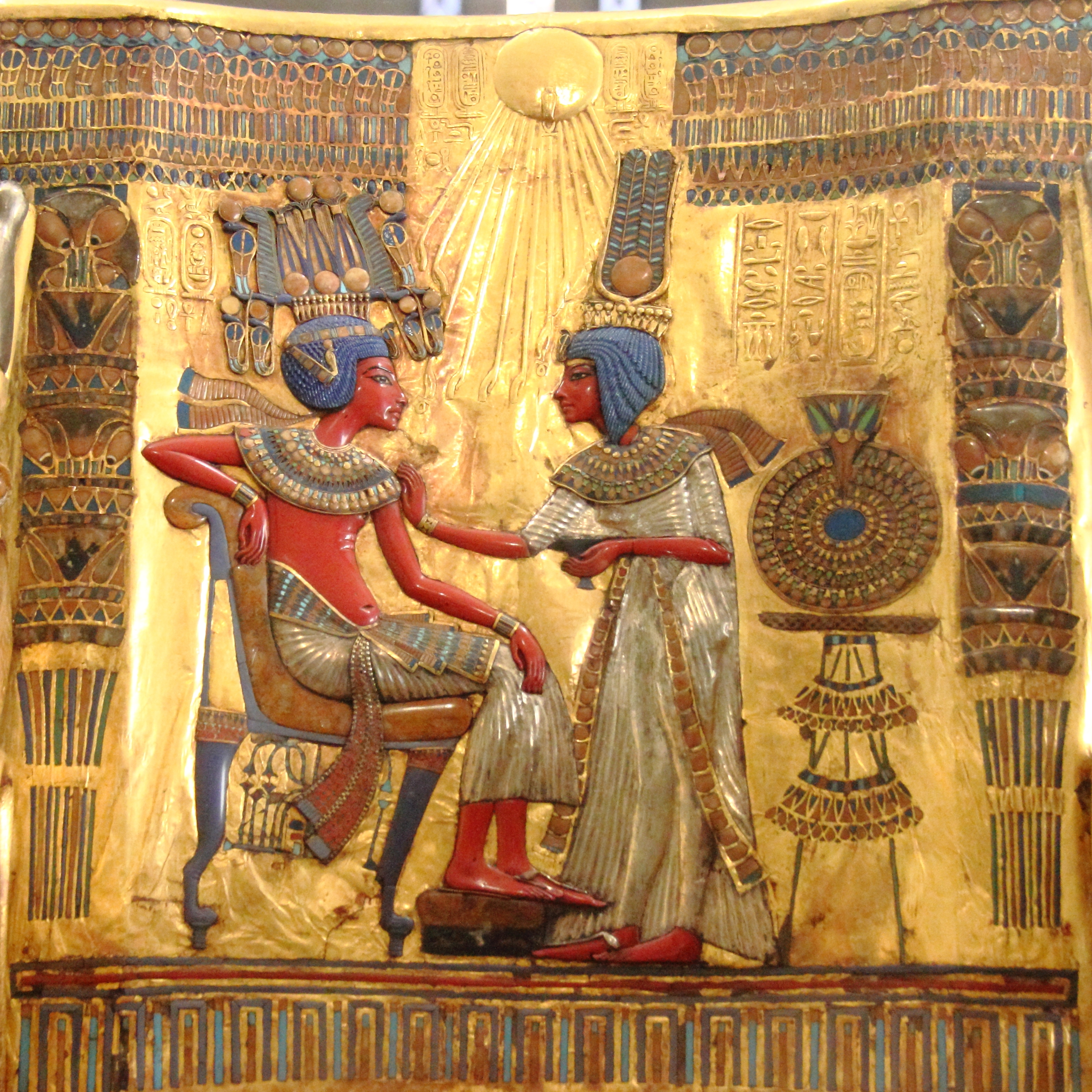
Tutankhamun and his queen, Ankhesenamun
By Tiger Cub – own work, Public Domain,

King Tutankhamun is one of the most famous rulers ever, thanks to Howard Carter‘s 1922 discovery of the pharaoh’s tomb in Egypt’s Valley of the Kings, sponsored by British aristocrat George Herbert. The find stirred the imaginations of millions fascinated by the boy king’s golden-masked mummy.

The throne of Tutankhamun, the Aten depicted above
By Djehouty – Own work, CC BY-SA 4.0,

He and his tomb are (one of) the most beautiful and, tragically, the most robbed and plundered in ancient Egyptian explorations. No wonder the shining gold and humans’ greed! Nonetheless, the efforts of the good side of humans still try to restore and discover more details of the life of this fascinating man, and they will continue for sure!

Here, we read an exciting story by Marie Grillot and Marc Chartier about a deep investigation and discovery using modern technology.

Tutankhamun: the story continues…

via égyptophile

In November 1922, after ten years of excavations and research in the Valley of the Kings, Howard Carter and Lord Carnarvon finally discovered the first step of Tutankhamun’s tomb, which they had been desperately searching for.

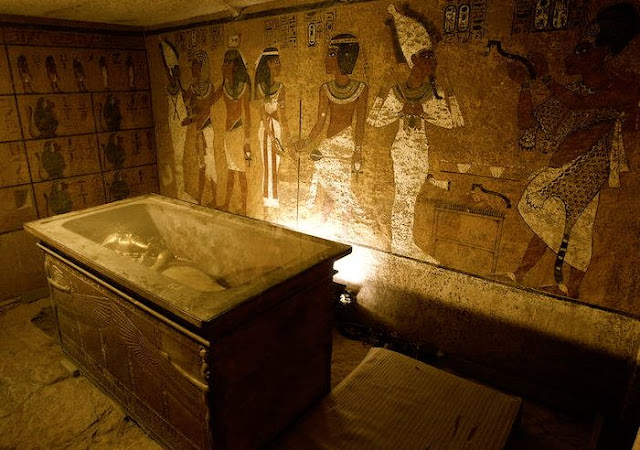
Within this KV62, with an area of just over 100 m², a team of the best experts will work on clearing and saving the objects. Some will devote nearly ten years to it, and the whole world, fascinated by this young pharaoh emerging from oblivion, will marvel at the priceless treasures surrounding him for his afterlife.

For more than 90 years, the number of visitors who have entered the pharaoh’s tomb to absorb a small part of his eternity has continued to increase, endangering his survival. The humidity generated by these visits significantly deteriorated the paintings and generated mould, causing significant damage. This led the Antiquities Department to limit the number of daily visits and close access to the site to the public in 2011.

This context, which seemed inevitable, was understood in 2002, and the basis for constructing a replica of the KV62 was studied.

Illustration Factum Arte

The company Factum Arte, founded by the British painter Adam Lowe and based in Madrid, was chosen to build this replica. The Egyptian Ministry of Tourism and Antiquities and funds from the European Union partially financed it.

Experts in these new technologies have implemented, used, and piloted innovative techniques, the most advanced of which is 3D. In 2009, for many months, the Factum Arte team invested in the tomb to memorize every centimetre with the highest precision. “The first work consisted of carefully recording the relief of the walls and the sarcophagus with a scanner specially designed for the occasion. Its resolution reached one hundred million points per m². Then, the second stage consisted of photographing the paintings with a very high resolution and faithfully respecting the colours.”

Armed with this data, Factum Arte technicians returned to their premises in Madrid, where they began manufacturing the facsimile in the form of hundreds of high-density polyurethane panels. These were assembled on-site to form the four walls of the mortuary chamber. The inauguration of the “double” tomb took place in April 2014.

And this is where another part of this beautiful story begins…

Egyptian Minister of Antiquities, Mamdouh Al Damati, listening to British Egyptologist Nicholas Reeves,
near the sarcophagus of Tutankhamun – Photo: AFP/ Khaled Desouki

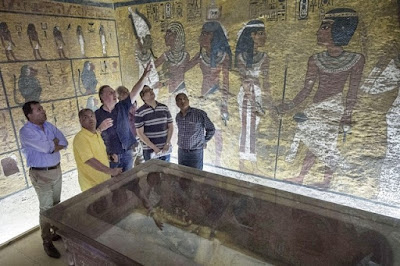
Nicholas Reeves, an English Egyptologist and foremost specialist in Tutankhamun, carefully studies the photos taken by Factum Arte in the burial chamber. This room is the only one in the tomb, and it is decorated with paintings: “rudimentary, classic, of austere simplicity” executed on a plaster coating painted yellow. These paintings reflect the ritual name given to it in antiquity: “the Hall of Gold.” He then noticed reliefs which could be blocked openings overtures onto two rooms unexplored until now. By pushing further his reasoning, he believes that one wall (the north wall) would be Queen Nefertiti’s burial place, while the other (the west wall) would be a storage space.

Nicholas Reeves supports his hypothesis – contested, it is necessary to recall, by other Egyptologists – first of all on his interpretation of the frescoes of the northern wall of the tomb (which represent the young king Tutankhamun performing a funerary ritual for his mother, Queen Nefertiti), then on the fact that Tutankhamun died prematurely, at the age of 19, and that, due to lack of an available tomb, the priests would have taken the decision to reopen Nefertiti’s tomb, ten years after his death, to bury the young king in a hypogeum not provided for him.

Jean-Claude Barré
© http://www.HIP.Institute / Philippe Bourseiller

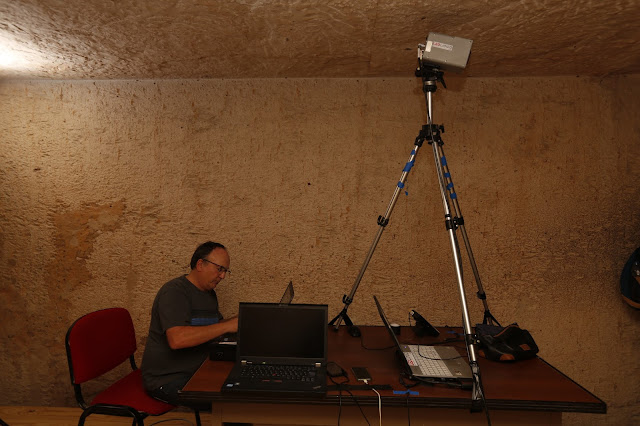
To verify this hypothesis, the Ministry of Antiquities has given the green light to enter noninvasive and nondestructive techniques onto the scene. First of all, infrared thermography is an operation led by Jean-Claude Barré, who came to Egypt as part of the “Scan Pyramids” mission. Based on images captured regularly over 24 hours, this technique can reveal temperature differences, possibly leading to cavities under a given surface. This was indeed the case in the tomb of Tutankhamun, where such temperature differences were detected through the painted coating of the north wall, without it being possible to determine the exact configuration of a hollow space or, even more so, its content.

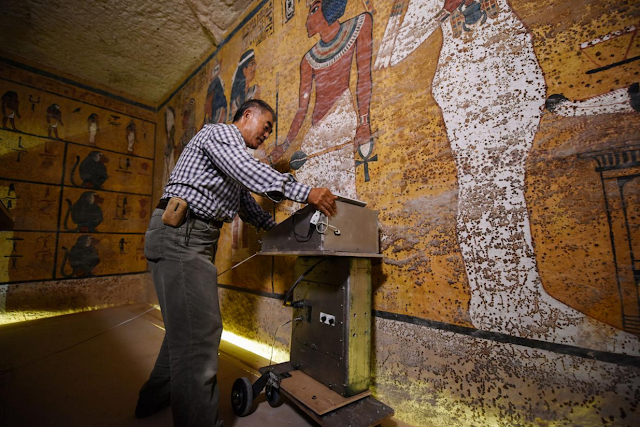
After some tests in a tomb whose configuration is already known (the KV5) to verify the effectiveness and reliability of the equipment used, the second series of surveys in Tutankhamun’s tomb was carried out using the radar technique. This device was placed 5 cm from the wall to prevent damage.

During the press conference, held in Luxor on November 28, 2015 late in the morning, at the house of Howard Carter, the Minister of Antiquities, Dr. Mamdouh El-Damaty, announced that the radar scans revealed the existence of a large void, with a long corridor, behind what we now know to be a false wall (a “ruse”, a ploy, intended to thwart possible tomb robbers) in Tutankhamun’s burial chamber. It is helpful to remember that the tomb was robbed several times in antiquity.

Hirokatsu Watanabe
Photo Brando Quilici – National Geographic

Analyzes by Hirokatsu Watanabe, a Japanese radar specialist, also provide evidence of a second door hidden in the adjoining west wall.

The Minister declared, “We previously spoke of a 60 per cent chance that something was behind the walls. But now, reading the first analyses, we can assert a 90 per cent probability.”

He specifies that the data collected will quickly be examined more deeply in Japan.

He then mentioned a possible next step: digging a small hole in the wall (on an unpainted space) of the neighbouring room, called the “Treasure Room,” adjoining the “empty” behind the wall in the burial chamber to introduce a browser camera.

Missing fragments of the wall broken by Carter, photographed by Burton
and reconstituted in the replica of the tomb – photo Marie Grillot

It is unthinkable to risk damaging or deteriorating these painted walls. It is helpful to remember that during the second season of excavation, Howard Carter destroyed part of the scene on the south wall and then recovered the fragments. Still, these practices are no longer used today.

The questions remain and even multiply… But one answer is inevitable: Tutankhamun has not finished being in the spotlight!

Marie GrillotMarc Chartier

To complete the information:

http://news.nationalgeographic.com/2015/11/151126-nefertiti-tomb-tut-egypt-archaeology/ http://news.nationalgeographic.com/2015/11/151128-tut-tomb-scans-hidden-chambers/ http://english.ahram.org.eg/NewsContent/9/40/171833/Heritage/Ancient-Egypt/Radar-test-underway-before-search-for-Nefertiti-in.aspx

Horemheb and His Deity Earring.

Standard

Horemheb, which means “Horus is in Jubilation” in Ancient Egyptian, was the final pharaoh of Egypt’s 18th Dynasty, ruling for at least 14 years between 1319 BC and 1292 BC. Despite marrying Ay’s daughter Mutnedjmet, Horemheb had no blood relation to the preceding royal family and is believed to have come from a common background.

The Memphite Tomb of Horemheb is situated in the Saqqara necropolis near Memphis, Egypt. The tomb was built before Horemheb became the king, and he did not use it for his burial. Instead, he constructed the Theban tomb KV57 for this purpose. The tomb served as the resting place for Horemheb’s two wives, Mutnedjmet and Amenia.

Relief from Horemheb’s tomb. Receiving ‘gold of honour’ collars. Wikipedia

Here is the adventurous story of the discovery of this divine Jewel, presented by adorable Marie Grillot.🙏

An earring…from Horemheb?

via égyptophile

Horemheb’s earring – gold and glass paste – 18th or 18th Dynasty
from his tomb discovered in Saqqara in 1975 by an Anglo-Dutch mission led by Geoffrey Martin
Journal of Cairo Museum Entries – JE 97864

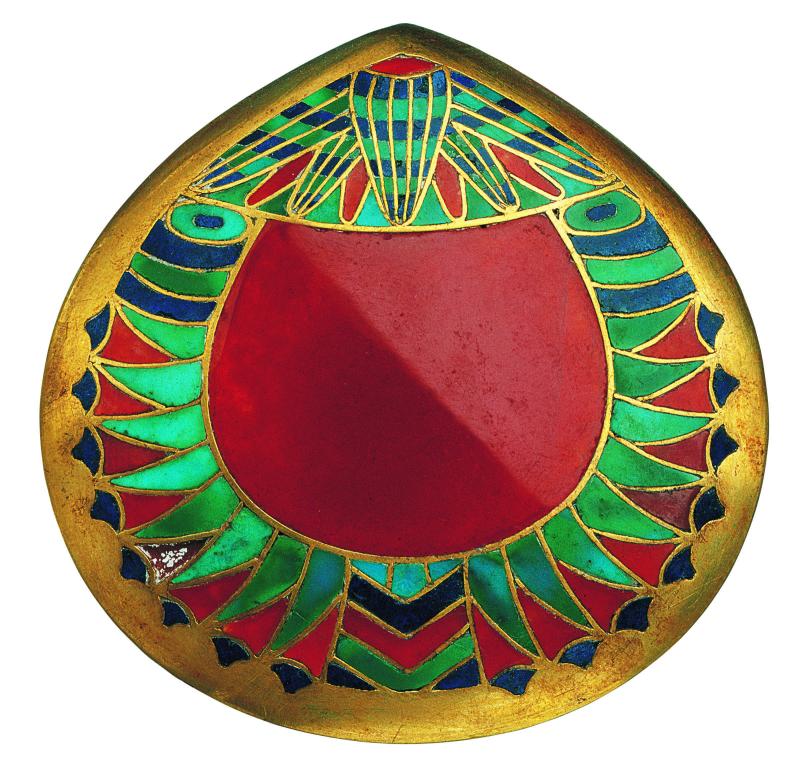
This round earring, with a diameter of 3.9 cm, is made of gold with mostly lacunar glass paste inlays.

This round earring, with a diameter of 3.9 cm, is made of gold with mostly lacunar glass paste inlays.
In its centre, in a golden circle and erected on a golden barrette, is a sphinx. He is represented in a walking attitude, which is unusual, to say the least…

The Sphinx is a “hybrid being” described as an androcephalus when it combines an animal body, a lion, and a human head. “The Egyptian sphinx was a protective and positive entity,” generally representing the “portrait” of the pharaoh to whom it was dedicated or allied.

Horemheb’s earring – gold and glass paste – 18th or 18th Dynasty
from his tomb discovered in Saqqara in 1975 by an Anglo-Dutch mission led by Geoffrey Martin
Journal of Cairo Museum Entries – JE 97864

The body of the Sphinx, which works in openwork, is delicately chiselled to restore the details of the fur, muscles, and legs…

The royal head is wearing the “blue” crown, which is sometimes compared to a “helmet”. This “khepresh” seems to appear in royal representations in the New Kingdom and, according to Karol Mysliewiec: “the first known royal statue wearing the khepresh is one of Amenhotep III”. If no crown of this type has actually been discovered, we can assume that it was: “probably made of leather or ostrich skin on a rigid, bulb-shaped structure often embellished with yellow gold or white polka dots “. This notion was also very well rendered by the goldsmith who created it…

Horemheb’s earring – gold and glass paste – 18th or 18th Dynasty
from his tomb discovered in Saqqara in 1975 by an Anglo-Dutch mission led by Geoffrey Martin
Journal of Cairo Museum Entries – JE 97864

The face is both emaciated and prognathous, an impression accentuated by the artificial beard, which lengthens the profile. The long and carried forward neck is decorated with a large ousekh necklace with several rows very cleverly rendered by incisions.
This central element is surrounded by two larger and nicely crafted concentric circles. They are composed of large gold chevrons, regularly spaced, in the intervals of which blue glass paste was encrusted, perhaps in several shades. Unfortunately, this colourful decoration has, for the most part, disappeared.

The outer circle is bordered by a lovely twist of gold, which is welded into small rings made up of a series of small shots welded two by two. “The edges of the pendant are decorated with small rings obtained by granulation, some of which had originally been inlaid with tiny cylinders of glass paste. Pendants were undoubtedly suspended from the five rings of the lower register. A sheet of gold shaped like an ousekh necklace was welded to the top of the Jewel,” specifies Daniella Comand (The Illustrated Guide to the Egyptian Museum).

Horemheb’s earring – gold and glass paste – 18th or 18th Dynasty
from his tomb discovered in Saqqara in 1975 by an Anglo-Dutch mission led by Geoffrey Martin
Journal of Cairo Museum Entries – JE 97864 (photo Orientalia: Vol. 47)

The suspension system is incomplete: in fact, only one of the two rings remains, which were placed on either side of the lobe and in which the tube slid, which, passing through it, ensured fixation.

This unique earring was discovered in the tomb General Horemheb built in Saqqara long before he became pharaoh and ordered the digging of a new hypogeum in the Valley of the Kings.

His tomb in the Memphite necropolis, unearthed in the 19th century and then lost, was “rediscovered” in 1975 by an Anglo-Dutch mission. Led by Geoffrey Martin, he and his team devoted four seasons of excavations… During the 1977 mission, this Jewel was found “in a room in the well in the outer courtyard”.

Relief depicting Horemheb receiving the gold reward – limestone – New Kingdom – 1333-1319 BC AD
from his tomb in Saqqara – Rijksmuseum van oudheden – RMO – Leiden – museum photo

The Sphinx’s countenance typically reveals Amarna features if its provenance “de facto” associates it with Horemheb. Thus, in “The Wonders of the Egyptian Museum in Cairo”, Francesco Tiradritti presents it as “a pendant representing Akhenaten as a sphinx”. An idea echoed by Nigel Fletcher-Jones who, in “Ancient Egyptian Jewelry”, believes that: “It was probably made during the reign of Akhenaten (around 1352-1336 BC) or his son Tutankhamun ( circa 1336-1327). Furthermore, in “The Great Discoveries of Ancient Egypt”, Nicholas Reeves considers that it “probably comes from a later burial, from the Ramesside period, that of Princess Bentânat”.

This earring was registered in the Journal of Entries of the Cairo Museum under the reference JE 97864.

Marie Grillot

Sources:

Samy Salah, The Illustrated Guide To The Egyptian Museum, Guide National Geographic https://archive.org/details/TheIllustratedGuideToTheEgyptianMuseumBySamySalah/page/n267/mode/2up

Fletcher-Jones, N, Ancient Egyptian Jewelry: 50 Masterpieces of Art and Design, 2019, The American University in Cairo Press
Francesco Tiradritti, Trésors d’Egypte – Les merveilles du musée égyptien du Caire
The Memphite tomb of Horemheb: the central chapel revisited, in: J. van Dijk (ed.), Another mouthful of dust, Egyptological studies in honour of Geoffrey Thorndike Martin (OLA 246, Leuven, 2016), 421-434., M. Raven https://www.academia.edu/37852972/The_Memphite_tomb_of_Horemheb_the_central_chapel_revisited_in_J_van_Dijk_ed_Another_mouthful_of_dust_Egyptological_studies_in_honour_of_Geoffrey_Thorndike_Martin_OLA_246_Leuven_2016_421_434 Orientalia: Vol. 47 https://books.google.co.uk/booksid=6tikRiQ1y0QC&pg=PR20&lpg=PR20&dq=Boucle%20d%27oreille%20Horemheb&source=bl&ots=Ds7UgBXNQZ&sig=ACfU3U3LgGzlurFYP7XKEP73RLCXbJWs0w&hl=fr&sa=X&ved=2ahUKEwjr8PLpp6_3AhXkg_0HHVbjB6oQ6AF6BAgzEAM&fbclid=IwAR0nSUs-R9O8DiZcHzWZqO3qCfjomrru_Fz0xPBj_fzFgmaoy76zSJ8pd5o#v=onepage&q=Horemheb&f=false

Nicholas Reeves, Ancient Egypt. The great discoveries, Thames & Hudson, 2002, Les Grandes découvertes de l’Egypte ancienne, Editions du Rocher, 2001
Tombe d’Horemheb à Saqqarah https://www.osirisnet.net/tombes/saqqara_nouvel_empire/horemheb_saqqara/horemheb_saqqara_01.htm

Publié il y a 29th April 2022 par Marie Grillot

A Kohl Tube, Sky-Blue Deity; A Divine Gift For An Eternal Beauty!

Standard

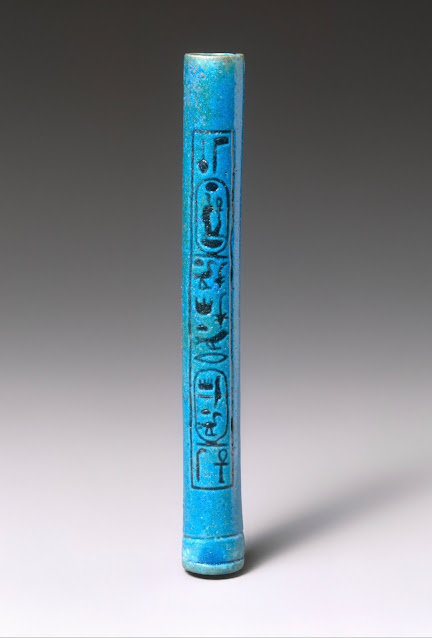
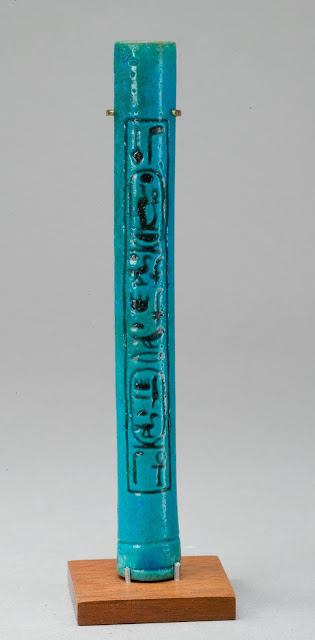
This is a deep blue glazed faience kohl tube. A column is inlaid with light blue on one side of the cylinder. This inscription is placed within a light blue frame. It reads, “The Good God, Lord of the Two Lands, Neb ma’at-re (Amenhotep III). The Kingdom, Wife Tiy, granted life.” A shallow indentation forms a border at the bottom of the tube. Condition: Small cracks at the bottom; blue glaze missing on half of the “neb” sign.

Here is another fascinating story by the brilliant lady Marie Grillot of a deity tube to help compare to divine beauty.

A kohol tube in the names of Amenhotep III and his daughter and wife Satamon…

via égyptophile

Kohl tube of Satamon, daughter and the great royal wife of Amenhotep III – earthenware – 18th dynasty
formerly in the collection of Reverend William MacGregor – acquired by Lord Carnarvon at Sotheby’s London in 1922
arrived at the Metropolitan Museum of Art in New York in 1926 by acquisition from the Carnarvon Collection – entry number 26.7.910

This delicate and elegant Egyptian earthenware kohol tube is 14.4 cm high and has a diameter of 1.8 cm. For Jeanne Vandier d’Abbadie (“Egyptian toilet objects at the Louvre Museum”), it was during the New Kingdom that kohol vases or pots which had varied shapes “were very often replaced by kohol tubes. This new form would have been introduced into Egypt under the reign of Tuthmosis III by the Asians. Indeed, it sometimes happens, from this time on, that the servants who assist the lady in her toilet have the Syrian type… These young foreigners hand their mistress the kohol tube into which the stylus is immersed…”

Originally, this tube was a simple Nile reed – hence sometimes its name “flute” -in the hollow of which the makeup was placed. For the wealthier classes of society, artisans were inspired by this natural element. They reproduced it more “luxurious” with more precious materials, ivory, for example, or, in this case, earthenware.

Kohl tube of Satamon, daughter and the great royal wife of Amenhotep III – earthenware – 18th dynasty
formerly in the collection of Reverend William MacGregor – acquired by Lord Carnarvon at Sotheby’s London in 1922
arrived at the Metropolitan Museum of Art in New York in 1926 by acquisition from the Carnarvon Collection – entry number 26.7.910

In ancient times, kohol was the makeup product par excellence; it was inseparable from the concept of beauty, intimately linked to the enhancement of the gaze. Its use has thus transcended these stretched eyes surrounded by black, which, even today, disturbs and fascinates. Made from powdered galena, it not only highlighted the intensity of the “Egyptian” gaze but also had, in this country where the light is so bright, the reverberation so intense, and the sun so burning, a protective function of the eye.

It was applied using a fine stylus – or stick. With a rounded head and a blunt tip, it could be made of hematite, wood (like ebony), ivory, and sometimes bronze or copper. No stylus is presented with this tube; one can imagine it has disappeared. Likewise, nothing indicates the presence or absence of a small “accommodation” fitted inside to store it. The sealing is also absent: in the more “rustic” models, it was done by a plug of fabric or wood.

Kohl tube of Satamon, daughter and the great royal wife of Amenhotep III – earthenware – 18th dynasty
formerly in the collection of Reverend William MacGregor – acquired by Lord Carnarvon at Sotheby’s London in 1922
arrived at the Metropolitan Museum of Art in New York in 1926 by acquisition from the Carnarvon Collection – entry number 26.7.910

In “Amenhotep III, the Sun Pharaoh”, Arielle P. Kozloff provides technical information on its creation: “The colour of the tube is medium blue, which suggests a copper base. This colour was used more frequently towards the end of the reign of Amenhotep III and during the Amarna period, unlike the cobalt-based blues that the king preferred. The dark-coloured inscription is undoubtedly cobalt-based.”

If the object is well made, the vertical inscription presented in a rectangle delimited by a black line in a column of delicate hieroglyphs is precious. Christiane Ziegler (“Queens of Egypt”) translates it thus: “The good god Nebmaâtre [Amenhotep III]; the king’s daughter, the Great Royal Wife Satamon, may she live.” She adds, “We noticed that the king’s name always accompanies that of the woman in his family mentioned on the kohol tubes.”

When we mention the wife of Amenhotep III, we immediately think of Queen Tiyi… Satamon (“The Daughter of Amon”) was the eldest daughter of Tiyi and Amenhotep III. However, explains Christian Leblanc in “Queens of the Nile”: “She distinguished herself especially towards the end of the reign of Amenhotep III by herself becoming the wife of her own father”.

Due to our current morality and contemporary conception of the family, understanding and admitting such a union is often tricky. However, well attested since at least the Middle Kingdom, this incest could only exist in the royal and divine world for reasons of an eminently sacred nature. Ordinary mortals did not practise it.

Relief depicting Satamon from the funerary temple of Amenhotep III
Petrie Museum, London – UC 14373 – museum photo

“The role of princesses was so important that two of them, Satamon and Isis, became ‘Great Royal Wives’ during the last decade of the reign, which in no way diminishes the status of Queen Tiya. Indeed, the “Theological model of divine families on which that of the king’s family was modelled favoured the adoption of different generations of women. Was Hathor not simultaneously mother, wife and daughter of the god Ra?” (Arielle P. Kozloff). Thus, different museums hold kohol tubes, identical or close to that of Satamon, with the names of Tiyi, of course, and Isis.

Its current history is found in the 20th century in the collection of Reverend William MacGregor (1848-1937). This vicar is a “prominent member of the Egypt Exploration Society and the Institute of Archeology of the University of Liverpool. He patronised numerous excavations, notably those undertaken by Naville, Garstang, and Petrie, for which he frequently and actively participated in the field. His remarkable collection of antiquities is unprecedented compared to any other private collection in England, Europe or America” was then specified in the introduction to the sales catalogue when he decided to separate it. One thousand eight hundred objects will be auctioned at Sotheby’s London from June 26 to July 6, 1922.

Reverend William MacGregor, vicar, prominent member of the Egypt Exploration Society, Institute of Archeology, University of Liverpool and patron of many excavations
(Liverpool, 16-5-1848 – Tamworth, 26-2-1937)

Satamon’s kohol tube, presented under lot 255, will be acquired by another great collector, Lord Carnarvon. The same year, it was among the artefacts lent by the British aristocrat for the “Exhibition of Ancient Egyptian Art” at the Burlington Fine Arts Club in London. Percy Newberry, responsible for writing the catalogue, describes it as follows under number 17: “Kohol tube – blue glazed earthenware -, with a vertical line of hieroglyphs in black, giving the names of Amenhotep III and the great royal wife, Sat-amon'”.

Lord Carnarvon died in Cairo on April 5, 1923, shortly after the discovery of Tutankhamun’s tomb. According to a codicil to his will, intended for his wife, Lady Almina, he had expressed his suggestions on the future of his collection in case she had to part with it, which she did, putting Howard Carter in charge of the negotiations.

Lord Carnarvon – George Edward Stanhope Molyneux Herbert, 5th Earl of Carnarvon
(Highclere – RU – 26-6-1866 – Continental-Savoy Hotel, Cairo, Egypt – 5-4-1923)
and his wife, Lady Almina

Thanks to the generosity of Edward S. Harkness, the Metropolitan Museum of Art in New York acquired it in 1926 for $145,000.

This is how this kohol tube bearing the names of Amenhotep III and Satamon arrived in the great New York Museum collections: it was registered under entry number 26.7.910.

Marie Grillot

Sources:

Kohl Tube Inscribed for Amenhotep III and Princess Sitamun https://www.metmuseum.org/art/collection/search/544512 Catalogue of the MacGregor collection of Egyptian antiquities, Sotheby, Wilkinson & Hodge, auction catalogue, sale dates: 26-30 June and 3-6 July 1922, London, 1922 https://www.abebooks.fr/edition-originale/Catalogue-MacGregor-collection-Egyptian-antiquities-Sotheby/31411328486/bd Percy Edward Newberry, Harry Reginald Hall, Catalogue of an Exhibition of Ancient Egyptian Art, London: Burlington Fine Arts Club, p. 34 no. 17, 1922 https://archive.org/details/catalogueofexhib00burlrich Rev William MacGregor https://www.tamworthheritagetrust.co.uk/articles/rev-william-macgregor Jeanne Vandier d’Abbadie, Egyptian toilet objects at the Louvre Museum, editions of the national museums, Paris, 1972
William C. Hayes, Scepter of Egypt II: A Background for the Study of the Egyptian Antiquities in the Metropolitan Museum of Art: The Hyksos Period and the New Kingdom (1675-1080 B.C.), Cambridge, Mass., The Metropolitan Museum of Art, p. 257, fig. 155, 1959
Christian Leblanc, Nefertari, “L’aimee-de-Mout”, Editions du Rocher, 1999 (pp. 185-186 on incest practised in the royal sphere)
Amenhotep III, the sun pharaoh, Meeting of National Museums, 1993
Christiane Ziegler, Queens of Egypt, Somogy éditions d’art, Grimaldi Forum, 2008
Christian Leblanc, Queens of the Nile, The Library of the Introuvables, 2009
Morris L. Bierbrier, Who Was Who in Egyptology, London, Egypt Exploration Society, 2012
Pierre Tallet, 12 queens of Egypt who changed history, Pygmalion, 2013

 Published January 6 ago by Marie Grillot

Howard “Indi” Carter

Standard

Howard Carter, a British archaeologist born on May 9, 1874, in Swaffham, Norfolk, England, is known for his significant contribution to Egyptology. In 1922, he discovered the most complete tomb of King Tutankhamun, which remains one of the most celebrated and richly endowed discoveries in the history of Egyptology. Carter passed away on March 2, 1939, in London.

Here is the story of his accidental discovery of one of the ancient heritages, as we might know it from the acts of the adventurers, with heartfelt thanks to the brilliant Marie Grillot.

The pic at the top via The Collector.

Carter finds a grave under his horse’s hoof!

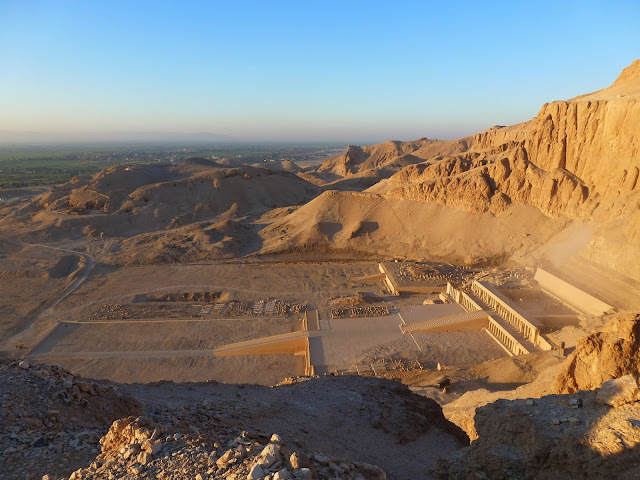
The tomb called “Bab el-Hossan” discovered in 1900 by Howard Carter, is, in fact, a cenotaph of Montouhotep II: its location (pit), in front of his funerary temple, is visible in the middle-left of this photo (photo Daniel Lefèvre)

via égyptophile

It was in October 1891 that Howard Carter arrived in Egypt to work as a draftsman and copyist for Percy Edward Newberry at the Egypt Exploration Foundation. Then, from 1893, still for the EEF, but this time under the direction of Edouard Naville, he copied the bas-reliefs of Deir el-Bahari intended to illustrate the Egyptologist’s work “The Temple of Deir el-Bahari”.
In this context, the one who, in November 1922, will emerge from oblivion, Tutankhamun will make, in an entirely fortuitous manner, his first discovery…
This “adventure” will stretch over two years and is worthy of Indiana Jones! It began in November 1898, on an exceptionally grey and rainy day in the Theban necropolis and the rocky cirque of Deir el-Bahari.

Carter is concerned about the impact of these rains on the temple murals. So, he decides to go to the site “with his colleague Charles Sillem” to observe and estimate potential damage.

The tomb called “Bab el-Hossan” discovered in 1900 by Howard Carter, is, in fact, a cenotaph of Montouhotep II:
its location (pit) is visible here

While he is in front of the temple of Montouhotep, his horse’s foot sinks into a hole… and they both fall! Carter gets up and hastens to examine what caused the fall. “Looking in the small hole formed there, I saw the traces of stonework”, he relates.

He was very intrigued and then opened up to Edouard Naville. As this sector is not in the area of his concession, he attaches little importance to it and does not encourage him to carry out other investigations.

For his part, Howard Carter will not forget this place; he promises to return there to further the research.

To do this, he knows that he must wait for his professional situation to evolve, which will happen quickly. Indeed, in 1899, Gaston Maspero, back at the head of the Antiquities Service, appointed him general inspector of monuments in Upper Egypt.

The following year, finally feeling free to carry out his first “independent” excavation, Howard Carter returned to the site and saw his intuition confirmed: it was indeed a burial! The work to clear what will be known as “Bab el-Hossan” (the horse’s grave) will prove gigantic!

Portrait of a young Howard Carter (author and date unknown)

The opening, which will have to be enlarged, leads to a corridor dug into the rock, 17 meters deep, leading to a sealed door. The clearing carried out with a large team that nevertheless takes turns tirelessly takes an incredible amount of time.

Behind the door, Carter encounters a new 150-meter corridor leading to a large room. Inside, draped, wrapped, and wrapped in linen, is a giant statue!

A well leads to a second chamber located around thirty meters lower. In it, Carter finds vases, pots, and boat models. In another well, a wooden chest bears the name of a pharaoh. This inscription will allow the statue to be identified.

Statue of Montouhotep II – painted sandstone – from his cenotaph located under his temple of Deir el-Bahari
discovered in 1900 by Howard Carter in what is generally referred to as: “Bab el-Hossan.”
Egyptian Museum in Cairo – JE 36195

It is made of painted sandstone and is 1.38 m high and 0.47 m wide. It represents Montouhotep II, ruler of the 11th dynasty. He sits on his throne, wearing the red crown of Lower Egypt and the white habit of jubilee (sed). His broad face, full lips, and a false beard are black.

Its eyes are painted white with black pupils. His hands are black, and his arms are crossed on his chest in the Osiriac position. His legs, also black, are very thick, even disproportionate. In their “Official Catalog of the Egyptian Museum in Cairo,” Mohamed Saleh and Hourig Sourouzian put forward this interesting hypothesis about the colour of its complexion: “It seems that the statue was painted black before burying it.”

As for Rosanna Pirelli (“The Wonders of the Egyptian Museum in Cairo”), she analyzes this particular representation of the sovereign as follows: “This is a strong and hieratic image of the second unifier of the pharaonic state after Menes. The statue symbolizes the double nature of the pharaoh who, during his lifetime, embodies the falcon god Horus, the mighty conqueror, while in death, he is identified with Osiris, the sovereign of the deceased.

Statue of Montouhotep II – painted sandstone – from his cenotaph located under his temple of Deir el-Bahari
discovered in 1900 by Howard Carter in what is generally referred to as: “Bab el-Hossan.”
Egyptian Museum in Cairo – JE 36195 – photo of the museum

Did Howard Carter discover the tomb of the great pharaoh? Mohamed Saleh and Hourig Sourouzian say, “The statue of Montouhotep had been ritually buried in a vault under the terrace (of his temple) and which seems to have been the initial tomb of the king, before having been transformed into a cenotaph. The entrance from this vault opened into the forecourt of the funerary monument of Montouhotep.”

Montouhotep II (“may Montu be satisfied”) reigned between 2061 and 2010 BC. AD. He led an important policy of cultural and commercial restoration.

Location of the temple of Montouhotep (partly ruined today)
in the rocky cirque of Deir el-Bahari

His funerary complex located at Deir el-Bahari was, perhaps, according to the hypothesis put forward by Edouard Naville, a temple with a double terrace topped by a small pyramid. Today, it is primarily degraded and cannot be visited. However, it can be seen from the temple of Hatshepsut, or better yet, an overview of it from the path linking Deir el-Bahari to Deir el-Medineh, which overlooks it.

This statue, “found under the hoof of a horse,” is exhibited at the Cairo Museum (JE 36195). It represents a magnificent example of the renaissance of Egyptian art from the beginning of the Middle Kingdom…

It is important to point out that, in “Howard Carter, The Path to Tutankhamun”, T.G.H. James tells us that this discovery had not been up to what Howard Carter had expected… “His disappointment was deep enough in itself, but worse still, it was increased by the fact that he had committed the stupidity to inform Lord Cromer, the British Consul General, who actually held power in Egypt, suggesting that it was possible that a tomb, possibly royal, had been found. As Maspero wrote to Naville: ‘ ‘He announced his discovery too early to Lord Cromer. Lord Cromer came to witness his success and is now in despair, having been unable to show him anything of what he had predicted. I console him as best I can because “He’s a really good boy, and he does his duty very well.”

Unfortunately, this experience led Nicholas Reeves to say in “Ancient Egypt: The Great Discoveries” that Carter then decided that, for any possible future discovery, he would wait until he was absolutely sure of what he had found before making the announcement. For Tutankhamun, he adopted this strategy:”…

Marie Grillot

Sources:
Herbert Eustis Winlock, Excavations at Deir El Bahri 1911-1931, The Macmillan Company, New York, 1942 https://archive.org/details/Winlock_Deir_El_Bahari_1911-1931 Thomas Garnet Henry James, Howard Carter, The path to Tutankhamun, TPP, 1992 https://archive.org/stream/HowardCarterThePathToTutankhamunBySam/Howard+Carter+The+Path+to+Tutankhamun+By+Sam_djvu.txt

Nicholas Reeves, Richard H. Wilkinson, The Complete Valley of the Kings, The American University in Cairo Press, 1996
Mohamed Saleh, Hourig Sourouzian, Official Catalogue of the Egyptian Museum in Cairo, Verlag Philippe von Zabern, 1997
Francesco Tiradritti, Treasures of Egypt – The wonders of the Egyptian Museum in Cairo, Gründ, 1999
Nicholas Reeves, Ancient Egypt. The Great Discoveries, Thames & Hudson, 2002, The Great Discoveries of Ancient Egypt Editions du Rocher, 2001
National Geographic Guide, The Treasures of Ancient Egypt at the Egyptian Museum in Cairo, 2004
The Egyptian Museum in Cairo, Abeer El-Shahawy, Matḥaf al-Miṣrī, American Univ in Cairo Press, 2005
Statue of King Mentuhotep the Second http://www.globalegyptianmuseum.org/record.aspx?id=14914 The Egyptian Museum in Cairo, Abeer El-Shahawy, Matḥaf al-Miṣrī

Rocky cirque of Deir el Bahari: on the right, the temple of Hatshepsut; set back, barely visible, the temple of Thoumosis III, and to the left, the temple of Menthouhotep in the courtyard of which Bab El-Hossan was found – photo taken from the Luxor City Facebook page.

Published June 21 2014, by Marie Grillot
Labels: bab el-hossan Carter Deir_el-Bahari hossan the tomb of the horse Montouhotep naville

Cloisonné Gold Pendant, a Timeless Lotus Flower!

Standard

This fascinating jewel is not only a designer piece but a symbol of birth and rebirth!
Here is another brilliant article by Marie Grillot about the secret of this magical lotus jewel, which will remain forever.

This pendant comes from the treasure of Princess Mérit (Mereret), whose tomb was found in March 1894 by Jacques de Morgan in the sector of the “northern pyramid” of Dahchour.

Kha and Merit receive offerings on a painted chest from two of their children.
By Museo Egizio

Cloisonné gold pendant of a princess of Dahchour

Cloisonné gold pendant of Princess Merit (Mereret) – gold, carnelian, turquoise, lapis lazuli
Middle Kingdom – 12th Dynasty – Reigns of Sesostris III and Amenemhat III – 1878 – 1798 BC-AD
discovered in his tomb in Dahchour on March 6, 1894, during excavations carried out by Jacques de Morgan
Egyptian Museum in Cairo – CG 53070 – JE 30877 – photo of the museum

via égyptophile

This lovely pendant is made of cloisonné gold, garnished with semi-precious stones. The brilliance that the gems reflect, their perfect execution, and their exceptional state of conservation make it difficult to believe that they are almost… 4000 years old!

It takes the shape of a “convex” shell, the upper part representing an open lotus flower. Its petals, pointing downwards, are made of a delicate and luminous cloisonné composed of turquoise, lapis lazuli and carnelian.

Cloisonné gold pendant of Princess Merit (Mereret) – gold, carnelian, turquoise, lapis lazuli
Middle Kingdom – 12th Dynasty – Reigns of Sesostris III and Amenemhat III – 1878 – 1798 BC-AD
discovered in his tomb in Dahchour on March 6, 1894, during excavations carried out by Jacques de Morgan
Egyptian Museum in Cairo – CG 53070 – JE 30877
published here in “Jewelry and goldsmiths. Booklet 3”, Émile Vernier

“Under this area, the main decoration develops. The middle is occupied by a carnelian of unusual dimensions: 0 m. 021 millimetres high and 0 m. 026 millimeters wide. Its general shape is close to a circle, part of which is cut by the upper area. All around the carnelian, a decoration is developed made, in the axis, of alternating cloisonné chevrons: lapis, carnelian and turquoise, and on each side, curved serrations of turquoise, leaving between them curvilinear triangles in carnelian followed by other small triangles of lapis, then approaching the upper area, alternating bands of lapis and turquoise and ending with an ellipse in turquoise having as its middle a small ellipse of lapis is framed by a fairly wide edge where the gold is bare. The reverse is made of a concave plate of plain gold, where we see a horizontal ring in the upper part, flat and vertically striated,” explains Emile Vernier (Jewelry and goldwork. Booklet 3).

Cyril Aldred’s interpretation follows: “The pendant… is inlaid with a motif inspired by the lotus flower from which is suspended a crown of stylized flower petals, ending in a pendant of three chevrons”.

As for Nigel Fletcher-Jones (“Ancient Egyptian Jewelry”), he specifies that “The pendant was originally suspended from a chain of gold beads to which twenty-six small oyster shells were soldered at regular intervals”.

Cloisonné gold pendant of Princess Merit (Mereret) – gold, carnelian, turquoise, lapis lazuli
Middle Kingdom – 12th Dynasty – Reigns of Sesostris III and Amenemhat III – 1878 – 1798 BC-AD
discovered in his tomb in Dahchour on March 6, 1894, during excavations carried out by Jacques de Morgan
Egyptian Museum in Cairo – CG 53070 – JE 30877 – photo of the museum

This jewel is loaded with symbols and “powers”… Thus, the oyster shell was, for a short period of the Middle Kingdom, an amulet which, according to Carol Andrews (Amulets of Ancient Egypt) “, gave health” and brought well-being to the person who wore it… As for the lotus, which is very present in Pharaonic iconography, it is not only the symbol of birth but also that of rebirth.

The stones used are also loaded with symbolism. In “The Gold of the Pharaohs”, Christiane Ziegler provides these details: “The ‘méfékat’ turquoise was extracted from Sinai where the pharaohs launched mining expeditions. Its luminous colour, evoking the growth of young shoots in spring, was synonymous with vitality and joy. Its presence in the funerary equipment undoubtedly gave the dead the joy of rebirth.” Carnelian, Héréset, “possessed the invigorating virtues of blood”. As for lapis lazuli, she explains to us: “in ancient myths, it constituted the beard and hair of the gods and had virtues comparable to those of turquoise”…

Pyramid of Amenemhat III in Dahchour
Photo by Jacques de Morgan published in “Excavations at Dahshur”, 1894

This pendant comes from the treasure of Princess Mérit (Mereret), whose tomb was found in March 1894 by Jacques de Morgan in the sector of the “northern pyramid” of Dahchour.

In his work “Excavations at Dahchour”, published the same year, he relates: “The underground necropolis that I had just opened was therefore not the tomb of the king, but rather the gallery of the princesses, one of the annexes of the tomb principal. Later, I discovered among the treasures the names of the princesses Hathor-Sat and Merit and the titles of a sixth royal daughter on the worm-eaten remains of a wooden box. Then he adds, “Meticulous examination of the floor of the galleries revealed on March 6 a cavity dug in the rock at the foot of sarcophagus C. The ground was loose,e and the worker’s foot sank into the middle of the moving debris. A few blows of the pickaxe revealed its treasures: gold and silver jewels and precious stones were there, piled up in the middle of the worm-eaten fragments of a box where they had once been kept. “

Cloisonné gold pendant of Princess Merit (Mereret) – gold, carnelian, turquoise, lapis lazuli
Middle Kingdom – 12th Dynasty – Reigns of Sesostris III and Amenemhat III – 1878 – 1798 BC-AD
discovered in his tomb in Dahchour on March 6, 1894, during excavations carried out by Jacques de Morgan
Egyptian Museum in Cairo – CG 53070 – JE 30877
published here in “Excavations at Dahshur” by Jacques de Morgan

Georges Legrain, who worked alongside him, was responsible for drawing up the first jewellery catalogue and faithfully reproducing drawings and watercolours. The large number of pieces to be presented will mean that this pendant will be described in a laconic manner: “Bivalve shell decorated with multicoloured stones on its convex part. The main design represents a lotus flower supporting an indefinite red object, from which herbs escape …”

Jacques de Morgan brandishing one of the pieces of Dahchour’s treasure (Princess Khnoumit’s tiara)
during its discovery in April 1894 in the funerary complex of Amenemhat II in Dashour
(drawing published in “L’Illustration” on May 11, 1895)

We can only subscribe to the words of Pierre Tallet in his work “Sesostris III and the end of the 12th Dynasty”: “One last area where the ending 12th dynasty seems to have particularly excelled is that of jewellery. The royal necropolises of this period thus delivered the first truly important collection of Egyptian jewellery, for the most part, intended for women in the pharaoh’s entourage: jewellery and toiletries from Sat-Hathor-Iounet to El-Lahoun, Mereret… These different lots of Precious objects, where gold, silver and various fine stones such as lapis lazuli, turquoise, amethyst and carnelian abound, give an idea of the splendour in which the royal family lived.

This pendant was registered in the Journal of Entries of the Cairo Museum under the reference JE 30877 and in the General Catalogue CG 53070.

Marie Grillot

Sources:

Excavations at Dahchour, Jacques de Morgan, Berthelot, M. (Marcellin), Legrain, Georges Albert, 1865-1917; Jquier, Gustave, 1868-1946; Loret, Victor, 1859-1946; Fouquet, Daniel https://archive.org/details/fouillesdahcho01morg/page/n213/mode/2up Dahchour excavations: 1894-1895, Jacques de Morgan, Wien 1903, http://digi.ub.uni-heidelberg.de/diglit/morgan1903/0049 Jewellery and goldsmiths. Booklet 3, Number 52640-53171, by Mr. Émile Vernier http://gallica.bnf.fr/ark:/12148/bpt6k57740426/f96.item.r=52859.texteImage Summary list, booklet published in 1894 by M. de Morgan; Excavations at Dahchour, II; Morgan’s catalogue, 1897 by Morgan Jacques. Letter on the latest discoveries in Egypt. In: Reports of the sessions of the Academy of Inscriptions and Belles-Lettres, 38th year, N. 3, 1894. pp. 169-177; https://doi.org/10.3406/crai.1894.70401 https://www.persee.fr/doc/crai_0065-0536_1894_num_38_3_70401 Jewellery and goldsmiths. Booklet 3, Number 52640-53171, by Mr. Émile Vernier http://gallica.bnf.fr/ark:/12148/bpt6k57740426/f96.item.r=52859.texteImage The gold of the pharaohs – 2500 years of goldsmithing in ancient Egypt, Catalogue of the summer 2018 exhibition at the Grimaldi Forum in Monaco, Christiane Ziegler Jewels of the Pharaohs, Cyril Aldred, ed Thames & Hudson Ltd. London, 1978 Ancient Egyptian Jewelry: 50 Masterpieces of Art and Design, 2019, Fletcher-Jones, N, The American University in Cairo Press Ancient Egyptian Jewelry, Carol Andrews, Harry N. Abrams, INC., Publishers, 1991 Amulets Of Ancient Egypt, Carol Andrews, published for Trustees of the British Museum by British Museum Press https://archive.org/details/AmuletsOfAncientEgypt_201707 Treasures of Egypt – The wonders of the Egyptian Museum in Cairo, Francesco Tiradritti
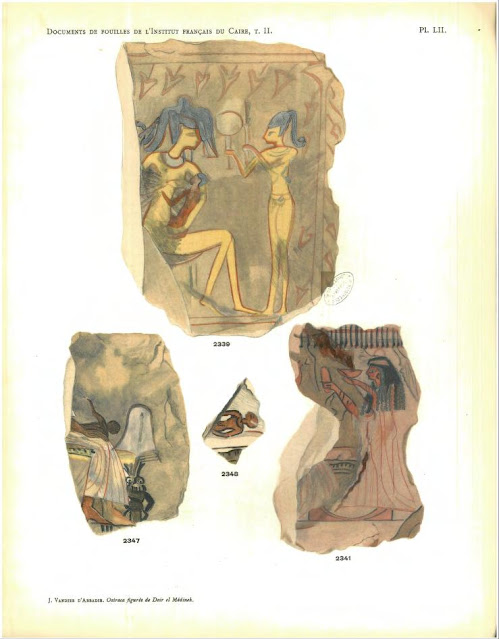
Posted December 21 2021, by Marie Grillot

Labels: CG 53070 – JE 30877 Dachour Dashour de Morgan expo Ramsès II 2023 fouilles 1894 Jacques de Morgan la villette Mereret Merit Mérit or clloisonnée pendeentif