Karfreitag (Good Friday)

Standard
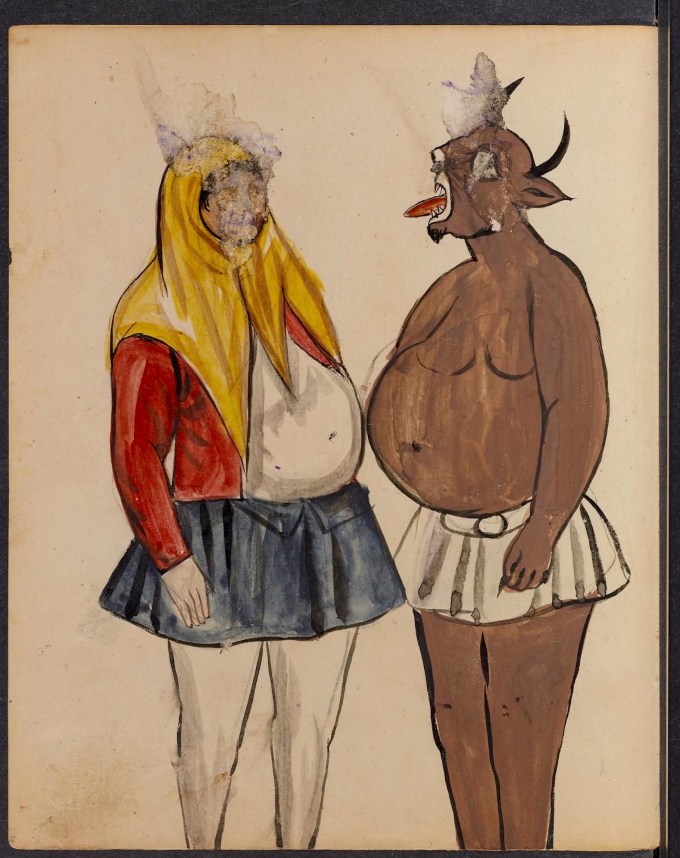
The Crucifixion of Jesus | Jesus was crucified on a hill cal… | Flickr
Flickr

Yes, today according to Christian history, is the day in which Jesus has been crucified. In Germany this day called Karfreitag as in English they call it Good Friday and I can’t say why is it so different; as I read somewhere; it once has been called God’s Friday and then it became for Good!

This is an explanation about its meaning in German; Karfreitag is the day where Christians remember the crucifixion of Christ. According to Duden, the Kar in Karfreitag comes from the Mid High German word chara, which means “wail,” “sorrow” or “lamentation.” Another, less common word for Karfreitag is stiller Freitag – “silent Friday.” via https://www.thelocal.de/20190419/karfreitag

Here I’ve found an interesting article about the culprit who was responsible for this event: Pontius Pilate. The question is; what actually had happened to the malefactor? It isn’t clear what, but the fact is that he’s never been turned in to stone! In any case if one wants to damn him to the highest level in the hell, I would say in my opinion; he might do his order to make this day an unforgettable day. 🙏💖

The Strange Afterlife of Pontius Pilate

The enduring legacy of the Roman governor who faced the ultimate politician’s dilemma. Kevin Butcher | Published 25 March 2016

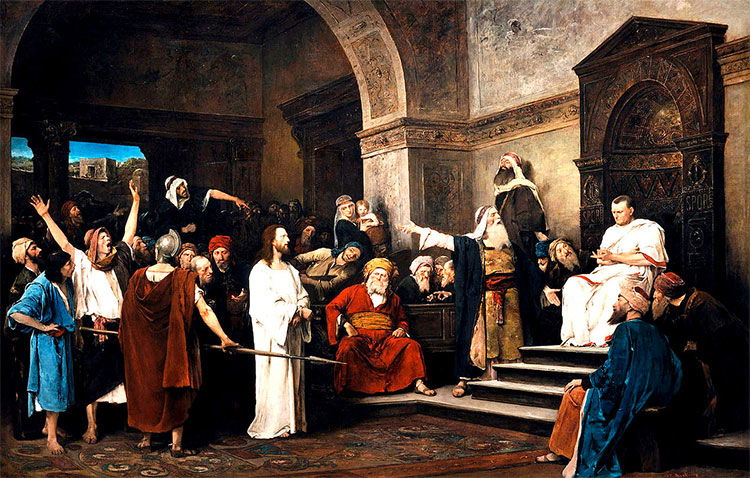
Christ before Pilate, Mihály Munkácsy, 1881Christ before Pilate, Mihály Munkácsy, 1881

Towards the end of the second century AD the pagan intellectual Celsus wrote an anti-Christian treatise mocking belief in Jesus Christ. If Jesus really had been the Son of God, he asked, why hadn’t God punished Pontius Pilate, the man responsible for crucifying him? Why had Pilate not been driven insane or torn apart, like the characters in Greek myths? Why had no calamity befallen him?

While there are plenty of later Christian traditions about the punishment of Pontius Pilate, all of these seem to belong to a period long after Celsus was writing. Celsus’ challenge, and the response of early Christians to it, suggests that there was more than a kernel of truth in the claim that the Prefect of Judaea had evaded misfortune. This is implicit from the efforts early Christians made to absolve him of responsibility for the Crucifixion.

The only reliable statement we have about Pilate’s life after his time in Judaea comes from the pen of the Jewish writer Josephus. In his Antiquities of the Jews, written about 60 years after the events, Josephus states that Pilate was recalled to Rome after his mishandling of a riot involving the Samaritans in AD 36. For this he would have expected to face a hearing before the Emperor Tiberius, the aged but uncompromising ruler who had appointed him ten years earlier. Pilate hurried back, but by the time he arrived, in March AD 37, the ailing Tiberius had died. A new emperor, Caligula, had taken up the reins of power. 

What happened next is guesswork. Josephus says nothing more about him, implying that there was no hearing. Perhaps, in the general euphoria surrounding Caligula’s accession, his case was put on hold, or simply forgotten. Maybe the hearing did go ahead and he was acquitted. For all we know, he was given another posting. 

The lack of a suitably grisly fate for Pilate put Christian apologists in a quandary. As governor, it was Pilate’s job to pass judgement in capital cases: he was the one who condemned Jesus to suffer on the cross. There was no circumventing his guilt. Divine punishment should have followed.

Yet in the early years of Christianity it was difficult to make such claims. The Roman state was suspicious of the new cult and, if Christians wanted to avoid confrontation, it was best not to accuse one of Rome’s officials of deicide. The canonical Gospels stressed that Pilate was not fully to blame. He could find no fault in Jesus: ‘I have found in him no grounds for the death penalty. Therefore I will have him punished and then release him’, Pilate declares in Luke’s Gospel. John has Pilate twice announce ‘I find no basis for a charge against him’. The apocryphal Gospel of Peter, thought by many scholars to be among the earliest Christian texts, went even further. In this, Pilate and his soldiers play no part in the crowd’s mocking or torturing of Jesus. He himself declares ‘I am pure from the blood of the Son of God’ and, together with his soldiers, who guard the tomb of Jesus, he conspires to keep the miracle of the Resurrection secret from the Jewish priests. 

The tradition of a blameless Pilate, a witness to the Passion, led to a strange early Christian fascination with him. By the second century AD, fake letters of Pilate, recounting the wondrous story of Jesus, circulated among the faithful. The so-called Acts of Pilate, allegedly deriving from the governor’s own records, portray Pilate as a convert. Tertullian, the late second-century Christian theologian, described Pilate as someone ‘who himself also in his own conscience was now a Christian’ and alleged that Tiberius was so convinced by Pilate’s reports that he would have placed Jesus among the Roman gods had not the Senate refused. So influential were the various versions of the Acts of Pilate that in the early fourth century the Roman state created and promoted an anti-Christian, ‘true’, pagan version in an attempt to discredit the Christian ones. Needless to say this was no more reliable than its rivals.

All of this might seem merely capricious, but the absolution of Pilate came at a terrible cost. The early Christians shifted the blame for the Crucifixion onto others. A rebuttal of the arguments of Celsus, written by the third-century bishop Origen, shows this clearly: ‘It was not so much Pilate that condemned Him,’ he wrote, ‘as the Jewish nation’. Celsus had chosen the wrong culprit; and the fact that the Jewish nation had been torn apart by the Romans and dispersed across the face of the earth was proof of God’s retribution. The fake letters and the Christian versions of the Acts of Pilate said much the same thing, as did other Christian apologists. The Acts went so far as to have the Jewish crowd telling Pilate that they willingly accept the blood-guilt, an echo of the Gospel of Matthew, which has the same crowd shouting ‘his blood be on us and our children!’ These claims formed a basis for Christian persecution of the Jews right up to modern times. 

Video: Professor Kevin Butcher of the University of Warwick on the real Pontius Pilate

Pilate’s costly absolution was the product of specific religious and political circumstances. When the Roman Empire became a Christian state in the fourth century, there was no longer any need to emphasise his innocence. The Nicene Creed, formulated under Emperor Constantine in AD 325 and emended in AD 381, stated bluntly that Christ ‘was crucified under Pontius Pilate’. It became acceptable to cast Pilate as a villain and a range of myths developed describing his grisly end.

Some influential Christians demurred, however. Saint Augustine, writing in the sixth century, argued that when Pilate wrote on the cross ‘Jesus of Nazareth, King of the Jews’, he really meant it: ‘It could not be torn from his heart that Jesus was the King of the Jews.’ 

While the West went on to develop the tradition of a ‘bad’ Pilate who was punished for his misdeeds, the Eastern Church preferred a more sympathetic interpretation. Not only was Pilate a Christian; he was a confessor and even a martyr. One eastern text, The Handing Over of Pilate, has Tiberius ordering the governor to be beheaded for having allowed the Crucifixion to go ahead. First Pilate repents and then a voice from heaven proclaims that all nations will bless him, because under his governorship the prophecies about Christ were fulfilled. Finally an angel takes charge of his severed head. In some accounts he is buried with his wife and two children next to the tomb of Jesus – the ultimate martyr’s sepulchre.

In the Gospel of Matthew, Pilate’s wife warns her husband not to harm Jesus and for this she achieved sainthood among Orthodox Christians. The Copts and Christians of Ethiopia took the next step and canonised Pilate himself. An Ethiopian collection of hagiographies lists St Pilate’s Day as the 25th of the summer month of Sanne, a day shared with his wife Procla and the saints Jude, Peter and Paul: 

Salutation to Pilate, who washed his hands 
To show he himself was innocent of the blood of Jesus Christ

Those familiar with the western tradition may find the idea of St Pontius Pilate curious or even absurd. But the fascination with Pilate never abates. From the Acts of Pilate to Mikhail Bulgakov’s novel The Master and Margerita, the man who cross-examined and crucified Jesus remains an enigma, a shadowy metaphor for opposites: equivocation and stubbornness, cowardice and heroism, cruelty and clemency. His dilemma – to do the right thing or the popular thing – is every ruler’s quandary. Perhaps that is why people can sympathise with him: we too must sometimes face a difficult choice; though, fortunately for us, its legacy is likely to be less enduring.

Kevin Butcher is Professor in the Department of Classics and Ancient History at the University of Warwick and the author of The Further Adventures of Pontius Pilate.

via https://www.historytoday.com/homepage

The Old Friends

Standard

A time it was, and what a time it was, it was
A time of innocence
A time of confidencesLong ago it must be
I have a photograph
Preserve your memories
They’re all that’s left you

These words are really a masterwork; those days Al and me, we were crazy about these two, and we have swallowed all their works like this one but I understand it now as I myself, getting aged and working with many old peoples, especially in these moments in which they might all feel lonely and scary.

This album actually was not so popular, because, there comes an old-friends talk in between; in a senior institution; we must just to listen to.

therefore, I would like to present this old but forever album to our old friends.

The poems are fascinating; Sharing a park bench quietly?
How terribly strange to be seventy”. it is an imagination of the Arts: it means for me a creation.

So young and so thoughtful

Old friends
Old friends
Sat on their park bench like bookends
A newspaper blowin’ through the grass
Falls on the round toes
Of the high shoes
Of the old friendsOld friends
Winter companions, the old men
Lost in their overcoats, waiting for the sunset
The sounds of the city sifting through trees
Settle like dust
On the shoulders of the old friendsCan you imagine us years from today
Sharing a park bench quietly?
How terribly strange to be seventyOld friends
Memory brushes the same years
Silently sharing the same fearA time it was, and what a time it was, it was
A time of innocence
A time of confidencesLong ago it must be
I have a photograph
Preserve your memories
They’re all that’s left youSource: LyricFindSongwriters: Paul SimonBookends Themes lyrics © Universal Music Publishing Group

Take care all you old friends, just stay healthy and no fear, be safe 💖💖🥰

Fifty + Years Loneliness (!!!)

Standard
Pinterest
Hard but true.

You might be surprised to see I’ve titled this with three Exclamation Marks instead of Nombre 3. I just wanted to show how I feel! 😁

I have mentioned, as I had a look back on the latest two chapters, that I have really a problem to write this story, my life story. I have known it as I read them, again and again, I’ve just thought: “what the hell; this man has a problem!! ” 😛

You know, I have learned in my life to get out of me, stay beside and look at myself as another person, I think it helps to get knowing oneself better and here I found this memorandum somehow poor. Here I must really thank you, dearest and adorable friends, despite all these poorness did support them. I am deeply grateful and appreciated.

As I might take the advantage of your kindness, let me analyse why I have such a problem with this story; since I got known psychology through Sigmund Freud, I have found out that I have many complexes in my life; When our mother lied us about father’s death, my unconsciousness knew there’s something wrong as I remember Al, who somehow got it clearly, tried to help mother’s secret on one side and to stop me not putting so many questions there all about, dear brother. I have found it out after some months later when I looked into the old magazine and saw the memorial ceremonies of the funeral which took place after father died (he was a famous writer in his time) and I asked her about the matter, her answer was just “get out and let me alone!” I went out, and of course, she came after me and we’ve taken us in arms wept together.

Pinterest

But these all have remained in my inner soul like deep tracks which I had to work with them, as I am still working on.

It’s surely a big problem but to this comes my inexperiences on writing too and also, two foreign languages which I have to struggle with; English and German. You know, I have learned both by myself; Al and I have learned English at home in Iran when we both began to work as a journalist and when we came in Germany, I’ve noticed that no matter if I can live and communicate in English with people I must learn German to better understand and be understood, therefore, bought some grammar books and did it myself! Now when I begin to think or write in English, both languages mixed up together; I am living here in Germany since 1985 and I speak, think, dream in German and when I want to switch into English, the conversant words for me are mostly German words; I have to translate them in English in my head! If you might notice in the last chapter, I’d written in the title; “Fufty” + Loneliness (2) It is just a mixed-up Fifty in English and Fünfzig in German!!

Here is an example by Master Dr Freud 😉😄

4 in German, is vier (sounds fear) and 6 sounds sex!

You might ask why I don’t write in German, and I might answer; I have the English language almost in my blood, maybe because since my childhood I’m listening to the English music and to be honest; writing in German is not so easy as the German believe in by themselves. 😉

Anyway, I wondered how many mistakes I’ve made, not only because of the languages but also my extremely humbleness plus a lot of excitement cause of lack of self-confidence.

Therefore, I dicided to make a stop to write about my life, I am sure I will back on this soon, thank you all again and again for your wounderful, inspiring suports and kind words. Blessing 💖🙏💖🙏

The Queen of Illustrations

Standard
The New York Times

I just can’t go by any posts about this Queen without rush on to it and swallow every cell of this wonderful Goddess. Honestly, in my youth, I fell in love with some famous characters; the first one as I clearly can remember was Angela Cartwright; who got famous as Brigitta von Trapp in The Sound of Music and surely was known as Penny in the TV-series Lost in Space. And there it happened. I have fallen in love with her….

Anyway, the next one as still remains in my memory was Brigitte Bardot (I think that my old male friends can well have understanding!) though our love has a short time and with no success.

Now, I tell you that I have all forgotten and left all my old lovers behind but; this Goddess of painting is unforgettable (I still believe that my male friends all are agreed!)

So, now let’s enjoy this wonderful post by the very agreeable culture site http://www.openculture.com/ Thanks and,,, I love you all 💖💖🥰😘

What the Iconic Painting, “The Two Fridas,” Actually Tells Us About Frida Kahlo

I never painted dreams. I painted my own reality. —Frida Kahlo

You may be forgiven for assuming you already know everything there is to know about Frida Kahlo.

The subject of a high profile bio-pic, a bilingual opera, and numerous books for children and adults, her image is nearly as ubiquitous as Marilyn Monroe’s, though Frida exercised a great deal of control over hers by painting dozens of unsmiling self-portraits in which her unplucked unibrow and her traditional Tehuana garb feature prominently.

(Whether she would appreciate having her image splashed across shower curtainslight switch coversyoga mats, and t-shirts is another matter, and one even a force as formidable as she would be hard pressed to control from beyond the grave. Her immediately recognizable countenance powers every souvenir stall in Mexico City’s Coyoacán neighborhood, where Casa Azul, the home in which she both was born and died, attracts some 25,000 visitors monthly.)

A recent episode of PBS’ digital series The Art Assignment, above, examines the duality at Frida’s core by using her double self-portrait, The Two Fridas (Las Dos Fridas), as a jumping off place.

Kahlo herself explained that the traditionally dressed figure on the right is the one her just-divorced ex-husband, muralist Diego Rivera had loved, while the unloved one on the left fails to keep the untethered vein uniting them from soiling her Victorian wedding gown. (The vein, originates on the right, rising from a small childhood portrait of Rivera, that was among Kahlo’s personal effects when she died.)

It’s an expression of loneliness and yet, the twin-like figures are depicted tenderly clasping each other’s hands:

Bereft but comforted

Fractured but intact

Lonely but not isolated

Broken but beautiful

Humiliated but proud

Kahlo’s boundaries, it suggests, are highly permeable, in life, as in art, drawing from such influences as Bronzino, El Greco, Modigliani, Surrealism, and Catholic iconography in both European religious painting and Mexican folk art.

As for the new thing learned, this writer was unaware that when Kahlo married Riveraher elder by 22 yearsin a 1929 civil ceremony, she did so in skirt and blouse borrowed from her indigenous maid… a fact which speaks to the end of her popularity in certain quarters.

Fifty + Years Lonlelyness (2)

Standard
The melancholy man and the goat!

Hi, my dear friends. I must apologize for my failures in the last post, as I noticed them in the night in bed!! Anyway, I have a serious situation this time as I have to work and coordinate my household; my wife is a woman of the world. Just let’s begin.

As I mentioned in the first part, it’s not easy to be born and grow up by sensible parents; a writer as a father with a lot of wishes and dreams and a bookworm as a mother whose biggest wish was to be left alone in a room fulfil with books and glass water and a loaf of bread would be enough for her!

Mother in everlasting position, Dreaming.

Here, man can say that God saves the soul! And yes, my childhood was based on a lot of trauma. Especially after my father died, it became much more complicated, but the very beginning;

It is, of course, not so much to explain; I have written there about in my some memories a time of love, happiness, a time of also, strike, strife, discord and again love and forgiveness.

You might read my post, “A CHARACTERISTIC LOVE STORY.” There, I have described the crazy beginning of this family’s foundation, which can result in mostly chaotic high-spiritual tensions in our lives.

Let’s begin after the father’s death because I can remember better. I don’t know why; maybe because I had to work on this. My father died the night after we returned from a wedding ceremony very late at night, and both “Al and I” knew nothing about what happened. In the morning, Mother told us he had travelled (He did travel often, but surely not after a party where he was almost drunk!). This wrong announcement was acceptable to me, but for Al, it wasn’t enough. He was a thinker even 9 at age ( I was 7 when my father left this Earth.), but of course, we both took it as a fact and, according to the mother’s order, went to the uncle’s house with a pool a big garden and so on and on. It was an offer which no child could refuse.

Those were the days, I’d bet! 😉

The main tension began after this time because Al was almost sure there was something wrong with this and me, the bloody child; I might have mentioned something but surely wanted rather ignore it! Therefore, it began a funny, and it might be better to say a tragic play between us three: Mother, Al and Me, and it was and still remains a trauma, which I will try to tell you about next. Thank you to all who read this, and forgive me for my failure. Take care and be safe. 🙏💖🙏

In Aswan, a “pilgrimage” not to be missed: the unfinished obelisk …

Standard
Unfinished Obelisk in one of Aswan granite quarries,
about 2 km south of the city, near the Fatimid cemetery

Let’s have a look at the forever magical land of Egypt and their philosophical relationship to the stones.

By:

Marie Grillot

Marie Grillot Égypte-actualités with a great thank.

Translated from French.

To pay homage to a broken destiny, to hope of shattered greatness, you have to go to the quarries of Aswan, about 2 km south of the city, near the Fatimid cemetery…

In this place lies the one that could have been the highest obelisk in Egypt,… Wearing its sparkling pyramidion, it would then proudly bear the name and the cartouches of the pharaoh who ordered its execution…

But, “in Antiquity, at the time of the extraction, the team in charge of the operation discovered cracks on the block and tried several times to reduce its size. These attempts were unsuccessful and the monument was abandoned “(Nessim Henry Henein – BIFAO 109).

Cracks on the block of the unfinished obelisk in one of Aswan granite quarries,
about 2 km south of the city, near the Fatimid cemetery

Florence Maruéjol reminds us of all the symbolism of the obelisks: “Like most elements of religious architecture, they are loaded with symbols. They materialize the Benben, the sacred stone venerated in antiquity in the temple of Heliopolis. They also embody the primordial hill on which the sun landed at the beginning of the world. They are also assimilated to petrified sunbeams “.

Giving up all hope of embodying this, he remained forever “fused” connected by one side to this stone bench of Syene, name of the ancient city of Aswan.

Overview of the Aswan granite quarry,
located approximately 2 km south of the city near the Fatimid cemetery

Clot Bey informs us about the mineralogical and geological composition which gave it its name: “Around Aswan, there are these varieties of granite, so famous in antiquity, known as syenite. We find in this mineralogical bench syenites pink, porphyritic, pink and yellow, grey, white and black, grey and pink, veined and black; porphyritic gneiss, white and quartz granites. Most of the huge monoliths left to us by the Egyptians, the obelisks, the colossi, are red syenite; we also see many statues and emblematic monuments of a smaller volume in black or grey syenite “.

Unfinished Obelisk is one of Aswan granite quarries, about 2 km south of the city, near the Fatimid cemetery
Photo dated 1890
Aswan, half of the year obelisk in quarry – circa 1890

Jean-Jacques Ampère, in his “Travel and Research in Egypt and Nubia” published in 1848 describes his visit thus:

We wandered curiously in the quarries of Syene. These quarries are a plain of granite cut in the open air for the needs of Egyptian architecture and especially sculpture. Egypt offers, in fact, very few monuments built in granite, but all the obelisks, many statues and sphinxes are of granite and of this pink granite peculiar to Syene, from where it took the name of syenite. It is from here that these famous monoliths came out, which, after decorating Thebes or Heliopolis, now embellish the squares of Rome and Paris. We understand how these masses could be detached. Holes that can still be seen arranged along with a horizontal slit show how large pieces of granite were separated from the rock. In these holes, the corners were used to break the rock.

We even see in Syene’s quarry an obelisk which has not been entirely detached; it is there lying on the ground, to which still holds by one side. By contemplating this living testimony of a work which has stopped for so many centuries, it seems that we are witnessing this work and that we see it being interrupted. One can believe that the workers, after taking their nap, will come back and finish their work; the unfinished work still seems to last. “

For many years this notion of the use of “corners” persisted, even Marcelle Baud in his Blue Guide will echo it: “They (the old quarries) show the process used by the Egyptians for the extraction of These notches, which delimited the surface to be extracted, received wooden wedges which were then wet. The swelling wood caused the block to burst in the delimited places and this obtained roughly smooth surfaces ready for polishing”…

In the 1920’s, Reginald – Rex – Engelbach, Egyptologist English, devoted several seasons
to study the unfinished obelisk Aswan and restore its findings in three reference books

But the truth about the exact technique used will emerge from 1920 – 1921, thanks to Pierre Lacau, then head of the Antiquities Service, which entrusted the study of the unfinished obelisk to Réginald Engelbach.

In his Report on the works carried out during the winter of 1920-21, he made the following observation:

“In Aswan, all the tourists knew the unfinished obelisk which still lies in place in the granite quarry. The sand had invaded it and it had to be cleared again. I took the opportunity to try to clear it in a complete way, in order to examine closely the technical procedures of the Egyptian quarrymen. M. Engelbach, the chief inspector for Upper Egypt, was charged with the work and he was pleasantly surprised to see the enormous needle stretch out in a disproportionate way; the part currently cleared of the debris which covered it is already 36 meters long, and the work is not finished. It is therefore already the largest of the known obelisks (we have one of thirty and one meters only). One cannot help but think of the well-known text by Deir el Bahari which tells us about obelisks of fifty-two meters; this surprising figure is much less likely now to be only an exaggeration. “

Rex Engelbach, an English Egyptologist of Alsatian origin, remembers: “Although its existence has been known for centuries, the unfinished obelisk had never been cleared until the end of this winter of 1922 when my department allocated the sum of LE 75 to do it. In this work, I was assisted by Mahmûd Eff. Mohamed and Mustafa Eff. Hassan of the department of antiquities who supervised the workers”.

He initially trained as an engineer and finds there a very interesting subject of study: he seeks to understand why this immense long-form mass carved in granite, this monument of more than 1100 tonnes was abandoned there in the New Empire.

Unfinished Obelisk in one of Aswan granite quarries at about 2 km south of the city, near the Fatimid cemetery
Partially quarried “Unfinished Obelisk”; 18th Dynasty 1539-1292 BC gold.
(Underwood & Underwood Co .; entre pictures taken in 1900 and 1920).
These photos show the obelisk as it was when Engelbach began to study

He senses that what in antiquity might have appeared as a catastrophe, a waste of time for workers and sponsors, contains a wealth of information, a source of knowledge and understanding of the work and extraction of these materials. monoliths from the Pharaonic eras.

He devotes several seasons to exploring the site, he excavates, clears, clears the pit that surrounds the obelisk, drawing information, remarks and conclusions which he will reproduce in three works.

In “The Aswân Obelisk”, “he provides a complete and detailed description of the obelisk. Far from being limited to a description of the boulder, the trenches surrounding it, the wells and certain details which struck it on the site, he develops hypotheses and tries to elucidate the way in which the various operations relating to obelisks were to be conducted, from the marking on the surface of the granite hill of the quarry to their erection in front of the pylons of the temples. “

Dolerite balls made    near the obelisk incomplete in one of Aswan granite quarries
about 2 km south of the city, near the Fatimid cemetery

In “The Problem of the Obelisks”, “he explains the stages in the production of the obelisk in four points: – equalization of the upper layer of the block obtained by thermal shock; – use of Dolerite balls to equalize the surfaces; – drawing of the contours of the obelisk traced on the upper surface after levelling; – realization of the trench which surrounds it “.

He came to this staggering observation in particular: “We used neither scissors nor wedges to detach the obelisk from the quarry; the dolerite balls were the only tools used. In other words, the obelisk was not cut but excavated … Not only the sides but also the underside of the obelisk were detached by percussion. “

And finally, in “The Wonder of the Obelisk”, he summarizes all the knowledge acquired during his excavations.

If this obelisk did not illuminate a temple with its presence, it served many other functions. Thanks to Engelbach, he shed light on the “making” of his fellows. He also brought to our attention the excellent level of technicality enjoyed by tailors, and he always recalls the almost philosopher’s relationship that the ancient Egyptians had with stone…

Marie Grillot

Sources:

https://archive.org/details/problemofobelisk00enge

http://www.ifao.egnet.net/bifao/109/

https://archive.org/details/problemofobelisk00enge

https://archive.org/stream/aswnobeliskwiths00egyp#page/4/mode/2up

http://www.ngu.no/upload/Publikasjoner/Special%20publication/SP12_s87-98.pdf

http://www.lmd.jussieu.fr/~jldufres/publi/1996/Manip_Billet_1996/Scan/p_dossier_11.pdf

http://www.egypt-nile.co.uk/unfinished_obelisk.htm

http://www.ifao.egnet.net/bifao/Bifao109_art_12.pdf

BIFAO 109 (2009), p. 221-237 Nessim Henry HeneinNotes on the extraction of the Unfinished Obelisk in Aswan quarries© 2019 IFAO BIFAO online https://www.ifao.egnet.net100 questions about ancient Egypt, Florence Maruéjol, La Boétie, 2013

Fifty + Years Loneliness (1)

Standard
He had always won though rather mentally and not physically!
(in the background; cousin, and mother wash the dishes).

Yes, I dare! You, I mean some of you my friends here, who intensive were interested in me as an individual person, were much interested in my life story somehow, but to put it bluntly, as I am, somewhat, a humble person, it was very difficult for me to write about it, though, I have a memorial note with the same title on work.

But, what else!, I thought I begin here with you all (who interested of course) to tell my story;

A big head but remains raw for too long!

I have begun the story with the picture of me and my brother Al, no chance without him. He is a part or better to say; a huge part of my life… no doubt.

Okay, let’s begin with a daisy lazy vision in front of my tired old eyes and dig into my memory; I can see into a foggy scene a large yard and a big house in there we’re both born or may re-born.

I see at first, a gate for driving in and a veranda for parking lot and after you walked into the yard and passed a pool which rests between two big rose garden with some trees of peach and apples, you’d reach the main door to enter into the house.

I regret not to have a pic of my birthplace, I had it surely but it’s out of hand!

It sounds all big and great, of course, it was because of my father’s lucky goal after his success in publishing a book in which he had not only made a difference between Persians and Arabs way in their religion but also he put an old costume called Sufi’s with his translation or better to say a gathering of the quotes by the first Imam in Shiites; Ali. It was more a sanctify about Ali as an Imam, he made him as a legendary.

Therefore, he became famous in a night (I think it is a wish of every writer) though I am sure that he was not even religious; he was all in his life against mullahs and their teachings in the Mosque, he was never welcome there! that was his chance to hit the goal and did it.

Therefore, we were born in a big house with a big garden a great yard and rich building without any religious influences.

It is not easy to be born in a family with so many sensibilities, as an artist can have, I tell you, the children take it most!

I must end this part and look for the next, hopefully you too 😊 Be safe and have a nice WE🙏💖🙏

Happy? new Year! سال نو پیروز

Standard
Yahoo News

First I must say; Yes, I am at home! Because I have not a full-time job anymore but am a short-time worker. 😁

The reason why is that everything is in a still-stand or interruption modus as you’ve surely known it.

Anyway, today at nine o’clock the Spring has begun and in old Persian, it was and still is, the beginning of a new year, but I have put a question mark after the word “happy” that I think it might be really under a question while in these days it is hard to be.

Nevertheless, I gave the title also the Persian words; (translated) “New Year be Succeed” that is much fitter than” be happy” and could be a wish for the new one.

Then let me say;

Happy New Year to all #Persian allover Earth. Though it’d not be so happy as it’d be! somebody might say last years; what could be worse than this?! Now we see it can be worse!!
But anyhow, stay strong and together (with distance😁 ) as we know; this too shall pass 😏Hoping for a better year 💖🙏

سال نو مبارک به همه #پارسیان روی کره زمین. گرچه آنقدر مبارک نمیتواند بود! ممکن است کسی سالهای گذشته بگفت؛ چی ممکنه بدتر از این پیش بیاد! حالا می بینیم که می تواند بدتر شود !!
اما به هر حال ، قوی و در کنار هم باشید (با فاصله 😁). همانطور که می دانیم این نیز بگذرد 😏به امید سالی بهتر

Take care and be safe everybody 💖💖🙏✌💖

Loving Vincent

Standard
Holland.com

I think Vincent van Gogh, as he belongs to genius artists in this world, was one of the rare ones who had mostly suffered in his short life.

I might have a half-dozen art in me but as I have been among to a family of artists, I know how they suffer as ingrained artists and trying all in their life to bring out all these energies to create in the form of books, paintings or music etc.

Some months ago I saw in a TV magazine an announcement over this movie; Loving Vincent, and I have recorded it. But I had got barely time to watch it and almost forgotten. two days ago in the evening, my wife asked me if I still have kept the movie and could we watch it. Of course, I have responded!

This is an amazing product because it isn’t fixed on van Gogh personally, even it shows him almost as a third person. The most weight of the movie is on his suffer and in a fascinating form by his own works.

And at the end as his death remains a mystery, his last words before he goes, remain forever: I think it’s good for all of us.

Encyclopedia Britannica

Now I understand
What you tried to say to me
And how you suffered for your sanity
And how you tried to set them free
They would not listen, they did not know how
Perhaps they’ll listen now

🙏💖🙏🧡

Tomb of Sennedjem at Deir el-Medineh: 131st anniversary of its discovery

Standard
Sennedjem and his wife Iyneferti (photo Marie Grillot)

There’s never enough (for me at least) to look at this magic land because there is still a lot to discover and we are still remaining in unknown!

By my adorable friend Marie Grillot via https://egyptophile.blogspot.com/ Translated from French.

To commemorate the 131st anniversary of the discovery of the tomb of Sennedjem (TT 1) at Deir El-Medineh, a conference was organized by the Ministry of Antiquities on Sunday, February 5, 2017, at the Mummification Museum in Luxor. The communications were made by Dr. Moustafa Waziri, director general of Antiquities of Louqsor, Dr. Moustafa el-Saghir, of the Department of Antiquities, Dr. Laurent Bavay, director of the French Institute of Oriental Archeology as well as Drs. Anne-Claire Salmas and Cédric Larchet, from the same Institute, and finally, John Shearman from the American Research Center in Egypt (ARCE).
The interventions are unfortunately not available at the moment.

The scientific conference of February 5, 2017. On the left, some of the speakers: Laurent Bavay, Mostafa al-Saghir, Mostafa al-Wazery (photos Ayman Amer)

The village of Deir el-Medineh – then known as Set Maât (the “Place of Truth”) – was founded at the beginning of the 18th dynasty under the reign of Thutmosis Iᵉʳ, and then expanded and enlarged several times, especially under the reigns of Thutmosis III and early ramessids.

Deir el-Medineh today – photo © Marie Grillot

There lived, sheltered by high walls, the community of artisans who worked on the digging and decoration of the eternal dwellings of the Valley of the Kings and of the Valley of the Queens. He remained active until the reign of Ramesses XI.

Ptolemaic temple of Deir el-Medineh in 1900

“Rediscovered” in the 19th century, he saw “scroll” many “researchers” then Egyptologists: Bernardino Drovetti, Henry Salt, Karl Richard Lepsius, Auguste Mariette, Gaston Maspero … Ernesto Schiaparelli will undertake excavations there in 1905, then the German Georg Christian Julius Möller. The site concession was then definitively awarded to Ifao in 1917; for thirty years, from 1922 to 1951, Bernard Bruyère methodically explored the site and made wonderful discoveries.

The Door to the tomb of Sennedjem
Egyptian Museum in Cairo

The tomb of Sennedjem was discovered in January 1886 by ‘gournawis’. Indeed, “in 1886, Salam Abu Duhi, a villager from Gournah was granted a concession in an area of Deir el-Medineh close to his home. After only a few days of excavations, Salam and three of his friends made a spectacular discovery : at the bottom of a still unexplored burial well, they found a wooden door whose ancient seals were intact. Salam immediately informed Maspero, who happened to be in Luxor for his annual inspection visit. ” (Hidden treasures of Egypt, Zahi Hawass).

Gaston Maspero’s correspondence with his wife Louise (Gaston Maspero – Lettres d’Égypte) gives us the extraordinary adventure “live” … So the great Egyptologist wrote to him on February 2, 1886: “They come to get me to go to the mountain: a tomb that we have been working on for eight days has finally been opened. It is virgin! It is a tomb of the XXth dynasty: the wooden door is still in place, and we have already counted eleven mummies. is a big find. I probably won’t have time to write before the post boat leaves because I don’t think we can be back before ten o’clock. ”…

Sennedjem tomb vault – photo © Marie Grillot

He continues his story on February 3: “The cellar is about 5 m long by 3 wide. It is vaulted, with a very low vault and painted in the most vivid colors; unfortunately, the paintings and texts are only extracts from the Book of the Dead. It was filled to the top with coffins and objects: eight adult mummies, two children’s mummies, a family of those cemetery priests I told you about in the letters I wrote from Turin in 1880 (?) The mummies are superb, of a beautiful red varnish with very neat representations, but they are only the least interesting part of the find.

sarcophagus of Khonsu, son of Sennedjem

You know that we carried the mummies to the tomb on sledges, carried by men or dragged by oxen. Our tomb contains two of these complete sledges: first the floor, with the rings intended to pass the sticks, when we wanted to carry, then the movable panels of the catafalque in which we locked the coffin, then the ledge cover … and it is how we will exhibit everything at the Boulaq Museum. Besides that, the complete furniture: eight large canopic jars, forty small boxes with funeral statuettes, a hundred charming limestone figurines, twenty painted earthenware vases, a new different bed for the shape of the first two … In addition, a beautiful armchair with a canvas background imitating the tapestry; two stools with canvas bottom imitating red leather, a folding chair, bouquets of flowers, a cubit, an ostracon containing a very curious, although very short, historical novel. Insinger and Toda photographed the magnesium chamber and will photograph some of the objects. “

Masks of the mummies of Sennedjem and his wife
Egyptian Museum in Cairo

Jan Herman Insinger is a banker from the Netherlands who came to Luxor in order to benefit from a climate which can soothe his tuberculosis. Before having a castle built a little flashy on the edge of the Nile, he lives on board his dahabieh “Meermin” (the siren). He became close to Maspero and, during his inspections, offered him his services as a photographer. As for Eduard Toda I Güell, Consul General of Spain in Egypt from 1884 to 1886, real friendship and a relationship of trust linked him to Maspero, which led him to entrust him with important responsibilities within the archaeological mission. This is how he is at his side during the event which we relate and which is described by Jules Daressy as “one of the most interesting events in the history of excavations in Egypt”. Better still, the diplomat-archaeologist is entrusted, by the director of Antiquities called to another excavation site, with the “immediate responsibility” for clearing the tomb.

Box of oushebtis and oushebtis from the tomb of Sennedjem
Met museum

It should be noted that, in the letter previously quoted, Gaston Maspero specifies: “It goes without saying that we bought from the fellahs the half that was due to them: it cost us 46 guineas. Once we have chosen all that is good for the museum, the sale of mummies and superfluous objects will bring us at least 60 guineas, maybe eighty who will go to the excavations of Luxor and the Sphinx. It will have been a good deal in all ways, good from a scientific point of view, since it gave us monuments of which we had no specimen, good from a financial point of view, since not only will the objects end up costing us nothing, but that we will have gained enough money for new excavations. “

Eduard Toda, with objects from the tomb of Sennedjem,
on the boat “Boulaq”, en route to Cairo (1886)
Toda Fund Library Víctor Balaguer Museum (Vilanova)

In the “Bulletin of the French Society of Egyptology” – 1988, Josep Padro reports: “In three days and with seven workers, (Toda) completely excavated the tomb and carried out the transfer of its contents on-board the ‘Boulaq’, the vessel of the Antiquities service. Once the transfer was completed, (he) drew up an inventory of the funeral furniture on the boat, with the objects collected and the mummies before his eyes. Toda also took 15 photos himself in the tomb, with the technical assistance of Insinger, which are engraved after the plates which illustrate his memoir; and he copied and translated the hieroglyphic texts, with the help of Bouriant. “

According to Bernard Bruyère: “Tomb No. 1 is not only one of the most beautiful and best-preserved in Thebes; but it is also a perfect, complete and typical example of a large family tomb comprising the four components regular, the courtyard and chapels accessible to the living, the well and the vault reserved for the dead. “

Sennedjem in adoration in front of Horus with the head of a falcon,
followed by two of the four fis of Horus, Amsit and Hapy
(Osirisnet.net)

The eternity home of Sennedjem is one of those open to the public in Deir el-Medineh: by the scenes and colours that cover its walls, his visit leaves an unforgettable memory!

Sources :

Gaston Maspero, “Lettres d’Égypte, Correspondance avec Louise Maspero”, Elisabeth David, Seuil, 2003

Deir el-Medina” (Ifao)

Trésors cachés de l’Égypte, Zahi Hawass
Eduard Toda, pionnier de l’égyptologie espagnole” (égyptophile)

Eduard Toda i Güell” (Amigos de la Egiptologia)
Précisions sur deux momies de l’ancienne collection Toda“, par Josep Padro

Sennedjem TT1” (osirisnet.net)

Padro Josep, “Bulletin de la Société Française d’Égyptologie” – 1988, n°113, pp. 32-45

Sources:

Gaston Maspero, “Letters from Egypt, Correspondence with Louise Maspero”, Elisabeth David, Seuil, 2003

“Deir el-Medina” (Ifao)

Hidden treasures of Egypt, Zahi Hawass

“Eduard Toda, pioneer of Spanish Egyptology” (Egyptophile)

“Eduard Toda i Güell” (Amigos de la Egiptologia)

“Details on two mummies from the old Toda collection”, by Josep Padro

“Sennedjem TT1” (osirisnet.net)

Padro Josep, “Bulletin of the French Society of Egyptology” – 1988, n ° 113, pp. 32-45