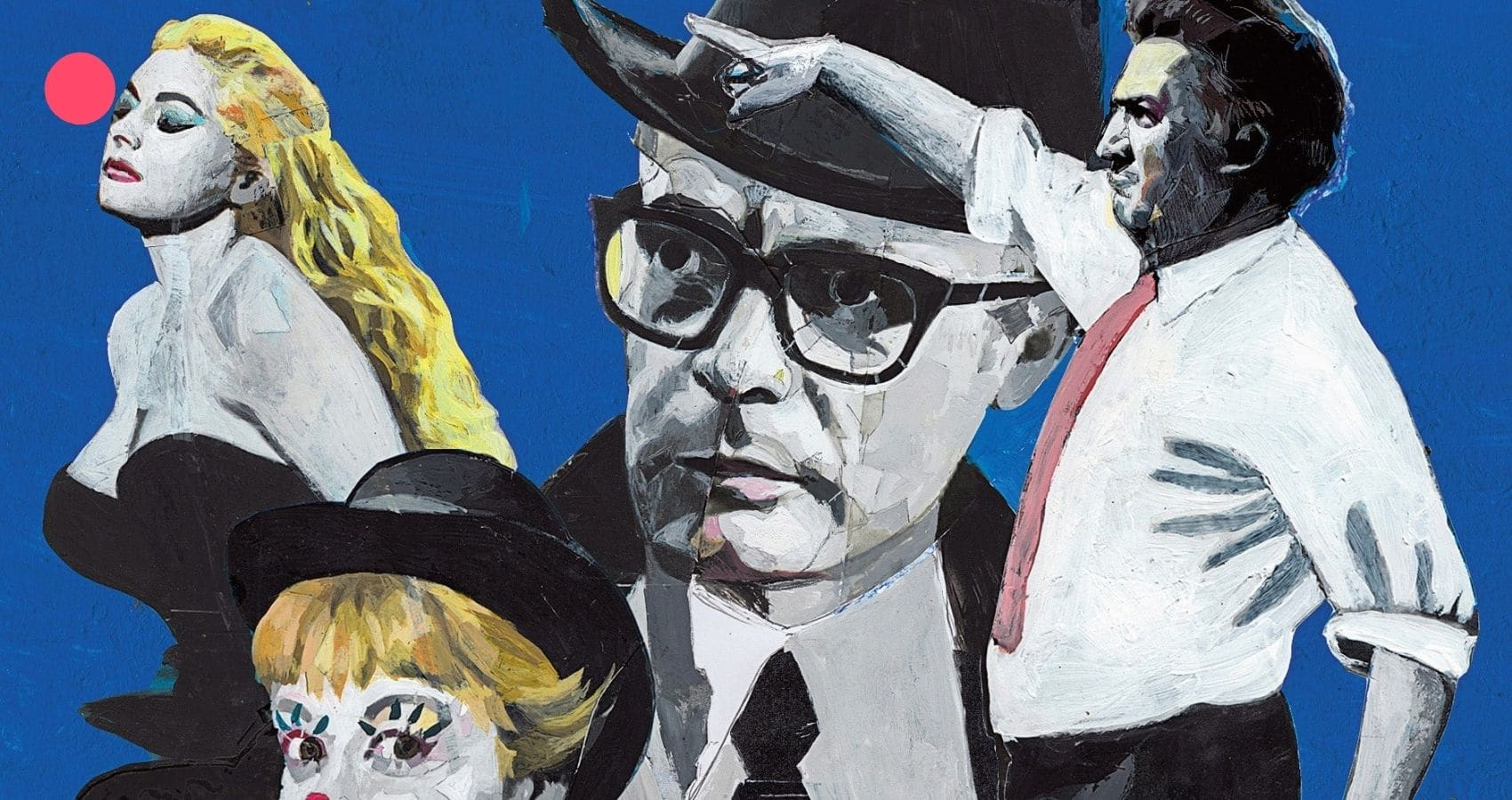
As I’m almost running to participate in my granddaughter’s fourth birthday, I present an interesting movie, Ginger & Rosa (You might have seen it already), about growing up and coming together to the age of two girls born after WWII, written and directed by Sally Potter. They become best friends until later; they find their feelings towards life differently. Of course, this topic may not be unique, although it was from the 60s when the generations underwent a turbulent change.
However, what focused my attention was the character of Roland, the father of Ginger. He is a kind of “I don’t care, it is the way I feel, and nothing else matters”! A type of Dadaism? He breaks all the moral rules of society which I don’t mind as it was common at that time, but what I mean is, where stays the conscience? I just believe he goes too far!
He reminded me of a friend in our wildlife in the early 70s in Iran. After our mother’s death, we were deeply submerged in arts and paintings, intoxicated by various drugs. In between, we got to know a new friend, addicted like us, a great painter, and gay. I said before that I was a complete hippy and follower of “don’t worry, be happy”, but this new friend was more than that. He was often with us; we drew one or two paintings, took opium all through the night and talked about arts, people and politics. One day after he left, I noticed that an expensive camera belonging to our father-in-law had vanished. We were trying to solve this mystery when a close and mutual friend informed us that our artist friend had stolen and sold it!
Of course, our mutual friend complained about his actions and found it very cowardly to us, but he raised his shoulder and said; take what you get; that is life! I have often thought about it and tried to analyse the difference between our carefulness and negligence. I concluded that we were both against social morals, but I always wanted to handle it with my inner moral, which I call “conscience”, and he seemed to have nothing of the kind.
This Roland is a phenomenon, and honestly, I prefer these crazy types from the 60’s more than the youths now! At least they have tried a new way to challenge, but today’s young people are almost useless and too fearful of taking any risks.
Now I must leave to congratulate my lovely granddaughter, Mila, for the fourth winter in her young life. (Where has the time gone!) I wish you all a beautiful and leisurely weekend.💖🤗🙏🌹
I have no intention of starting a political debate here. What I want to talk about is present in our environment, our social situation, and our life. I don’t mean the people who never care what is happening worldwide, even in their neighbour’s or private life. I am talking to writers, artists, and anybody who uses the mind and thinks twice! I try to keep my ears and eyes open and observe the happening worldwide. I know many artists have made or are making art like movies, writing books, or even composing a song and painting a picture in the sense of future predictions, which are primarily negative! Still, I come back again and again to these two writers.
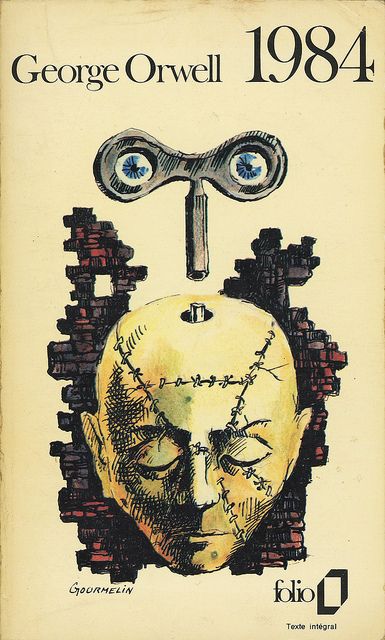
George Orwell and Aldous Huxley, these genii, have stunningly prophesied a future which might have seemed like science fiction in those days. Still, as we consider it deeply, it seems to become real! Although their observations differed, Orwell’s is gloomy, and Huxley’s is bright, the concepts were the same: to keep everything under control! Am I right, or am I right?!
Aldous Huxley was an English writer and philosopher, and visioner. He frequently wrote about Hindu and Buddhist spiritual ideas, pacifism, and mysticism and renounced all wars. George Orwell (Eric Arthur Blair) was an English novelist, essayist, journalist, and critic. His work is characterised by lucid prose, social criticism, opposition to totalitarianism, and support of democratic socialism. In 1917, as the two had a time together, he was one of the students as Huxley briefly worked as a teacher at Eton, the esteemed boarding school in England. His childhood was not as joyful as Huxley’s, what he described as a “lower-upper-middle class” family.
If we really look around us, we have some parts of Orwell’s vision, and some others are of Huxley’s. Thank goodness Orwell’s vision is not widespread, although the temptation from potentates has been palpable throughout history. Nevertheless, Huxley’s vision is soft, gentler, and practical. I compare it to what the Americans did against the ever-increasing USSR’s communism after WWII; They simplified capitalism, and every family could own something. Of course, if they didn’t have any money, no problem, pay in instalments or take out a loan! It could be a nice start, and it worked.
Of course, both visions are unpleasant and frightening, though, in a letter (from 1949) that Huxley wrote to Orwell, his former high school French student, he said that his “hellish” vision of the future is much better than Orwell’s! Huxley starts the letter by praising the book, describing it as “profoundly important.” He continues, “The philosophy of the ruling minority in Nineteen Eighty-Four is a sadism which has been carried to its logical conclusion by going beyond sex and denying it.”
And I agree with Huxley; however, Orwell’s 1984 has been more proven through new tech and media, the cameras all over the world. “Big Brother Is Watching You” is now confirmed! But this is not by force and brutality, as Orwell meant to say; it is like a worthy present for our safety! It is always a good feeling, for sure, that we do not have to take so much care. That is almost the American way of life which tries to extend worldwide, and it goes back to what I said: the more you own, the more protection you will need and the more conservative you become.
As for the meaning of life, it doesn’t have to suck!
Friends. You must have known me by now and know I am not one of those leftists who want to promote the Plutarian government here! My political point of view is only the democratic reign, which includes proper education and open-minded and open-hearted aspects, and not a wishing life all-inclusive.
Anyway, I built my hopes on the power of art and am convinced that the spirit of art will solve all problems in our society. I’m counting on you, my artist friends. In the second part, I will write more about the two and the power of imagination. I appreciate your interest.
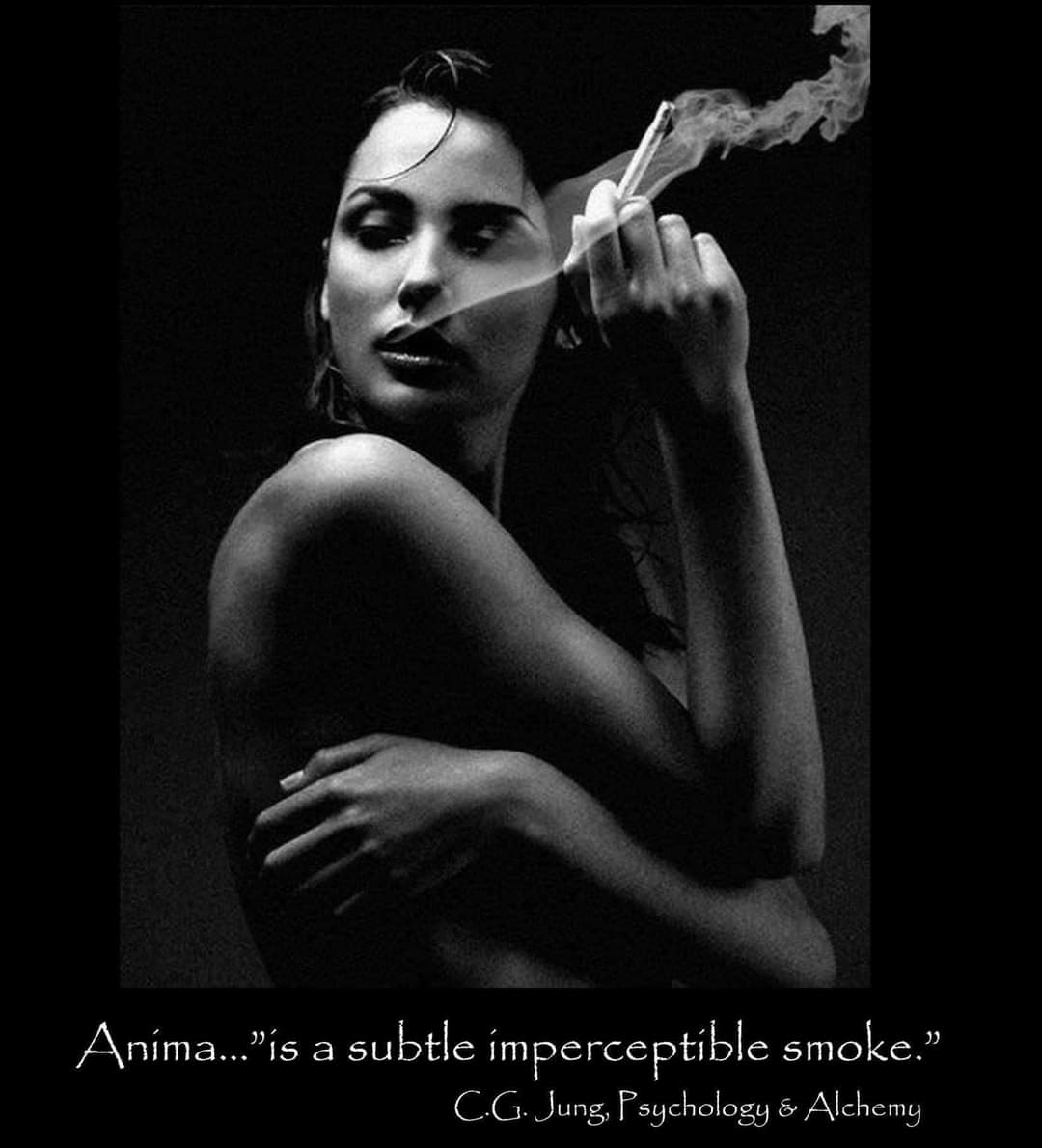
Anima means Soul. It is actually borrowed from the Latin Anima (“a current of air, wind, air, breath, the vital principle, life, soul”), sometimes equivalent to animus (“mind”), both from Proto-Indo-European (“to breathe, blow”). And the Latin term for the “animating principle” and the Latin translation of the Greek psyche: On the Soul (De anima, Aristotle’s treatise on the Soul). Soul the incorporeal essence of a living being in many religious, philosophical, and mythological traditions.
Then, as we see, the Anima (the Soul) can not have gender, and if we comprehend that we, women and also men, have the Anima in us, as we have the Soul in us, there might be many problems be solved in our every day of life.
Today, I share a piece of Dr Jung’s works from his overview of the most important basic concepts and connections of his analytical psychology. Here is the definition of Anima and Animus and their influence on human beings. That is, in my believe, very helpful for us to know these hidden developments of the unconscious on the reactions and behaviour of humans. Especially for us men! Of course, I partition it not to be too long and tedious for you. I have already written some articles: here, here, here.
First, let’s read what Jung means by Individuation:
Definitions: Individuation is… a process of differentiation that aims to develop the individual personality… Since the individual is not only an individual being but also requires a collective relationship to his existence, the process of Individuation does not lead to isolation but a more intensive and general collective context.
Of course, we might need to be careful about the term; “collective“, which Dr Jung doesn’t mean a gathering mass with that. It relates to our individualities and personalities and our past. (I have an eye to translate his explanation on Collective Unconscious if the time gives me a chance!)
Anyway, he says:
The Persona, the ideal image of the man as he should be, is internally compensated by female weakness. Through the individual playing the strong man on the outside, he becomes a woman, an Anima (for the definition of this term, see Definitions, in Psychological Types, GW 6, §§ 877-890), because it is the Anima that opposes the Persona. But because the inside is dark and invisible to the extraverted consciousness, and because one can think of one’s weaknesses the less, the more one is identical with the Persona, the counterpart of the Persona, the Anima, also remains entirely in the dark and is therefore initially projected, causing the hero to come under his wife’s slippers. If her increase in power is considerable, she bears it badly. She becomes inferior, and the man needs the welcome proof that it is not he, the hero, who is inferior in “private life” but his wife. On the other hand, the woman has that illusion, which is so attractive to many, that she has married at least one hero, unconcerned about her own uselessness. This game of illusions was often called the “content of life”.
Just as it is essential for the purpose of Individuation, of self-realization, that one knows how to distinguish oneself from what one appears to be to oneself and others, so it is also necessary for the same purpose that one recognizes one’s invisible system of relationships with the unconscious, viz the Anima becomes conscious of being able to distinguish oneself from her. One cannot distinguish oneself from something unconscious. Of course, when it comes to Persona, it’s easy to make someone understand that they and their position are two different things. On the other hand, it is difficult to distinguish oneself from the Anima, and that is so difficult because it is invisible. Yes, one even initially has the prejudice that everything that comes from within stems from the most fundamental of beings. The “strong man” will perhaps admit to us that he is actually seriously lacking in the discipline in “private life”, but that is precisely his weakness, with which he declares his solidarity. In this tendency, there is, of course, a cultural heritage that should not be despised. For if he recognizes that his ideal Persona is responsible for the nothing less than ideal Anima, his ideals are shaken, the world becomes ambiguous, and he himself becomes ambiguous. A doubt about the good overcomes him, and worse still, a doubt about his good intentions. Suppose one considers with what powerful historical assumptions our most private idea of a good intention is linked. In that case, one will understand that, in the sense of our previous worldview, it is more pleasant to accuse oneself of personal weakness than to shake ideals.
But since the unconscious factors are as determining facts as the entities that regulate the life of society, and the former as collective as the latter, I may as well learn to make a distinction between what I want and what I wish to be imposed by the unconscious, how I can see what my authority requires of me and what I desire. At first, however, only the incompatible demands from outside and inside are tangible, and the ego stands in between, like between the hammer and the anvil. Compared to this ego, which is usually nothing more than a mere plaything of external and internal demands, some entity is difficult to define, and I would under no circumstances want to give the insidious name “conscience”, despite the word itself in its best understood that instance would probably designate aptly. Spitteler described with unsurpassable humour what has become of our “conscience”. (Cf. Spitteler: Prometheus and Epimetheus, 1915; and Jung: Psychological Types, GW 6, §§ 261 ff.). The proximity of this meaning should therefore be avoided as far as possible. It is probably better to realize that this tragic game of opposition between inside and outside (represented in ‘Job‘ and ‘Faust‘ as God’s wager; Götterdämmerung) is basically the energizing of the life process, that tension of opposites which is incessant in self-regulation. Differing in appearance and purpose, these Opposing Powers actually signify and will the individual’s life; they oscillate around this as the middle of the scales. Precisely because they are related to each other, they also agree in a middle sense, which is, so to say, necessarily born out of the individual voluntarily or involuntarily and is therefore also sensed by him. One has a sense of what should be and what could be. Deviating from this hunch means going astray, error and disease.
It is probably no coincidence that our modern concepts of “personal” and “personality” derive from the word “persona”. As much as I can say of my ego that it is personal or a personality, I can just as well speak of my Persona that it is a personality with which I more or less identical. The fact that I have two personalities is not strange insofar as every autonomous or relatively autonomous complex has the peculiarity of appearing as a personality or personified. This is probably most easily observed in the so-called spiritistic manifestations of automatic writing and the like. The sentences produced are always personal statements and are presented in a personal form in the first person as if there were a personality behind every sentence fragment uttered. The naive mind, therefore, must immediately think of ghosts. As is well known, something similar can also be observed in the hallucinations of the insane. However, the latter are often even more precise than the former, merely thoughts or fragments of such, whose connection with the conscious personality can often be readily seen by everyone.
Let’s finish this part at this place, and for taking a break, watch a compatible challenge between Alfred Hitchcock and Carl Jung, including analyses on the matter of Anima.
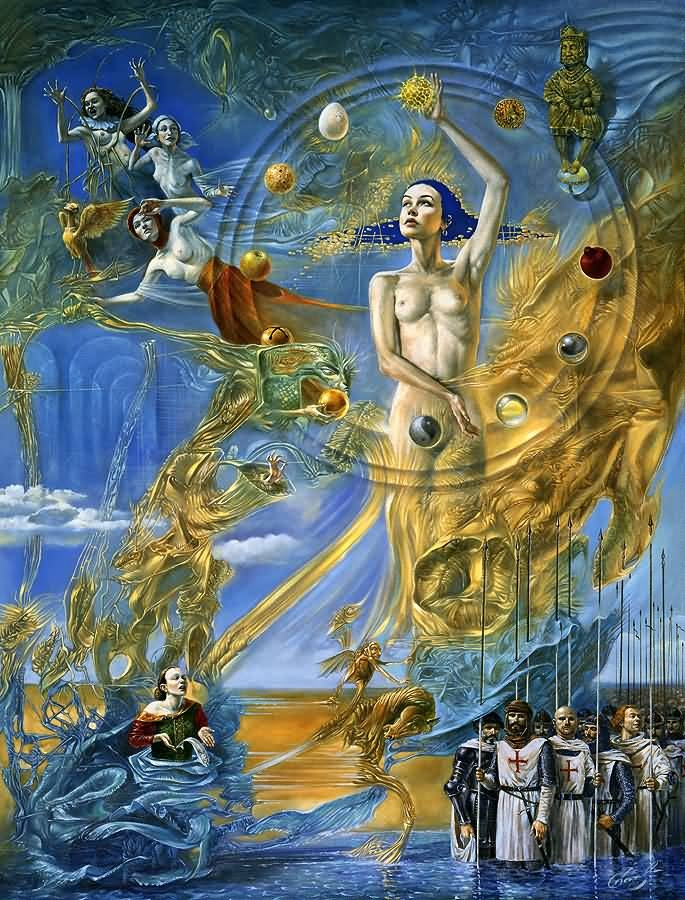
Thank you all, and have a lovely weekend. (The illustration on the top: Michael Cheval’s art
Here, if one is interested, is the visual audio from Jung’s written words on Carl Spitteler’s Prometheus And Epimetheus:
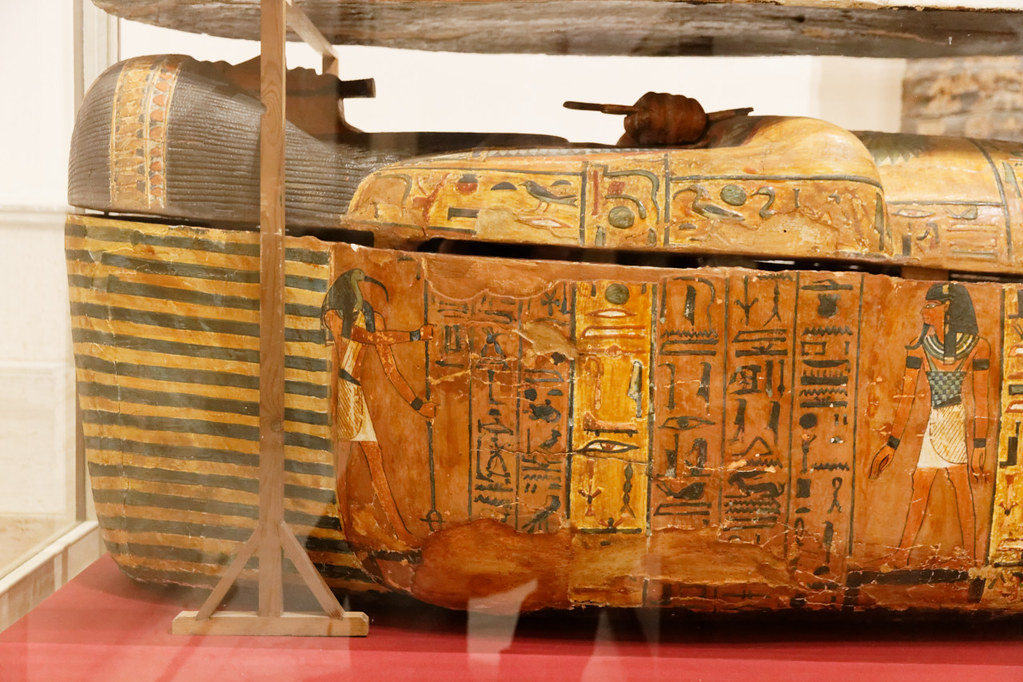
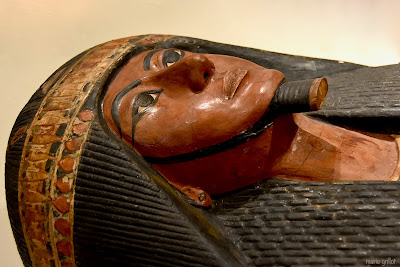
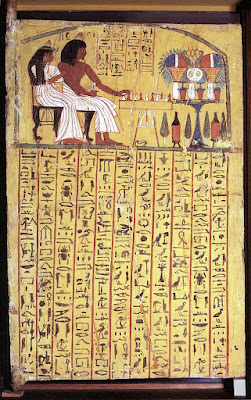
The Egyptians believed that individuals were made up of five parts: the ba, the ka, the name, the shadow and the physical body. According to Žabkar, there is no exact equivalent of the term ba in English. It is similar to our concept of personality but also refers to power and was extended to the gods. However, Ba is represented as a human-headed bird that leaves the body and only becomes manifest after the person has died.
AshofaroharAlex grey art. KundaliniSusa / The winged globe of Ahora Mazda carried by two androcephalous winged lions / From Palace of Darius the Great / LouvreI have always wondered about so many divine statues and paintings with wings from different ancient cultures. It does not only to the human wish to be able to fly; I am sure it has to do with what the ancient human had seen in their encounters with Gods!
Anyway, let’s stay in Egypt with this fascinating golden bird, The Ba! It was often shown as a bird whose duty was to feed the deceased. The Ba was so closely linked with the physical body that it needed food and drink. The Ba depended upon the corpse with which it had to be reunited each night. Here is a brilliant report by Marie Grillot about the Ba Amulet and its discovery.💖🙏
Bird-ba of Tutankhamun – gold, turquoise, lapis lazuli, glass, carnelian – 18th dynasty found on his mummy in October 1925 in tomb KV 62, discovered on November 4, 1922, by Lord Carnarvon and Howard Carter referenced: carter 256-b(2) – registered in the Journal of Entries of the Egyptian Museum in Cairo: JE 61903 – GEM 759-A.J.
“Between the open wings, the head of Tutankhamun, modelled in relief, is silhouetted in left profile. Despite the short tuft of a stylized beard under the chin, which is only a royal insignia, the portrait is that of a child. The elongated eye, the little upturned nose, the smiling mouth with full lips, and the roundness of the cheek make up an amiable and lively physiognomy. The slightly acute facial angle lends itself to replacing the profile of a bird, and the rows of the necklace provide a transition between the neck of the child and the ocellated body. A striated diadem, adorned with the uraeus on the forehead, is tied at the back of the head under a lotus flower, from which the two free ends of the ribbon fall on the shoulder, consolidating, like the beard, the implantation of the head above the wings “… Here is an extract of the description, all in sensitivity, that makes of this artefact, Pierre Gilbert in “The Reign of the Sun Akhnaton and Nefertiti.”
Bird-ba of Tutankhamun – gold, turquoise, lapis lazuli, glass, carnelian – 18th dynasty found on his mummy in October 1925 in tomb KV 62, discovered on November 4, 1922, by Lord Carnarvon and Howard Carter referenced: carter 256-b(2) – registered in the Journal of Entries of the Egyptian Museum in Cairo: JE 61903 – GEM 759-A.J.
The sovereign’s bird-ba is 12.5 cm high and 33 cm wide, conferred by the span of its outstretched wings. Like the body and the tail, they are worked according to the cloisonné technique. The degree of excellence achieved by the goldsmiths of the 18th dynasty made it possible to combine inclusions of semi-precious stones, which perfectly render the texture and composition of the plumage. Gold, lapis lazuli, turquoise, carnelian, or even glass, realistically restore the location of the primary and secondary remiges, as well as the rectrices of the tail, in shimmering polychromy. The body is decorated with a pattern of drops, using the same tones. The legs, in solid gold, each hold a ‘shen’ sign. This symbol of eternity is made of carnelian surrounded by turquoise-coloured glass.
Bird-ba of Tutankhamun – gold, turquoise, lapis lazuli, glass, carnelian – 18th dynasty found on his mummy in October 1925 in tomb KV 62, discovered on November 4, 1922, by Lord Carnarvon and Howard Carter referenced: carter 256-b(2) – registered in the Journal of Entries of the Egyptian Museum in Cairo: JE 61903 – GEM 759-A.J. Photo: The Griffith Institute – Tutankhamun: Anatomy of an Excavation
The Howard Carter Archives – Photographs by Harry Burton
On October 28, 1925, Howard Carter discovered this magnificent jewel which rested on the chest of the young king. He indeed had to wait until the 4th season of excavation, after having dismantled the four chapels of gilded wood, opened the sarcophagus, then the three coffins, to finally find himself face to face with the mummy of Tutankhamen… He noted in his diary: “Below this mask, which extends to the hands, we see the linen envelope as well as the outer layers of strips, held in place by wide bands of gold, flexible, longitudinal and transverse, and a protective figure of Nekhbet in inlaid gold, very decorative. She has outstretched wings on either side of the body and a human head”.
Bird-ba of Tutankhamun – gold, turquoise, lapis lazuli, glass, carnelian – 18th dynasty found on his mummy in October 1925 in tomb KV 62, discovered on November 4, 1922, by Lord Carnarvon and Howard Carter referenced: carter 256-b(2) – registered in the Journal of Entries of the Egyptian Museum in Cairo: JE 61903 – GEM 759-A.J. Photo: The Griffith Institute – Tutankhamun: Anatomy of an Excavation The Howard Carter Archives – Photographs by Harry Burton
If he likens it at first reading to the vulture goddess “Mistress of the sky, protective goddess of Upper Egypt and the Pharaoh”, he will refine his perception. Thus in his descriptive card, he will note, “Pectoral in gold Ba- (bird) in the form of the vulture Nekhbet”. He also specifies that this jewel was provided with “eyelets” at the back, which made it possible to sew it to the linen fabric…
His presence responds to chapter 89 of the Book of the Dead, which indicates the “Words to be spoken on a soul of gold, encrusted with jewels, placed on the neck of man”.
Bird-ba of Tutankhamun – gold, turquoise, lapis lazuli, glass, carnelian – 18th dynasty found on his mummy in October 1925 in tomb KV 62, discovered on November 4, 1922, by Lord Carnarvon and Howard Carter referenced: carter 256-b(2) – registered in the Journal of Entries of the Egyptian Museum in Cairo: JE 61903 – GEM 759-A.J. Photo: The Griffith Institute – Tutankhamun: Anatomy of an Excavation The Howard Carter Archives – Photographs by Harry Burton
In “The bird-ba, second life in ancient Egypt”, Michèle Juret gives us the keys to better understand the importance of this ba entity that we “commonly translate by the word soul although the concept is much more complex. … The ba enjoys total freedom. She will be able to leave the tomb, climb into the bark of Ra, enjoy its rays, drink the regenerating water of the tree goddess, and take advantage of the food offerings… Each evening she will rejoin her deceased’s body; their reunion depends on survival….”
Bird-ba of Tutankhamun – gold, turquoise, lapis lazuli, glass, carnelian – founded 18th dynasty on his mummy in October 1925 in tomb KV 62, discovered on November 4, 1922, by Lord Carnarvon and Howard Carter referenced: carter 256-b(2) – registered in the Journal of Entries of the Egyptian Museum in Cairo: JE 61903 – GEM 759-A.J. Photo: The Griffith Institute – Tutankhamun: Anatomy of an Excavation The Howard Carter Archives – Photographs by Harry Burton
On the mummy of the young king, and between his bandages, the priests and embalmers had deposited one hundred and fifty jewels, amulets or other objects. Howard Carter will draw the exact location of each ornament and reference them individually in “group 256”. This bird-ba was thus recorded “Carter 256-b(2)”. It was later recorded in the Cairo Museum Entry Journal JE 61903. It’s been listed at the GEM (Grand Egyptian Museum) – soon to be opened in Giza – as GEM 759-A.J.
T.G.H. James, Howard Carter, The path to Tutankhamun, TPP, 1992
Nicholas Reeves, Toutankhamon, vie, mort et découverte d’un pharaon, , Editions Errance
Christiane Desroches-Noblecourt, Vie et mort d’un pharaon, Hachette, 1963
Zahi Hawass, Catalogue de l’exposition Toutankhamon, trésors du pharaon d’or, IMG Melcher Media, 2018
“Le Règne du Soleil Akhnaton et Nefertiti”, Catalogue de l’exposition organisée par les Ministres de la Culture aux Musées Royaux d’Art et d’Histoire, Bruxelles, 17 janvier – 16 mars 1975
Michèle Juret, L’oiseau-ba, seconde vie dans l’Egypte antique”
I am still challenged with the Christmas holidays, work, and doing my best as a grandpa and a helpful companion to the Iranian freedom seekers. So I didn’t want to share any posts this weekend. Well, I wanted to give myself a break. It’s nice to sit in front of the computer and do something other than having to write. But I did think I could congratulate my friends on the New Year with a simple and heartfelt wish, with some words and some illustrations which may say more than the words.
The time runs so fast that I wonder where it has gone. Some say that our beloved Earth has increased her speed; she might get rid of us as soon as possible! However, for my peace of mind, I keep my memories as they are the only things that will remain. And the only wish I’d have (Okay, maybe two or three!?) is peace not just for the whole world but also in everyone’s hearts, and most of all for the young women and men in Iran to overcome that horrible and inhuman regime.
I started as an amateur on the path of writing, but unfortunately, it was too late, as I am, right now, pretty much at the end of my own way. It could be nice if it had happened some decades ago; nevertheless, with your kindness, I enjoy sharing my littleness, and I learn a lot: one can never stop learning! Thank you and gratitude.
Anyway, let’s begin this new year with ambitions towards a peaceful and sensual world. As the Germans say: Es kann nur Besser werden!
As today is a special day and many people are busy with celebrations and presents, I thought that I shouldn’t make it so difficult and with one post make me, and hopefully you, a pleasure. And it couldn’t be better than to grab one of the best-ever Christmas stories by Charles Dickens: the master of hearts.
He explained: In this Ghostly little book, I have endeavoured to raise the Ghost of an Idea which shall not put my readers out of humour with themselves, with each other, with the season, or with me. May it haunt their houses pleasantly, and no one wish to lay it. – Charles Dickens
Here I present an Oscar-Winning Animation of Charles Dickens’ Classic Tale, A Christmas Carol (1971). I have seen many different versions of his masterwork. However, this animation is unique in itself.
Let’s read a contribution about this brilliant work and the making of.
Indeed I’m not the only child of the 70s to have been equal parts mesmerized and stricken by director Richard Williams’ faithful, if highly condensed, interpretation of Charles Dickens’s A Christmas Carol.
Yellow, meagre, ragged, scowling, wolfish; but prostrate, too, in their humility. Where graceful youth should have filled their features out, and touched them with its freshest tints, a stale and shrivelled hand, like that of age, had pinched, and twisted them, and pulled them into shreds. Where angels might have sat enthroned, devils lurked, and glared out menacing. No change, no degradation, no perversion of humanity, in any grade, through all the mysteries of wonderful creation, has monsters half so horrible and dread… This boy is Ignorance. This girl is Want. Beware them both, and all of their degree, but most of all beware this boy, for on his brow I see that written which is Doom, unless the writing be erased.
D.T. Nethery, a former Disney animation artist and fan of this Christmas Carol, explains that the desired Victorian look was achieved with a labour-intensive process involving drawing directly on cells with Mars Omnichrom grease pencil and then painting the backs and photographing them against detailed watercoloured backgrounds.
As director Williams recalls below, he and a team, including master animators Ken Harris and Abe Levitow, were racing against an impossibly tight deadline that left them pulling 14-hour days and 7-day work weeks. Reportedly, the final version was completed with just an hour to spare. (“We slept under our desks for this thing.”)
As Michael Lyons observes in Animation Scoop, the exhausted animators went above and beyond with Jones’ request for a pan over London’s rooftops, “making the entire twenty-five minutes of the short film take on the appearance of artwork that has come to life”:
…there are scenes that seem to involve camera pans, or sequences in which the camera seemingly circles around the characters. Much of this involved not just animating the characters, but the backgrounds as well and in different sizes as they move toward and away from the frame. The hand-crafted quality, coupled with a three-dimensional feel in these moments, is downright tactile.
The short’s television premiere caused such a sensation that it was given a subsequent theatrical release, putting it in the running for an Oscar for Best Animated Short Subject. (It won, beating out Tup-Tupfrom Croatia and the NSFW-ish Kama Sutra Rides Again, Stanley Kubrick had handpicked to play before A Clockwork Orange in the UK.)
With theatres in Dallas, Los Angeles, Portland, Providence, Tallahassee and Vancouver cancelling planned live productions of A Christmas Carol out of concern for public health during this latest wave of the pandemic, we’re happy to get our Dickensian fix snuggled up on the couch with this animated 50-year-old artefact of our childhood….
I wish you all, my dear friends, a lovely and blessed celebration and merry Christmas. With a hope for a better world in tranquillity and a good-hearted mind. May peace and love fulfil your life. 🙏💖🤗
Today is the Winter Solstice, and as you see, I am making an extra post, not only because of this but also for the shortest day (what a day, I have the light on!) and longest night. This night in Iran is traditionally called Yalda Night: Shabe-Yalda. On Yalda night, the whole family gathers around the fireplace in the warm room, and the grandmother tells old legends and fairytales while cracking many kinds of nuts. I once shared an article on this topic; here. However, on these days and nights in Iran, there is no time for any celebration but fighting for their right to live in freedom; I, nevertheless, share this short manifest to send my prayers to them and keep the hope it will be celebrated in the next year.
I have found that I am the only retiree in the world who is busier than he was at work! It might sound strange but believe me, it is true. As I was working, I knew I was at a job and took my hobby for enjoyment on the weekend. But now, I have to divide myself into at least three persons; the one who is a retired grandpa has unlimited time to help family and household. The second one is still a working-class hero to refresh my miserably low passion! And the third is the famous amateur writer who tries to keep himself and the name of an esteemed family of artists. It is hard; I even have an “end of work time” every evening! Nevertheless, I prefer to keep myself engaged with stress than to be an ordinary pensioner. May force be with me!
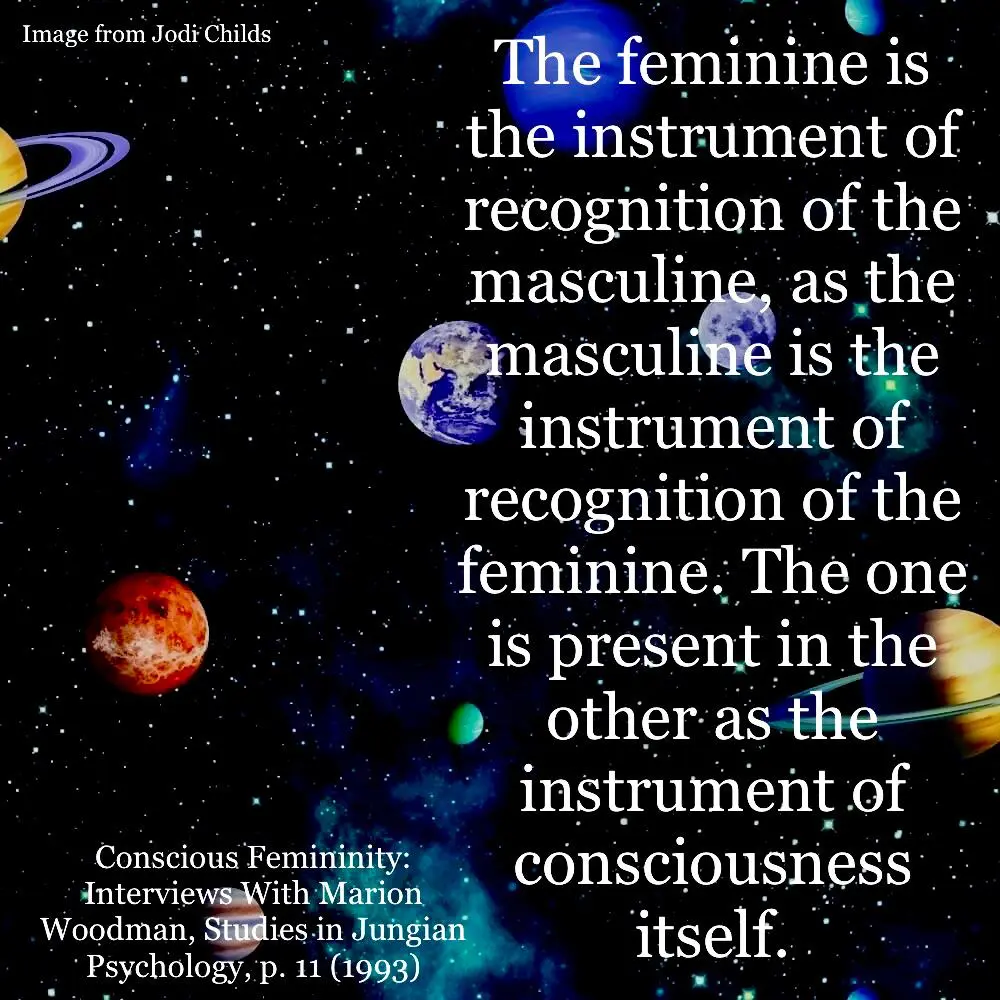
That’s Why, for my second post, I use (steal!) one of my beloved FB posts about one of the most prized and fascinating women in the world, Marion Woodman, which I took from her book, The Pregnant Virgin.
These words are simply from the section; Introduction of that book, but what makes it so appealing is this statement: The word “feminine”, as I understand it, has very little to do with gender, nor is woman the custodian of feminity. This made me think a lot about what she wanted to utter with that. And I came on the purpose of the Feminine is the leading form of our existence! If we look at the famous holy books, which all come from three prominent religions from the same area and are so familiar, at the same time full of hatred for each other: it’s said that God made the woman from the left rip of man. Doubting these words is not new, as we can almost be sure that these books have been rewritten many times in favour of men, but the subject is more profound than we might imagine. Isn’t it possible that the creation and genesis have no gender at all, and it can be summed up in one word; Feminine? I think this word does nothing to do with female or womanly; we must think more expended, more expansive: The Whole.
{And then I read Carolyne (Gold) Heilbrun’s review of Lyndall Gordon’s biography of Virginia Woolf. Heilbrun points out that Woolf was, like all women, trained to silence that “the unlovable woman was always the woman who used words to effect. She was caricatured as a tattle, a scold, a shrew, a witch.” Women felt “the pressure to relinquish language, and “nice women” were quiet. She concludes that “muted by centuries of training, women writers especially have found that when they attempted truthfully to record their own lives, language failed.”If that is true of the artist, it is no less true of any woman attempting to speak with her own voice. It is also true of the man who dares to articulate his soul process. The word “feminine”, as I understand it, has very little to do with gender, nor is woman the custodian of feminity. Both men and women are searching for their pregnant virgin. She is the part of us who is outcast, the part who comes to consciousness through going into darkness, mining our leaden darkness, until we bring her silver out.}
Marion Woodman, The Pregnant Virgin (introduction)
Marion Woodman here with an adorable friend of mine, Elaine Mansfield
In the end, I will be proudly happy about the new revolution in Iran under the motto: #Woman_Life_Freedom; there is the only way to save our future!
Art at the head of the post: by zgul-osr1113, deviantart.
I might hang this post to my “Fifty Years…'”, but I think it isn’t only my memories but is more an analysis of my experiences on LSD, which I have told plenty in these Part 1, Part 2 and Part 3 articles.
Since November 16, 1938, the Swiss chemist Albert Hofmann first synthesized LSD in the Sandoz (now Novartis) laboratories in Basel, Switzerland, and five years later, on April 19, 1943, the psychedelic properties were found, remained an unknown Med. for researching the psyche of human’s soul. However, I guess it may be studied secretly for millenarian uses.
In any case., I think Hofmann’s attention was not to make any weapon out of it. We, humans, are always searching for the purpose of our existence on this planet and to understand our inner beings. It has always been a complex process because the psyche is like a riddle. The unconscious wasn’t a new topic as Sigmund Freud began to handle with: The possibility of an unconscious mind can be traced back to Galen (c. A.D. 130–200), a Greek physician and founder of experimental physiology who recognized that we make unconscious inferences from perceptions (cf. Whyte, 1978, p. 78). The Roman philosopher Plotinus (c. 204–270) observed that we become aware of the thought process only when we attend to it. He likened attention to a mirror that, when properly positioned, reflected unconscious processes. The Christian philosopher St. Augustine (354–430) likened the unconscious mind to a ghost experienced as a felt presence, although invisible. St. Thomas Aquinas (1224–1274) developed a theory of mind that featured unconscious processing. The Swiss physician Paracelsus (1493–1541) recognized the role of the unconscious mind in the aetiology of disease. Whyte (1978) noted that Descartes (1596–1650) believed that all unconsciousness was physiological and therefore did not recognize an unconscious mind as such. His emphasis on the conscious mind may be primarily responsible for our contemporary conscious-centric psychology. (from the Author Warren W. Tryon)
Also, this is a long story. However, I think Dr Jung ended all speculations and opened the door to a cavern or crypt in our soul, which we must go inside to find the answers ourselves.
That is the point to which I want to refer. Space and Time belong to the eathy life; if we believe in the soul, the soul cannot share the requirements of earthly life. Human is more than what most people usually assume. As I heard and read from many brain searchers, our brain is not fully known as it must be. We may use a tenth of it. And to go inside to find out which function has remained careless, we need Hallucinogens drugs! And there, this will expand our imagination to begin our trip inside our soul.
It might be my opinion Al and I have experienced it nine-time, and every time, depending on the quality of the LSD, we had brought a discovery of one unknown corner of the soul. For example, in the fifth or sixth session, we both were the group’s leaders (to take LSD, it is essential to have an expert as a leader.) one of our members got afraid; he was uneasy, as I noticed, and I asked him what’s the matter, he said his heart is going mad. I let an MC cassette in the recorder to play one of his favourite music; then he got calm and sat comfortably. Here we notice how important the atmosphere can be for such a trip.
But I think the best trip we had was once we got an excellent quality LSD tablet, a so-called conical sugar pill, which we had no tension in our body, as we had most with the other sessions, and the trip was an extraordinary and strange one. I was the first one who noticed that something was not as usual. In the other sessions, we listened to music or watched famous paintings in books to enjoy them deeper than before, but I couldn’t find any enjoyment. My eyes and ears were unknown to me. I was shocked, of course, and the others didn’t want to accept my feeling. I felt I had separated from my body and wanted to travel away. I tried to explain my situation but couldn’t even speak. Though later, Al and the other friend, Mehrdad, joined me. There was nothing mattered! As we got down later from this trip and talked about it, we discovered that no object or material existed for us; you could be in a room or a jar, and there was no difference! The most significant discovery on this trip was we all were individuals there, and the so-called “group journey” on LSD, which we had heard about from West those days, turned out to be wrong.
Anyway, I don’t want to cause you any headaches! I know it is still unacceptable in our society to take drugs as a way of healing, but I do believe it is a crucial topic to work with. Keep curiosity alive🙏💖
It is not a ritual for me; as I mentioned before, his presence is perceptible daily. However, this day, his birthday, is a plea or fetch to share our common memories.
His birthday was yesterday, and I posted a few words for his celebration; nevertheless, I want to write more about him. No matter the day, there is no time and space in heaven!
I chose this picture above on purpose; our good and the careless time those days, as we were settled in Germany, in freedom, to practice our teenies ages even though we were in our thirties of life. He’d be 70 years old this time, and if his body were still in his earthly existence, we would have a big party together. And yet, I thought I celebrate his birthday in relation to Iran’s new revolution as I am sure he won’t stay calm and even might want to travel back there to participate in this fight for their right.
As you might notice, it is the so-called; The Day After! ((the 90s) Summer, sunny and warm. (And the main thing,, to turn one’s brain off!!)
That is true. We were very active those days after Khomeini’s regime came to power because we knew he was another dictator even worse than Shah, but we were few. And then, there they come, the Kurds! Yes, as all the so-called intellectuals from left and right kept shut up to the Islamic regime, the Kurdish people from Mariwan raised against it. Al and I were working with one of the most famous magazines in this short Spring of freedom after the fall of Shah’s regime. This magazine was forbidden in his regime and could begin to work again after the revolution. I was working as a report collector and photographer; Al had a page called: A line of Nostalgia! Al has had a beautiful writing style of his own; I think that you all, as writers, know what I am talking about, a unique style of writing in which the writer can assert her/himself. Like Shakespeare, Charles Dickens, Ernest Hemingway etc. Al had gotten this magical style from our father. I am not talking about the excitement of the story a writer presents; I’m talking about the way of writing it; it takes you with the words on the waves of his/her thoughts’ floating and floating…
I want to share a piece of his written thoughts here; I tried translating it from Persian, hoping it achieved the goal! It fits the situation now as the new uprising in Iran began in Marivan, the Kurdish province.
When I say conspiracy, slander, false and baseless slander, everyone knows what I mean; Everyone understands that those shameless lies that we see on the walls of the city, in the alleys and streets, which show the new arrangements and new inventions of the defective and diseased reactionary and imperialist brain, are what I mean. I do not intend to defend those free and pure people who are attacked by the dirtiest and most disgusting types of conspiracies in existence. Because it is the stupidest thing in the world if I want to defend people whose clean and untainted hands have always been in front of the eyes of the informed and committed classes of our society in an obvious way. I don’t intend to stand up for defence because the vile and evil actions of those unknown people are the best reason for those who want to prove their innocence. The only thing that made me mention this issue is the similarities that we feel when we see those disclosures; for example, such lies remind me of childish tricks played on radio and television about forgery and distortion. Censorship of news, movies and other programs is expected. Or it is in the line of funny reasons and excuses that the former spokesperson (and some other ministers) used to cover up the officials’ actions.
Or, most of the time, I was reminded of that well-known and experienced TV showman who, in addition to running his shows, also works at the apparently respectable job of deputy minister when he is unemployed. I think these similarities cannot be so coincidental. Maybe if we sit and think, we can find out where the flow is coming from. For this point, many agree that the Kurdish people are the pride and cause of Iranian pride. So far, I have heard from many people who said how they were significantly affected by meeting and dealing with the ideas, thoughts and views of a Kurd. So far, I have seen their kind of behaviour and deep understanding of issues and personalities in very few people. I don’t know what the reason is… The environmental conditions and weather and basically the geographical coordinates of their land are the reason or maybe all the suffering and torture and or suffering that has passed on to them over the years and even centuries have made such extraordinary men and women. It is as if they have come to earth to teach us and others about freedom and Righteousness. What the people of Marivan showed cannot evoke any other idea in me. Every day and in any situation, we witness how people can lower their heads and bend down to the point where they can touch the ground with their forehead with no sign; this dedication and sacrifice of the people of Marivan is a great lesson. And it is shocking for all nations to learn how to maintain freedom and free thinking in the most awkward and difficult situations and not succumb to force and pressure. Such is the logic of being human and dying human. Those who, if they die, will die standing tall.
And here is a birthday present from me to Al; it is a selected quote from Al’s last novel, “Season of Limbo”, which was made by a highly adorable friend of mine, Petra Glimmdull. I am sure he will be delighted with that.
In ca. two years, I will reach his current age if I’d survive. No one knows; wait and see; in any case, I am very thankful, at least half a century, to be the companion of such a genius. Stay by me.
You must be logged in to post a comment.