Egyptian Wall Painting, A Divine Fascination!

Standard

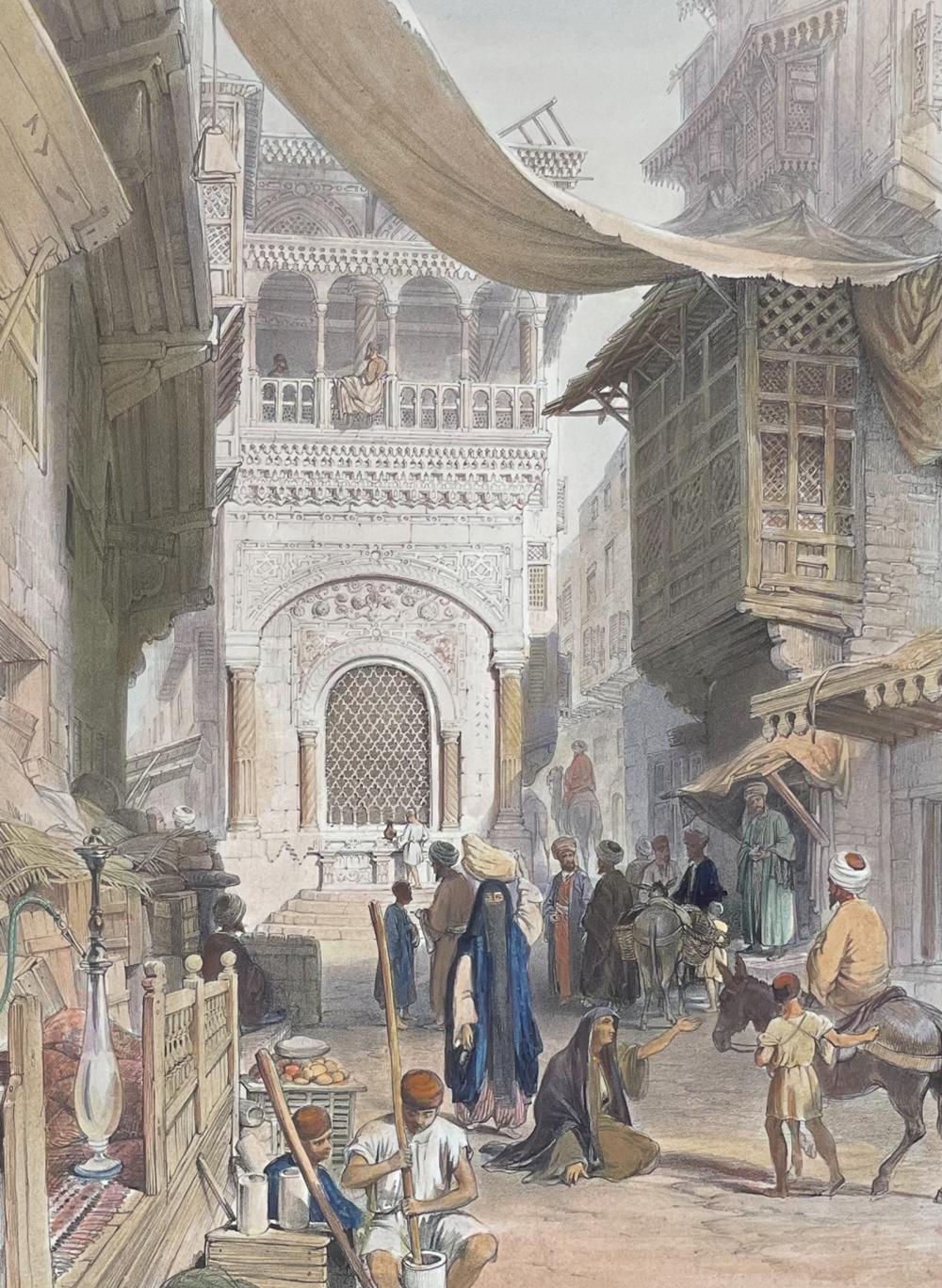
We got to know and were heartfeltly amazed by such fabulous wall paintings by artisans of ancient Egypt. And naturally, these all motivated some painters, much later in the 19th century, like David Roberts, Jacob Jacobs, and many others, to try to copy these Masterworks. However, they did never reach close to the originals.

One of them was Robert Hay, not only a painter but also an Egyptologist. His works are fine and brisant.

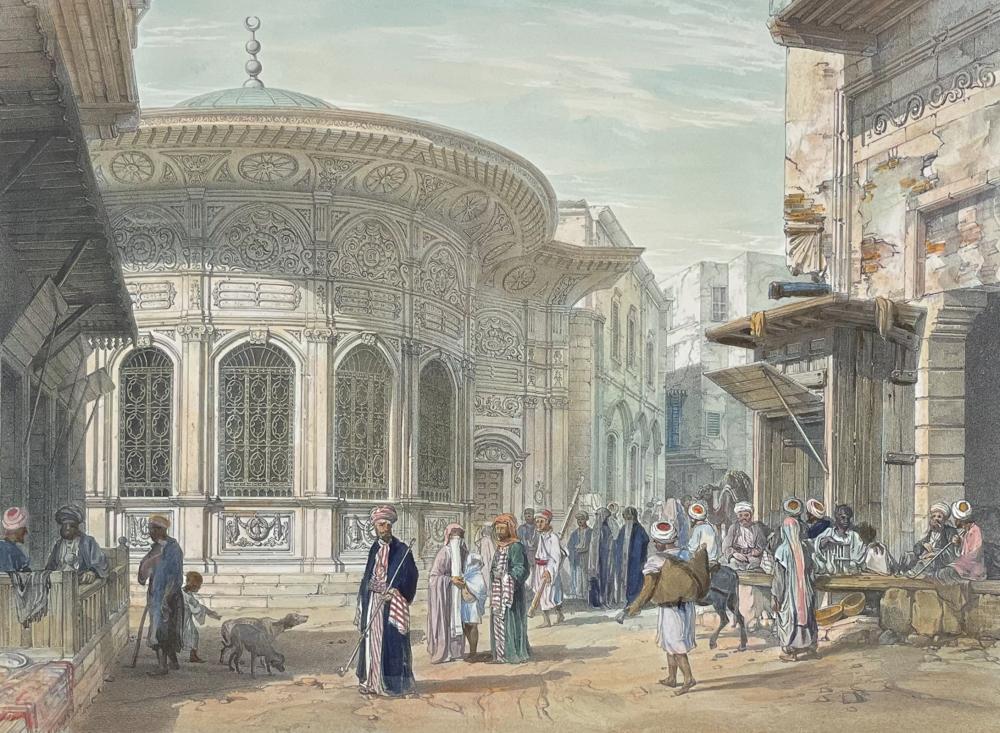
And here is an attempt to step into the shoes of grandees.
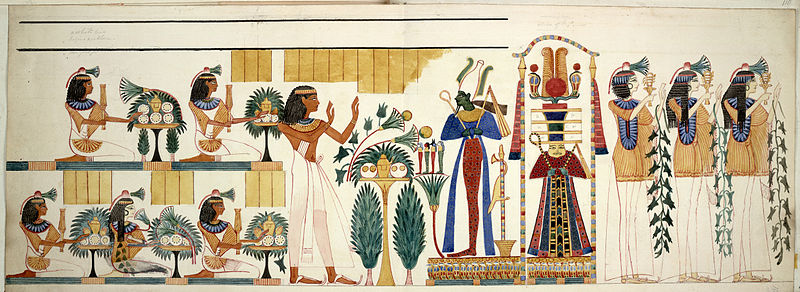
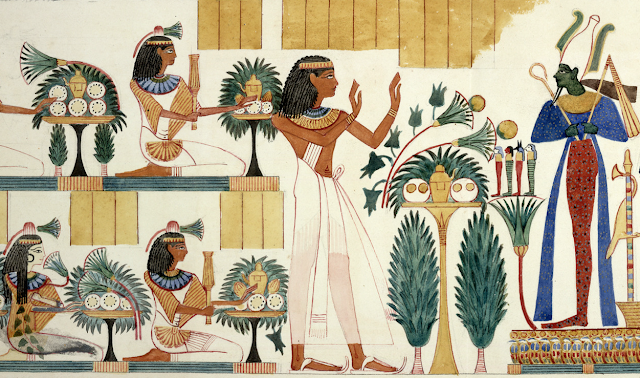
(Whole drawing) Procession of figures with offerings; part of a wall painting from the tenth tomb at Gourna, Thebes. Made during an expedition to Egypt organised by Robert Hay between 1826 and 1838

Images credit:https://landioustravel.com/egypt/ancient-egyptian-tombs/ / Stock Photo / invaluable / Wikimedia Commons

Let’s enjoy this brilliant article by Marie Grillot about this enthusiastic and fascinated man for the magic land of Egypt.πŸ’–πŸ™

Robert Hay: his precious drawings, plans, and surveys of 19th-century Egypt have much to teach us…

via; Γ©gyptophile

Reproduction of a procession of offering bearers – part of a painted wall of a tomb in Gournah -,
made during Robert Hay’s expedition to Egypt between 1826 and 1834

Robert Hay is a Scottish Egyptologist and collector to whom we owe an important and magnificent collection of drawings, plans and copies of hieroglyphic inscriptions. The 49 “volumes” he will bring back from his travels constitute a unique “sum” and an invaluable testimony to Egypt and its sites as they appeared at the beginning of the 19th century.
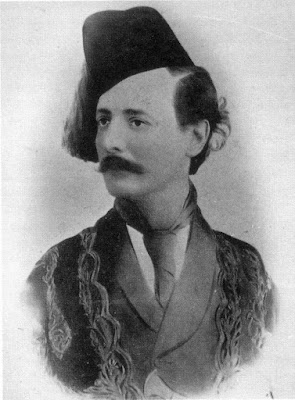
Robert_Hay_in_turkish_costume

Born on January 6, 1799, in Duns Castle in Berwickshire, Robert Hay first turned to a career in the navy, which also gave him the opportunity to visit Alexandria for the first time.

In 1819, when he was just 20 years old, he inherited – from his older brother – the Linplum estate. This legacy certainly leads him to reconsider his situation. So he decided to leave the navy, and in 1824, he left for the Middle East.

Strongly marked by the “drawings brought back from the land of the pharaohs by two architects”, it aims to survey the sites and ancient monuments of Egypt.

His thirst for learning, seeing, understanding, and interest in everything he discovers on the land of the pharaohs will never be denied. He will make many stays there, spread over ten years.

An excellent draftsman himself, he will be keen to surround himself with talented artists. During a stay in Rome, he hired Joseph Bonomi and offered him a modestly paid ‘commission’ as a sculptor and illustrator to accompany him on his Egyptian expedition. If Hay proves to be very demanding in the quality of the readings, wishing for maximum precision, Bonomi, ingenious and inventive, will be able to adapt and give the best of his talent, even when the working conditions prove to be complicated.

At Christmas 1824, they embarked for Nubia, where, for four months, they drew many sites. Then: “at the end of April, Hay and Bonomi leave Abu Simbel to continue the survey of various temples of Nubia before reaching Kalabsha (Beit al-Wali), where Bonomi works long hours, making numerous mouldings of the reliefs”.

After six weeks in Philae, they reached Thebes in October and found James Burton, a distant relative of Robert Hay, and settled in the Valley of the Kings.

In addition to Bonomi, Hay collaborated with half a dozen other artists, such as Owen Brown Carter, Frederic Catherwood, or even George Oskins, an antique dealer who, in particular, says: “The ‘Hay group’ most often stayed in the hypogeum of Ramses IV… The new occupants had stretched canvases at the monument’s entrance to protect themselves from the sun and installed their bedding in the corridors with a pleasant coolness.

A 360Β° panorama from the hills of Sheikh Abd el-Qurna, Egypt, illustrating landmarks in the surrounding area, such as the Ramesseum, the Colossi of Memnon, the Temple of Seti I and the Shrine of Sheikh Abd el-Qurna

The days were devoted to the surveys of the tombs. In parallel, Hay will conduct an in-depth study of the sarcophagi remaining in the Valley of the Kings. He will have many drawings executed.

But work also sometimes gave way to leisure. Thus, on Thursday evening: “artists and travellers passing through Thebes gathered in his house, or rather in his tomb… The beautiful paintings of the past were lit by torchlight, and the smell of mummies had been long chased away by the aroma of roasted meats.”

When Hay left the Valley of the Kings, he settled in a house in Gournah, a “small fortress” built-in 1820 by the consul Henry Salt, to house Athanasi in particular, which was located not far from the residence of the Egyptologist John Gardner Wilkinson. The relationship between Hay and the Egyptologist was special, as evidenced, in veiled terms, by this sentence: “Wilkinson and Hay had a lot in common. But they also had differences.”

In July 1826, considering he was paid too little, Bonomi decided to resign. He also wishes to strengthen his own reputation by producing designs and casts for himself. Hay is furious, but he finally quickly replaces him with Edward William Lane, nephew of the great painter Thomas Gainsborough.

In May 1828, Hay married in Malta Kalitza Psaraki, daughter of a Cretan magistrate whom he had previously rescued from the slave market in Alexandria. She will then accompany him on his various stays in the land of Egypt and will give him two sons.

In 1830, when Lane left his post for health reasons, Hay asked Bonomi to collaborate with him again, but this time with a much higher salary. “Bonomi hesitated at first, but Hay’s persuasion led him to finally agree to join the team by including one of his travelling companions, the artist A. Dupuy.”

Excerpts from “Illustrations of Cairo”

In the spring of 1834: “Robert Hay definitively leaves Egypt where he has spent nearly ten years recording the temples and tombs of the Nile Valley, not only with sketches and brief descriptions, as earlier travellers had done but in a much more complete way, with plans, architectural data, detailed copies of wall paintings and inscriptions”.

Robert Hay published, in 1840, “Illustrations of Cairo”. The work, which brought together his own lithographs and those of his brilliant “colleagues”, did not receive the expected reception, and the author faced a big financial loss.

Years later, on February 28, 1862, James Burton died in relative destitution, abandoned by his family and friends. Robert Hay will be his executor and pay the debts he left behind.

He won’t survive a long time. It was the following year, on November 4, 1863, to be precise, that he died in East Lothian, Scotland, at the age of 64.

Pencil drawing by Robert Hay in 1827 of Border Stele A,
which shows Akhenaten, Nefertiti and their two eldest daughters making offerings

When he died, most of his collection of antiquities (529 pieces) was purchased by the British Museum “for Β£1000”. The rest of the objects inherited by his son Robert James Alexander Haye will be sold in London, in 1868, by the antique dealers Rollin and Feuardent to Mr Samuel A. Way. In June 1872, his son, C. Granville Way, donated it to the Boston Museum of Fine Arts.

As for the drawings, they remained for some time in the property of the Hay family, “but eventually they went to the British Library (then part of the British Museum), where they are now deposited in 49 portfolios”.

It remains for us to regret that the rich and interesting portfolios of Hay have not yet been published and to hope that they will be soon because, according to those who have had the immense good fortune to see them, it appears that “The Decorations of the Theban Tombs of Hay’s expedition are among the most delightful and the most precise. On the other hand, the panoramic views he drew provide reliable documentation of the small villages bordering the Nile nearly 200 years old. His artists’ evocative drawings of Islamic monuments, many no longer standing, show them in the 19th century.”

Marie Grillot

Sources:

The Lost Portfolios of Robert Hay, par Jane Waldron Grutz
Histoire de la VallΓ©e des Rois, John Romer, Vernal – Philippe Lebaud, 1991

Six Views of Cairo – Robert Hay 

Travellers in Egypt, Paul Starkey, Janet Starkey, Tauris Parke, 2001
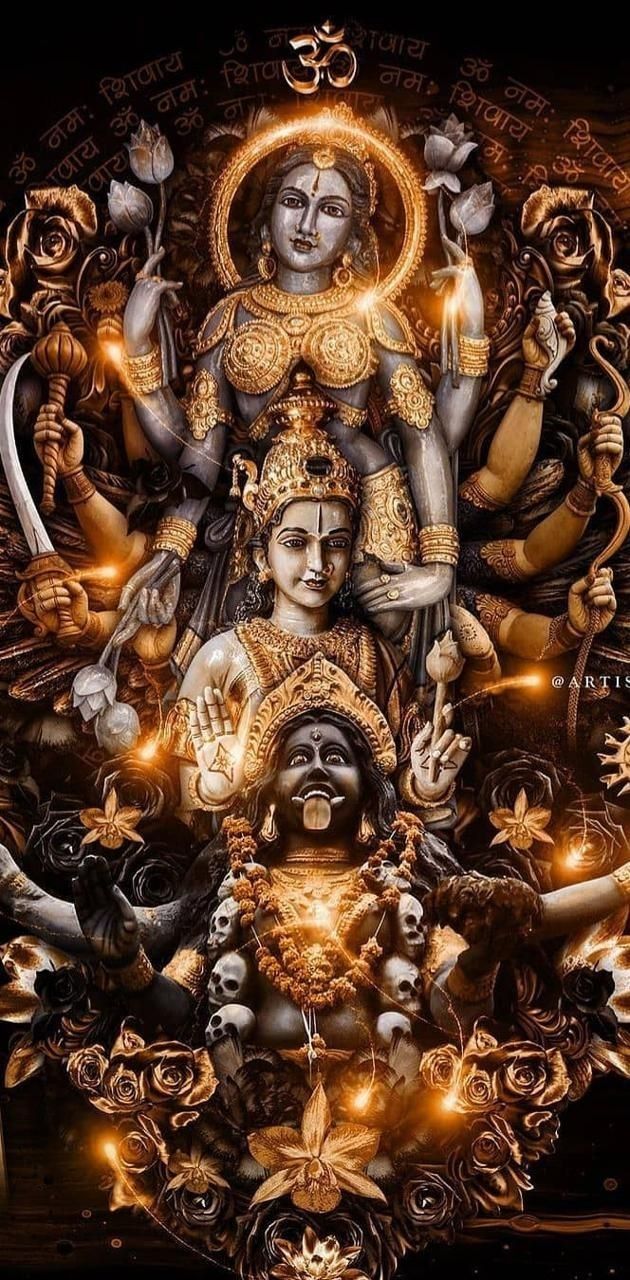
Shakti, The Transcendent Mother.

Standard
Devi Aditi is Parashakti or Shakti, the transcendent mother; She had three forms the Trishakti or Tridevi, Maa Mahasaraswati, Maa Mahalakshmi and Maa Mahakali, she’s the three gods Brahma, Vishnu and Shiva. Maa Saraswati is Brahmani. She’s her power of balance (Sattviki Shakti). Maa Lakshmi is Vaishnavi. She’s her power of activity (Rajasik Shakti). Maa Kali is Maheshwari. She’s her power of destruction (Tamsik Shakti)

I have here another deep dive (but short!) into the fascinating magic power of the symbols, especially Eastern ones for you! My mind is going to explode, though, but as we might “must” know, the wisdom came from the orient towards the west to teach the barbarians and the Huns! Here we can read what Dr Jung explained so precisely:

Westerners cannot slap Eastern spirituality on top of a western ego and expect enlightenment. ~Carl Jung. By Mr Purrington πŸ™

Here is an analysis of a dream, along with the Mandala Symbols. In his book: Dream and Dream Interpretation.

Dream 21; (Mandalasymbolic)
The large, transparent sphere contains many small spheres. A green plant grows out at the top.
The sphere is a whole that encompasses all content; the life that the useless struggle has stopped becomes possible again. In Kundalini Yoga, the “green womb” is a designation for Ishvara (Shiva) emerging from his latent state.

Trimuti- “three forms” or “trinity” are the trinity of supreme divinity in Hinduism, in which the cosmic functions of creation, preservation, and destruction are personified as a triad of deities. Typically, the designations are that of Brahma; the creator (A), Vishnu; the preserver (U), and Shiva; the destroyer (M). (OM)

Trimurti-image. The triangle symbolizes the coherence of the universe according to the peak of unity, the tortoise: Vishnu and the lotus, which grows up from the skull with the two flames: Shiva.

In the background: the radiant Brahma sun – the whole thing corresponds to the alchemical >opus<, where the tortoise symbolizes the >Massa Confusa<, the skull the >vas< of transformation, the flower the >self< or wholeness. (After an Indian depiction.)

C.G. Jung, Psychology of Alchemy. Do well everyone

From Steven Georgiou to Yusuf Islam and Back to Normal (?) Again!

Standard

I am still involved with these Iranian Space-Seminars on Twitter. Most of them are very interesting, listening to the people trying to form the political future of Iran. There are fascinating discussions by courageous Iranian people these days, and I always try to listen to them, though I must confess that I am not the youngest anymore to preserve to the end! One of them was about religion, women and human rights. Honestly, I was too tired to participate, but it lingered in my head and motivated me to write an article on this topic: religion in general and women in uniqueness. Although, there was more to this, which brought me new ideas:

Some days ago, I watched a documentary about Cat Steven’s changing beliefs; it made me more enthusiastic about writing referring to this phenomenon. Of course, I knew many years ago, since those days, that this genius musician had lost his way and mind to himself and gone crazy! And when I heard it, I was so upset about his decision that I didn’t follow it anymore.

I tried to keep him like I got to know him as Cat Stevens, an excellent songwriter. Although the question is, why does it happen at all? Why a musician like him, who had a good successful life in a free society, suddenly must fall into such an abyss!? Is it the fault of far too many opportunities in a free and prosperous world, or is it his early fame? Is too much freedom dangerous? I can’t say. I also, though rarely, met women who converted their Christian beliefs to Islam. I must say I was shocked whenever I heard it or met one.

You might answer that it is not all good in the west. I agree, though. I was born in a country with many limitations: political and religious narrowness and separations between gender. Therefore, when I came to the west, I thought I would meet more open and free-minded people. Of course, my thoughts were almost correct, but almost! I got to know women who married Muslim men, have been converted to Islam and wear hijab! Even in discos, they come without their husbands to enjoy music, which Islam forbids. And every day, as I see the brave women in Iran freeing their hair from this oppression, the women in a free political environment return to Middle Ages! Isn’t it a paradox?

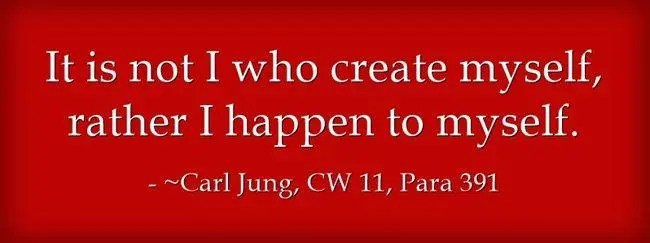
It may make it clear what Dr Jung uttered to explain humans’ way of being:

Yes, I am convinced that it is an utterly wrong way. It is a reactionary decision, as Iranians say, “throw oneself from a hole in a well”! But why must it happen?
We may accept that man is in the grip of confusion, whether bound or free. The case of Cat Stevens shows us: he was famous and happy as he sang this song;

He was, without a doubt, looking for himself and the famous happiness! Might his losing path be because he had no chance in love? The song; “Lady D’Arbanville” tolls his pain and frustration with life.

As Stevens was nearing the end of his recovery, he attended a party that boasted a gathering of musicians in London, including Jimmy Page, Steve Winwood, Ginger Baker, Eric Clapton and others. Among the party-goers was Patti D’Arbanville, a US teenager pursuing a modelling career and later gaining prominence as an actress. The two began dating. D’Arbanville stayed with him whenever she was in London but often found her career taking her to Paris and New York City. After over a year together, Stevens was ready to invest in a more serious relationship than was his young, ambitious girlfriend. On a foray to New York, she heard his song about her on the airwaves. Her reaction was one of sadness. She said,

I just have to be by myself for a while to do what I want to do. It’s good to be alone sometimes. Look, Steven [Stevens’ given name] wrote that song when I left for New York. I left for a month; it wasn’t the end of the world, was it? But he wrote this whole song about ‘Lady D’Arbanville, why do you sleep so still.’ It’s about me dead. So while I was in New York, for him, it was like I was lying in a coffin… he wrote that because he missed me because he was down… It’s a sad song.

D’Arbanville continues,

I cried when I heard it because that’s when I knew it was over for good.

My brother Al and I loved and adored him and his songs. He was one of our idols in the music world. Even we were excited when he, on his search, found the way to the Buddha and began to get help in the zen philosophy. Still, his sudden backward turn from progressiveness to primitiveness (I believe that Islam is a primitive religious ideal) not only shocked us, but it was also very disappointing. He left the world of music and art and began to find happiness in the sadness.
And it was not enough: in the early 80s, when the book by Salman Rushdie: The Satanic Verses, was published, Khomeini made his “Fatwa” (Islamic rule) to condemn Rushdie to death. The free world was horrified, but what has Stevens, who meanwhile called himself Yusuf Islam, done? In an interview, or better to say in a TV discussion with Salvatore Adamo, he uttered his opinion to Adamo’s question of what he’d think by this “Fatwa” he said it was a correct verdict! How deep could one fall?!
Long story short, he is back now in his previous life as if nothing had happened. The difference is only he has a long white bird… Ridiculous!

However, the riddle remains about how strange it is the human to understand this explosive point of the meeting between the soul and the body and endure the pressure to find the balance.

We can now hear one of his latest songs when he was still decent in his head! He confesses that this song is about himself and his way in lost. He was right those days, this sad cat!

The title image: Original Portrait Painting by Cor Lap _ Conceptual Art on Canvas _ Me and my cat

THE DANCER, from The Wanderer, by Kahlil Gibran.

Standard

As I believe the one we have been given as a gift from the Soul, the Whole, the Almighty, is a part of her soul: the art, to use it and to take the profits of unlimited imagination.

Here, I share a beautiful explanation by Kahlil Gibran on this divine treasure.
From the book; The Wanderer. πŸ™πŸ’–

Once there came to the court of the Prince of Birkasha, a dancer with her musicians. And she was admitted to the court, and she danced before the prince to the music of the lute and the flute and the zither.

She danced the dance of flames and the dance of swords and spears; she danced the dance of stars and the dance of space. And then she danced the dance of flowers in the wind.

After this, she stood before the throne of the prince and bowed her body before him. And the prince bade her come nearer, and he said unto her, “Beautiful woman, daughter of grace and delight, whence comes your art? And how is it that you command all the elements in your rhythms and your rhymes?”

And the dancer bowed again before the prince, and she answered, “Mighty and gracious Majesty, I know not the answer to your questionings. Only this I know: The philosopher’s soul dwells in his head, the poet’s soul is in the heart; the singer’s soul lingers about his throat, but the soul of the dancer abides in all her body.”

Sennedjem; An Extraordinary and Highly Valued Artisan.

Standard

I know I have posted some articles about Sennedjem before (here, here and here), but I believe it is worth returning to this artist of divine Gods and Goddesses again.

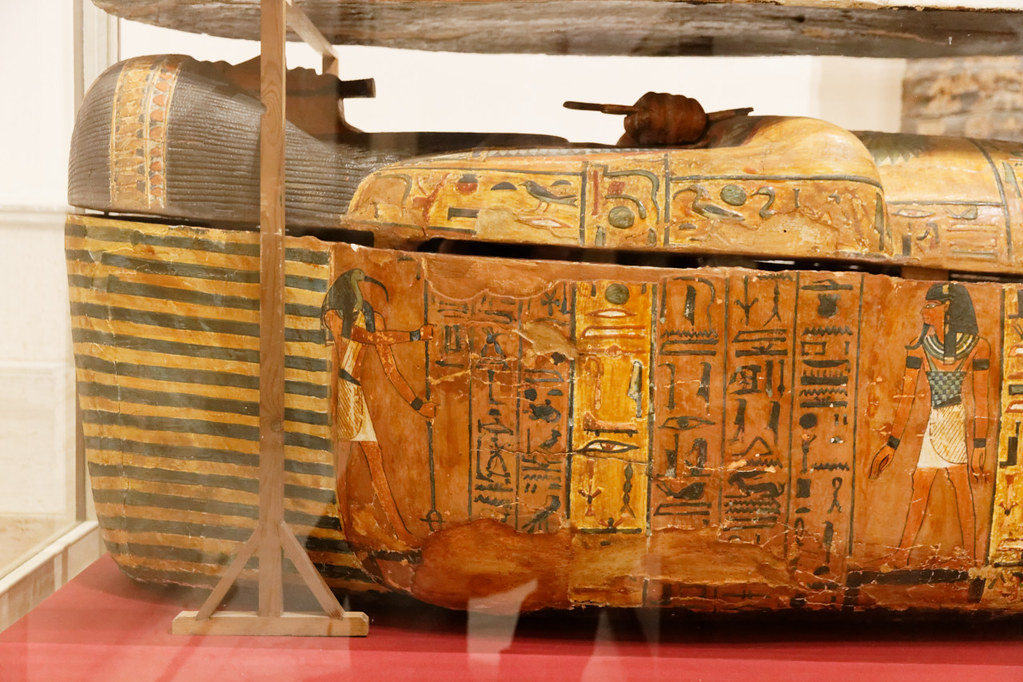
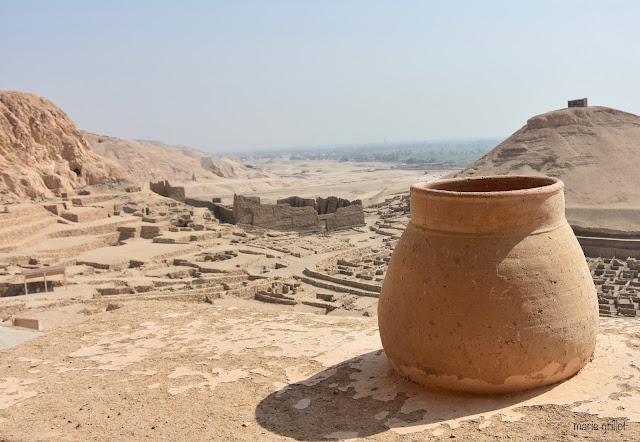
One of the most glorious and revealing galleries in Ramses the Great and the Gold of the Pharaohs is the one that holds a single object. It is the outer coffin of the ancient Egyptian artisan Sennedjem, who lived in Deir el-Medina (in Egyptian, Set Maat or β€œPlace of Truth”) during the reigns of Ramses II and his father, Seti I. He was part of an elite group of skilled craftspeople and artists who lived in this walled village on the west bank of the Nile at Thebes and worked primarily in the tombs in the nearby Valley of the Kings. Sennedjem held the title of β€œservant in place of Truth,” indicating that he was one of the teams responsible for constructing and decorating the royal tombs. Sennedjem’s own tomb was on a hill overlooking the workers’ settlement. A small pyramid sits on top of the entrance to an offering chapel. Below that lies Sennedjem’s decorated burial chamber. The painted reliefs from the walls and ceiling of that chamber are reproduced in the exhibition and surround Sennedjem’s coffin, as they did when the intact tomb was discovered in 1886. These are some of the most famous scenes from Egyptian tombs, showing his progress from death into the afterlife. famsf.org

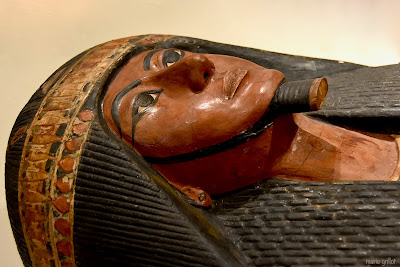
The coffin of the ancient Egyptian artisan Sennedjem; Fine Arts Museums of San Francisco //

It is undoubtedly a treasure for us humans that there were such artisans to show and let us know the divine life of Gods and Goddesses and the peoples in those days. And all in all, we could say that this kind of art is inspired by Gods and Goddesses and can be stated as divine work, and here with this gorgeous coffin for him, we recognize the respect given to this artist.

The image above: Coffin of Sennedjem by Chris Irie

Now let our dear Madam Marie Grillot tell us about this precious coffin and its fascination.πŸ™πŸ’–

The external coffin of Sennedjem, craftsman of the Place de VΓ©ritΓ©

via Γ©gyptophile

The external coffin of Sennedjem – stuccoed and painted wood – 19th Dynasty – the reign of Ramses II
from his tomb – TT 1 – at Deir el-Medina
discovered by Salam-Abou-Douy de Gournah and by the Service des AntiquitΓ©s in January-February 1886
registered in the Diary of Entries of the Egyptian Museum in Cairo – JE 27303 – photo Β© Sandro Vannini/ Laboratoriorosso

Sennedjem was, under the reigns of Sethi I and Ramses II (XIXth dynasty), one of the β€œservants” of the β€œPlace of Truth”. Cabinetmaker or more probably mason, he lived, with his family, in one of the stone houses covered with a roof of palm leaves of β€œSet MaΓ’t her imenty Ouaset”. Founded at the beginning of the 18th Dynasty during the reign of Thutmose III, this royal institution was dedicated to the artisans who worked on the excavation and decoration of the eternal abodes of the Valley of the Kings, the Valley of the Queens, and even necropolises more distant. β€œThe fact that we often refer to them as β€˜workers’ sometimes tends to substantiate the misconception that the community of the village of Deir el-Medina was at the lowest rung of Egyptian society. In fact, these men were craftsmen, for the most part highly qualified and distinguished for their know-how,” specifies Pierre Grandet in β€œThe artists of Pharaoh, Deir el-Medineh and the Valley of the Kings”). Protected by high walls, the members of the community also had places of worship and, on the slopes of the Theban mountain, a necropolis in which to dig their eternal home. It was there that, at the very beginning of the reign of Ramesses II, Sennedjem was buried, and until the end of the time, ramesside other members of his family…

β€œSet MaΓ’t her imenty Ouaset” – the β€œPlace of Truth west of Thebes” of antiquity
is known today as the craftsmen’s village of Deir el-Medina

Their tomb was rediscovered in January 1886 by β€œgournawis”. In β€œHidden Treasures of Egypt”, Zahi Hawass recounts the following circumstances: Only days of excavations, Salam and three of his friends made a spectacular discovery: at the bottom of a still unexplored burial shaft, they found a wooden door whose ancient seals were intact. Salam immediately informed Maspero, who happened to be in Luxor for its annual inspection visit”. In his correspondence to his wife Louise on February 3, the Director of Antiquities told this story: β€œThe vault is approximately 5 m long by three wide. It is vaulted, with a shallow burial and painted with vivid colours; unfortunately, the paintings and texts are only excerpts from the Book of the Dead. It was filled to the top with coffins and objects: eight adult mummies, two child mummies, a family of these priests of the cemetery about whom I spoke to you in the letters I wrote from Turin in 1880 (?) The mummies are superb, of a beautiful red varnish with elegant representations, but they are only the least interesting part of the discovery. You know that the mummies were carried to the tomb on sledges, held by men or drawn by oxen. Our tomb contains two of these complete sledges: first the floor, with the rings intended to pass the sticks, when one wanted to carry, then the movable panels of the catafalque in which one locked the coffin, then the lid in cornice… and c This is how we will exhibit everything at the Boulaq museum. Alongside this, the complete furniture: eight large canopic boxes, around forty small funerary statuette boxes, around a hundred charming limestone figurines, around twenty painted earthenware vases, a new bed different in shape from the first two,… In addition, a beautiful armchair with a canvas bottom imitating the tapestry; two stools with canvas bottoms imitating red leather, a folding chair, bouquets of flowers, a cubit, an ostracon containing a very curious historical novel, although very short”…

Mandated by Gaston Maspero, Eduard Toda β€œaccompanies” the artefacts from the tomb of Sennedjem,
on the boat bound for the Boulaq Museum (1886)
Toda Fund Library VΓ­ctor Balaguer Museum (Vilanova)

Sennedjem’s body lay in a magnificent stuccoed and painted wooden mummified coffin. His mummy β€œwas protected by a wooden board covering his body and his funerary mask and representing him dressed as he was alive” (Hanane Gaber, β€œAt work, we recognize the pharaoh’s craftsman”).

Sennedjem’s body lay in a magnificent stuccoed and painted wooden mummified coffin. His mummy β€œwas protected by a wooden board covering his body and his funerary mask and representing him dressed as he was alive” (Hanane Gaber, β€œAt work, we recognize the pharaoh’s craftsman”).
cercueil de sennedjem

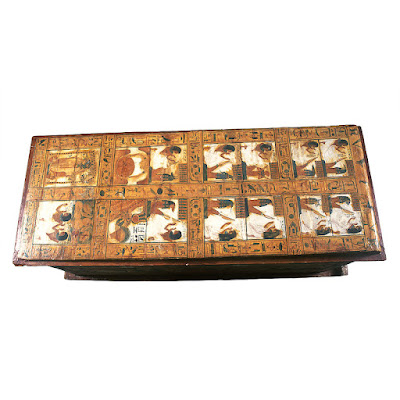
The whole was placed in an imposing β€œsarcophagus” of polychrome and varnished stuccoed wood. 2.60 m long, 0.98 m wide and 1.25 m high, it takes the form of a naos, adorned with a coved cornice, topped with β€œa domed roof rounded at the β€˜front, whose gentle slope joins the cornice at the rear’.

It is entirely covered with hieroglyphic scenes or inscriptions. In β€œThe Tomb of Sennedjem at Deir-El-Medina TT.1”, Martha Sara Saujaume specifies: β€œIts decoration corresponds to the type of drawings of the 19th Dynasty, in particular for the yellow colour of the background of the vignettes and for the decoration with vignettes corresponding to the Book of the Dead, in very bright colours such as blue and red, as well as texts from the same Book of the Beyond arranged in vertical columns… The decoration on the sides is divided into two registers. Lower comprises columns of text with chapters from the Book of the Dead. In the upper register, we find the Four Sons of Horus and vignettes from the Book of the Dead”…

Top of the lid of the external coffin of Sennedjem
Varnished and painted stuccoed wood – 19th Dynasty – the reign of Ramses II
from his tomb – TT 1 – at Deir el-Medina
discovered by Salam-Abou-Douy de Gournah and by the Service des AntiquitΓ©s in January-February 1886
registered in the Diary of Entries of the Egyptian Museum in Cairo – JE 27303

Represented standing, two by two and turning their backs, the four protective goddesses watch over Sennedjem: at the head are Selkis and Neith, at the feet Isis and Nephthys, each with one arm along the body, the other slightly spread in protective sign. Moving, charming, they are wearing a three-part black wig with a light headband. The hieroglyphic sign is placed on the top of their skull, which allows their identification. They are dressed in tight dresses held by straps, and their neck is adorned with a lovely necklace with multiple rows…

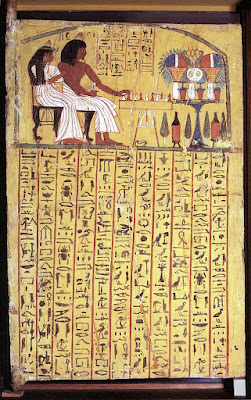
Martha Sara Saujaume notes the presence of β€œfamily” representations, such as: β€œthe deceased and his wife Iineferti seated on chairs. She hugs her husband by the shoulders while they play Senet before a table of offerings. This same scene is found inside the access door to the funeral chamber of the deceased. To the right of this scene, we see the ba of the deceased, Sennedjem and Iineferti, on a white chapel. In front of him, the deceased is kneeling in adoration before the two lions holding the Horizon on their shoulders….”

Detail of the door to the tomb of Sennedjem – stuccoed and painted wood – 19th Dynasty – the reign of Ramses II
from his tomb – TT 1 – at Deir el-Medina – discovered by Salam-Abou-Douy de Gournah and by the Antiquities Service in January-February 1886
registered in the Journal of Entries of the Egyptian Museum in Cairo – JE 27303 – on display since April 2021 at the Nmec (National Museum of Egyptian Civilization) in Fustat

At the time of the burial, to facilitate the hauling of it towards the vault, the sarcophagus was deposited on a sledge: β€œOn the skids of the sledge of the funerary tank of Sennedjem, wheels which left their mark there, had been adapted to facilitate the transport of the heavy and cumbersome piece of furniture. This type of funerary tank with a sledge base only seems to appear in the 18th Dynasty and to disappear with the end of the New Kingdom” (Ruth Anthelme, Christian Leblanc, β€œRamses the Great”).

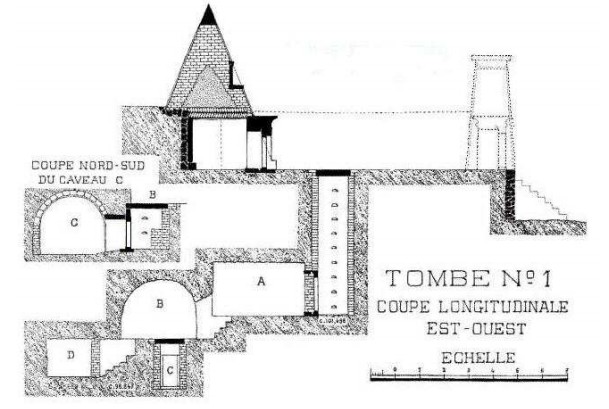
Map of Sennedjem’s tomb at Deir el-Medina published in
“Tomb No. 1 of SEN-NEDJEM (1959), BruyΓ¨re, Bernard (1879-1971), MIFAO 88 from 1959

This external coffin has been registered in the Cairo Museum Entry Journal JE 27301. It will be presented at the β€œRamses & the Gold of the Pharaohs” exhibition to be held from April 7 to September 6, 2023, at La Grande Halle de la Villette, in a scenography featuring the most beautiful scenes from the funerary vault… Let us remember that, for Bernard BruyΓ¨re, the tomb of Sennedjem (TT 1 – TT = Theban tomb): β€œis not only one of the most beautiful and best preserved in Thebes; but it is, moreover, a perfect, complete and typical example of a large family tomb comprising the four regular components, the courtyard and the chapels accessible to the living, the well and the vault reserved for the dead”…

Sennedjem and his wife Iyneferti are represented on the walls of their tomb – TT 1 – Deir el-Medineh
discovered by Salam-Abou-Douy de Gournah and by the Service des AntiquitΓ©s in January-February 1886

It is interesting to specify that Khonsou, son of Sennedjem, rested in an almost identical external coffin (JE 27302) which was at the β€œRamses the Great” exhibition, organized by Christiane Desroches Noblecourt, from May 15 to October 15, 1976, at Grand Palace in Paris.

Marie Grillot

Sources:

Sarcophagus of Sennedjem http://www.globalegyptianmuseum.org/record.aspx?id=15748 Bruyère, Bernard, La tombe N°1 de SEN-NEDJEM (1959), MIFAO 88 de 1959 https://archive.org/details/MIFAO88

Padro Josep, β€œBulletin of the French Society of Egyptology” – 1988, nΒ°113, pp. 32-45

Elisabeth David, Gaston Maspero, Letters from Egypt, Correspondence with Louise Maspero, Seuil, 2003

Christiane Desroches Noblecourt, Ramses the Great, National Galleries of the Grand Palais (1976)

Hanane Gaber, Laure Bazin Rizzo, FrΓ©dΓ©ric Servajean, At work, we know the craftsman… of Pharaoh! – A century of French research in Deir el-Medina (1917-2017), 2018, SilvanaEditorial

Pharaoh’s artists, Deir el Medineh and the Valley of the Kings, Louvre, 2002

Zahi Hawass, Hidden Treasures of Egypt
Nicholas Reeves, the great discoveries of ancient Egypt, Γ‰ditions du Rocher, 2001

Osirisnet.net website – Tomb of Sennedjem https://www.osirisnet.net/tombes/artisans/sennedjem1/sennedjem1_02.htm

https://www.osirisnet.net/tombes/artisans/sennedjem1/e_sennedjem1_01.htm

Federico Fellini in Search of his Shadow and the Collective Unconscious.

Standard

Honestly, it was a great surprise for me to know that Federico Fellini, the great master of surrealism in movies, was interested in connecting to a psychologist and analysing his psyche. And as Dr Freud’s famous dream analysis was considered, he met Jungian psychotherapist Ernst Bernhard to learn more about himself.

At the beginning of the nineties, in contrast with the academic environment that considered Freud’s thought scientific while rejecting that of Jung, I undertook a study on Jungian thought in Italian literature. An essay was dedicated to Andrea Zanzotto‘s “Mother-norm”. I got in touch with the poet, who told me about the psychotherapy he had undergone for years, and when my book came out, he suggested that I send a copy to Federico Fellini, to whom I had dedicated a few pages. Ernst Bernhard

A major discovery for Fellini after his Italian neorealism period (1950–1959) was the work of Carl Jung. After meeting Jungian psychoanalyst Dr Ernst Bernhard in early 1960, he read Jung’s autobiography, Memories, Dreams, Reflections (1963) and experimented with LSD. Bernhard also recommended that Fellini consult the I Ching and keep a record of his dreams. What Fellini formerly accepted as “his extrasensory perceptions” were now interpreted as psychic manifestations of the unconscious. Bernhard’s focus on Jungian depth psychology proved to be the single most significant influence on Fellini’s mature style. It marked the turning point in his work from neorealism to filmmaking that was “primarily oneiric”.

In Making a Film, Fellini said that he had been dazzled by Jung, the Zurich doctor who had made him discover unknown landscapes and new perspectives from which to look at life. It was his analyst, the German Jew Ernst Bernhard, who introduced him to Jung.

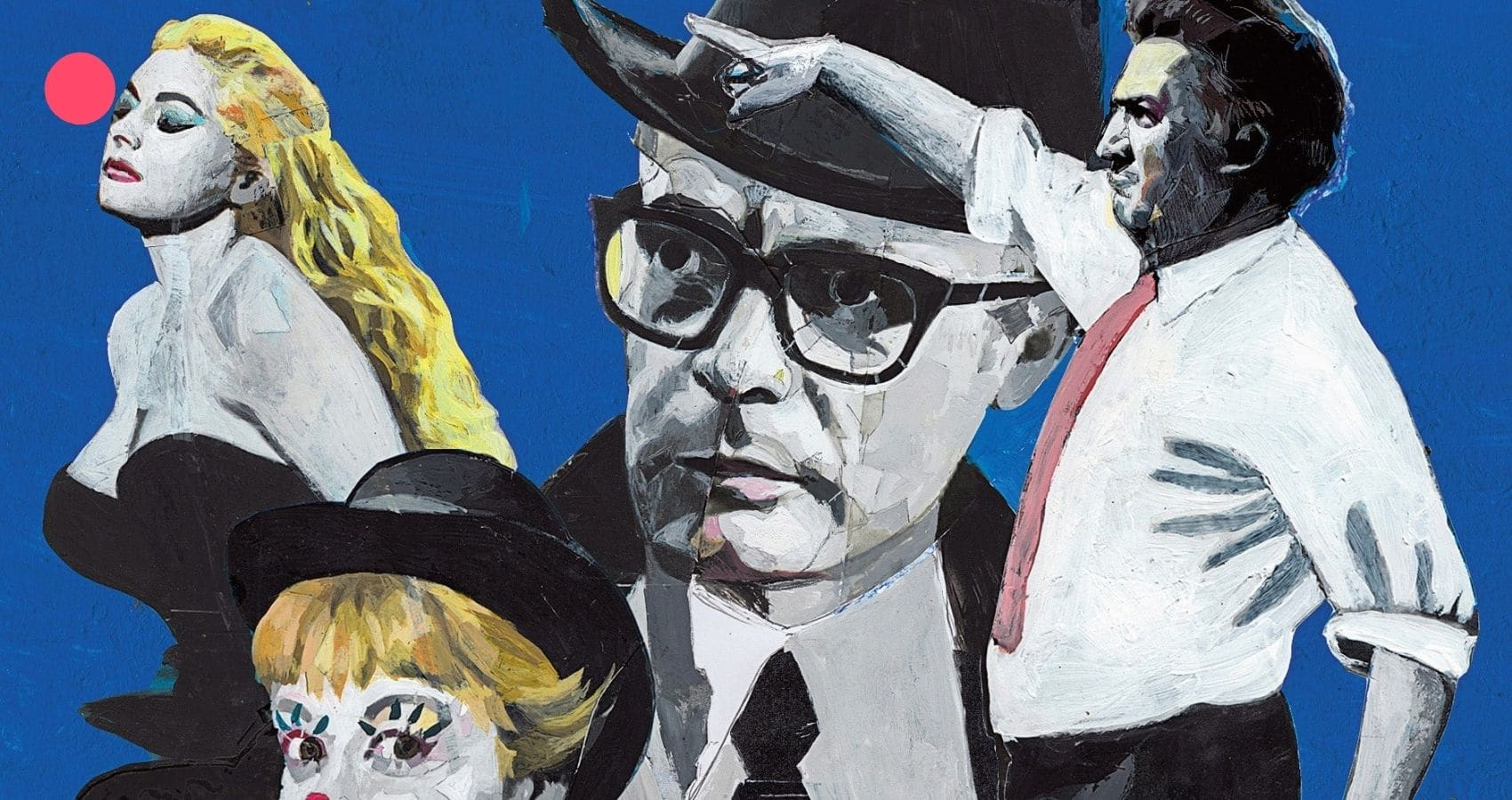
Image from Articolo21

Fellini was one of the many Italian authors and writers who frequented his studio in Via Gregoriana, which overlooked Rome and a world many feared. During the therapy, the analyst used the I Ging, the Chinese book of changes, and this created scandal; some strongly advised him not to use it. He had even taken him to confinement in the fascist camp of Ferramonti, from which he would have been deported to a Nazi concentration camp in Germany if, at the last moment, the orientalist Giuseppe Tucci had not managed to make his return to Rome.

He remained hidden for months in a secret room of his study. Dissatisfied with the Italian version of the I Ging based on the German version of Richard Wilhelm, he entrusted a new translation to one of his patients, Bruno Veneziani, Italo Svevo’s brother-in-law.

Β This discovery opened the door to his shadow to begin changing his style from neorealism (as was usual in Italy after WWII) to making such surreal movies and, as a consequence, Jung’s seminal ideas on theΒ animaΒ and theΒ animus, the role of archetypes and the collective unconscious directly influenced such films asΒ 8+1⁄2Β (1963, with Marcello Mastroianni),Β Juliet of the SpiritsΒ (1965, with his wife Giulietta Masina), and further;Β Fellini SatyriconΒ (1969),Β CasanovaΒ (1976), andΒ City of WomenΒ (1980).Β Other key influences on his work includeΒ Luis BuΓ±uel, Charlie Chaplin, Sergei Eisenstein, Buster Keaton, Laurel and Hardy,Β theΒ Marx Brothers,Β andΒ Roberto Rossellini.

Postscript!

I have never believed in success in any post to share today (I hope you enjoyed it.); as you know, I repeatedly said many different businesses surrendered me! Even now, there are so-called Spaces on Twitter (online seminars) to which I have (honourably) been invited, and it takes more time.
Anyhow, it is life! Next week I will not be able to post anything, because we are travelling to meet friends in northern Germany.
Have a wonderful time, everyone, and let’s pray for peace and love. πŸ™πŸ’–βœŒπŸŒΉπŸ’–πŸ™

Sources:

Wikipedia

https://www.breakinglatest.news/entertainment/federico-fellini-and-his-analyst-ernst-bernhard/

Federico Fellini’s dream dimension: his encounter with Ernst Bernhard

The individuation; Anima and Animus. Carl Jung (P. 3)

Standard

I think this issue, Anima, is an essential key to understanding our inner souls. We don’t have to make this mistake that the anima is of female nature, and it’s not to do with males. I think Dr Jung, with his thesis Anima and Animus, wanted to explain the genderless of the soul. I hope I don’t sound so big-mouthed. Still, when I think about our existence on this earth and keep asking the same question: why are we here, and what is the meaning of life, I become more convinced that maybe we did send out of paradise to hell, as it’s written in the holy books, though, not to this beautiful earth as hell! We were sent to our own hell, where we must meet our own evil and learn to know and handle with.

I might go too far (I don’t really know how deep this “far” could be!), but I know for sure, as far as we recognize, the fantasy world is unlimited. That’s why I am trying to discover my still unknown inner to find the answers to many questions…

Thanks, Mr Purrington

We believe that what we feel and think inwardly must be compared to others we know. Therefore, we cause misunderstandings in participating in our society: I am talking about excessive expectations!

It is a term of Participation mystique or mystical participation, derived from LΓ©vy-Bruhl, which Jung gladly chopped on:

The further we go back into history, the more we see personality disappearing beneath the wrappings of collectivity. And if we go right back to primitive psychology, we find absolutely no trace of the concept of an individual. Instead of individuality we find only collective relationship or what LΓ©vy-Bruhl callsΒ participation mystiqueΒ (Jung, [1921] 1971: par. 12).

By Petra Glimmdall

He continues in his “Individuation; Anima and Animus”:

The fact that a man naively attributes his anima reactions to himself, without realizing that he cannot identify with an autonomic complex, recurs in female psychology, but to an unprecedented extent, if possible. The fact of identification with the autonomous complex is the essential reason for the difficulty of understanding and representing, quite apart from the inevitable obscurity and unfamiliarity of the problem. We always naively assume that we are the only masters in our own house. Our understanding must, therefore, first get used to the thought that even in our most intimate soul life, we live in a kind of house that at least has doors and windows onto the world, the objects or contents of which affect us but do not belong to us. This premise is not easy for many to think about, just as it is not easy for them to really see and accept that their fellow human beings do not necessarily have the same psychology as they do. My reader may think that the latter remark is probably an exaggeration since one is generally aware of individual differences.

By Craig Nelson

But one must consider the fact that our individual consciousness psychology emerges from a primordial state of unconsciousness and, therefore, indifference (termed “Participation Mystique” by LΓ©vy-Bruhl).

As a result, awareness of difference is a relatively late acquisition of humanity and probably a relatively small slice of the indeterminately large field of primordial identity. Differentiation is the essence and the “conditio sine qua non” of consciousness. Therefore, everything that is unconscious is undifferentiated, and everything that happens unconsciously proceeds from the basis of indifference, so it is initially completely undecided as to whether it belongs or will belong to the self. It cannot be determined a priori whether it is with the other person, with me, or with both. Feelings also do not provide any reliable clues in this regard.

>Participation mystique, orΒ mystical participation, refers to the instinctive human tie to symbolic fantasy emanations. According to Carl Jung, this symbolic life precedes or accompanies all mental and intellectual differentiation. The concept is closely tied to that ofΒ projectionΒ because these contents, which are often mythological motifs, project themselves into situations and objects, including other persons.

Jung defines participation mystique as one of his basic definitions in Psychological Types, crediting it to Lucien LΓ©vy-Bruhl.

PARTICIPATION MYSTIQUE is a term derived from LΓ©vy-Bruhl. It denotes a peculiar kind of psychological connection with objects, and consists in the fact that the subject cannot clearly distinguish himself from the object but is bound to it by a direct relationship which amounts to partial identity. (Jung, [1921] 1971: paragraph 781). <

See: Participation mystique – Wikipedia

I will write more of this, as it is an important (or might be one of the most) issue in our searching the meaning of life!

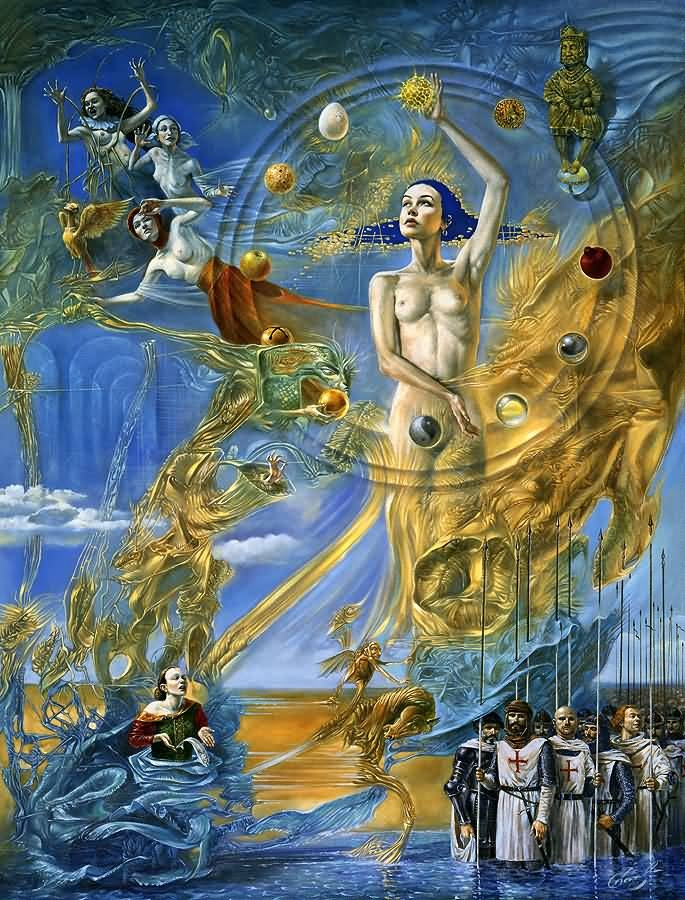
The image on top: Eternity of Absurdity – Michael Cheval

Here is a highly recommended old recording of Jung’s life for fans. I have only a wish from my highly accepted Jungian Masters; if you please pronounce the name of Dr Jung in original German: “Yoong” and not Yang or young! Actually, the word Jung means Young, though he’s never been called young; his name is Jung (Yoong) Carl Gustav! Have a lovely weekend. πŸ€—πŸ’–πŸ™

The Art and The Artists Will Never Die! See You There!

Standard

He was and still is one of my Idols in my progressing music. I want to write a tribute to him, to have a simple bosom thought of him, David Crosby, a great human and musician. We discover him in the early seventies when finally Woodstock, the movie, had got its allowance to shine on the screen in cinemas of Iran. Those days, he and the other three camerades: Graham Nash, Steven Still and Neil Young, were together and represented the soundtrack for this movie.

It is good to be born at the right time in the right place, and he was one of these lucky ones. David (Van Cortlandt) Crosby was a special one for me, not only because of his famous moustache but also because I love his soft and gentle voice. We got to know him among his mates, but I know much more about him now as I live in a (somehow) free part of the world.

Their world was a world for the people who looked after freedom and how it fitted the world of our dreams. Those days, it was just like a dream for us to reach this still fascinating space of freedom: Love and Peace. And he gave us the feeling to make a dream, at least. Thank you, David Crosby, for this present.

And as I was fighting to keep my hair long as possible and tried to convince my mother to accept it (in a discussion, she gave me the right, I was stunned!) I understood that we, in Iran, are not too far away from our mates in the US. The bad luck was that we were too few!!

In any case, it was a good time for us. There was no talk about how and what; it was only about when! We, the youths, wanted to be free to show our feelings, nothing about political change or something similar. We only wanted our right to offer our freedom to have free choice! But we were damn too few! However, I thank him for being there; I have learned much from his openness towards life. And as I keep my music style, I will try to be faithful towards our Deja Vu!

I don’t think of any conflict! The arts, I believe, belong to our abilities to understand the universe. We have something “plus” if we have ever deserved it. We might try, and we might win the point; who knows!

Now let the ghost speaks. The other side is nothing more than to look at what you have done in that before!

“I Won’t Stay For Long”

One, two, three

I’m standing on the porch.
Like it’s the edge of a cliff
Beyond the grass and gravel lies a certain abyss
And I don’t think I will try it today
I’m facing a squall line of a thousand-year storm
I don’t know if I’m dying or about to be born
But I’d like to be with you today
Yes, I’d like to be with you today

And I won’t stay for long
I’ve got a place of my own
A little slice
There’s a sliver of air between the water and the ice
It’s where I live, where I breathe
An abandoned song
It echoes through this well I’ve fallen in
If I could just remember the smell of your skin
Then I could live, I could breathe
I could breathe

I’m asking perfect strangers if I look to be alright
I feel like I lost an anchor in the ocean of my night
And I don’t want you to see me this way
I won’t tell a soul
I’ll only worship the sun
I won’t turn around to find you when the moment is done
I just need to be close today
I need to be with you today

And I won’t stay for long
I’ve got a place of my own
A little slice
There’s a sliver of air between the water and the ice
It’s where I live, where I breathe
An abandoned song
It echoes through this well I’ve fallen in
If I could just hold onto the smell of your skin
I could live, I could breathe
I could breathe

The artists never die; they did something to stay alive; their creations.

https://classicsdujour.com/david-crosby-remember-my-name-melancholy-movie/

Thank you, my friends. Let’s think higher of this earth a little. I believe we can find much more answers to our questions. I think we deserve it! πŸ˜‰πŸ€—πŸ’–πŸ™

Huxley’s or Orwell’s, The Main Concept Comes to The Same End! (P. 2)

Standard

“Actual happiness always looks pretty squalid compared to the overcompensations for misery. And, of course, stability isn’t nearly so spectacular as instability. And being contented has none of the glamour of a good fight against misfortune, none of the picturesqueness of a struggle with temptation, or a fatal overthrow by passion or doubt.
Happiness is never grand.”
― Aldous Huxley, Brave New World

In the first part, I have written about the visions of Orwell and Huxley and their power of imagination of humans’ future. I believe that this god’s (or whatsoever) given power of imagination teaches us how to handle the challenges in our life. This power is in all of us; we only have to overcome our fears and let our imagination free will.

When George Orwell and Aldous Huxley wrote their warning books 1984 and Brave New World, they wanted to share their worries about the future with us.

As Orwell imagines his totalitarian world being in a dark cover and was concerned above all about the particular threat posed by totalitarianism to words and language, Hoxley still had one foot in the nineteenth century: he couldn’t have dreamed his upside-down morality unless he himself also found it threatening. While writing his book, he was still in shock from the US visit, particularly frightened by mass consumerism and its group mentality and vulgarities; there dies the individuum, while Orwell deeply thought about Hitler’s and Stalin’s totalistic reigns.

It’s probably hard to compare these two masterpieces and find one or the other better, as we can take both visions as doctrine and keep our eyes open. But I still believe Huxley’s vision is a much better tricky scam, which could not be exposed.
Huxley explained in his letter to Orwell:

Whether, in actual fact, the policy of the boot-on-the-face can go on indefinitely seems doubtful. My own belief is that the ruling oligarchy will find less arduous and wasteful ways of governing and of satisfying its lust for power, and these ways will resemble those which I described in Brave New World. I have had occasion recently to look into the history of animal magnetism and hypnotism and have been greatly struck by how, for a hundred and fifty years, the world has refused to take serious cognizance of the discoveries of Mesmer, Braid, Esdaile, and the rest.

Therefore, Huxley’s vision is more compatible nowadays: in his novel, The Brave New World: everything looks bright and cheerful. Wars, poverty and hunger, are far away. For the elimination of disturbing journalism is already concerned: Truth? You don’t want to ruin your career, do you? Or the danger of artists is gone; they have become sellers of their own arts themselves; business is business! In the earlier time, the artists had nothing to do with the market. They were busy with their creations, and the managers had to discover them and take care of selling their art. Still, now they must earn their money via “do it yourself”, which keeps them busy and in the position of a seller, they never could let their spirits fly over the imaginative world of art.

I don’t know and never learned how to sell!

And the Fear is the Safety!

That is, for sure, worth reading such brilliant visions. They help us to broaden our views. They are not alone; there are more examples: one is Ray Bradbury, who, in his fascinating book Fahrenheit 451, shows us his vision of the future. I wonder if they were not there, we might fall into a terrible trap!

I also have watched movies on this topic, great films like Soylent Green, a 1973 American movie directed by Richard Fleischer, which is about a dark vision happening in the year 2022 (we have passed already and didn’t even notice!!) or Zardoz a 1974 science fantasy film written, produced and directed by John Boorman, which, in the end, gives us hope for a new begin!? (I have once shared a post on this film.)

This image above, which I have gaped from the Net, tells a lot! We really are in the middle of these traps, but we can create our own art and learn from each other.

I will put a part three on this issue and share some more thoughts if it doesn’t bore you. πŸ€—πŸ™

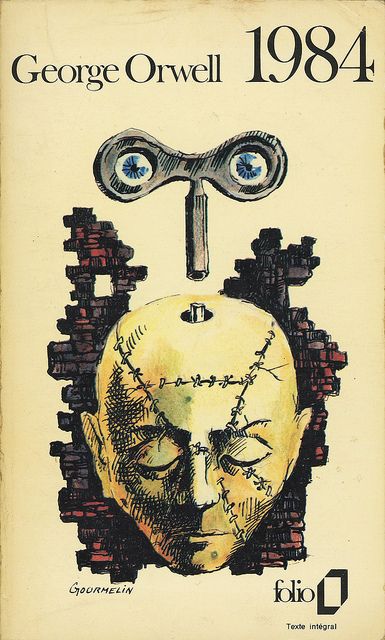
The Pics at the top: Trash Riot & Photo byΒ swallace99Β onΒ Flickr Collection Folio 177 – George Orwell – 1984

The individuation; Anima and Animus. Carl Jung (P. 2)

Standard

In the first part, I shared Jung’s thoughts on Anima and how it influences our life. Honestly, I have noticed that following and understanding the text might be challenging. I know it is not easy, as I read them to translate. He mainly has long paragraphs and uses the word; Man, everywhere it would need as the third person. It is typical German! I kept trying to use “the one” instead because I find using the word “man” might be misunderstood. After all, we are talking about both sexes!

So let’s continue reading his words:

The tendency of relatively autonomous complexes to personify themselves immediately is also why the persona appears so “personal” that the ego can, without too much difficulty, doubt what its “true” personality is…

As we know, Persona is the soul; it images our protruding like a mask. We might hide it by changing our masks, but the unconscious always projects from behind. He explains this here in this way:

…So now, what is true of a persona, and all autonomous complexes in general, is also the case of the anima – she is also a personality, and that is why she is so easily projected onto a woman; that means she – as long as it is unconscious – always is projected. Because “everything unconscious” is projected. The first bearer of the soul picture is probably always the mother; later, it is the woman who arouses the man’s feelings, regardless of whether in a positive or negative sense. Because the mother is the first bearer of the image of the soul, separation from her is a delicate and important remoteness of the highest educational significance. We find, therefore, even among the primitives, a large number of rites which organise separation. Merely growing up with external separation is not enough; it still requires the particularly drastic male consecration and rebirth ceremonies to effectively complete the separation from the mother (and thus from childhood).

By Petra Glimmdall πŸ’–πŸ™

Dr Jung’s explanation about men may be too harsh to us men, but he is right! We might consider it honestly. He continues:

Just as the father acts as a protection against the dangers of the outside world and, in this way, becomes a model of the persona for the son, so the mother is a protection against the dangers that threaten his soul from the darkness. In the male initiations, therefore, the initiate receives instruction about things in the beyond, which enables him to renounce the protection of his mother.

Despite all its primitiveness, the modern civilised man has to do without this fundamentally excellent educational measure. The consequence of this is that the Anima is transmitted to the woman in the form of the mother-imago, with the result that the man, as soon as he marries, becomes childish, sentimental, dependent and submissive, or, in the other case, rebellious, tyrannical, and sensitive, always on considering the prestige of his superior manhood. The latter, of course, is merely the inverse of the former. The protection against the unconscious that his mother meant for him has yet to be replaced by the modern one, which is why he unconsciously designed his marriage ideal in such a way that his own might have to take on the magical role of mother. Under the cloak of the ideal, exclusive marriage, he actually seeks protection from his mother and thus seductively accommodates the woman’s possessive instinct. His fear of the dark unpredictability of the unconscious gives the woman illegitimate power and makes the marriage such an “intimate community” that it constantly threatens to burst from inner tension – or he does the opposite in protest with the same success.

I stop it here again for a break till the next post. Thank you all for your interest, and wishing a lovely time. πŸ’–πŸ™πŸ€—

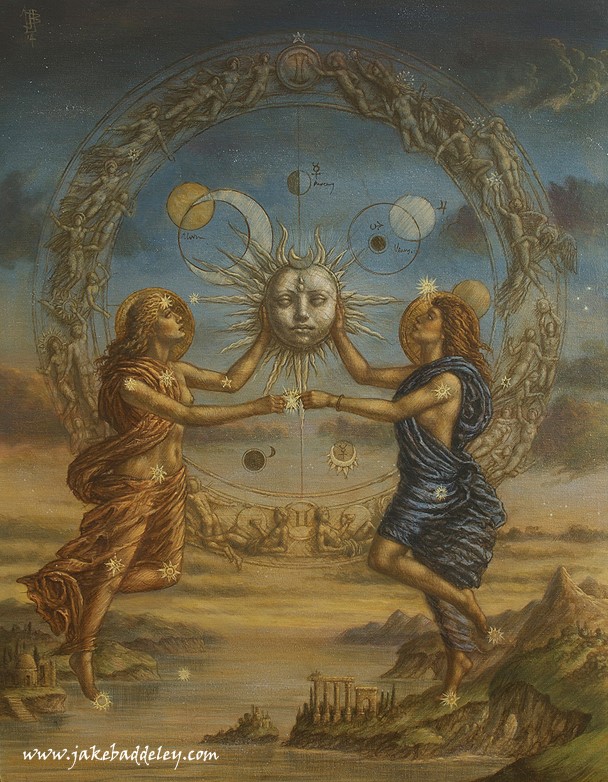
Two first Pics at the top: Jake Baddeley