Karomama I, Divine Worshiper of Amun-Ra, The Mysterious Priestess in the Rank of Queen!

Standard

As we know with Osiris, Amun-Ra( Amon, Ammon, Amoun, Amen, Amana) is the most widely recorded of the Egyptian gods. Amun was the god who created the universe. Ra was the god of the sun and light, travelling across the sky daily in a burning boat. The two gods were combined into one, Amun-Ra, in the time of the New Kingdom, between the 16th and 11th centuries BCE.

©Kairoinfo4u – The sacred boats of Amun-Ra, Mut and Khonsu (Ancient Egypt Online)

Today, I would like to introduce the statue of Karomama, the “divine worshiper of Amun”. Amun had many worshipers; one of them was Karomama 1st. Here is a brilliant report by Marie Grillot (& Marc Charier) about the story of this treasure.

“Statue of Karomama, “divine worshiper of Amun” in Thebes Bronze inlaid with pink gold, silver, electrum – 22nd dynasty Probably coming from Thebes – Acquired by Jean-François Champollion

Princess Karomama is the granddaughter of Osorkon I, priestess and the divine consort of Amun.

Let’s read the whole story:

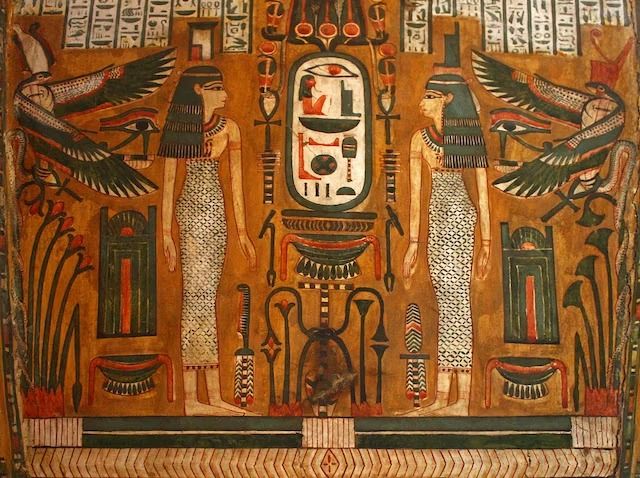
The image at the top: Amun-Re; Ammon; Amon; Amun (Cristalinks)

Karomama, Divine Worshiper, Totally and Eternally “Divine”!

égyptophile

Karomama, “divine worshiper of Amun” – bronze inlaid with pink gold, silver, electrum – 22nd dynasty
from Thebes – acquired by Jean-François Champollion in Egypt in 1829 from Giovanni (Yanni) of Athanasi
Louvre Museum – N 500

In July 1827, the outline of the Franco-Tuscan expedition to Egypt was put on paper. Jean-François Champollion and Ippolito Rosellini and their teams will have the primary missions of visiting the monuments of ancient Egypt and purchasing objects for the royal collections.

Champollion devoted himself with infinite passion to monuments for 17 months, from July 1828 to December 1829. But he was also keen to bring back numerous objects to enrich the Egyptian antiquities division of the Charles X Museum (future Louvre), inaugurated on December 15, 1827, and of which he was appointed curator.

Karomama, “divine worshiper of Amun” – bronze inlaid with pink gold, silver, electrum – 22nd dynasty
from Thebes – acquired by Jean-François Champollion in Egypt in 1829 from Giovanni (Yanni) of Athanasi
Louvre Museum – N 500

Thus, on December 26, 1829, he wrote to Baron de la Bouillerie: “I have also brought together a collection of selected objects of great interest, among which is a bronze statuette, of exquisite artistry, entirely inlaid in gold, and representing an Egyptian queen of the Bubastide dynasty. It is the most beautiful object of this kind.”

And, in a letter to Rosellini, Champollion explains the acquisition as follows: “This large bronze statuette of the divine worshiper Karomama was part of the collection assembled in Alexandria by Yanni Athanasi, the former collaborator of Salt: I had his beautiful bronze of the queen and a hundred other first-rate pieces for a thousand tari.” Giovanni d’Athanasi was then known and recognized: in 1819, he succeeded Belzoni to the English consul Henry Salt, who appreciated his ability to estimate the quality and value of antiquities and his sense of commerce. Athanasi thus supplied the Salt collections while building a personal collection himself.

Karomama, “divine worshiper of Amun” – bronze inlaid with pink gold, silver, electrum – 22nd dynasty
from Thebes – acquired by Jean-François Champollion in Egypt in 1829 from Giovanni (Yanni) of Athanasi
Louvre Museum – N 500

This is how the Karomama statue arrived in Paris. It measures 59 cm high and, on the Louvre website, it is presented as follows, under the inventory number N 500: “Walking on a base, barefoot, arms outstretched to shake the sistrums, Karomama is dressed in “a pleated dress close to the body, with ample sleeves. Half-long, the dress is caught in the plumage of the vulture, which slides over the thighs. The short hairstyle fits the face widely. The coiled uraeus emerges from the modius, a small pad on which a crown was originally embedded. A sumptuous goldwork adornment shines on the top of her shoulders and the base of her chest… The inscriptions on the base indicate her identity: “Beloved by Amon-Re, she is his divine spouse, the Divine Adoratrix.”

Karomama, “divine worshiper of Amun” – bronze inlaid with pink gold, silver, and electrum – 22nd dynasty
from Thebes – acquired by Jean-François Champollion in Egypt in 1829 from Giovanni (Yanni) of Athanasi
Louvre Museum – N 500

Today, It is considered one of the most beautiful pieces in the Egyptian Department of Antiquities. She finally overcame this problematic period where, after the admiration aroused upon her arrival, she was placed in a somewhat dark display case, covered with dust and oblivion… to make room for new acquisitions.

In the 1890s, Émile Chassinat (attached to the Department of Egyptian Antiquities) brought her out of her “exile where her happier rivals had relegated her”.

Karomama, “divine worshiper of Amun” – bronze inlaid with pink gold, silver, and electrum – 22nd dynasty
from Thebes – acquired by Jean-François Champollion in Egypt in 1829 from Giovanni (Yanni) of Athanasi
Louvre Museum – N 500

He made an exact analysis entitled “A bronze statuette of Queen Karomama (XXII dynasty)” which appeared in 1897, of which there are some extracts: “Karomama, indeed of mixed blood, Libyan of more or less recent stock, shows a finesse of line, which some will perhaps find dry, which denounces the race and which imitates, so to speak, the classic type of goddesses as the sculptors copied it from generation to generation. Perhaps it has even been embellished here to highlight the queen’s superior essence better… The nose is thin and slightly arched; the widely slit eyes are elongated naturally and not by the artifice of kohol; the mouth is pursed and curled with relatively thin lips, and the accentuated oval of the face changes us from the somewhat tiring banality of the portraits of women that we commonly encounter… She is represented in a conventional pose. Standing, left leg slightly forward, she half extends her arms; the closed fists most probably held two sistrums… The upper chest and part of the arms are hidden by a sizeable five-row necklace where the decorative talent of the damascener is given full display. Each row is made up of different patterns; the last simulates pendants… The electrum, gold and silver combine their colours, a little pale now, with perfect harmony and good taste. Despite the profusion of precious materials, the general impression is excellent; perhaps it was not the same when the work left the hands of the artisan; we cannot affirm it because time has often done things well by attenuating”… “It alone, one could say, of all the bronzes in the Louvre, gives the satisfactory impression of the perfection to which the artists Egyptians had reached all branches of plastics.”

Karomama, “divine worshiper of Amun” – bronze inlaid with pink gold, silver, electrum – 22nd dynasty
from Thebes – acquired by Jean-François Champollion in Egypt in 1829 from Giovanni (Yanni) of Athanasi
Louvre Museum – N 500

Christiane Ziegler (“Tanis the Gold of the Pharaohs”), who studied the inscriptions on the statue, specifies that this magnificent work: “was erected in order ‘to perpetuate the name of the sovereign in the temple of Amun'”. She adds: “Other passages in the text suggest that this effigy of Karomama was originally placed inside one of the multiple chapels built during the Libyan era in the sacred enclosure of the temples of Karnak.”…

Excavation site of the tomb of Karomama in the temple of Touy within the Ramesseum enclosure
Million-year-old temple of Ramesses II, on the west bank of Thebes
carried out in 2014 by the French Archaeological Mission of West Thebes (MAFTO/CNRS-UMR 8220/LAMS)
and the Center for Study and Documentation on Ancient Egypt (CEDAE/CSA)

And as Egypt took its time to reveal its secrets, Karomama returned to the news in 2014.

It is on the west bank of Thebes, on the site of the millions-year-old temple of Ramses II, the Ramesseum, where the French Archaeological Mission of West Thebes (MAFTO/CNRS-UMR 8220/LAMS) and the Center d Study and Documentation on Ancient Egypt (CEDAE/CSA) was carrying out their excavation campaign in 2014, when his tomb was discovered, precisely within the enclosure of the small temple of Touy. In this sector, the excavations were then carried out in cooperation with the Institute of Egyptology of the University of Leipzig, whose team was led by Benoît Lurson, with funding from the Gerda Henkel Foundation.

Oushebtis and canopic vases in the name of the divine worshiper Karomama were purchased by Karl Richard Lepsius in 1842

In “Ramses II and the Ramesseum”, published in 2019, Christian Leblanc provides this valuable information: “In the northern sanctuary, originally reserved apparently for Nefertari, the tomb of Karomama, a divine worshiper of Amun under the 22nd dynasty. Undoubtedly, the granddaughter of Osorkon II, this ‘wife of the god’ who had the rank of queen, is well known to us from the beautiful bronze statuette damascened with gold and silver acquired in Egypt by J .-F. Champollion and since preserved in the Louvre, but also by two canopic vases and some chaouabtis formerly purchased in Gournah by R.C. Lepsius during the Prussian scientific expedition. These funerary remains accessible on the local antique market obviously suggested that the tomb had been desecrated, which was confirmed when it was discovered in 2014. Its last looting, which could date back between 1820 and 1844, was almost systematic since the excavation only delivered a few amulets and fragmentary chaouabtis in glazed frit on which could still be read the quality and the name inscribed in a cartouche of its deceased and insignia owner: ‘The Osiris, the divine worshiper of Amon Karoma(ma) -loved-of-Mout justified'”.

Fragmentary chaouabtis in glazed frit on which the quality and the name can still be read
in a cartridge of his deceased: ‘Osiris, the divine worshiper of Amon Karoma (my)-beloved-of-Mout justified'”
discovered at the Ramesseum in 2014 during the MAFTO/CNRS-UMR 8220/LAMS mission
and the Center for Study and Documentation on Ancient Egypt (CEDAE/CSA) – photo by MAFTO

In the bowels of western Thebes, the story of Karomama continues to be written… because, as Christian Leblanc says: “This mysterious priestess who had the rank of queen still has a lot to teach us, particularly about her family ties “…

Marie Grillot

Sources:

Jean-François Champollion (Champollion the Younger), Letters written from Egypt and Nubia in 1828 and 1829, Didier & Cie Libraires Editeurs, Paris, 1868 http://gallica.bnf.fr/ark:/12148/bpt6k103771z/f1.image.r=Il%20est%20donc%20du%20plus%20haut%20interest%20pour%20l’Espagne%20elle-mère.texteImage

Statue of the divine worshiper of Amon Karomama http://cartelfr.louvre.fr/cartelfr/visite?srv=car_not_frame&idNotice=17845&langue=fr

Émile Chassinat, A bronze statuette of Queen Karomama (22nd dynasty) (Louvre Museum). In: Monuments and memories of the Eugène Piot Foundation, volume 4, fascicle 1, 1897. pp. 15-26; https://www.persee.fr/doc/piot_1148-6023_1897_num_4_1_1146 Elisabeth Delange, Marie-Emmanuelle Meyohas, Marc Aucouturier The statue of Karomama, a testimony of the skill of Egyptian metallurgists in polychrome bronze statuary, Journal of Cultural Heritage, Volume 6, Issue 2, April-June 2005, Pages 99-113 http://www.sciencedirect.com/science/article/pii/S1296207405000348

Benoît Lurson, Claude Obsomer et alii, Lost and found: the Tomb of the Divine Adoratrice Karomama (22nd Dynasty)
From the mother of the king to the wife of the god. The first summary of the results of the excavations of the temple of Touy and the tomb of Karomama // Von der Königsmutter zur Gottesgemahlin. Erste Synthese der Ausgrabungsergebnisse des Tempels von Tuja und des Grabes von Karomama, Safran, 2017 https://www.academia.edu/38735032/ From_the_mother_of_the_king_to_the_wife_of_god._First_synthesis_of_the_results_of_the_excavations_of_the_temple_of_Touy_and_of_the_tombe_of_Karomama_Von_der_Königsmutter_zur_Gottesgemahlin._Erste_Synthese_der_Ausgra bungsergebnisse_des_Tempels_von_Tuja_und_des_Grabes_von_Karomama
Christiane Ziegler, Tanis l’or des pharaons, exhibition catalog Paris, National Galleries of the Grand Palais, March 26 – July 20, 1987
Christian Leblanc, Ramses II and the Ramesseum. From the splendour to the decline of a million-year-old temple, L’Harmattan, 2019

DREAM SYMBOLS OF THE INDIVIDUATION PROCESS BY C. G. JUNG (D)

Standard

In this part (the previous: 1, 2, 3,) Dr. Jung goes intensively into the essence of Geometry and Alchemy. It seemed this topic got his attention so profoundly that he stopped working on his work, Liber Novus.

In The Red Book, Reader’s Edition by Sonu Shamdasani, we read why Jung did stop working on Liber Novus: In his afterword, written in 1959, he wrote:
My acquaintance with alchemy in 1930 took me away from it. The beginning of the end came in 1928 when [Richard] Wilhelm sent me the text of the “Golden Flower”, an alchemical treatise. There, the contents of this book found their way into actuality, and I could no longer continue working on it. To the superficial observer, it will appear like madness. It would also have developed into one had I not been able to absorb the overpowering force of the original experiences. With the help of alchemy, I could finally arrange them into a whole. I always knew that these experiences contained something precious, and therefore, I knew of nothing better than to write them down in a “precious”, that is to say costly, book and to print the images that emerged through reliving it all – as well as I could. I knew how frightfully inadequate this undertaking was, but despite much work and many destructions, I remained faithful to it, even if another / possibility never…

{This appears on p. 190 of the calligraphic volume of Liber Novus. The transcription was abruptly left off in the middle of the sentence on p. 189. This epilogue appears on the next page, in Jung’s normal handwriting. This, in turn, was abruptly left off in the middle of the sentence!}

There is one more completed painting in Liber Novus. In 1928, Jung painted a Mandala of the golden castle (The Red Book, p. 163); after finishing, it struck him that the Mandala had something Chinese about it. Shortly afterwards, he got a letter from Richard Wilhelm with the text of The Secret of The Golden Flower, asking him to write a commentary on it. Jung was struck by it and the timing:

The next gave me an undreamed confirmation of my ideas about the Mandala and the circumambulation of the centre. It was the first event which broke through my isolation. I became aware of an affinity; I could establish ties with someone and something. (Memories, pp. 222-23)

So! Let’s now continue the story.

The Mandala Symbolism (Dream 16) P.4

There are a lot of people there. Everyone walks counterclockwise around the square. The dreamer is not in the middle but on one side. It is said that one wants to reconstruct the gibbon.

Since alchemy, in its philosophical form, has dealt with problems that are very close to those that interest our modern psychology, it is perhaps important to go into the dream motif of the monkey that is to be reconstructed in a square room. In the vast majority of cases, alchemy identifies its transformation substance with the >argentum vitum< or Mercurius. Chemically, this term refers to Mercury, but philosophically, it refers to the ‘spiritus vitae’, even the world soul (Fig. 48). Thus, Mercurius also takes on the meaning of the god of revelation, Hermes.

Anima Mundi, Thurneysser to Thurn:_quinta_Essentia_1574_06

This is not the place to present this connection in detail. This should happen elsewhere. (The Spirit Mercurius, CW 13). Hermes is linked to the idea of roundness and squareness, as shown in a particular Papyrus V, line 401 of the ‘Papyri Graecae Magicae’. (Ed. by Preisedanz, 1928/31, p. 195). There you will find the name Strongylós και tetrágonos (rounder and square). It is also called tetraglochin (square). It actually has to do with the number four; therefore, there is also a Hermes tetracephalus (four-headed). (See Bruchmann: Epitheta Deorum, quae apud poetas Graecos leguntur, 1893). These attributes were also known in the Middle Ages, such as Cartari’s work shows. (Cartari: Les Images des dieux des anciens, 1581, p. 403). It says there: >Davantage, les figures quarres de Mercure (Fig. 49), qui n’avait seulement que la teste et le membre viril, signifoient que le soleil est le Chef du monde, et qui seme toutes choses, mesmes les quatre costez de la figure quarree, designed ce que signifie la sistre aquatre chordes, qui fut aussi donnee a Mercure, c’est a dire, les quatre parties du monde, ou autrement, les quatre saisons de l’annee ou bien que les deux equinocces, et lesdeux solstices, viennent a`faire les quatre parties de tout le Zodiaque.<

[“Moreover, the square figures of Mercury (Fig. 49), which only had the head and the virile member, signify that the sun is the Head of the world and which shows all things, even the four sides of the figure square, designate what is meant by the “four-chord sistrum”, which was also given to Mercury, that is to say, the four parts of the world, or otherwise, the four seasons of the year or even the two equinoxes, and the two solstices, come to make the four parts of the whole Zodiac.”]

Figure 10 Herm. Red-figure
vase. Museum of Fine Arts,
Boston. 465 BC.

It is easy to understand that such qualities made Mercurius particularly suitable to represent that mysterious transformative substance of alchemy because this is round and square. This whole consists of four parts (four elements). Therefore, both the four-part Gnostic primitive man (Paracelsus as a spiritual phenomenon, CW 13, § 168 and §§ 206 ff.) (Fig. 50) and the Pantocrator Christ are an >imago lapidis< (Cf. Ideas of Redemption in Alchemy, CW 12, §§ 332ff) (Fig. 51).

Fig. 50
Christ (as Anthropos) stands on the globe, surrounded by the four elements (fire, water, earth, air). (De Glanville: Le Proprietàire “The properties” of chaos, 1487)
Fig. 51
Tetramorph (Anthropos symbol), standing on two wheels (symbols of the Old and New Testament). (From the Athos Monastery Watopaedi, 1213).

Insofar as Western alchemy is largely of Egyptian origin, we direct our attention primarily to the Hellenistic Hermes Trismegistos, whose figure, on the one hand, is a godfather to the medieval Mercurius and, on the other hand, is derived from the ancient Egyptian Thoth (Fig. 52). The attribute of Thoth was the dog-monkey, or he was directly represented as a monkey.

Fig. 52
Amon-Ra, the spirit of the four elements of the Egyptians. (Champollion: Pantheon Egyptian)
(Budge: The Gods of The Egyptians, 1904, Vol. 1, pp. 21 and 404).

Thanks to the countless editions of the Book of the Dead, this view remained in direct view until the latest times. In alchemy, whose existing texts, with a few exceptions, belong to the Christian era, the ancient connection between Thoth-Hermes and the monkey has disappeared. However, it still existed in the Roman Empire. But since Mercurius has much to do with the devil (which will not be discussed in detail here), the monkey (Fig. 53) appears again in the neighbourhood of Mercurius in the Simia Dei. It is part of the nature of the transformative substance that, on the one hand, it is thoroughly cheap, even contemptible, which is expressed through a series of devil allegories, such as the snake, dragon, raven, lion, basilisk and eagle, but on the other hand it is also the valuable, even that Divine itself means. The change leads from the lowest to the highest, from the animal-archaic infantile to the mystical >Homo Maximus<.

Fig. 53
Demon in monkey form. (Speculum humanae salvationis, 14. Jh.) The Mirror of Human Salvation, 14th century.

Let’s take another break! I want to express my gratitude to all of you for being here with me. I appreciate it!🙏💖🤗

The Image at the top: Ex libris Maria (Combining Opposites) Albin Brunovsky, 1985

Just a Quick Update on my Return!

Standard

With a heartfelt greeting, I wanted to say hello again and tell a little about my feelings and how I am happy to get back here, though I don’t know where I really am!
Sometimes I feel like I’m in the wrong movie, as the Germans would say: “Ich bin im falschen Film”! This feeling usually arises when I travel and am away from my loved friends and social media connections for an extended period.
Of course, I don’t want to be in media as much as I usually am, but I don’t want to break totally up, as I have some duties (translating the topics in English and German) about that happening in Iran right now.
But there is a leak in the matter; I do not have such facilities and all of the necessary resources (like I have at home) which might be needed, only a SmartPhone, making it difficult for me, and I must try to strain my aged eyes to read and work on the small display. I may never belong to this modern bourgeois world!

Honestly, my complaint is about something else; I feel that there is no understanding that sometimes one is prevented from reacting as usual to this mass of writers and artists in WP. I admit there are a few exceptions who understand me entirely, but most of my adorable friends have immense expectations for feedback or acquiring customers!

Acknowledging that every individual has unique experiences that shape their understanding of the world around them is crucial. As a result, when interacting with others, we must consider the diverse range of societies and backgrounds that exist to gain a fuller understanding of their perspective. Recognizing and respecting these differences can build stronger connections and more meaningful relationships with those around us.


I come from a time when artists struggled to make ends meet and did not know how to market their art. I belong to that era when young people would secretly wait for their beloved at the bakery, stealing glances from the corner of their eyes. I prefer communicating through letters and exchanging phone numbers rather than relying on technology.

Art has become increasingly commercialized in recent times. It is rare to find artists solely focused on creating art, as most must also consider the business side of selling their works. If only my father had known this, I would be wealthy now! My father was highly regarded and famous during his time, but he belonged to a generation of artists who were less concerned with making money and more focused on their craft.

My father at his best time.

Stop complaining! Let’s share something useful. 😉Thanks for your attention.🙏💖

Cartoon above; Istockphoto

God of The Rainbow

Standard

You have the one God, and you become your one God in the innumerable number of Gods!

With immense gratitude and always grateful to Petra Glimmdall

The title of this post was inspired by the Iranian youth’s motto during their revolution, where they referred to their new God as “The God of Rainbow”. I am sure this is the perfect name for a God who would embody every colour and form of existence if we believed in the creation of humans.

This is a worthy choice. So, I have faith in this new generation. But let’s delve deeper into the topic of God! I allow myself to get help from my mentor, Dr. Jung, especially his Masterwork, The Red Book.

An imaginative image of the God of the rainbow!?
via mgki master

I have been baptised with impure water for rebirth. A flame from the fire of Hell awaited me above the baptismal basin. I have bathed myself with impurity, and I have cleansed myself with dirt. I received him, I accepted him, the divine brother, the son of the earth, the two-sexed and impure, and overnight he has become a man. His two incisors have broken through, and light down covers his chin. I captured him, I overcame him, I embraced him. He demanded much from me and yet brought everything with him. For he is rich; the earth belongs to him. But his black horse has parted from him.

“You are afraid to open the door? I, too, was afraid since we had forgotten that God is terrible. Christ taught: that God is love. But you should know that
love is also terrible .”

Carl Jung
Red Book

Of course, the term God is not limited to the Third World (especially the Muslim world). It is a general whole world problem! As you might know, I am a non-religious person and having such a God as a great man sitting on his throne scratching his beard and sometimes having a horrible caprice, for me, is absolutely nonsense! However, I know these thoughts are also turning in your brains, my intellectual friends. Thus, I love the God of the rainbow, and I believe Dr. Jung himself has had a great challenge finding or even having encountered this very God.

“The practical knowledge of human nature I have accumulated in the course of sixty [60] years has taught me to regard each case as a new experience, for which, first of all, I have to seek the individual approach.” ~C.G. Jung, “Symbols and the Interpretation of Dreams,” The Symbolic Life, CW 18, par. 518

Another gift from my adorable friend, Petra Glimmdall

“If a man is contradicted by himself and does not know it, he is an illusionist, but if he knows that he contradicts himself, he is individuated.” ~C.G. Jung, Letters, Vol. 2, p. 324

I must confess to stealing this last quote of Dr. Jung from one of the articles of a great Jungian analyst and an adorable friend of mine, Jean Raffa, and I am sure she has no problem with it. (You can find the whole article here!)

“[T]he term self is often mixed up with the idea of God. I would not do that. I would say that the term self should be reserved for that sphere, which is within the reach of human experience, and we should be very careful not to use the word God too often. As we use it, it borders on impertinence; it is unlawful to use such a concept too often. The experience of the self is so marvellous and so complete that one is, of course, tempted to use the conception of God to express it. I think it is better not to because the self has the peculiar quality of being specific yet universal. It is a restricted universality or a universal restrictedness, a paradox; so it is a relatively universal being and therefore doesn’t deserve to be called “God.” You could think of it as an intermediary [a portal? my word], or a hierarchy of ever-widening-out figures of the self till one arrives at the conception of a deity. So we should reserve the term God for a remote deity that is supposed to be the absolute unity of all singularities. The self would be the “preceding stage” [quotes mine], a being that is more than man and that definitely manifests; that is the thinker of our thoughts, the doer of our deeds, maker of our lives, yet it is still within the reach of human experience.” CG Jung, Nietzsche’s Zarathustra: Note of the Seminar Given in 1924-1939, Vol. II (3 June 1936) par. 977-78.

We actually don’t need to think twice, as once must be enough, that if any God exists, it has to be a God for all the possibilities and coloured, don’t you think so?

I wish you all a wonderful weekend! I’ll try my best to publish some posts next time. However, here in Germany, it’s also school holidays in early October, and my lovely wife tends to take me away (to kidnap me!). Honestly, I give dearly up and let myself be taken away because I believe I need a break urgently!🤗💖🙏😘🦋

Thanks also, #psychoanalysis

The God Amun with His Apostle By Side!

Standard

The Temple of Amun is an archaeological site at Jebel Barkal in Northern State, Sudan. It is about 400 kilometres (250 mi) north of Khartoum near Karima. The temple stands near a large bend of the Nile River in the region called Nubia in ancient times. The Temple of Amun, one of the largest temples at Jebel Barkal, is considered sacred to the local population. Not only was the Amun temple a leading centre of what was once considered an almost universal religion but, along with the other archaeological sites at Jebel Barkal, it was representative of the revival of Egyptian religious values. Up to the middle of the 19th century, the temple was subjected to vandalism, destruction, and indiscriminate plundering before it came under state protection.

The image above is a limestone sculpture depicting the Gods Amun and Tutankhamun. XVIII Dynasty, 1333-1323 BCE, from the Temple of Amun, Thebes. (Egyptian Museum, Turin)

Here is an excellent, elegantly written report by Marie Grillot about this discovery.

The Statuary Group of Amun and Tutankhamun from the Turin Museum

Statuary group of Amun and Tutankhamun (or Horemheb?) – Limestone – 18th dynasty Discovered in 1818 at the Temple of Mut in Karnak by Jean-Jacques Rifaud on behalf of Bernardino Drovetti
Arrived at the Egyptian Museum in Turin through the acquisition of the Drovetti Collection in 1824 – C. 768

via égyptophile

This statuary group, 2.11m high, sculpted in magnificent white limestone, sits at the entrance to the Galleria del Rei (gallery of the kings) of the Egyptian Museum in Turin.

Dated from the New Kingdom, from the 18th dynasty, it represents the Theban god Amun-Re, seated on a throne, with to his left, on a much smaller scale, a pharaoh, who is standing.

Amon, recognizable by his characteristic flat hairstyle topped with two tall stylized ostrich feathers, is “ideally” handsome, with a face and body of perfect proportions.

In 1824, in his “Letters to Mr. the Duke of Blacas d’Aulps relating to the Royal Egyptian Museum in Turin”, Jean-François Champollion described it as follows“ “The main figure, which represents the most powerful of the divinities of Egypt, Amon-ra, (Ammon), was no less, although seated, than eight feet in height; he is now only six feet three inches, the upper parts of the hairstyle being today destroyed. The king of gods is represented with a human head whose features, full of grandeur, are executed with admirable finesse of work.

Amon – Detail of the statuary group of Amon and Tutankhamun (or Horemheb?) – Limestone – 18th dynasty
Discovered in 1818 at the Temple of Mut in Karnak by Jean-Jacques Rifaud on behalf of Bernardino Drovetti
Arrived at the Egyptian Museum in Turin through the acquisition of the Drovetti Collection in 1824 – C. 768

He wears a false beard and is adorned with a large necklace “with eight rows ending in beads in the shape of pears”. His torso is absolutely perfect, punctuated by the swell of the chest and the slight hollow of the navel. He is dressed in a single-pleated linen loincloth that reaches above the knee. His forearms, decorated with bracelets, rest on his thighs and, in his right hand, he firmly holds the sign of life“ “ankh”.

The powerful legs help to accentuate the impression of strength and stability; the feet are bare.

The pharaoh who stands next to him is slightly behind. Its size, much smaller, reflects the “recognition of God’s omnipotence and the fact that he places himself under his protection. With his right arm, he surrounds the shoulders of the divinity.

Tutankhamun (or Horemheb?) – Statuary group of Amon and Tutankhamun (or Horemheb?) – Limestone – 18th dynasty
Discovered in 1818 at the Temple of Mut in Karnak by Jean-Jacques Rifaud on behalf of Bernardino Drovetti
Arrived at the Egyptian Museum in Turin through the acquisition of the Drovetti Collection in 1824 – C. 768

He wears the uraeus nemes and the false beard. His face is sculpted very precisely. “The face modelled in an elongated and triangular way, the upper lip arched with drooping ends, the lower lip a little swollen and protruding, finally the furrow of the lips which cannot be said to be rectilinear, but rather slightly sinuous, all these particular traits of Tut-Ankh-Amon, we find them on the face of the statue. These are the same conventions which mark the effigy of the pharaoh as immortalized in his best status,” analyzes Ernest Scamuzzi in “Egyptian Art at the Turin Museum”.

His gaze looks far away. “The eyes are represented in hollow orbits with half-closed eyelids, unlike pre-Amarna faces, whose features were graphically applied to a flat frontal plane and underlined with strongly artificial lines which joined the lines of the makeup”, specifies Eleni Vassilika in “Art Treasures of the Museo Egizio”. And she adds: “The king has a high waist, a prominent abdomen, and, to accentuate it, the belt of his loincloth is lowered in the front.” Thus, we can also read reminiscences of the Amarna era in how the sculptor treated the body.

The garment, which we imagine to be made of finely pleated linen, is nicely worked, particularly on the belt and on the central panel, which falls longer. He has, just like ”his” God, bare feet.

Does this statue really represent Tutankhamun? Or his successor, Horemheb, because it is impossible to hide the fact that the statue bears his name…

Statuary group of Amun and Tutankhamun (or Horemheb?) – Limestone – 18th dynasty Discovered in 1818 at the Temple of Mut in Karnak by Jean-Jacques Rifaud on behalf of Bernardino Drovetti
Arrived at the Egyptian Museum in Turin through the acquisition of the Drovetti Collection in 1824 – C. 768 (museum phot“)

“In reality, the king’s Amarna features are so convincing that they suggest this sculpture could be a product of Akhenaten’s immediate successor, King Tutankhamun,” says Eleni Vassilika.

It may also be a usurpation “common phenomenon in royal circles. “… And it is interesting to read this interpretation by Ernest Scamuzzi: “If the name of the successor of Tout-Ankh-Amon, Horemheb, whose reign put an end to the 18th dynasty, is engraved to the right and left of the front face of the throne of Amun, and in the two lines of text which are engraved at the top and the right of the pharaoh, it does not follow that we must, on the sole testimony of more recent use, attribute to Horemheb the first initiative of this group begun but not completed, perhaps because of the brevity of his reign, by Tut-Ankh-Amon.

Thus, this statue is undoubtedly linked to the “restoration” of the cult of the Theban god Amon by the successors of Amenhotep IV – Akhenaten (who had, we remember, imposed the cult of a single god, Aton).

This statuary group comes from the large Karnak complex. Dedicated to the Theban triad, it is made up of three distinct groups: the Montou enclosure, the large buildings dedicated to Amon Ré and the Mout domain. It is precisely in this last area – which extends around ten hectares south of the large temple to which a dromos connects it – that it was found.

Statuary group of Amun and Tutankhamun (or Horemheb?) – Limestone – 18th dynasty Discovered in 1818 at the Temple of Mut in Karnak by Jean-Jacques Rifaud on behalf of Bernardino Drovetti
Arrived at the Egyptian Museum in Turin through the acquisition of the Drovetti Collection in 1824 – C. 768
Inscription engraved by the discoverer

As evidenced by the inscription engraved on the right side of the throne, “N1 Drt by Jq Rifaud sculptor. 1818 Thebes IN THE SERVicE of D. M. D”, the discovery was made by Jean-Jacques Rifaud from Marseille who, in 1818, began excavations at Karnak on behalf of Bernardino Drovetti (the “M.D.” of engraving).

Drovetti, of Italian origin, formerly of the Egyptian campaign, was then serving as French consul in Egypt, a post to which he had been appointed in 1803. At age 26, he had thus found, with immense happiness, the land of the pharaohs.

Upon his arrival, this antique enthusiast “ruined himself in antique objects and constituted a collection of first value which commanded the admiration of Chateaubriand”. At the same time, he gave Méhémet Ali the support of the Masonic lodge that he directed, the “Egyptian Secret Society”, and became its advisor. This proximity allowed him to easily obtain the “firman” (permits) to undertake excavations.

In this original drawing by Jean-Pierre Granger (1818), Bernardino Drovetti holds the plumb line;
behind him, we recognize the energetic face of Rifaud.
(interpretation by Jean-Jacques Fiechter in “The Harvest of the Gods”)

So, to carry out his projects successfully, he recruits several agents. The main ones are the sculptor Jean-Jacques Rifaud and the designer Frédéric Cailliaud – who excavated and researched the most beautiful pieces for him. On the ground, particularly in ancient Thebes, the team came up against the “competitor” of the British consul Henry Salt, who notably employed the great Giovanni Battista Belzoni.

The rivalry is such that the protagonists often show themselves unscrupulous, resorting to disrespectful practices in their frantic race for discovery. What will be called the “war of the consuls” is full of quite extraordinary episodes!

Moreover, the fact that the discoverer engraved his name on the statues was undoubtedly not only a way of “referencing” them but also a good way of not having the authorship of the discovery stolen!

If the consuls constitute their personal collection, they also constitute, at the same time, very important collections which they offer to the sovereigns of certain European countries (mainly Italy, France and England) who wish to create or enrich their museums…

It was precisely in 1824, when His Majesty the King of Sardinia purchased the first “Drovetti” collection, that the statue arrived in Turin. It was referenced C.768.

Marie Grillot

Sources:

Museum of Turin https://collezioni.museoegizio.it/eMP/eMuseumPlus?service=direct/1/ResultLightboxView/result.t1.collection_lightbox.$TspTitleImageLink.link&sp=10&sp=Scollection&sp=SfieldValue&sp=0&sp=1&sp=3&sp=Slightbox_3x4&sp=0&sp=Sdetail&sp =0&sp=F&sp=T&sp=10

Jean-François Champollion, Letters to M. le Duc de Blacas d’Aulps relating to the Royal Egyptian Museum of Turin, first letter – historical monuments, Turin, July 1824, Firmin Didot, 1824 (pp. 1-92). http://gallica.bnf.fr/ark:/12148/bpt6k65247619

Egyptian Museum, Turin Museum of Egyptian Antiquities Foundation, Franco Cosimo Panini Editore, 2016
Art Treasures of the Egyptian Museum, Eleni Vassilika, Allemandi & Co
Museo Egizio guide, editions Franco Cosimo Panini
The Egyptian Museum Turin, Federico Garolla Editore
Egyptian Art at the Turin Museum, Ernest Scamuzzi, Hachette, 1966
The harvest of the gods – The great adventure of Egyptology, Jean-Jacques Fiechter
Table of Egypt, Nubia and surrounding places, or Itinerary for the use of travellers who visit these regions, Jean-Jacques Rifaud, Treuttel et Würtz (Paris), 1830
Topographical bibliography of ancient Egyptian hieroglyphic texts, reliefs, and paintings – II – Theban Temples by the late Bertha Porter and Rosalind L.B. Moss, Hon. D. Litt. (Oxon.),F.S.A.. assisted by Ethel W. Burney, second edition revised and augmented, Oxford at the Clarendon Press, 1972

Posted 7th September 2020
Labels: Amon Champollion Drovetti Karnak Rifaud (Jean-Jacques) Toutankhamon Turin (musée)

Dream Symbols of the Individuation Process By C. G. Jung (C)

Standard

Okay, we can delve deeper into this analysis if you’re ready. According to Jung, modern intelligent people would not find these theories amusing. They may be too tired or lazy to understand or consider them outdated. I fully understand Dr. Jung’s sentiments and how he often felt isolated. In my opinion, these magical concepts may provide solutions to certain mysteries surrounding our existence.

Here we go! (to freshen the memories, here and here are the old posts.)

The Mandala Symbolism (Dream 16) P.3

There are a lot of people there. Everyone walks counterclockwise around the square. The dreamer is not in the middle but on one side. It is said that one wants to reconstruct the gibbon.

Such things are, of course, complete nonsense to the modern intellect. However, this value judgment in no way eliminates the fact that such combinations of ideas occur and have even played an important role over many centuries. It is up to psychology to understand these things and leave it to the layperson to complain about nonsense and obscurantism. (Many of my critics who claim to be ‘scientific’ do exactly the same thing, as did the bishop who excommunicated cockchafers for improper reproduction.).

Just as the stupas contain relics of the Buddha in their innermost being, the Lamaistic square, like the Chinese square of the earth, contains the holiest or magically effective thing: namely the cosmic energy source, the god Shiva, the Buddha, a bodhisattva or a great teacher; in Chinese it is Kiän, the sky with its four radiating cosmic forces (Fig. 46).

Figure 46
The pearl, as a symbol of Kiän, is surrounded by four emanating forces (Dragons). (Chinese Bronze Mirror from the T’ang period, 7th-9th centuries)

In the Western, medieval Christian mandala, too, the deity is enthroned in the middle, often in the form of the triumphant Savior with the four symbolic figures of the evangelists (Fig. 47). The dream symbol contrasts most violently with this highest met physical idea; Because in the centre the ‘gibbon’, which is undoubtedly a monkey, is to be reconstructed. Here, we meet the monkey again, who first appears in Dream 22.

Figure 47
Rectangular mandala with a cross, in the middle of which stands the Lamb of God (Agnus Dei), surrounded by the four evangelists and the four streams of paradise. The four cardinal virtues are depicted in the four medallions. (Zwiefalten Monastery, Breviary, 12th century)

It gives rise to panic and the intellect’s helpful intervention. Now, it is to be ‘constructed’, which probably means nothing other than that the anthropoid, the archaic fact ‘human’, is to be restored. The left-hand path obviously does not lead up into the realm of gods and eternal ideas but down into natural history, the animal instinctual basis of human beings. So it is a – to put it in ancient terms – a Dionysian mystery.

Figure 7
The symbolic city as the earth’s centre represents a temenos with its protective walls arranged in a square. Majer: Viatorium, (Voyager)1651

The square corresponds to the Temenos (see Fig. 7), where theatre is played, in this case, a monkey play instead of a satyr play. The ‘golden flower’ interior is a ‘germinal point’ where the ‘diamond body’ is produced. The synonym’ ancestral land’ perhaps even indicates that this creation emerges from integrating the ancestral stages. (Wilhelm/Jung: The Secret of the Golden Blossom, 1939, p. 112.)

By my very adorable friend Petra Glimmdall.🙏💖

Ancestral spirits play a significant role in primitive renewal rites. Central Australian natives even identify with their mystical ancestors of the Alcheringa period, a kind of Homeric age. Likewise, in preparing for the ritual dances, the Taos Pueblos identify with the sun, whose sons they are. Psychologically, re-identification with the human and animal ancestors means an integration of the unconscious, actually a renewal bath in the source of life, where one is fish again, that is, unconsciously as in sleep, drunkenness and death; hence the incubation sleep, the Dionysian consecration and the ritual death in initiation. Of course, these processes always take place in holy places. One can easily translate these ideas into the concreteness of Freudian theory: the Temenos is then the womb, and the rite is a regression to incest. But these are the neurotic misunderstandings of people, some of whom still remain infantile and do not know that these are the subjects which have always been the exercises of adults, whose activities cannot possibly be explained as mere regressions to infantilism. Otherwise, humanity’s most significant and highest achievements would ultimately be nothing but perverted children’s wishes, and the word ‘childish’ would have lost its raison d’être.

Let’s take another break. Thank you for reading, and have a lovely WE.🤗🦋

Image on top: EDEN II by Carlos-Quevedo

Anniversary of #Jina_Mahsa_Amini, not the Memory of Death but the Blossoming of the Soul, the Soul of Freedom.

Standard

It is one year since 22-year-old Jina (Mahsa) Amini was hit to death by the morality police custody, who had been accused of not wearing her hijab [veil] properly. Of course, it didn’t end up there as many other young girls and boys followed her and were brutally killed almost in the same way, and it is still continual. She was not only the start; she had also enflamed fire behind the ashes.

You may remember that I wrote those days about these happening and my feelings toward the Western governments ignoring all this bloodshed.

Yes, it’s been one year, and many more young people were arrested, raped, executed or died under torture in prisons. But still, the West keep silent, or even worse, they try to continue merchandising with the Mullahs under the slogan: We can not condemn a regime because we don’t like their faces!! Says @Josef Borrel, High Representative of the European Union for Foreign Affairs and Security Policy since 2019. Even if it sounds sad, politicians are never interested in humanity, people or Human Rights. Profits are, for them, the only subject that man must negotiate about! In this case, Western politicians are monitoring the ongoing conflict between Russians and Ukraine before seeking to initiate a regime change in Iran.

Dr. Parchizade, a political theorist, historian of ideas, senior analyst, and a valuable friend of mine, wrote in his article; Iran’s Mahsa Revolution One Year On

Who are the protesters?

The Woman, Life, Freedom Revolution was not the expression of a unified political movement. Not everyone opposes the Islamist regime for the same reasons, and people from every imaginable political stripe took part. The opposition is divided, however, into two main camps, which we can identify as the “progressive” and the “reactionary” opposition.

In the progressive camp fall the various pro-democracy movements of Iran. This includes a wide sweep of ordinary people as well as politically active individuals and organizations ranging from liberal to socialist and secular to Islamist. These currents have popular bases in Iranian society, especially among middle and lower classes as well as the marginalized sections of society such as ethnic, religious and sexual minorities.

You can read the whole article here.

On the other side, there’s the son of the former king (Shah) of Iran. He has been living a comfortable life for the past forty-five years since leaving Iran with his family and a substantial amount of money that rightfully belonged to the Iranian people. Despite not actively opposing the Mullahs regime, he has now become the focus of Western interest. Is this another attempt at the same 1953 coup against Dr. Mossadegh? Dr. Mossadegh’s efforts to establish democracy were thwarted when American and English intelligence services installed his father, Mohammad-Reza, in power. In fact, the former head of SAVAK and the agents of the former Shah’s regime are all working to control this revolution.

In any case, the Iranian youth will always avoid falling into the tricksters. They have created the motto #Woman_Life_Freedom and God of the rainbow, a goal that is not only specific to Iranians but covers all humanity. Throughout history, revolutions have typically been led by a single individual with an ideology. However, the current movement is unique because it is a post-modern revolution without a clear leader. Instead, the prominent figures are the individuals taking to the streets.

Anyway, throughout their history, the Iranian people have experienced multiple revolutions, each time gaining new insights. Unfortunately, these revolutions have come at a significant cost of time and bloodshed. Though, as I remember, after World War II, Willy Brandt became the Chancellor of Germany and famously declared his desire for more democracy. He said: “Er wolle mehr Demokratie wagen!” (He wanted to dare more democracy.) We might have to do it as well!

Ultimately, I understand that everyone in this world is preoccupied with their own concerns and surroundings. However, I humbly request that any of my friends who come across this article take a moment to offer their prayers and well wishes to the youth who are only seeking their fundamental human rights to live.

You are not lost; your way is ongoing to reach the goal. Never forgive, never forget!

For more interest, here are a few articles which I once wrote. Here, here, and here. 💖🙏💖🦋

Music as an Amoral Ecstasy!

Standard

“I am fond of music, I think, because it is so amoral. Everything else is moral, and I am after something that isn’t. I have always found moralizing intolerable.” ― Hermann Hesse.

Over the weekend, I shared about my spouse’s cold. Unfortunately, it ended up spreading to others, including myself. I initially believed I could withstand it, but I was mistaken. As a result, I currently feel drained and exhausted, listless with null lust! Even though the symptoms aren’t severe. This is why I express myself with this post briefly yet with profound significance.

Memories flooded back from my youth when I came across this quote by Hermann Hesse. I remembered the days spent with my brother Al when we would enter the wonderland of music. As children, we listened to the radio with our mother, who loved this new invention and enjoyed audio shows and old Persian music. After that, our older brother brought us to the world of Western music, where we captured some unforgettable and amoral times. Therefore, I understand what Hermann Hesse means when he says these words. We must thank for the music which has been given to us.

So I say
Thank you for the music, the songs I’m singing
Thanks for all the joy they’re bringing
Who can live without it, I ask in all honesty
What would life be?
Without a song or a dance, what are we?
So I say thank you for the music
For giving it to me. (ABBA; “Thank You For The Music”)

I will end my post with another quote from Hermann Hesse and wish you all a safe and healthy weekend.🦋🙏🥰

“I have had to experience so much stupidity, so many vices, so much error, so much nausea, disillusionment and sorrow just to become a child again and begin anew. I had to experience despair; I had to sink to the greatest mental depths, .. in order to experience grace.”

(Hermann Hesse, Siddhartha)

“Two Mistresses” Amulet, “The Star Appearing in the City”. (Psusennes I Tomb)

Standard
Psusennes I Tomb, evisceration gold plaque. Thoth, Oudjat Eye. Anubis and Horus, 1040 BC Egypt Stock Photo.

Psusennes I (Ancient Egyptian: pꜣ-sbꜣ-ḫꜥ-n-njwt; Greek Ψουσέννης) was the third pharaoh of the 21st Dynasty who ruled from Tanis between 1047 and 1001 BC. Among the most extraordinary findings about Psusennes was his relocation from the metropolis of Pi-Ramesse to Tanis. Pi-Ramesse was the fabled riverside capital built by Rameses II. Its location had puzzled archaeologists for years until Montet discovered its ruins in Tanis. His tomb is the only pharaonic tomb ever found completely unscathed by any tomb-robbing!

Montet with Psusennes I at various stages of the excavation. Photos from

This Golden Amulet with its mysterious “Two Mistresses (Ladies) is another riddle from the Wonder of Egypt. However, the story of its discovery is also fascinating, which we can read in this brilliant reportage by Marie Grillot with heartfelt thanks.

This golden amulet of the “Two Mistresses” was sewn to the shroud of Psusennes I

via égyptophile

“Two Mistresses” Amulet – gold – Third Intermediate Period – 21st Dynasty – circa 1000 BC J.-C.
From the tomb of Psusennes I, discovered in Tanis (NRT III) in 1940 by Pierre Montet.
Egyptian Museum – JE 85815 – photo © World Heritage Exhibitions
The two ladies’ amulet combines two important deities, the vulture goddess Nekhbet and the cobra goddess Wadjet, the titulary deities of Upper and Lower Egypt who signified the union of the land

The death of Ramses XI, marking the end of the “ramesside” era, plunges the Kingdom of the Two Lands into an unstable political succession. At the beginning of the “Third Intermediate Period”, two “entities” govern it: in the South, in Thebes, the High Priests of Amun, while in the Delta, in Tanis, the “Tanite” kings settle. This line is founded by Smendès, who will reign for a quarter of a century and will briefly be succeeded by Amenemnisout. Then, the “Maât” seems to be back… “The arrival of Psusennes I at the head of Egypt, around 1039, marked the triumph of the strategy of Pinedjem I who, relying on the temple of Amun of Thebes, had succeeded in giving his son the crown of the North. His family now held the whole country…” (Damien Agut, Juan Carlos Moreno-Garcia, “The Egypt of the Pharaohs – from Narmer to Diocletian”).

During this 47-year reign, Psusennes I innovated by having a tomb “prepared for himself and his relatives within the very enclosure of the temple of Amun” (“Pharaonic Egypt”)…

When he died, around 989 BC, his mummy was placed there in a silver sarcophagus in his image, which itself was placed in an anthropomorphic black granite sarcophagus, all resting in an imposing pink granite tank … It will remain there for more than 2900 years…

Mask of Psusennes I – gold, lapis lazuli, black glass, white glass
Third Intermediate Period – 21st Dynasty – circa 1000 BC. J.-C.
from his tomb at Tanis (NRT III), discovered in 1940 by Pierre Montet
Egyptian Museum – JE 85913 – Museum photo

In March 1939, Pierre Montet and his team detected the existence of a room, unexplored, in the tomb of Sheshonq… The constraints inherent in the Second World War will involve a long wait before prospecting… It will not be opened until February 16 1940. “Ah, here he is, at last, this pharaoh whose presence so many clues announced to Tanis! His name is there with his titulature and protocol, all intact. Psusennes means ‘The star which rises from the city’, and his banner name recalls that he is ‘Valiant bull by the gift of Amon, the opulent who appears in Thebes'” recounts Georges Goyon in “The Discovery of the Treasures of Tanis”.

Elevation view of tomb NRT III (Royal Necropolis of Tanis) containing the tombs of Psusennes I,
of his wife Moutnedjemet, then of their son Aménémopé, of another son of king Ânkhefenmout,
of the chief general of King Oundebaounded and in the antechamber, the sarcophagus
of Sheshonq II between the remains of the mummies of Siamon and Psusennes II

He rested in “a deep room of pink Aswan granite”, surrounded by an exceptionally rich funerary treasure.

This tiny gold amulet, part of a series of ten, was sewn to the royal shroud. 3.6 cm high and 4 cm wide, it is certainly not one of the most sumptuous pieces… but its “symbolism” is strong.

Some gold amulets belonging to the series of ten from the tomb of Psusennes I (21st Dynasty)
discovered in Tanis (NRT III) in 1940 by Pierre Montet
published in “Tanis Trésors des Pharaons” by Henri Stierlin & Christiane Ziegler
On the right, the amulet of the “Two Mistresses” (Egyptian Museum – JE 85815)
“Executed in thin gold leaf, these 3 cm high amulets ensured the protection of the mummy of Psoussenès: one can recognise from left to right, the falcon, the soul-bird, the vulture and the symbol of the double royalty on the Haute Some gold amulets belonging to the series of ten from the tomb of Psousennes I (XXI dynasty) discovered in Tanis (NRT III) in 1939-1940 by Pierre Montet – published in “Tanis Trésors des Pharaons” d’ Henri Stierlin & Christiane Ziegler – on the right, the amulet of the “Two Mistresses” (Egyptian Museum – JE 85815) Cairo, Egyptian Museum, inv. JE 85814 and Lower Egypt”. Henri Stierlin, Christiane Ziegler, Tanis Treasures of the Pharaohs, Seuil, 1987 Psousennes I Cairo, Egyptian Museum, inv. I 85814

It is a wide necklace of the “usekh” type, equipped with a counterweight. The central motif represents the two tutelary goddesses of the Double Country: “The vulture-cobra group treated as a single being,” analyses Pierre Montet.

The vulture represents the goddess Nekhbet, originating from the city of Upper Egypt, which, in antiquity, bore her name and, today, is called El Kab. “Mistress of the sky, protective goddess of Upper Egypt and of the Pharaoh”; this divinity is very present in the iconography.

As for the cobra, it is associated with Wadjet, the tutelary goddess of Lower Egypt, originating from a district of Buto. “Originally, she is essentially a deity of the fertility of the soil and the waters and her name puts her in close relation with greenery and regeneration. However, her particular form and role as protector of the Delta, of the monarchy of the North, quickly caused its assimilation to the uraeus,” specifies Isabelle Franco in her “Dictionary of Egyptian Mythology”.

Thus, the cobra and the vulture symbolise the sovereign’s power over the Two Lands. Images of the unification of the kingdom: “Their heads were often placed side by side on the front of headdresses worn by kings on state occasions and on the headdresses of their statues and other depictions”.

Through this small amulet, called the “Two Mistresses”, by sharing the wings of one and the same bird, “the two deities extend their protection over the sovereign and the royalty,” specifies Christiane Ziegler in “Pharaohs”.

In “The Gold of the Pharaohs – 2500 years of goldsmithing in ancient Egypt” focuses more particularly on the technique of “chiselling” used by the goldsmith who made it: “Cut in a thin sheet of n gold, this amulet features a cobra and a vulture with wings spread in an arc. The raptor’s plumage and the details of the reptile’s body are chiselled with infinite delicacy on this jewel, which does not exceed 4 centimetres wide. Chasing consists of tracing a hollow decoration, no doubt indicated beforehand, using a chisel struck by any mass. The presence of the marks of blows can recognise this technique”.

This “Two Mistresses” amulet was recorded in the Cairo Museum Entry Journal JE 85815.

Marie Grillot

Sources:

Pierre Montet, Tanis – Twelve years of excavations in a forgotten capital of the Egyptian Delta, 1942

Montet Pierre, The royal necropolis of Tanis according to recent discoveries. In: Minutes of the sessions of the Academy of Inscriptions and Belles-Lettres, 89th year, N. 4, 1945. pp. 504-517

Montet, Pierre, 1 Construction and the tomb of Psousennes in Tanis (1951) https://archive.org/stream/Montet1951/Montet%2C%20Pierre%20-%201%20Les%20constructions%20et%20le%20tombeau%20de%20Psousennes%20à%20Tanis%20%281951%29%20LR_djvu.txt

Pierre Montet, The Enigmas of Tanis, In Syria. Volume 29 issue 3-4, 1952. pp. 361-362 https://www.persee.fr/doc/syria_0039-7946_1952_num_29_3_4794_t1_0361_0000_2

Georges Goyon, The discovery of the treasures of Tanis, Pygmalion, 1987

Tanis the gold of the pharaohs, catalogue of the exhibition Paris, National Galleries of the Grand Palais, March 26 – July 20, 1987

Henri Stierlin, Christiane Ziegler, Tanis Treasures of the Pharaohs, Seuil, 1987

Jean-Pierre Corteggiani, Ancient Egypt and its gods, 2007

Isabelle Franco, Dictionary of Egyptian Mythology, 2013

Pharaons – Catalog of the exhibition presented at the Institut du monde arabe in Paris, from October 15, 2004 to April 10, 2005

The Gold of the Pharaohs – 2500 years of goldsmithing in ancient Egypt, Catalog of the 2018 summer exhibition at the Grimaldi Forum in Monaco, Christiane Ziegler

Damien Agut, Juan Carlos Moreno-Garcia, The Egypt of the Pharaohs – from Narmer, 3150 BC. AD to Diocletian, 284 AD. AD, Belin, 2016

Pierre Tallet, Frédéric Payraudeau, Chloé Ragazzolli, Claire Somaglino, Pharaonic Egypt, history, society, culture, Armand Colin, 2019

Posted May 17 by Marie Grillot
Labels: amulet Lower Egypt Bouto cobra two mistresses Two Lands Double Country El Kab expo Ramses II 2023 Goyon Upper Egypt la Villette Montet Nekhbet NRT III Wadjet Psousennes I Tanis vulture

An Unexpected Event!

Standard

Honestly, I wasn’t sure if I’d have enough time for my second post today because my wife and I were planning to drive to Hagen to meet her sister, which is about 150 km south of us. I had even prepared one of my heaviest and most effective masks for that occasion. However, my wife caught a bad cold, and we had to cancel the trip. While I’m not happy that she’s sick, I have to admit that I’m relieved that I don’t have to wear that very mask!

So! I thought the best way would be the easiest way to share the visit to an Art Gallery in our small town, Bielefeld, which we did last Sunday. Putting it bluntly, I do not have a good relationship with where I live. When I first moved here, it was a friendly “big” village filled with all peace and beauty. But it began to try to expand to become a big town, damaging its charm and losing every corner of what it once was. When Regina offered me to visit a museum last Sunday, I immediately thought of the City Museum, the biggest one in our town and the most boring one ever! But she had a different one in mind: “Kunstforum Hermann Stenner”. Also, I agreed, and when we arrived, I was pleasantly surprised to see such fascinating art from somehow unknown artists and more amused to find out that most of them were women.

For example, Marlies Jung 😉

Anyway, here are you and this intriguing new art by the new generation.

I love this girl!

The picture at the top: Kunstforum Hermann Stenner by Thomas Ruthmann. The rest by me!

Have a lovely time! 💖🙏🤙