Cine: “Mrs Palfrey at the Claremont” / Poesía: “Daffodils” de William Wordsworth.-

Standard

Aquileana's avatar⚡️La Audacia de Aquiles⚡️

William Wordsworth: “I Wandered Lonely as a Cloud” / “Daffodils”:

I Wander’ d lonely as a cloud/ That floats on high o’er vales and hills/
When all at once I saw a crowd, A host, of golden daffodils/Beside the lake, beneath the trees,
Fluttering and dancing in the breeze/Continuous as the stars that shine/And twinkle on the Milky Way,
They stretch’d in never-ending line/Along the margin of a bay: Ten thousand saw I at a glance,
Tossing their heads in sprightly dance./The waves beside them danced; but they Out-did the sparkling waves in glee: A poet could not but be gay, In such a jocund company: I gazed — and gazed — but little thought/ What wealth the show to me had brought: or oft, when on my couch I lie/ In vacant or in pensive mood, They flash upon that inward eye…Which is the bliss of solitude;
And then…

View original post 209 more words

►Greek Mythology: “Metamorphoses” by Ovid / “Flowers and Plants in some Greek Myths II” 🌹.-

Gallery

Aquileana's avatar⚡️La Audacia de Aquiles⚡️

metamorphoses-ovid

flowers-and-plants-in-greek-myths2

guarda_griega1_3-1-1 (1)

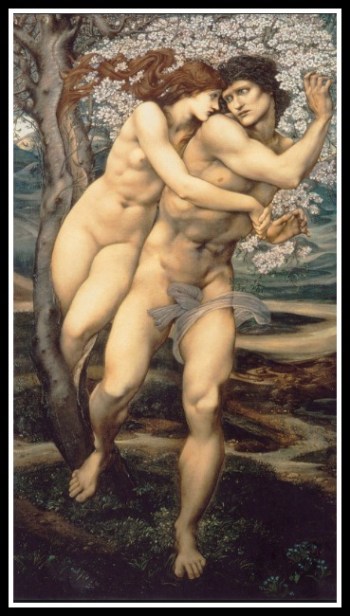
"The Tree of Forgiveness." by Edward Burne-Jones. 19th century. “The Tree of Forgiveness.” by Edward Burne-Jones. 19th century.

guarda_griega1_3-1-1 (1)

_________________________________________________________________

⇒“Metamorphoses” by Ovid:

"Metamorphoses" by Ovid. Illustration by George Sandys. 1632. “Metamorphoses” by Ovid. Illustration by George Sandys. 1632.

In my previous post, I have mentioned Ovid´s book “Metamorphoses”as a key source of Greek Mythology. 

“Metamorphoses” is a narrative poem in fifteen books by the Roman poet Ovid, completed in 8 CE.

It is a “mock-epic” poem, written in dactylic hexameter, the form of the great epic poems of the ancient tradition, such as “The Iliad” and  “The Odyssey.

This poem describes the creation and history of the world, incorporating many classical myths.

Love and hubris are main topics in Ovid´s “Metamorphoses”. 
Unlike the predominantly romantic notions of Love, Ovid considered love more as a dangerous, destabilizing force.
However, there is an explanation for this attitude: during the reign of Augustus, the Roman emperor during Ovid’s time, major attempts were made to regulate morality by creating legal and illegal forms of love, by encouraging marriage…

View original post 1,894 more words

Carl Jung: Hitler himself (from what I heard) is more than half crazy.

Standard

Anonymousdear Mrs. N., 5 October 1939If there hadn’t been such a throng of things lately I surely would have written to you long ago. It is a curious thing that the closer people are to very …

Source: Carl Jung: Hitler himself (from what I heard) is more than half crazy.

Carl Jung: If they [England & France] should lose the war, we also shall not escape the reign of the Antichrist.

Standard

To Henriette GoodrichMy dear Mrs. Goodrich, 20 May 1940Your very kind letter has touched me profoundly. I hope I have not to avail myself of your most generous proposition. My whole family includin…

Source: Carl Jung: If they [England & France] should lose the war, we also shall not escape the reign of the Antichrist.

Carl Jung: If they [England & France] should lose the war, we also shall not escape the reign of the Antichrist.

Standard

Carl Jung: As nothing can happen without a pre-existing pattern, not even creation ex nihilo,…

Standard

Carl Jung: As nothing can happen without a pre-existing pattern, not even creation ex nihilo,…

Standard

“Just as the decision to become man apparently makes use of the ancient Egyptian model, so we can expect that the process itself will follow certain prefigurations.” ~Carl Jung, CW 11, par. 625“As …

Source: Carl Jung: As nothing can happen without a pre-existing pattern, not even creation ex nihilo,…

Carl Jung: I’m very much interested in your new parapsychological enterprise which you promise.

Standard

Carl Jung: I’m very much interested in your new parapsychological enterprise which you promise.

Standard

To J.B. RhineDear Dr. Rhine, 5 November 1942Thank you for your kind letter. I’m very much interested in your new parapsychological enterprise which you promise. If I have any comments to make…

Source: Carl Jung: I’m very much interested in your new parapsychological enterprise which you promise.