
Greek Mythology: “Selene, Goddess of the Moon” / Poetry: “Selene Awakens”, by Christy Birmingham.-
Gallery
►Greek Mythology: “Selene, Goddess of the Moon”:
►Poetry: “Selene Awakens”, by Christy Birmingham:

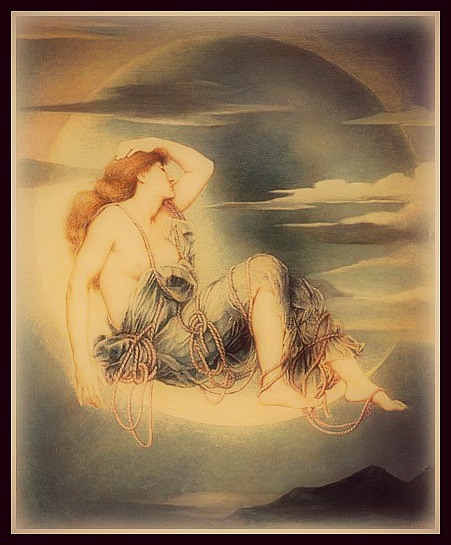 “Luna” by Evelyn De Morgan (1885).

__________________________________________________________________________________________________
Selene is the Greek Goddess of the Moon. She is the daughter of the Titans Hyperion and Theia.
Besides, Selene is sister of the Sun-God Helios, and Eos, Goddess of the Dawn.
In classical times, Selene was often identified with Artemis, much as her brother, Helios, was identified withApollo.
Just as Helios, from his identification with Apollo, is called Phoebus (“bright”), Selene, from her identification with Artemis, is also commonly referred to by the epithet Phoebe (feminine from the name is of Greek origin, it is likely connected to the word selas (σέλας), meaning “light”.
Both Selene and Artemis were also associated with Hecate, and all three were regarded as Lunar Goddesses, although only Selene was regarded as the personification…
View original post 640 more words
►Philosophy: “Plato´s Cave and Fifteen Million Merits” (Black Mirror).-
Gallery►Philosophy: “Plato´s Cave and Fifteen Million Merits” (Black Mirror):


__________________________________________________________________
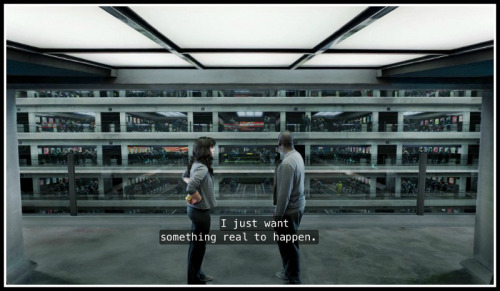
Hello readers! This is a post in collaboration with Christy Birmingham, from Poetic Parfait and When Women Inspire. You might wonder how the idea of writing this post came up. Well, basically, I had begun watching Season Three of Black Mirror, which was recently released on Netflix. I told Christy how much I liked it, and, from that moment, we started chatting about the series. Soon after, Christy watched “The Entire History of You”, which is the third episode of the first season, followed by “Fifteen Million Merits” (the second episode of the same season).
We discussed both episodes. And we decided to do a post on the latter. Therefore, this complete post was a result of the exchanges of points of views. But each one of us focused on particular themes.
 Christy Birmingham
Christy wrote…
View original post 3,077 more words
In What Can We Trust?
StandardIn What Can We Trust?
StandardLast night I had two dreams, my first since the presidential election. They were helpful, and I hope they might be helpful to some of you.
Source: In What Can We Trust?
Plato´s “Republic”: “The Allegory of the Cave and the Analogy of the Divided Line”.-
Standard♠ Plato´s “Republic”: “The Allegory of the Cave and the Analogy of the Divided Line”:
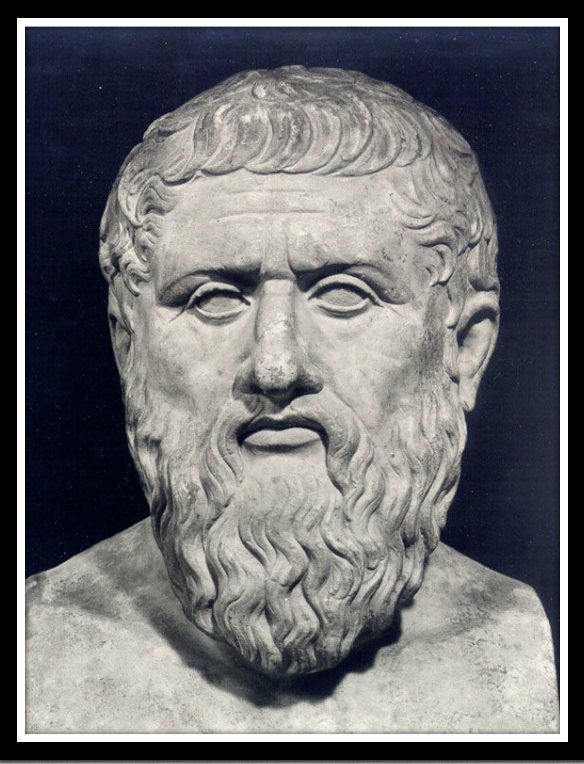 Plato (427/347 BCE).-
________________________________________________________________________________________________
Plato’s Allegory of the Cave is written as a dialogue between Plato’s teacher Socrates and Plato’s brother Glaucon at the beginning of “The Republic” Book VII (514a–520a). This allegory is presented after the analogy of the sun (507b–509c) and the analogy of the divided line (509d–513e).
In the allegory, Plato likens people untutored in the Theory of Forms to prisoners chained in a cave, unable to turn their heads. All they can see is the wall of the cave. Behind them burns a fire. Between the fire and the prisoners there is a parapet, along which puppeteers can walk. The puppeteers, who are behind the prisoners, hold up puppets that cast shadows on the wall of the cave. The puppeteers are just people outside the cave walk along this walkway, who…
View original post 939 more words
Carl Jung: Your ear troubles are very distressing.
StandardTo Dr. S.Dear Colleague, 15 July 1939I am here again in October and can see you then.Your ear troubles are very distressing. They can of course be considerably intensified or reduced by one’s…
Carl Jung: Your ear troubles are very distressing.
Standard►Greek Mythology: “Andromeda and Perseus” / Poetry: “On The Sonnet”, by John Keats 💫.-
Gallery

 “Perseus and Andromeda” by Gustave Moreau. 1869.

__________________________________________________________________________________________________________________
Andromedawas the beautiful daughter of King Cepheus and Queen Cassiopeia of Joppa in Palestine (called Ethiopia).
Cassiopeia had offendedthe Nereids by boasting that Andromeda was more beautiful than they, so in revenge Poseidon sent a sea monster called Cetus to ravage Cepheus’ kingdom as divine punishment.
Since only Andromeda’s sacrifice would appease the gods, she was chained to a rock and left to be devoured by the monster.
Meanwhile, Perseus had already killed the fearsome Gorgon Medusa .
As he was riding the winged horse, Pegasus over Africa in his return home, he encountered the Titan Atlas, who challenged him.
In their confrontation, Perseus used Medusa’s head to turn the Titan into stone.
Later on, he came across the beautiful chained Andromeda, and as he did, he approached Cetus while being invisible (because he was wearingHades’s helm, which…
View original post 1,529 more words
Poetry / Poesía: William Shakespeare: “Sonnet CXVI” / “Soneto CXVI”.-
Standard♠Poetry / Poesía:
William Shakespeare: “Sonnet CXVI” / “Soneto CXVI”:

____________________________________________________________________________________________________________________________
♠Poesía: William Shakespeare: “Soneto CXVI”:
 Soneto 116 en castellano.-
___________________________________________________________________________________________________________________________
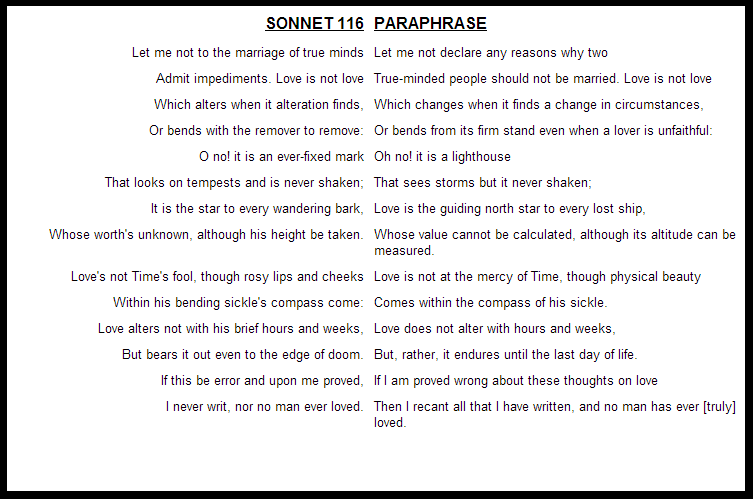
♠William Shakespeare: “Sonnet 116”:

_____________________________________________________________________________________________________________________
♠William Shakespeare: “Sonnet 116”: “Let me not to the marriage of true minds”:
_____________________________________________________________________________________________________________________
♠William Shakespeare´s Sonnet 116:
“Summary & Analysis”:
Shakespeare´s Sonnet 116 was first published in 1609. Its structure and form are a typical example of the Shakespearean Sonnet
The poet begins by stating he should not stand in the way of true love. Love cannot be true if it changes for any reason. Love is supposed to be constant, through any difficulties. In the sixth line, a nautical reference is made, alluding that love is much like the north star to sailors. Love should also not fade with time; instead, true love lasts forever.
This sonnet attempts to define love, by telling both what it is and is not. In the…
View original post 1,181 more words
 lampmagician
You must be logged in to post a comment.