Amen, you are the lord of the beginning. ~Carl Jung

Standard

lewislafontaine's avatarCarl Jung Depth Psychology

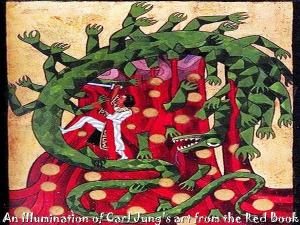
Amen, you are the lord of the beginning.
Amen, you are the star of the East.
Amen, you are the jfower that blooms over everything.
Amen, you are the deer that breaks out of the forest.
Amen, you are the song that sounds far over the water.
Amen, you are the beginning and the end. ~Carl Jung; Red Book.

126 In “Dreams,” Jung noted on January 3, 19I7: “In Lib. nov. snake image III incent” [stimulus to snake image III in Liber NOvus] (p. I). This notation appears to refer to
this image.
127 Image legend: “brahmallaspati.” Julius Eggling notes that “Brihaspati or Brahmanaspati, the lord of prayer or worship, takes the place of Agni, as the representative of the priestly dignity … In Rig-Veda X, 68,9 … Brihaspati is said to have found (avindat) the dawn, the sky and the fire (agni), and to have chased away the darkness…

View original post 39 more words

A Blind Alley to be Avoided: Isolation

Standard

Source: A Blind Alley to be Avoided: Isolation

A Blind Alley to be Avoided: Isolation

Standard

lewislafontaine's avatarCarl Jung Depth Psychology

A Blind Alley to be Avoided: Isolation

WHEN MAN has realized that he carries the world’s fortune in himself and that a limitless future stretches before him in which he cannot founder, his first reflex often leads him along the dangerous course of seeking fulfillment in isolation.

In one example of this-flattering to our private egotism- some innate instinct, justified by reflection, inclines us to think that to give ourselves full scope we must break away as far as possible from the crowd of others. Is it not in our aloofness from our fellows, or alternatively in their subjection to ourselves, that we will find that ‘utmost limit of ourselves’ which is our declared goal? The study of the past teaches us that, with the onset of reflection, an element partially liberated from phyletic servitudes began to live for itself. So is it not in a line continuous with that…

View original post 508 more words

Carl Jung’s Red Book Illumination #119

Standard

Source: Carl Jung’s Red Book Illumination #119

Carl Jung’s Red Book Illumination #119

Standard

lewislafontaine's avatarCarl Jung Depth Psychology

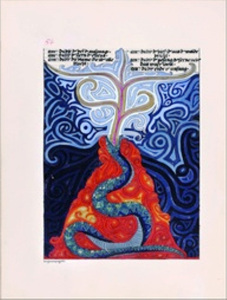
Carl Jung’s Illumination #119 from The Red Book.

I am he, the nameless one, who does not know himself and whose name is concealed even from himself I have no name, since I have not yet existed, but have only just become. To myself I am an Anabaptist and a stranger. I, who I am, am not it. But
I, who will be I before me and after me, am it. In that I abased myself I elevated myself as another. In that I accepted myself I divided myself into two, and in that I united myself with myself I became the smaller part of myself I am this in my consciousness. However, I am thus in my consciousness as if I were also separated
from it. I am I [Image119] I not in my second and greater state, as if I were this second and greater one mysel£ but…

View original post 126 more words

Izdubar

Standard

lewislafontaine's avatarCarl Jung Depth Psychology

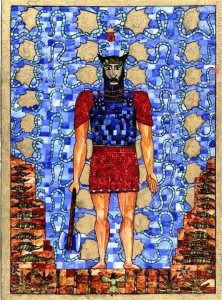
This is a portrait of Izdubar. Izdubar was an early name given the figure now known as Gilgamesh, based on a mistranscription. It resembles an illustration of him in Wilhelm Roscher’s Ausführliches Lexikon der griechischen und römischen Mythologie. Jung discussed the Gilgamesh epic in 1912 in Transformations and Symbols of the Libido, using the corrected form. His use of the older form here indicates that the figure is related to, but not identical to the figure in the epic. Jung encounters Izdubar in a fantasy. Jung says that he comes from the West, and tells Izdubar about the setting of the sun, the roundness of the earth, and the emptiness of space. Izdubar wants to know where he gets his knowledge from, and whether there is an immortal land where the sun goes for rebirth. Jung says he comes from a world where this is science. Izdubar is aghast to…

View original post 389 more words

“My sister, my soul, what do you say?” ~Carl Jung

Standard

Source: “My sister, my soul, what do you say?” ~Carl Jung

“My sister, my soul, what do you say?” ~Carl Jung

Standard

Unknown's avatarCarl Jung Depth Psychology

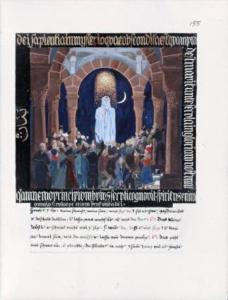
Carl Jung; Red Book Illustration #155:

I spoke to her: “My sister, my soul, what do you say?”

But she spoke, flattered and therefore tolerantly: “I let grass grow over everything that you do.”

I: “That sounds comforting and seems not to say much.”

S: “Would you like me to say much? I can also be banal, as you know, and let myself be satisfied in that way.”

I: “That seems hard to me. I believe that you stand in a close connection with everything beyond,” ~Carl Jung; Red Book

In “The psychological aspects of the Kore” (1951), Jung anonymously described this image as “Then she [the anima] appears in a church, taking the place of the
altar, still over-life-size but with veiled face.”

He commented: “Dream xi restores the anima to the Christian church, not as an icon but as the altar itself The altar is the place of…

View original post 273 more words

Carl Jung’s Vision of Emma Jung

Standard

Source: Carl Jung’s Vision of Emma Jung