Carl Jung on the Perils of Noise in Modern Times

Standard

lewislafontaine's avatarCarl Jung Depth Psychology

Carl Jung on Noise in Modern Times:

Carl G. Jung [September 1957]

Dear Professor Oftinger:

Unfortunately I am so old and tired that I am no longer able comply with your wish. You maybe assured, however, that I have every sympathy with your project and understand it only too well. I personally detest noise and flee it whenever and wherever possible, because it only disturbs the concentration needed for my work but forces me to make the additional physic effort of shutting it out.

You may get habituated to it as to over indulgence to alcohol, but just as you pay for this with cirrhosis of the liver, so in the end you pay for nervous stress with a premature depletion of your vital substance. Noise is certainly only one of evils our time, though perhaps most obtrusive.

The others are gramophone, the radio, and now the blight of television…

View original post 885 more words
Some Carl Jung Quotations XLIX

Standard

lewislafontaine's avatarCarl Jung Depth Psychology

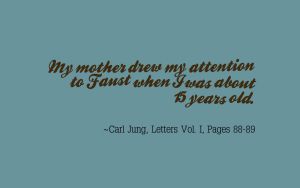
My mother drew my attention to Faust when I was about 15 years old. ~Carl Jung, Letters Vol. I, Pages 88-89

Faust is out of this world and therefore it transports you; it is as much the future
as the past and therefore the most living present. ~Carl Jung, Letters Vol. I, Pages 88-89

Dreams may sometimes announce certain situations long before they actually happen. This is not necessarily
a miracle or a form of precognition. Many crises in our lives have a long unconscious history. ~Carl Jung, Man and His Symbols, Page 29

No genius has ever sat down with a pen or a brush in his hand and said: “Now I am going to invent a
symbol.” ~Carl Jung, Man and His Symbols, Page 55.

In other words, though an individual’s visible personality may seem quite
normal, he may well be concealing from others—or even from himself—the deplorable

View original post 618 more words

Man and His Environment

Standard

Unknown's avatarCarl Jung Depth Psychology

Man and His Environment

Hans Carol, a Swiss geographer from Zurich University, sought views on regional planning for the Canton of Zurich from influential persons, among whom was Jung, who gave him a half-hour appointment in February 1950. The subject so engrossed Jung that he kept Carol nearly an hour longer. Carol came across notes of their conversation some years later and wrote them up for the Neue Zurcher Zeitung’s literary supplement, June, 1963; a slightly expanded account appeared in the magazine Landscape in 1965. The following is reprinted from the anthology, Jung Speaking.

Carol: I would be grateful if you, as a leading psychologist, would comment on the subject of man and his environment. Although we planners try not to look at the human being as a mere product of his physical environment, we believe nonetheless that the environment is a crucial factor in human existence. Just as men…

View original post 667 more words

Married on Valentine’s Day

Standard

Unknown's avatarCarl Jung Depth Psychology

Married on Valentine’s Day:

The couple met when she was sixteen years old (some sources say fifteen) and he was twenty one. They were married on 14 February 1903 (Valentine’s Day) seven years after they first met. Together they had five children: Agathe, Gret, Franz, Marianne and Helene.

When Emma died Carl Jung carved a stone in her name, “She was the foundation of my house.” He is also said to have cried “She was a queen! She was a queen!” while mourning for her. The inscription Jung put on Emma’s grave was “Oh vase, sign of devotion and obedience.”

Carl Jung wrote to Erich Neumann at the time of Emma’s death:

Dear Neumann:

Deepest thanks for you heartfelt letters…I am sorry that I can only set down these dry words, but the shock I have experienced is so great that I can neither concentrate nor recover my power of…

View original post 431 more words

Are Psychological Types Inherited or Learned?

Standard

Source: Are Psychological Types Inherited or Learned?

Are Psychological Types Inherited or Learned?

Standard

lewislafontaine's avatarCarl Jung Depth Psychology

“There is, finally, a third group, and here it is hard to say whether the motivation comes chiefly from within or without. This group is the most numerous and includes the less differentiated normal man” (Jung, 1971. Jung, C. G. (1971). Psychological types. In W. McGuire (Ed.) The collected works of C. G. Jung (Vol. 6), Bollingen Series XX. Princeton, NJ: Princeton University Press.)

Attitudes signifies expectation, and expectation always operates selectively and with a sense of direction.(Psychological Types by C G Jung : Para 688, Page 415)

When a function habitually predominates, a typical attitude is produced. According to the nature of the differentiated function, there will be constellations of contents that create a corresponding attitude.(Psychological Types by C G Jung : Para 691, Page 417)

Only a limited number of contents can be held in the conscious field at the same time, and of these only a few…

View original post 1,771 more words

Carl Jung, Plotinus, Greek Myth, Depth Psychology

Standard

Source: Carl Jung, Plotinus, Greek Myth, Depth Psychology