The man’s Eros does not lead upward only but downward into that uncanny dark world of Hecate and Kali, which is a horror to any intellectual man. The understanding possessed by this type of woman will be a guiding star to him in the darkness and seemingly unending mazes of life. ~Carl Jung, Psychology of the Unconscious; Page 100.
Carl Jung and The Book of Job
StandardSource: Carl Jung and The Book of Job
Carl Jung and The Book of Job
Standard• From the ancient records we know that the divine drama was enacted between God and his people, who were betrothed to him, the masculine dynamis, like a woman, and over whose faithfulness he watched jealously. A particular instance of this is Job, whose faithfulness is subjected to a savage test. As I have said, the really astonishing thing is how easily Yahweh gives in to the insinuations of Satan. If it were true that he trusted Job perfectly, it would be logical for Yahweh to defend him, unmask the malicious slanderer, and make him pay for his defamation of God’s faithful servant. But Yahweh never thinks of it, not even after Job’s innocence has been proved. We hear nothing of a rebuke or disapproval of Satan. Therefore we cannot doubt Yahweh’s connivance. His readiness to deliver Job into Satan’s murderous hands proves that he doubts Job precisely because he…
View original post 259 more words
Gilgamesh and the Rig Veda
StandardSource: Gilgamesh and the Rig Veda
Gilgamesh and the Rig Veda
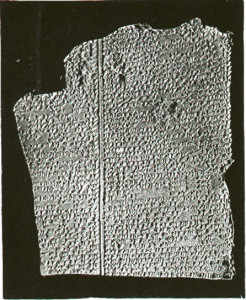
StandardThe Epic of Gilgamesh is, perhaps, the oldest written story on Earth.
It comes to us from Ancient Sumeria, and was originally written on 12 clay tablets in cunieform script.
It is about the adventures of the historical King of Uruk (somewhere between 2750 and 2500 BCE).
Notice how a passage in the first Book of Gilgamesh refers to Gilgamesh as “Man” being 2/3rds God and 1/3rd Human
Who can compare with him in kingliness?
Who can say like Gilgamesh: “I am King!”?
Whose name, from the day of his birth, was called “Gilgamesh”?
Two-thirds of him is god, one-third of him is human. ~Gilgamesh, Book 1.
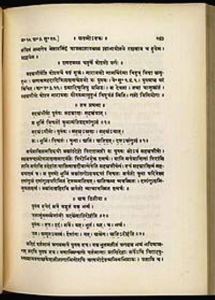
The Rig Veda was written 2200–1600 BC in the Northwestern Subcontinent of India. Notice How this venerable Book refers to Purusha as “Man” being 3/4th Immortal and 1/4th Mortal
HYMN XC. Puruṣha.
1. A THOUSAND heads hath Puruṣa, a thousand eyes, a thousand…
View original post 109 more words
Hindu Brahmans and Gnostics
StandardSource: Hindu Brahmans and Gnostics
Hindu Brahmans and Gnostics
StandardThe Zosimos vision mentioned above betrays the same train of thought, where it is said of the place of transformation:
We have already observed that the place of transformation is really the uterus. Absorption in one’s self (introversion) is an entrance into one’s own uterus, and also at the same time asceticism.
In the philosophy of the Brahmans the world arose from this activity; among the post-Christian Gnostics it produced the revival and spiritual rebirth of the individual, who was born into a new spiritual world.
The Hindu philosophy is considerably more daring and logical, and assumes that creation results from introversion in general, as in the wonderful hymn of Rig Veda, 10, 29, it is said:
” What was hidden in the shell,
Was born through the power of fiery torments.
From this first arose love,
As the germ of knowledge,
The wise found the roots of existence in…
View original post 12 more words
Carl Jung on the Perils of Noise in Modern Times
StandardCarl Jung on the Perils of Noise in Modern Times
StandardCarl Jung on Noise in Modern Times:
Carl G. Jung [September 1957]
Dear Professor Oftinger:
Unfortunately I am so old and tired that I am no longer able comply with your wish. You maybe assured, however, that I have every sympathy with your project and understand it only too well. I personally detest noise and flee it whenever and wherever possible, because it only disturbs the concentration needed for my work but forces me to make the additional physic effort of shutting it out.
You may get habituated to it as to over indulgence to alcohol, but just as you pay for this with cirrhosis of the liver, so in the end you pay for nervous stress with a premature depletion of your vital substance. Noise is certainly only one of evils our time, though perhaps most obtrusive.
The others are gramophone, the radio, and now the blight of television…
View original post 885 more words
Some Carl Jung Quotations XLIX
StandardSource: Some Carl Jung Quotations XLIX


You must be logged in to post a comment.