The Celtic Yin and Yang Symbol

Standard

lewislafontaine's avatarCarl Jung Depth Psychology

n Celtic art, the motif of two interlocking commas that appear to swirl is a recurrent one which can be traced back to the late 5th century BC. With a view to the much later Chinese symbol, art historians of the La Tène culture refer anachronistically to these clinging pairs as “yin yang”.
Early Celtic yin yangs are typically not treated for themselves alone, but appear as part of larger floral or animal ornament, such as revolving leaves at the bottom of a palmette or stylized tails of seahorses. In the 3rd century BC, a more geometrical style develops in which the yin yang now figures as a principal ornamental motif. It is not clear whether the Celts attributed any symbolic value to the emblem, but in those cases where it is placed prominently, such as on the upper end of a scabbard, its use seems to have been apotropaic.

View original post 166 more words

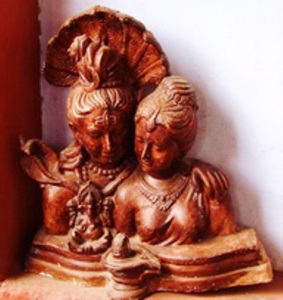
Lord Shiva, his consort Parvati

Standard

Unknown's avatarCarl Jung Depth Psychology

Lord Shiva, his consort Parvati and a small Shiva Linga which is in the centre foreground.

Dr. Jung has refered to this holy union as the “mysterium coniunctionis”. Libido, the energy of the self and the universe. It gets confused with sex. But, it is embodied in the physical relationship between male and female as well as the pyschic relationship between the conscious and unconscious, the masculine energies and feminine energies within, with soul and spirit, with light and shadow.

View original post

Carl Jung: Each person works on his own pillar, until one day the temple will be built.

Standard

Source: Carl Jung: Each person works on his own pillar, until one day the temple will be built.

Carl Jung: Each person works on his own pillar, until one day the temple will be built.

Standard

Unknown's avatarCarl Jung Depth Psychology

Max Zeller: Memory of C.G. Jung

When I was in Zurich in 1949, the first time after the war, I was terribly occupied with the question,
“What am I doing as an analyst?”

With the overwhelming problems in the world, to see twenty or twenty-five patients, that’s nothing.

What are we doing, all of us?

I stayed in Zurich about three months and saw Jung quite a number of times.

Then I had to return to Los Angeles, and the last hour with him came.

The evening before, there was a great feast, a celebration of students and faculty from the Institute at an elegant Swiss hotel.

Every single analyst was made fun of in the most incredible way.

We laughed and howled. Meier was there, and he got quite a load to carry.

Then they took on Mrs. Jung and she got her share.

When they were all through…

View original post 1,130 more words

Carl Jung: Jung said, “Ja, you know, that is the temple we all build on.”

Standard

Source: Carl Jung: Jung said, “Ja, you know, that is the temple we all build on.”

Carl Jung: Jung said, “Ja, you know, that is the temple we all build on."

Standard

lewislafontaine's avatarCarl Jung Depth Psychology

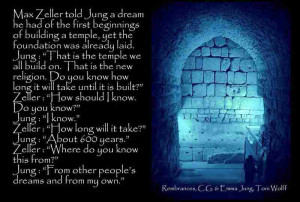
Sometimes when working on the Stone Sanctuary and in considerable doubt about why I am doing what I am doing,I think of Max Zeller’s dream.

In 1949, Zeller, who had spent time in a concentration camp and latter became a Jungian analyst, told Jung this dream:

A temple of vast dimensions was in the process of being built. As far as I could see–ahead, behind, right and left–there were incredible numbers of people building on gigantic pillars. I, too, was building on a pillar.

The whole building process was in its very first beginnings, but the foundation was already there, the rest of the building was starting to go up, and I and many others were working on it.

Jung said, “Ja, you know, that is the temple we all build on.

We don’t know the people because, believe me, they build in India and China and in Russia and…

View original post 177 more words

When a summit of life is reached……

Standard

Source: When a summit of life is reached……

When a summit of life is reached……

Standard

lewislafontaine's avatarCarl Jung Depth Psychology

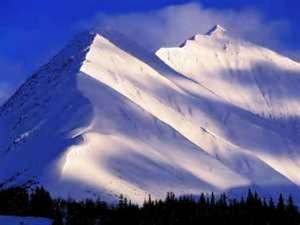
“When a summit of life is reached, when the bud unfolds and from the lesser the greater emerges, then, as Nietzsche says, “One becomes Two,” and the greater figure, which one always was but which remained invisible, appears to the lesser personality with the force of a revelation.

He who is truly and hopelessly little will always drag the revelation of the greater down to the level of his littleness, and will never understand that the day of judgment for his littleness has dawned. But the man who is inwardly great will know that the long expected friend of his soul, the immortal one, has now really come, “to lead captivity captive”: that is, to seize hold of him by whom this immortal had always been confined and held prisoner, and to make his life flow into that greater life-a moment of deadliest peril!

Nietzsche’s prophetic vision of the Tightrope…

View original post 37 more words