What Made Freddie Mercury the Greatest Vocalist in Rock History? The Secrets Revealed in a Short Video Essay

Standard
By http://www.openculture.com/
I like his voice but as I like more Rony James Dio’s voice! But to put it bluntly, Freddie Mercury’s is a something very special. Anyway, this analysis is nice to observe 🙂

I wasn’t always a Queen fan. Having cut my music fan teeth on especially downbeat, miserable bands like Joy Division, The Cure, and The Smiths, I couldn’t quite dig the unabashed sentimentality and operatic bombast. Like one of the “Kids React to Queen” kids, I found myself asking, “What is this?” What turned me around? Maybe it was the first time I heard Queen’s theme song for Flash Gordon. The 1980 space opera is most remarkable for Max von Sydow’s turn as Ming the Merciless, and for those bursts of Freddie Mercury and his mates’ multi-tracked voices, explosions of syncopated angel song, announcing the coming of the eighties with all the high camp of Rocky Horror and the rock confidence of Robert Plant.

As a frontman, Mercury had so much more than the perfect style and stance—though he did own every stage he set foot on. He had a voice that commanded attention, even from mopey new wave teenagers vibrating on Ian Curtis’s frequency. What makes Mercury’s voice so compelling—as most would say, the greatest vocalist in all of rock history? One recent scientific study concluded that Mercury’s physical method of singing resembled that of Tuvan throat singers.

He was able to create a faster vibrato and several more layers of harmonics than anyone else. The video above from Polyphonic adds more to the explanation, quoting opera soprano Montserrat Caballé, with whom Mercury recorded an album in 1988. In addition to his incredible range, Mercury “was able to slide effortlessly from a register to another,” she remarked. Though Mercury was naturally a baritone, he primarily sang as a tenor, and had no difficulty, as we know, with soprano parts.

 https://youtu.be/MS4_Z84-rRE


Mercury was a great performer—and he was a great performative vocalist, meaning, Caballé says, that “he was selling the voice…. His phrasing was subtle, delicate and sweet or energetic and slamming. He was able to find the right colour or expressive nuance for each word.” He had incredible discipline and control over his instrument, and an underrated rhythmic sensibility, essential for a rock singer to convincingly take on rockabilly, gospel, disco, funk, and opera as well as the blues-based hard rock Queen so easily mastered. No style of music eluded him, except perhaps for those that call for a certain kind of vocalist who can’t actually sing.

That’s the rub with Queen—they were so good at everything they did that they can be more than a little overwhelming. Watch the rest of the video to learn more about how Mercury’s superhuman vibrato produced sounds almost no other human can make; see more of Polyphonic’s music analysis of one-of-a-kind musicians at our previous posts on Leonard Cohen and David Bowie’s final albums and John Bonham’s drumming; and just below, hear all of those Mercury qualities—the vibrato, the perfect timing, and the expressive performativity—in the isolated vocal track from “I Want to Break Free” just below.

Related Content:

Scientific Study Reveals What Made Freddie Mercury’s Voice One of a Kind; Hear It in All of Its A Cappella Splendor

Watch Behind-the-Scenes Footage From Freddie Mercury’s Final Video Performance

Queen Documentary Pays Tribute to the Rock Band That Conquered the World

Josh Jones is a writer and musician based in Durham, NC. Follow him at @jdmagness

More Illustrated Alice

Standard

Cakeordeath's avatarcakeordeathsite

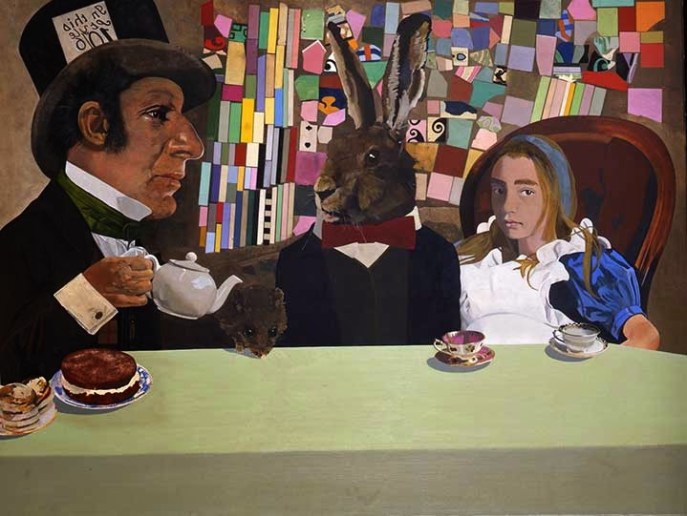
Peter Blake-Alice In wonderland 1970 Peter Blake-Alice in Wonderland 1970

I previously wrote about the illustrations that have graced the Alice books over the years, with a special emphasis on the Surrealists (see my post Illustrating Alice). However this generated such a large response from readers that I soon realised that I had barely scratched the surface, as Alice has been published in thousands of editions in over a hundred languages, with a myriad of differing artistic interpretations worldwide and therefore a follow up post was very much in order.

Several Australian readers mentioned the paintings of Charles Blackman featuring Alice which certainly possess intensity and verve. Also noted was another artist from the Antipodes, (or the Antipathies as Alice called the Land Down Under during her descent down the rabbit hole),  Donna Leslie and her brilliant illustrations for the bilingual adaption Alitji In The Dreamtime in Pitjantjatjara and Australian English, that drew heavily on…

View original post 182 more words

“The Message of Mr Cogito” by Zbigniew Herbert

Standard

Via https://symbolreader.net/


Remembering Queen in their finest hour

Standard

Jack Eason's avatarHave We Had Help?

Back in the nineteen-seventies the best rock band of them all was Queen – the late Freddie Mercury, aka Farrokh Bulsara (Lead vocals and keyboards), Dr Brian May (Lead guitar), John Deacon (Bass guitar) and Roger Taylor (Drums). To this day no other rock band has even come close to their brilliance and musicality, no matter what anyone says to the contrary.

By the way, if you are wondering, Freddy’s lineage was Iranian, and Brian May is a doctor of Astrophysics…

View original post

Maiden Name

Standard

Niall O'Donnell's avatarEnglish-Language Thoughts

You may never have thought much about this term. It probably seems fairly logical to you. It’s the name your mother had when she was a younger woman, before she was married, and maiden is an old word for a young woman, isn’t it? Yes, but as always, there’s a little more to it than that.

View original post 181 more words

Prisca Theologia

Standard

P. James Clark's avatarThe Classical Astrologer

Hermes Trismegistus, floor mosaic in the Cathedral of Siena

This brief article is intended as an introduction to a much larger study of the relationship between enlightened wisdom versus narrow-minded dogma. In the process, I will focus on the Universal approach to religion as taught by Zoroaster and demonstrated by the extraordinary tolerance and benevolence of Darius I,  king of the Persian Achaemenid Empire.  The Persian Empire at this time included most West Asia, the Caucasus,  Thrace, -Macedonia, and Paeonia. It also reached the Black Sea coastal regions, the North Caucasus, and Central Asia

Darius was the author of the first bill of rights, was the liberator of the Jews, banishment of slavery and subscribed policy of noninterference with the religions of other groups.  This meant that the religion of Zoroaster had been spread through most of the known world. long before Alexander.

The Prisca Theologia is one of the…

View original post 2,925 more words

The White Album

Standard

Niall O'Donnell's avatarEnglish-Language Thoughts

Have you ever wondered why we call a group of songs released together by the same band or artist an album? No? Well, I guess you and I are just very different people then…

It occurred to me as strange recently while writing about mistletoe. If you recall, the plant’s Latin name is ViscusAlbum, with Album meaning white. How did we get from there to a music album?

View original post 292 more words

Songs from the Gathas – Removing Spells & Illness

Standard

P. James Clark's avatarThe Classical Astrologer

A Persian Zoroastrian King and his young son, Salmân al-Fârisî, enter a fire temple administered by three priests,

This is another of those topics which deserve a lengthy article, but for now a blog entry will have to suffice as an introduction to a highly complex topic. The video, shown below, was made available on YouTube by a Zoroastrian gentleman who has an extraordinary channel at Fereydoun Rasti Zoroastrianism & Iran If this material interests you, I heartily recommend looking through the extensive archives of videos. 

I posted this rather lengthy video because it uses the Zoroastrian scriptures known as the Gathas. The similarity to the Vedic word Gita (song) is no accident: Maneckji Nusservanji Dhalla states that “It is an uncontested fact that there is a marked closeness between the grammar,metre, and style of the Rig Veda and the Gathas.” (History of Zoroastrianismp11).. The power of words…

View original post 683 more words