

Everyone has inside of them a piece of good news. The good news is that you don’t know how great you can be! How much you can love! What you can accomplish! And what your potential is!
-Anne Frank

Everyone has inside of them a piece of good news. The good news is that you don’t know how great you can be! How much you can love! What you can accomplish! And what your potential is!
-Anne Frank


One of my favorite goddesses is the Gaelic goddess Nicnevin also known as The Queen of Elphame, Queen of the Fairies of Fife or Gyre Carlin, the Bone mother.
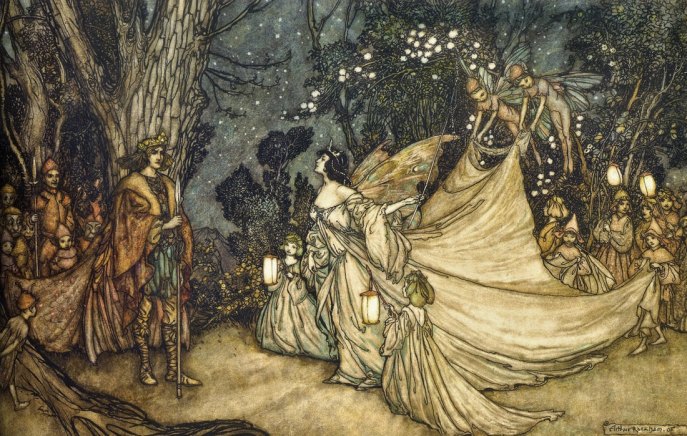
The Fairy Queen, illustration by Arthur Rackham
Nicnevin name evolved from the Gaelic Nic an Neamhain, meaning “Daughter of Flap,” spirit-woman or goddess who personifies the frenzied havoc of war. She is symbolized by flying geese similar to the symbols of the Roman goddess Juno. Succeeding the chaotic Christian witch trials, she was then categorized as a Seelie (benevolent fairy) Queen of Elphame and Unseelie (malevolent fairy) Nicnevin goddess of Witches. She represents both sides of the divine feminine.
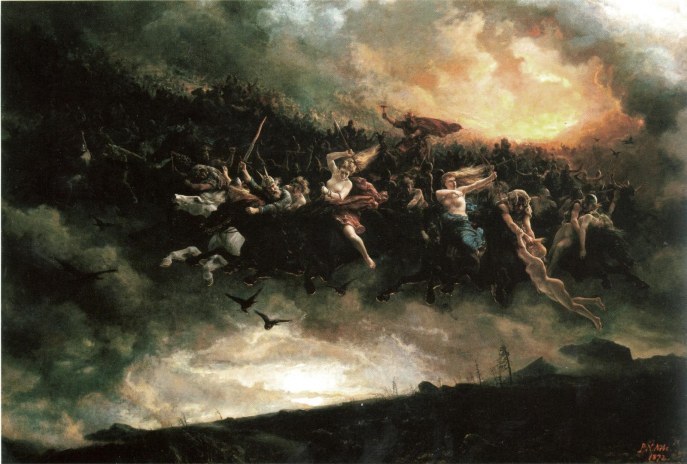
The wild hunt: Asgårdsreien (1872) by Peter Nicolai Arbo
Nicnevin is associated with the dead riders of the night in German folklore of the Wild Hunt. She is a shape shifter representing once more the divine feminine. She…
View original post 358 more words
 Piranesi-Carceri d’invenzione (Imaginary Prisons)-Title Plate-1745-1761
In the mid-eighteenth century, the would be Venetian architect, etcher of Roman views and manufacturer of hybrid artefacts, Giovanni Battista Piranesi, produced a remarkable series of prints entitled Carceri d’invenzione (Imaginary Prisons). The Imaginary Prisons can be classed as capricci, architectural fantasies, however these astounding visions would have an impact far beyond the narrow limits of this particular genre.
The first plate of fourteen prints was published between 1745-1750 and later revised with two additional etchings in 1761. It’s most obvious and immediate influence was upon the craze for the Gothic novel that swept throughout Europe in the late 18th Century. The Prisons would also exercise a considerable hold upon the imagination of the English Romantics. Not only do we find the two original gentleman junkies, Thomas De Quincey and Samuel Coleridge, discussing Piranesi at length in De Quincey’s classic autobiography and drug memoir, Confessions…
View original post 246 more words
Sunday, May 6, 2018
Hello, one and all! It’s Get Caught Reading Month. I couldn’t resist making a video for the mini-series Chris Graham – the Story Reading Ape and I are doing in honor of this event. Please click here for episode-1 of Artie Meets the Alchemist*. Video trailer follows.
Learn how to win a free Kindle copy of one of my books!
***
Now, promoting my “partner in crime” Chris Graham.
 A lovely book of poetry by Chris Graham’s mom
***
And my own shameless self-promotion…


Murder at the Bijou — Three Ingredients I

This is a work of fiction. Characters, names, places, and incidents are either the product of the author’s imagination or are used fictitiously, and any resemblance to actual persons, living or…
View original post 75 more words
In the portrait
she wears a coral
shawl across her
shoulders.
Terracotta lips
are set in granite.
Her eyes are the
color of the earth,
they scream the
anguish of the world.
Her image is etched
into ragged tapestry
hung from nails
on a farmhouse wall.
She is captured by the
hand of a woman uprising.
She is proud,
she is Mexico.

self portrait by Frida Kahlo
In honor of our beautiful neighbors to the South…Mexico
Via: http://www.openculture.com/

In the spring of 1934, a young man who wanted to be a writer hitchhiked to Florida to meet his idol, Ernest Hemingway.
Arnold Samuelson was an adventurous 22-year-old. He had been born in a sod house in North Dakota to Norwegian immigrant parents. He completed his coursework in journalism at the University of Minnesota, but refused to pay the $5 fee for a diploma. After college he wanted to see the country, so he packed his violin in a knapsack and thumbed rides out to California. He sold a few stories about his travels to the Sunday Minneapolis Tribune.
In April of ’34 Samuelson was back in Minnesota when he read a story by Hemingway in Cosmopolitan, called “One Trip Across.” The short story would later become part of Hemingway’s fourth novel, To Have and Have Not. Samuelson was so impressed with the story that he decided to travel 2,000 miles to meet Hemingway and ask him for advice. “It seemed a damn fool thing to do,” Samuelson would later write, “but a twenty-two-year-old tramp during the Great Depression didn’t have to have much reason for what he did.”
And so, at the time of year when most hobos were travelling north, Samuelson headed south. He hitched his way to Florida and then hopped a freight train from the mainland to Key West. Riding on top of a boxcar, Samuelson could not see the railroad tracks underneath him–only miles and miles of water as the train left the mainland. “It was headed south over the long bridges between the keys and finally right out over the ocean,” writes Samuelson. “It couldn’t happen now–the tracks have been torn out–but it happened then, almost as in a dream.”
When Samuelson arrived in Key West he discovered that times were especially hard there. Most of the cigar factories had shut down and the fishing was poor. That night he went to sleep on the turtling dock, using his knapsack as a pillow. The ocean breeze kept the mosquitos away. A few hours later a cop woke him up and invited him to sleep in the bullpen of the city jail. “I was under arrest every night and released every morning to see if I could find my way out of town,” writes Samuelson. After his first night in the mosquito-infested jail, he went looking for the town’s most famous resident.
When I knocked on the front door of Ernest Hemingway’s house in Key West, he came out and stood squarely in front of me, squinty with annoyance, waiting for me to speak. I had nothing to say. I couldn’t recall a word of my prepared speech. He was a big man, tall, narrow-hipped, wide-shouldered, and he stood with his feet spread apart, his arms hanging at his sides. He was crouched forward slightly with his weight on his toes, in the instinctive poise of a fighter ready to hit.
“What do you want?” said Hemingway. After an awkward moment, Samuelson explained that he had bummed his way from Minneapolis just to see him. “I read your story ‘One Trip Across’ in Cosmopolitan. I liked it so much I came down to have a talk with you.” Hemingway seemed to relax. “Why the hell didn’t you say you just wanted to chew the fat? I thought you wanted to visit.” Hemingway told Samuelson he was busy but invited him to come back at one-thirty the next afternoon.
After another night in jail, Samuelson returned to the house and found Hemingway sitting in the shade on the north porch, wearing khaki pants and bedroom slippers. He had a glass of whiskey and a copy of the New York Times. The two men began talking. Sitting there on the porch, Samuelson could sense that Hemingway was keeping him at a safe distance: “You were at his home but not in it. Almost like talking to a man out on a street.” They began by talking about the Cosmopolitan story, and Samuelson mentioned his failed attempts at writing fiction. Hemingway offered some advice.
“The most important thing I’ve learned about writing is never writing too much at a time,” Hemingway said, tapping my arm with his finger. “Never pump yourself dry. Leave a little for the next day. The main thing is to know when to stop. Don’t wait till you’ve written yourself out. When you’re still going good and you come to an interesting place and you know what’s going to happen next, that’s the time to stop. Then leave it alone and don’t think about it; let your subconscious mind do the work. The next morning, when you’ve had a good sleep and you’re feeling fresh, rewrite what you wrote the day before. When you come to the interesting place and you know what is going to happen next, go on from there and stop at another high point of interest. That way, when you get through, your stuff is full of interesting places and when you write a novel you never get stuck and you make it interesting as you go along.”
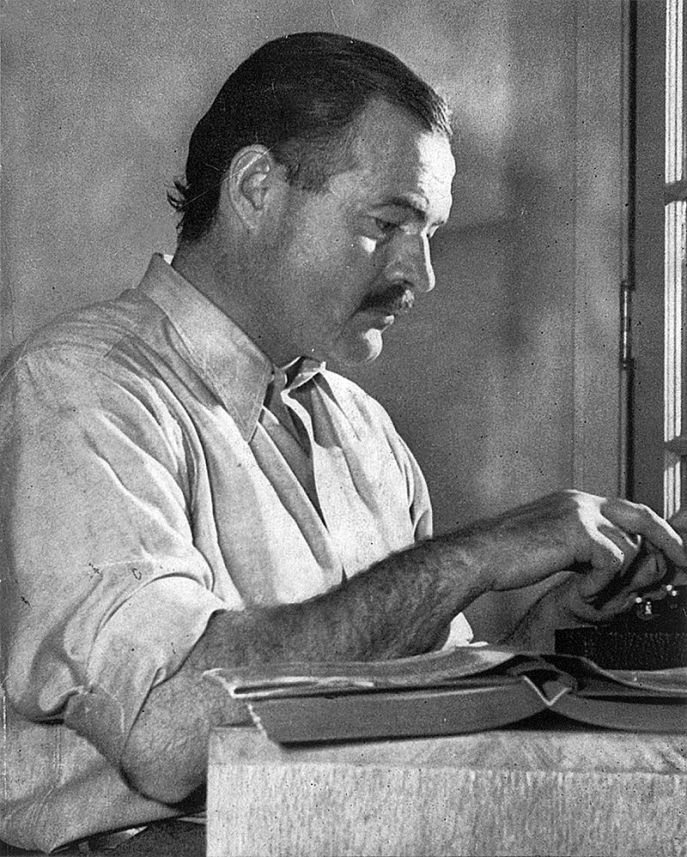
Hemingway advised Samuelson to avoid contemporary writers and compete only with the dead ones whose works have stood the test of time. “When you pass them up you know you’re going well.” He asked Samuelson what writers he liked. Samuelson said he enjoyed Robert Louis Stevenson’s Kidnapped and Henry David Thoreau’s Walden. “Ever read War and Peace?” Hemingway asked. Samuelson said he had not. “That’s a damned good book. You ought to read it. We’ll go up to my workshop and I’ll make out a list you ought to read.”
His workshop was over the garage in back of the house. I followed him up an outside stairway into his workshop, a square room with a tile floor and shuttered windows on three sides and long shelves of books below the windows to the floor. In one corner were a big antique flat-topped desk and an antique chair with a high back. E.H. took the chair in the corner and we sat facing each other across the desk. He found a pen and began writing on a piece of paper and during the silence I was very ill at ease. I realized I was taking up his time, and I wished I could entertain him with my hobo experiences but thought they would be too dull and kept my mouth shut. I was there to take everything he would give and had nothing to return.
Hemingway wrote down a list of two short stories and 14 books and handed it to Samuelson. Most of the texts you can find in our collection, 800 Free eBooks for iPad, Kindle & Other Devices. If the texts don’t appear in our eBook collection itself, you’ll find a link to the text directly below.
Hemingway reached over to his shelf and picked up a collection of stories by Stephen Crane and gave it to Samuelson. He also handed him a copy of his own novel, A Farewell to Arms. “I wish you’d send it back when you get through with it,” Hemingway said of his own book. “It’s the only one I have of that edition.” Samuelson gratefully accepted the books and took them back to the jail that evening to read. “I did not feel like staying there another night,” he writes, “and the next afternoon I finished reading A Farewell to Arms, intending to catch the first freight out to Miami. At one o’clock, I brought the books back to Hemingway’s house.” When he got there he was astonished by what Hemingway said.
“There is something I want to talk to you about. Let’s sit down,” he said thoughtfully. “After you left yesterday, I was thinking I’ll need somebody to sleep on board my boat. What are you planning on now?”
“I haven’t any plans.”
“I’ve got a boat being shipped from New York. I’ll have to go up to Miami Tuesday and run her down and then I’ll have to have someone on board. There wouldn’t be much work. If you want the job, you could keep her cleaned up in the mornings and still have time for your writing.”
“That would swell,” replied Samuelson. And so began a year-long adventure as Hemingway’s assistant. For a dollar a day, Samuelson slept aboard the 38-foot cabin cruiser Pilar and kept it in good condition. Whenever Hemingway went fishing or took the boat to Cuba, Samuelson went along. He wrote about his experiences–including those quoted and paraphrased here–in a remarkable memoir, With Hemingway: A Year in Key West and Cuba. During the course of that year, Samuelson and Hemingway talked at length about writing. Hemingway published an account of their discussions in a 1934 Esquire article called “Monologue to the Maestro: A High Seas Letter.” (Click here to open it as a PDF.) Hemingway’s article with his advice to Samuelson was one source for our February 19 post, “Seven Tips From Ernest Hemingway on How to Write Fiction.”
When the work arrangement had been settled, Hemingway drove the young man back to the jail to pick up his knapsack and violin. Samuelson remembered his feeling of triumph at returning with the famous author to get his things. “The cops at the jail seemed to think nothing of it that I should move from their mosquito chamber to the home of Ernest Hemingway. They saw his Model A roadster outside waiting for me. They saw me come out of it. They saw Ernest at the wheel waiting and they never said a word.”
Note: An earlier version of this post originally appeared on our site in May 2013.
“The one who is lying to himself is the one who is first offended.” ~ F. Dostoevsky
By SearchingTheMeaningOfLifeThe main thing is not to lie to yourself.
The one who is lying to himself
and believes in his own lie,
it reaches the point of not seeing any truth
neither inside nor in others –
so he loses any appreciation for others
and every self-esteem.
Do not indulge anyone, stop loving.
And not having the love begins to be distraught
passions and achesto work and entertain.
So it reaches absolute brutality and all because it is constantly lying to others and to himself.
The one who is lying to himself
he is the first to be offended.
Why, sometimes, it is very pleasant to feel afflicted.
Is not that right;
Extract from F. Dostoevsky’s book “Brothers of Caramazev”by SearchingTheMeaningOfLife

 Το κυριότερο είναι να μη λέτε ψέματα στον ίδιο τον εαυτό σας.
Αυτός που λέει ψέματα στον εαυτό του
και πιστεύει στο ίδιο του το ψέμα,
φτάνει στο σημείο να μη βλέπει καμιάν αλήθεια
ούτε μέσα του ούτε στους άλλους -
κ΄ έτσι χάνει κάθε εκτίμηση για τους άλλους
και κάθε αυτοεκτίμηση.
Μην εχτιμόντας κανέναν, πάβει ν΄ αγαπάει.
Και μην έχοντας την αγάπη αρχίζει να παρασέρνεται
απ΄τα πάθη και την ακολασία
Το κυριότερο είναι να μη λέτε ψέματα στον ίδιο τον εαυτό σας.
 Αυτός που λέει ψέματα στον εαυτό του
και πιστεύει στο ίδιο του το ψέμα,
φτάνει στο σημείο να μη βλέπει καμιάν αλήθεια
ούτε μέσα του ούτε στους άλλους -
κ΄ έτσι χάνει κάθε εκτίμηση για τους άλλους
 και κάθε αυτοεκτίμηση.
 Μην εχτιμόντας κανέναν, πάβει ν΄ αγαπάει.
Και μην έχοντας την αγάπη αρχίζει να παρασέρνεται
απ΄τα πάθη και την ακολασία
View original post 62 more words
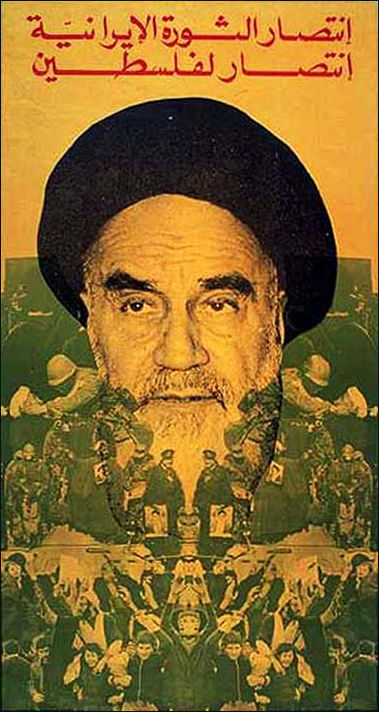 Iran revolutionary victory poster in Arabic. C. 1979
I recently posted a brief article on the Chart of the Year for Tehran. You may wish to consult that in concert with charts in this article.
The geopolitical position of contemporary Iran will be well-known to anyone likely to read this article. The situation is becoming acutely dire as western powers continue to impose sanctions and essentially treat the Iranians like wayward children. Persia is an ancient and proud culture and her people don’t take well to manipulations by other nations who most assuredly do not have their best interests at heart. Moreover, these other nations are considered as the abodes of the unbelievers. Prior to the ousting of the Shah, there was certainly corruption, but Iran was not a Theocracy. This allowed for a porous relationship with the rest of the world.
In the abstract to his 1994 MA Theis, Bhasin Gurbeen writes “the…
View original post 1,227 more words

Flung out of the shrine I used to call
My own.
I seek solace in places ghastly.
Greater than thou but not thou.
Intricately crafted. Divine corporeal!
But not thou.
Sweeter tongues but I do settle for thine.
I pine closure.
I fail to howl.
Unripe grief bears no tears.
Unripe? Or too ripe.
A seething semblance to frail verses .
Now faces stranger to me familiar to you Replace my presence.
Ha! Replace? Seek anew
For replace fails to materialise.
Cause you my dearest, will eternally Pine the day you chopped your lifeline.
-Rounak Barman
(3/4/18)
Image courtesy: http://amywilliamslc.com/event/the-empowered-goddess-circle/





 lampmagician
You must be logged in to post a comment.